Go-To-Market Strategy for Digital Products: A 2026 Playbook
Most digital products don't fail on features — they fail on distribution. Here's a concrete GTM framework: motion selection, ICP scoping, list building, a 90-day timeline, and the metrics that tell you it's working.
TL;DR
- A go to market strategy for digital products is a distribution plan, not a launch checklist. Motion, segment, and channel economics decide the outcome — the feature set rarely does.
- Pick one primary motion (product-led, sales-led, hybrid, marketplace, or community-led) based on your ACV and buying committee size. Running two at once before $1M ARR usually splits the budget and kills both.
- Your ICP definition is only real when it produces a finite, named list of accounts and contacts you can actually reach this quarter.
- Track activation rate, pipeline coverage, and CAC payback from week one. Vanity signups hide a broken funnel for months.
- Budget 90 days: 30 for positioning and list build, 30 for channel tests, 30 for doubling down on whatever produced qualified conversations.
What is a go-to-market strategy for digital products?#
A go to market strategy for digital products is the specific set of decisions about who you sell to, how they find you, what they pay, and who does the selling. Everything else — the roadmap, the pricing page, the launch tweet — is downstream.
Think of it like opening a coffee shop. You can obsess over the espresso blend, but the business is decided by the corner you rent, the commuters who walk past at 8am, and whether they can order in under 90 seconds. Product quality is the price of entry. Distribution is the business.
Digital products distort this in two ways. First, marginal cost is near zero, which tempts teams into "just get more users" thinking that ignores CAC. Second, the buyer and the user are frequently different people — a developer adopts your API, a VP of Engineering signs the contract, and procurement kills it in week six. A GTM strategy that only addresses one of those three has a hole in it.
The five components you must actually write down:
- Segment — a named list of accounts, not a persona poster. "Series A-to-C B2B SaaS companies in North America with 20-200 employees running HubSpot" is a segment. "Modern growth teams" is a mood.
- Positioning — the alternative you displace and the one reason a buyer switches. If you can't name what gets uninstalled, you don't have positioning.
- Motion — self-serve, sales-assisted, enterprise, marketplace, or community. This determines your entire cost structure.
- Pricing and packaging — the unit you charge for (seats, credits, usage, outcomes) and where the upgrade wall sits.
- Channel plan — the two or three routes you will actually fund, with a kill criterion for each.
Missing any one of these turns launch into an expensive experiment with no control group.

Why do most digital product launches fail?#
Not because of quality. Here are the failure patterns that show up over and over in post-mortems:
- Building for a segment you can't reach. Your ICP is "CISOs at Fortune 500." Great. You have no list, no referrals, and no events budget. The strategy is technically correct and operationally impossible.
- Choosing a motion that doesn't match the price. Selling a $12/month tool with two SDRs and a 21-day sales cycle burns money on every deal. Selling an $80k platform with a self-serve signup form and no human contact loses to the vendor who showed up.
- Confusing launch with distribution. Product Hunt, a press release, and a launch week produce a spike and a flat line. A repeatable channel produces a slope.
- No activation definition. If you can't state the single action that predicts retention (invited a teammate, connected a data source, ran the first job), you cannot optimise anything.
- Data decay in the outbound list. B2B contact data goes stale at roughly 2-3% per month as people change roles. A list built in January and mailed in June is materially different from the one you researched.
Trap five is the quietest killer because it looks like a messaging problem. Reply rates fall, the team rewrites the sequence, rates fall further — when the real issue is that a fifth of the mailbox addresses no longer exist and the sending domain is now flagged.
Which go-to-market motion fits your product?#
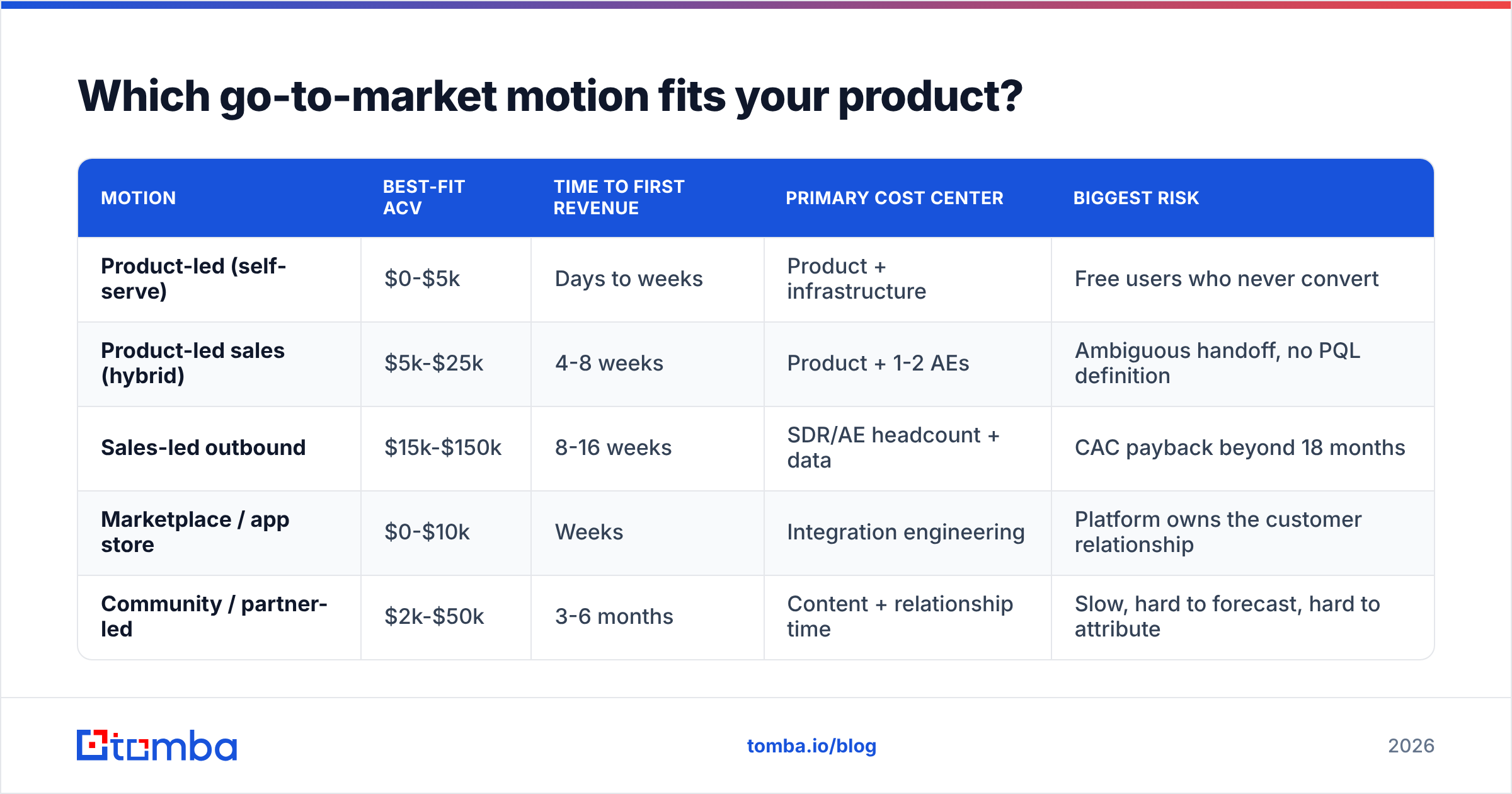
Match the motion to your average contract value and the size of the buying committee. This table is the single most useful artifact in the whole plan.
| Motion | Best-fit ACV | Time to first revenue | Primary cost center | Biggest risk |
|---|---|---|---|---|
| Product-led (self-serve) | $0-$5k | Days to weeks | Product + infrastructure | Free users who never convert |
| Product-led sales (hybrid) | $5k-$25k | 4-8 weeks | Product + 1-2 AEs | Ambiguous handoff, no PQL definition |
| Sales-led outbound | $15k-$150k | 8-16 weeks | SDR/AE headcount + data | CAC payback beyond 18 months |
| Marketplace / app store | $0-$10k | Weeks | Integration engineering | Platform owns the customer relationship |
| Community / partner-led | $2k-$50k | 3-6 months | Content + relationship time | Slow, hard to forecast, hard to attribute |
The rule of thumb: if the annual price is below roughly $5k, a human cannot profitably touch the deal, so the product has to sell itself. Above about $25k, a buying committee forms and self-serve alone stalls at the security review. The uncomfortable middle — $5k-$25k — is where product-led sales lives, and it demands a real product-qualified-lead definition before you hire anyone.
Gartner's research on B2B buying behaviour has been consistent for years on one point: buyers spend the large majority of the cycle without a vendor rep in the room. That doesn't remove the need for sales in higher-ACV motions — it changes what sales is for. Your reps are there for the last 17% of the journey, where risk, procurement, and internal politics live.
How do you define an ICP that produces an actual list?#
An ideal customer profile is only finished when it compiles into a query. Work through these layers in order:
- Firmographic — industry, employee count, revenue band, geography, funding stage. These are the coarse filters and they're cheap to apply.
- Technographic — what they already run. If your product plugs into Shopify, Snowflake, or Salesforce, the installed base is your addressable market. This is usually the highest-signal filter available.
- Behavioural / trigger-based — hiring for a role your product supports, recently funded, a new VP in seat, or visiting your pricing page. Triggers turn a static list into a prioritised queue.
- Contact-level — the title that feels the pain, the title that owns the budget, and the title that blocks the deal. You need all three mapped, not just the champion.
Then pressure-test it with the honest question: can I get 300 named accounts and 900 verified contacts matching this definition in the next two weeks? If the answer is no, the ICP is aspirational and you should widen it or change the acquisition route.
Once the definition is set, domain search turns a target account list into the actual people and email patterns inside each company, and data enrichment fills in the seniority, department, and location fields your sequencing tool needs for segmentation. Reputable list vendors like BookYourData are a fine complement when you want pre-built industry lists rather than building account-by-account — most teams end up using both a static list source and a live lookup layer.
What does a 90-day go-to-market plan look like?#
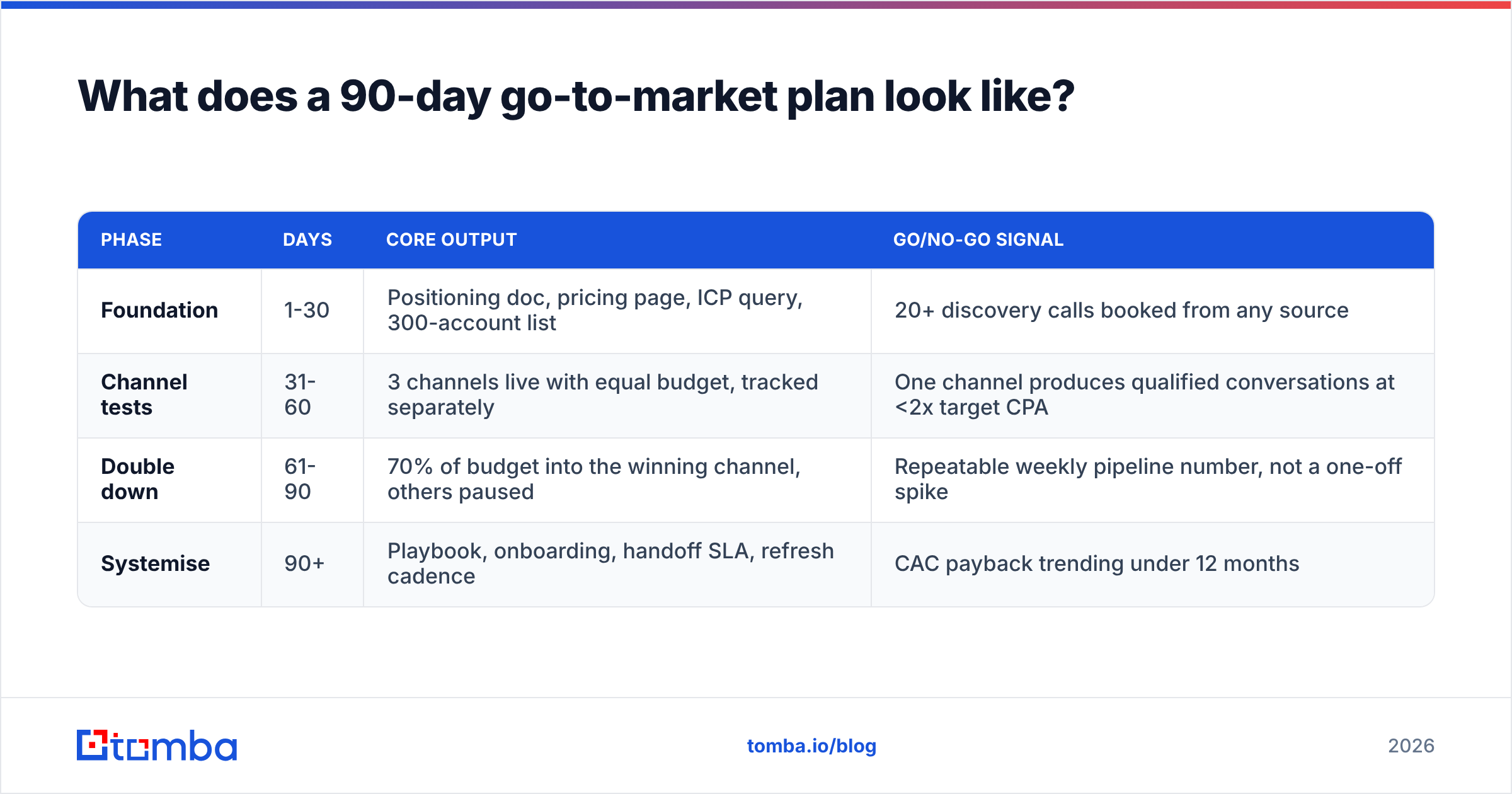
Ninety days is enough to prove or kill a channel. It is not enough to build a brand, so don't plan as if it is.
| Phase | Days | Core output | Go/no-go signal |
|---|---|---|---|
| Foundation | 1-30 | Positioning doc, pricing page, ICP query, 300-account list | 20+ discovery calls booked from any source |
| Channel tests | 31-60 | 3 channels live with equal budget, tracked separately | One channel produces qualified conversations at <2x target CPA |
| Double down | 61-90 | 70% of budget into the winning channel, others paused | Repeatable weekly pipeline number, not a one-off spike |
| Systemise | 90+ | Playbook, onboarding, handoff SLA, refresh cadence | CAC payback trending under 12 months |
Two operating rules make this work. First, write the kill criterion before you spend the money. "We stop LinkedIn ads if CPL exceeds $180 after $6k spend" is a decision made calmly in advance. Second, hold budget equal across tests in phase two. Uneven spend produces uneven data and you will pick the wrong winner.
For the outbound test specifically, resist the urge to blast. Two hundred deeply researched contacts in a tight segment tells you more than 5,000 generic sends, and it protects the sending domain you'll need for the next two years. Run every address through an email verifier before the first send so bounce rate stays under 2% — inbox providers treat a spike in unknown-user bounces as a strong negative signal, and recovering a burned domain takes longer than the whole 90-day plan.

Which metrics prove the strategy is working?#
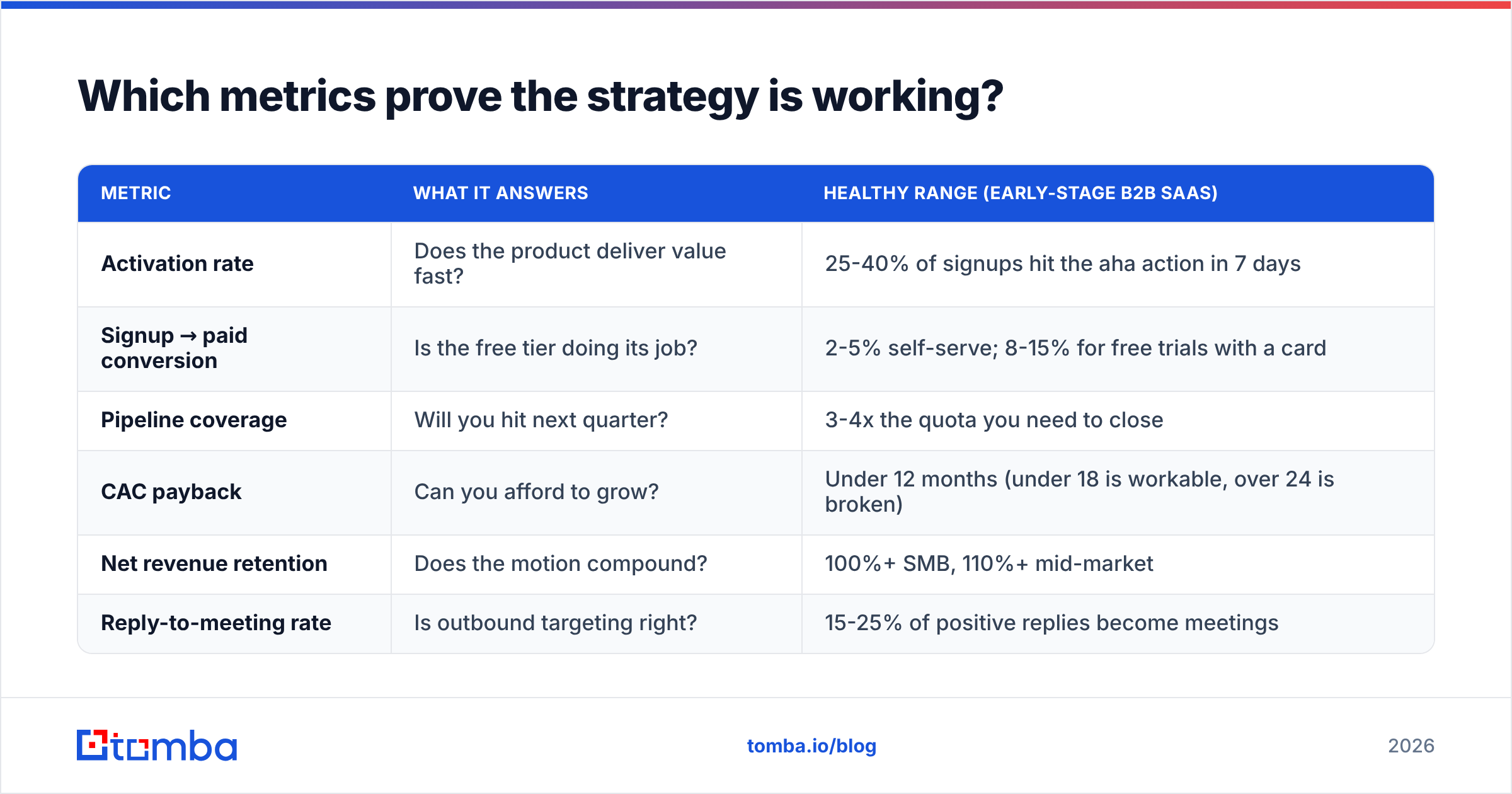
Track a small number of leading indicators. Revenue is a lagging metric and it will tell you the truth about six months too late.
| Metric | What it answers | Healthy range (early-stage B2B SaaS) |
|---|---|---|
| Activation rate | Does the product deliver value fast? | 25-40% of signups hit the aha action in 7 days |
| Signup → paid conversion | Is the free tier doing its job? | 2-5% self-serve; 8-15% for free trials with a card |
| Pipeline coverage | Will you hit next quarter? | 3-4x the quota you need to close |
| CAC payback | Can you afford to grow? | Under 12 months (under 18 is workable, over 24 is broken) |
| Net revenue retention | Does the motion compound? | 100%+ SMB, 110%+ mid-market |
| Reply-to-meeting rate | Is outbound targeting right? | 15-25% of positive replies become meetings |
The two most diagnostic pairs: if signups are strong but activation is weak, your positioning is attracting the wrong people — that's a GTM problem, not an onboarding problem. If activation is strong but conversion is weak, your packaging gives too much away before the paywall.
Review your definitions of MQL and pipeline stages with whoever owns revenue operations before you start reporting, or you will spend the first board meeting arguing about the denominator.
What does the GTM tool stack actually need?#
Buy the minimum, and only after a channel has proven itself. A common early stack:
- Contact data and enrichment — to build and refresh the target list. This is the input to everything else; garbage here poisons the whole funnel.
- Sequencing / sending — one tool, one sending domain per brand, warmed properly.
- CRM — even a lightweight one, from day one. Retro-fitting deal history is miserable.
- Product analytics — to define and measure activation. Without it, PLG is guesswork.
- Review and intent sources — G2 category pages and comparison traffic are high-intent and frequently underpriced relative to broad paid search.
Compare vendors on how they behave at your scale, not on feature checklists. Credit models, API rate limits, and export restrictions matter far more at month six than the marketing site suggests. HubSpot's sales resources are a reasonable neutral starting point for stack templates if you're building the first version from scratch.
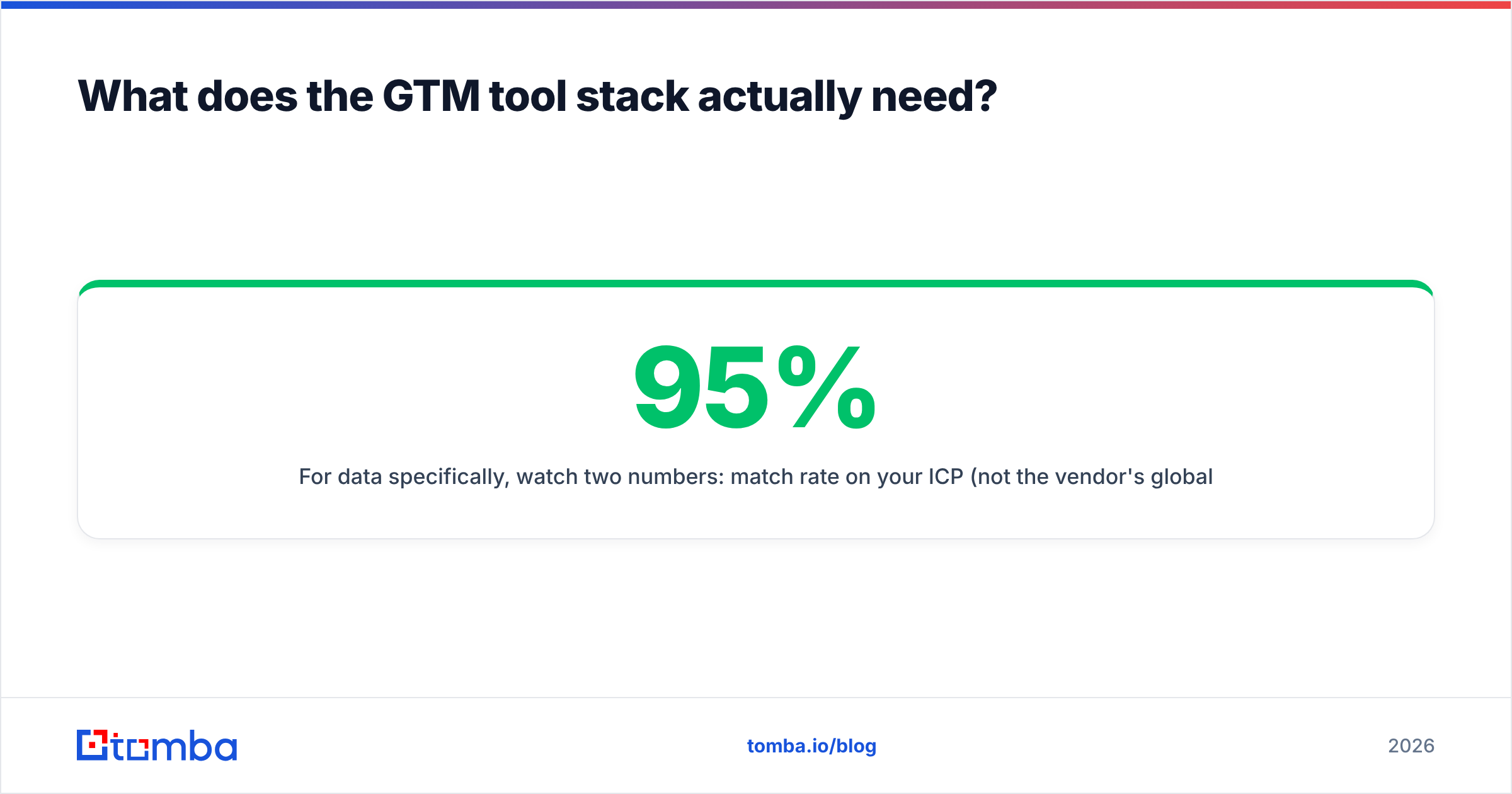
For data specifically, watch two numbers: match rate on your ICP (not the vendor's global average) and cost per usable contact after verification. A provider with a 95% headline accuracy claim and a 40% match rate in your niche is worse than one with an 88% claim and an 80% match rate. Run a 100-contact pilot against a segment you know well before signing anything annual.
How do you avoid the five traps?#
Short version, one line each:
- Unreachable ICP — test reachability before you commit. If you can't build the list, change the segment.
- Motion/price mismatch — put your ACV in the motion table above and follow it.
- Launch ≠ distribution — plan the week after launch before you plan launch day.
- No activation metric — define the aha action in one sentence, instrument it, and report it weekly.
- Stale data — re-verify any list older than 60 days, and never mail an unverified batch.
None of these need extra headcount. They need decisions made in advance and written down where the team can see them.
Start with the list#
The fastest way to find out whether your go to market strategy for digital products is real is to try to build the target list. If 300 named accounts and their decision-makers come together in an afternoon, you have a segment you can actually attack. If they don't, you've learned something worth more than another month of roadmap work.
Tomba's Email Finder turns a target company list into verified, reachable contacts — domain search for company-wide patterns, verification to keep bounce rates under 2%, and enrichment fields for segmentation, with a free tier of 25 searches a month and paid plans from $49/month. Build the list first, then decide what to say. See Tomba pricing for the full breakdown.
Related guides#
Ready to find emails that actually work?
Join 150,000+ professionals who stopped guessing and started sending. Free credits on signup — no credit card required.
Get the Tomba newsletter
Practical outbound tactics and product updates — once every two weeks.
About the author