Go To Market Strategy for Fintech: A 2026 Operator's Guide
Fintech GTM breaks in ways SaaS GTM never does: compliance gates, long procurement, and regulated buyers. Here is the motion-by-motion playbook that actually converts in 2026.
TL;DR
- Fintech go-to-market fails at trust and compliance gates, not at top-of-funnel volume. Your bottleneck is usually security review, not lead count.
- Pick one dominant motion (PLG, sales-led, embedded/API, or partner-led) and fund it properly. Fintechs that run all four at once burn 18 months proving nothing.
- Sales cycles for regulated buyers run 3-9 months. Budget CAC payback at 18-24 months, not the 12 months a horizontal SaaS deck promises.
- Compliance artifacts (SOC 2 Type II, PCI DSS scope statement, model risk documentation) are marketing assets. Publish them, gate them, and route them like content.
- Contact data quality decides whether ABM works at all. A wrong email to a Head of Payments does not bounce quietly — it burns the domain you need for the next 200 accounts.
What makes a go to market strategy for fintech different?#
Selling financial software is selling risk transfer. Your buyer is not asking "does this feature work" — they are asking "if this breaks, does my name end up in a regulator's letter."
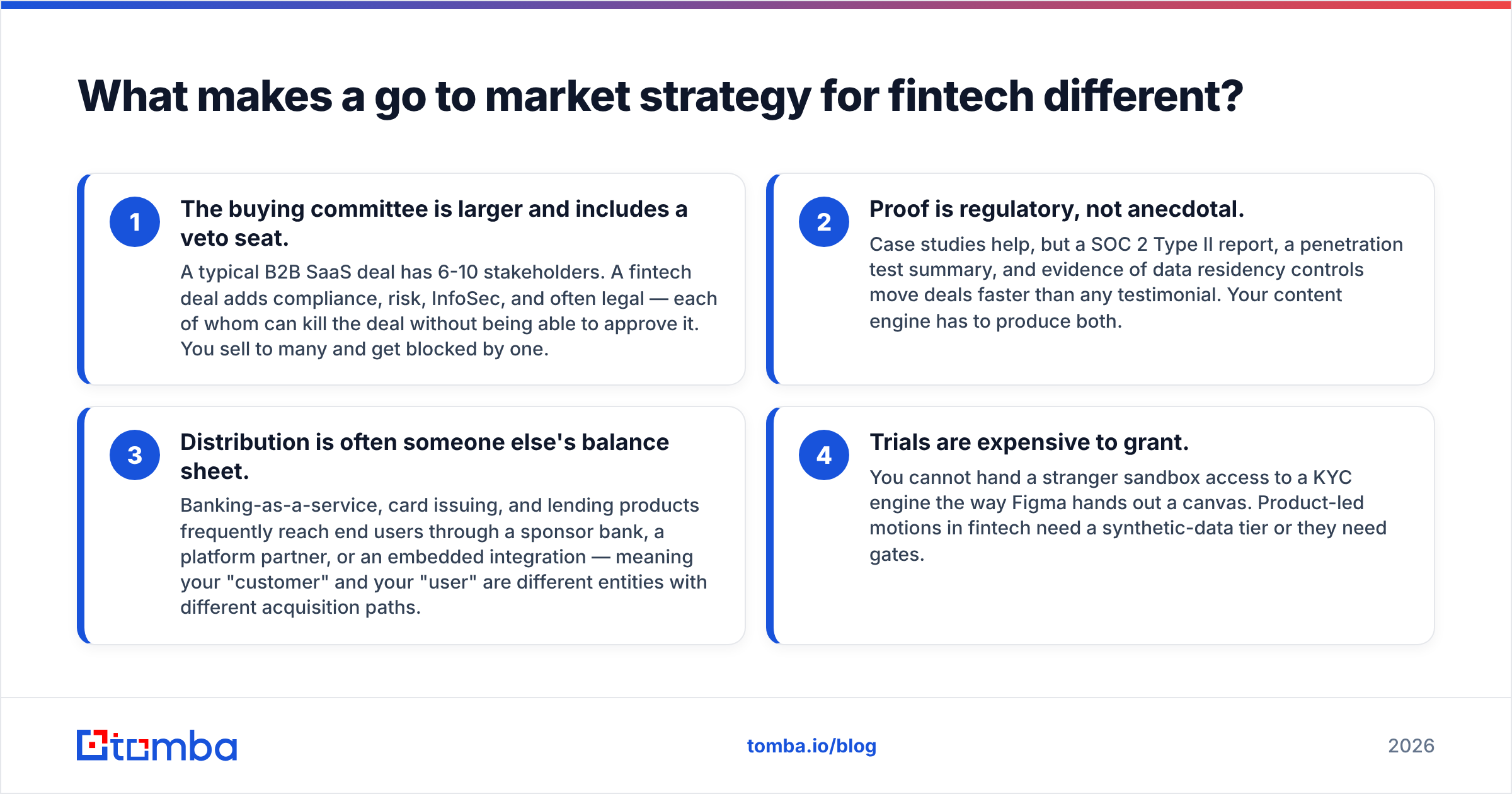
Three structural differences drive every tactical choice downstream:
- The buying committee is larger and includes a veto seat. A typical B2B SaaS deal has 6-10 stakeholders. A fintech deal adds compliance, risk, InfoSec, and often legal — each of whom can kill the deal without being able to approve it. You sell to many and get blocked by one.
- Proof is regulatory, not anecdotal. Case studies help, but a SOC 2 Type II report, a penetration test summary, and evidence of data residency controls move deals faster than any testimonial. Your content engine has to produce both.
- Distribution is often someone else's balance sheet. Banking-as-a-service, card issuing, and lending products frequently reach end users through a sponsor bank, a platform partner, or an embedded integration — meaning your "customer" and your "user" are different entities with different acquisition paths.
- Trials are expensive to grant. You cannot hand a stranger sandbox access to a KYC engine the way Figma hands out a canvas. Product-led motions in fintech need a synthetic-data tier or they need gates.
The practical consequence: a go to market strategy for fintech is mostly a sequencing problem. You are deciding what proof to build first, which segment will accept the proof you already have, and which motion converts that proof into revenue fastest.
Which GTM motion should a fintech pick first?#
Most fintech founders default to sales-led because the first three logos came from the founder's network. That is not a strategy — that is a warm intro list running out.
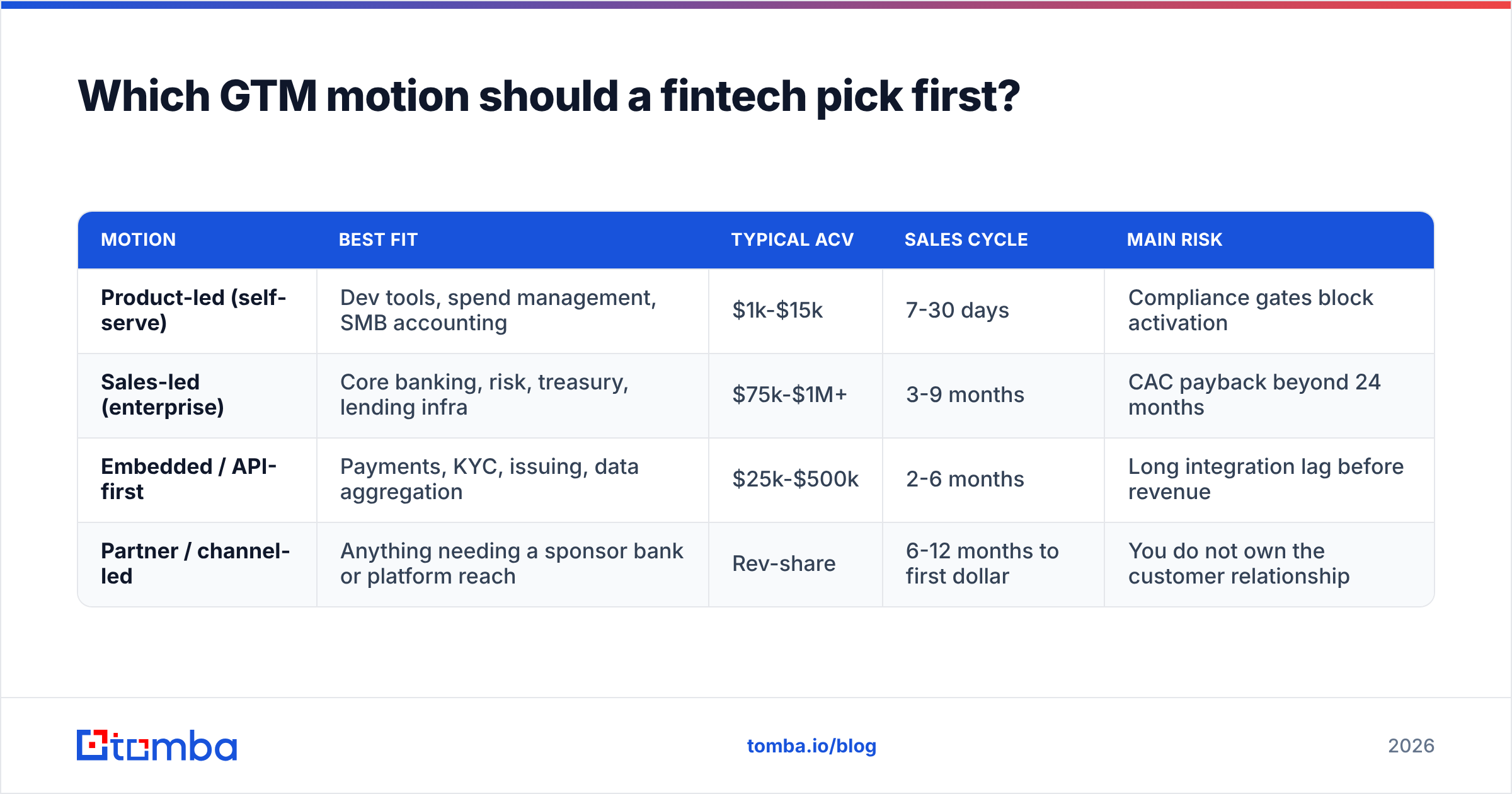
Here is how the four viable motions actually compare in 2026:
| Motion | Best fit | Typical ACV | Sales cycle | Main risk |
|---|---|---|---|---|
| Product-led (self-serve) | Dev tools, spend management, SMB accounting | $1k-$15k | 7-30 days | Compliance gates block activation |
| Sales-led (enterprise) | Core banking, risk, treasury, lending infra | $75k-$1M+ | 3-9 months | CAC payback beyond 24 months |
| Embedded / API-first | Payments, KYC, issuing, data aggregation | $25k-$500k | 2-6 months | Long integration lag before revenue |
| Partner / channel-led | Anything needing a sponsor bank or platform reach | Rev-share | 6-12 months to first dollar | You do not own the customer relationship |
Read that table as a commitment device. If your ACV is $8k and your sales cycle is six months, you have a motion mismatch — either the price is wrong or you are selling to the wrong segment.
A useful filter: can a technical evaluator get to a moment of value without a human and without touching real customer money? If yes, PLG is on the table. If no — and for most regulated products the answer is no — you need sales-led or embedded, and your PLG investment should go into documentation and sandbox quality instead of a free tier.
Stripe's official documentation is the canonical example of docs-as-GTM: developers evaluate, integrate, and advocate internally before anyone in sales gets involved. That is achievable without a free tier. It is not achievable without an API you would be proud to show a skeptic.
How do you define an ICP that survives compliance review?#
Your ideal customer profile in fintech needs a regulatory dimension most SaaS ICPs skip.
Build it on five axes:
- Firmographic — company size, transaction volume, geography, entity type (bank, credit union, neobank, platform, fintech).
- Regulatory posture — who supervises them, what frameworks they must satisfy (PCI DSS, GDPR, DORA, state money transmitter licensing), and whether your product changes their audit scope.
- Technical readiness — do they have engineers who can integrate an API in under six weeks, or do they need a fully managed deployment?
- Trigger events — new CISO, funding round, a public enforcement action, migration off a legacy core, or a partner bank exit. These are the highest-intent signals in the category.
- Blocking risk — what is the single most likely reason this account cannot buy? If you cannot answer it in one sentence, you have not qualified them.
That last axis is what separates a fintech ICP from a generic one. A $2B credit union may be a perfect firmographic fit and still be structurally unable to buy because their core provider contract runs another four years. Disqualify early. G2's category data is a reasonable starting point for mapping which vendors already sit in your prospects' stacks — incumbents tell you what you are actually competing against.
Once the ICP is defined, the operational job is finding the humans inside it. That is where a domain search beats buying a static list: you pull the actual current roster at a target institution rather than a database snapshot from 14 months ago, which in fintech is roughly three compliance-officer turnovers ago.
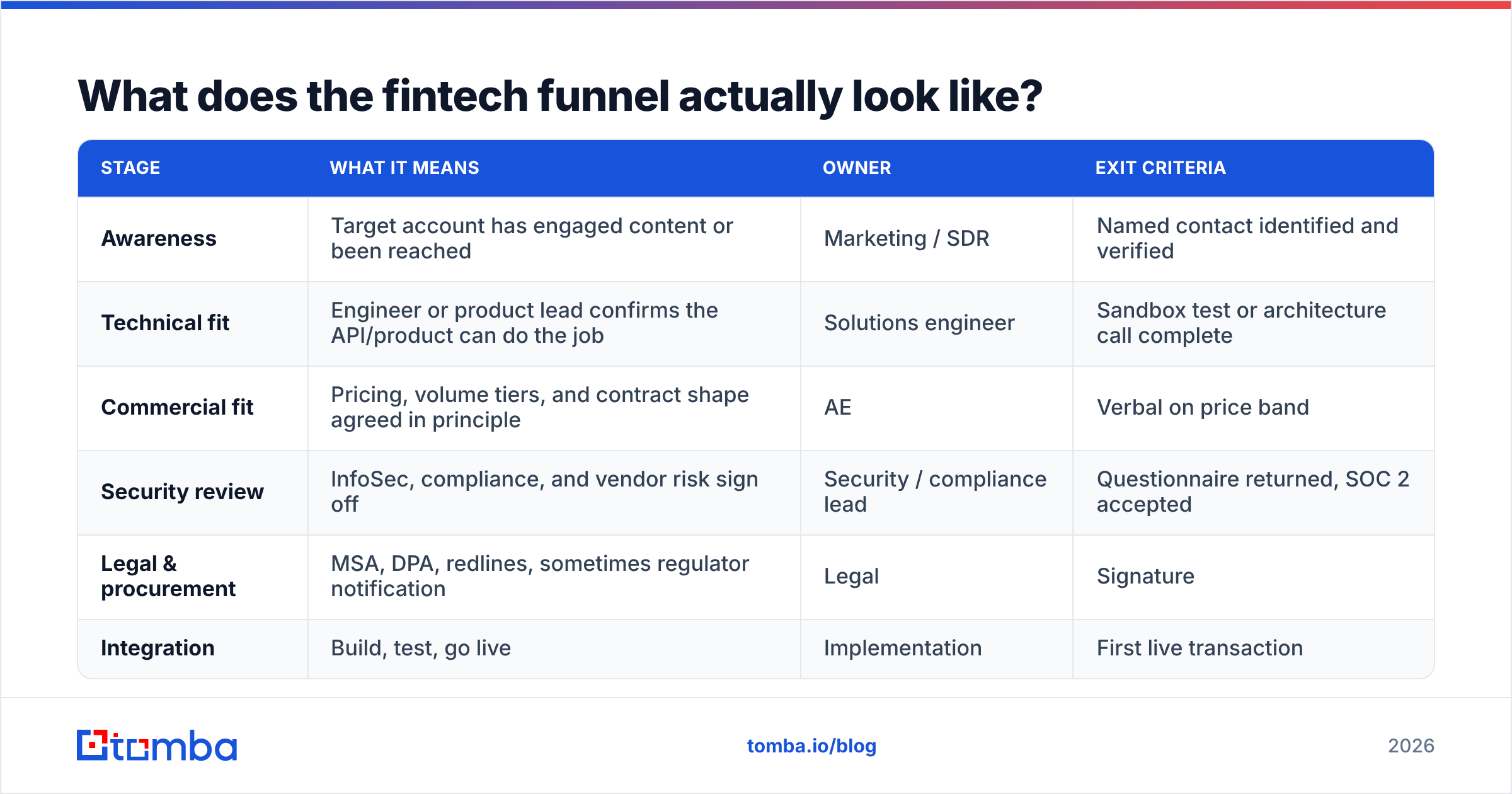
What does the fintech funnel actually look like?#
Forget the marketing-qualified lead as your north star. In fintech, a form fill from a Head of Risk at a target bank and a form fill from a student are the same object in your CRM and wildly different in reality.
Use a stage model that mirrors how the deal really progresses:
| Stage | What it means | Owner | Exit criteria |
|---|---|---|---|
| Awareness | Target account has engaged content or been reached | Marketing / SDR | Named contact identified and verified |
| Technical fit | Engineer or product lead confirms the API/product can do the job | Solutions engineer | Sandbox test or architecture call complete |
| Commercial fit | Pricing, volume tiers, and contract shape agreed in principle | AE | Verbal on price band |
| Security review | InfoSec, compliance, and vendor risk sign off | Security / compliance lead | Questionnaire returned, SOC 2 accepted |
| Legal & procurement | MSA, DPA, redlines, sometimes regulator notification | Legal | Signature |
| Integration | Build, test, go live | Implementation | First live transaction |
Two things get missed constantly. First, security review deserves an owner and a stage — most fintechs let it float and then wonder why deals stall for seven weeks. Second, revenue starts at integration, not at signature. If your board deck counts signed ARR and your cash counts live ARR, you have a forecasting problem that compounds.
Track your win rate separately by stage. If you lose most deals at security review, the fix is a trust center, not more SDR dials. If you lose at commercial fit, your pricing model is wrong for the segment.
How should you build demand for a regulated product?#
Three channels do most of the work in fintech, and one channel that works elsewhere mostly does not.
Works: search around problems, not products. Nobody searches "embedded lending API" until they already know the category exists. They search "how to handle Reg B adverse action notices" and "chargeback ratio threshold." Own the operational questions your buyer Googles at 11pm.
Works: original data and benchmarks. Fintech operators are numerate and starved for real benchmarks — approval rates, fraud loss ratios, cost per KYC check. Publishing your aggregate (anonymized, compliant) data buys you citations and inbound that no thought-leadership post will.
Works: targeted outbound to a small, precise list. In a market with 4,000 relevant institutions, blasting 40,000 contacts is not scale — it is domain suicide. Build a list of 300 accounts, find the right five people at each, verify every address, and write like a human.
Mostly does not work: broad paid social. Fintech buying committees are not impulse-clicking a LinkedIn ad into a demo request. Paid works for retargeting and for narrow account-list campaigns; it rarely works as primary demand gen at a defensible cost.
For outbound to be viable at all, the data layer has to hold. Sending to stale addresses at regulated institutions damages sender reputation fast, and unlike an ecommerce list you cannot simply move to a fresh domain and start over — your domain is part of your credibility. Run every list through an email verifier before the first send, and re-verify quarterly. Fintech has one of the highest role-change rates of any B2B vertical; a list you built in January is measurably wrong by June.

What should fintech pricing and CAC look like in 2026?#
Pricing is a GTM decision, not a finance decision. In fintech you have four shapes, and each one implies a different sales motion:
- Per-seat — works for workflow tools (treasury, spend, close management). Predictable, easy to procure, caps your upside.
- Usage / per-transaction — works for payments, KYC, data calls. Aligns with customer value, but makes forecasting harder and invites volume renegotiation at renewal.
- Percentage of value — works for lending, FX, and interchange-adjacent products. Highest upside, hardest to defend once a customer scales.
- Platform fee plus usage — the default for API-first fintech in 2026. Floor covers your compliance cost, usage captures growth.
On unit economics, calibrate against reality rather than horizontal SaaS blogs. Enterprise fintech deals carry a real cost most SaaS does not: the security-review and implementation labor sits inside your CAC whether you book it there or not. A sales-led fintech with $150k ACV and a six-month cycle will typically see CAC payback around 18-24 months. That is fine — if your gross retention is above 90% and your contracts are multi-year. It is fatal if you priced monthly.
Gartner's B2B buying research is worth reading here for one specific finding: buyers spend a small fraction of their time with any single vendor. In fintech, where the committee is larger, your effective face time with the actual decision-maker is smaller still. That is the argument for enablement content the champion can forward internally — one-pagers for compliance, architecture diagrams for InfoSec, ROI models for finance. You will not be in the room when the decision is made.
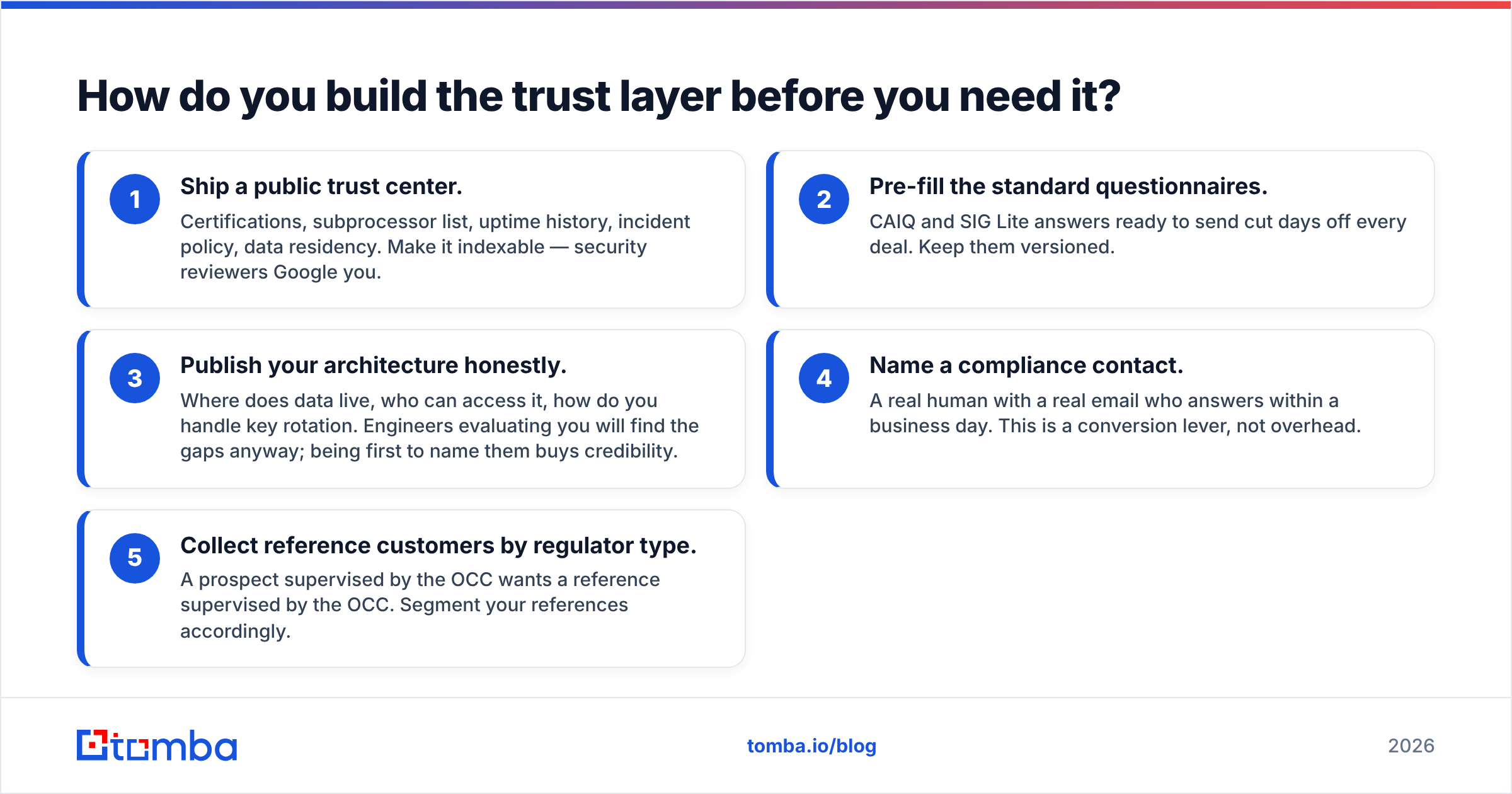
How do you build the trust layer before you need it?#
Do this before you have a pipeline that depends on it, because building it under deal pressure takes three times as long.
- Ship a public trust center. Certifications, subprocessor list, uptime history, incident policy, data residency. Make it indexable — security reviewers Google you.
- Pre-fill the standard questionnaires. CAIQ and SIG Lite answers ready to send cut days off every deal. Keep them versioned.
- Publish your architecture honestly. Where does data live, who can access it, how do you handle key rotation. Engineers evaluating you will find the gaps anyway; being first to name them buys credibility.
- Name a compliance contact. A real human with a real email who answers within a business day. This is a conversion lever, not overhead.
- Collect reference customers by regulator type. A prospect supervised by the OCC wants a reference supervised by the OCC. Segment your references accordingly.
Peer platforms in the data space — including BookYourData, which publishes clear accuracy commitments and compliance posture — demonstrate that transparency about data provenance is itself a differentiator in regulated buying. Buyers in this category read the fine print. Reward them for it.
What does a 90-day fintech GTM plan look like?#
If you are starting or resetting, here is a sequence that avoids the common failure of doing everything at 20% intensity.
Days 1-30 — Narrow. Pick one segment and one motion. Write the ICP with the blocking-risk axis filled in. Build the target account list — 200-400 accounts, not 5,000. Identify the three roles you need at each account (economic buyer, technical champion, compliance gatekeeper) and find verified contacts for each. A bulk email finder run against your account list does in an afternoon what an SDR does in three weeks, and the Tomba API keeps the records current inside your CRM rather than in a spreadsheet that rots.
Days 31-60 — Prove. Run one outbound sequence, one content asset built on original data, and one partner conversation. Instrument every stage of the funnel above. Get five real discovery calls with target-ICP accounts and record the objections verbatim. You are looking for the repeated blocker, not for closed deals yet.
Days 61-90 — Systematize. Fix the top blocker (usually a missing compliance artifact or an unclear pricing story). Codify what worked into a repeatable play. Only now hire the second AE or double the ad budget. Scaling before you find the repeatable play is how fintechs burn a Series A on GTM that never compounds.
Throughout, keep one metric honest: cost per qualified security review reached. Not MQLs, not demos — the count of accounts that made it to the stage where compliance actually engaged. That number tells you whether your GTM is working long before ARR does.
Where does data quality fit into all of this?#
Everything above assumes you can reliably reach the right person at the right institution. In fintech, that assumption breaks more often than in other verticals: titles are non-standard (is it Head of Risk, CRO, or VP Compliance?), institutions have multiple domains, and email formats vary between the holding company and the operating bank.
Three habits fix most of it:
- Verify at the point of use, not the point of purchase. Data decays. Re-check before every campaign, not once at import.
- Resolve the domain first, then the person. Bank holding companies and their subsidiaries often use separate mail domains. Getting this wrong sends your outreach to a shell entity with no staff.
- Enrich for role context, not just email. Knowing that your contact moved from a $500M credit union to a $12B bank six weeks ago is the trigger event your whole sequence should be built on. Contact enrichment turns a static list into an intent signal.
Ready to build the contact layer under your fintech GTM?#
A go to market strategy for fintech lives or dies on whether you can consistently reach the compliance gatekeeper, the technical champion, and the economic buyer at the same institution — with addresses that actually deliver. Start with the Tomba Email Finder to build a verified, current contact base across your target account list. The free tier gives you 25 searches a month to test the data against accounts you already know, and paid plans start at $49/mo on Starter with Growth at $99/mo — see Tomba pricing for the full breakdown. Build the list once, verify it continuously, and spend your GTM budget on the deals that can actually close.
Related guides#
Ready to find emails that actually work?
Join 150,000+ professionals who stopped guessing and started sending. Free credits on signup — no credit card required.
Get the Tomba newsletter
Practical outbound tactics and product updates — once every two weeks.
About the author