Go-To-Market Strategy for IT Services: 2026 Playbook
IT services firms lose deals to positioning, not price. Here's a concrete 2026 go-to-market strategy for IT services — ICP, offer design, channel mix, pricing, and the data layer that makes outbound actually work.
TL;DR
- IT services firms rarely lose on capability. They lose because the buyer cannot tell them apart from the other six vendors on the shortlist — go-to-market is a positioning problem before it's a pipeline problem.
- Pick one ICP slice (industry + company size + trigger event), then build a productized offer with a fixed scope and a named outcome. "We do cloud, security, and app dev" is not an offer.
- Your channel mix in 2026 should be roughly 40% partner/ecosystem, 30% targeted outbound, 20% content and search, 10% events — not 100% referrals and hope.
- Outbound only works when the contact data is clean. Bounce rates above 3% will kill the domain that carries your whole pipeline.
- Measure four numbers: qualified meeting rate, proposal win rate, average contract value, and time-to-first-invoice. Everything else is decoration.
What is a go to market strategy for IT services?#
A go-to-market strategy for IT services is the documented answer to five questions: who you sell to, what specific problem you solve for them, how you package and price that solution, which channels reach those buyers, and what your sales motion looks like from first touch to signed statement of work.
Think of it like a restaurant. A GTM strategy is not the kitchen — the kitchen is your delivery team, your certified engineers, your AWS partnership. GTM is deciding you're a neighbourhood ramen shop for office workers who have 35 minutes for lunch, not a place that serves ramen, pizza, tacos, and steak to anyone who walks past. The kitchen can cook all four. The business only works when you pick one.
Most IT services companies skip this. They stay generalist because generalist feels safe, then wonder why every deal turns into a price comparison. When a buyer cannot articulate why you specifically, procurement decides — and procurement decides on rate cards.
The structural problem in IT services is that you're selling something invisible until it's delivered. A software buyer can trial the product. Your buyer is being asked to commit six figures based on a deck, three references, and a gut read on whether your team will still be around in eighteen months. Every element of your GTM either reduces that perceived risk or adds to it.
Why do most IT services GTM plans fail?#
Four failure patterns show up over and over.
- Undifferentiated positioning. The website says "trusted technology partner delivering innovative solutions." So does everyone else's. Buyers use language as a filter — if you describe yourself in category-level terms, you get sorted into the category, and the category competes on price.
- Referral dependency with no second engine. Referrals are the highest-converting channel in professional services and also the least controllable. Firms that hit a ceiling almost always hit it because referral volume flattened and nothing else was ever built.
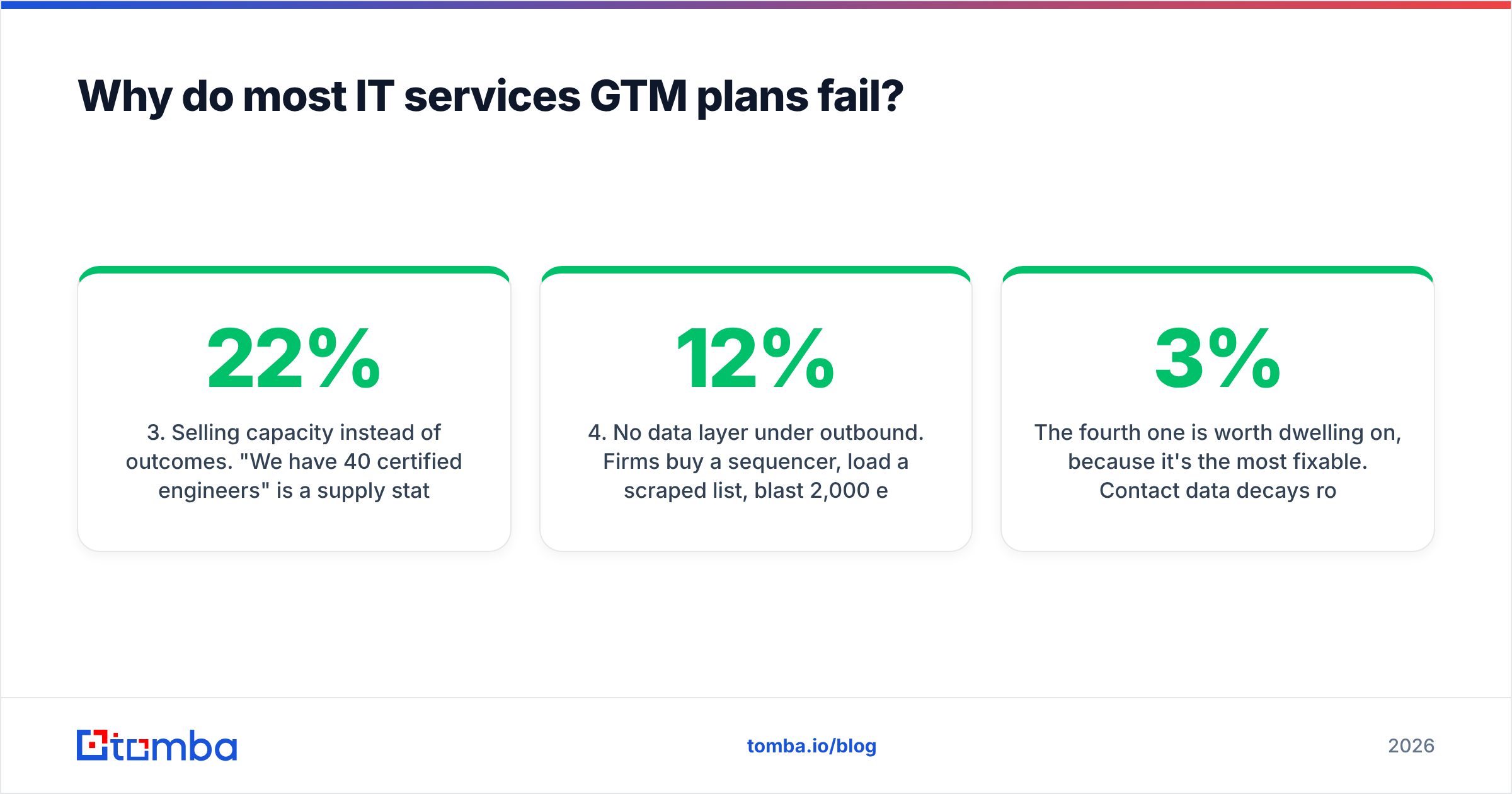
- Selling capacity instead of outcomes. "We have 40 certified engineers" is a supply statement. "We cut your cloud spend 22% in 90 days without touching production" is a demand statement. Buyers pay for the second one and negotiate hard on the first.
- No data layer under outbound. Firms buy a sequencer, load a scraped list, blast 2,000 emails, get a 12% bounce rate, and burn their sending domain. Then they conclude "outbound doesn't work for services." Outbound worked fine. The list didn't.

The fourth one is worth dwelling on, because it's the most fixable. Contact data decays roughly 2-3% per month in B2B — people change jobs, companies get acquired, domains migrate. A list you bought in January is meaningfully wrong by June. Running a email verifier pass before every send is a ten-minute step that protects the asset your entire pipeline depends on.
How do you define the right ICP for an IT services firm?#
Your ideal customer profile needs three layers, not one.
Layer one — firmographics. Industry, employee count, revenue band, geography, tech stack. For IT services, tech stack is often the sharpest filter: a firm specializing in Azure migrations should be targeting companies with on-prem VMware footprints, not everyone with "IT" in a job title.
Layer two — the buying trigger. This is what separates a list from a pipeline. Triggers that predict IT services demand include: new CIO or VP Engineering hire (first 120 days), announced funding round, M&A activity, a compliance deadline (SOC 2, DORA, HIPAA), end-of-life vendor announcements, and public job postings for roles you could replace with a managed service.
Layer three — the economic buyer's actual pain. Not the technical pain. The CTO cares about legacy system fragility; the CFO who signs the check cares that an outage cost them $400k in Q3. Write your messaging for the person with the budget, and let the technical champion validate you afterwards.
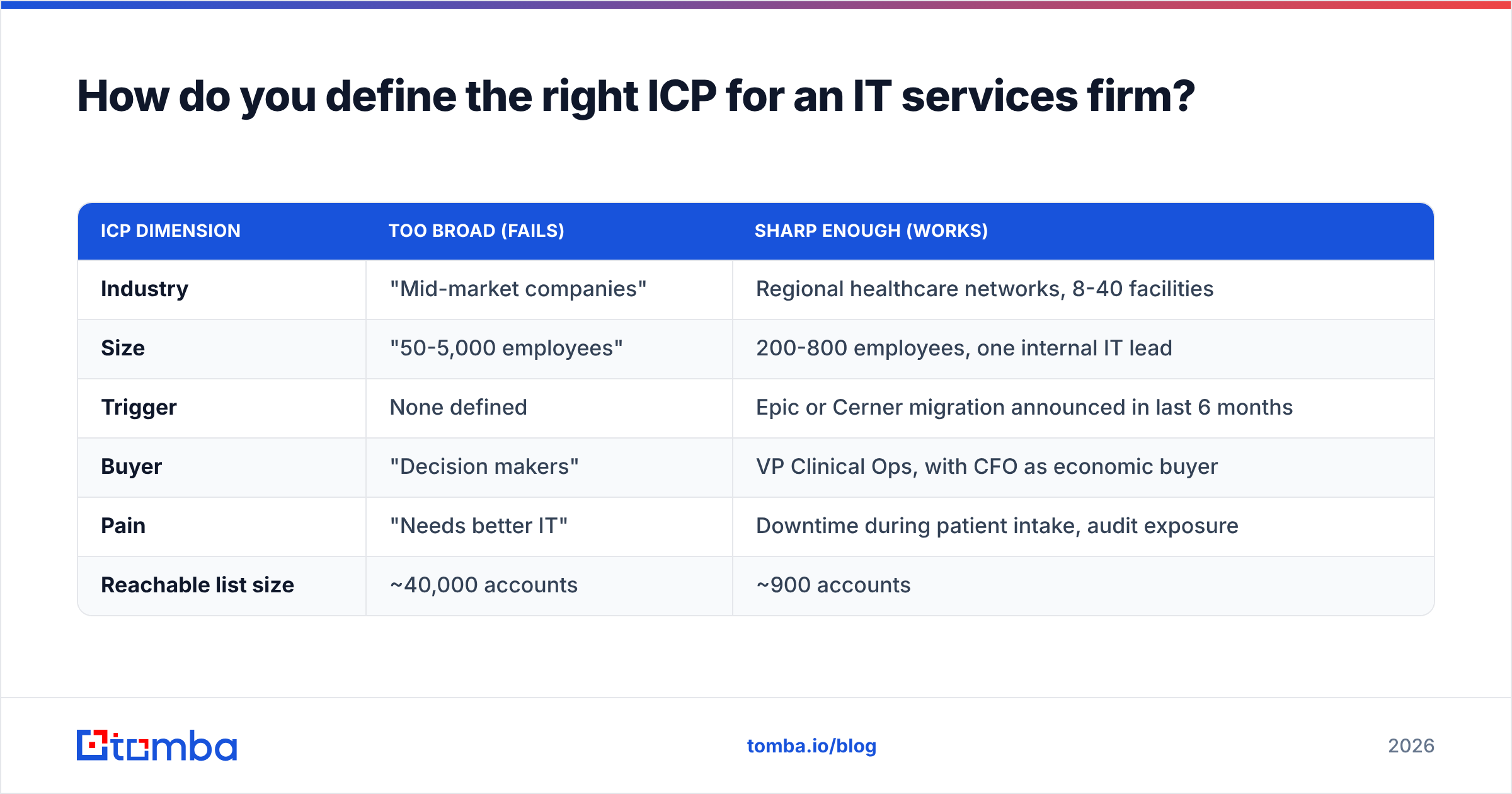
A useful test: if your ICP definition could describe more than about 3,000 companies, it's too broad for a services firm under $20M revenue. You do not have the marketing budget to reach 30,000 companies with any real frequency.
| ICP dimension | Too broad (fails) | Sharp enough (works) |
|---|---|---|
| Industry | "Mid-market companies" | Regional healthcare networks, 8-40 facilities |
| Size | "50-5,000 employees" | 200-800 employees, one internal IT lead |
| Trigger | None defined | Epic or Cerner migration announced in last 6 months |
| Buyer | "Decision makers" | VP Clinical Ops, with CFO as economic buyer |
| Pain | "Needs better IT" | Downtime during patient intake, audit exposure |
| Reachable list size | ~40,000 accounts | ~900 accounts |
Once the ICP is sharp, building the actual account list becomes mechanical. Use a domain search to pull the contact structure of each target company, filter by department and seniority, and you have a working list in an afternoon rather than a quarter.
What does a productized IT services offer look like?#
Productization is the single highest-leverage move in IT services GTM, and most firms resist it because it feels like leaving money on the table.
A productized offer has: a fixed name, a fixed scope, a fixed timeline, a fixed price (or a tight band), and a named deliverable. Examples that work:
- Cloud Cost Audit — 3 weeks, $18,000, delivers a line-item reduction plan with implementation estimates.
- SOC 2 Readiness Sprint — 8 weeks, $45,000, delivers gap analysis, policy pack, and evidence collection setup.
- Legacy App Assessment — 4 weeks, $25,000, delivers a rebuild-vs-refactor recommendation with cost modelling.
- Managed Detection Onboarding — 6 weeks, $30,000 + $6,000/mo, delivers deployed tooling and a staffed runbook.
Each of these does three jobs at once. It makes the first purchase decision small and reversible, which slashes the perceived risk that stalls services deals. It gives your marketing something concrete to say. And it creates a natural upsell path — nearly every audit produces a remediation scope worth 4-8x the audit fee.
The objection is always "but our clients are all different." They are, in delivery. They are not in the shape of the problem. The audit is standardized; what you find is bespoke. That distinction is where the margin lives.
Which channels actually generate IT services pipeline in 2026?#
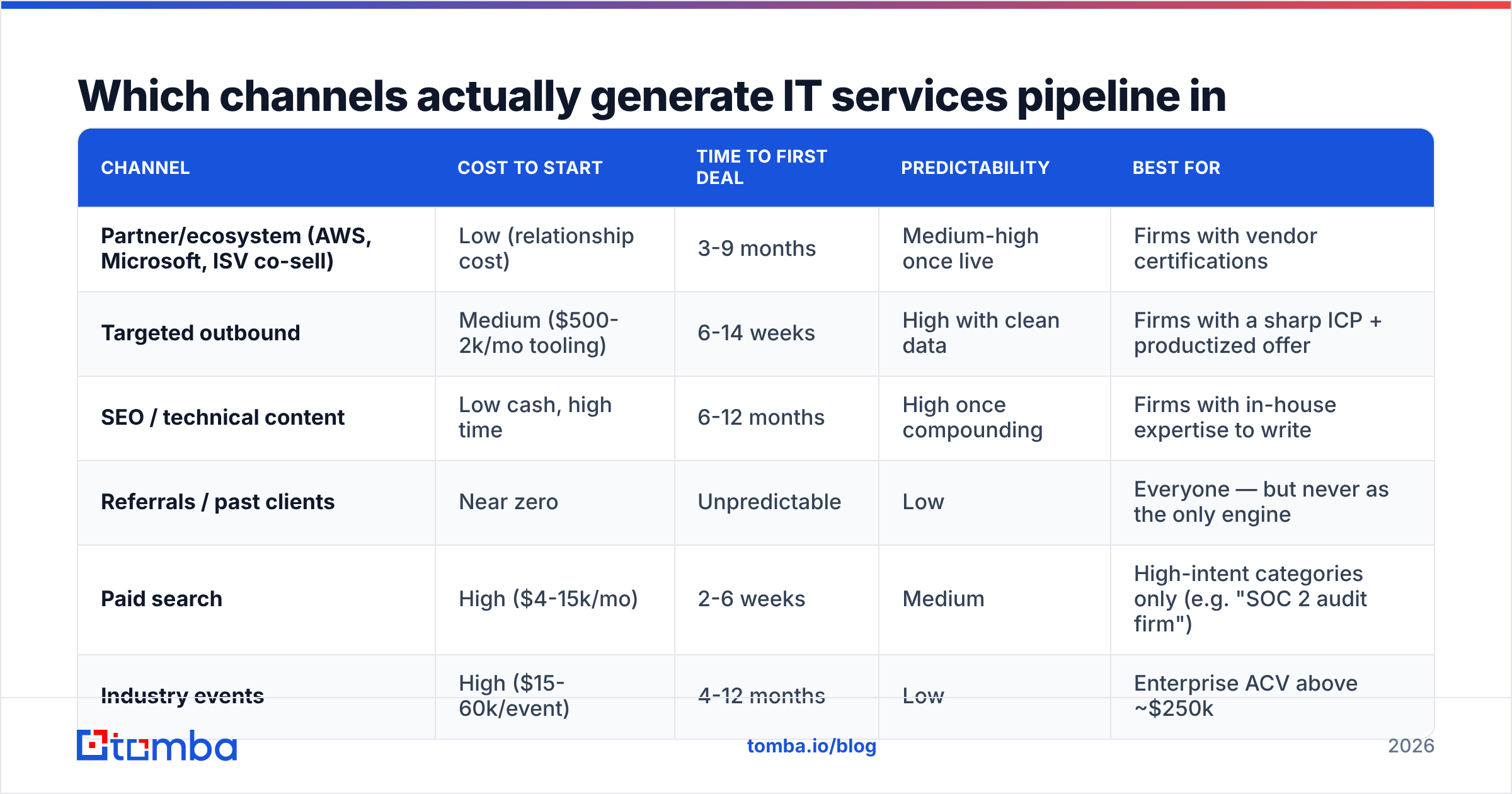
Here's the honest ranking, based on what converts for firms in the $2M-$50M range.
| Channel | Cost to start | Time to first deal | Predictability | Best for |
|---|---|---|---|---|
| Partner/ecosystem (AWS, Microsoft, ISV co-sell) | Low (relationship cost) | 3-9 months | Medium-high once live | Firms with vendor certifications |
| Targeted outbound | Medium ($500-2k/mo tooling) | 6-14 weeks | High with clean data | Firms with a sharp ICP + productized offer |
| SEO / technical content | Low cash, high time | 6-12 months | High once compounding | Firms with in-house expertise to write |
| Referrals / past clients | Near zero | Unpredictable | Low | Everyone — but never as the only engine |
| Paid search | High ($4-15k/mo) | 2-6 weeks | Medium | High-intent categories only (e.g. "SOC 2 audit firm") |
| Industry events | High ($15-60k/event) | 4-12 months | Low | Enterprise ACV above ~$250k |
Partner ecosystems deserve more attention than they get. If you're an AWS Partner or in the Microsoft co-sell motion, the vendor's field team is incentivized to bring you into deals — they get consumption credit, you get a warm enterprise introduction. Most firms register for the program and then never build the field relationships that actually generate referrals. The program is the ticket; the relationships are the show.
Outbound is where the data layer matters most. A 900-account list with three contacts per account is 2,700 people. At realistic rates — 45% open, 6% reply, 30% of replies becoming meetings — that's roughly 48 meetings from one full pass. That math only holds if the emails land. Enrich the list properly, verify emails before send, and keep bounce rate under 2%.

For content, resist the urge to write "5 Benefits of Cloud Migration." Write the thing only you can write: the postmortem of a migration that went sideways, the actual cost model with real numbers, the vendor comparison you built internally. G2 and Gartner already own the generic comparison queries. You own the specific, experience-earned ones.
How should you price and package IT services offers?#
Three models, and most firms should run two of them simultaneously.
Time and materials is the default and the worst of the three. It caps your margin at your utilization rate, punishes you for getting faster, and turns every invoice into a negotiation about hours. Use it only for genuinely open-ended discovery or staff augmentation.
Fixed-fee project works when scope is knowable — which is exactly what productization makes true. You take on delivery risk and get paid for efficiency. A team that delivers a fixed-fee assessment in 60 hours instead of 100 keeps the difference. That's the incentive alignment you want.
Retainer / managed service is the goal state. Predictable revenue, higher valuation multiple, and a relationship that surfaces new project work continuously. The path is almost always: productized entry offer → project → retainer. Very few clients start at retainer with a firm they've never worked with.
Practical rule for the entry offer: price it at roughly 5-8% of the expected downstream engagement value. Low enough to approve without a committee, high enough to signal seriousness. Free assessments attract tire-kickers and get deprioritized the moment something urgent lands.
How do you build the outbound motion without burning your domain?#
The sequence matters more than the tooling.
- Build the account list from the ICP definition — not from a generic "all companies with 200-800 employees" export. Use trigger events to prioritize.
- Find the right contacts per account. Three roles minimum: technical champion, economic buyer, and one adjacent stakeholder. A bulk email finder turns a company list into a contact list in one pass.
- Verify before you send. Every address, every time. Catch-all domains need separate handling — they'll accept anything at the SMTP layer and bounce silently later.
- Warm the sending domain properly. Use a subdomain (
go.yourfirm.com), not your primary. Ramp from 20 sends/day to 50 over three weeks. Configure SPF, DKIM, and DMARC before the first send, not after the first spam complaint. - Write to the trigger, not to the product. "Saw you announced the Epic rollout — the three places those go over budget are X, Y, Z. We wrote up what we found on the last four." That's a real email. "I wanted to reach out about our cloud solutions" is not.
- Multi-thread from touch one. Services deals die when your single champion leaves. Three contacts per account isn't spam, it's insurance.
Google and Yahoo's bulk sender requirements — enforced since 2024 — put a hard 0.3% spam complaint threshold on senders. Combine that with a bounce rate ceiling and you have a system with very little tolerance for dirty lists. Check the current Google sender guidelines before you scale volume; they've tightened twice since introduction.
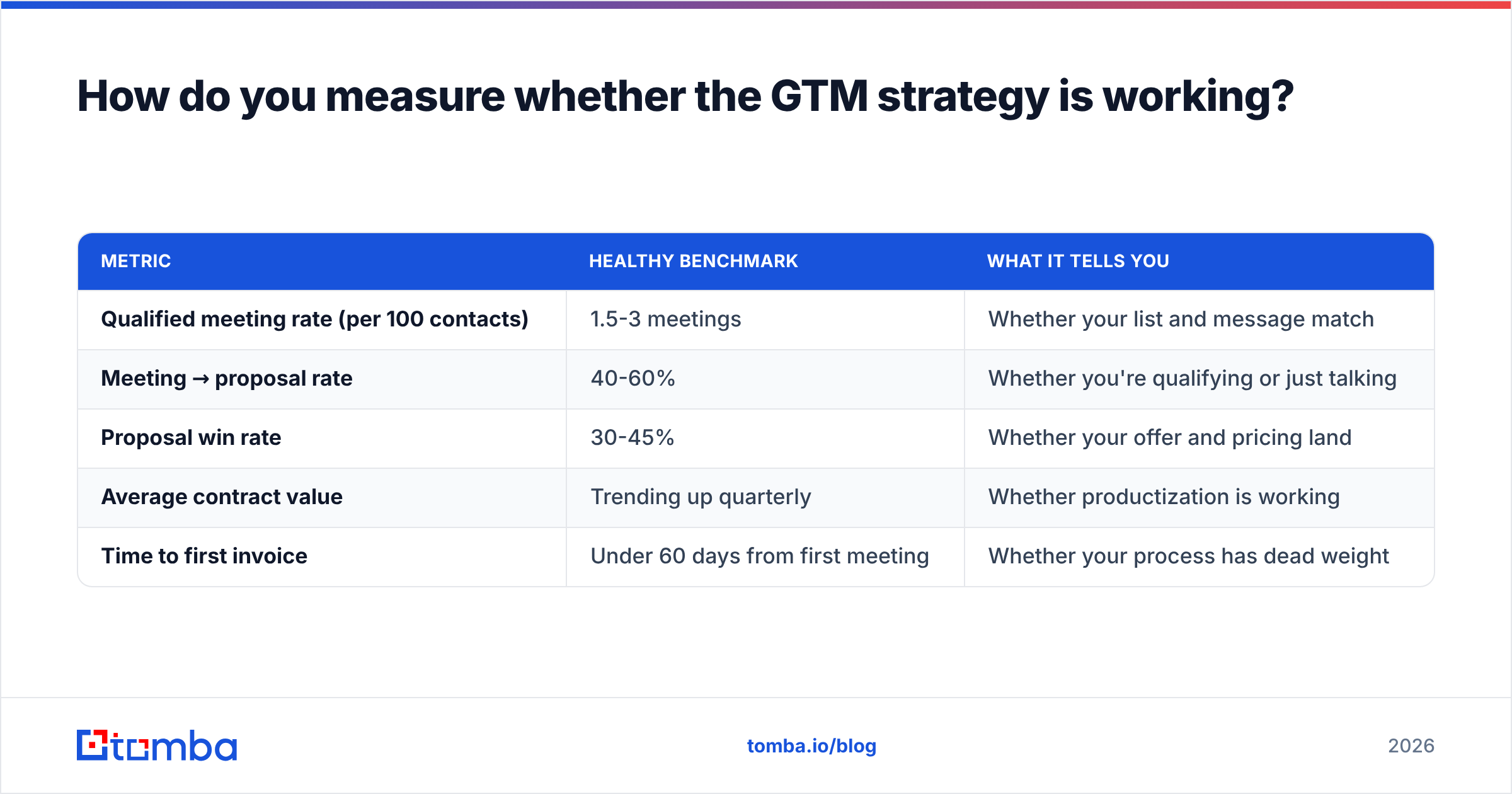
How do you measure whether the GTM strategy is working?#
Track four metrics, review monthly, and ignore the rest for the first year.
| Metric | Healthy benchmark | What it tells you |
|---|---|---|
| Qualified meeting rate (per 100 contacts) | 1.5-3 meetings | Whether your list and message match |
| Meeting → proposal rate | 40-60% | Whether you're qualifying or just talking |
| Proposal win rate | 30-45% | Whether your offer and pricing land |
| Average contract value | Trending up quarterly | Whether productization is working |
| Time to first invoice | Under 60 days from first meeting | Whether your process has dead weight |
If meeting rate is low, the problem is upstream — list quality or messaging. If meeting rate is fine but proposals don't convert, the problem is the offer or the price. If proposals convert but ACV is flat, you're winning small work and never expanding. Each symptom points at a different fix, which is why aggregating everything into "pipeline" hides the actual issue.
One more thing worth tracking that most firms don't: source of first touch on closed-won deals, attributed honestly. Not last-click. If a deal came from a conference conversation eighteen months ago that went nowhere, then a piece of content, then an outbound email — the outbound email did not create that deal. Over-crediting the last touch is how firms accidentally defund the channel that actually works.
What's the 90-day implementation sequence?#
Days 1-30 — Decide. Write the ICP down in one paragraph. Pick one productized offer and price it. Rewrite the homepage headline so it names the buyer and the outcome. Kill the services grid that lists twelve capabilities.
Days 31-60 — Build the list and the infrastructure. Assemble the target account list against the ICP. Enrich contacts, verify them, and load into a sequencer. Set up the sending subdomain with full authentication. Draft three sequences mapped to three trigger types.
Days 61-90 — Run and read. Send at controlled volume. Book meetings. Track the four metrics from day one. Do not change the message before you have 300 sends of data — small samples generate false conclusions and endless rewriting.
By day 90 you should have real numbers, not opinions. That's the entire point: a GTM strategy is a hypothesis, and 90 days of disciplined execution is what turns it into a known quantity.
Where does contact data fit into all of this?#
Underneath everything. Your positioning can be sharp, your offer productized, your sequences well-written — and the whole thing produces nothing if the emails don't reach a human.
That's the piece most IT services firms underinvest in, because it's unglamorous. But the arithmetic is brutal: a 15% bad-data rate on a 2,700-contact list means 405 wasted sends, a bounce rate that trips spam filters, and a sending domain that stops delivering for the other 2,295. One bad list can cost you a quarter.
Build the account list from your ICP, then use the Tomba Email Finder to resolve verified contacts across your target accounts — by domain, by name, or in bulk. The free tier gives you 25 searches a month to test the workflow on a handful of accounts, and paid plans start at $49/mo on Starter, with Growth at $99/mo when your list volume grows. See Tomba pricing for the full breakdown. Get the data layer right first, and the rest of the GTM strategy has something solid to stand on.
Related guides#
Ready to find emails that actually work?
Join 150,000+ professionals who stopped guessing and started sending. Free credits on signup — no credit card required.
Get the Tomba newsletter
Practical outbound tactics and product updates — once every two weeks.
About the author