Go To Market Strategy For Marketplace: 2026 Playbook
Marketplaces fail at launch because they treat supply and demand as one GTM motion. Here is the sequencing, the cold-start math, and the tooling that actually moves liquidity.

A go to market strategy for marketplace launches has one job: get both sides to transact in the same place. Most launches miss it. They treat sellers and buyers as one audience, buy demand too early, and land buyers on an empty catalog. Below is the sequencing, the cold-start math, and the metrics that tell you it is working.
TL;DR
- A marketplace go-to-market is two GTMs on one P&L. Supply and demand have different channels, different CAC, and different payback windows. Treat them as one motion and you stall.
- Pick the constrained side first. In ~80% of marketplaces that side is supply, and supply is acquired through direct outbound, not paid ads.
- Your north-star metric at launch is liquidity (percentage of listings that transact within a defined window), not GMV or signups. GMV is the easiest number to fake and the least predictive.
- Go narrow: one city, one vertical, one job-to-be-done. Every winner from Uber to Faire started with an absurdly small beachhead.
- Budget 60-70% of your first-year GTM spend on the constrained side. The unconstrained side costs less than you modeled. The constrained side costs more.
What is a go to market strategy for marketplace launches?#
A go to market strategy for marketplace launches is the plan for reaching transaction liquidity in a defined segment — not the plan for acquiring users. That distinction is the whole game.
A SaaS launch is like opening a restaurant: you build the kitchen, then you find diners. A marketplace launch is like opening a farmers' market. You have no product until the farmers and the shoppers show up on the same morning. Empty stalls repel shoppers. No shoppers repel farmers. That is the cold-start problem, and it gives marketplace GTM a very different shape from SaaS GTM.
Three structural differences drive everything else:
- Two customer types, two funnels. A seller has a different buying committee, objection set, and lifetime value than a buyer. You need two ICPs, two message sets, and often two teams.
- Value is created between users, not by you. Your product does not work until both sides exist in the same place at the same time. Feature velocity does not fix a liquidity problem.
- Growth is geographically and vertically local. A dense marketplace in one Chicago neighborhood beats a thin one across fifty states. Density compounds. Breadth does not.
So you cannot buy your way out of the cold start. Paid demand against an empty supply base burns cash and earns bad word of mouth. Almost every marketplace that reached scale did the unglamorous thing first: manual, direct, one-at-a-time supply recruitment.
Which side of the marketplace should you launch first?#
Start with the constrained side — the side that is harder to replace and slower to acquire.
Run this diagnostic before you spend a dollar:
- Which side has more alternatives today? If sellers have ten other channels and buyers have none, sellers are constrained. Recruit sellers.
- Which side has higher switching costs? High switching cost = constrained side.
- Which side is geographically fixed? Physical supply (restaurants, contractors, warehouses) is nearly always the constraint.
- Which side would you have to pay to show up? If you would have to subsidize them, they are constrained.
- Which side, once acquired, attracts the other for free? That is your magnet, and usually your constraint.
In most B2B and local marketplaces, supply is the constraint. In content, community, and some fintech marketplaces (lending, insurance), demand is the constraint. Supply there is capital, and capital is abundant.
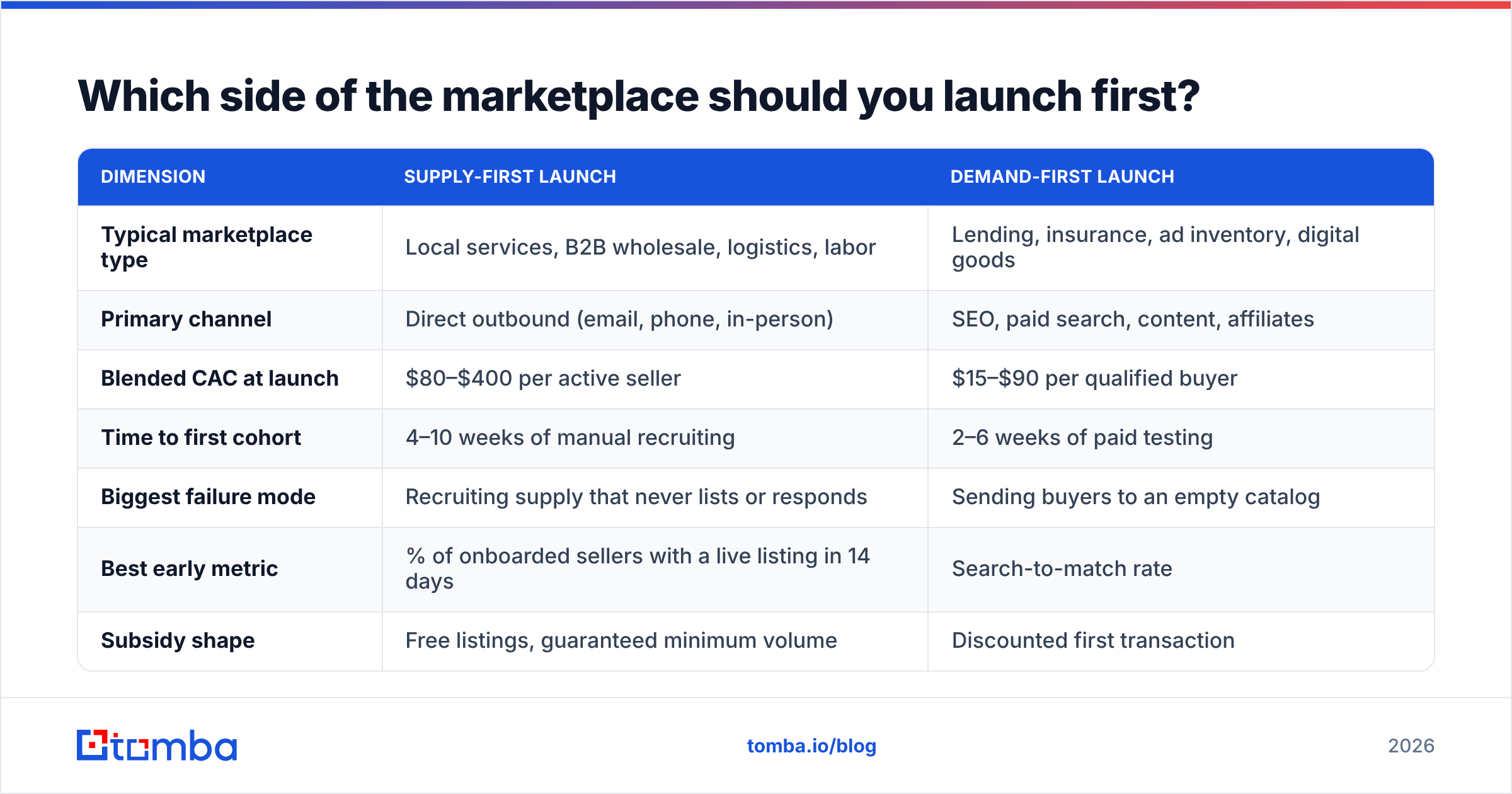
Here is how the two sequencing paths differ in practice:
| Dimension | Supply-first launch | Demand-first launch |
|---|---|---|
| Typical marketplace type | Local services, B2B wholesale, logistics, labor | Lending, insurance, ad inventory, digital goods |
| Primary channel | Direct outbound (email, phone, in-person) | SEO, paid search, content, affiliates |
| Blended CAC at launch | $80–$400 per active seller | $15–$90 per qualified buyer |
| Time to first cohort | 4–10 weeks of manual recruiting | 2–6 weeks of paid testing |
| Biggest failure mode | Recruiting supply that never lists or responds | Sending buyers to an empty catalog |
| Best early metric | % of onboarded sellers with a live listing in 14 days | Search-to-match rate |
| Subsidy shape | Free listings, guaranteed minimum volume | Discounted first transaction |
Uber seeded drivers before riders in each new city. Airbnb hand-recruited hosts in New York and photographed their apartments. Faire recruited brands before retailers. The pattern holds across a decade of case studies documented by firms like a16z and in the research behind Wikipedia's online marketplace entry.
How do you actually acquire the first 100 supply-side partners?#
You do it manually, and you do it with a targeted list — not a spray campaign.
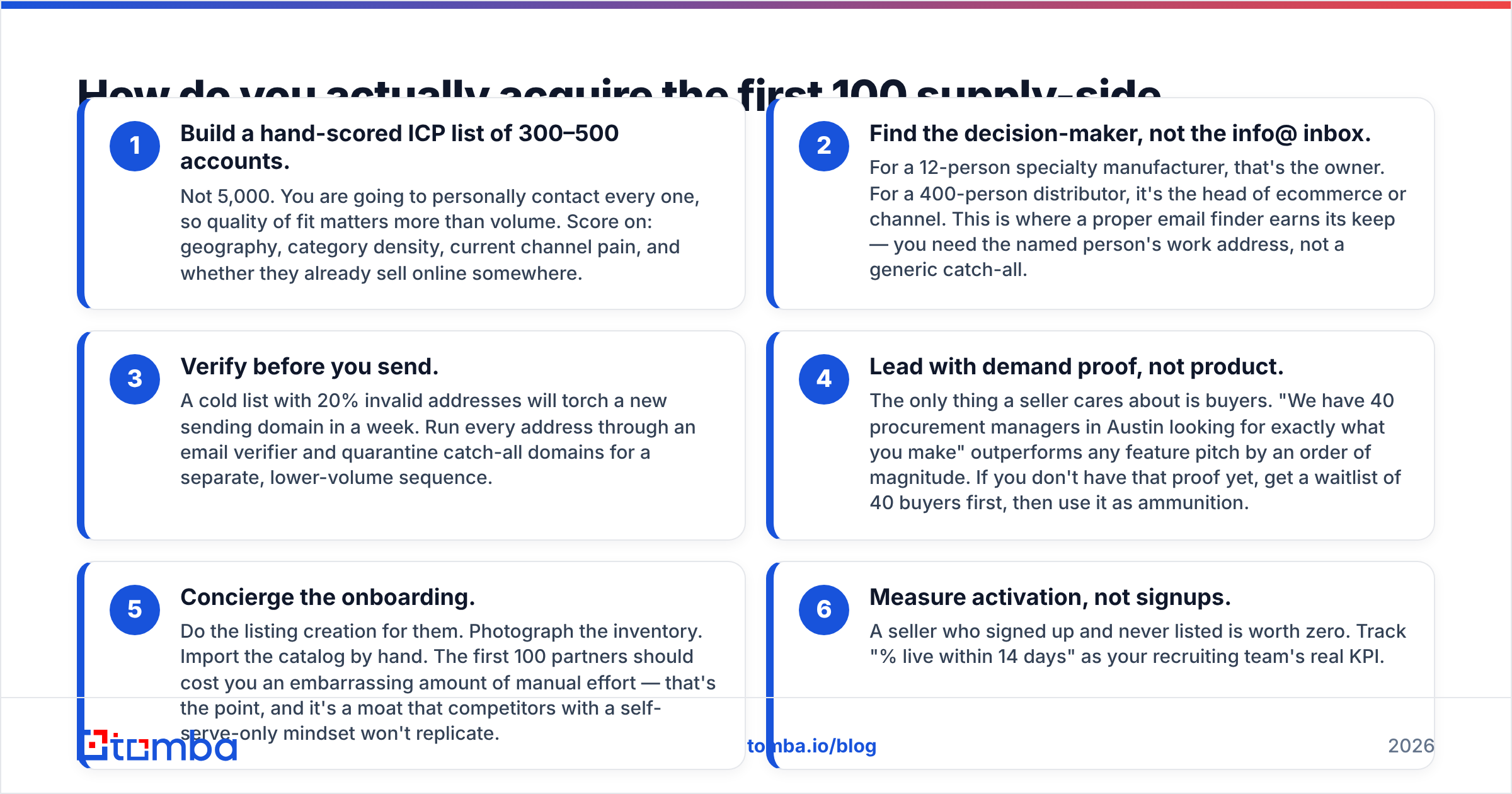
The mechanics work in two stages. First, build and clean the list:
- Build a hand-scored ICP list of 300–500 accounts. Not 5,000. You will contact every one personally, so fit matters more than volume. Score on geography, category density, current channel pain, and whether they already sell online.
- Find the decision-maker, not the info@ inbox. At a 12-person specialty manufacturer, that is the owner. At a 400-person distributor, it is the head of ecommerce or channel. A proper email finder earns its keep here. You need the named person's work address, not a catch-all.
- Verify before you send. A cold list with 20% invalid addresses will torch a new sending domain in a week. Run every address through an email verifier. Quarantine catch-all domains for a separate, lower-volume sequence.
Then run the outreach and the onboarding:
- Lead with demand proof, not product. The only thing a seller cares about is buyers. "We have 40 procurement managers in Austin looking for exactly what you make" beats any feature pitch. No proof yet? Get a waitlist of 40 buyers first, then use it as ammunition.
- Concierge the onboarding. Create the listings for them. Photograph the inventory. Import the catalog by hand. The first 100 partners should cost an embarrassing amount of manual effort. That is the point, and it is a moat self-serve-only competitors will not copy.
- Measure activation, not signups. A seller who signed up and never listed is worth zero. Track "% live within 14 days" as your recruiting team's real KPI.
For most teams the bottleneck is steps 2 and 3. Building an accurate, deduplicated contact list at the speed the recruiting motion demands is slow work. A bulk email finder run against your scored account list turns a two-week slog into an afternoon. Pair it with data enrichment to add firmographics and role titles. Pull from a domain search when you have the company but not the person.
What metrics should you track before and after launch?#
Liquidity first. Everything else is a supporting indicator.
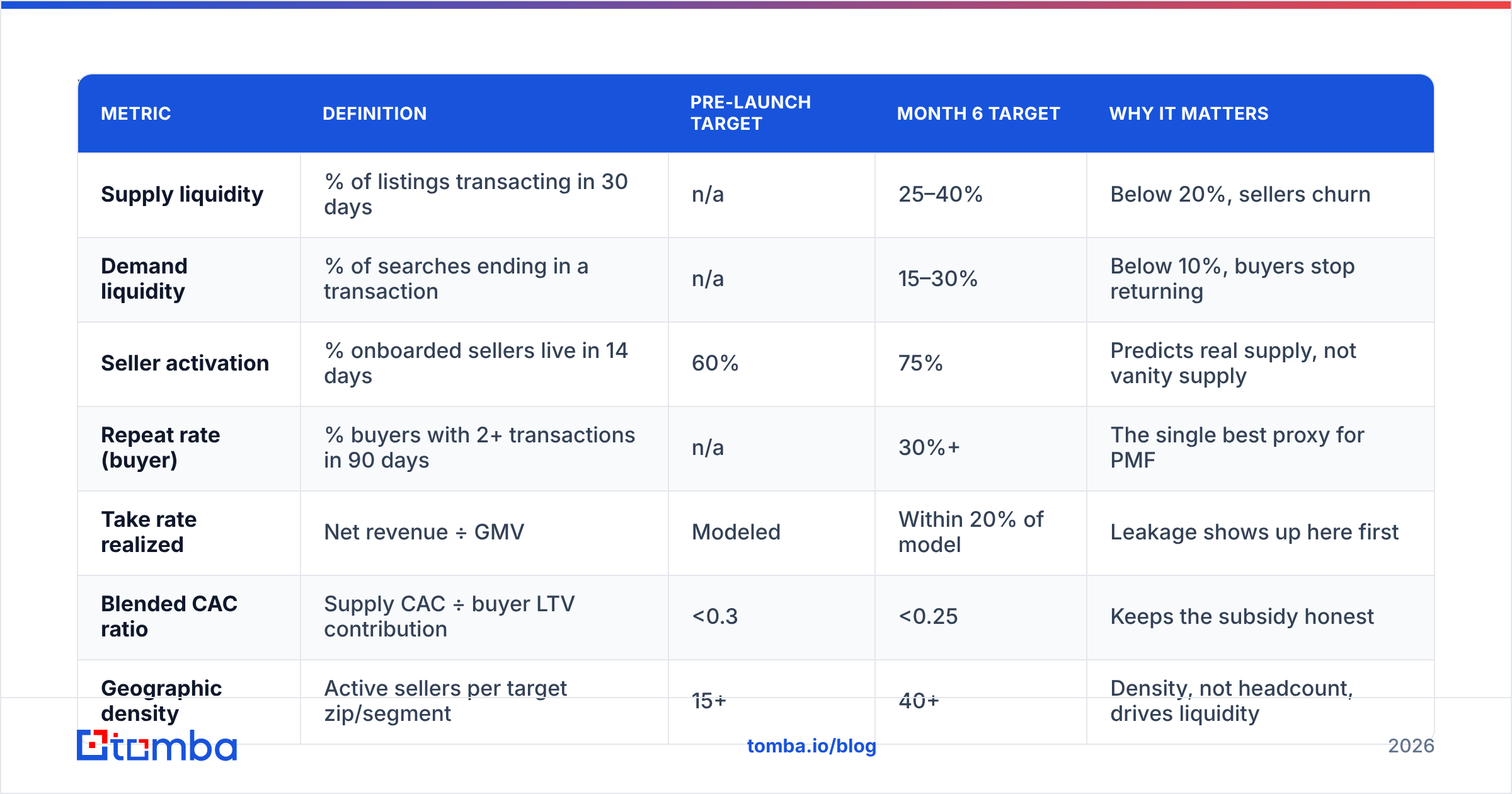
Define liquidity precisely for your model. For example: "percentage of listings that receive a booking within 30 days" (supply-side) and "percentage of searches that end in a transaction" (demand-side). Then track this stack:
| Metric | Definition | Pre-launch target | Month 6 target | Why it matters |
|---|---|---|---|---|
| Supply liquidity | % of listings transacting in 30 days | n/a | 25–40% | Below 20%, sellers churn |
| Demand liquidity | % of searches ending in a transaction | n/a | 15–30% | Below 10%, buyers stop returning |
| Seller activation | % onboarded sellers live in 14 days | 60% | 75% | Predicts real supply, not vanity supply |
| Repeat rate (buyer) | % buyers with 2+ transactions in 90 days | n/a | 30%+ | The single best proxy for PMF |
| Take rate realized | Net revenue ÷ GMV | Modeled | Within 20% of model | Leakage shows up here first |
| Blended CAC ratio | Supply CAC ÷ buyer LTV contribution | <0.3 | <0.25 | Keeps the subsidy honest |
| Geographic density | Active sellers per target zip/segment | 15+ | 40+ | Density, not headcount, drives liquidity |
Two traps worth naming:
GMV is vanity at this stage. You can manufacture GMV with subsidies and one whale account. It tells you nothing about whether the marketplace works. Report it to investors. Run the business on liquidity and repeat rate.
Disintermediation leakage is a silent killer. If realized take rate drifts 30% below your model, buyers and sellers are transacting off-platform. Fix it with payment guarantees, dispute resolution, and insurance — not with contractual threats.

How should you sequence the first 12 months?#
Here is a phase plan that maps to how funding rounds and liquidity actually progress.
Phase 1 — Weeks 0–8: Constrained-side seeding. No product marketing. No paid spend. One founder or one recruiter works a 300-account list by hand. Goal: 40–60 activated sellers in a single geography or vertical. Success looks like a catalog dense enough that a buyer searching your core category finds 5+ credible options.
Phase 2 — Weeks 8–20: Controlled demand injection. Now you turn on demand, but narrowly. Use content and SEO aimed at the exact query your beachhead buyers use, plus direct outbound to a hand-built buyer list. Keep paid spend under 20% of the demand budget until you know your search-to-transaction rate. Concierge the first 50 transactions yourself. Every failed match is a product spec.
Phase 3 — Weeks 20–36: Liquidity tuning. Your job is now matching quality, not volume. Improve search ranking, response-time SLAs, and trust signals such as reviews, verification badges, and escrow. Most marketplaces stall here because they scaled acquisition before fixing match rate. Only expand geography once the beachhead hits 25%+ supply liquidity.
Phase 4 — Weeks 36–52: Replicate and instrument. Clone the beachhead playbook into market two. This is where you learn whether your GTM was a repeatable system or a founder's personal network. Build the B2B database workflow, the enrichment pipeline, and the sequencing templates so market two takes half the time market one did.
A common mistake: raising a large round at the end of Phase 1 and spending it on Phase 4 activities. Capital cannot compress liquidity learning. It can only make the failure more expensive.
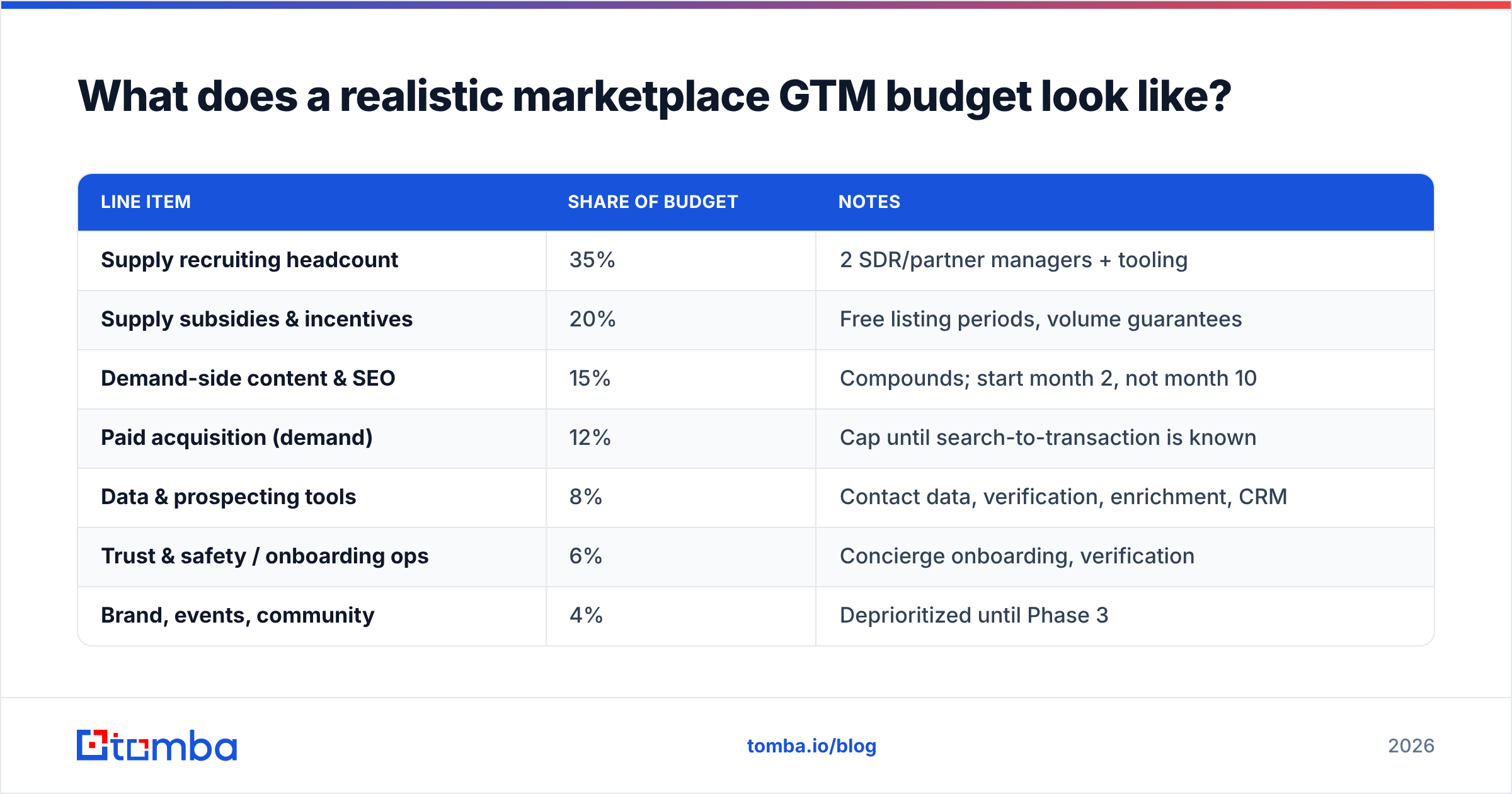
What does a realistic marketplace GTM budget look like?#
Marketplace GTM budgets skew toward people and data, not media. Here is a representative allocation for a seed-stage marketplace spending roughly $600K on GTM in year one:
| Line item | Share of budget | Notes |
|---|---|---|
| Supply recruiting headcount | 35% | 2 SDR/partner managers + tooling |
| Supply subsidies & incentives | 20% | Free listing periods, volume guarantees |
| Demand-side content & SEO | 15% | Compounds; start month 2, not month 10 |
| Paid acquisition (demand) | 12% | Cap until search-to-transaction is known |
| Data & prospecting tools | 8% | Contact data, verification, enrichment, CRM |
| Trust & safety / onboarding ops | 6% | Concierge onboarding, verification |
| Brand, events, community | 4% | Deprioritized until Phase 3 |
The line most founders underfund is data and prospecting tools. It is also the line that decides whether the 35% headcount spend produces anything. A partner manager who spends 60% of the week hunting for contact details costs you twice what you think.
For a neutral read on how buyers evaluate this tooling category, G2's sales intelligence grids are a reasonable starting point. HubSpot's research on outbound benchmarks helps calibrate reply-rate expectations.
What are the most common marketplace GTM mistakes?#
These failures account for most of the marketplaces that stall in year one. Three are about sequencing:
- Launching both sides at once with equal budget. You get a thin marketplace on both sides and liquidity on neither. Pick a side.
- Defining the beachhead too broadly. "Home services in California" is not a beachhead. "Licensed electricians in three Sacramento zip codes" is.
- Confusing supply signups with supply. Fifty registered sellers with no live listings is zero supply. Activation rate is the only number that counts.
Four are about spending ahead of liquidity:
- Buying demand before supply is dense. Every buyer you send to a sparse catalog is a buyer you have probably lost for good.
- Skipping verification on cold outbound lists. New sending domains have no reputation buffer. One campaign to a 20%-invalid list can take months to recover from. Check the fundamentals on email deliverability before your first send.
- Scaling geography before fixing match rate. Expansion multiplies your current unit economics. If they are bad, expansion makes them worse faster.
- Ignoring the off-platform leak. Design for on-platform value — payments, guarantees, dispute handling — from day one, not after take rate slips.
How do you know your marketplace GTM is working?#
Four signals, in order of reliability:
- Buyer repeat rate above 30% at 90 days. Nothing else predicts durability this well.
- Organic supply inbound. When sellers apply without outbound, your demand proof has become self-evident. This is the clearest sign the flywheel has started.
- Supply liquidity above 25% without subsidy. If liquidity collapses when you cut the incentive, you bought transactions, not a marketplace.
- Market two reaching Phase 2 in half the time market one did. This proves you have a playbook, not a lucky beachhead.
If three of the four are green after 12 months, expand aggressively. If fewer than two are green, do not expand. Go back to Phase 3 and fix matching. Expansion is the most expensive way to discover a product problem.
Where to start#
A go to market strategy for marketplace founders lives or dies on the first hundred supply conversations. Those partners are recruited one call at a time. The bottleneck is rarely persuasion. It is finding the right named person with a working email address before your competitor does.
If you are in Phase 1 right now, build your 300-account scored list and get a verified, role-matched contact for each one. The Tomba Email Finder does exactly that: give it a company domain and a name, get back a verified professional address with a confidence score. Then push the whole list through bulk verification before your first sequence goes out. The free tier covers 25 searches a month if you want to test the workflow on a sample. Tomba pricing starts at $49/mo on Starter and $99/mo on Growth when you are ready to run the full recruiting motion.
Build the list. Verify it. Then go have a hundred conversations.
Related guides#
// get started
Find, verify and enrich your first contacts today
Start on the free plan with 25 searches a month, then scale when your team is ready.
Free plan · No credit card required · GDPR & CCPA
// about the author