Go To Market Strategy For Product Managers: 2026 Playbook
Most product launches fail at distribution, not at the build. Here is the exact GTM sequence product managers use to pick a segment, prove the message, and hand sales a list that converts.
TL;DR
- A go to market strategy for product managers is not a launch checklist — it is a written bet on one segment, one problem, one channel, and one price, with a kill date attached.
- Most launches fail on distribution, not on the product. If you cannot name the 200 accounts who should buy first, you do not have a GTM strategy yet.
- The four decisions that matter: ICP definition, wedge use case, motion (PLG vs sales-led vs hybrid), and pricing entry point. Everything else is execution.
- Product-led and sales-led are not a religious choice. Pick based on time-to-value and contract size, not on what your last company did.
- Ship a launch scorecard before launch day: activation rate, week-4 retention, pipeline sourced, and CAC payback. Missing baselines is how launches get declared "successful" with zero revenue.
What is a go to market strategy for product managers?#
A go to market strategy is the plan for how a specific product reaches a specific buyer, gets bought, and gets used — repeatedly and profitably. For a product manager, it is different from the marketing team's launch plan. Marketing owns the campaign. You own the thesis underneath it: who this is for, what job it replaces, why now, and what proof you need before you spend more.
Think of it like opening a restaurant. The recipe is your product. The GTM strategy is deciding you serve office workers within a four-block radius, at lunch, at a $14 price point, and that you win because they get food in six minutes. Great food in the wrong neighborhood at the wrong hour still closes.
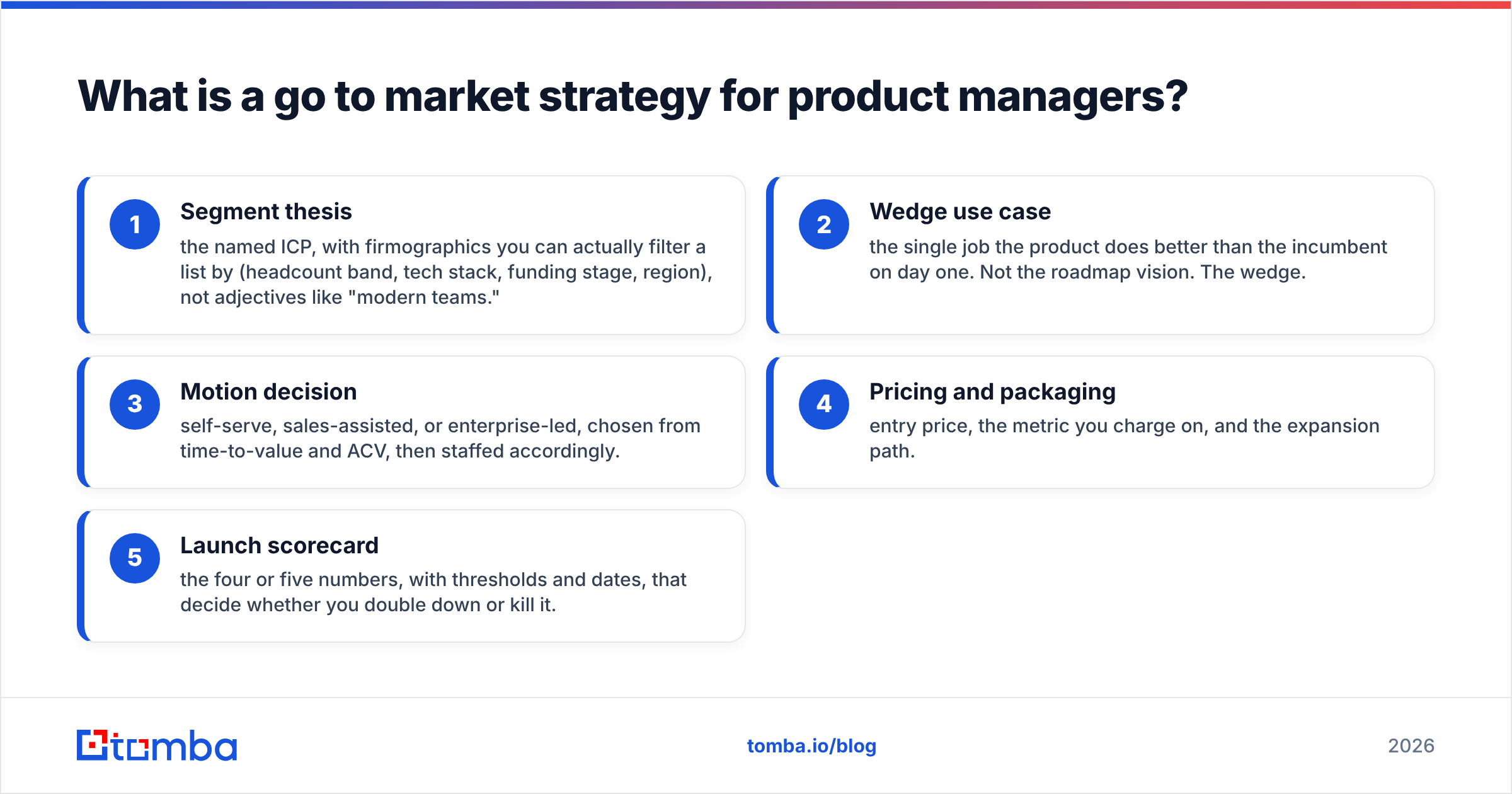
The PM-owned portion breaks into five artifacts:
- Segment thesis — the named ICP, with firmographics you can actually filter a list by (headcount band, tech stack, funding stage, region), not adjectives like "modern teams."
- Wedge use case — the single job the product does better than the incumbent on day one. Not the roadmap vision. The wedge.
- Motion decision — self-serve, sales-assisted, or enterprise-led, chosen from time-to-value and ACV, then staffed accordingly.
- Pricing and packaging — entry price, the metric you charge on, and the expansion path.
- Launch scorecard — the four or five numbers, with thresholds and dates, that decide whether you double down or kill it.
If any of those five is missing, you have a launch plan, not a strategy.
Why do most product launches fail at distribution, not at the build?#
Because build quality is measurable inside the building and distribution quality is not. You can see the test suite go green. You cannot see the 4,000 accounts that never heard the message.
Three failure patterns show up over and over:
The horizontal launch. The product is positioned for "any team that collaborates." Nobody in that group feels the pain acutely enough to change tools. The fix is uncomfortable: name one industry and one role, and accept you are ignoring 95% of the addressable market for two quarters.
The launch with no list. Marketing writes the blog post, sales gets a Slack ping, and nobody has a target account list. Outbound teams then improvise from a scraped export with 40% bounce rates, which torches the sending domain in week one. Before launch day, the account list and the verified contacts for it should already exist — that is the single most neglected GTM asset in most orgs.
The premature scale. Two enterprise logos close on heroic founder effort and the company hires six AEs. The motion was never repeatable; it was founder-led. Repeatability means a rep who joined last month can close using the deck, not that the CEO can.
Gartner's research on B2B buying has repeatedly found that buyers spend a small minority of their purchase journey with any single vendor's sellers. That has a direct implication for PMs: most of your GTM is asynchronous. Docs, pricing pages, comparison content, and product trials do the selling while nobody is in the room.
How do you define an ICP you can actually build a list from?#
Write the ICP as a database query, not as a persona poster. If your description cannot be turned into filters, it will never turn into pipeline.
A usable ICP has four layers:
- Firmographic — industry, headcount band, revenue band, region. Example: US and UK SaaS companies, 50–500 employees, Series A through C.
- Technographic — what they already run. If your product replaces or plugs into a known tool, that tool is your highest-signal filter.
- Trigger — the event that creates urgency. New VP of Sales, a compliance deadline, a funding round, a competitor's price hike, a migration announcement.
- Persona — the individual title who owns the pain plus the title who signs. These are often different people, and the difference determines your content plan.
Then test it. Pull 100 accounts that match all four layers, find the decision-maker contacts, and run a small outbound sequence. You are not measuring reply rate to validate the copy — you are measuring whether the segment reacts at all. A segment that produces zero interest at 100 accounts will not produce interest at 10,000.
This is where list quality quietly decides the experiment's outcome. If a third of your addresses bounce, a dead test looks identical to a dead segment. Use a bulk email finder to build the sample list from company domains, then run everything through an email verifier so bounce rate stays under 3% and the signal you get back is about the segment, not your data hygiene.
Which GTM motion should you pick: PLG, sales-led, or hybrid?#
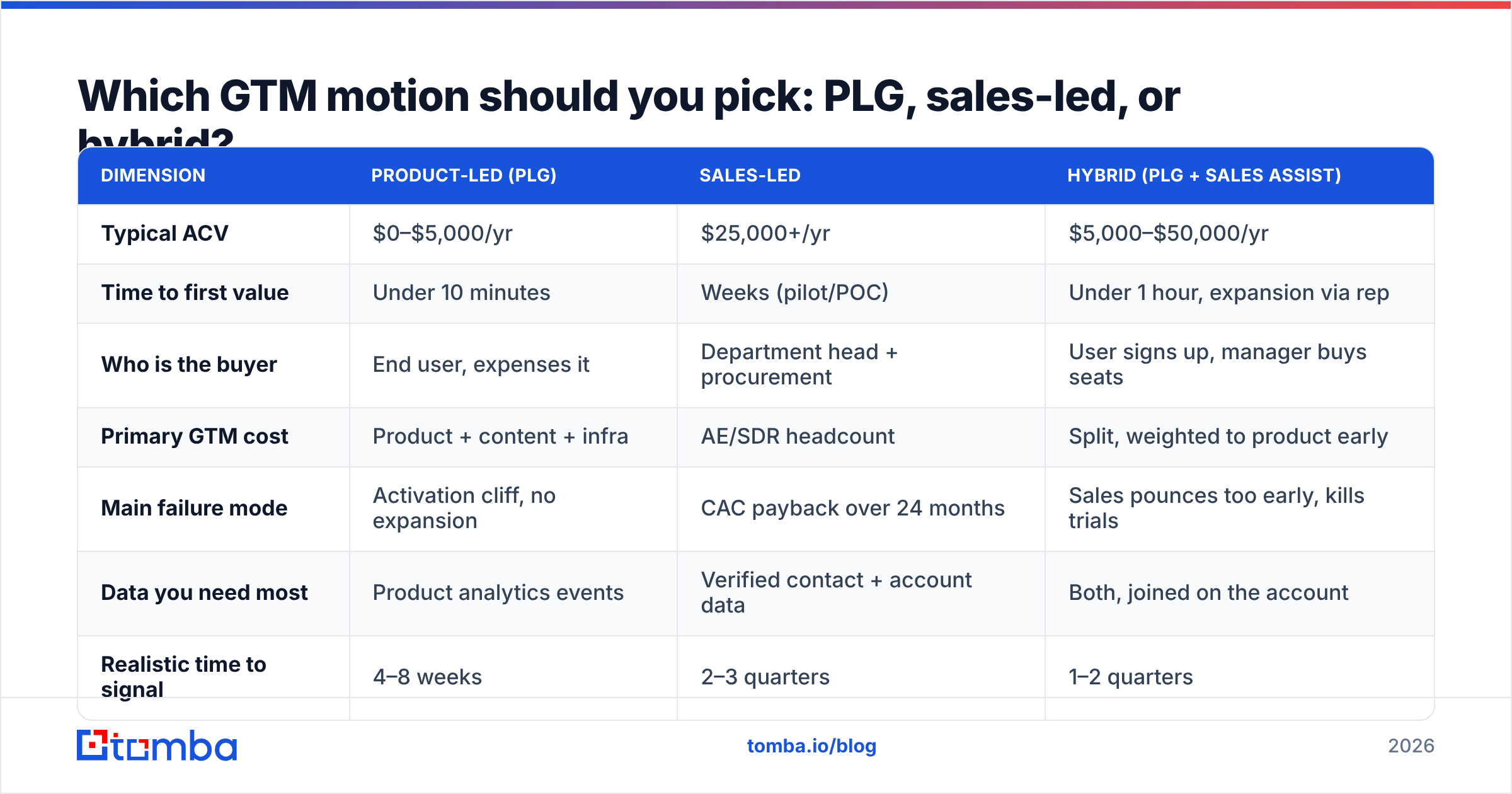
Pick by two variables: how long it takes a user to feel value alone, and how big the contract is. Everything else is noise.
| Dimension | Product-led (PLG) | Sales-led | Hybrid (PLG + sales assist) |
|---|---|---|---|
| Typical ACV | $0–$5,000/yr | $25,000+/yr | $5,000–$50,000/yr |
| Time to first value | Under 10 minutes | Weeks (pilot/POC) | Under 1 hour, expansion via rep |
| Who is the buyer | End user, expenses it | Department head + procurement | User signs up, manager buys seats |
| Primary GTM cost | Product + content + infra | AE/SDR headcount | Split, weighted to product early |
| Main failure mode | Activation cliff, no expansion | CAC payback over 24 months | Sales pounces too early, kills trials |
| Data you need most | Product analytics events | Verified contact + account data | Both, joined on the account |
| Realistic time to signal | 4–8 weeks | 2–3 quarters | 1–2 quarters |
Rules of thumb that hold up in practice:
- If a single user can get real value in under ten minutes without configuration, PLG is available to you. If setup requires an admin, an integration, and a security review, it is not, no matter how much you want it.
- If your ACV is under roughly $5,000, a sales-led motion mathematically cannot pay back. One AE costs more than a hundred of those deals net of churn.
- Hybrid is the default for most B2B software in 2026, but it fails when sales gets alerted on signup instead of on a qualified usage threshold. Define the product-qualified lead threshold before you turn on alerts.
For a deeper definition of the underlying discipline, revenue operations is the function that keeps these motions instrumented once you have more than one running at a time.
What does a 90-day GTM launch plan look like?#
Sequence it backwards from the scorecard. Here is the shape that works for a mid-size B2B launch.
Days 1–30 — Evidence. Run 15 customer interviews inside the ICP, half of them with people who evaluated you and chose something else. Losses tell you more about positioning than wins do. Write the positioning one-pager: for whom, replacing what, unlike whom, proven by what. Build the first target account list — 200 accounts, not 20,000 — and enrich it.
Days 31–60 — Proof. Run the wedge use case with 8–12 design partners. Instrument activation. Write the three assets that carry the most weight in B2B evaluation: a comparison page against the incumbent, a pricing page with real numbers, and a technical doc that shows the integration path. Draft the sales narrative and have a rep who was not in the room deliver it back to you. If they cannot, it is not a narrative, it is your internal jargon.
Days 61–90 — Distribution. Turn on the channels in a fixed order: existing customer base first (cheapest pipeline you will ever have), then targeted outbound to the enriched list, then partner or community channels, then paid. Paid last, always, because paid amplifies whatever message you have — including a wrong one, expensively.
Launch day itself is a non-event if the previous 89 days were done right. It is a press release on top of a working motion.
How do you price a new product without guessing?#
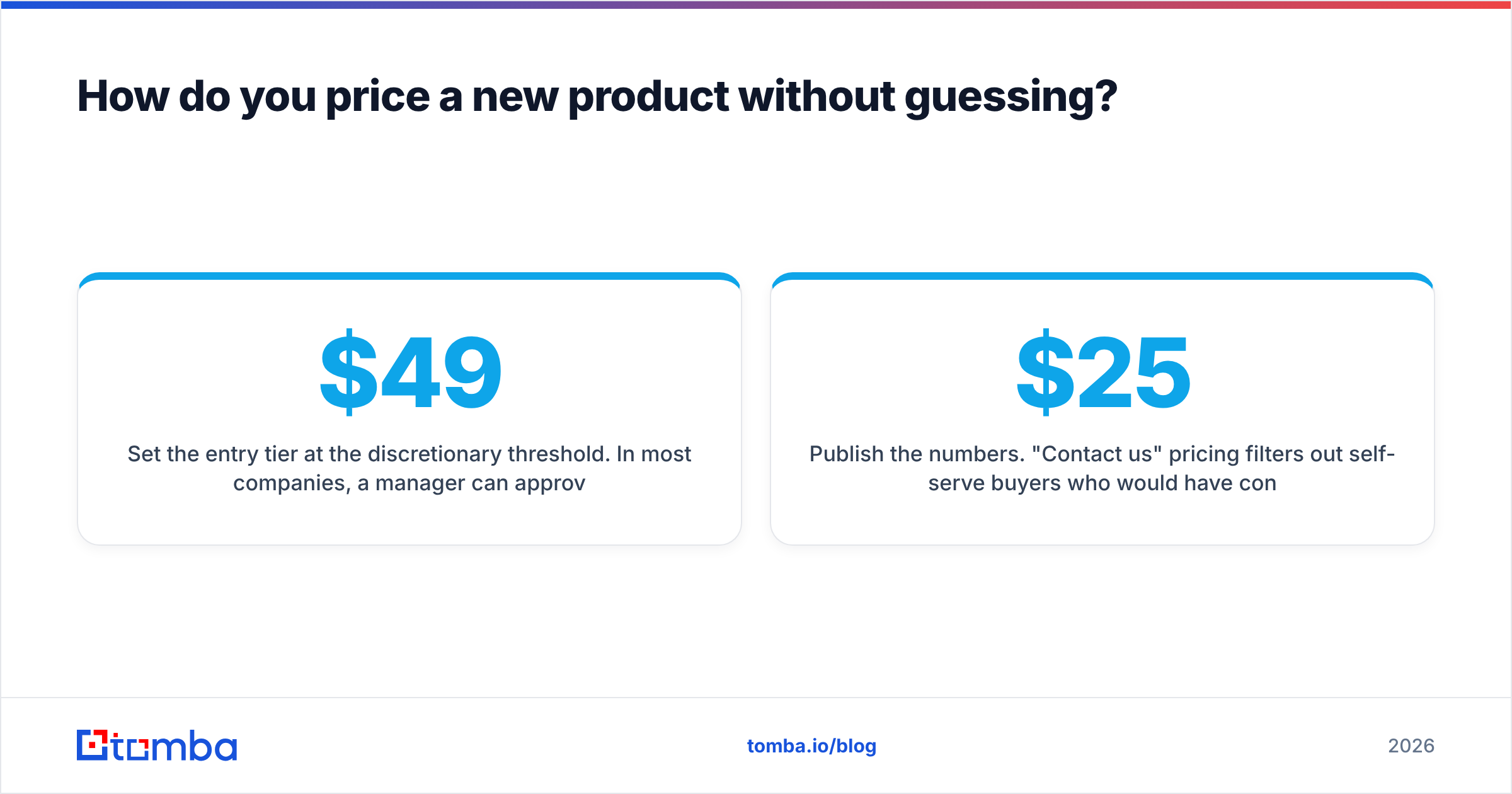
Charge on the metric that grows with the value the customer receives, and set the entry price where your target buyer can approve it without a committee.
Three practical moves:
Find the value metric. It should scale with customer success, be easy to forecast, and be hard to game. Seats work when the product is used daily by individuals. Usage works when consumption maps to output. Avoid metrics customers can suppress by using your product less — you have then priced against adoption.
Set the entry tier at the discretionary threshold. In most companies, a manager can approve somewhere in the low hundreds per month without procurement. Landing under that line collapses your sales cycle. This is why so many B2B tools cluster in the $49–$99 entry range — Tomba pricing sits there deliberately, with a free tier at 25 searches per month, Starter at $49/mo, Growth at $99/mo, and Pro at $249/mo. The pattern is not accidental: free tier to prove value, an entry tier under approval friction, then a step up when the account expands.
Publish the numbers. "Contact us" pricing filters out self-serve buyers who would have converted and does not stop competitors from finding out anyway. If your ACV is under $25,000, publish. G2's category pages make the comparison for buyers whether you participate or not.
Which metrics tell you the GTM is working — or failing?#
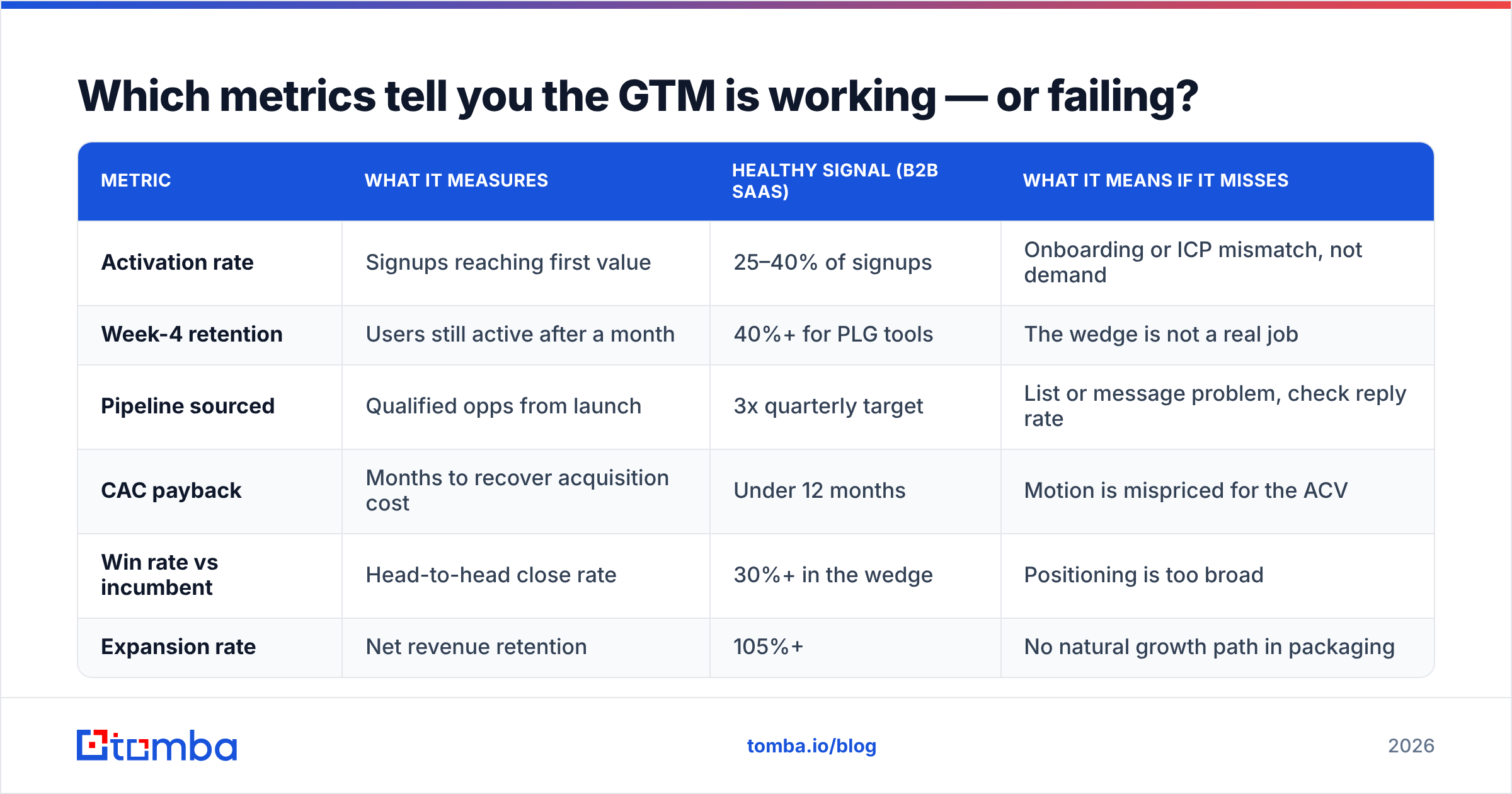
Pick five and put thresholds on them before launch. Otherwise every result gets narrated as a win.
| Metric | What it measures | Healthy signal (B2B SaaS) | What it means if it misses |
|---|---|---|---|
| Activation rate | Signups reaching first value | 25–40% of signups | Onboarding or ICP mismatch, not demand |
| Week-4 retention | Users still active after a month | 40%+ for PLG tools | The wedge is not a real job |
| Pipeline sourced | Qualified opps from launch | 3x quarterly target | List or message problem, check reply rate |
| CAC payback | Months to recover acquisition cost | Under 12 months | Motion is mispriced for the ACV |
| Win rate vs incumbent | Head-to-head close rate | 30%+ in the wedge | Positioning is too broad |
| Expansion rate | Net revenue retention | 105%+ | No natural growth path in packaging |
The diagnostic sequence matters more than any single number. Low reply rate on outbound is a message or data problem. Good replies but low meeting-to-opp conversion is a qualification problem. Good pipeline but low win rate is a positioning problem. Good win rate but bad payback is a pricing problem. Each has a different owner and a different fix, and confusing them wastes a quarter.
Track response rate separately from meeting rate. A campaign with 8% replies and 0.5% meetings is telling you the targeting is right and the offer is wrong.
How do product managers and sales stay aligned after launch?#
Alignment is a data problem before it is a communication problem. Two teams looking at different account records will disagree forever regardless of how many syncs you hold.
Practical mechanisms that actually change behavior:
- One shared account list. Same source, same enrichment, same field definitions, synced into the CRM. If sales maintains a spreadsheet and product looks at analytics, you will argue about who the customer is for the rest of the year. HubSpot's own guidance on sales and marketing alignment reduces to the same point: one definition, one system of record.
- A weekly loss review. Fifteen minutes, three losses, PM present. Read the actual notes, not a summary. Patterns appear within a month.
- PQL definitions agreed in writing. Which usage event makes an account worth a rep's time? Write it down. Revisit quarterly.
- PM-authored objection handling. You know the honest limitations better than anyone. Give sales the true answer to "why not use X instead" before a customer asks it in a live call.
Enrichment closes the loop here: when a rep opens an account, they should see firmographics, the technographic signal, and verified contact details in one place. Data enrichment that fills those fields automatically removes the most common excuse for stale CRM records — that updating them is manual work.
What are the most common GTM mistakes PMs make?#
- Launching to everyone. Broad positioning feels safe and converts nobody. Narrow until it feels uncomfortable, then narrow once more.
- Treating the launch as the finish line. The launch is the start of the learning loop. Budget team capacity for the eight weeks after, not just the eight before.
- Confusing interest with demand. Waitlist signups, webinar attendance, and demo requests are interest. A signed contract or a paid conversion is demand. Only one of them pays salaries.
- Skipping the loss interviews. Wins are flattering and uninformative. The person who evaluated you seriously and picked a competitor will tell you exactly what your GTM is missing, usually in under twenty minutes.
- Building the list last. Target accounts, contacts, and verified emails should exist before the messaging is finalized, because looking at the real list changes the messaging.
- Scaling headcount off a founder-led deal. Repeatability is proven by a new rep closing with the standard materials, not by a heroic close.
Where does contact data fit into the GTM plan?#
At the point where strategy becomes execution. Segment thesis, wedge, motion, and pricing are decisions. The target account list is the first artifact that turns those decisions into something a person can act on Monday morning.
The sequence is straightforward: define the ICP filters, resolve those filters into company domains, find the right roles at each domain, verify the addresses, and push the result into your CRM and sequencer. The domain search step is what converts a list of companies into a list of people — you supply the domain, you get the professional addresses and roles attached to it. Verification before sending protects the sender reputation that every subsequent campaign depends on.
Skip this and every downstream number gets noisy. A 30% bounce rate does not just waste sends; it makes a promising segment look dead and pushes you to change a strategy that was working.
Ready to turn your GTM thesis into a real target list?#
The fastest way to test a segment is to put 200 real, verified contacts in front of it and see what comes back. Use the Tomba Email Finder to go from ICP filters to a clean, deliverable contact list — start on the free tier with 25 searches a month to validate your first segment, then move to Starter at $49/mo once the thesis holds. Your GTM strategy is only as good as the list it runs on.
Related guides#
Ready to find emails that actually work?
Join 150,000+ professionals who stopped guessing and started sending. Free credits on signup — no credit card required.
Get the Tomba newsletter
Practical outbound tactics and product updates — once every two weeks.
About the author