Go-To-Market Strategy for Professional Services: 2026 Guide
Product GTM playbooks break when the product is your people. Here is how consultancies, agencies, and accounting firms actually build a go-to-market strategy that fills a pipeline in 2026.
TL;DR
- A go to market strategy for professional services sells capacity and judgment, not seats. Your unit economics, buying committee, and sales cycle all behave differently from SaaS — copying a product playbook is the most common failure mode.
- Referrals are not a strategy. They are an outcome. Firms that grow past the founder's network build a repeatable second channel — usually targeted outbound, thought leadership, or partner-sourced referrals — before they need it.
- Pick one of four GTM motions: expertise-led, partner-led, outbound-led, or productized. Trying all four with a 6-person firm guarantees none of them work.
- Your ICP must be defined by delivery economics (project size, margin, repeatability), not just firmographics. A "perfect fit" logo you lose money serving is not a fit.
- The operational bottleneck is almost always data: knowing who to call, at which company, with a verified email. Fix that before you write more copy.
Why do product GTM playbooks fail professional services firms?#
Because the product is a calendar. When a SaaS company signs a customer, marginal cost is near zero. When your consultancy signs a client, you owe them 400 hours of senior time that does not exist yet. That single difference reshapes everything downstream.
Three specific breakages:
1. You cannot outrun capacity. A SaaS team can 3x pipeline and figure out onboarding later. A 12-person firm that 3x's pipeline either turns work away or delivers badly and burns its reputation — the only asset it has. GTM velocity in services must be paced against hiring and utilization, which means your pipeline targets are a function of billable capacity 90 days out, not a growth-at-all-costs number.
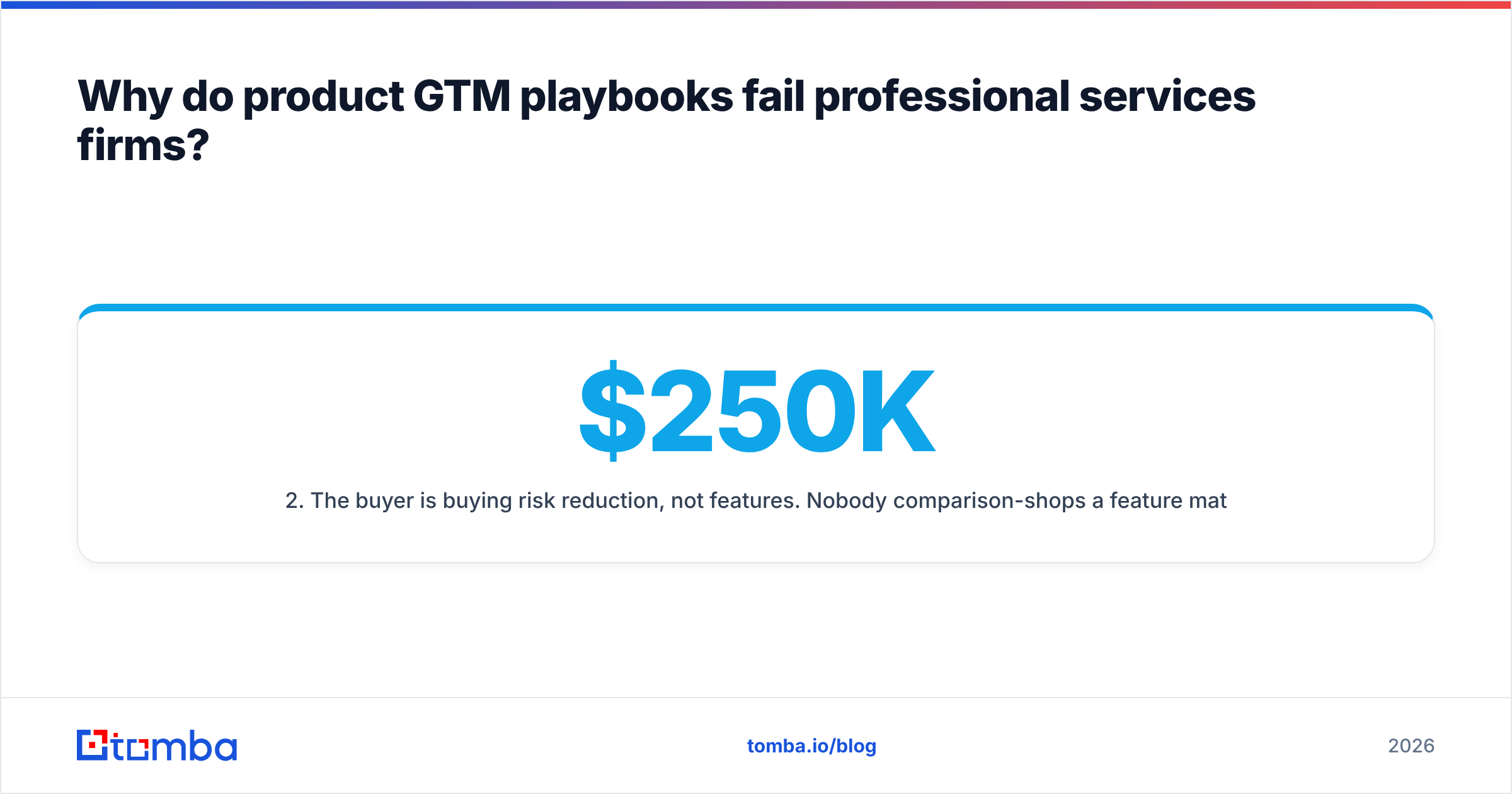
2. The buyer is buying risk reduction, not features. Nobody comparison-shops a feature matrix for a $250K transformation engagement. They are asking "will this team make me look stupid?" That means proof — case studies, named references, published thinking, the partner's LinkedIn presence — does the work that a product demo does elsewhere.
3. Your churn math is inverted. SaaS optimizes retention of a recurring subscription. Services firms deal with natural project endings. Your equivalent of net revenue retention is account expansion and re-engagement, which means your GTM has to include a deliberate motion for turning finished projects into the next scope — not just net-new logos.
Gartner's research on B2B buying behavior consistently finds buyers spend the majority of their purchase journey doing independent research rather than talking to sellers. In services that ratio is even more skewed — by the time a prospect emails you, they have read your work, checked your team on LinkedIn, and asked two peers about you.
What are the four GTM motions for professional services?#
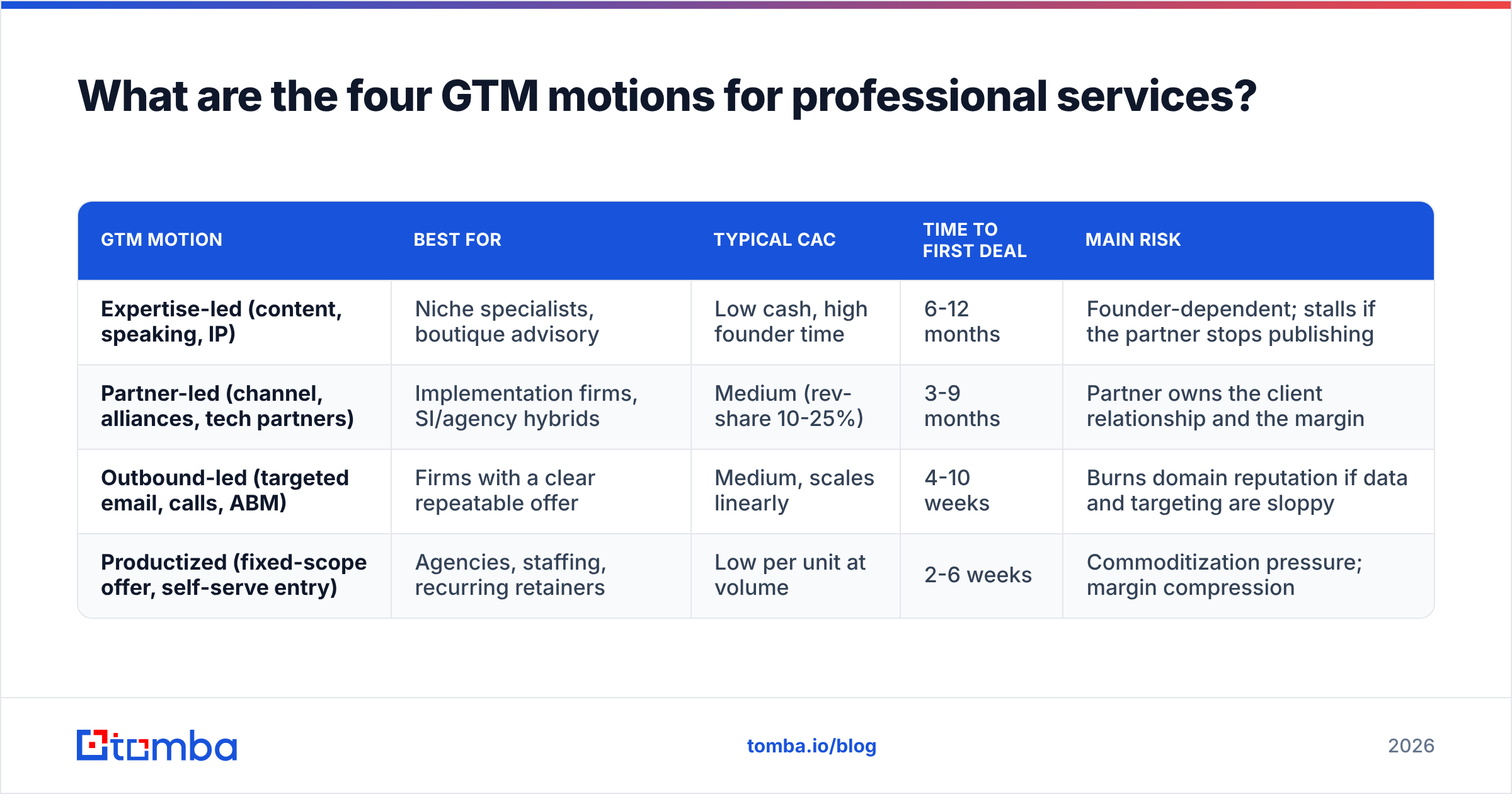
Every services firm runs some blend, but exactly one should be primary. Here is the honest trade-off table.
| GTM motion | Best for | Typical CAC | Time to first deal | Main risk |
|---|---|---|---|---|
| Expertise-led (content, speaking, IP) | Niche specialists, boutique advisory | Low cash, high founder time | 6-12 months | Founder-dependent; stalls if the partner stops publishing |
| Partner-led (channel, alliances, tech partners) | Implementation firms, SI/agency hybrids | Medium (rev-share 10-25%) | 3-9 months | Partner owns the client relationship and the margin |
| Outbound-led (targeted email, calls, ABM) | Firms with a clear repeatable offer | Medium, scales linearly | 4-10 weeks | Burns domain reputation if data and targeting are sloppy |
| Productized (fixed-scope offer, self-serve entry) | Agencies, staffing, recurring retainers | Low per unit at volume | 2-6 weeks | Commoditization pressure; margin compression |
The pattern that works for most firms under $10M: pick expertise-led as the brand layer, and outbound-led as the pipeline layer. Content builds the credibility that makes cold outreach land; outreach creates the volume that content alone cannot.
The pattern that fails: expertise-led alone, then panic when a big client offboards.
How do you define an ICP that reflects delivery economics?#
Most services ICPs stop at "SaaS companies, 200-1000 employees, Series B+." That is a targeting filter, not an ICP. Add the delivery dimensions:
- Project size floor. Below what deal value does the engagement lose money after sales cost and partner oversight? For most boutique firms this is somewhere between $25K and $75K. Anything below is a lead-gen offer, not a client.
- Repeatability score. How much of the delivery is patterns you have already built versus net-new invention? High-repeatability segments carry 15-30 points more gross margin. That is where your GTM spend should concentrate.
- Buying committee shape. A CFO-signed engagement moves differently from a VP Marketing discretionary spend. Map who signs, who blocks, and who champions — then build target lists per role, not per company.
- Expansion surface. Does a first project naturally open a second? Firms that win on land-and-expand should weight this heavily; a one-and-done vertical will keep you on a treadmill.
- Reference willingness. Segments where clients can publicly name you compound. Segments under NDA do not feed the expertise-led layer.
- Trigger availability. Can you detect a buying moment — funding round, new exec hire, compliance deadline, tech migration? No observable trigger means outbound is guesswork.
Score prospective segments 1-5 on each and you will find two or three that dominate. That scoring exercise is a genuine revenue operations function, not a marketing one, because it merges CRM data with delivery margin data.
What does the outbound layer actually require?#
Three things, in order: a list, a reason, a channel. Most firms get this backwards and start with copy.
The list. For a services firm, the list is small and precise. You are not emailing 50,000 people; you are emailing 400 named individuals at 150 accounts you would genuinely be proud to serve. That precision changes the tooling requirement — you need accuracy over volume. Build the account list first (from triggers, partner ecosystems, event attendee lists, funding databases), then find the right humans at each. A domain search run across your target account list gives you every discoverable contact at those companies in one pass, and a bulk email finder turns a spreadsheet of names into a working outreach list.
The reason. Cold outreach for services works when the first line proves you understand a specific situation, not a generic pain. "Congrats on the Series B" is not a reason. "You just hired a VP of RevOps and posted three Salesforce admin roles — usually that means a migration" is a reason.
The channel. Email plus LinkedIn plus, for higher-value accounts, a phone call. Services deals are relationship deals; a multi-touch sequence across channels outperforms email-only by a wide margin. For enterprise-tier accounts, adding B2B phone numbers to your sequences is what separates a 2% reply rate from a 7% one.
How do you keep deliverability intact when you have no room for error?#
This is where most services firms quietly destroy their own GTM. Your firm's domain is your brand. A bounce-heavy campaign from partners@yourfirm.com does not just hurt a campaign — it degrades the deliverability of your proposals and invoices.
Non-negotiables before your first send:
- Send from a secondary domain. Buy
yourfirm-team.comor similar, warm it separately, and keep the primary domain clean for client correspondence. - Verify every address. A list built from scraping or a stale CRM export will run 15-25% invalid. Run it through an email verifier before it touches a sequence. Keep bounce rate under 2%.
- Handle catch-all domains deliberately. Large enterprises frequently run catch-all servers that accept anything, so standard verification returns "unknown." A catch-all verifier resolves a meaningful share of these rather than forcing you to guess or discard them.
- Cap daily volume per mailbox. 30-50 sends per mailbox per day, ramped over four weeks. Add mailboxes to scale, not volume per mailbox.
- Authenticate properly. SPF, DKIM, and DMARC configured and monitored. Google and Yahoo's bulk sender requirements made this table stakes, not optional.
Your sender reputation is a slow asset to build and a fast one to lose. In a firm where the founder's inbox is the revenue engine, that asymmetry matters more than it does at a company with a dedicated SDR domain farm.
How should you sequence a 90-day GTM launch?#
A realistic build order for a firm of 5-40 people. Do not parallelize these — each step's output is the next step's input.
Days 1-15 — Define and instrument. Score your segments against the six ICP dimensions above. Pick one primary segment and one adjacent test segment. Write the offer as a one-page scope with a price range. Set up your CRM with the pipeline stages you will actually use — most services firms need five, not twelve.
Days 16-30 — Build the account list and the proof layer. Assemble 100-200 named accounts with observable triggers. In parallel, publish or refresh the three assets a skeptical buyer needs: a specific case study with numbers, a point-of-view piece that takes a real position, and clean team bios. If you cannot point to proof, outbound converts at a fraction of its potential.
Days 31-50 — Contact data and infrastructure. Find and verify contacts at every target account. Configure the secondary sending domain, warm mailboxes, and connect everything to your CRM so replies do not live in someone's personal inbox. This is the step firms rush and regret.
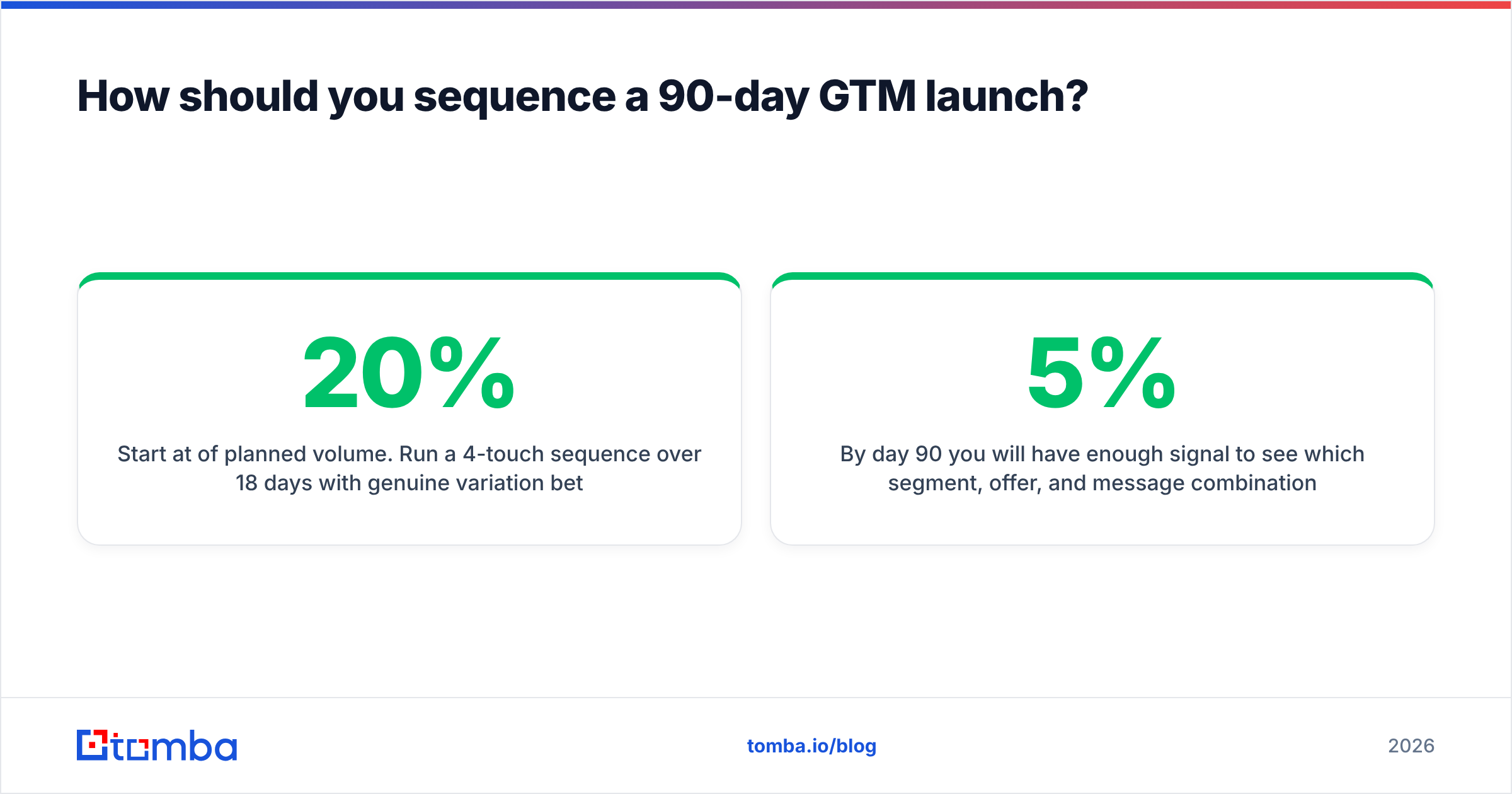
Days 51-75 — Launch and instrument the sequence. Start at 20% of planned volume. Run a 4-touch sequence over 18 days with genuine variation between touches, not "just bumping this." Track reply rate and meeting rate per segment, not open rate — open tracking has been unreliable since Apple Mail Privacy Protection and is a poor decision input.
Days 76-90 — Read the data and cut. By day 90 you will have enough signal to see which segment, offer, and message combination is working. Kill the losers without sentiment. Double volume on the winner. A response rate above 5% on a well-targeted services list is good; above 10% means you found something and should scale it hard.
How do you measure a services GTM without SaaS metrics?#
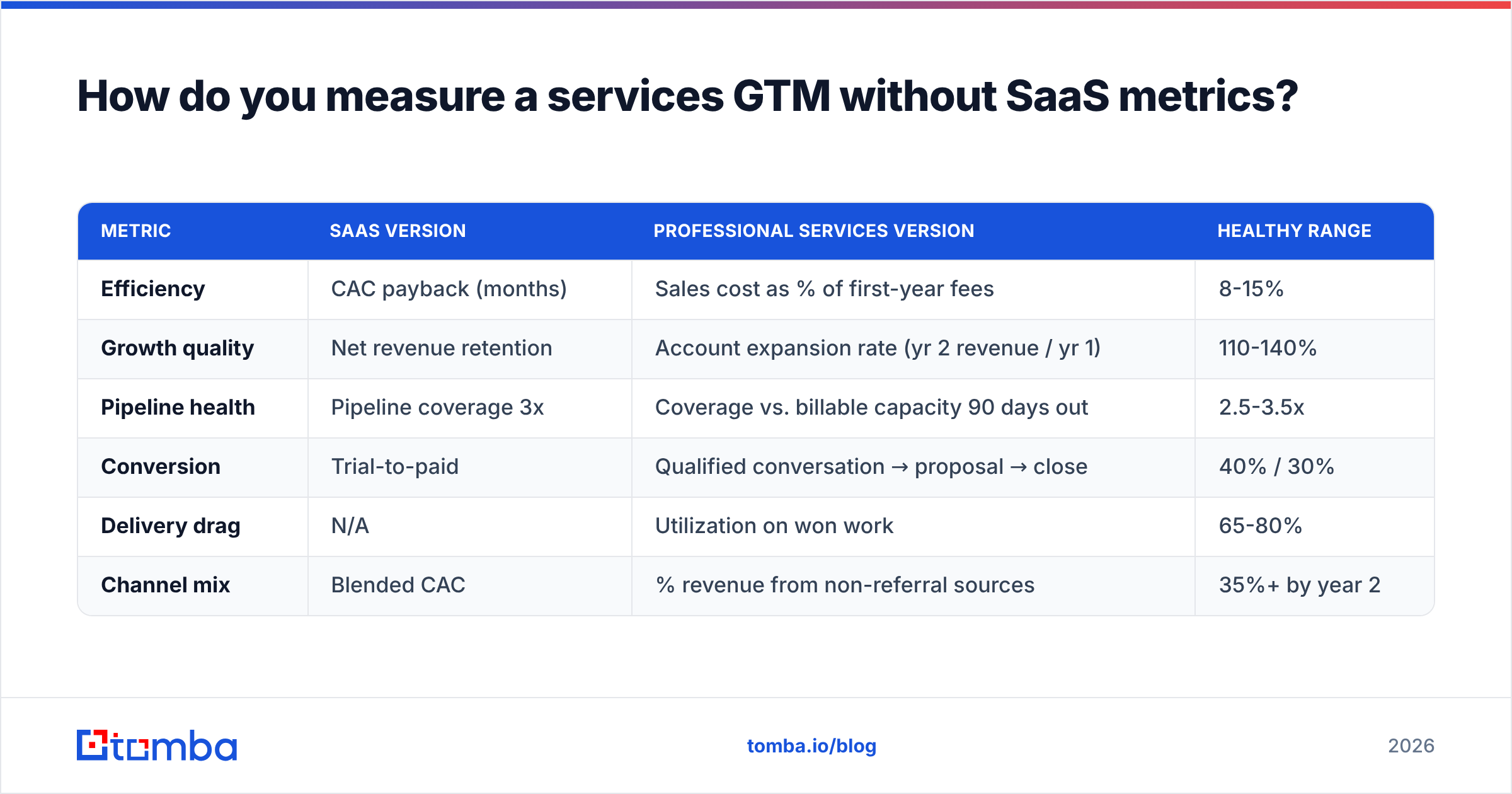
Swap the SaaS dashboard for one that reflects capacity-constrained economics.
| Metric | SaaS version | Professional services version | Healthy range |
|---|---|---|---|
| Efficiency | CAC payback (months) | Sales cost as % of first-year fees | 8-15% |
| Growth quality | Net revenue retention | Account expansion rate (yr 2 revenue / yr 1) | 110-140% |
| Pipeline health | Pipeline coverage 3x | Coverage vs. billable capacity 90 days out | 2.5-3.5x |
| Conversion | Trial-to-paid | Qualified conversation → proposal → close | 40% / 30% |
| Delivery drag | N/A | Utilization on won work | 65-80% |
| Channel mix | Blended CAC | % revenue from non-referral sources | 35%+ by year 2 |
That last row is the one to watch. A firm with 95% referral-sourced revenue is not a low-CAC success story — it is a single-channel dependency with no throttle. Getting non-referral revenue past a third of the total is the practical definition of having a real go-to-market function.
For benchmarking against how peers describe their own stacks and win rates, verified review platforms like G2 and buyer-behavior research from Gartner are more useful than vendor-published claims. And if you run HubSpot, their sales research library publishes conversion baselines you can sanity-check your own numbers against.
What about AI in a services GTM in 2026?#
Two honest uses, and one overhyped one.
Works: research compression. Drafting a genuinely researched first line used to take 6-8 minutes per prospect. With an LLM reading a company's recent filings, job posts, and news, it takes under a minute. That is a 6x increase in personalized-touch capacity — real, measurable leverage. Wiring a data source directly into your assistant via an MCP server for email lets the research and the contact lookup happen in the same step.
Works: proposal and scoping acceleration. Services firms lose deals to slowness. Cutting proposal turnaround from nine days to two is often worth more than any messaging change.
Overhyped: fully autonomous outbound. AI SDR tools that generate and send at volume are pushing exactly the wrong behavior for a firm whose reputation is its product. The constraint in services outbound was never message volume — it was targeting precision and credibility. Automating the volume side while leaving targeting untouched just makes the bad outcome arrive faster.
What is the most common mistake at each firm size?#
- Under 5 people: treating the founder's network as infinite. It is not. Start channel two while channel one still works.
- 5-20 people: hiring a salesperson before defining a repeatable offer. A rep with no ICP and no proof assets will fail in seven months and cost you $150K.
- 20-50 people: letting each partner run their own GTM. Five partial motions beat by one funded one, every time.
- 50+: over-indexing on brand marketing while the outbound engine stays manual and under-instrumented.
The through-line: services firms consistently under-invest in the boring middle layer — the account list, contact data, CRM hygiene, verification — and over-invest in the visible ends, brand and closing. The middle layer is what makes both ends work.
Where should you start this week?#
Pick your primary segment, build a 100-account target list, and get verified contact data for the three roles that matter at each account. That is a two-week project that produces the single asset every other part of your go to market strategy for professional services depends on.
Tomba's Email Finder is built for exactly this shape of work: precise, account-based list building rather than dumping a million-row database on you. Search by domain or by name, get confidence-scored results, verify before you send, and push straight into your CRM. The free tier gives you 25 searches a month to test your list-building process end to end; Tomba pricing starts at $49/mo on Starter, $99/mo on Growth, and $249/mo on Pro when you are ready to run the full 200-account motion. Build the list first — the copy is the easy part.
Related guides#
Ready to find emails that actually work?
Join 150,000+ professionals who stopped guessing and started sending. Free credits on signup — no credit card required.
Get the Tomba newsletter
Practical outbound tactics and product updates — once every two weeks.
About the author