Go To Market Strategy for SaaS Startups: 2026 Playbook
Most SaaS GTM advice is a template nobody has shipped. This is the working playbook: how to pick a motion, size a real ICP, price it, and build the data layer that makes outbound land in 2026.

TL;DR
- A go to market strategy for SaaS startups is four decisions, not a deck: who you sell to, how they buy, what you charge, and which channel carries the first 100 customers.
- Pick one motion for the first 18 months. Product-led, sales-led, and community-led all work; running all three at seed stage works for nobody.
- Your ICP should be small enough to list. If you can't enumerate 200-500 named accounts in a spreadsheet, you have a market, not an ICP.
- Pricing is a GTM decision, not a finance decision. Your price point dictates whether you can afford a rep, and therefore which motion is even legal for your margins.
- The data layer — verified contacts, enrichment, routing — is the part founders skip and then blame on "the messaging."
What is a go to market strategy for SaaS startups?#
A go-to-market strategy is the specific, testable plan for how a product reaches its first paying customers and then repeats that with less effort each time. For SaaS it comes down to four locked answers:
- Segment — the named accounts you will chase, defined by firmographics plus a trigger event, not by "SMBs in North America."
- Motion — how the buyer moves from awareness to payment: self-serve, sales-assisted, sales-led, or partner-led.
- Pricing and packaging — the price point, the unit you meter, and where the upgrade wall sits.
- Channel — the one or two acquisition sources you'll actually staff: outbound, content/SEO, paid, communities, integrations marketplaces.
Everything else — positioning docs, battlecards, enablement decks — is downstream artifact work. Those matter, but only after the four are fixed. Most startups that "can't find product-market fit" have actually built a good product for a segment they never narrowed.
The failure mode is predictable. A founder reads that PLG is dead, that outbound is dead, that SEO is dead, and ends up half-committing to five channels. Six months later there is data on nothing because every channel got 20% of the attention it needed to produce signal.
Wait — corrected image syntax below.
Which GTM motion fits your product?#
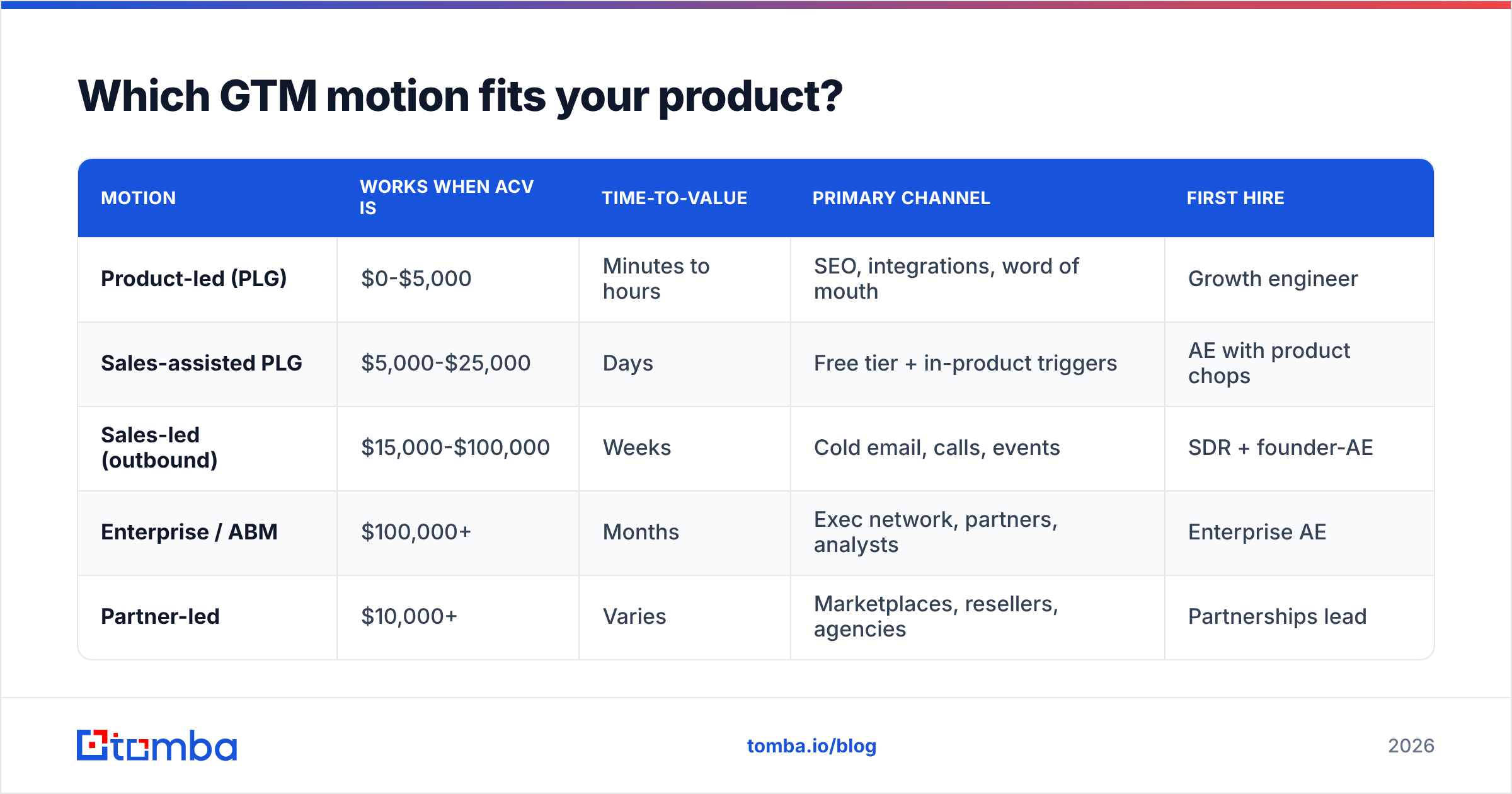
Motion follows two variables: annual contract value (ACV) and time-to-value. If a user can get value in under 10 minutes without talking to anyone, self-serve is on the table. If value requires data migration, security review, or three stakeholders, it isn't — regardless of how much you like the idea of a frictionless funnel.
| Motion | Works when ACV is | Time-to-value | Primary channel | First hire |
|---|---|---|---|---|
| Product-led (PLG) | $0-$5,000 | Minutes to hours | SEO, integrations, word of mouth | Growth engineer |
| Sales-assisted PLG | $5,000-$25,000 | Days | Free tier + in-product triggers | AE with product chops |
| Sales-led (outbound) | $15,000-$100,000 | Weeks | Cold email, calls, events | SDR + founder-AE |
| Enterprise / ABM | $100,000+ | Months | Exec network, partners, analysts | Enterprise AE |
| Partner-led | $10,000+ | Varies | Marketplaces, resellers, agencies | Partnerships lead |
The math that decides it: a fully loaded SDR + AE pair in the US costs roughly $250,000-$320,000 a year. To keep CAC payback under 18 months, that pair needs to close somewhere north of $400,000 in new ARR. At a $2,000 ACV that's 200 new logos per rep pair per year — around 17 closes a month, which nobody sustains in B2B. At $25,000 ACV it's 16 deals a year, which is boring and achievable.
So: if your ACV is under about $8,000 and you can't raise it, a human-driven sales motion will burn you. Go self-serve and spend the money on product and distribution instead. Gartner's B2B buying research makes the same point from the buyer's side — buyers now spend only about 17% of the purchase journey with any vendor's sales team, and a fraction of that with yours specifically.
How do you define an ICP you can actually sell to?#
Write it as a list of companies, not a paragraph of adjectives. The test is brutal and useful: open a spreadsheet and try to fill 200 rows with real company names that match your definition. If you can't, the definition is too abstract. If you fill 20,000 rows, it's too broad.
A working ICP row has five columns:
- Firmographics — employee count band, revenue band, geography, industry code.
- Technographics — what they already run. "Uses HubSpot + Snowflake" is a far better filter than "data-driven company."
- Trigger — hiring a role, raising a round, launching a product, a compliance deadline, a leadership change. Triggers convert 3-5x better than static fit alone.
- Buying committee — the economic buyer, the champion, the blocker. Name the titles.
- Pain proxy — an observable signal that the pain exists: an open job req, a public roadmap, a slow page, a missing SOC 2 badge.
That fifth column is what separates a prospect list from a spray list. It is also the column that most lead databases will not give you — you assemble it from job boards, funding feeds, and site scans, then attach contacts to it.
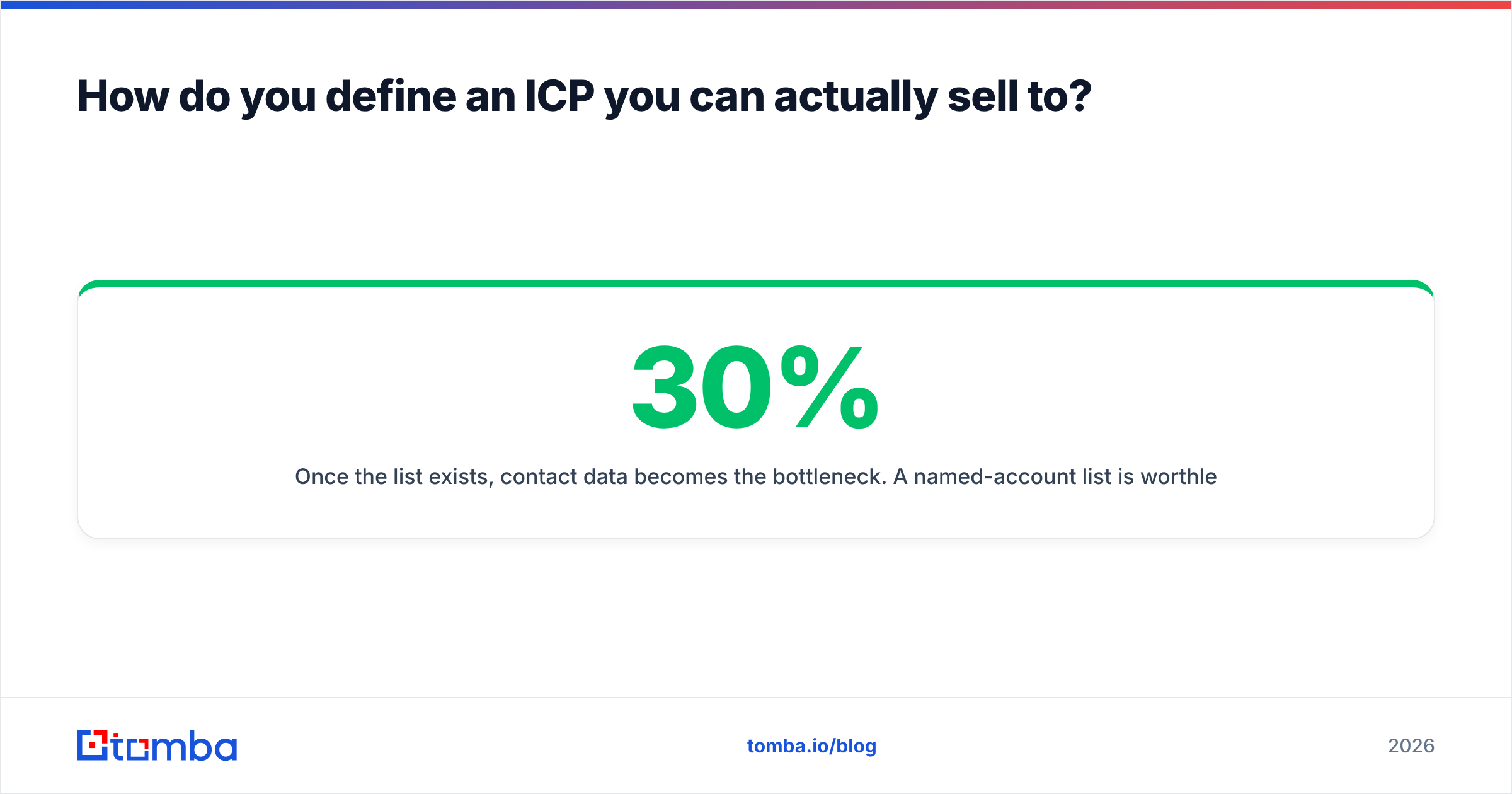
Once the list exists, contact data becomes the bottleneck. A named-account list is worthless if 30% of the email addresses bounce, because bounces above roughly 2% start damaging your sender reputation and then your entire domain underperforms. Run every list through an email verifier before the first send, and use a domain search to pull the right contacts per account rather than buying a generic export.
What does a 90-day GTM launch plan look like?#
Ninety days is enough to prove or kill a motion. Here's the structure that survives contact with reality:
Days 1-15 — Narrow. Lock the ICP to a single segment. Write the list of 200-500 named accounts. Interview 10 customers or prospects who fit it. Extract the exact words they use for the problem; those words become your subject lines and your homepage headline.
Days 16-30 — Instrument. Set up the data layer before the campaigns: CRM fields for segment/trigger/source, a verified contact set, and one dashboard that answers "how many qualified conversations did we have this week." Not MQLs. Conversations.
Days 31-60 — Run one channel hard. Pick outbound or content or paid. Ship at minimum 1,000 targeted outbound touches, or 12 substantive content pieces, or $10,000 of paid spend. Below those thresholds you get noise, not data.
Days 61-90 — Read the signal. You want reply rate, meeting rate, and — most importantly — the shape of objections. Consistent objections mean you're talking to the right people about the wrong value. Silence means the wrong people.
The instrumentation step is where most startups lose the quarter. If you can't attribute a closed deal back to a segment and trigger, you'll relearn the same lesson every quarter.
Is product-led growth better than sales-led for SaaS in 2026?#
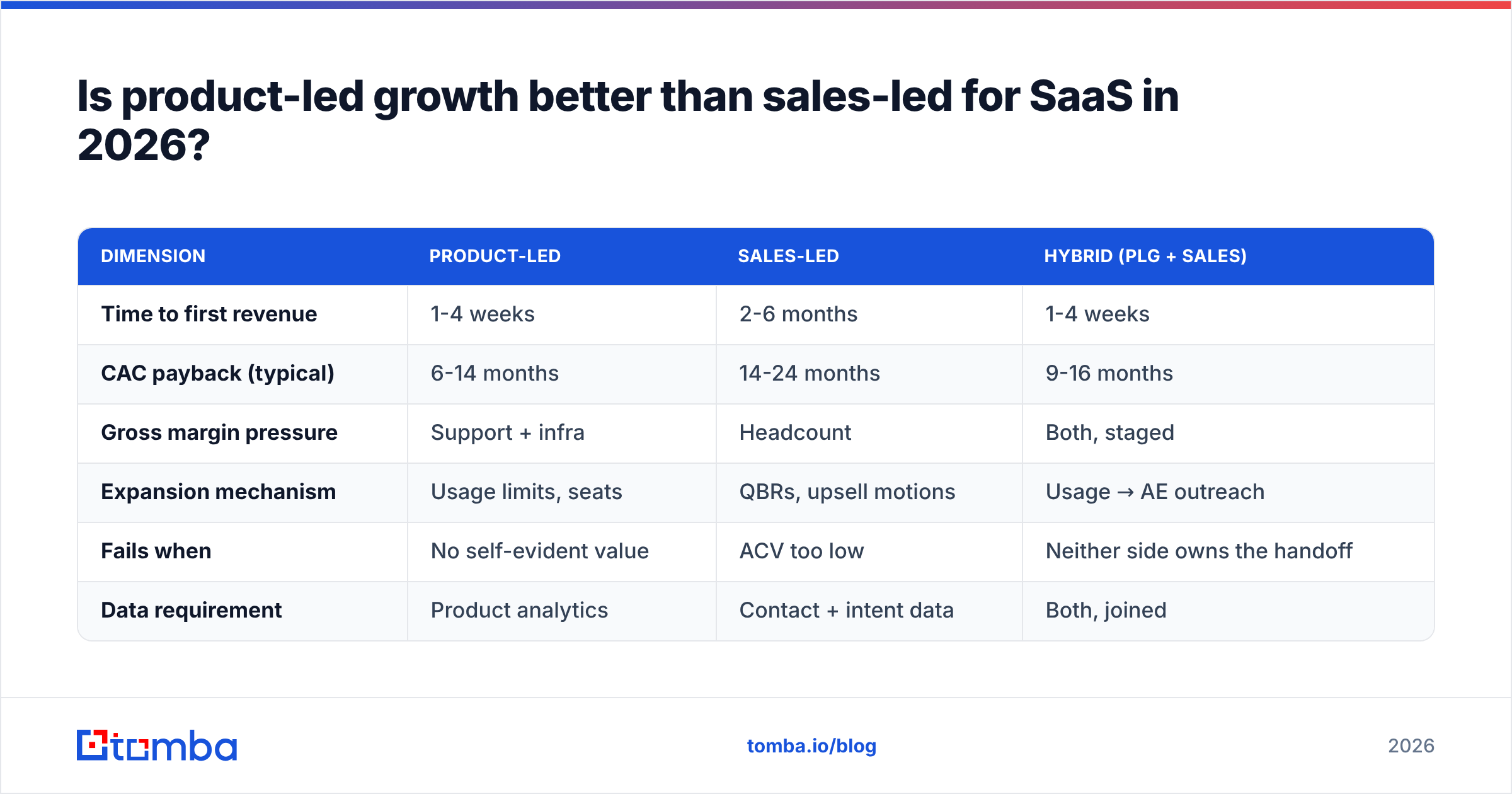
Neither is better. The interesting shift is that the two have converged — PLG companies now hire sales teams to work product-qualified accounts, and sales-led companies now ship free tools to generate top-of-funnel. The pure versions are increasingly rare.
| Dimension | Product-led | Sales-led | Hybrid (PLG + sales) |
|---|---|---|---|
| Time to first revenue | 1-4 weeks | 2-6 months | 1-4 weeks |
| CAC payback (typical) | 6-14 months | 14-24 months | 9-16 months |
| Gross margin pressure | Support + infra | Headcount | Both, staged |
| Expansion mechanism | Usage limits, seats | QBRs, upsell motions | Usage → AE outreach |
| Fails when | No self-evident value | ACV too low | Neither side owns the handoff |
| Data requirement | Product analytics | Contact + intent data | Both, joined |
Hybrid's failure mode deserves emphasis: when a free user hits a usage threshold and nobody owns the follow-up, you have built a leaky bucket with extra steps. Define the PQL threshold, define who gets pinged, and define the SLA — 30 minutes is the standard that actually moves conversion, and HubSpot's research on lead response time has held up on that for years.

How should you price a SaaS product at launch?#
Price higher than feels comfortable, meter on a unit that grows with customer value, and leave a free tier only if it creates distribution.
Three rules that hold across most early-stage SaaS:
- Pick a value metric, not a seat count — unless seats genuinely correlate with value. Credits, records processed, endpoints monitored, and messages sent all scale with the customer's success. Seats punish adoption.
- Three tiers, one obvious middle. Anchor high, make the middle tier the one you want 70% of customers on, and put the enterprise tier behind "contact us" so you can learn what large buyers will pay.
- Raise prices before you're ready. Early-stage SaaS underprices by 30-50% on average. A price increase tested on new logos only is the cheapest experiment you will ever run.
For reference, a mature tool stack tends to look like tiered credit pricing — Tomba's pricing, for instance, runs a free tier at 25 searches/month, Starter at $49/mo, Growth at $99/mo, and Pro at $249/mo, metered on lookups rather than seats. That shape lets a solo founder start free and a 12-person sales team scale up without a renegotiation. Whatever you build, the principle is the same: the customer should hit the upgrade wall at the exact moment the product has already paid for itself.
Free tiers earn their keep when they create distribution — public artifacts, shared links, integrations, referrals. A free tier that just gives away the product to people who would have paid is a discount, not a growth loop.
What GTM mistakes kill SaaS startups fastest?#
- Targeting "everyone with the problem." The problem is common; the urgency is rare. Sell to the 5% with a deadline.
- Hiring sales before founder-led selling works. If the founder can't close 10 deals with a rough deck, a $180K AE won't either. They'll just do it more expensively and blame the leads.
- Confusing traffic with pipeline. 40,000 monthly visitors and 3 demos is a positioning failure, not a conversion-rate-optimization project.
- Ignoring data hygiene until deliverability breaks. By the time your domain is flagged, recovery takes 4-8 weeks. Check email deliverability fundamentals — SPF, DKIM, DMARC, list quality — before volume, not after.
- Changing the ICP every month. Each pivot resets your learning to zero. Commit for a quarter minimum.
- Buying a database instead of building a list. Bulk exports from any provider go stale at roughly 2-2.5% per month as people change jobs. Refresh at the point of use, not at the point of purchase.
On that last point, there's a real distinction between list sources. Curated database vendors like BookYourData sell pre-verified contacts by segment, which is genuinely fast when you need volume into a well-defined vertical. Real-time finder tools resolve contacts on demand against a domain and name, which is better when your ICP is trigger-based and your account list changes weekly. Most teams end up using both: a database for breadth, an on-demand email finder for the accounts they identified themselves this morning.
How do you build the GTM data layer?#
Think of it like plumbing in a house. Nobody tours a home to admire the pipes, but every fixture fails without them. Your GTM data layer is the same — invisible when it works, catastrophic when it doesn't.
The minimum viable stack has four jobs:
- Identify accounts — a source of company records matching your ICP filters, refreshed monthly. Website visitor identification can add accounts already showing intent; tools like website visitor reveal turn anonymous traffic into named companies you can prioritize.
- Resolve contacts — turn "VP Marketing at Acme" into a deliverable email and, where you run a calling motion, a mobile number. Use a bulk email finder for list-level work and an API for anything programmatic.
- Enrich and score — attach firmographics, technographics, and triggers so routing and sequencing can be automated rather than manual. Contact enrichment at the CRM record level keeps scoring honest.
- Sync and route — push everything into the CRM with clean field mapping so attribution survives. A HubSpot integration or equivalent is the difference between a system and a pile of CSVs.
Test the whole chain with 50 accounts before you run 5,000. You'll find the field-mapping bug, the duplicate problem, and the bounce rate at a scale where fixing them takes an afternoon instead of a quarter.
What metrics prove your GTM strategy is working?#
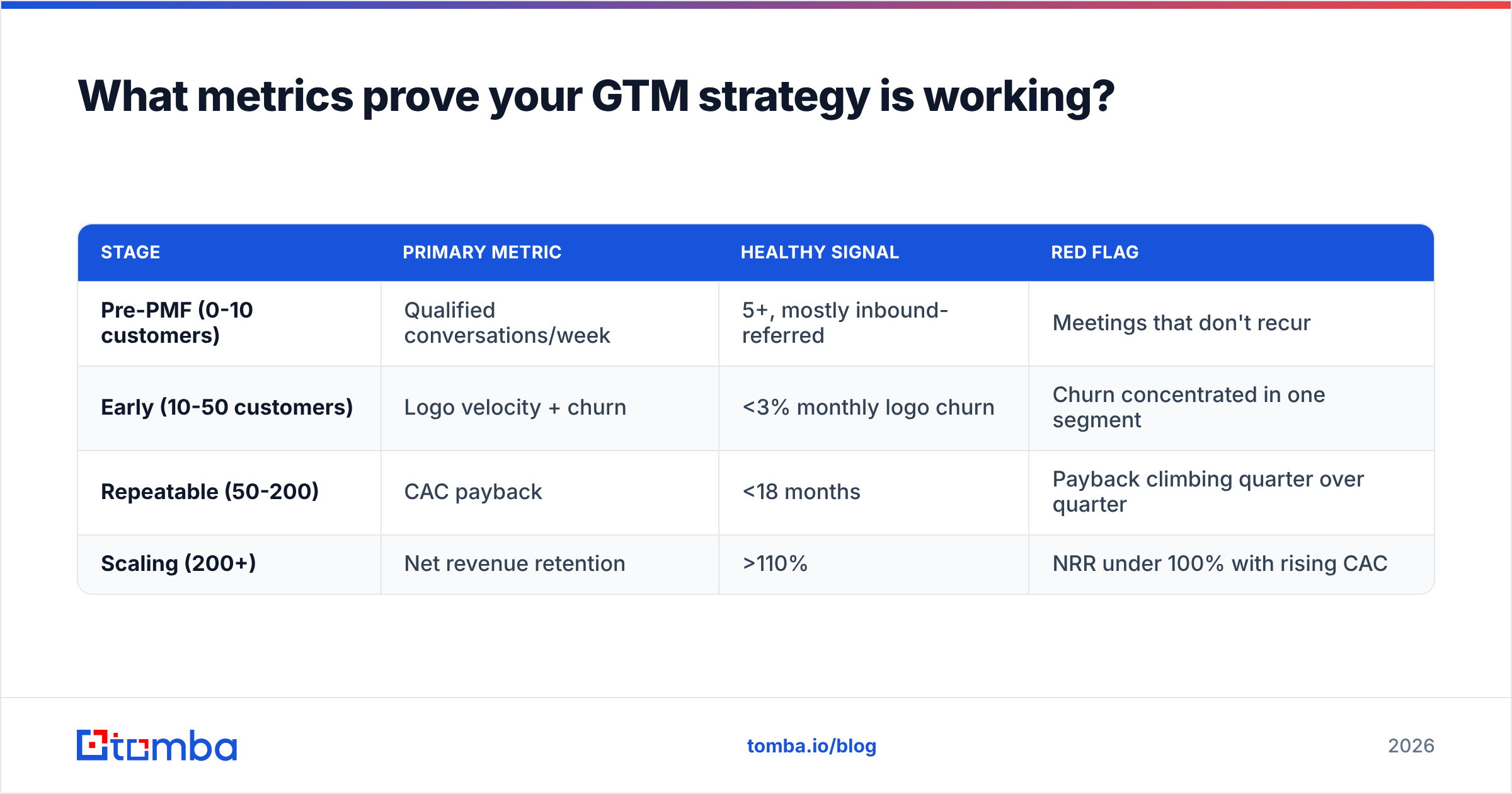
Stage-appropriate metrics, in order:
| Stage | Primary metric | Healthy signal | Red flag |
|---|---|---|---|
| Pre-PMF (0-10 customers) | Qualified conversations/week | 5+, mostly inbound-referred | Meetings that don't recur |
| Early (10-50 customers) | Logo velocity + churn | <3% monthly logo churn | Churn concentrated in one segment |
| Repeatable (50-200) | CAC payback | <18 months | Payback climbing quarter over quarter |
| Scaling (200+) | Net revenue retention | >110% | NRR under 100% with rising CAC |
Two cross-stage indicators matter more than the rest. Sales cycle variance: if deals close in 14 days or 140 days with no pattern, you're selling to multiple segments and calling it one. Win rate by source: if outbound wins at 4% and inbound at 22%, that's not a "sales problem," that's your channel telling you where the intent is.
Third-party review platforms like G2 are worth watching as a lagging indicator too — the categories your buyers actually browse tell you who they think your competitors are, which is frequently not who you think.
Putting it together#
A go to market strategy for SaaS startups is a set of constraints you accept on purpose. One segment. One motion. One channel that gets real investment. One price point you test upward. Everything else is optionality you can't afford yet.
The teams that compound are the ones that made those four choices early, instrumented them properly, and resisted the urge to widen the funnel every time a week went slow. Narrow, measure, then widen — in that order.
When your ICP list is built and it's time to turn account names into real conversations, start with the contact layer. The Tomba Email Finder resolves professional email addresses by domain, name, or company, with verification built in so your first campaign doesn't cost you your sender reputation. The free tier covers 25 searches a month — enough to validate the motion on your first 25 named accounts before you commit budget to a channel.
Related guides#
Ready to find emails that actually work?
Join 150,000+ professionals who stopped guessing and started sending. Free credits on signup — no credit card required.
Get the Tomba newsletter
Practical outbound tactics and product updates — once every two weeks.
About the author