Go To Market Strategy For Services: The 2026 Playbook
Services don't sell like software. Here's how to build a go to market strategy for services firms — positioning, pricing, channel mix, and the outbound motion that actually books discovery calls in 2026.
TL;DR
- A go to market strategy for services is not a SaaS GTM with the word "software" crossed out. You sell capacity and judgment, not seats, so your constraint is delivery bandwidth — not server cost.
- Services firms win on narrow positioning (one buyer, one problem, one outcome) far more than on volume. A 40-account list beats a 4,000-account blast almost every time.
- Your three realistic channels are referrals/partners, authority content, and targeted outbound. Paid ads work last, not first, because service buyers rarely convert cold on a form.
- Pricing model is a GTM decision, not a finance decision. Hourly, fixed-fee, retainer, and productized each change who you can sell to and how fast you close.
- The operational bottleneck for most services GTM is contact data quality. If you can't reach the exact decision-maker, the strategy is a slide deck.
What Is a Go To Market Strategy for Services?#
A go to market strategy for services is the documented plan for how a firm that sells human expertise — consulting, agency work, staffing, managed services, professional services, implementation partners — turns a defined market segment into booked engagements at a predictable rate.
Here's the distinction that matters. A software company sells a product that already exists; GTM is about distribution. A services company sells a promise that will be manufactured after the contract is signed; GTM is about trust plus availability. You are asking a buyer to spend $30,000 to $500,000 on work that does not exist yet, based largely on your credibility and a scope document.
That single difference cascades into everything:
- Proof replaces demos. You cannot let a prospect trial your senior consultant for 14 days. Case studies, teardowns, and referenceable clients do the work a free trial does in SaaS.
- Capacity caps growth. A SaaS firm can sign 100 customers in a month. If you have six delivery people, signing 20 engagements is a crisis, not a win.
- The buying committee is smaller but more senior. Services deals often skip procurement-heavy evaluation and go straight to a VP or founder who has budget and a fire to put out.
- Deal size varies 10x within the same ICP. Two companies with identical firmographics might buy a $9,000 audit or a $240,000 transformation program. Your qualification has to catch that.
- Churn looks like project end. Renewal isn't automatic. Every engagement has a natural death date, so land-and-expand has to be designed in from the first scope.
If your plan doesn't account for those five, you have a marketing plan, not a go to market strategy for services.
Why Do SaaS GTM Playbooks Fail for Service Firms?#
Because they optimise for the wrong constraint. SaaS GTM is a volume game with near-zero marginal cost — pour more leads in, the machine absorbs them. Services GTM is a matching game with hard marginal cost. Every unqualified call burns a delivery lead's hour, and that hour was billable.
The three most expensive imported mistakes:
Mistake 1: Treating MRR logic as retainer logic. SaaS optimizes for net revenue retention. Services should optimize for utilization at target margin. A $12,000/month retainer that consumes 70% of a principal's week is worse than a $9,000/month one that consumes 30%.
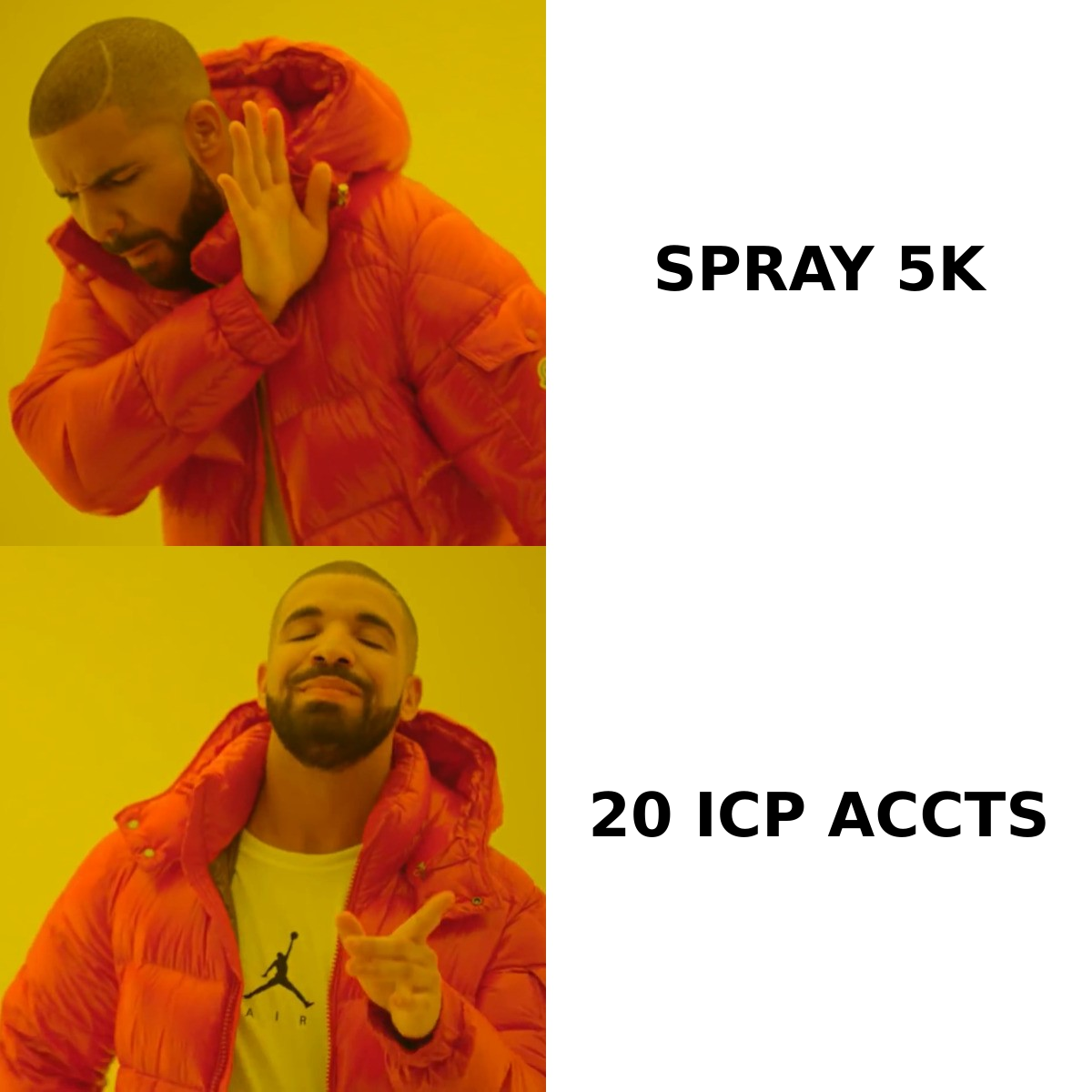
Mistake 2: Volume-first outbound. Sending 5,000 generic emails to build "top of funnel" produces meetings with people who cannot buy a $60,000 engagement. It also cooks your sending domain. Services outbound should look more like 30 highly specific messages a day than 500 templated ones.
Mistake 3: Gated-ebook lead gen. The classic SaaS MQL funnel — ebook, nurture sequence, sales-qualified handoff — assumes a self-educating buyer. Service buyers educate themselves by reading your public teardown of a problem they have, then contacting you directly. Gating that content mostly filters out the people who would have hired you.
How Do You Choose a Positioning That Actually Sells?#
Pick the narrowest segment where you can honestly claim to be the obvious choice, then verify that the segment has both budget and a recurring trigger event.
The test I use: can you finish this sentence with zero hedging? "We help [specific role] at [specific company type] fix [specific expensive problem] in [specific timeframe]."
Compare:
- Weak: "We're a full-service digital agency for growing businesses."
- Strong: "We help Heads of RevOps at Series B B2B SaaS companies untangle Salesforce after a merger, in 90 days."
The second one is scary to write because it excludes 95% of the market. That's the point. Narrow positioning does three things at once: it raises your price ceiling, it makes referrals easy to route ("call these people, they do exactly that"), and it makes prospecting tractable — you can actually build a list of Series B SaaS companies that announced an acquisition in the last two quarters.
Positioning also needs a trigger event attached. Services get bought when something breaks or changes: a funding round, a new executive hire, a compliance deadline, a platform migration, a bad quarter, a merger. Without a trigger, you're asking a busy person to create a project from scratch. With one, you're arriving exactly when the project is already forming.
The positioning audit — six questions#
- Who exactly signs? Name the title, not the department.
- What breaks without you? Quantify in revenue, risk, or hours.
- What triggers the search? List three observable events.
- Who else do they call? Name real competitors, including "we'll do it internally."
- What proof do you have? Two named case studies minimum, with numbers.
- Can you build a list of 200 companies that match? If not, the segment isn't operational.
Question six is where most positioning exercises die. A segment you cannot enumerate is a segment you cannot sell into systematically. If your definition is "companies with a culture of innovation," you have a vibe, not an ICP. If it's "US SaaS companies, 50-500 employees, using HubSpot, that raised Series B in the last 18 months," you can build that list this week.
Which GTM Channels Work Best for Services in 2026?#
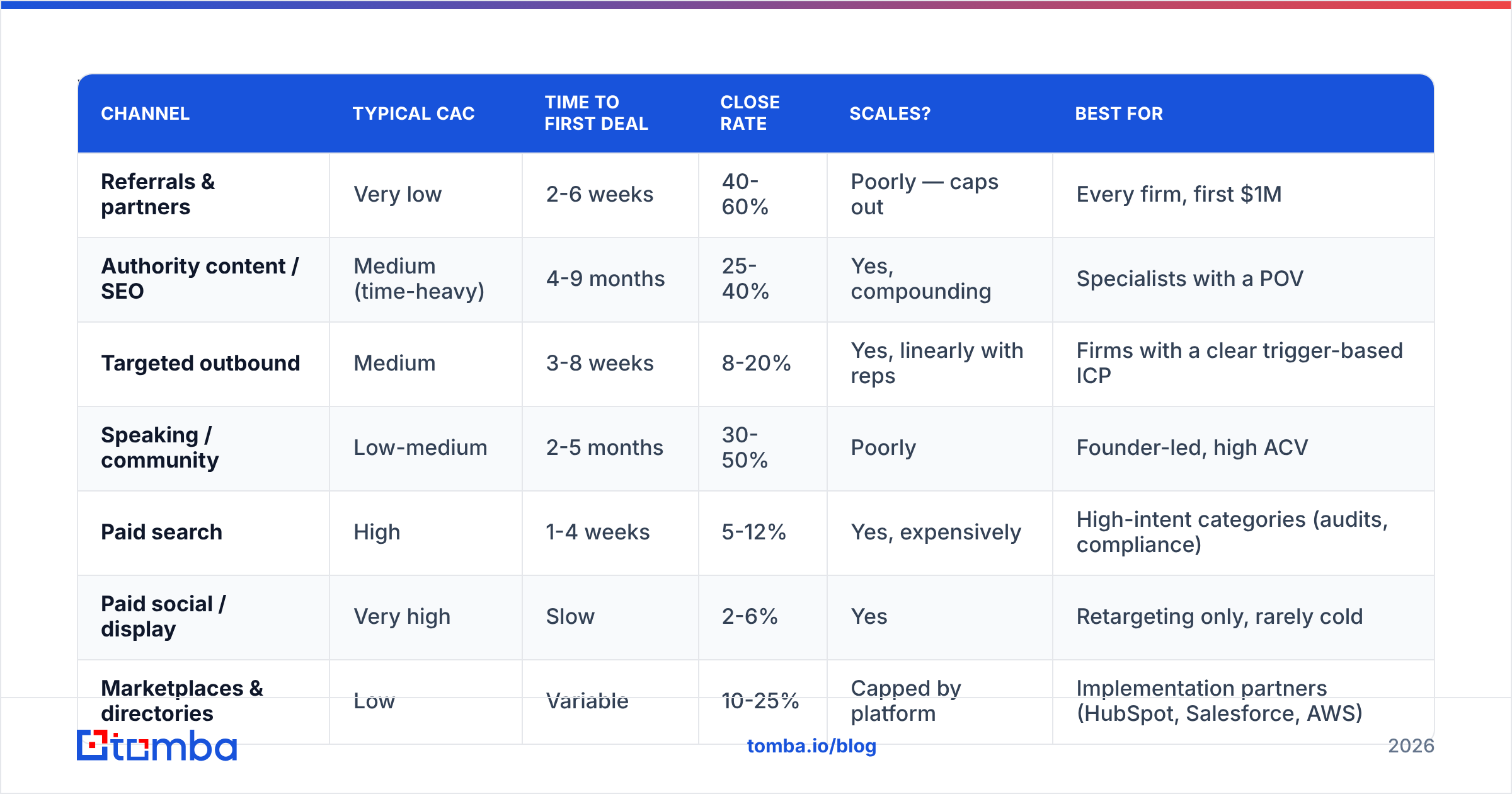
Referrals convert best, content compounds best, and outbound scales most predictably. Paid acquisition is the weakest primary channel for services and the strongest amplifier for an existing one.
| Channel | Typical CAC | Time to first deal | Close rate | Scales? | Best for |
|---|---|---|---|---|---|
| Referrals & partners | Very low | 2-6 weeks | 40-60% | Poorly — caps out | Every firm, first $1M |
| Authority content / SEO | Medium (time-heavy) | 4-9 months | 25-40% | Yes, compounding | Specialists with a POV |
| Targeted outbound | Medium | 3-8 weeks | 8-20% | Yes, linearly with reps | Firms with a clear trigger-based ICP |
| Speaking / community | Low-medium | 2-5 months | 30-50% | Poorly | Founder-led, high ACV |
| Paid search | High | 1-4 weeks | 5-12% | Yes, expensively | High-intent categories (audits, compliance) |
| Paid social / display | Very high | Slow | 2-6% | Yes | Retargeting only, rarely cold |
| Marketplaces & directories | Low | Variable | 10-25% | Capped by platform | Implementation partners (HubSpot, Salesforce, AWS) |
Three notes on reading that table.
Referrals are not a strategy, they're an outcome. They convert brilliantly and they cap hard. Every services firm that stalls at $1-2M stalled because referrals were the only channel and the referral pool ran dry. Build the second channel while referrals are still working, not after.
Content only works with a real point of view. "5 Tips for Better Marketing" ranks nowhere and converts no one. A public teardown of how a specific system fails, with your fix, gets forwarded internally to the person with budget. Your best-performing asset is usually the one your competitors would be nervous to publish.
Outbound is the only channel you can turn up on demand. That's why it's the backbone of most services GTM plans past the referral stage — and why data quality is the whole ballgame. If your list is stale, you're not doing outbound, you're doing bounce testing. Run new lists through an email verifier before the first send, not after your reply rate tanks.
Partner-led motion deserves a specific call-out. If you implement or extend a platform, that vendor's partner directory is often the highest-intent inbound source available. HubSpot's Solutions Partner Program and the Salesforce AppExchange consulting listings both route real buying intent to listed firms. This is closer to a distribution deal than to marketing, and it's underused.
How Should You Price a Services Offer?#
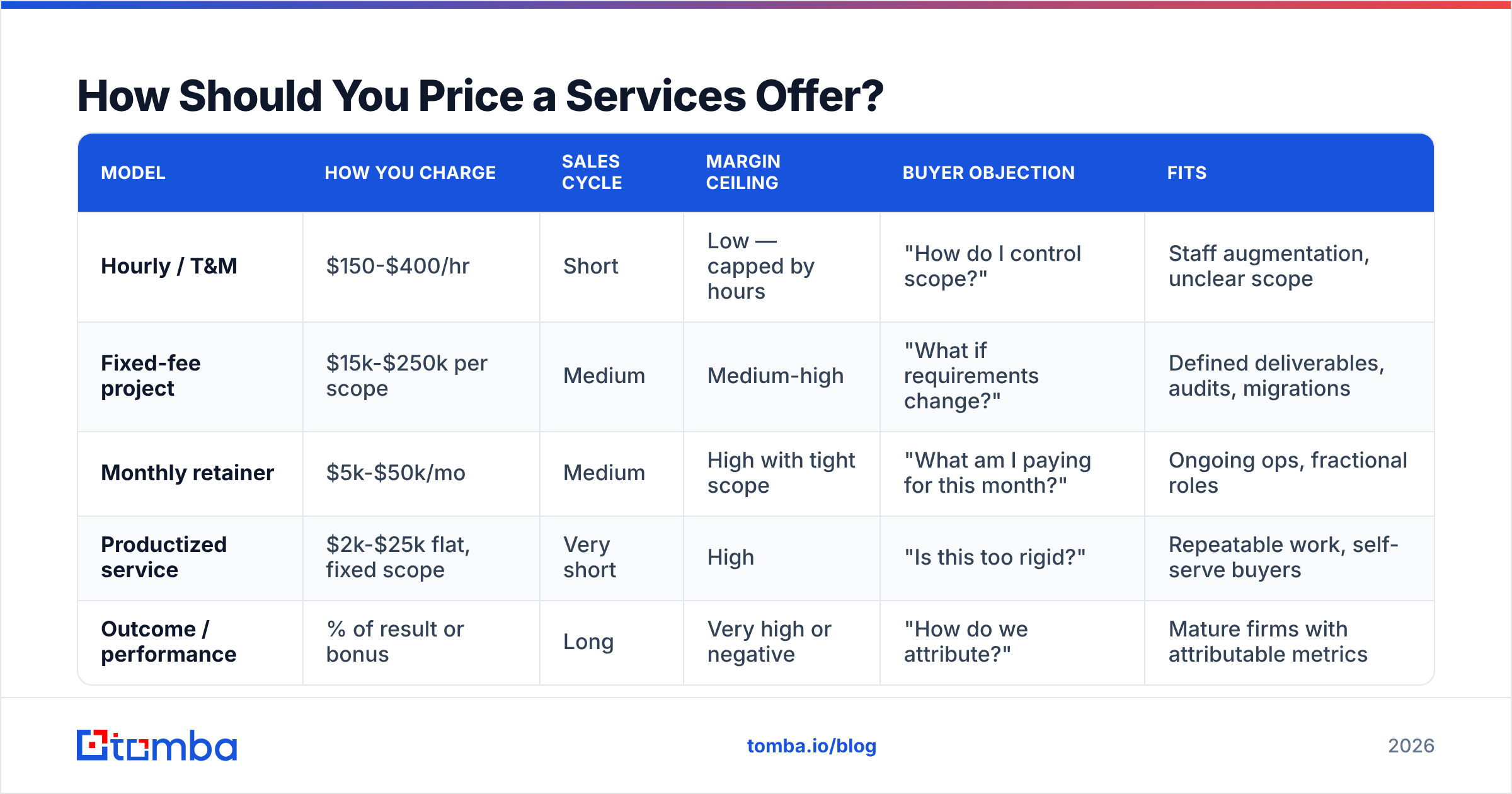
Choose the pricing model that matches your buyer's risk tolerance and your delivery predictability — then let it dictate your sales motion, not the other way around.
| Model | How you charge | Sales cycle | Margin ceiling | Buyer objection | Fits |
|---|---|---|---|---|---|
| Hourly / T&M | $150-$400/hr | Short | Low — capped by hours | "How do I control scope?" | Staff augmentation, unclear scope |
| Fixed-fee project | $15k-$250k per scope | Medium | Medium-high | "What if requirements change?" | Defined deliverables, audits, migrations |
| Monthly retainer | $5k-$50k/mo | Medium | High with tight scope | "What am I paying for this month?" | Ongoing ops, fractional roles |
| Productized service | $2k-$25k flat, fixed scope | Very short | High | "Is this too rigid?" | Repeatable work, self-serve buyers |
| Outcome / performance | % of result or bonus | Long | Very high or negative | "How do we attribute?" | Mature firms with attributable metrics |
The strategic move most firms miss: productize the entry point, retain on the back end. Sell a $7,500 fixed-scope audit that a director can approve without a procurement cycle. Deliver something genuinely useful. Then propose the $25,000/month implementation retainer to a buyer who has already seen you work. This converts dramatically better than pitching the big retainer cold, because you've replaced the free trial that services can't offer.
Hourly billing is the model to escape fastest. It caps your revenue at headcount times hours, punishes you for getting faster, and turns every efficiency gain into a pay cut. It's fine as a starting point and terrible as a destination.
How Do You Build the Outbound Motion Without Torching Your Domain?#
Narrow the list, verify the data, personalize on trigger events, and keep daily volume low enough that your replies stay human.
Here's the sequence that works for a services firm with a clear ICP.
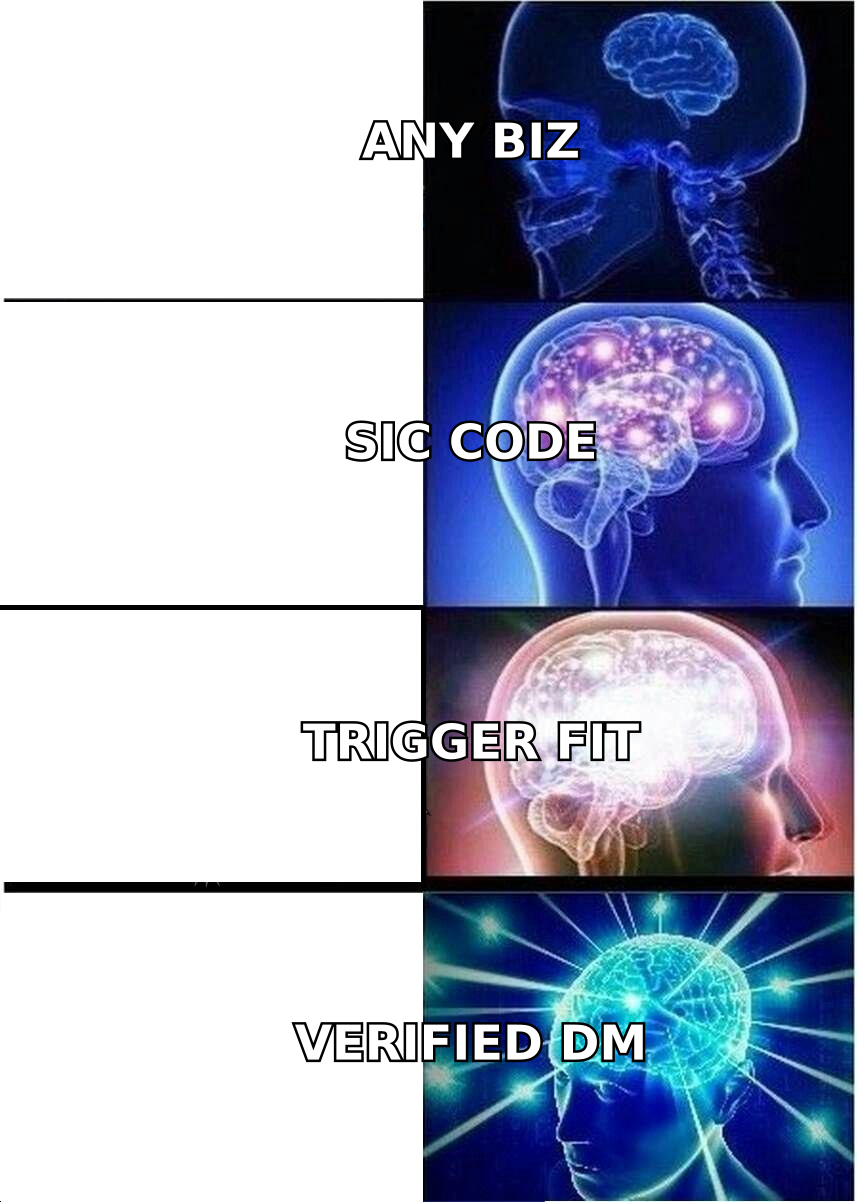
Step 1 — Build the account list, not the contact list. Start with 100-300 companies that match your positioning statement and show a trigger event. Funding announcements, executive hires, job postings for roles adjacent to your service, tech-stack changes. A job posting for "Marketing Ops Manager" at a company using a tool you specialize in is a stronger signal than any firmographic filter.
Step 2 — Find the right human at each account. Not "anyone in marketing." The specific person who owns the broken thing. For a 200-account list this is a real research task, and it's where most services firms quietly give up. A domain search pulls the addressable contacts at a company along with the pattern the company uses, so you're working from evidence rather than guessing first.last@.
Step 3 — Verify before you send. Services outbound runs on tiny volumes from a founder's or partner's real mailbox. You cannot afford a 12% bounce rate on a domain you also use for client communication. Verification isn't optional hygiene here — it's protecting the asset your delivery team communicates through. If a chunk of your list sits on catch-all domains, run those through a catch-all verifier rather than treating them as either safe or unusable.
Step 4 — Write to the trigger, not the persona. "I saw you're hiring a RevOps manager three months after the Series B — most teams at that stage discover their Salesforce instance can't support the new segmentation. We fixed exactly that for [named client]. Worth 20 minutes?" That's specific, falsifiable, and shows you did work. Persona-level copy ("as a marketing leader, you're probably struggling with...") reads as automated because it is.
Step 5 — Cap volume at what you can actually service. If you can deliver four new engagements this quarter, sending 400 emails a day is self-harm. 30-60 well-researched sends a day from one mailbox, with real replies handled personally, will fill a services pipeline. Watch your sender reputation the way you'd watch a client's NPS.
Step 6 — Route replies to a closer with delivery credibility. Services buyers detect a pure salesperson in about 40 seconds. The first call should involve someone who could actually do the work or has scoped it 50 times. This is the single highest-leverage change most firms can make to their close rate.
What Metrics Should a Services GTM Actually Track?#
Track pipeline coverage against delivery capacity, not against an arbitrary revenue target.
The core set:
- Qualified conversations per month — the true top-of-funnel number. Not MQLs, not downloads. Conversations with someone who has the problem and the budget.
- Proposal-to-close rate — should sit between 30% and 60% for a well-positioned firm. Below 25% means you're proposing too early or to the wrong people.
- Average engagement value and its distribution, not just the mean. A bimodal distribution ($8k audits and $200k programs) means you're really running two GTMs and should staff them separately.
- Time from first touch to signed SOW — establishes your planning horizon. If it's 90 days, pipeline you build in Q1 is Q2 revenue, full stop.
- Utilization at target margin — the constraint metric. Selling past 85% utilization degrades delivery quality and creates the churn you'll feel two quarters later.
- Referral rate per closed engagement — if it's under 0.3, your delivery experience isn't generating advocacy and no amount of outbound will fix the leak.
One trap worth naming: benchmarking yourself against SaaS conversion rates. Firms on G2 and similar review platforms publish SaaS-shaped funnel benchmarks that simply don't map to a business selling $75,000 engagements to 200 possible buyers. Your funnel is short, narrow, and high-value. A 2% site-to-lead rate is irrelevant when your entire addressable market is 400 companies.
How Do You Sequence the First 90 Days?#
Positioning first, proof second, one channel third. Firms that run all three channels at once at month one usually run none of them well.
Days 1-30 — Define and enumerate. Write the positioning statement. Interview five past clients about why they actually hired you (the answer is rarely what you think). Build the 200-account target list. Nail down your entry-offer price and scope.
Days 31-60 — Build proof and infrastructure. Two case studies with real numbers. One flagship piece of public thinking that demonstrates expertise rather than asserting it. Set up your sending domain properly — SPF, DKIM, DMARC — and get your contact data enriched and verified. Warm the mailbox if it's new.
Days 61-90 — Run one channel hard. Pick outbound or content or partners. One. Measure qualified conversations weekly. Adjust the message, not the strategy, for at least six weeks before concluding anything. A services outbound test needs 300-500 well-targeted sends to produce a readable signal, and that takes real time at 40/day.
Only at month four should you add a second channel. Services GTM fails from dilution far more often than from picking the wrong channel.
Common Failure Modes — And the Fix#
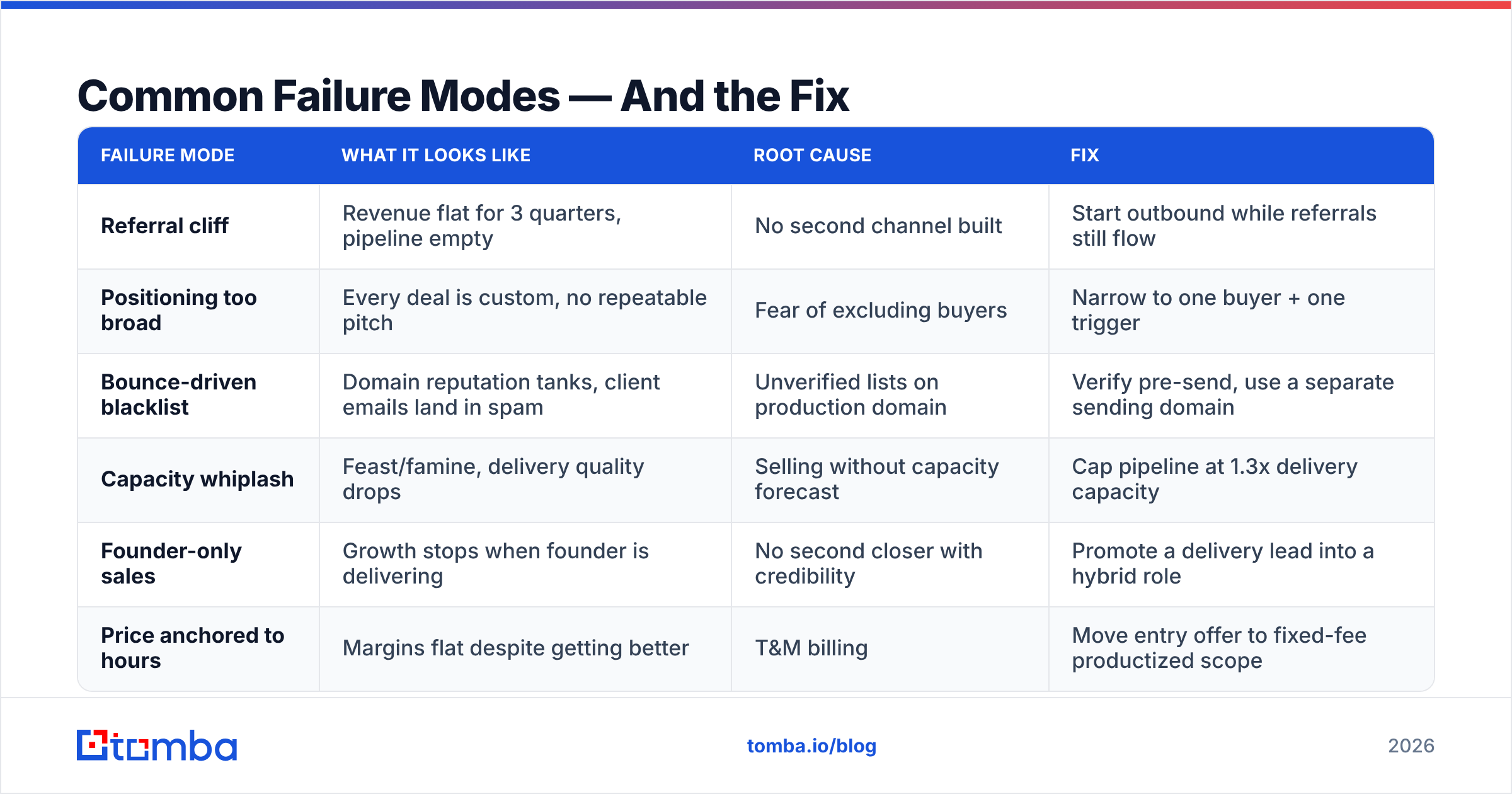
| Failure mode | What it looks like | Root cause | Fix |
|---|---|---|---|
| Referral cliff | Revenue flat for 3 quarters, pipeline empty | No second channel built | Start outbound while referrals still flow |
| Positioning too broad | Every deal is custom, no repeatable pitch | Fear of excluding buyers | Narrow to one buyer + one trigger |
| Bounce-driven blacklist | Domain reputation tanks, client emails land in spam | Unverified lists on production domain | Verify pre-send, use a separate sending domain |
| Capacity whiplash | Feast/famine, delivery quality drops | Selling without capacity forecast | Cap pipeline at 1.3x delivery capacity |
| Founder-only sales | Growth stops when founder is delivering | No second closer with credibility | Promote a delivery lead into a hybrid role |
| Price anchored to hours | Margins flat despite getting better | T&M billing | Move entry offer to fixed-fee productized scope |
Get the Contact Layer Right#
Every part of this plan — the 200-account list, the trigger-based outbound, the partner referral follow-up — runs on knowing exactly who to contact and having a working address for them. That's the unglamorous foundation under a good go to market strategy for services.
Tomba Email Finder is built for that layer: search by domain, name, or company, get verified professional addresses with confidence scores, and push them straight into your sequencing tool or CRM. The free tier gives you 25 searches a month to test your ICP list before committing, and paid plans start at $49/month on Starter, $99/month on Growth, and $249/month on Pro — see full Tomba pricing for bulk and API limits. If you're building lists at volume, the bulk email finder handles the whole account list in one pass rather than one lookup at a time.
Build the list. Verify it. Write to the trigger. That's the difference between a GTM plan that lives in a deck and one that fills the calendar.
Related guides#
Ready to find emails that actually work?
Join 150,000+ professionals who stopped guessing and started sending. Free credits on signup — no credit card required.
Get the Tomba newsletter
Practical outbound tactics and product updates — once every two weeks.
About the author