Go to Market Strategy for Software Services: 2026 Playbook
Most software services GTM plans copy SaaS and fail. Here is the go to market strategy for software services that actually moves pipeline for agencies, dev shops, and implementation partners in 2026.
A go to market strategy for software services has one job: turn your team's skills into booked work. It is not a SaaS plan with the word "license" swapped out. This guide covers the models, the budget, and the math that decide who wins deals in 2026.
TL;DR
- A go to market strategy for software services sells booked work, not licenses. Every sale needs people free to deliver it. So demand and staffing have to move together.
- Four motions work: founder-led outbound, partner-led, productized inbound, and account-based expansion. Most firms under $10M should pick two.
- Sell the outcome and the vertical, not the tech stack. "We build React apps" loses to "We cut claims-processing time for mid-market insurers."
- Your math is different. Cycles run 60 to 120 days. Deals are bigger. Accounts are fewer. So clean contact data beats list size.
- Budget 8 to 12% of services revenue in 2026. Weight it toward partner work and targeted outbound, not broad paid media.
What Is a Go to Market Strategy for Software Services?#
A go to market strategy for software services is your written plan for turning one skill set into booked work with one buyer group. It covers five things: how you position, what you sell, which channels you use, how you price, and how you sell.
The first difference from product GTM is capacity. A SaaS firm signs 40 new logos and pays a support ticket. A 60-person dev shop signs eight deals and needs eight senior engineers. Either they exist or they don't. So your plan is a demand plan and a staffing plan at once. Ignore that and you either starve the bench or overbook it. Both wreck delivery. Bad delivery kills referrals, and referrals are your best channel.
The second difference is proof. Buyers cannot try your work first. Nobody gets a free trial of a six-month rebuild. They judge you on signals instead: case studies, named references, the quality of your questions, whether you knew their rules before the first call. Your job is to build those signals on purpose.
The parts of a go to market strategy for software services you must decide#
- Segment and ICP. Name the industry, size, stack, and trigger. "US health payers, 500 to 5,000 staff, legacy .NET, just acquired" is a segment. "B2B companies" is a wish.
- Offer design. Decide the small first sale (audit, sprint, assessment) and the real one. A small first sale lowers risk and speeds the first close.
- Channel mix. List where good calls come from: outbound, partners, content, events, referrals. Rank them. Give each a share of pipeline.
- Pricing model. Time and materials, fixed fee, outcome-based, or a monthly pod. This shapes your sales cycle more than any marketing choice.
- Sales process and data. Write stage rules and exit rules. Then get contact data for the whole buying group, which runs three to seven people.
- Proof engine. Build the habit that turns finished work into case studies and references.
How Is Services GTM Different From SaaS GTM?#
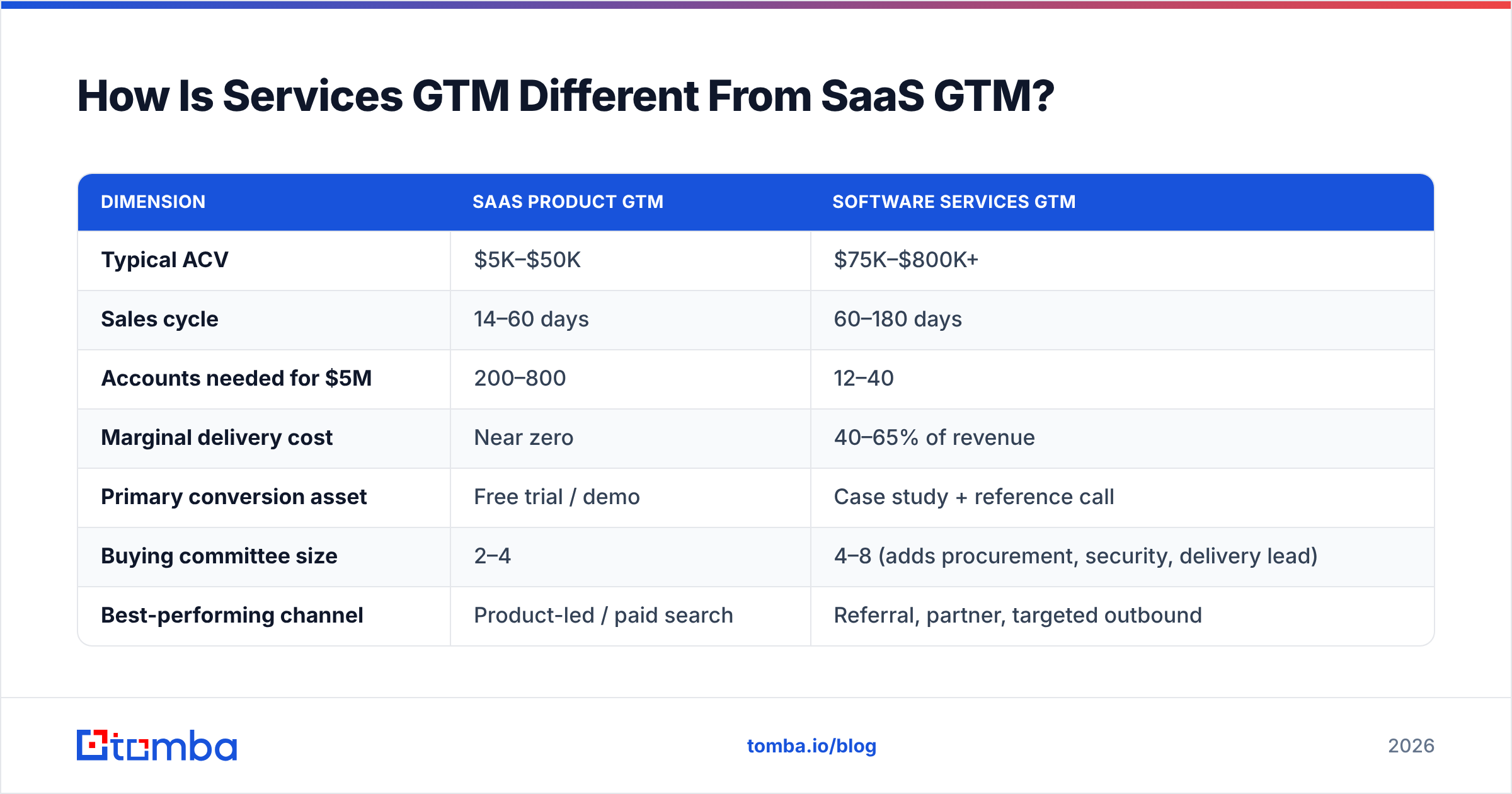
The numbers split in ways that break borrowed plans. Set your targets from a SaaS benchmark report and you will fire a team that was doing fine.
| Dimension | SaaS product GTM | Software services GTM |
|---|---|---|
| Typical ACV | $5K–$50K | $75K–$800K+ |
| Sales cycle | 14–60 days | 60–180 days |
| Accounts needed for $5M | 200–800 | 12–40 |
| Marginal delivery cost | Near zero | 40–65% of revenue |
| Primary conversion asset | Free trial / demo | Case study + reference call |
| Buying committee size | 2–4 | 4–8 (adds procurement, security, delivery lead) |
| Best-performing channel | Product-led / paid search | Referral, partner, targeted outbound |
| Churn equivalent | Monthly logo churn | Non-renewal of retainer / project end |
Read the "accounts needed" row again. Say you need 25 new logos a year. You do not need 50,000 contacts. You need 400 right-fit accounts, mapped well and worked hard. That flips the usual advice about volume. Precision beats size here: right person, right title, live address, current employer. On a 400-account list, one wasted touch costs you 0.25% of the whole plan.
This is where most firms trip. They buy a bulk list. They bounce 30% of it. They burn the sending domain. Then they say outbound does not work for services. It does. Outbound on stale data does not. Run your target accounts through an email verifier before the first send. Use domain search to map every buyer at the account, not just one champion.
Which GTM Motion Should You Pick?#
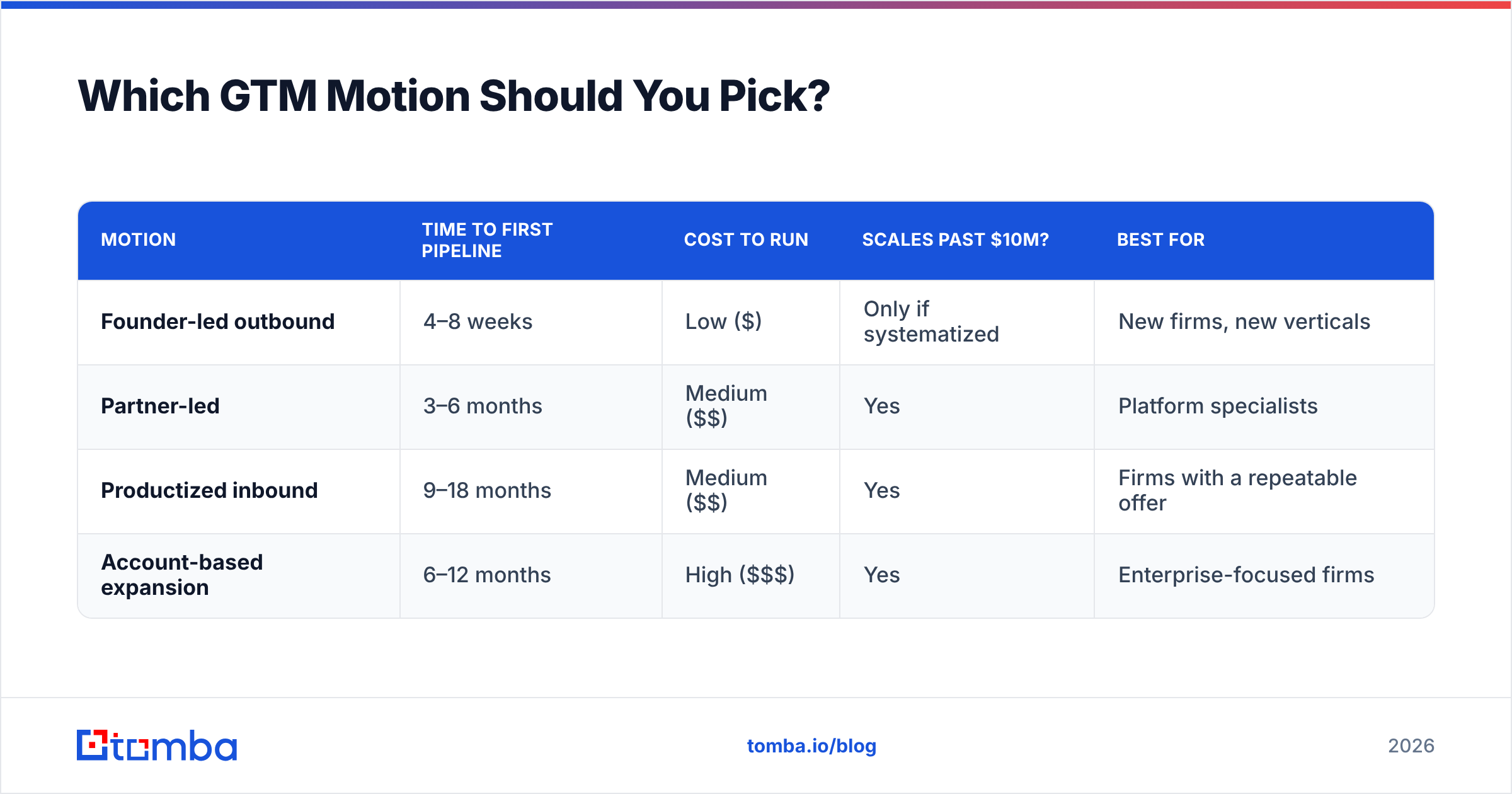
Four motions work. A go to market strategy for software services should use two: one that brings most pipeline now, one that compounds later.
1. Founder-led outbound. The founder or a named lead reaches out with a real point of view. It has the best reply rate of any cold channel in services. Credibility is solved on contact. The limit is founder hours. It works to about $3M to $5M. After that, hand the same play to a team of two or three.
2. Partner-led. You become the build partner for a platform: Salesforce, HubSpot, Snowflake, AWS, Databricks. Their field team finds the deal. You deliver it. Salesforce's partner program and its peers are still the steadiest pipeline for mid-size firms. The cost is real: badges to earn, margin to share, and one platform to depend on.
3. Productized inbound. You package one narrow, repeatable result. Think "SOC 2 readiness in 8 weeks" or "Rails to Go migration." Then you rank for it. The ramp is slow, 9 to 18 months. Margins are the best at scale. It also lifts every other channel, because buyers arrive half-sold.
4. Account-based expansion. Land small in a big company. Then spread to other units. Best lifetime value, slowest start. You need an org chart, not a lead list.
| Motion | Time to first pipeline | Cost to run | Scales past $10M? | Best for |
|---|---|---|---|---|
| Founder-led outbound | 4–8 weeks | Low ($) | Only if systematized | New firms, new verticals |
| Partner-led | 3–6 months | Medium ($$) | Yes | Platform specialists |
| Productized inbound | 9–18 months | Medium ($$) | Yes | Firms with a repeatable offer |
| Account-based expansion | 6–12 months | High ($$$) | Yes | Enterprise-focused firms |
The common failure is running all four at 25%. None of them clears the bar. Then you decide every channel is broken.
How Do You Position a Software Services Firm?#
Position on the result and the vertical. Never on the tech. Tech framing invites a price fight with every shop that uses the same stack, offshore teams included. Result framing invites a compare against the cost of the problem instead. This one choice does more for a go to market strategy for software services than any ad budget.
Swap this:
We're a full-stack development agency specializing in React, Node, and AWS.
For this:
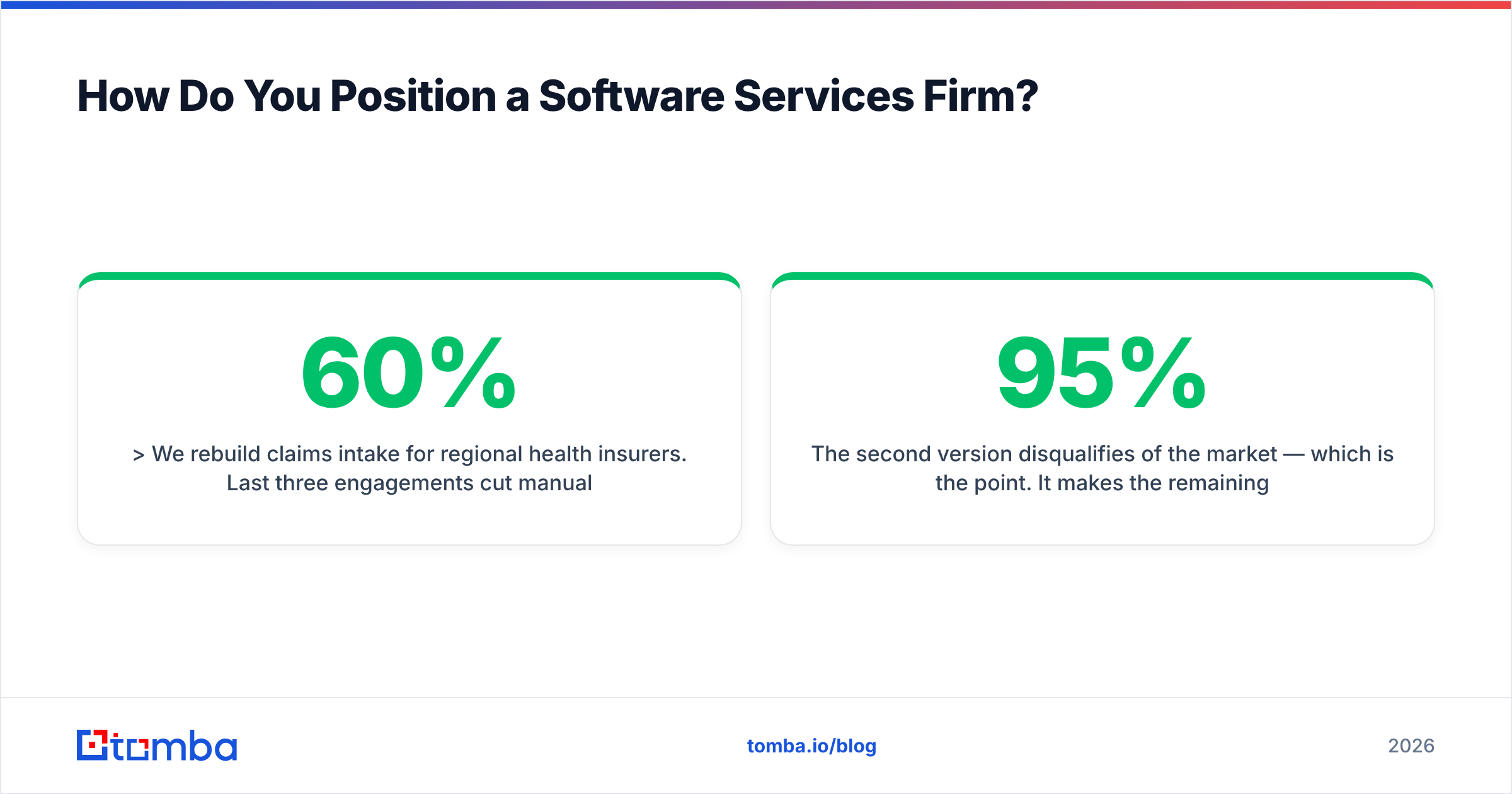
We rebuild claims intake for regional health insurers. Our last three jobs cut manual touch time 40 to 60% in two quarters.
The second one rules out 95% of the market. That is the point. The other 5% feel like you were built for them. It also hands your outbound a subject line that is not about you.
Run three tests on your statement:
- The rival test. Could a rival paste their logo on it and leave it as is? Then it is a category name, not a position.
- The trigger test. Does it name a moment to reach out? A raise, a merger, a deadline, a platform sunset.
- The proof test. Do two named clients match the claim? If not, narrow the claim until they do.
G2's category structure is a good reality check. Look at how buyers search for firms like yours. Vertical categories draw more reviews and close better than broad ones.
What Does the Pipeline Math Look Like?#
Work back from revenue. Do not work forward from activity. Take a firm that wants $6M in new bookings at a $200K average deal. Here is what the go to market strategy for software services has to produce:
- 30 closed deals
- 120 qualified deals, at a 25% close rate
- 600 first meetings, at a 20% meeting-to-deal rate
- Roughly 15,000 quality touches, at a 4% reply-to-meeting rate
- Which is about 2,500 well-researched accounts, worked across several people and channels
Now look at what breaks the model first. Say a quarter of your contact data is wrong. You do not just lose a quarter of the meetings. You also hurt your sending reputation, which drags down the rest. A 3% bounce rate is a warning. Past 5%, mailbox providers start filtering your whole domain. So a small, precious list calls for more care than a big one, not less.
Build the contact layer on purpose. Use an email finder to find the people you spotted on the org chart. Add B2B phone numbers for the follow-up that services deals need. Then run bulk verify before any sequence goes live.

How Should You Budget and Sequence the First 12 Months?#
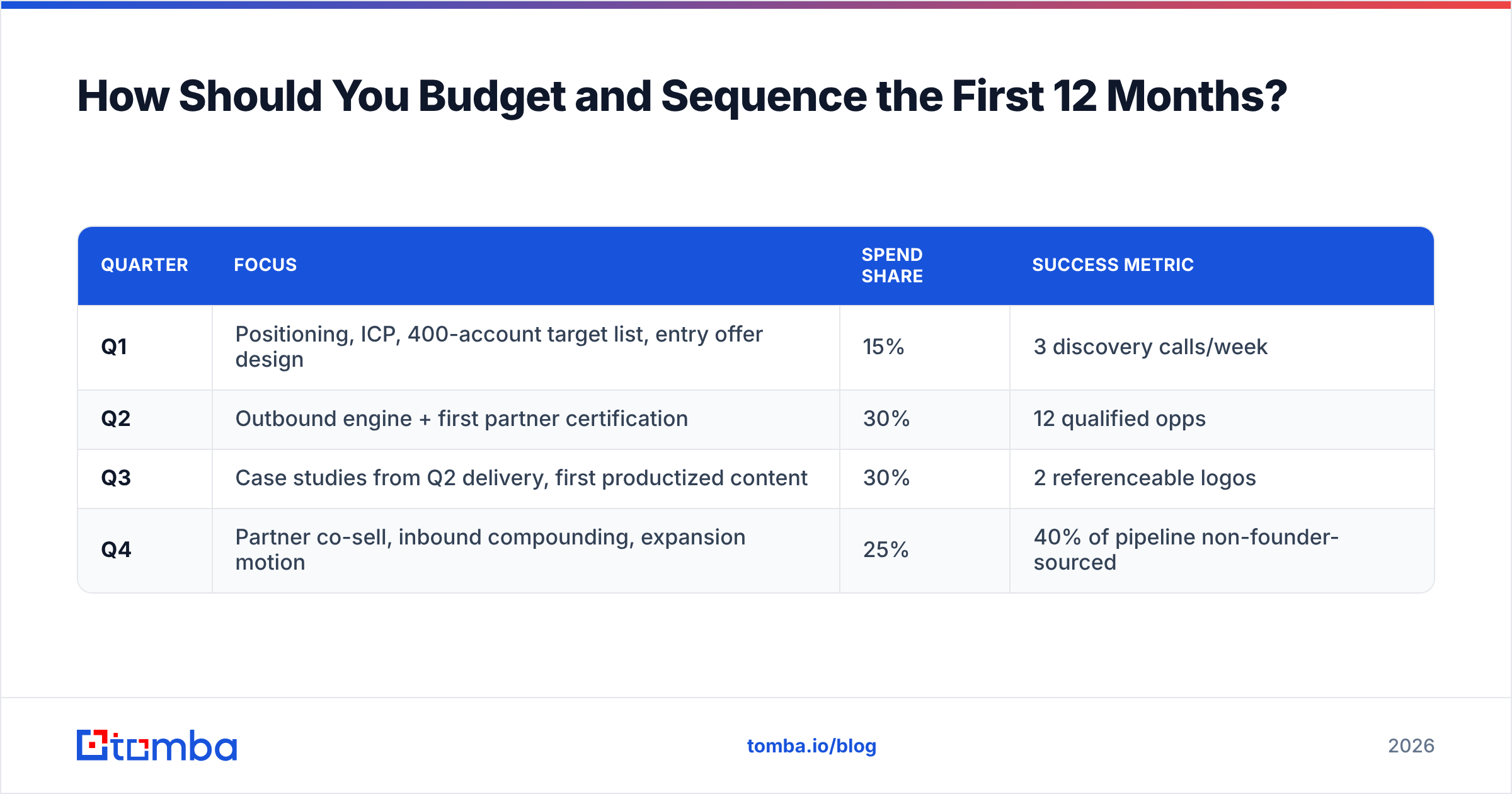
| Quarter | Focus | Spend share | Success metric |
|---|---|---|---|
| Q1 | Positioning, ICP, 400-account target list, entry offer design | 15% | 3 discovery calls/week |
| Q2 | Outbound engine + first partner certification | 30% | 12 qualified opps |
| Q3 | Case studies from Q2 delivery, first productized content | 30% | 2 referenceable logos |
| Q4 | Partner co-sell, inbound compounding, expansion motion | 25% | 40% of pipeline non-founder-sourced |
Total spend should land at 8 to 12% of services revenue. Below 6%, firms lean on referrals and stay fragile. One lost relationship takes a third of the pipeline. Above 15%, firms tend to buy ads for a purchase that ads cannot close.
Three rules hold up well:
- No content before two case studies. Content without proof is a blog nobody quotes.
- No partner badge before you have bench. Partner deals carry the platform's name. Botch the first one and the door shuts.
- No SDR team before the founder closes 10 deals with one script. You cannot hand off a play you have not proven.
Track pipeline cover at 3 to 4x, above the 3x SaaS norm. Big deals slip more. A slipped deal hurts worse than a lost one, because you held the bench for it. Keep it all in one system of record. The HubSpot integration or a similar CRM sync keeps clean contact data on the account record, not in a spreadsheet. For a shared language across sales, marketing, and delivery, most firms land on the revenue operations model by year two.
What Are the Most Common Failure Modes?#
Five faults break a go to market strategy for software services more often than the rest.
Selling skills, not results. Buyers are not buying engineers. They are buying a safe path to a business result. Every slide about your team is a slide not spent on theirs.
No small first offer. A cold run at a $400K deal closes about 5% of the time. A paid $15K to $25K review closes to the big deal 50 to 70% of the time. It pays for itself. It also screens out buyers who were never going to sign.
Ignoring security and procurement. In big deals, those reviews add 3 to 8 weeks. Keep a filled-out security pack, insurance papers, and standard contract edits ready. Firms that do this close faster.
Waiting for referrals. Referrals are the best channel, and most firms do nothing to earn them. Ask at delivery milestones, not at the end. Give the client one page of results to forward.
Leaning on one source. One partner, one platform, or one client above 30% of revenue is a risk, not a plan. Gartner's research on go-to-market planning puts concentration at the top of the list for revenue swings in services.
How Do You Know It's Working?#
Watch these signals, in the order they move:
- Reply quality, not reply rate. Two "tell me more" notes from right-fit accounts beat twenty "no thanks" notes from anyone.
- Discovery to proposal rate. Under 40% means your screening or your pitch is off. You are taking the wrong meetings.
- Pipeline the founder did not source. This is the best test of whether you built a system or a habit. Aim for 40% by month 12.
- Days from first touch to first meeting. Falling means your targeting got better. Rising means your list went stale.
- References on hand. Count the clients who will take a call. Below three, your close rate on big deals is capped.
Review it monthly. Cut any channel that has not made a qualified deal in two quarters. Not because it cannot work. Because you cannot fix it and run the other two at the same time.
Where Should You Start This Week?#
Pick one vertical. Build a 100-account list inside it. Map the buying group at each one: the money, the tech reviewer, and the delivery lead who lives with your work. Verify every contact before you send. Then run one motion hard for a full quarter before you judge it.
Accounts are the constraint, not volume. Tomba's Email Finder is built for this shape of work. Find named people at your target accounts by domain, name, or company, with checks built into the same step. Your small, high-value list stays clean. Start free with 25 searches a month to build the first list. Move to Starter at $49/mo or Growth at $99/mo once the motion proves out. Full Tomba pricing runs to Pro at $249/mo for teams working several verticals at once. Get the 100 accounts right, and the rest of your go to market strategy for software services is just execution.
Related guides#
Ready to find emails that actually work?
Join 150,000+ professionals who stopped guessing and started sending. Free credits on signup — no credit card required.
Get the Tomba newsletter
Practical outbound tactics and product updates — once every two weeks.
About the author