Go To Market Strategy For Startups: 2026 Playbook
Most startup GTM decks die on contact with the first 100 outbound emails. Here is the sequencing, motion selection, and data layer that actually moves a startup from zero to repeatable pipeline.
TL;DR
- A go to market strategy for startups is not a launch plan. It is a repeatable answer to four questions: who buys, why now, how they find you, and what it costs to close them.
- Pick one primary motion for the first 12 months — founder-led sales, product-led growth, outbound, or partner/channel. Running three at once is the most common way seed-stage teams burn 18 months.
- Your ICP is a hypothesis until 20 closed-won deals confirm it. Write it down as firmographics + a trigger event, then test it against real contact data, not a TAM slide.
- Contact data quality decides whether your outbound math works. At 30% bounce rates, no amount of copy fixes your reply rate.
- Track four numbers only in year one: qualified meetings, win rate, sales cycle length, and CAC payback. Everything else is vanity until those stabilize.
What Is a Go To Market Strategy for Startups?#
A go to market strategy for startups is the documented sequence of decisions that gets a specific product to a specific buyer at a repeatable cost. That is the whole definition. It is not a launch date, not a Product Hunt post, and not a positioning statement in a Notion doc nobody reads.
The difference between a GTM strategy and a marketing plan is scope. A marketing plan answers "how do we generate awareness." A GTM strategy answers "which segment, through which motion, at what price, closed by whom, at what acquisition cost, and how do we know when to double down."
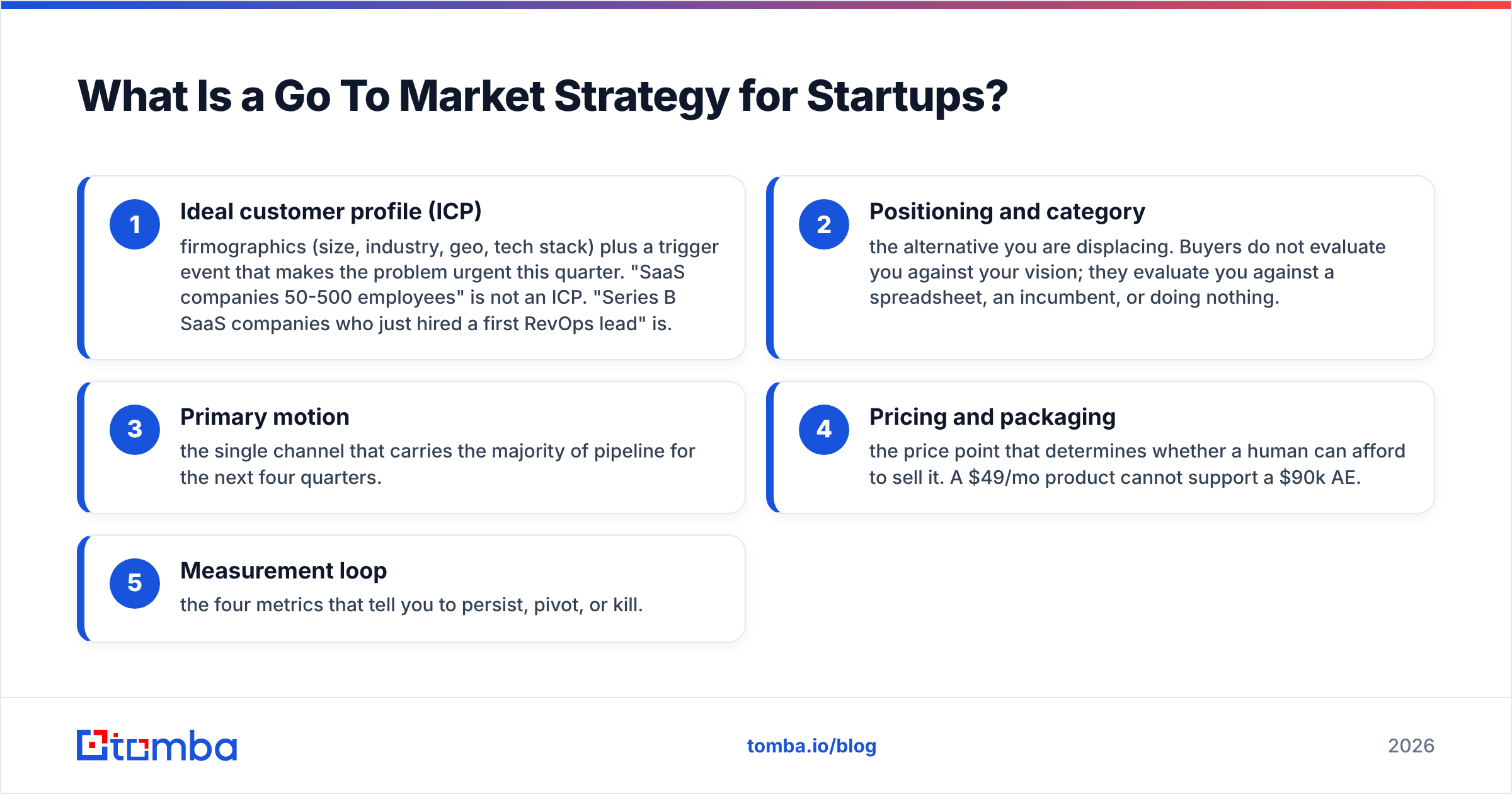
Five components, in dependency order:
- Ideal customer profile (ICP) — firmographics (size, industry, geo, tech stack) plus a trigger event that makes the problem urgent this quarter. "SaaS companies 50-500 employees" is not an ICP. "Series B SaaS companies who just hired a first RevOps lead" is.
- Positioning and category — the alternative you are displacing. Buyers do not evaluate you against your vision; they evaluate you against a spreadsheet, an incumbent, or doing nothing.
- Primary motion — the single channel that carries the majority of pipeline for the next four quarters.
- Pricing and packaging — the price point that determines whether a human can afford to sell it. A $49/mo product cannot support a $90k AE.
- Measurement loop — the four metrics that tell you to persist, pivot, or kill.
Get the order wrong and you get expensive noise. Teams that pick a motion before defining an ICP end up with a sales team calling anyone who answers.

Which GTM Motion Should Your Startup Pick First?#
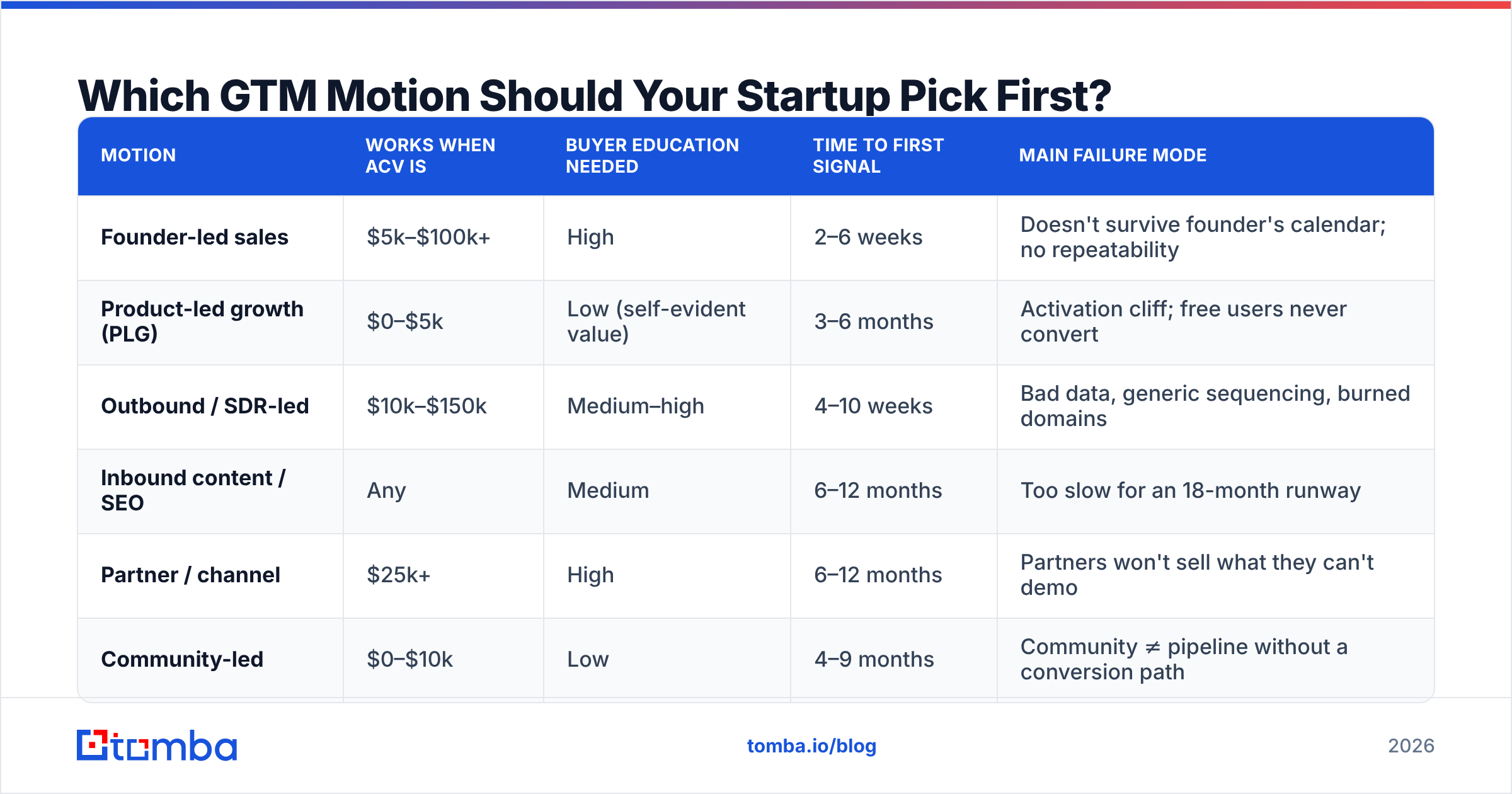
Pick based on your average contract value (ACV) and how much education the buyer needs. This is the single highest-leverage decision in your GTM plan, and ACV is the cleanest predictor.
| Motion | Works when ACV is | Buyer education needed | Time to first signal | Main failure mode |
|---|---|---|---|---|
| Founder-led sales | $5k–$100k+ | High | 2–6 weeks | Doesn't survive founder's calendar; no repeatability |
| Product-led growth (PLG) | $0–$5k | Low (self-evident value) | 3–6 months | Activation cliff; free users never convert |
| Outbound / SDR-led | $10k–$150k | Medium–high | 4–10 weeks | Bad data, generic sequencing, burned domains |
| Inbound content / SEO | Any | Medium | 6–12 months | Too slow for an 18-month runway |
| Partner / channel | $25k+ | High | 6–12 months | Partners won't sell what they can't demo |
| Community-led | $0–$10k | Low | 4–9 months | Community ≠ pipeline without a conversion path |
The pattern most seed-stage B2B companies follow: founder-led sales first, because it is the only motion that produces qualitative learning fast. You need 20–30 discovery calls to learn what language buyers actually use. Then layer outbound once the pitch converts consistently, and only then invest in content, which compounds slowly.
Product-led growth is the exception that swallows teams. PLG works when the product delivers value in a single session without a human — think Figma, Linear, Loom. If your product requires data integration, admin permissions, or a change in team behavior, PLG is a two-year infrastructure bet, not a fast start. Gartner's research on B2B buying has consistently found that buyers spend a small minority of the buying cycle with any single vendor's sellers, which argues for making self-serve evaluation easy — but "easy to evaluate" and "PLG as your primary revenue motion" are different commitments.
How Do You Define an ICP That Actually Holds Up?#
Define it with three layers, and treat every layer as falsifiable.
Layer 1 — Firmographics. Employee count, revenue band, industry, geography, funding stage. These are filters, not insight. They only narrow the universe.
Layer 2 — Technographics and operational signals. What is in their stack? Do they run HubSpot or Salesforce? Do they have a data warehouse? Do they already pay for a category-adjacent tool? A company already paying for a competitor is often a better prospect than a greenfield account, because budget and problem-awareness both exist.
Layer 3 — Trigger events. New executive hire in the buying role, funding round, a job posting that names your problem, an acquisition, a compliance deadline. Triggers are what turn a "someday" account into a "this quarter" account.
Write the ICP as one sentence you would defend in a board meeting: "Series A–B B2B SaaS companies, 50–300 employees, US/EU, running Salesforce, who have posted a RevOps or Sales Ops role in the last 60 days." That sentence is testable. You can build a list against it in an afternoon using a B2B database and a domain search to map contacts at each account.
Then falsify it. Pull your last 20 closed-won and 20 closed-lost deals. If your closed-won set does not cluster on the ICP sentence, your ICP is aspirational. Rewrite it to match reality, not the deck.
One caution on TAM math: a large addressable market does not make a good ICP. Startups die from being too broad far more often than from being too narrow. Narrow enough that you can name 200 accounts by hand, then expand outward from the segment that converts.
What Does the First 90 Days of Execution Look Like?#
Run it in three 30-day blocks. Each block has one exit criterion — if you do not hit it, you do not advance.
Days 1–30: Evidence gathering
- Run 25 discovery calls with people who match the ICP sentence. Not customers — prospects. Record them.
- Extract the exact phrasing buyers use for the problem. Your website copy should be quotes from these calls, not internal jargon.
- Build a target account list of 200 named companies. Not 20,000 — 200 you could research individually.
- Exit criterion: three consistent pain patterns you heard in 15+ of 25 calls.
Days 31–60: Motion test
- Build contact data for the 200 accounts: decision-maker, champion, and blocker at each. Use a bulk email finder to resolve contacts at scale, then run every address through an email verifier before a single send. Aim to keep bounce rate under 2%.
- Send in cohorts of 50, not 200. Change one variable per cohort — subject line, offer, or persona.
- Book and run 15 first meetings.
- Exit criterion: a reply rate above 4% on at least one cohort, and at least 3 opportunities created.
Days 61–90: Repeatability check
- Close 2–5 deals, even at a discount. The goal is a documented path from cold to signed.
- Write the sales process down: stage definitions, exit criteria per stage, and the objection handling that actually worked.
- Measure sales cycle length and average deal size for the first time.
- Exit criterion: a second person (not the founder) can run a discovery call using the documented script and reach the same qualification outcome.
If you fail an exit criterion, do not advance — diagnose. Failing the day-60 gate almost always traces to one of three causes: wrong list, wrong offer, or bad data. Check them in that order, because the wrong list makes the other two impossible to evaluate.
Why Does Contact Data Quality Break Most Startup GTM Plans?#
Because outbound math is multiplicative, and data quality sits at the front of the chain. Run the numbers.
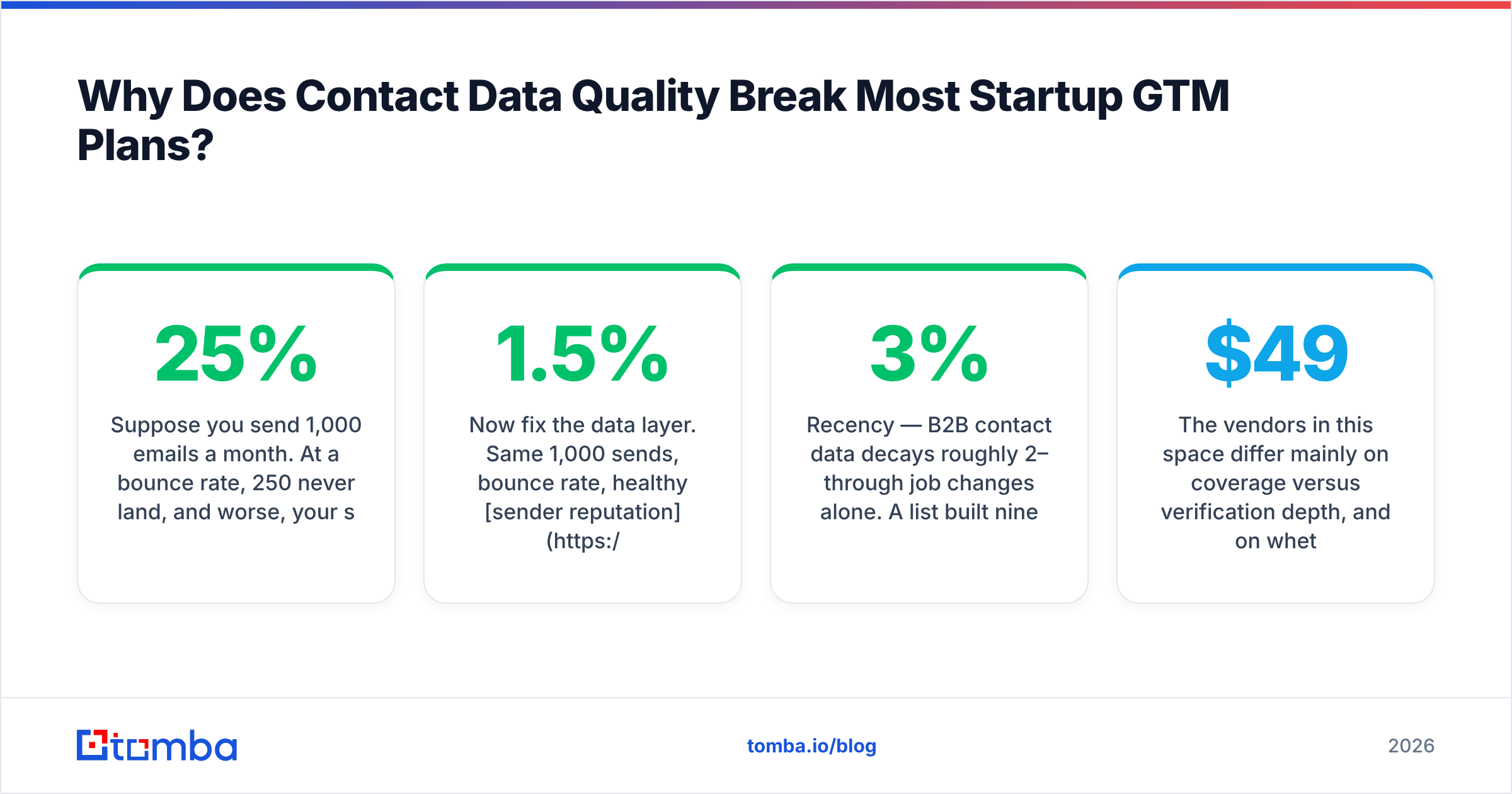
Suppose you send 1,000 emails a month. At a 25% bounce rate, 250 never land, and worse, your sender reputation degrades — which suppresses inbox placement for the 750 that do send. Effective delivered volume might be 550. At a 3% reply rate on delivered mail, that is 16 replies, maybe 5 meetings.
Now fix the data layer. Same 1,000 sends, 1.5% bounce rate, healthy sender reputation, 900+ landing in the primary inbox. Same 3% reply rate gives you 27 replies and 9 meetings. You did not change a word of copy. You nearly doubled pipeline by fixing the input.
This is why "our messaging isn't working" is usually a misdiagnosis. Before rewriting your sequence for the fourth time, verify:
- Deliverability floor — SPF, DKIM, and DMARC configured; warmed domains; sending volume ramped, not spiked. Google's bulk sender guidelines set the hard requirements here, and they are enforced, not advisory.
- Address validity — every address verified before send, catch-all domains handled separately with a catch-all verifier rather than blindly mailed.
- Role accuracy — you are emailing the person who owns the problem, not a generic info@ address.
- Recency — B2B contact data decays roughly 2–3% per month through job changes alone. A list built nine months ago is meaningfully stale.
The vendors in this space differ mainly on coverage versus verification depth, and on whether you pay per credit or per seat. Tomba's pricing runs a free tier at 25 searches/mo, Starter at $49/mo, Growth at $99/mo, and Pro at $249/mo, with verification bundled rather than sold as a separate SKU — which matters when you are testing whether a motion works and do not want two vendors on the credit card. BookYourData is a solid alternative if you want a pay-as-you-go prebuilt list model rather than a search-and-verify workflow; the two solve slightly different jobs, and plenty of teams use both.

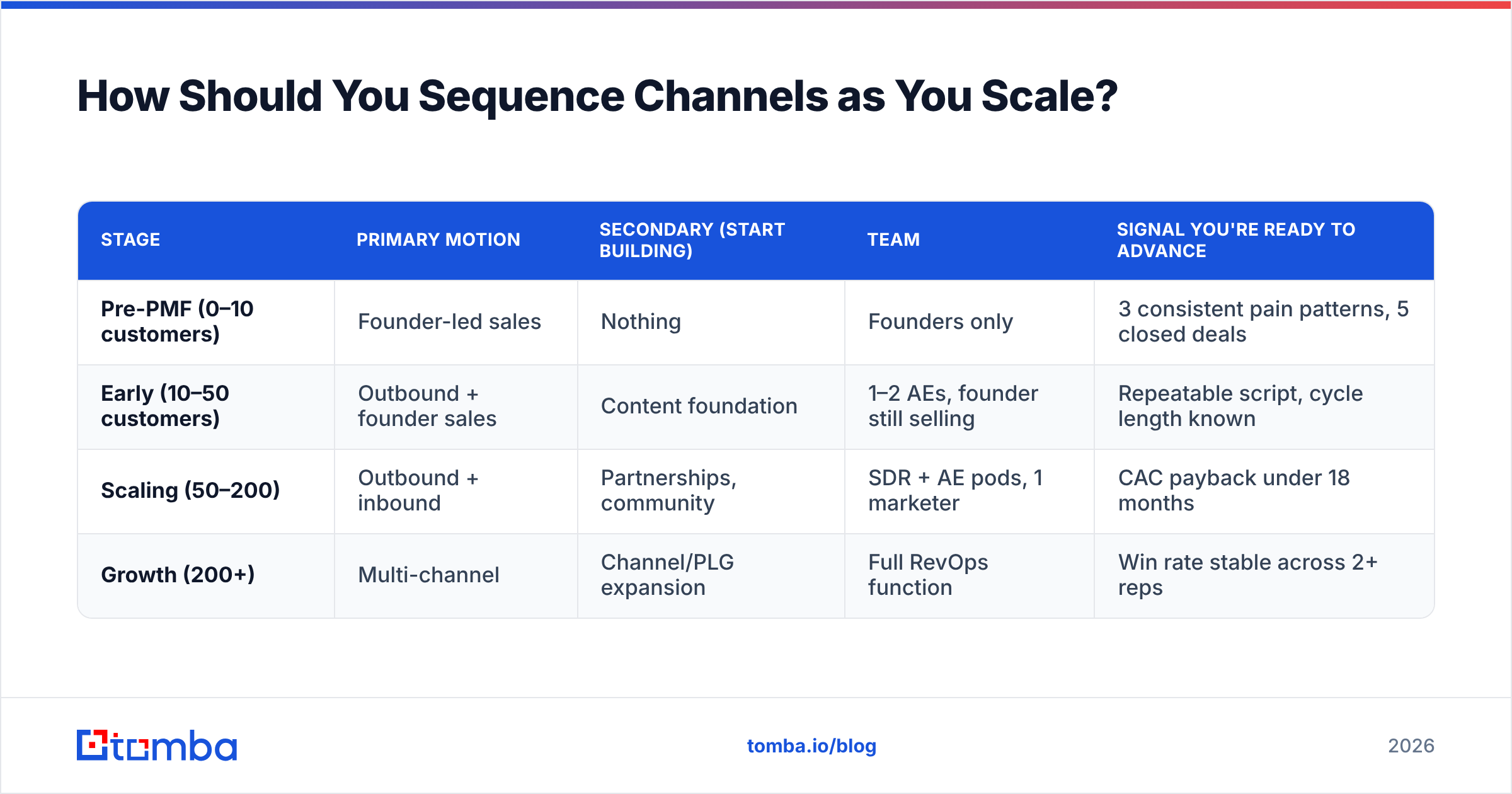
How Should You Sequence Channels as You Scale?#
Sequentially, with each channel funded by the one before it. The failure pattern is parallel investment before any single channel proves out.
| Stage | Primary motion | Secondary (start building) | Team | Signal you're ready to advance |
|---|---|---|---|---|
| Pre-PMF (0–10 customers) | Founder-led sales | Nothing | Founders only | 3 consistent pain patterns, 5 closed deals |
| Early (10–50 customers) | Outbound + founder sales | Content foundation | 1–2 AEs, founder still selling | Repeatable script, cycle length known |
| Scaling (50–200) | Outbound + inbound | Partnerships, community | SDR + AE pods, 1 marketer | CAC payback under 18 months |
| Growth (200+) | Multi-channel | Channel/PLG expansion | Full RevOps function | Win rate stable across 2+ reps |
Two rules govern the transitions.
Rule one: do not hire an SDR before the founder has closed 10 deals. An SDR cannot discover a pitch. They can only execute one. Hiring outbound headcount to figure out messaging is the single most expensive form of research available.
Rule two: do not add a second channel until the first one has a stable cost per opportunity for two consecutive months. Adding channels multiplies the variables and makes attribution impossible at exactly the moment you need clean signal.
The revenue operations function typically becomes necessary around the 50-customer mark, when handoffs between marketing, sales, and CS start dropping deals. Before that, RevOps is a spreadsheet the founder maintains.
What Metrics Actually Matter in Year One?#
Four. Everything else is a leading indicator of one of these, and leading indicators are easy to game.
- Qualified meetings per month. Define "qualified" strictly — matches ICP, has budget authority or a path to it, and named a problem you solve. Loose qualification inflates this number and hides a pipeline problem for a full quarter.
- Win rate from qualified meeting to closed-won. Below 15% usually means qualification is loose or you are losing to "do nothing." Above 40% at seed stage often means you are not talking to enough hard accounts.
- Sales cycle length (median, not mean). The mean gets destroyed by one enterprise outlier. Median tells you how to plan cash.
- CAC payback period. Fully loaded acquisition cost divided by monthly gross margin per customer. Under 12 months is strong, 12–18 is workable, over 24 means the motion does not fund itself.
Two metrics to deliberately ignore in year one: MQLs (they measure marketing activity, not buying intent) and pipeline coverage ratio (meaningless until you have enough closed deals to know your true win rate). Track win rate and response rate instead — both connect directly to revenue.
Review these four numbers monthly with the same definitions each time. Changing a metric definition mid-quarter is how teams accidentally convince themselves things are improving.
What Are the Most Common GTM Mistakes at Seed Stage?#
- Building for a persona you have never sold to. Founders from engineering backgrounds frequently target engineering buyers because it feels familiar, then discover the budget lives with a VP the product was never designed for.
- Confusing a launch with a motion. A Product Hunt launch produces a spike, not a channel. If your traffic returns to baseline in 72 hours, you had an event, not a strategy.
- Pricing on cost instead of value. Startups underprice because they fear rejection. Underpricing removes the margin that funds the sales team, and it signals low value to enterprise buyers who use price as a quality proxy.
- Scaling a channel that has not proven unit economics. Doubling outbound headcount on a channel with a 26-month CAC payback doubles the burn, not the growth.
- Treating data as a one-time purchase. Lists decay. Enrichment is an ongoing process. Teams that buy one list, work it for six months, and conclude "outbound doesn't work" have tested list decay, not outbound.
- Ignoring losses. Closed-lost interviews are the highest-signal, lowest-cost research available. Ten of them will tell you more about your positioning than another quarter of A/B testing subject lines.
The through-line: every one of these is a sequencing error. The tactics are usually fine; they are just applied before the prerequisite is in place. G2's category research is a reasonable place to sanity-check which tools your buyers already evaluate before you assume a category exists.
How Do You Build the Data Layer Behind the Strategy?#
Three components, built in order.
Account list. Start from your ICP sentence and build 200 named accounts manually. Manual is the point — you learn the segment while building it. Once the pattern is clear, automate expansion with filters that replicate your manual criteria.
Contact resolution. For each account, identify the economic buyer, the champion, and the likely blocker. Then find working contact details. An email finder resolves addresses from name plus domain; a LinkedIn finder works when you have the profile but not the address. Where phone matters — and for enterprise deals it usually does — layer a phone finder so you are not single-threaded on email.
Enrichment and hygiene. Push everything into your CRM with consistent field mapping, and set a re-verification cadence — quarterly is a reasonable default. Contacts that bounce get quarantined, not deleted, so you can re-resolve them when the person surfaces at a new company. That job change is often your best trigger event.
The operational discipline that separates teams that scale: every list is verified before send, every bounce is logged, and enrichment runs on a schedule rather than when someone remembers. It is unglamorous, and it is the difference between a 3% reply rate and a 0.8% one.
Where Should You Start This Week?#
Write the ICP sentence. One sentence, with a trigger event. Then build 200 accounts against it by hand, resolve verified contacts for three roles at each, and run 50-account cohorts with one variable changed per cohort. That is a complete GTM test in under 30 days, and it costs less than a single month of an SDR salary.
The data layer is where most of these tests silently fail, so make it the part you do not improvise. Tomba's Email Finder resolves professional addresses from a name and domain with verification built into the same workflow, so your first cohort goes out against clean data rather than a list you hope is accurate. Start on the free tier at 25 searches a month to validate your list-building process, then move to Starter at $49/mo once you know the motion is worth scaling.
Related guides#
Ready to find emails that actually work?
Join 150,000+ professionals who stopped guessing and started sending. Free credits on signup — no credit card required.
Get the Tomba newsletter
Practical outbound tactics and product updates — once every two weeks.
About the author