Go-To-Market Strategy for Startups: Example + Template
A real go-to-market plan for a seed-stage B2B SaaS — ICP, channel math, pricing, and the 90-day sequence — plus the numbers that decide whether it worked.
TL;DR
- A go-to-market strategy is four decisions, not a deck: who you sell to, what you promise them, how they find out, and what a closed deal costs you.
- The worked example below is a seed-stage B2B SaaS selling compliance tooling to 50-500 person fintechs — $1.2M ARR target, three channels, a 90-day sequence with real numbers.
- Most startup GTM plans fail on channel math, not messaging. If you can't write a CAC number per channel, you don't have a strategy yet.
- Outbound only works when the contact data underneath it is clean — a 22% bounce rate turns a working channel into a burned domain in six weeks.
- Copy the template at the bottom, fill in your own numbers, and kill any channel that misses payback by 2x after 90 days.
What is a go-to-market strategy, actually?#
A go-to-market strategy is the plan for how a specific product reaches a specific buyer profitably. That's it. It is not a brand deck, not a positioning workshop, and not a list of channels you'd "like to test."
Think of it like opening a restaurant. Positioning is deciding you're a ramen shop, not a steakhouse. GTM is choosing the street corner, the price of a bowl, how people hear you exist, and whether the math still works after rent. Plenty of founders nail the ramen and starve on the corner.
A complete GTM plan answers five questions with numbers attached:
- Ideal customer profile (ICP) — firmographics, trigger events, and the buying committee. Not "SMBs in tech."
- Value proposition and positioning — the one problem you solve better than the current alternative (which is usually a spreadsheet, not a competitor).
- Channel mix — where those buyers actually are, ranked by expected CAC, not by how fun the channel sounds.
- Pricing and packaging — the price point that matches the sales motion. A $99/mo product cannot support an outbound SDR.
- Motion and metrics — self-serve, sales-assisted, or enterprise; and the leading indicators you'll check weekly.
If any of those five is a vibe rather than a number, that's your weak link.
Which GTM motion fits your startup?#
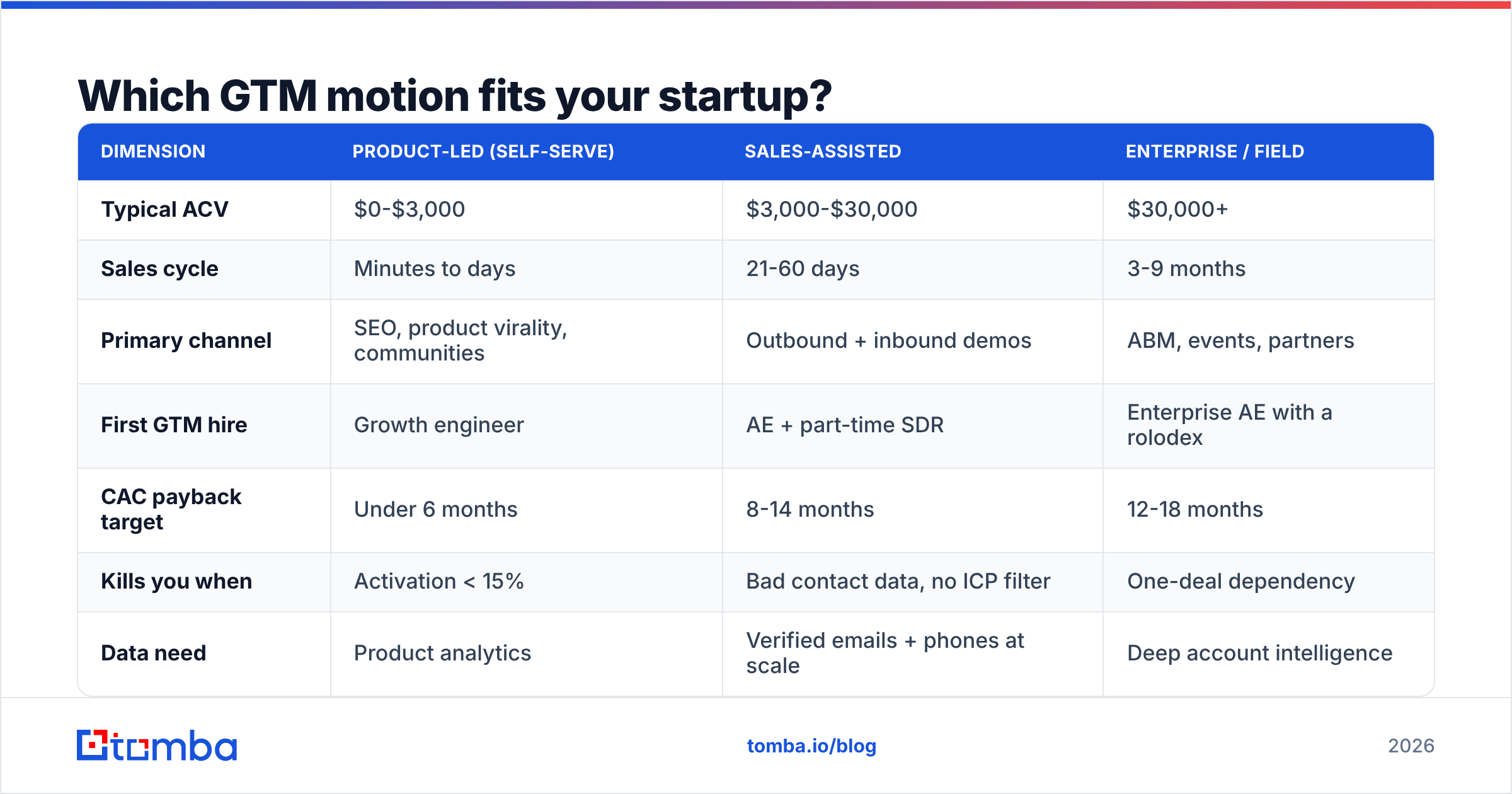
The single biggest structural decision is motion, because it determines your cost base for the next two years. Get it wrong and you hire five AEs for a product people want to buy with a credit card.
| Dimension | Product-led (self-serve) | Sales-assisted | Enterprise / field |
|---|---|---|---|
| Typical ACV | $0-$3,000 | $3,000-$30,000 | $30,000+ |
| Sales cycle | Minutes to days | 21-60 days | 3-9 months |
| Primary channel | SEO, product virality, communities | Outbound + inbound demos | ABM, events, partners |
| First GTM hire | Growth engineer | AE + part-time SDR | Enterprise AE with a rolodex |
| CAC payback target | Under 6 months | 8-14 months | 12-18 months |
| Kills you when | Activation < 15% | Bad contact data, no ICP filter | One-deal dependency |
| Data need | Product analytics | Verified emails + phones at scale | Deep account intelligence |
Notice the last row. Each motion has a different data appetite, and that's the part founders under-budget. A sales-assisted motion targeting 2,000 accounts needs roughly 6,000-8,000 verified contacts to run properly. Sourcing that badly is how a good plan dies quietly.
What does a real go-to-market strategy for startups example look like?#
Here's the worked example. Company: Ledgerloop, a fictional but realistic seed-stage startup selling automated SOC 2 evidence collection. Raised $2.5M. Team of nine. Target: $1.2M ARR in 12 months at a $14,000 average ACV — roughly 86 new customers.
Step 1 — The ICP, written narrowly enough to hurt#
Bad ICP: "B2B SaaS companies that need compliance."
Ledgerloop's ICP:
- Company size: 50-500 employees
- Vertical: fintech and fintech-adjacent (payments, lending, embedded finance)
- Geography: US and UK
- Trigger event: raised a Series A or B in the last 9 months, or posted a job for "Compliance Manager" / "Security Engineer"
- Champion: Head of Security, VP Engineering
- Economic buyer: CTO or CFO
- Current alternative: a Google Sheet plus a $40,000 audit firm engagement
That narrowness produces a countable market. Ledgerloop's list build returned 2,140 companies matching all criteria. At an average buying committee of 2.4 people, that's ~5,100 contacts to source and verify.
Step 2 — Positioning against the real alternative#
Ledgerloop's statement: "For fintech engineering leaders facing their first SOC 2, Ledgerloop collects 80% of audit evidence automatically — so your team spends four days on compliance instead of four weeks. Unlike general GRC platforms, we ship pre-built integrations for the payments stack you already run."
Three things make it work: a named buyer, a quantified delta (four days vs four weeks), and a stated competitive wedge. Vague positioning is the leading cause of low reply rates — the message isn't bad, it just isn't about anyone.
Step 3 — Channel math before channel execution#
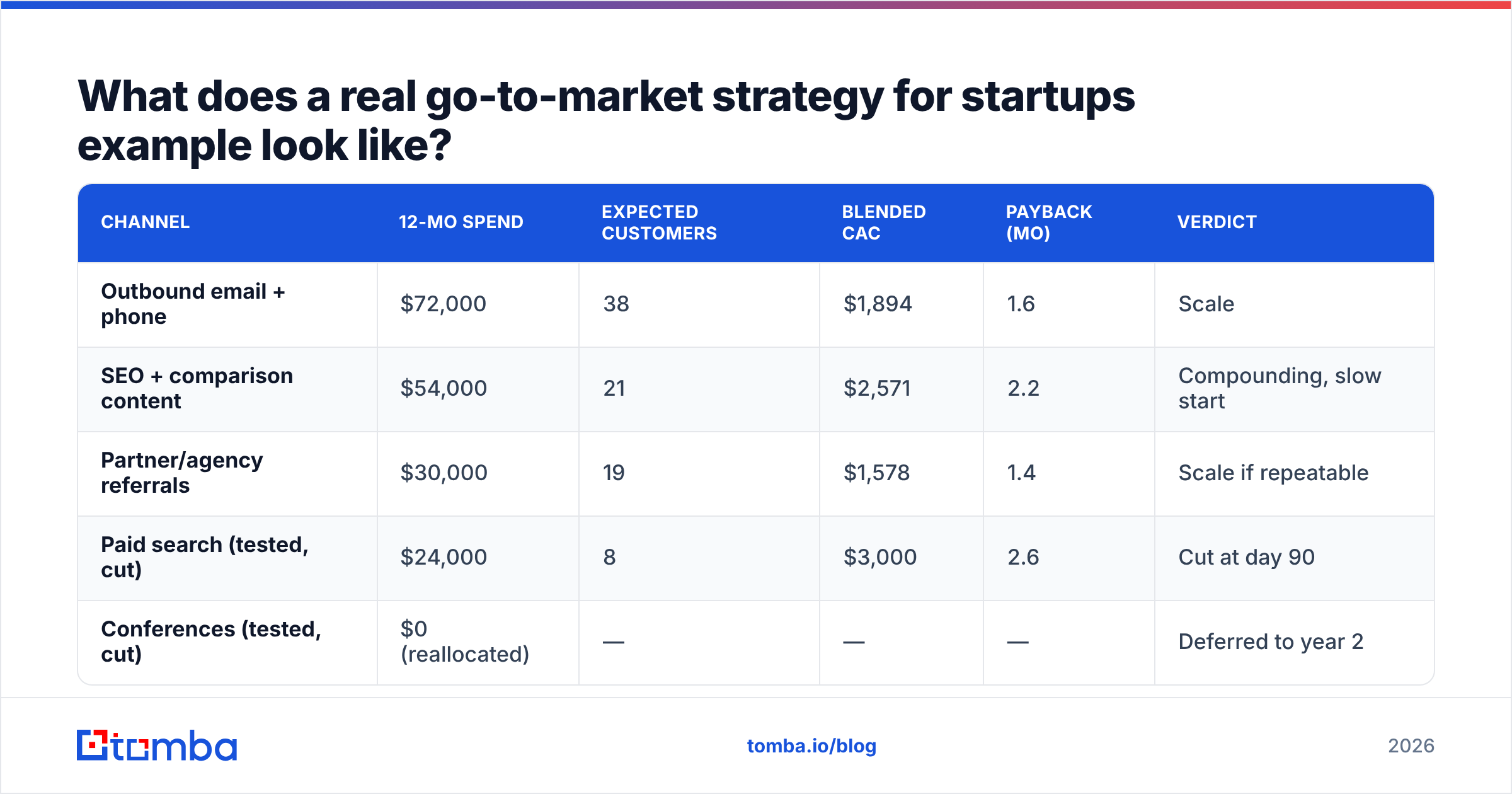
This is where the strategy becomes real. Ledgerloop budgeted $180,000 for GTM over 12 months and modeled three channels before spending a dollar.
| Channel | 12-mo spend | Expected customers | Blended CAC | Payback (mo) | Verdict |
|---|---|---|---|---|---|
| Outbound email + phone | $72,000 | 38 | $1,894 | 1.6 | Scale |
| SEO + comparison content | $54,000 | 21 | $2,571 | 2.2 | Compounding, slow start |
| Partner/agency referrals | $30,000 | 19 | $1,578 | 1.4 | Scale if repeatable |
| Paid search (tested, cut) | $24,000 | 8 | $3,000 | 2.6 | Cut at day 90 |
| Conferences (tested, cut) | $0 (reallocated) | — | — | — | Deferred to year 2 |
Total: 86 customers, $14K ACV, $1.2M ARR. The plan works on paper — and the paid search line got killed after 90 days because CAC drifted above the 2.5-month payback ceiling Ledgerloop set in advance. Deciding the kill threshold before the data arrives is the discipline most teams skip.
Step 4 — Pricing that matches the motion#
Ledgerloop landed on three tiers: $790/mo (single framework), $1,190/mo (multi-framework), and custom above 500 employees. A $14K ACV supports a sales-assisted motion with one AE and one SDR — barely. It would not support a field sales team, and the team wrote that constraint into the plan explicitly so nobody proposed hiring an enterprise AE in month five.
Step 5 — The 90-day execution sequence#
- Days 1-15: Build the account list. Enrich and verify contacts. Set up three sending domains, configure SPF/DKIM/DMARC, start warmup.
- Days 16-30: Ship four cornerstone SEO pages targeting bottom-funnel queries. Write and test three outbound sequences against 200 contacts each.
- Days 31-60: Scale the winning sequence to 1,200 contacts/month. Launch partner outreach to 15 fractional CISO firms. First 8 customers expected.
- Days 61-90: Review CAC by channel. Cut anything above 2.5-month payback. Double budget on the top performer. Hire the second AE only if pipeline coverage exceeds 3x.
Why do most startup GTM plans fail in month three?#
Because the infrastructure underneath the plan was never checked. Three failure modes account for most of it.
Failure mode one: the list is garbage. Ledgerloop's first scraped list bounced at 22%. Two sending domains got throttled inside three weeks. The fix was boring — run every address through an email verifier before it enters a sequence, and route catch-all domains through a catch-all verifier rather than guessing. Post-cleanup bounce rate: 1.8%. Same copy, same offer, 4x the replies, because the messages were actually arriving.
Failure mode two: no single owner per channel. When "the team" owns outbound, nobody reads the reply data on Friday. Assign one name per channel and one weekly number they report.
Failure mode three: the plan has no kill switch. Founders keep funding a channel because they've already funded it. Write the threshold down in month zero, in the same doc as the forecast.
How do you build the target list without burning your domain?#
The account list is a research problem; the contact list is a data problem. Keep them separate.
For accounts, start from trigger events rather than static firmographics — funding announcements, job postings, and tech-stack changes all indicate active budget. Crunchbase and public job boards cover most of this at seed stage without a six-figure data contract.
For contacts, the sequence that holds up under volume looks like this:
- Resolve the company domain from the account name, then run a domain search to pull known addresses and detect the company's email pattern.
- Find the named individuals — the champion and the economic buyer — with an email finder rather than permutating and hoping.
- Verify everything before it touches a sequence, including catch-all domains.
- Enrich for context — title, seniority, and company size feed both your routing rules and your merge fields. Data enrichment here saves the AE from manual research per account.
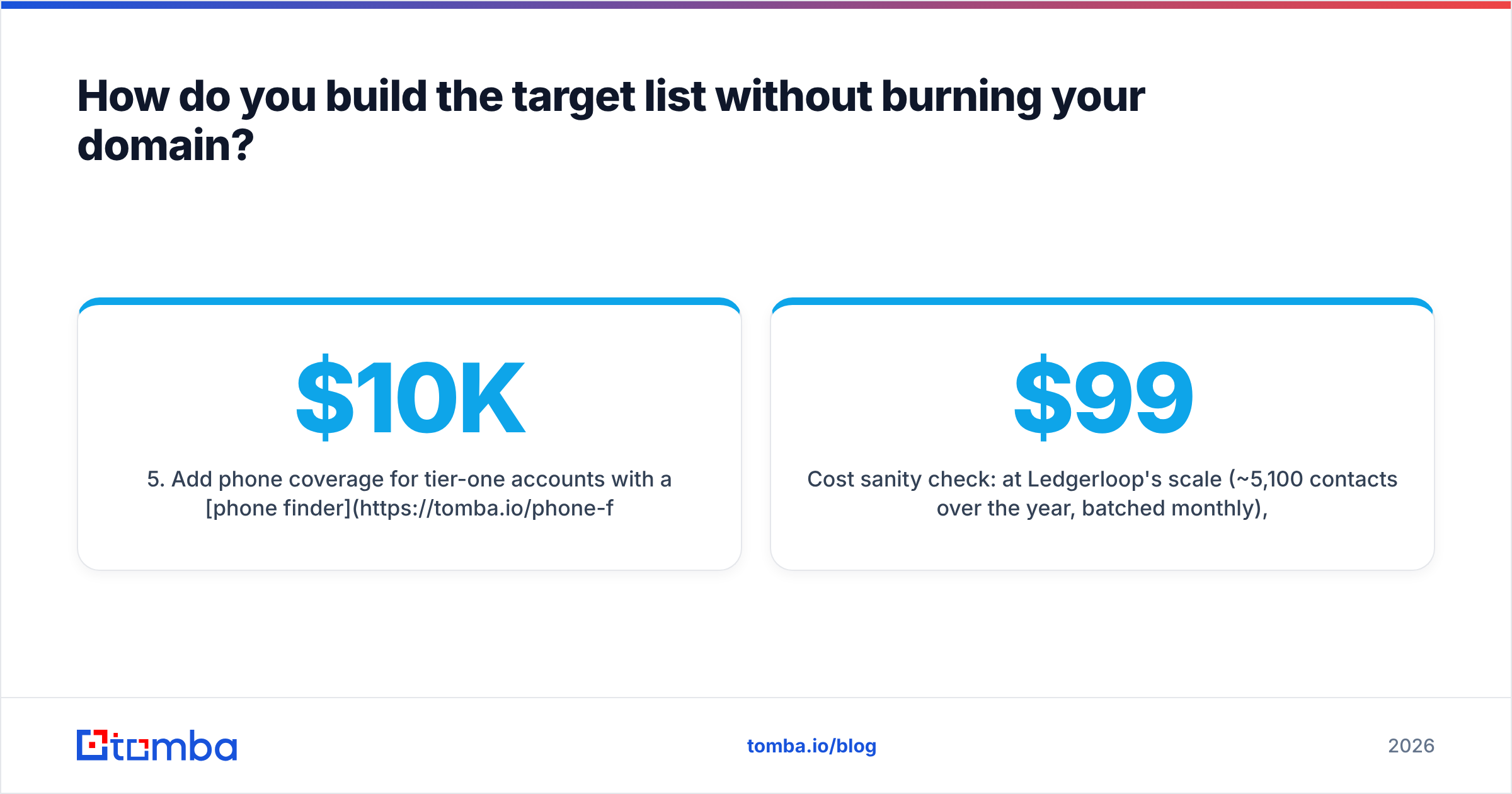
- Add phone coverage for tier-one accounts with a phone finder. Multi-threaded outreach converts meaningfully better than email-only on ACVs above $10K.
- Deduplicate against your CRM so you don't cold-email an existing opportunity. This happens more than anyone admits.
Cost sanity check: at Ledgerloop's scale (~5,100 contacts over the year, batched monthly), the Growth plan at $99/mo covers the volume. Full Tomba pricing runs from a free tier at 25 searches/mo up through Starter at $49/mo, Growth at $99/mo, and Pro at $249/mo. Against a $180,000 GTM budget, contact data is under 1% of spend and gates the effectiveness of about 40% of it. That ratio is worth internalizing.
Which metrics tell you the GTM strategy is working?#
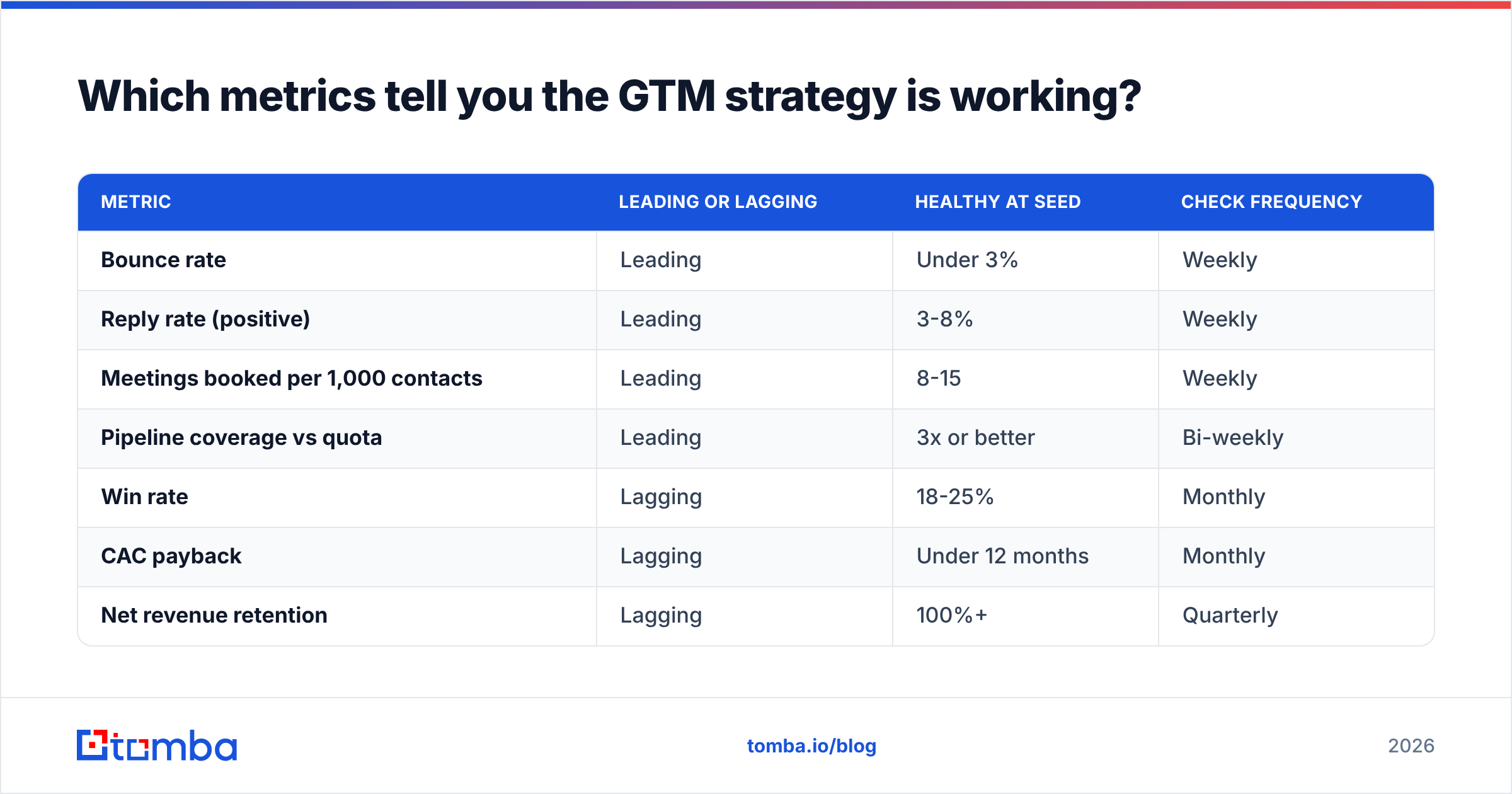
Weekly, not quarterly. Quarterly reviews find problems two months after they were fixable.
| Metric | Leading or lagging | Healthy at seed | Check frequency |
|---|---|---|---|
| Bounce rate | Leading | Under 3% | Weekly |
| Reply rate (positive) | Leading | 3-8% | Weekly |
| Meetings booked per 1,000 contacts | Leading | 8-15 | Weekly |
| Pipeline coverage vs quota | Leading | 3x or better | Bi-weekly |
| Win rate | Lagging | 18-25% | Monthly |
| CAC payback | Lagging | Under 12 months | Monthly |
| Net revenue retention | Lagging | 100%+ | Quarterly |
The leading indicators are cheap to fix and the lagging ones aren't. If your bounce rate is 9%, no amount of copywriting workshops will save the quarter. Fix the input.
For benchmark context on what "normal" looks like across categories, G2's software buyer behavior research and HubSpot's annual sales data are both free and reasonably honest about methodology — more useful than the vendor blog stats that circulate without a source.
What does the template look like when you fill it in yourself?#
Strip Ledgerloop's specifics and you get a one-page structure. Fill each line with a number or leave it blank and admit you don't know yet.
- ICP: size, vertical, geography, trigger event, champion title, economic buyer title, current alternative
- Countable market: how many companies match all criteria (a real number from a real list build)
- Positioning: for [buyer] facing [problem], we [outcome with a metric], unlike [alternative]
- Motion: self-serve / sales-assisted / enterprise — and the ACV that justifies it
- Channels: three maximum for the first year, each with projected spend, customers, CAC, and a written kill threshold
- Pricing: tiers, and the sentence explaining why this price supports this motion
- 90-day sequence: what happens in days 1-15, 16-30, 31-60, 61-90
- Weekly scorecard: four leading indicators, one owner per channel
Two rules make the template useful rather than decorative. First, three channels maximum in year one — a seed team running five channels is running five channels badly. Second, every channel line needs a kill threshold written before launch, because you will not be objective about it in month four.
The strategies that survive contact with reality share a trait: they're specific enough to be wrong. "We'll target mid-market SaaS through content and outbound" cannot be falsified, so it never gets corrected. "2,140 fintechs, 38 customers from outbound at under $1,900 CAC, kill at 2.5-month payback" gets corrected every single week.
Where to start this week#
Pick the narrowest ICP you can defend and build the actual list. Not a persona doc — a spreadsheet with company names in it. That exercise alone kills more bad GTM assumptions than any strategy offsite, because a market that sounded big often turns out to be 300 companies, and a market that sounded niche turns out to be 4,000.
Once the account list exists, the contacts have to be real. Start with the Tomba Email Finder to source and verify the champions and economic buyers on your list — the free tier covers 25 searches while you validate the ICP, and Starter at $49/mo handles a first outbound cohort. Clean data won't fix a bad strategy, but bad data will absolutely sink a good one, and it's the cheapest variable in the entire plan to control.
Related guides#
Ready to find emails that actually work?
Join 150,000+ professionals who stopped guessing and started sending. Free credits on signup — no credit card required.
Get the Tomba newsletter
Practical outbound tactics and product updates — once every two weeks.
About the author