Go-To-Market Strategy for Startups: Template + 2026 Playbook
A fill-in-the-blank go-to-market strategy template for startups, plus the ICP math, channel scorecard, and 90-day launch sequence that decide whether your first 100 customers show up.
TL;DR
- A go-to-market strategy is four decisions written down: who you sell to, what you promise them, how they find out, and what happens after they reply. Everything else is decoration.
- Copy the fill-in-the-blank template in this post. It fits on two pages. If yours needs 30 slides, you haven't decided anything yet.
- Pick one ICP segment and one primary channel for the first 90 days. Founders who run four channels at 25% effort learn nothing from any of them.
- Your GTM is only as good as your contact data — a perfect message to a bounced address is a zero. Build the target account list before you write a single email.
- Measure at the stage level (list → reply → meeting → opp → close), not just revenue. Revenue tells you that it broke; stage conversion tells you where.
What is a go-to-market strategy, really?#
A go-to-market (GTM) strategy is the operating plan that connects a product to a paying buyer. Think of it like a flight plan. The plane exists, the destination exists, but without a filed route — altitude, fuel, waypoints, alternates — you're just taxiing expensively.
For a startup specifically, GTM answers five questions in order:
- Who is the buyer? Not "SMBs." A named segment: company size, industry, tech stack, trigger event, and the job title who signs.
- What breaks for them today? The pain in their language, not your feature list.
- Why you, why now? Your wedge — the one thing you do that the incumbent structurally can't.
- How do they hear about you? One primary channel, one experimental second.
- What is the motion after contact? Self-serve, founder-led sales, PLG-to-sales hybrid, or partner-led.
Most seed-stage GTM decks fail on question one. They describe a market ($47B TAM) instead of a customer (Head of RevOps at 50–200 person B2B SaaS companies using HubSpot who just hired their second SDR). You cannot build a target account list from a TAM slide. You can build one from that second sentence in about 20 minutes.
The honest framing from the analyst world backs this up: Gartner's research on B2B buying repeatedly finds that buying groups now average six to ten stakeholders and spend the majority of the cycle doing independent research. Your GTM has to be findable by a committee, not just persuasive to one champion.
What goes in a go-to-market strategy for startups template?#
Here's the template. Copy it into a doc and fill every bracket. If you can't fill a bracket, that's your next week of work — not a reason to skip it.
Section 1 — ICP definition
- Company: [employee range], [industry], [geo], [funding stage or revenue band]
- Trigger: [hiring signal / funding / tech install / regulatory change]
- Buyer: [job title], reports to [title], budget owner is [title]
- Disqualifiers: [who you will NOT sell to, even if they ask]
Section 2 — Value proposition
- Before state: [what their week looks like now]
- After state: [what changes in 30 days]
- Proof: [metric, case study, or benchmark you can actually cite]
- Wedge: [the thing the incumbent can't copy in a quarter]
Section 3 — Channel plan
- Primary channel: [outbound / content-SEO / community / partnerships / paid]
- Secondary experiment: [one only]
- Weekly volume commitment: [contacts, posts, or spend]
- Kill criteria: [the number below which you stop at week 8]
Section 4 — Sales motion
- Motion: [founder-led / PLG / inside sales / partner]
- Deal size assumption: [$]
- Cycle length assumption: [days]
- Handoff points: [who owns lead → opp → close]
Section 5 — Metrics and cadence
- Weekly: [contacts sourced, replies, meetings booked]
- Monthly: [pipeline created, win rate, CAC]
- Review ritual: [day, attendees, what gets cut]
Section 6 — Data and tooling
- Source of target accounts: [where the list comes from]
- Contact discovery: [tool]
- Verification: [tool + acceptable bounce threshold]
- CRM of record: [tool]
That's it. Two pages. A GTM template that runs longer than this is usually a fundraising artifact wearing a work outfit.
Which GTM motion fits your startup?#
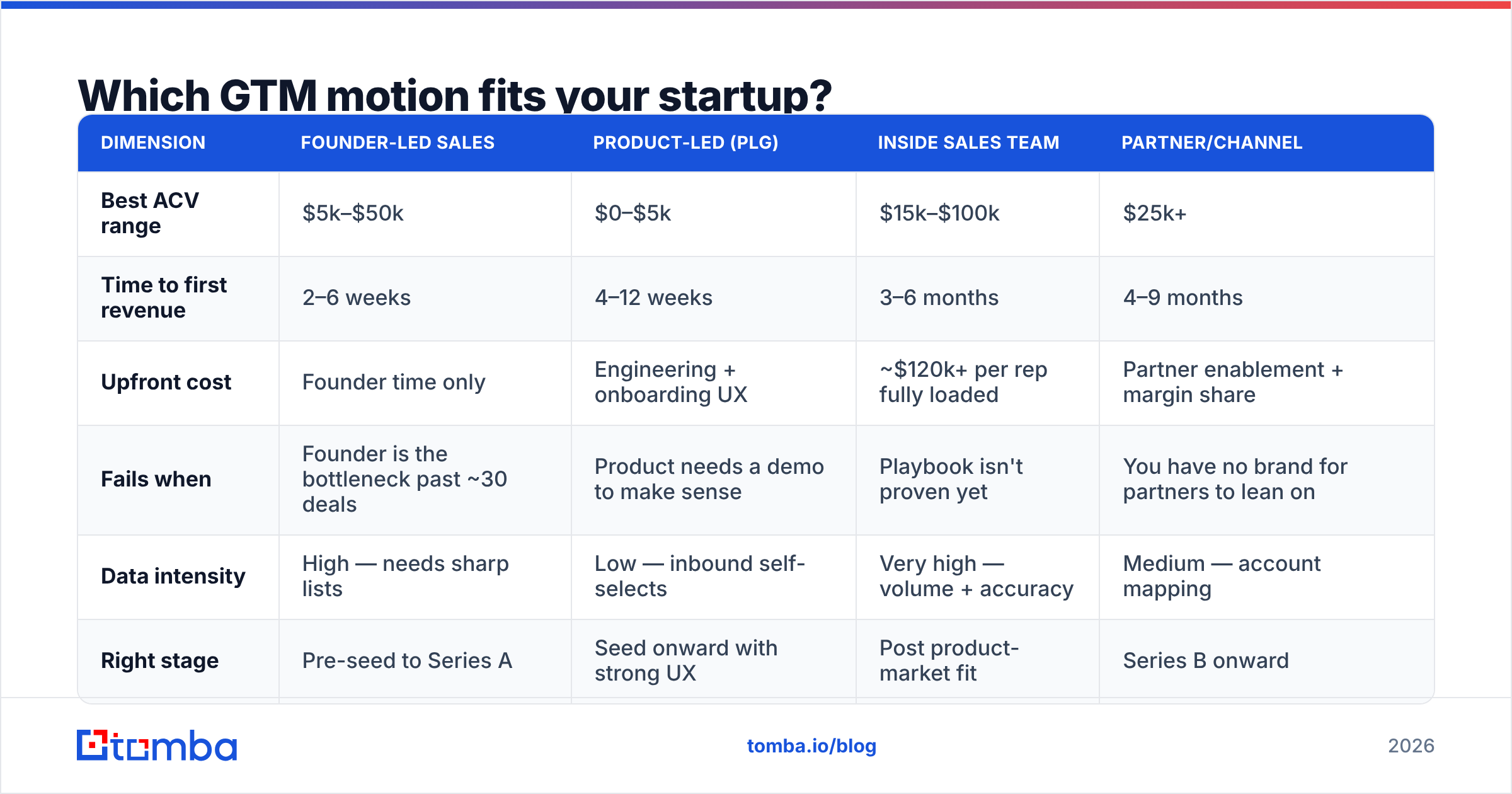
Motion choice is downstream of two numbers: annual contract value and how much the buyer needs to be taught before they buy. Cheap and obvious sells itself; expensive and novel needs a human.
| Dimension | Founder-led sales | Product-led (PLG) | Inside sales team | Partner/channel |
|---|---|---|---|---|
| Best ACV range | $5k–$50k | $0–$5k | $15k–$100k | $25k+ |
| Time to first revenue | 2–6 weeks | 4–12 weeks | 3–6 months | 4–9 months |
| Upfront cost | Founder time only | Engineering + onboarding UX | ~$120k+ per rep fully loaded | Partner enablement + margin share |
| Fails when | Founder is the bottleneck past ~30 deals | Product needs a demo to make sense | Playbook isn't proven yet | You have no brand for partners to lean on |
| Data intensity | High — needs sharp lists | Low — inbound self-selects | Very high — volume + accuracy | Medium — account mapping |
| Right stage | Pre-seed to Series A | Seed onward with strong UX | Post product-market fit | Series B onward |
The most common seed-stage mistake is hiring two SDRs before the founder has personally closed 20 deals. You're paying people to execute a playbook that doesn't exist. Run founder-led until you can write down the exact objection sequence and the exact email that gets replies — then hire.
The second most common mistake is choosing PLG because it sounds cheaper. PLG isn't cheaper; it moves the cost from salaries into product engineering and onboarding design. If your activation moment takes a 30-minute setup call, you don't have PLG. You have a free trial with a sales problem.
How do you build the target account list?#
This is the unglamorous half of GTM that determines the outcome. A brilliant message sent to 200 wrong or invalid addresses produces exactly nothing, and it damages the sending domain you'll need for the next twelve months.
Work in this order:
- Define the firmographic filter. Employee range, industry, geo, and one technographic signal (they run Shopify, they use Snowflake, they have job postings for a role your product serves).
- Build the account list first, contacts second. 200 well-chosen accounts beat 5,000 scraped ones. You want to be able to name why each company is on the list.
- Find the right person at each account. Use a domain search to pull the email patterns and named contacts at each company, then narrow to the title that owns the problem. For individual named prospects, an email finder resolves first name + last name + domain into a deliverable address.
- Verify before you send. Run the list through an email verifier and drop anything that isn't confirmed. Aim to keep hard bounces under 2% — above 3% and mailbox providers start throttling you.
- Enrich for personalization hooks. Funding round, recent hire, published content, tech stack. One specific hook per account beats five generic merge fields.
- Log the source. Six months in, you'll want to know which list source produced closed revenue. Tag it at import.
Two practical notes. First, catch-all domains — servers that accept mail to any address — will show up as "unknown" in most verification tools. Don't delete them blindly; a catch-all verifier can often resolve whether a specific mailbox exists behind the wildcard. Second, if your ICP skews toward roles that live on LinkedIn more than corporate directories, a LinkedIn finder fills gaps that domain-pattern logic misses.
Budget this properly. At Tomba's pricing, the Free tier gives 25 searches a month for testing the motion, Starter is $49/mo, Growth is $99/mo, and Pro is $249/mo — which for most seed-stage teams is a rounding error against one week of founder time spent hand-hunting emails.
How do you pick the one channel to start with?#
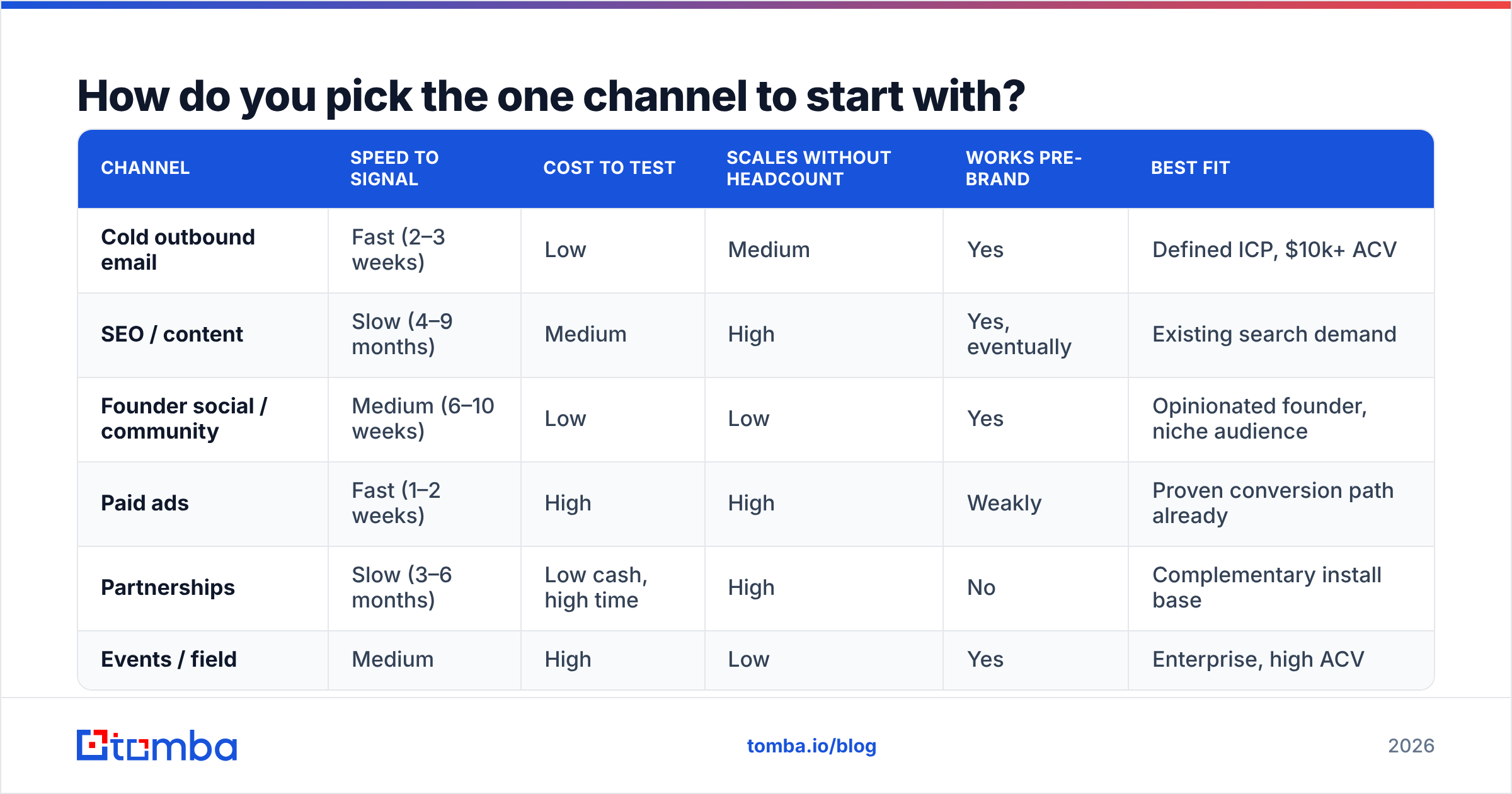
Score your options honestly instead of picking the one you're most comfortable with. Rate each 1–5 and multiply nothing — just look at where the 4s and 5s cluster.
| Channel | Speed to signal | Cost to test | Scales without headcount | Works pre-brand | Best fit |
|---|---|---|---|---|---|
| Cold outbound email | Fast (2–3 weeks) | Low | Medium | Yes | Defined ICP, $10k+ ACV |
| SEO / content | Slow (4–9 months) | Medium | High | Yes, eventually | Existing search demand |
| Founder social / community | Medium (6–10 weeks) | Low | Low | Yes | Opinionated founder, niche audience |
| Paid ads | Fast (1–2 weeks) | High | High | Weakly | Proven conversion path already |
| Partnerships | Slow (3–6 months) | Low cash, high time | High | No | Complementary install base |
| Events / field | Medium | High | Low | Yes | Enterprise, high ACV |
For most pre-Series-A B2B startups the answer is cold outbound plus content compounding underneath it. Outbound gives you conversations this month — which is how you learn what the market actually objects to — while content builds the demand you'll harvest next year. Running both is fine as long as one is the priority and the other is a background investment.
Set kill criteria in advance and write them into the template. "If 8 weeks of 250 verified contacts per week produces fewer than 6 booked meetings, we stop and rebuild the ICP." Written in advance, that's discipline. Decided afterward, it's rationalization.

What does the first 90 days look like?#
Days 1–14: Decide and document. Fill the template. Interview eight to twelve people who match your ICP — not to pitch, to learn the words they use. Rewrite your value proposition in their words. Pick the primary channel and the kill criteria.
Days 15–30: Build the machine. Assemble the 200-account list. Find and verify contacts. Set up your sending domain properly — SPF, DKIM, DMARC — and warm it. Skipping domain authentication is the single fastest way to make a good GTM plan look like a bad one, because your emails simply never arrive. Write three message variants, not fifteen.
Days 31–60: Run at real volume. Send consistently. Track replies by segment, not in aggregate — a 1% overall reply rate might be 0.2% in two segments and 4% in a third, and that third segment is your actual business. Book meetings yourself. Take notes on every objection verbatim.
Days 61–90: Cut and double down. Kill the segments and messages that didn't work. Expand the list in the segment that did. Now — and only now — write the playbook document a future hire could follow. If you can't write it, you don't have a repeatable motion yet, and hiring will just add cost to confusion.
A note on team structure: keep the loop tight. The person writing the messages should be the person reading the replies for at least the first 90 days. Insight dies in handoffs. This is also when your revenue operations discipline starts — clean stage definitions in the CRM now save you a painful data cleanup at Series A.
What are the most common GTM mistakes founders make?#
- Confusing a market with a customer. TAM slides don't produce meetings. Named accounts do.
- Launching before the list is verified. High bounce rates degrade sender reputation for months. Verify first, send second.
- Running four channels at quarter-effort. You get four inconclusive experiments instead of one clear answer.
- Writing for the buyer you wish you had. If your ICP is a 40-person company, stop referencing enterprise procurement pain.
- Hiring reps to fix a positioning problem. More volume on a message that doesn't work just produces more silence, faster.
- No kill criteria. Without a pre-agreed stop number, every failing channel gets "one more month."
- Measuring only revenue. Stage-level conversion tells you where the leak is; revenue only tells you that you're wet.
On tool selection, resist the urge to buy the full stack in month one. You need a list source, a verification step, a sending tool, and a CRM. That's four line items. Directories like G2 are useful for comparing options, and if you'd rather buy pre-built lists than build them, providers such as BookYourData offer verified B2B contact databases that pair well with your own enrichment. Everything past those four tools is a nice-to-have until you have repeatable pipeline.
How do you know your GTM strategy is working?#
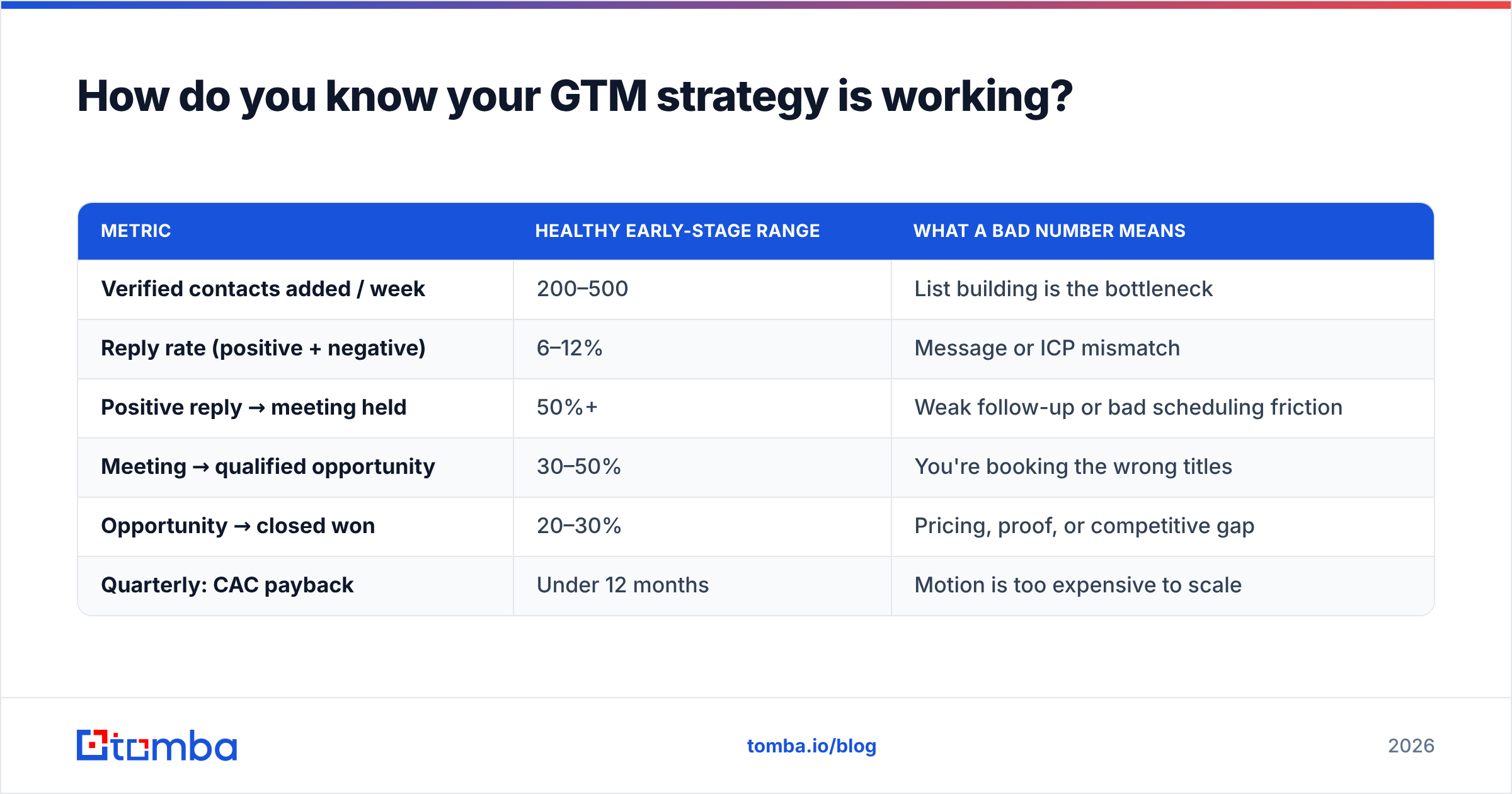
Track five numbers weekly and one quarterly. If the weekly five are healthy, the quarterly one takes care of itself.
| Metric | Healthy early-stage range | What a bad number means |
|---|---|---|
| Verified contacts added / week | 200–500 | List building is the bottleneck |
| Reply rate (positive + negative) | 6–12% | Message or ICP mismatch |
| Positive reply → meeting held | 50%+ | Weak follow-up or bad scheduling friction |
| Meeting → qualified opportunity | 30–50% | You're booking the wrong titles |
| Opportunity → closed won | 20–30% | Pricing, proof, or competitive gap |
| Quarterly: CAC payback | Under 12 months | Motion is too expensive to scale |
Compare your reply rate against your own baseline, not against the screenshots people post online. Benchmarks published by vendors like HubSpot are useful directionally, but your niche, ACV, and list quality move these numbers more than any industry average does. The trend line inside your own data is the only honest signal.
One habit worth building: every month, re-verify the portion of your list you haven't contacted yet. B2B contact data decays at roughly 2–3% per month as people change jobs. A list built in January is meaningfully worse by June, and the bounces from stale addresses hit the same sending domain your good emails travel on.
Ready to build the list your GTM plan depends on?#
A go-to-market strategy for startups lives or dies on execution details: a tight ICP, one channel run seriously, and a contact list that actually delivers. The first two are your judgment calls. The third is a tooling problem with a straightforward fix.
Start with the Tomba Email Finder to turn your 200 named target accounts into verified, deliverable contacts — free tier included, no card required, so you can pressure-test the motion before you commit budget. Fill in the template above, build the list this week, and let the replies tell you which parts of your plan were guesses.
Related guides#
Ready to find emails that actually work?
Join 150,000+ professionals who stopped guessing and started sending. Free credits on signup — no credit card required.
Get the Tomba newsletter
Practical outbound tactics and product updates — once every two weeks.
About the author