Go To Market Strategy for Technology Companies: 2026 Playbook
Most technology GTM plans die on execution, not positioning. This go to market strategy for technology playbook covers picking a motion, building a queryable ICP, budgeting the data stack, and the metrics that prove it works.
TL;DR
- A go to market strategy for technology is four decisions. Who you sell to. Which motion reaches them. What the buying process costs. How you prove it worked.
- Motion fit beats motion fashion. Product-led works below $5K ACV. Sales-led earns its cost above roughly $25K ACV. Most technology companies run a hybrid and mislabel it.
- Your ICP is only real if a data team can turn it into a query. "Mid-market SaaS that cares about security" is not an ICP. "50–500 employees, US/EU, uses Snowflake, hired a first CISO in the last 12 months" is.
- Contact data and verification decide whether outbound makes pipeline or bounce reports. Budget for it on purpose.
- Track four things each month: pipeline coverage by segment, CAC payback, win rate by source, and time-to-first-value. If those four move, the strategy works.
What is a go to market strategy for technology products?#
A go to market strategy for technology is your written answer to one question. How does a specific buyer find, evaluate, buy, and adopt this product at a profit?
Think of it like opening a restaurant. The menu is your product. The strategy is everything else: the neighborhood you pick, whether people walk in or order delivery, what you charge, and how the first hundred customers hear about you. Founders polish the menu and improvise the rest. That is backwards.
In technology, three things make this harder than in most categories:
- Buying committees are large and technical. Gartner's research on B2B buying puts the typical enterprise buying group at 6–10 people. Each one arrives with their own research. You are not persuading a person. You are arming an internal champion.
- The product changes underneath the strategy. Positioning written for a v1 API is wrong the quarter you ship a platform.
- Distribution is more contested than the product. Ten vendors can build the same feature set. Only a few will reach the right 4,000 accounts.
A serious GTM document is short, usually 6–10 pages. It is specific enough that a new AE, a new marketer, and a new RevOps hire would all make the same call on a messy deal.
Why do most technology go to market strategies fail?#
They fail at the seam between strategy and data, not at the strategy layer.
The plan says "target infrastructure teams at mid-market fintechs in North America." Nobody turns that sentence into a list. So the SDR team pulls whatever the CRM already holds, and marketing runs broad ads because broad is easy.
Six months later the pipeline is full of accounts nobody chose. The strategy was never wrong. It was never run against a real list.
Four failure patterns show up again and again:
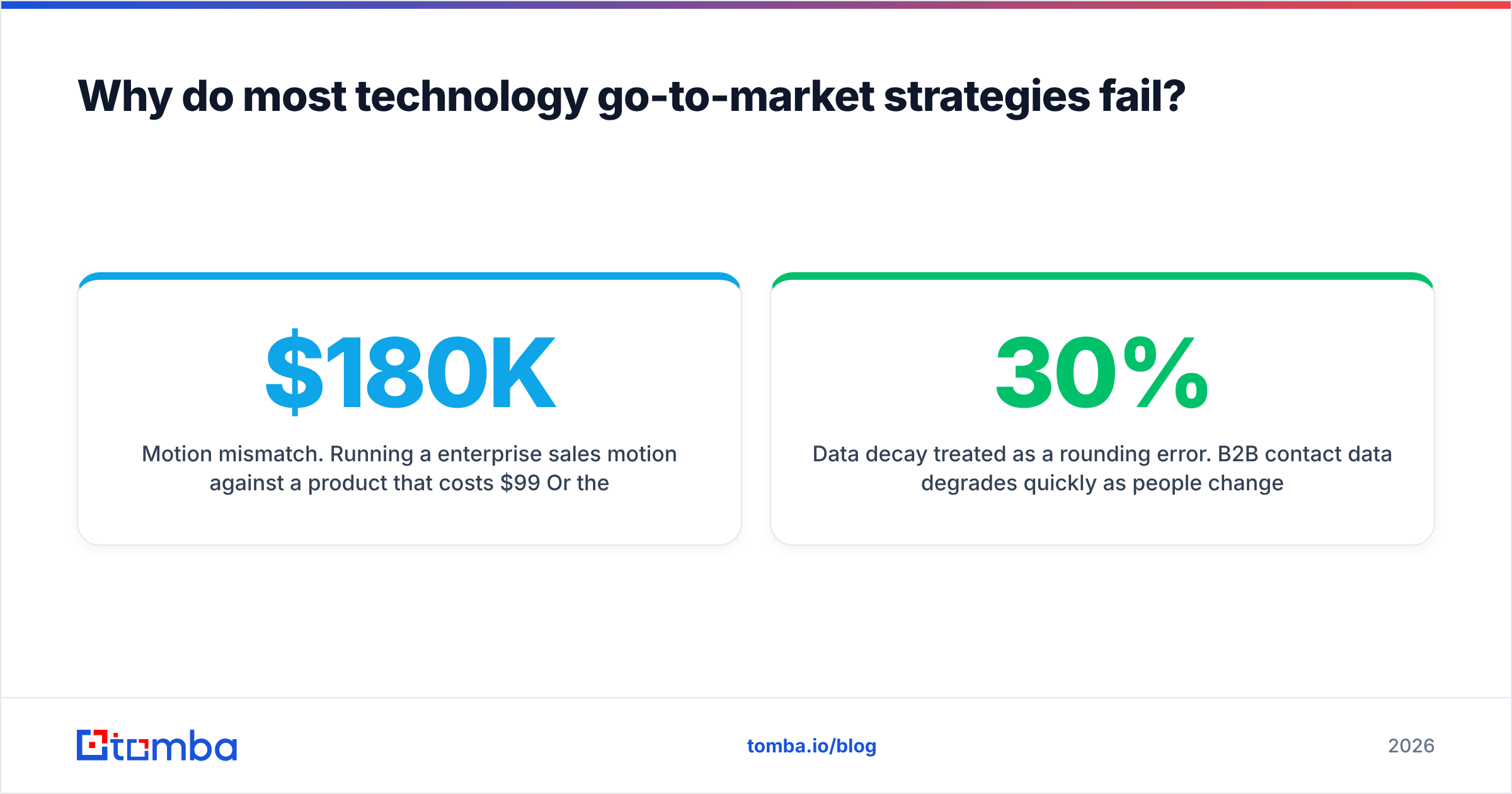
- Motion mismatch. Running a $180K enterprise sales motion against a $99/month product. Or the reverse: expecting self-serve signup to close a deal that needs a security review, a SOC 2 questionnaire, and procurement.
- Unqueryable ICP. Firmographic hand-waving that no analyst can filter on.
- Data decay treated as a rounding error. B2B contact data goes stale fast as people change jobs. Annual decay rates cited by data vendors and backed by HubSpot's research on database health sit near 22–30%. A list built in January is worse by July.
- No kill criteria. Every channel gets funded forever because nobody said in advance what failure looks like.

The fix for all four is the same. Make the strategy testable. Each motion gets a hypothesis, a budget, a time box, and a number that decides whether it survives the quarter.
Which go to market motion fits your technology product?#
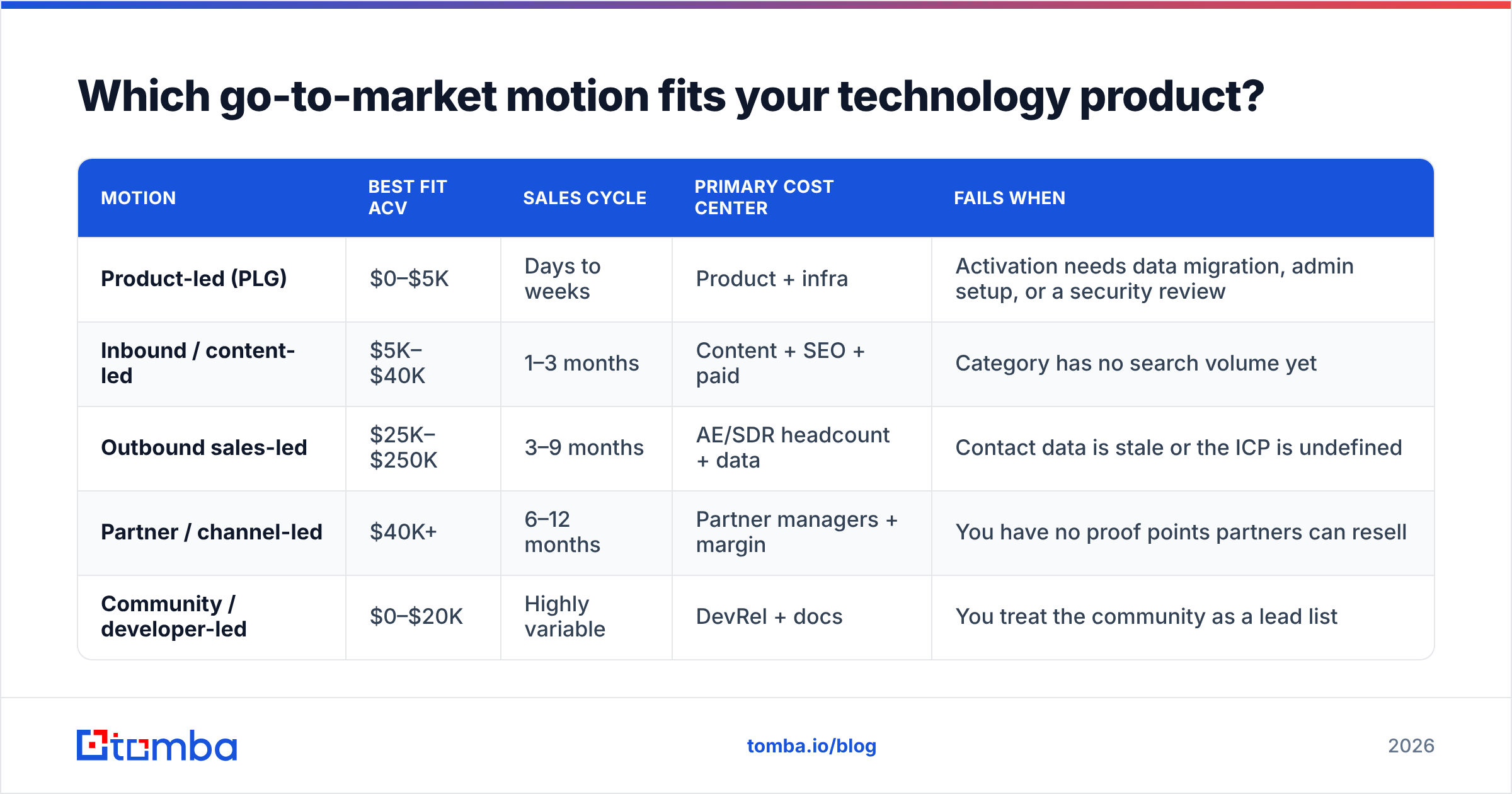
Pick based on your average contract value, how hard activation is, and how your buyer likes to evaluate. Do not pick based on what worked at a company you admire.
| Motion | Best fit ACV | Sales cycle | Primary cost center | Fails when |
|---|---|---|---|---|
| Product-led (PLG) | $0–$5K | Days to weeks | Product + infra | Activation needs data migration, admin setup, or a security review |
| Inbound / content-led | $5K–$40K | 1–3 months | Content + SEO + paid | Category has no search volume yet |
| Outbound sales-led | $25K–$250K | 3–9 months | AE/SDR headcount + data | Contact data is stale or the ICP is undefined |
| Partner / channel-led | $40K+ | 6–12 months | Partner managers + margin | You have no proof points partners can resell |
| Community / developer-led | $0–$20K | Highly variable | DevRel + docs | You treat the community as a lead list |
Two notes on this table. ACV bands are directional, not laws: a $12K product with a painful onboarding step still needs a human. And most technology companies in 2026 run two motions at once. A self-serve tier creates usage signal, and a sales team works the accounts where usage crosses a threshold.
That hybrid is fine. Running two motions on one set of metrics is not.
Before you commit, sanity-check demand with third-party review data. Category pages on G2 show which competitors buyers really shortlist you against. It is often not the list on your battlecard.
How do you build an ICP your data team can query?#
Write the ICP as filters. Then test whether those filters return a list you would be happy to work.
A queryable ICP has five layers:
- Firmographic — employee count band, revenue band, geography, industry codes. Real ranges, not "mid-market."
- Technographic — the tools in their stack that make you relevant or irrelevant. "Runs Kubernetes." "Uses Salesforce." "Has a public API."
- Trigger events — funding rounds, a new VP of Engineering, a compliance deadline, a price increase from a rival. Triggers turn a fit account into a timely one.
- Persona map — the economic buyer, the technical evaluator, and the champion, with the job titles they really use. Titles shift with company size.
- Disqualifiers — the explicit list of who you do not sell to. Teams skip this layer, and it saves the most SDR hours.
Now the step that separates a strategy from a document. Turn those five layers into a working account list with reachable contacts. Resolve companies to domains, find the decision-makers at each, and verify that the addresses are deliverable before anyone sends anything.
This is where a domain search approach beats buying a static list. You start from the account list your ICP filters produced, pull the relevant roles per domain, and enrich outward. A bulk email finder workflow does that at list scale. Running the results through an email verifier before the first send keeps your bounce rate in the range mailbox providers tolerate.
The discipline matters more than the vendor. No contact enters a sequence unverified. No list older than 90 days gets re-run without fresh verification.
What does a technology GTM data stack cost in 2026?#
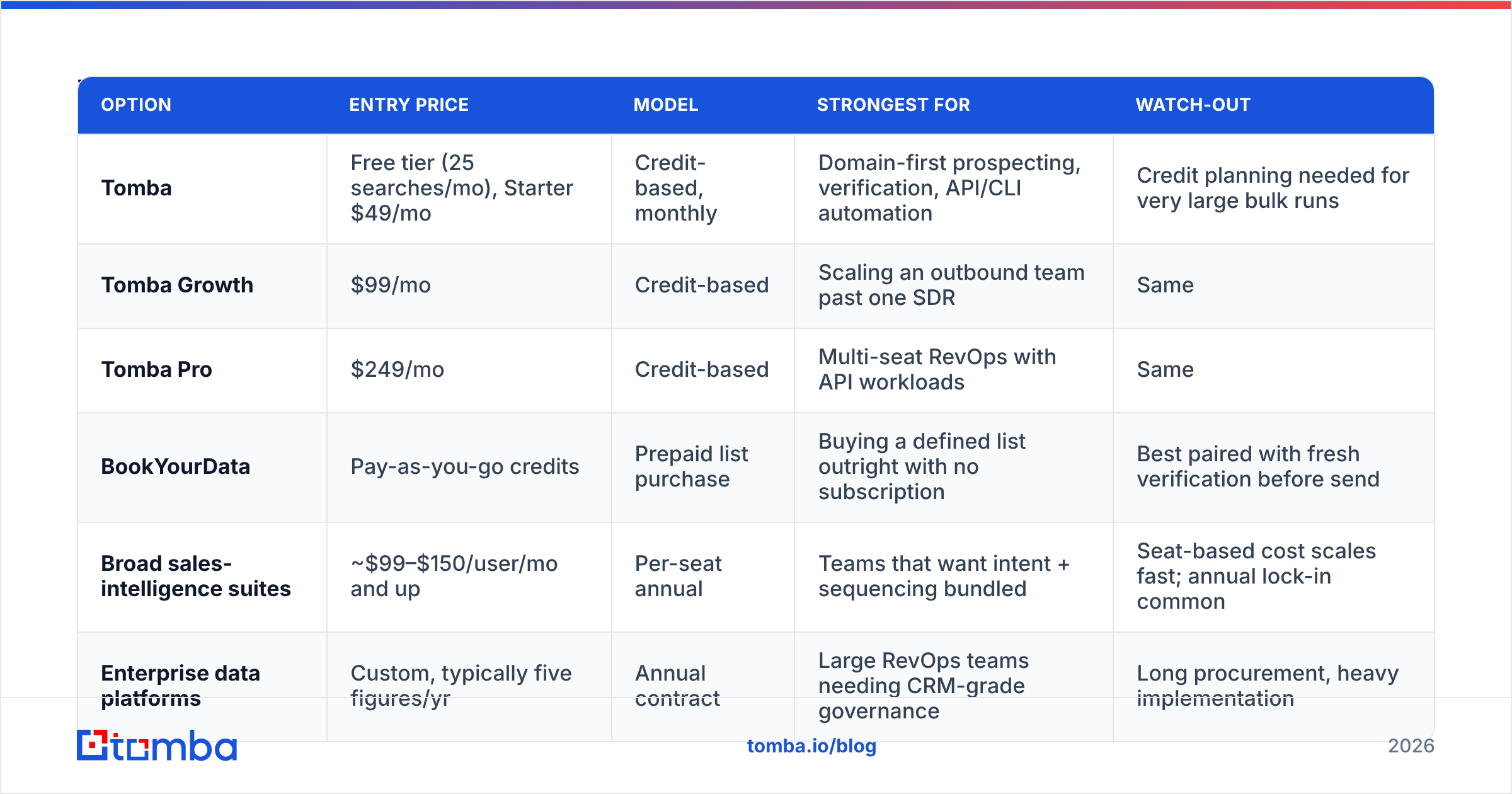
Less than most teams assume. Far less than a quarter of misdirected SDR effort. Here is how the contact-data layer prices out. List prices below reflect published entry tiers, so confirm them with each vendor before you budget.
| Option | Entry price | Model | Strongest for | Watch-out |
|---|---|---|---|---|
| Tomba | Free tier (25 searches/mo), Starter $49/mo | Credit-based, monthly | Domain-first prospecting, verification, API/CLI automation | Credit planning needed for very large bulk runs |
| Tomba Growth | $99/mo | Credit-based | Scaling an outbound team past one SDR | Same |
| Tomba Pro | $249/mo | Credit-based | Multi-seat RevOps with API workloads | Same |
| BookYourData | Pay-as-you-go credits | Prepaid list purchase | Buying a defined list outright with no subscription | Best paired with fresh verification before send |
| Broad sales-intelligence suites | ~$99–$150/user/mo and up | Per-seat annual | Teams that want intent + sequencing bundled | Seat-based cost scales fast; annual lock-in common |
| Enterprise data platforms | Custom, typically five figures/yr | Annual contract | Large RevOps teams needing CRM-grade governance | Long procurement, heavy implementation |
Full Tomba pricing is public, which is worth noting only because much of this category quotes on request. A two-SDR outbound motion running about 6,000 verified contacts a quarter lands in the $99–$249/month band for data. A loaded SDR costs well over $6,000/month each. The data layer is not where you should economize.

How do you sequence the first 90 days of a technology GTM launch?#
Sequence it so each phase produces evidence the next phase needs.
- Days 1–15: Narrow. Write the ICP as filters. Produce a named list of 300–500 target accounts. Name three disqualifiers. Agree on the one metric the launch is judged by.
- Days 16–30: Build the list. Resolve accounts to domains, map personas, find and verify contacts. Load them into the CRM with source and segment tagged from day one.
- Days 31–45: Test on a slice. Run 100–150 accounts across two message variants. You are testing positioning, not volume. Reply rate and meeting rate are the output.
- Days 46–70: Scale the winner. Push the winning variant to the full list. Add a second motion only now, once one channel shows signal.
- Days 71–90: Cut and codify. Kill what missed its threshold. Write down what worked: segment, trigger, message, channel, expected conversion.
The common mistake here is rushing steps 1 and 2 to reach step 3. Every hour saved on list quality comes back as a week of SDR time spent on accounts that were never going to buy.
What metrics prove a technology GTM strategy is working?#
Four, reviewed monthly, segmented by motion:
- Pipeline coverage by segment — aim for 3–4x quota for the coming quarter. Below 3x, you have a volume problem. Above 5x with a low win rate, you have a qualification problem.
- CAC payback period — sales and marketing cost divided by new gross margin per month. Under 12 months is healthy for B2B SaaS. Over 24 months means the motion costs too much for the ACV.
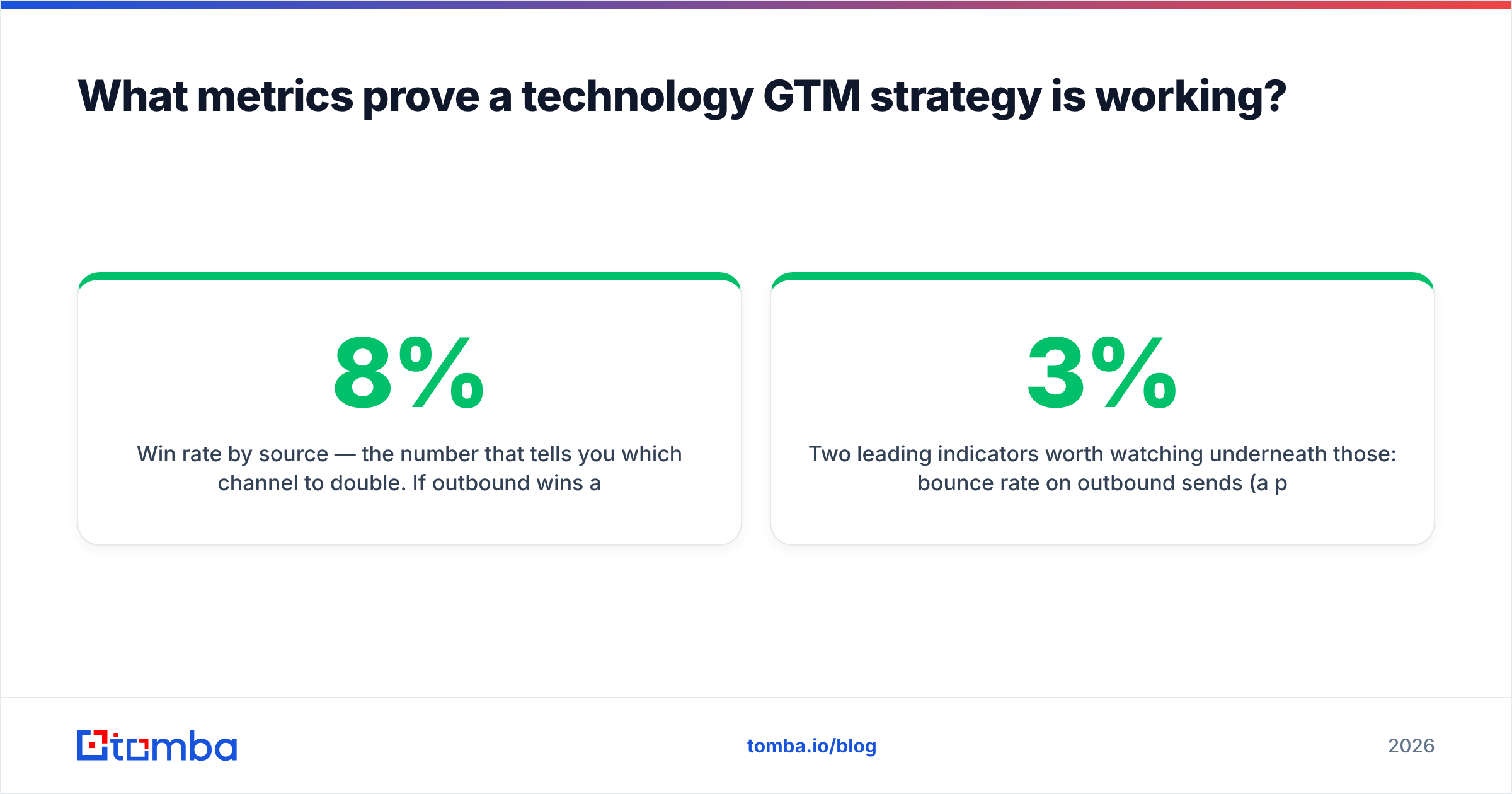
- Win rate by source — the number that tells you which channel to double. If outbound wins at 8% and inbound at 26%, that is a targeting problem, not a sales problem.
- Time-to-first-value — days from signup or close to the customer's first real outcome. It predicts retention earlier than NPS, and PLG motions live or die on it.
Two leading indicators sit underneath those. Bounce rate on outbound sends is a proxy for data hygiene: over 3% and your sender reputation is at risk. Meeting-to-opportunity conversion tells you whether SDRs are booking the right people.
Which go to market mistakes kill technology companies fastest?#
- Copying a public company's motion at seed stage. Their GTM runs on a brand you do not have yet.
- Hiring a VP of Sales before founder-led sales has closed 10 deals. Nobody can systematize a motion that has never been run.
- Treating positioning as a copywriting task. Positioning is a segmentation decision with words attached, and it belongs to whoever owns the ICP.
- Running outbound on unverified data. It hurts deliverability across every domain you own, and the damage outlasts the campaign.
- No disqualification criteria. Reps optimize for activity when nobody tells them what to skip.
Where should you start this week?#
Start with the list. The list is what makes every other decision falsifiable. Write your ICP as five layers of filters. Pull 300 accounts that match, find the decision-makers, verify the contacts, and send 100 emails across two message variants.
In ten days you will learn more about your go to market strategy for technology than another quarter of planning would teach you.
For the build-the-list step, the Tomba Email Finder takes you from a domain list to verified, role-mapped contacts. Start on the free tier at 25 searches per month, then move to Starter at $49/month once your first segment proves out.
Related guides#
Ready to find emails that actually work?
Join 150,000+ professionals who stopped guessing and started sending. Free credits on signup — no credit card required.
Get the Tomba newsletter
Practical outbound tactics and product updates — once every two weeks.
About the author