Go To Market Strategy Framework: A 2026 Operator's Guide
Most GTM decks are slides nobody opens twice. Here is a seven-layer go to market strategy framework you can actually run, with the metrics, data plumbing, and failure modes that decide whether it works.
TL;DR
- A go to market strategy framework is not a positioning deck. It is a chain of seven decisions — market, ICP, problem, offer, motion, channel, measurement. Each one limits the next.
- Most GTM plans fail at layer 2 (ICP) and layer 5 (motion), then get blamed on layer 6 (channel). Reps get blamed for a targeting problem.
- Pick exactly one primary motion for the first two quarters: product-led, sales-led, partner-led, or community-led. Blended motions require infrastructure you probably don't have yet.
- Your framework is only as good as the contact data underneath it. A perfect ICP with 40% bounce rates produces the same result as no ICP at all.
- Measure leading indicators (meetings booked per 100 accounts touched, reply rate by segment) for the first 90 days. Pipeline and CAC payback lag too much to steer with.
What is a go to market strategy framework?#
A go to market strategy framework is a repeatable decision structure. It connects who you sell to, what you sell them, how you reach them, and how you know it's working. Think of it like the wiring diagram for a house. The rooms — campaigns, sequences, launches — can change. The circuits underneath decide what is even possible.
Most GTM documents feel useless because they list outputs: "we'll run outbound, do content, attend three conferences." They skip the constraints that produced those outputs. A good framework makes those constraints explicit, in order.
Here are the first four layers, in dependency order:
- Market selection — Which market are you in, and is it growing, consolidating, or being disrupted? This decides whether you take share or create demand. Different budgets, different timelines.
- ICP definition — Not "mid-market SaaS." A real ICP has firmographic bounds (headcount, revenue, geo), technographic signals (what they already run), and a triggering event. If you can't build a target list from it, it isn't one.
- Problem framing — The specific, expensive, unsolved pain your ICP admits to. Ask whether the buyer has a line item, a person, or a spreadsheet for it today. No workaround means no urgency.
- Offer and pricing — Packaging, entry price, and the shape of the first deal. A $49 self-serve plan and a $50k annual contract imply very different motions downstream.
The last three layers turn those decisions into activity:
- Motion selection — Product-led, sales-led, partner-led, or community-led. This is the highest-leverage choice, and the one teams most often fudge.
- Channel mix — Outbound email, paid, SEO, events, LinkedIn, integrations marketplace. Channels serve the motion; they don't replace it.
- Measurement and feedback loop — What you check weekly, what you check quarterly, and what you are willing to kill.
Skip a layer and you inherit its defaults. Skip layer 2 and your channel spend gets averaged across everyone who happened to click.
How do the four GTM motions actually compare?#
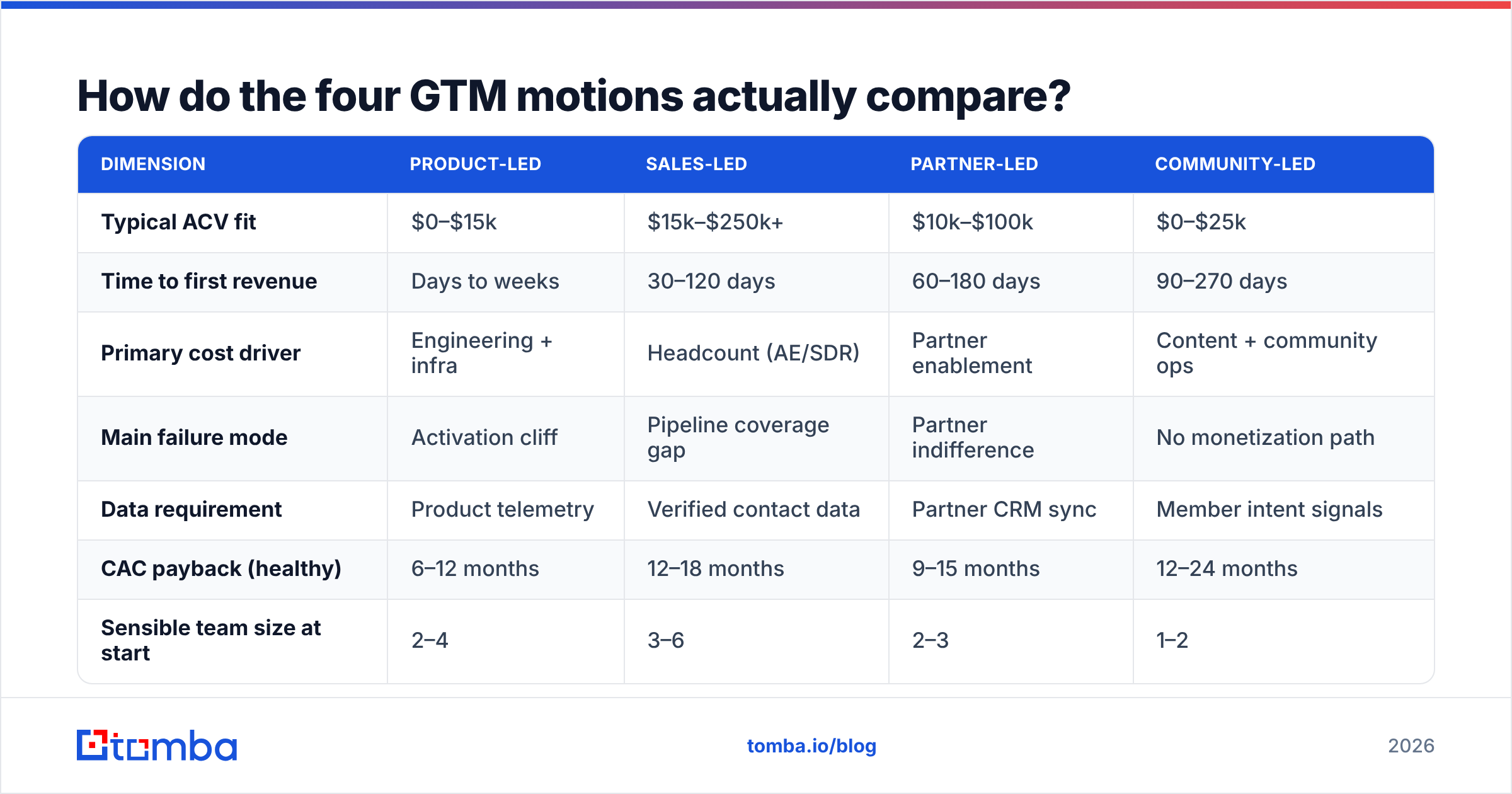
Motion choice determines your cost structure, your hiring plan, and your time-to-first-revenue. Choosing "all of them" means choosing none of them well.
| Dimension | Product-led | Sales-led | Partner-led | Community-led |
|---|---|---|---|---|
| Typical ACV fit | $0–$15k | $15k–$250k+ | $10k–$100k | $0–$25k |
| Time to first revenue | Days to weeks | 30–120 days | 60–180 days | 90–270 days |
| Primary cost driver | Engineering + infra | Headcount (AE/SDR) | Partner enablement | Content + community ops |
| Main failure mode | Activation cliff | Pipeline coverage gap | Partner indifference | No monetization path |
| Data requirement | Product telemetry | Verified contact data | Partner CRM sync | Member intent signals |
| CAC payback (healthy) | 6–12 months | 12–18 months | 9–15 months | 12–24 months |
| Sensible team size at start | 2–4 | 3–6 | 2–3 | 1–2 |
A practical filter: if your buyer can get value alone in under 20 minutes, product-led is available to you. If evaluation requires security review, procurement, or multi-stakeholder consensus, you're sales-led whether you like it or not — self-serve will just generate trials that never convert.
Partner-led deserves a caution. It looks cheap because you're not hiring reps. But partner motions have a long dead zone before the first co-sold deal. Gartner's B2B buying research shows buyers spend most of their journey outside vendor conversations. That is why partners can work — but only when the partner has a real reason to bring you into deals.
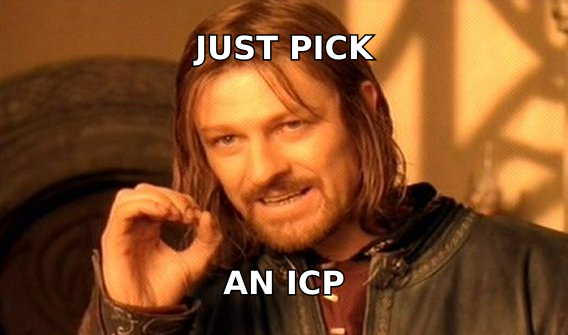
Why does ICP definition break most GTM frameworks?#
Because "ICP" gets written as a persona and then used as a filter, and those are different objects.
A persona describes a human: their goals, their day, their objections. Useful for copy. Useless for list building. A filter is a set of attributes you can query. It gives you a finite, named list of accounts. You need both, but the filter is what makes the framework work in practice.
Build your ICP filter with four components:
- Hard bounds — Headcount range, revenue range, country, industry codes. These are non-negotiable exclusions. Getting these wrong costs you nothing but wasted volume; getting them too loose costs you your sender reputation.
- Qualifying signals — Tech stack, funding stage, job postings, recent leadership changes. These rank accounts inside the bounds.
- Trigger events — A new VP of Sales, a Series B, a compliance deadline, a competitor's price increase. Triggers determine timing, and timing is most of outbound.
- Disqualifiers — Existing competitor contract with 11 months remaining, headcount under your minimum seat count, a geography you can't support. Write these down; they save more hours than any tool.
Once you have that filter, the bottleneck becomes contact data. You can build a perfect 400-account list and still fail. If you reach only 60% of the decision-makers, the list is 60% of a list. This is where most GTM frameworks go quiet. They assume the contact layer is solved. It isn't. Tools like domain search turn a company list into named contacts, and an email verifier keeps the resulting list from torching your domain reputation before the campaign starts.
Set a hard rule: no sequence launches against a list with more than 3% unverified addresses. That single rule prevents more damage than any subject-line optimization.
What does a working GTM framework look like layer by layer?#
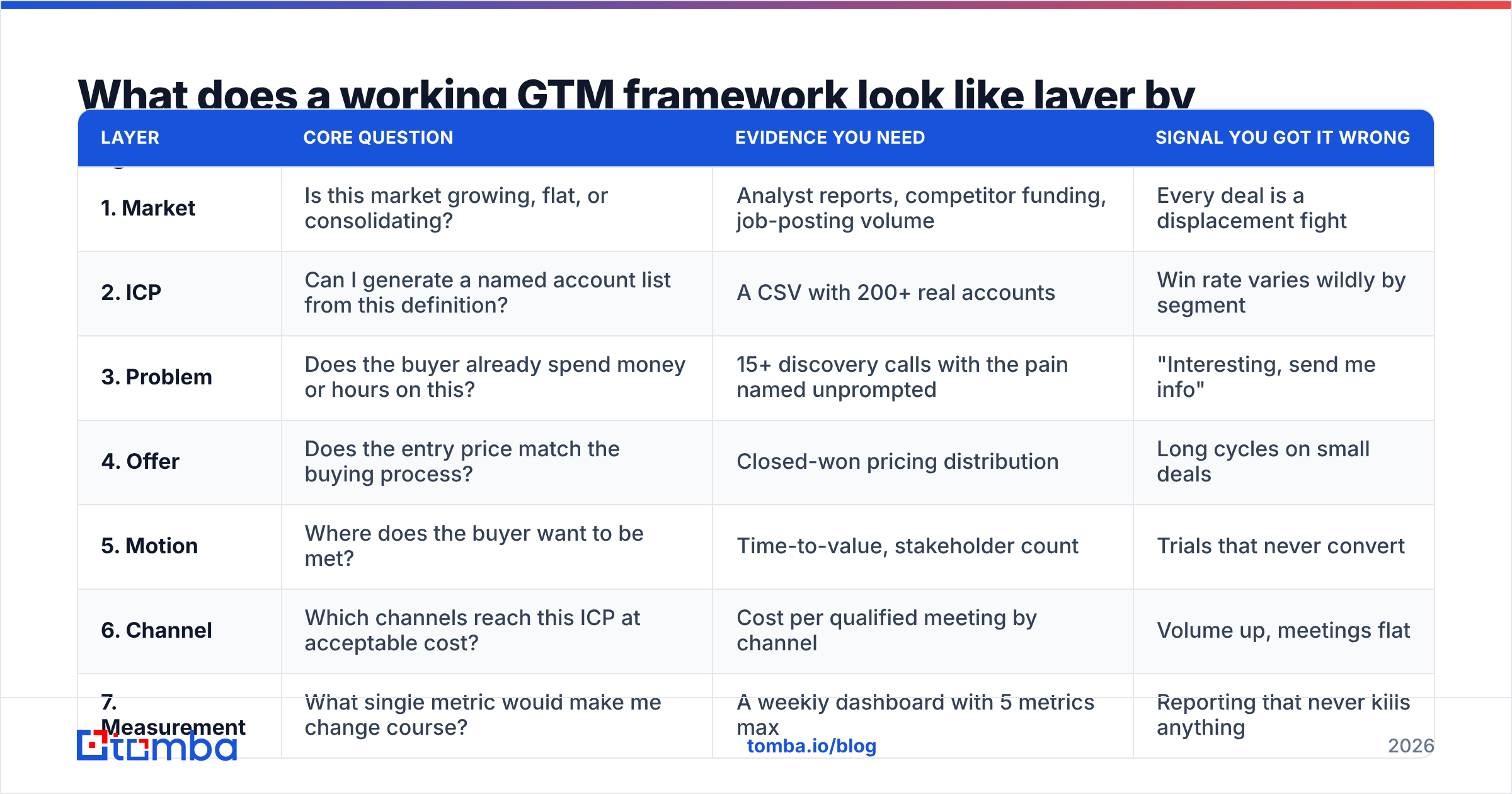
Here's the framework rendered as a decision table. Use it as a working document, not a one-time exercise — revisit it quarterly.
| Layer | Core question | Evidence you need | Signal you got it wrong |
|---|---|---|---|
| 1. Market | Is this market growing, flat, or consolidating? | Analyst reports, competitor funding, job-posting volume | Every deal is a displacement fight |
| 2. ICP | Can I generate a named account list from this definition? | A CSV with 200+ real accounts | Win rate varies wildly by segment |
| 3. Problem | Does the buyer already spend money or hours on this? | 15+ discovery calls with the pain named unprompted | "Interesting, send me info" |
| 4. Offer | Does the entry price match the buying process? | Closed-won pricing distribution | Long cycles on small deals |
| 5. Motion | Where does the buyer want to be met? | Time-to-value, stakeholder count | Trials that never convert |
| 6. Channel | Which channels reach this ICP at acceptable cost? | Cost per qualified meeting by channel | Volume up, meetings flat |
| 7. Measurement | What single metric would make me change course? | A weekly dashboard with 5 metrics max | Reporting that never kills anything |
The evidence column is the part people skip. A GTM framework without evidence requirements is just a set of opinions in a table.
How do you sequence the first 90 days?#
Days 1–30 are for narrowing. Days 31–60 are for testing. Days 61–90 are for committing.
Days 1–30 — Narrow. Lock layers 1 through 4. Interview at least 15 buyers who fit your hard bounds, including 5 who chose a competitor. Build your first 200-account target list. Do not launch anything yet. The temptation to send email in week one is the single most expensive impulse in early GTM.
Days 31–60 — Test. Launch your chosen motion against three ICP sub-segments in parallel, with identical messaging structure. You're not testing copy yet, you're testing segment responsiveness. Measure reply rate, positive reply rate, and meetings booked per 100 accounts touched. Keep volume low enough that each segment gets a fair read — 150 to 250 contacts per segment is usually enough to see a real difference.
Days 61–90 — Commit. Kill the two weakest segments. Double volume on the winner. Now start testing messaging, since you finally have a stable audience to test against. Build the data pipeline properly: enrichment, verification, CRM sync. Manual CSV work is fine for 200 accounts and fatal at 2,000, which is why data enrichment and a real email finder API belong in this phase rather than the previous one.
Which metrics should the framework actually track?#
Fewer than you think, and different ones at different altitudes.
Weekly (leading, steerable):
- Accounts touched
- Reply rate and positive reply rate, split by segment
- Meetings booked per 100 accounts touched
- Bounce rate (should be under 2%; above 5% means stop and fix data)
Monthly (mid-loop):
- Meeting-to-opportunity conversion
- Average sales cycle length by segment
- Pipeline created vs pipeline target
- Channel cost per qualified meeting
Quarterly (lagging, structural):
- CAC payback period
- Net revenue retention
- Win rate by segment and by source
- Magic number or equivalent efficiency ratio
The mistake is steering weekly decisions with quarterly metrics. CAC payback tells you whether last quarter's framework worked; it cannot tell you whether Tuesday's segment test is promising. Conversely, obsessing over weekly reply rates while never checking payback produces a very efficient machine pointed at unprofitable customers.
One more discipline: pick, in advance, the number that would make you kill the motion. Write it in the doc. "If meetings per 100 accounts stays under 1.5 after 60 days across all three segments, we change motion." Frameworks without pre-set kill criteria never change anything. By the time the results land, everyone is already invested.
How do B2B data quality problems sabotage the framework?#
Every layer above 5 sits on top of contact data, and that data decays faster than most teams plan for. People change jobs. Companies rebrand domains. Inboxes get retired. If your framework assumes a static list, it degrades quietly.
Three concrete failure modes:
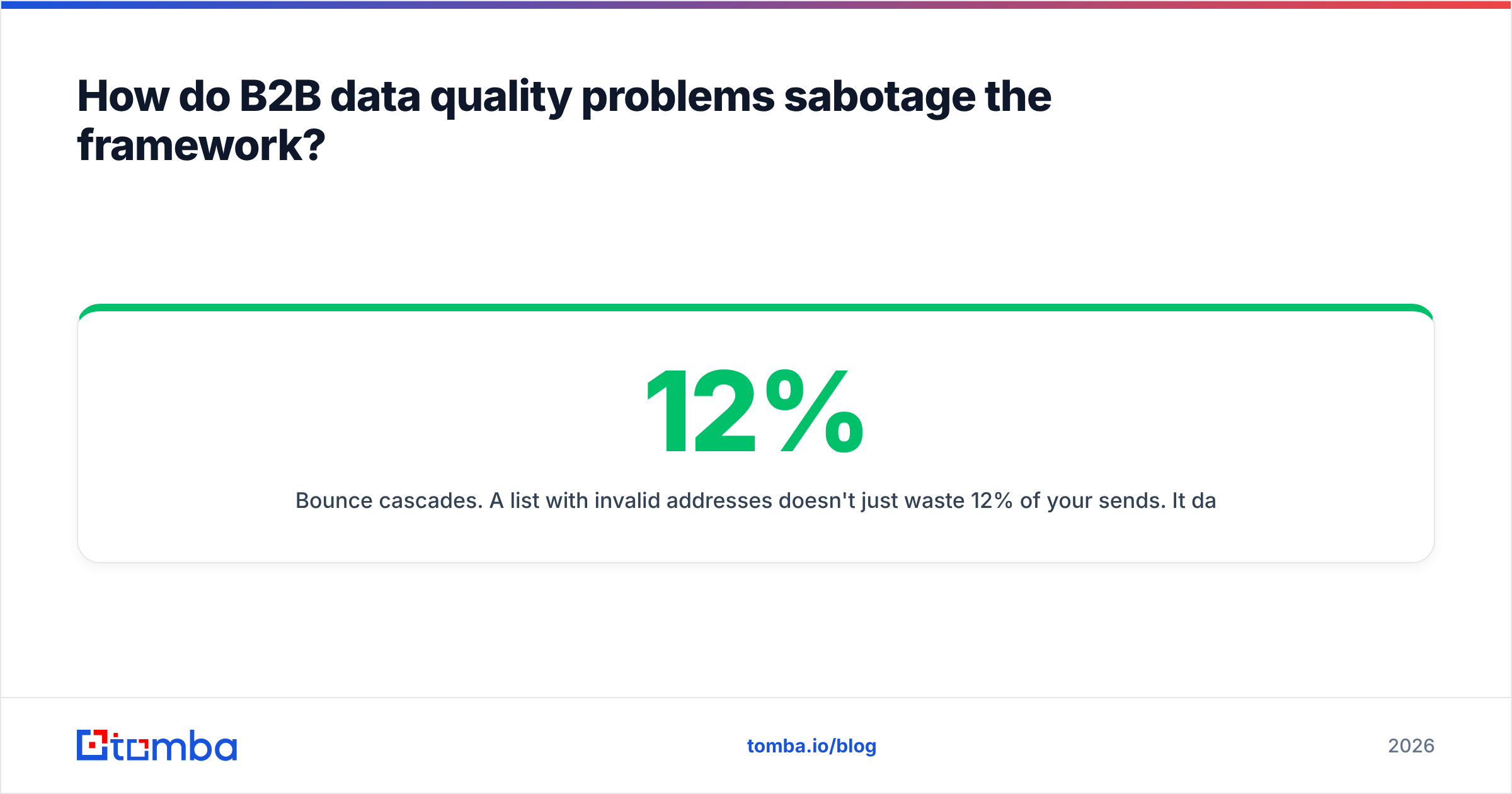
- Bounce cascades. A list with 12% invalid addresses doesn't just waste 12% of your sends. It damages sender reputation, which suppresses delivery of the other 88%. Your segment test then returns a false negative and you kill a good segment.
- Catch-all ambiguity. Many enterprise domains accept everything at the SMTP layer, so a naive verifier marks them "valid." You need a catch-all verifier to distinguish real mailboxes from accept-all black holes, or your enterprise segment will look artificially healthy on delivery and artificially dead on replies.
- Attribution rot. If enrichment happens after the CRM record is created, source data gets overwritten and your channel cost-per-meeting numbers become fiction. Enrich at ingestion, not at review.
Independent review sites help you sanity-check vendor claims. G2's data-quality category shows how widely accuracy varies between providers that all advertise similar coverage. Test with your own ICP sample before you commit. Industry-average accuracy numbers rarely hold up inside one vertical.
For teams working a defined account list, the practical setup is: source contacts by domain, verify before send, re-verify anything older than 90 days, and keep a suppression list that survives tool migrations. That last one sounds trivial until you switch sequencers and re-email 3,000 people who already said no.
How do you adapt the framework by company stage?#
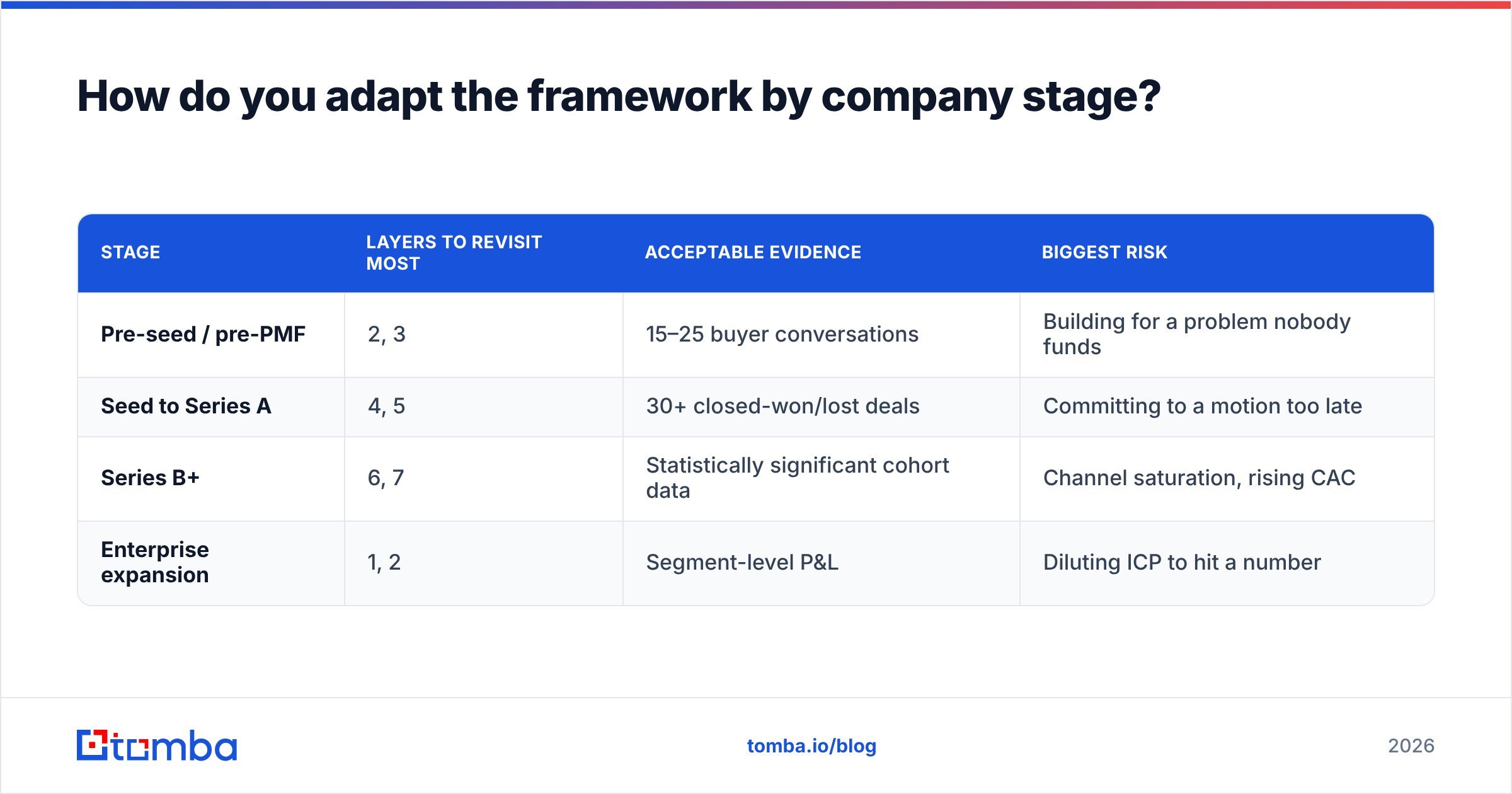
The seven layers don't change. The evidence bar and the reversibility do.
| Stage | Layers to revisit most | Acceptable evidence | Biggest risk |
|---|---|---|---|
| Pre-seed / pre-PMF | 2, 3 | 15–25 buyer conversations | Building for a problem nobody funds |
| Seed to Series A | 4, 5 | 30+ closed-won/lost deals | Committing to a motion too late |
| Series B+ | 6, 7 | Statistically significant cohort data | Channel saturation, rising CAC |
| Enterprise expansion | 1, 2 | Segment-level P&L | Diluting ICP to hit a number |
At the earliest stage, treat every layer as reversible and cheap to change. At Series B, changing layer 5 means restructuring a team, so the evidence bar rises accordingly. The framework's value at scale isn't discovery — it's preventing well-meaning expansion from silently widening the ICP until nothing converts.
One stage-independent rule: never change more than two layers in the same quarter. If you change ICP, motion, and channel simultaneously, you've destroyed your ability to attribute the result. This is the GTM equivalent of changing three variables in one experiment.
What are the most common go to market strategy framework mistakes?#
Three of them are decision mistakes:
- Confusing a channel with a strategy. "Our GTM is outbound" describes layer 6 only. It says nothing about who, why, or what happens after the meeting.
- ICP by wishful thinking. Defining the ICP as the customers you want, not the ones who convert fastest and churn least. Run the analysis on closed-won data. It usually contradicts the deck.
- Motion drift. Starting sales-led, adding self-serve to "capture the long tail," and ending up with a discounted enterprise product nobody can buy alone. The long tail is a distraction until the core motion is profitable.
The other three are measurement mistakes:
- Measuring only what's easy. Open rates are close to meaningless post-MPP. Meetings per 100 accounts touched is harder to compute, and it tells you something real.
- No kill criteria. Covered above, and worth repeating. It is the difference between a framework and a wish list.
- Ignoring the data layer. Teams spend six weeks on positioning and 20 minutes on where contact data comes from. Then they wonder why the campaign underperformed.
For a broader vocabulary on the operating side of this — revenue operations, pipeline definitions, stage exit criteria — it helps to standardize terms across sales, marketing, and finance before you start reporting. Half of GTM disagreements are definitional.
How do you document the framework so people actually use it?#
Keep it to two pages. One page is the seven-layer decision table with your current answers and the date each was last reviewed. The second page is the kill criteria and the current weekly dashboard.
Anything longer becomes an artifact rather than a tool. The test is simple: can a new AE read it in ten minutes and correctly describe who to target and why? If not, it's a document about your strategy rather than your strategy.
Review it on a fixed cadence — the first week of each quarter works — and record what changed and what evidence caused the change. Over four quarters you'll have something more valuable than the framework itself: a record of how your understanding of the market evolved, and which of your assumptions kept being wrong.
Where should you start this week?#
Start at layer 2, because it's the layer with the highest error rate and the lowest cost to fix. Pull your closed-won and closed-lost data, segment by firmographics, and find where win rate diverges by more than 15 points. That divergence is your real ICP telling you something your positioning deck isn't.
Then build the list. A go to market strategy framework that never becomes a named set of accounts and verified contacts stays theoretical. Theoretical GTM plans don't produce pipeline.
When you're ready to turn your ICP definition into a reachable list, Tomba Email Finder resolves company domains and names into verified professional email addresses, with a free tier at 25 searches per month and paid plans starting at $49/mo for Starter, $99/mo for Growth, and $249/mo for Pro — see Tomba pricing for the full breakdown. Build the account list first, verify before you send, and let the framework's measurement layer tell you what to do next.
Related guides#
Ready to find emails that actually work?
Join 150,000+ professionals who stopped guessing and started sending. Free credits on signup — no credit card required.
Get the Tomba newsletter
Practical outbound tactics and product updates — once every two weeks.
About the author