Go To Market Strategy Healthcare: The 2026 Playbook
Healthcare GTM fails on committee buying, procurement, and stale contact data — not on product. Here's the 2026 playbook: buyer map, motion selection, compliance-safe outbound, and the KPIs that predict a signed contract.
A go to market strategy healthcare buyers accept looks nothing like a normal B2B plan. Deals die in committee, not in the demo. Here is the 2026 playbook.
TL;DR
- A go to market strategy healthcare deal fails in committee. One hospital purchase touches 6–12 people. Clinical, IT, security, finance, and legal each hold a veto. None of them can sign alone.
- Pick the motion first, then hire. Provider, payer, digital health, and EHR channel motions differ in cycle time, deal size, and team shape.
- Compliance shapes the stack, not just the product. Touch patient data and you own a HIPAA problem. Touch work contact data and you own a data quality problem.
- Contact data rots fast here. Clinical leaders move. Health systems merge and drop whole domains. Verify before each send.
- Track pilot-to-contract rate and security review pass rate. Both beat MQLs at predicting revenue.
Why go to market strategy healthcare planning is different#
Healthcare buyers are not slow because they cannot decide. They are slow because a bad call costs patient safety. The contracts run for years and hurt to unwind.
Three forces shape any go to market strategy healthcare vendors run:
- The buyer is a committee. Your clinical champion cannot sign. They can only walk you through security review, IT review, the value analysis committee, and finance.
- The budget cycle is fixed. Health systems plan spend once a year. Miss the window and you wait. That is not the same as losing.
- Integration is the product. You have to trade data with Epic, Oracle Health (Cerner), Meditech, or the health plan claims system. Gartner's healthcare technology research ranks data sharing above feature depth.
So build the plan around removing risk. Persuasion comes second. Every call, asset, and pilot should kill one reason to say no.
Who actually buys in a healthcare deal?#
Map the committee before you write a single email. A go to market strategy healthcare team starts here. This is the cast in a large health system deal:
- Clinical champion (CMIO, service-line director, nurse lead) — cares about workflow. Wants to know how many clicks you add per shift.
- IT and integration lead — cares about FHIR and HL7 work, and about support tickets. Kills deals quietly.
- Security and privacy (CISO, privacy officer) — wants your SOC 2 report, pen test, subprocessor list, and BAA terms. Reviews run 4–10 weeks.
- Value analysis and supply chain — cares about cost and overlap. This is where 'we already have that' ends deals.
- Finance — cares about payback, and whether the savings are real dollars.
- Legal — cares about the BAA, indemnity, and who owns the data.
Health plans swap the clinical champion for a medical director. They add actuarial review too. Smaller buyers cut the list to three or four names. RCM firms, MSOs, and staffing groups all work that way. That is why many vendors start there.

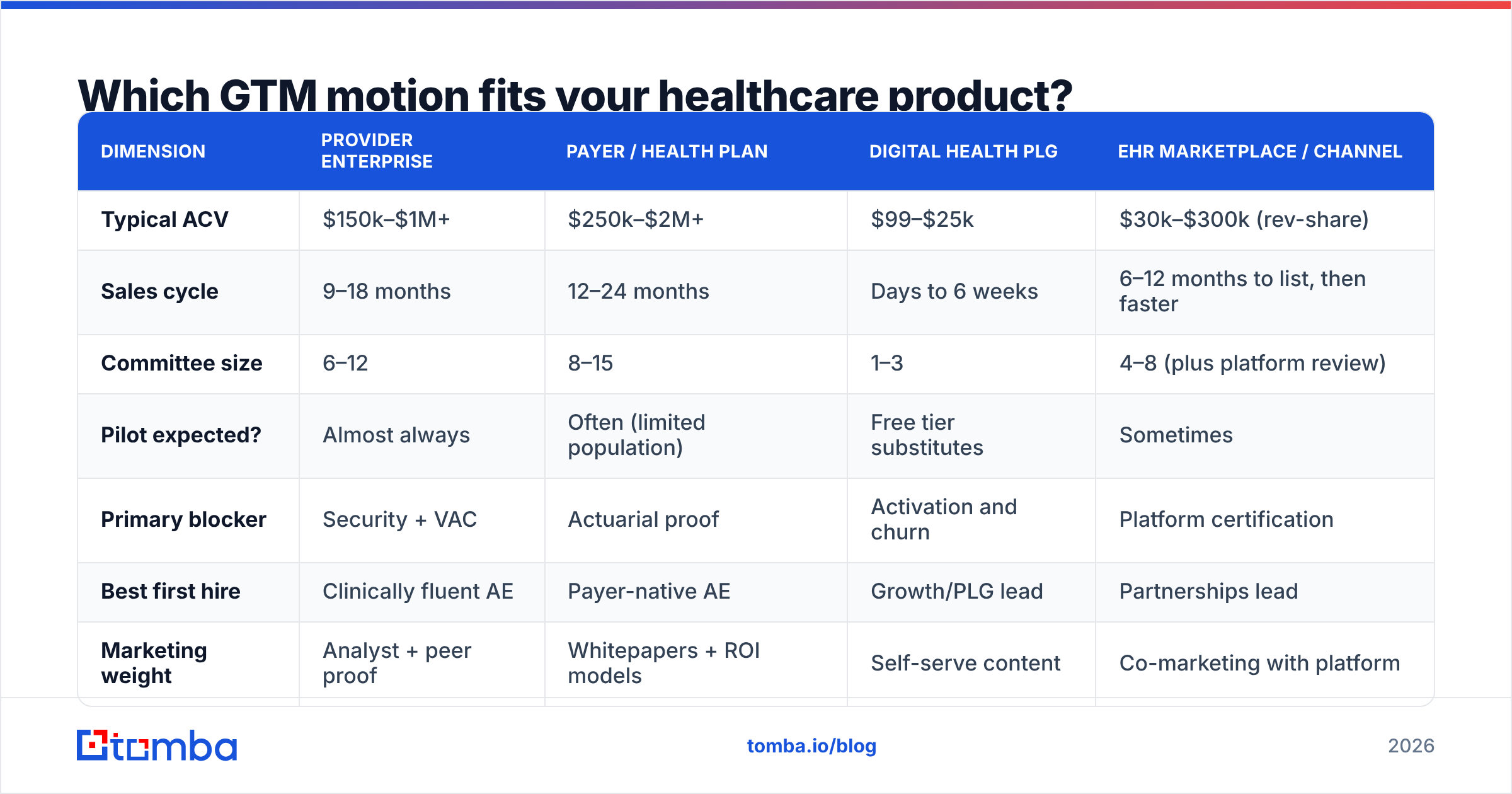
Which GTM motion fits your healthcare product?#
Most failed launches are motion mismatches. A $40k product gets sold with a $400k playbook. Compare the options first. Then hire.
| Dimension | Provider enterprise | Payer / health plan | Digital health PLG | EHR marketplace / channel |
|---|---|---|---|---|
| Typical ACV | $150k–$1M+ | $250k–$2M+ | $99–$25k | $30k–$300k (rev-share) |
| Sales cycle | 9–18 months | 12–24 months | Days to 6 weeks | 6–12 months to list, then faster |
| Committee size | 6–12 | 8–15 | 1–3 | 4–8 (plus platform review) |
| Pilot expected? | Almost always | Often (limited population) | Free tier substitutes | Sometimes |
| Primary blocker | Security + VAC | Actuarial proof | Activation and churn | Platform certification |
| Best first hire | Clinically fluent AE | Payer-native AE | Growth/PLG lead | Partnerships lead |
| Marketing weight | Analyst + peer proof | Whitepapers + ROI models | Self-serve content | Co-marketing with platform |
| Data need | Named committee contacts | Named plan executives | Product telemetry | Platform ecosystem contacts |
Read that table as a promise. Provider enterprise means a long runway and few deals. It also means a heavy proof burden. PLG in digital health means you live or die on retention.
One hybrid works well in a 2026 go to market strategy healthcare plan. Sell PLG to small clinics and the digital health long tail. Use that cash and those logos to fund the enterprise motion. The small deals create the outcome data the big committee asks for.
How do you build an ICP that survives review?#
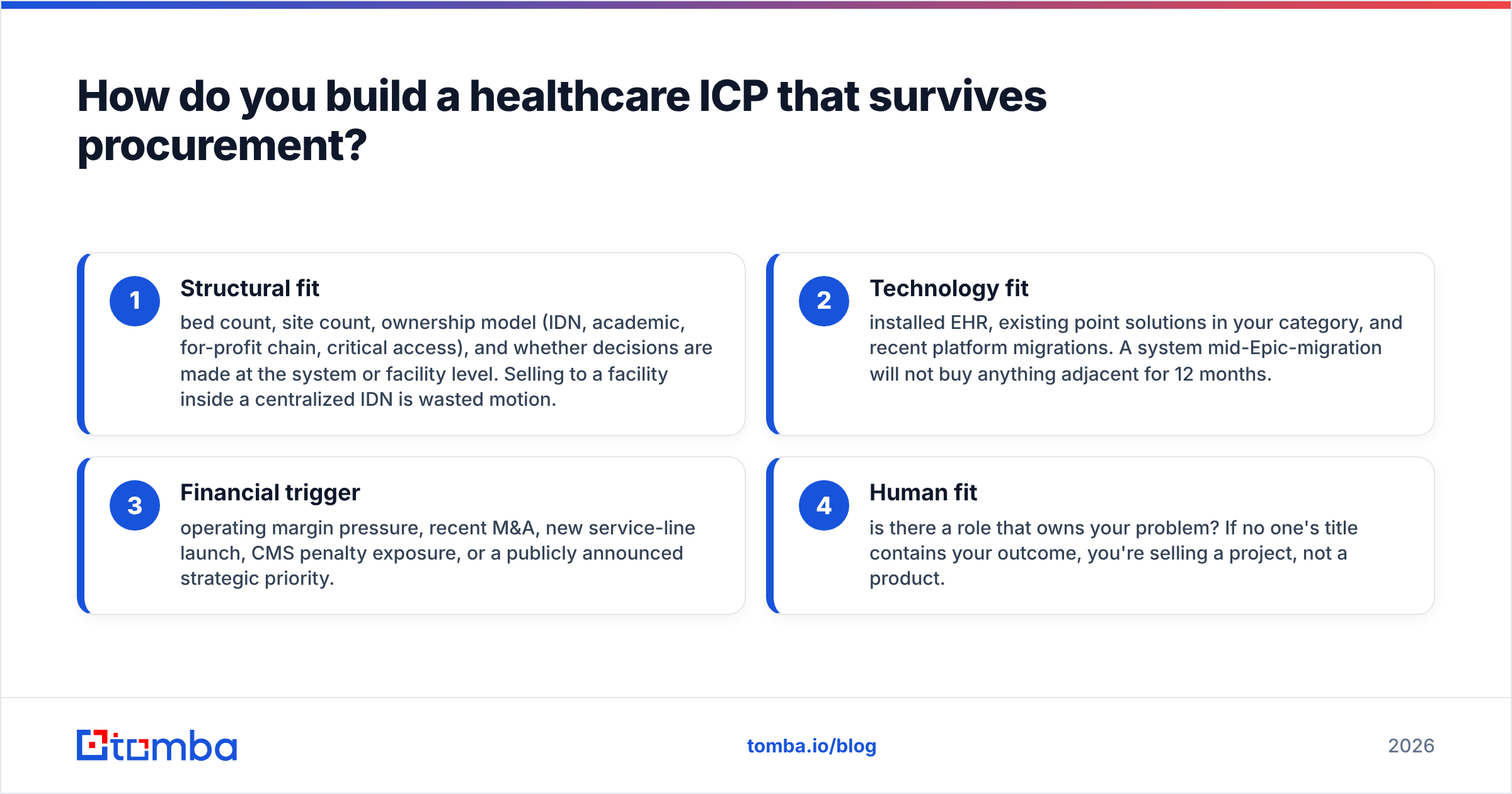
Firmographics alone are useless. 'Hospitals with 200+ beds' is a list, not an ICP. A go to market strategy healthcare team needs four filters:
- Structure — bed count, site count, owner type, and who decides. Selling to one site inside a central system wastes motion.
- Tech — the EHR in place, the tools you compete with, and recent migrations. A system mid-Epic rollout will not buy for 12 months.
- Trigger — margin pressure, a merger, a new service line, a CMS penalty, or a stated priority.
- People — does one role own your problem? If no title names your outcome, you are selling a project.
Score each account on all four. High on structure and tech, empty on trigger and people? Send it to nurture, not to a rep. This one habit lifts win rates more than any message rewrite.
Is outbound still viable in healthcare in 2026?#
Yes, but only precision outbound. Volume outbound burns your domain. It also annoys the exact people you need.
Three rules keep a go to market strategy healthcare team out of the spam folder:
- Never touch PHI. Prospect on work data only: role, employer, work email, work phone. The moment patient data enters your stack, HIPAA applies. Marketing tools are not built for that. Read the HHS guidance on HIPAA before your first campaign, not after your first incident.
- Write to the committee, not the persona. Send the champion a workflow story. Send the CISO a security summary. Send finance an ROI model built on their own numbers. One account, three messages, three formats.
- Respect the gateway. Health systems filter hard. Low volume and high relevance from a warm domain gets through. Blast sequences do not. Run a spam checker on every template first. Keep daily volume per mailbox low.
Precision needs clean data. Clinical leaders turn over fast. Health systems merge and re-domain. Titles mean different things at different systems. So build contact discovery into the workflow. Use domain search to map who works at a target system. Then run each address through an email verifier right before send. Quarterly cleanup is not enough. One merger can void 15% of a 500-contact list.
Some accounts gate email hard. Pair the contact record with a phone finder lookup there. In healthcare, a well-timed direct dial still beats email.

What does compliance require from your GTM stack?#
Compliance shows up in two places. Teams mix them up.
Product side is what security review reads. That means SOC 2 Type II, HITRUST, pen test results, a subprocessor list, encryption, and a signed BAA when PHI is in play. That is not a marketing problem. It is a marketing asset. Publish a trust center. Half the review answers itself.
GTM side is narrower and often ignored. Where does your prospect data come from? Can you honor a deletion request? How does your vendor source records? Does your sending meet CAN-SPAM and GDPR? Ask every data vendor those questions. Tomba lists its data sources in public. Expect the same from anyone you buy from.
Here is the failure mode. A rep scrapes a patient-facing directory into the CRM. Now the company holds data it cannot explain to an auditor. So set one hard rule for the go to market strategy healthcare team: work contact data only, from a vendor you can name.
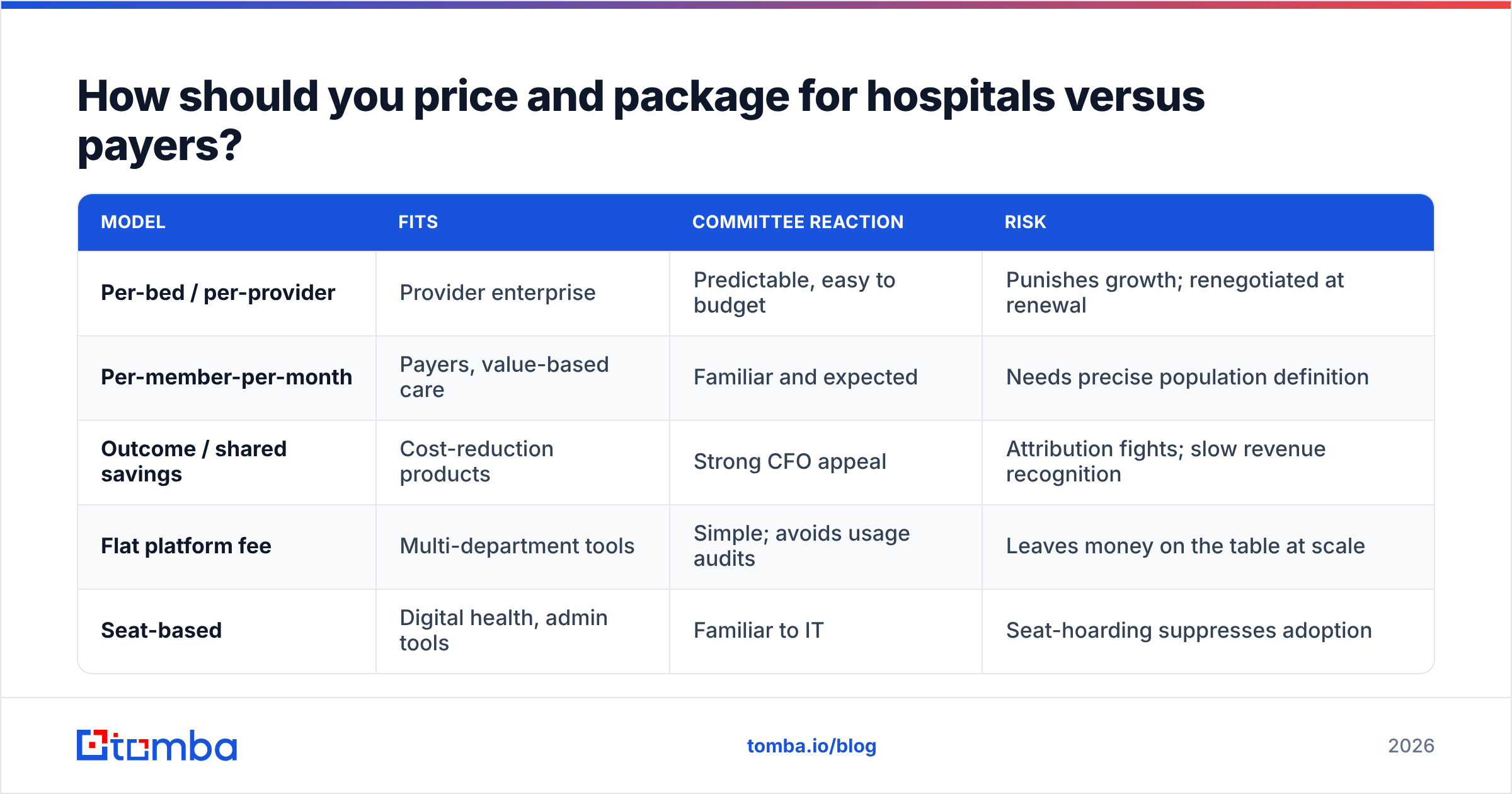
How should you price for hospitals versus payers?#
Pricing is a GTM call, not a finance call. Your model decides which committee reads you.
| Model | Fits | Committee reaction | Risk |
|---|---|---|---|
| Per-bed / per-provider | Provider enterprise | Predictable, easy to budget | Punishes growth; renegotiated at renewal |
| Per-member-per-month | Payers, value-based care | Familiar and expected | Needs precise population definition |
| Outcome / shared savings | Cost-reduction products | Strong CFO appeal | Attribution fights; slow revenue recognition |
| Flat platform fee | Multi-department tools | Simple; avoids usage audits | Leaves money on the table at scale |
| Seat-based | Digital health, admin tools | Familiar to IT | Seat-hoarding suppresses adoption |
Two notes. First, set a price floor in-house so reps stop cutting deals to close a quarter. Healthcare renewals quote the first price forever. Second, put a paid pilot in the price book. Free pilots look weak. Nobody defends a line item worth $0.
What KPIs should a healthcare GTM team track?#
MQL counts mean little when 11 people judge one purchase. Track what moves a deal toward signature. Five numbers keep a go to market strategy healthcare plan honest:
- Security review pass rate and median time — the biggest late-stage killer. If reviews take 10 weeks, fixing that beats any campaign.
- Committee coverage per deal — how many required roles you really know. Under four named contacts is a red flag.
- Pilot-to-contract rate — your true fit signal. Under 40% means your pilot goals are wrong.
- Cycle time by stage — averages hide the truth. You need to know if you stall at the committee or at legal.
- Contact data validity — the share of target contacts that verify clean. It quietly caps everything above it.
Feed these into one shared model. Give it to revenue operations, not to sales alone. Healthcare deals cross too many teams for a sales-only view.
What does a 90-day rollout look like?#
Days 1–30. Define and map. Lock the motion. Build the four-filter ICP. Score your list. Map the buying committee for your top 25 accounts by role. Stand up a trust center and a security answer library.
Days 31–60. Build data and message. Enrich target accounts with verified contacts in every committee role. Write three message tracks: clinical, technical, financial. Build one ROI model that uses the buyer's own math. Warm your sending domains first.
Days 61–90. Run and measure. Launch precision outbound to 25–50 accounts, not 5,000. Track cycle time by stage from day one. Close two pilots with written goals. Get the champion and their finance partner to sign those goals. Review committee coverage every week.
At day 90, answer one question honestly. Which stage kills our deals? A go to market strategy healthcare plan that names that stage is already ahead.
Where does contact data fit in?#
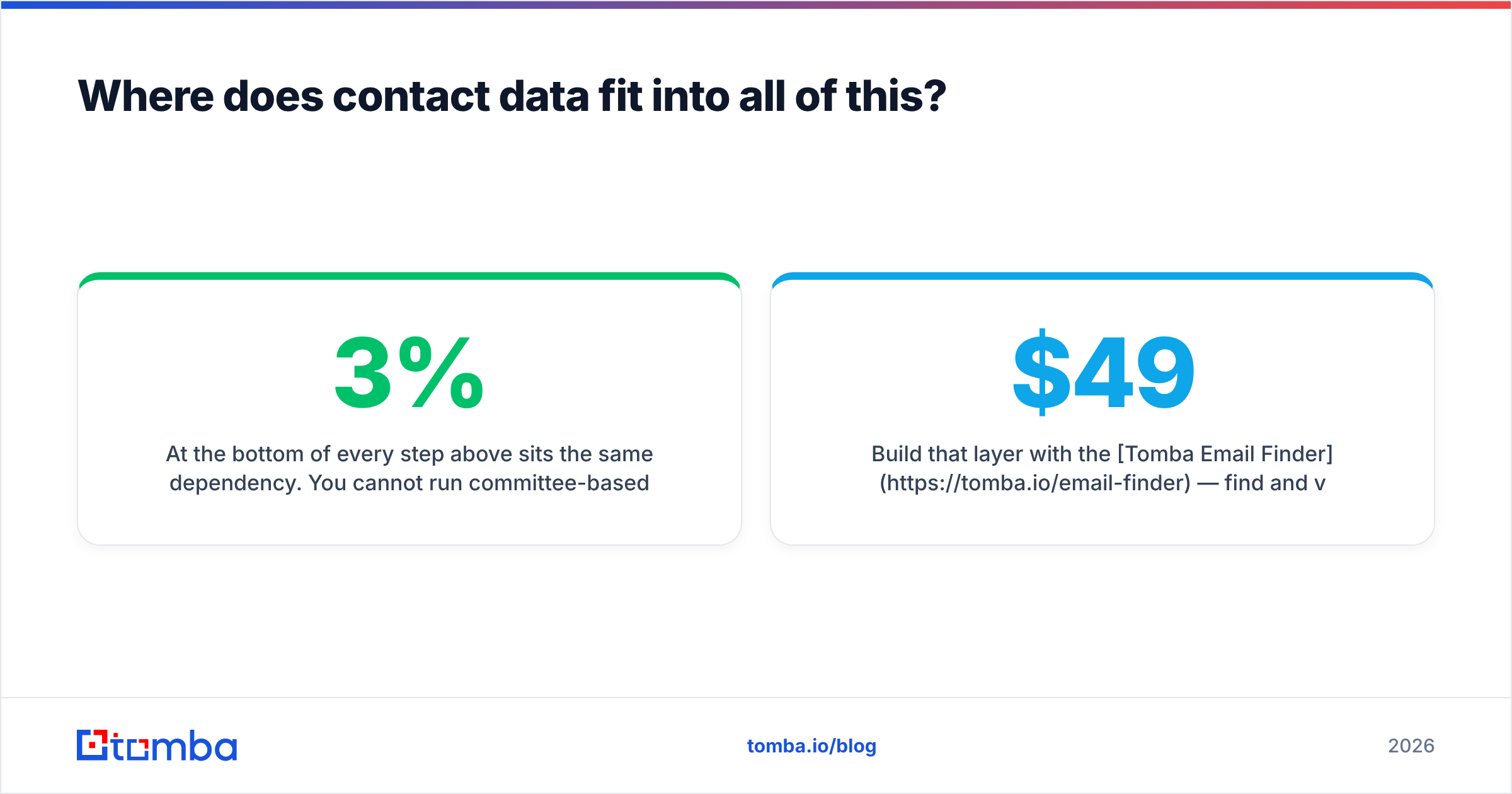
Every step above rests on the same thing. You cannot sell to a committee you cannot name. You cannot report coverage on a list that decays 2–3% a month. You cannot pass a security questionnaire on data you cannot source.
So start there. Map each target system's domain. Pull verified addresses for the roles your motion needs. Add title and seniority. Re-verify before each send window. It is dull work. It also decides whether your go to market strategy healthcare plan ever gets a hearing.
Build that layer with the Tomba Email Finder. Find and verify the clinical, IT, security, and finance contacts inside a health system by domain or by name. Verification sits in the same workflow, so bounced sends never touch your sender score. The free tier covers 25 searches a month. Test committee coverage on a few accounts first. Tomba pricing then starts at $49/mo on Starter, $99/mo on Growth, and $249/mo on Pro. Prefer to read reviews first? Compare it on G2. Either way, fix the data layer before you scale the motion.
Related guides#
Ready to find emails that actually work?
Join 150,000+ professionals who stopped guessing and started sending. Free credits on signup — no credit card required.
Get the Tomba newsletter
Practical outbound tactics and product updates — once every two weeks.
About the author