Go To Market Strategy Lean Startup: The 90-Day Playbook
Most lean startups burn runway on GTM motions built for funded teams. Here is how to pick a channel, validate demand with 100 real contacts, and hit repeatable revenue before your cash runs out.
TL;DR
- A go to market strategy lean startup teams can run is not a shrunken copy of a funded GTM plan. It is a chain of cheap tests. Each one is small enough that being wrong costs a week, not a quarter.
- Pick exactly one primary channel for your first 90 days. Founders who run outbound, content, paid, and partnerships at once learn nothing from any of them.
- Your first 100 contacts matter more than your first 10,000. Hand-build the list, verify every address, and read every reply yourself.
- The trigger to scale is a repeatable conversion rate across two separate lists. One lucky week is not a signal.
- Budget under $300 a month for tooling. In a go to market strategy lean startup budget, data quality is the one line item worth paying for.
What Is a Go To Market Strategy Lean Startup Teams Can Run?#
A go to market strategy lean startup founders can execute answers four questions in order. Who exactly buys this? What problem makes them buy today? Which single channel reaches them cheapest? And what evidence proves the answer is right before you spend money scaling it?
That last question is what separates lean GTM from the deck version. A Series B company can run a GTM plan for two quarters and then correct course. You cannot. If you have 14 months of runway and a two-person team, every GTM choice needs a kill criterion attached before you start.
Think of it like tasting soup while you cook. You do not serve the whole pot and then ask guests what they thought. In technical terms, lean GTM is build-measure-learn applied to distribution instead of product. Eric Ries made the loop famous for product work. Most founders never apply the same rigor to how they reach buyers. They treat channels as a matter of taste rather than a hypothesis to test.
So the output is not a 40-slide plan. A go to market strategy lean startup team can act on fits on one page: a named segment, a testable message, one channel, a weekly cost ceiling, and a date when you decide to double down or kill it.
What Are the Five Stages of Lean GTM?#
Run these in sequence. Skipping a stage is the most expensive mistake in early distribution. You end up tuning a funnel whose top is aimed at the wrong people.
- Segment narrowing (week 1-2). Go from "B2B SaaS companies" to "Shopify Plus stores with 20-80 employees that ship physical goods and have a named head of CX." If you cannot list 200 companies that match, the definition is too vague to test.
- Problem validation (week 2-4). Twenty to thirty conversations, no pitch. Listen for the words buyers use and the event that makes them start shopping. That trigger event becomes your messaging.
- Channel selection (week 4-5). Pick one. Outbound email, founder-led LinkedIn, communities, SEO, or partnerships. Choose where your segment already gathers, not the channel you personally enjoy.
Stages one to three cost almost nothing but time. The next two are where a go to market strategy lean startup either proves itself or falls apart.
- Message-market testing (week 5-10). Same list quality, three message variants, 50-100 contacts each. Watch reply rate, and watch reply quality even harder. Ten "tell me more" replies beat forty "no thanks" replies.
- Repeatability check (week 10-14). Rerun the winning message on a fresh list built the same way. If the conversion rate holds, you have a motion. If it collapses, your first result was list luck.
Most founders who tell me their GTM "isn't working" are stuck at stage one with a stage-four budget. They bought 25,000 contacts, wrote a decent email, and got a 0.4% reply rate. Then they concluded that cold email is dead. The real problem was an undefined segment.
Which GTM Motion Fits a Lean Startup Budget?#
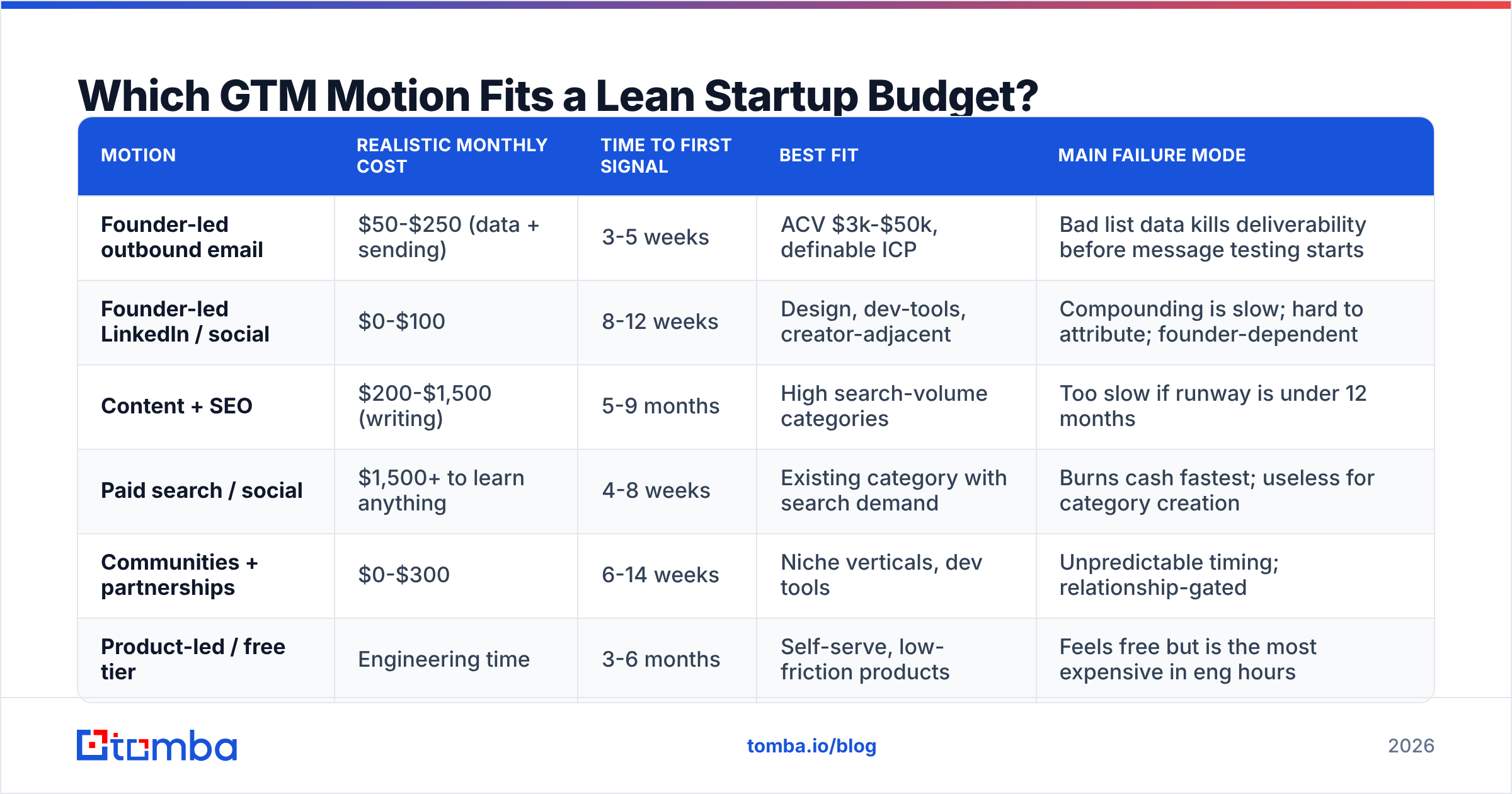
The honest comparison. Costs assume a two-founder team with no dedicated marketer. "Time to first signal" means the point where you have enough data to decide whether to continue.
| Motion | Realistic monthly cost | Time to first signal | Best fit | Main failure mode |
|---|---|---|---|---|
| Founder-led outbound email | $50-$250 (data + sending) | 3-5 weeks | ACV $3k-$50k, definable ICP | Bad list data kills deliverability before message testing starts |
| Founder-led LinkedIn / social | $0-$100 | 8-12 weeks | Design, dev-tools, creator-adjacent | Compounding is slow; hard to attribute; founder-dependent |
| Content + SEO | $200-$1,500 (writing) | 5-9 months | High search-volume categories | Too slow if runway is under 12 months |
| Paid search / social | $1,500+ to learn anything | 4-8 weeks | Existing category with search demand | Burns cash fastest; useless for category creation |
| Communities + partnerships | $0-$300 | 6-14 weeks | Niche verticals, dev tools | Unpredictable timing; relationship-gated |
| Product-led / free tier | Engineering time | 3-6 months | Self-serve, low-friction products | Feels free but is the most expensive in eng hours |
Outbound email takes the first slot in most go to market strategy lean startup plans for one unglamorous reason. It is the only channel where you control both the audience and the timeline. With SEO you wait on Google. With paid you need budget to buy significance. With outbound you can send 60 emails on Tuesday and know something real by Friday.
That edge disappears the moment your list quality drops. A purchased list with a 22% bounce rate does not give you a slow signal. It gives you a poisoned domain and no signal at all. So the tooling priority here inverts the usual order. Pay for accurate contact data first, sequencing software second, everything else later.
How Do You Build Your First 100 Contacts Without a Data Budget?#
Manually, then semi-automatically. Every go to market strategy lean startup lives or dies on this list, so build it by hand first.
- Start from companies, not people. Build a spreadsheet of 100 companies that match your narrowed segment. Use G2 category pages, funding announcements, job postings that mention your pain, and customer logos on competitor sites.
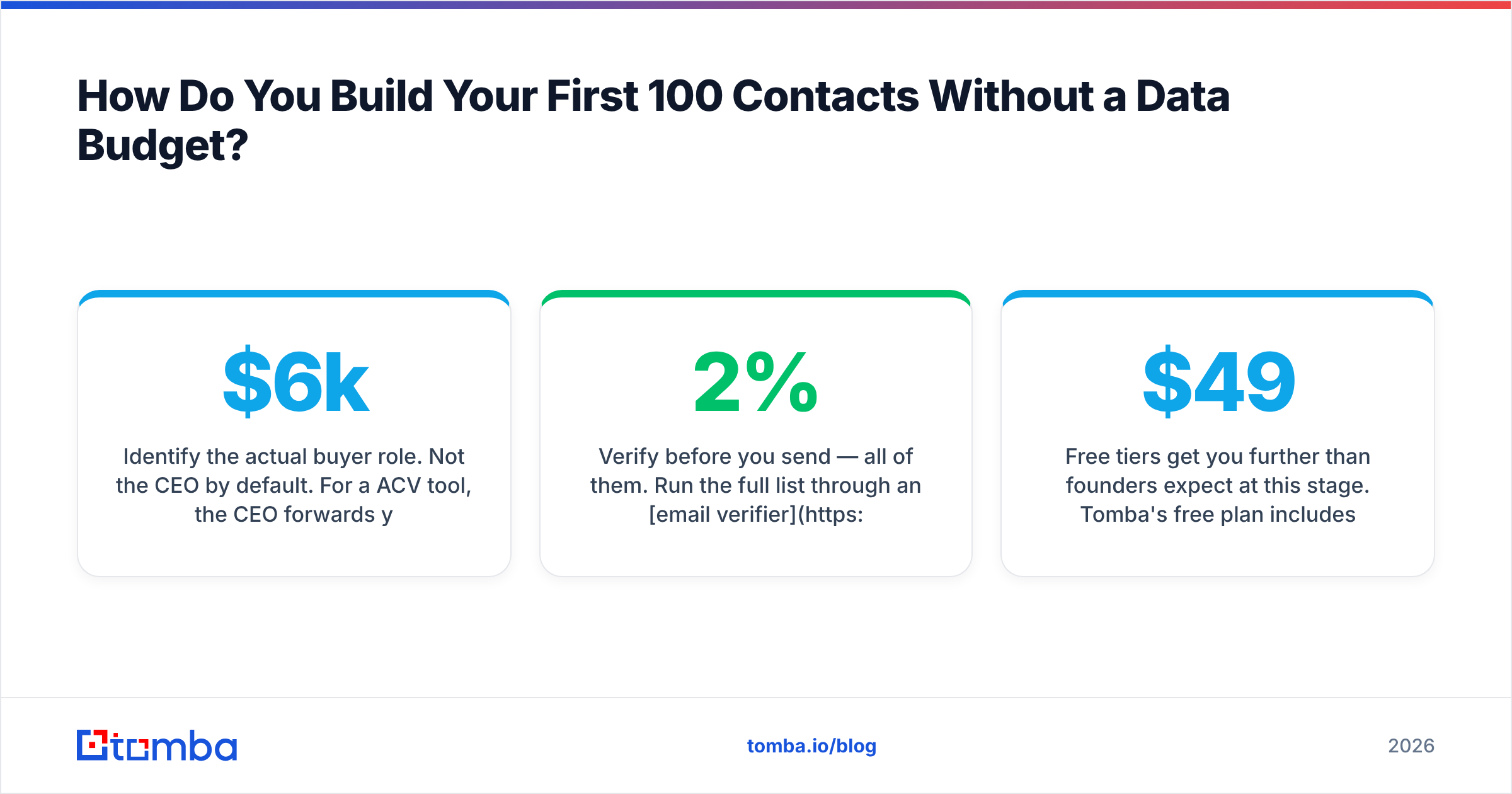
- Identify the actual buyer role. Not the CEO by default. For a $6k ACV tool, the CEO forwards your email into a void. Find the person whose weekly workflow your product changes.
- Resolve contact details. A domain search returns the addresses and email pattern for a company in one call. That beats guessing name.surname formats across 100 domains. When you already have a person's name, a Tomba Email Finder query is the direct path.
List building is the easy half. What you do next decides whether the data is worth anything.
- Verify before you send, all of them. Run the full list through an email verifier and drop anything invalid or risky. A bounce rate under 2% is not a nice-to-have. It is the precondition for everything else working.
- Enrich only what you will use. Do not spend credits on firmographics you will never mention. If your hook is "you're hiring three CX reps," you need the job-post signal, not revenue estimates.
- Read every reply yourself. For the first 300 sends, no automation on responses. The exact words in a "no" are your product roadmap.
Free tiers get you further than founders expect. Tomba's free plan includes 25 searches per month. That is enough to validate an email pattern for a handful of target accounts before you commit budget. When you need real volume, Tomba pricing starts at $49/month on Starter and $99/month on Growth. That is real money at pre-seed, but roughly a tenth of one wasted paid-ads test.
Deliverability comes first. The email deliverability basics are non-negotiable before your first send. Authenticate the domain, warm the mailbox for two to three weeks, and cap daily volume. Google's bulk sender guidelines spell out the authentication rules and the spam-rate threshold you must stay under. Skip this stage and you end up with a burned domain and the false belief that your market does not exist.
How Do You Know When to Scale a Channel?#
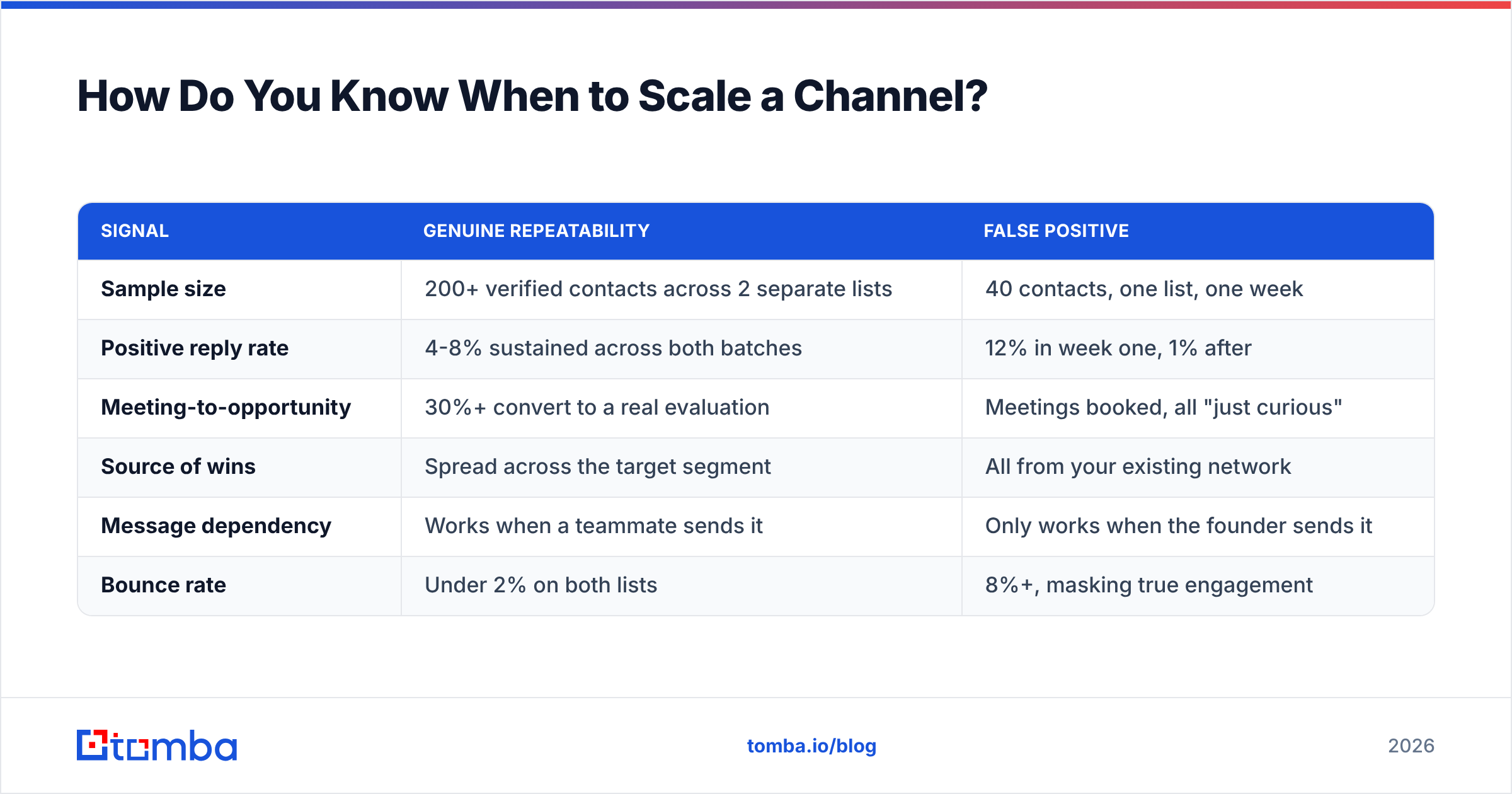
You scale when the same motion produces the same result on a list you built after the first one. In a go to market strategy lean startup, that is the entire test. Anything less is pattern-matching on noise.
Here is what "working" looks like for outbound at lean scale, next to what founders often mistake for working.
| Signal | Genuine repeatability | False positive |
|---|---|---|
| Sample size | 200+ verified contacts across 2 separate lists | 40 contacts, one list, one week |
| Positive reply rate | 4-8% sustained across both batches | 12% in week one, 1% after |
| Meeting-to-opportunity | 30%+ convert to a real evaluation | Meetings booked, all "just curious" |
| Source of wins | Spread across the target segment | All from your existing network |
| Message dependency | Works when a teammate sends it | Only works when the founder sends it |
| Bounce rate | Under 2% on both lists | 8%+, masking true engagement |
That last row deserves emphasis. High bounce rates do more than waste sends. They suppress inbox placement for the valid addresses too. Your real reply rate is then measured through a broken instrument. Fix data quality before you read any GTM result.
The "message dependency" row is the one founders resist. If a motion only converts when the founder sends it, you have founder-market fit, not go-to-market fit. That is still valuable. You just cannot hire against it yet.
What Tools Does a Lean GTM Stack Actually Need?#
Four categories, and a go to market strategy lean startup can defer two of them.
Need on day one:
- Contact data and verification. This is the input to everything else. Bad data invalidates every downstream metric. Budget $0-$99 a month depending on volume.
- A sending mailbox with proper authentication. A dedicated sending domain, SPF/DKIM/DMARC configured, warmed. Cost: the domain plus a mailbox seat.
Add once you have signal:
- Sequencing software. Below roughly 200 emails a week, a spreadsheet and manual sends give you better reply quality and more learning per send. Automation locks in a message before you know it works.
- A CRM. Under 30 open conversations, a spreadsheet is genuinely fine. Move to a proper CRM when handoffs start dropping context, not before. HubSpot's free tier is the usual landing spot.
Skip entirely at pre-seed: intent data platforms, ABM orchestration, sales engagement suites with per-seat minimums, and anything with an annual contract. G2's category listings help you map what exists. The honest answer for most lean teams is that seven of those tools solve problems you do not have yet.
If you want data flowing into a workflow rather than a UI, the Tomba API finds and verifies addresses programmatically. That matters when your list-building lives in a script or a Sheets workflow. If you would rather stay in a spreadsheet, the Google Sheets add-on covers the same ground without code.
What Do Lean Startups Get Wrong Most Often?#
Six failure patterns show up again and again in go to market strategy lean startup plans.
Running every channel at once. Four half-run experiments produce zero conclusions. One properly run experiment produces a decision. Sequence, do not parallelize. You cannot interpret four noisy signals at the same time.
Confusing activity with progress. 2,000 emails sent is not a milestone. Two customers who found you through a repeatable path is a milestone. Track outcomes, not effort.
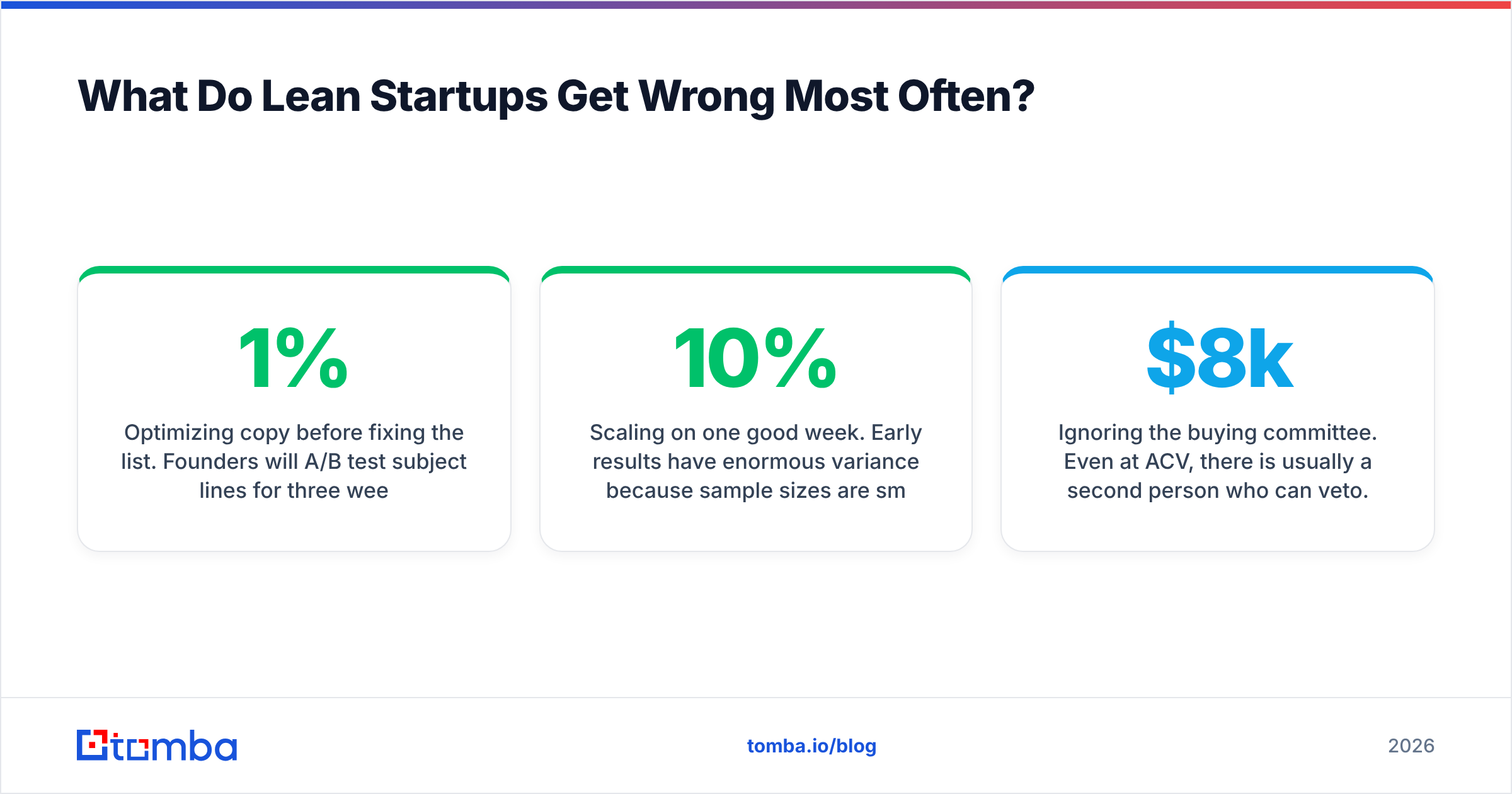
Optimizing copy before fixing the list. Founders A/B test subject lines for three weeks on a list of poorly matched contacts. The message is rarely the binding constraint at stage one. The segment almost always is. If your reply rate is under 1%, rebuild the list instead of rewriting the email.
Scaling on one good week. Early results swing wildly because samples are small. A 10% reply rate on 40 contacts tells you almost nothing. Wait for the second list.
Treating GTM as a marketing problem. In a two-person startup, the person who knows the product deeply has to talk to buyers. Outsourcing early GTM to an agency or a junior SDR removes the learning. Delegate once the motion is documented, not before.
Ignoring the buying committee. Even at $8k ACV, someone else can usually veto. Founders map the champion and forget who owns the budget line. Ask early who else needs to see this.
How Should You Sequence Your First 90 Days?#
The first half is setup and listening.
- Days 1-14: Narrow the segment until you can name 200 specific companies. Write the one-page GTM doc with kill criteria.
- Days 15-30: Twenty-five problem conversations. No pitching. Set up the sending domain and start mailbox warmup in parallel. Warmup takes calendar time you cannot compress later.
- Days 31-45: Build and verify list one (100 contacts). Send three message variants manually, 33 contacts each.
The second half is where you earn a decision.
- Days 46-60: Read every reply. Rewrite using the actual language buyers used. Book and run the meetings yourself.
- Days 61-80: Build list two from the same segment definition and run the winning message. This is your repeatability test.
- Days 81-90: Compare the two batches against the table above. Double down, adjust the segment, or change channel. Decide in writing.
Ninety days and roughly $300 of tooling. After that, your go to market strategy lean startup either has a validated motion or a documented reason to change direction. Both beat a year of running four channels at 25% effort each.
Getting Started#
The bottleneck in a go to market strategy lean startup is almost never strategy. It is having a list of real people at real companies whose addresses actually deliver. Without that, every metric you collect measures your data quality rather than your market.
Start with the Tomba Email Finder to build and verify your first 100 contacts. The free tier covers 25 searches a month. That is enough to validate your email patterns and test your segment before you commit to a paid plan. If the first list converts and the second one confirms it, scaling stops being a gamble and becomes a decision.
Related guides#
Ready to find emails that actually work?
Join 150,000+ professionals who stopped guessing and started sending. Free credits on signup — no credit card required.
Get the Tomba newsletter
Practical outbound tactics and product updates — once every two weeks.
About the author