Go-To-Market Strategy Medium Businesses Can Actually Run
Medium-sized companies get squeezed: too big for founder-led selling, too small for enterprise GTM machinery. Here is the segmentation, motion mix, data layer, and metric set that actually works at 50-500 employees.
A go to market strategy medium businesses can actually staff looks nothing like the startup version. You have real budget now. You still have no bench depth. This guide covers the segmentation, the motion mix, the data layer, and the metrics that hold up at 50-500 employees.
TL;DR
- A go to market strategy medium businesses run (roughly 50-500 employees, $5M-$100M revenue) fails for a different reason than it fails at startups: not lack of focus, but too many half-funded motions running at once.
- Pick two motions, fund them properly, and kill the rest. Three or more motions at medium scale almost always means none of them get enough budget to reach payback.
- Your data layer matters more than your tooling. Bad contact data quietly caps every downstream metric — reply rate, meeting rate, CAC payback.
- The realistic 2026 stack for a medium-sized team costs $1,200-$4,000/month, and roughly 15-25% of that should sit in contact data and verification.
- Measure CAC payback by segment, not blended. Blended payback hides the segment that is burning your budget.
What Counts as a "Medium" Business in Go-To-Market Terms?#
Forget the headcount definition for a second. In GTM terms, you are a medium-sized business the moment three things become true at once:
- Founder-led sales stops scaling. The founder can no longer take every discovery call, and win rates drop the first time someone else runs the pitch.
- You have more than one ICP. Usually because a second segment bought organically and nobody killed it.
- You have specialists, but not departments. One demand gen person. Two SDRs. A RevOps contractor. Nobody has backup.
That third condition is the one that breaks strategies. A startup can improvise because everyone does everything. An enterprise can absorb a bad quarter because it has bench depth. A medium-sized company has neither — one person going on parental leave can stall an entire channel.
So the operating question for a go to market strategy medium teams can run is not "what could work?" It is "what can we run at full strength with the people we actually have?"
Why Does the Startup Go-To-Market Playbook Break at Medium Scale?#
Because the startup playbook optimises for learning speed and the medium playbook has to optimise for repeatability. Those pull in opposite directions.
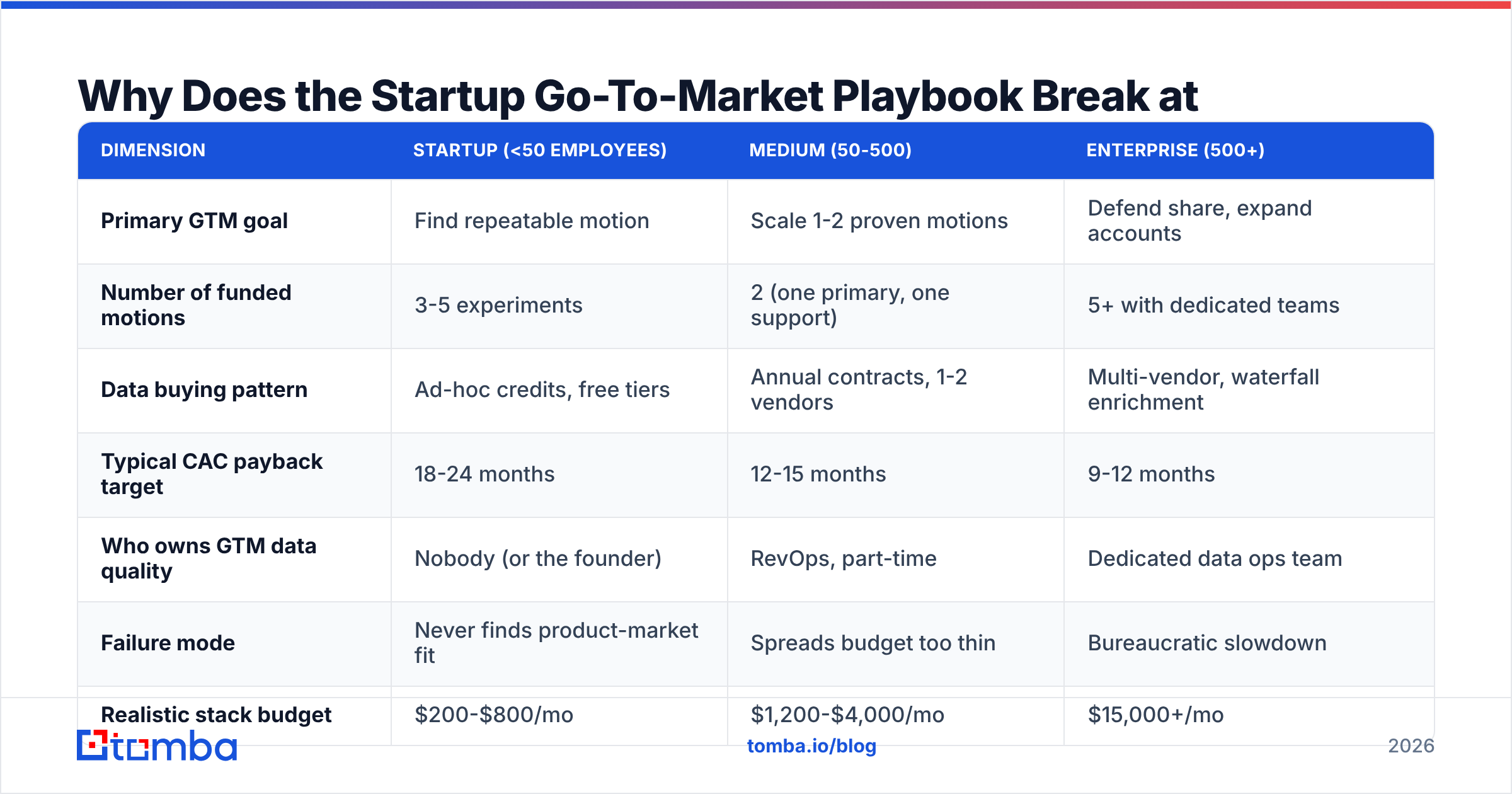
At seed stage, running five experiments at 20% effort each is correct — you are buying information. At $20M ARR, running five channels at 20% effort each is how you end up with five channels that all "kind of work" and none that pay back inside 18 months.
| Dimension | Startup (<50 employees) | Medium (50-500) | Enterprise (500+) |
|---|---|---|---|
| Primary GTM goal | Find repeatable motion | Scale 1-2 proven motions | Defend share, expand accounts |
| Number of funded motions | 3-5 experiments | 2 (one primary, one support) | 5+ with dedicated teams |
| Data buying pattern | Ad-hoc credits, free tiers | Annual contracts, 1-2 vendors | Multi-vendor, waterfall enrichment |
| Typical CAC payback target | 18-24 months | 12-15 months | 9-12 months |
| Who owns GTM data quality | Nobody (or the founder) | RevOps, part-time | Dedicated data ops team |
| Failure mode | Never finds product-market fit | Spreads budget too thin | Bureaucratic slowdown |
| Realistic stack budget | $200-$800/mo | $1,200-$4,000/mo | $15,000+/mo |
The middle column is the uncomfortable one. You inherit enterprise expectations with startup resourcing. The board wants predictable pipeline and reported CAC payback; you have one demand gen hire. Gartner's sales research has repeatedly flagged this squeeze. Buying groups have grown, cycles have lengthened, and the cost of covering an account has risen faster than most mid-market budgets. You can read more on their sales practice research for the buyer-side view.

Which Go-To-Market Strategy Medium Businesses Should Pick#
Pick one primary motion and one supporting motion. Here is how the five realistic options behave at medium scale:
- Outbound (SDR + sequenced email/phone). Best when your ACV is above ~$8K and your ICP is identifiable by firmographics. Fastest to stand up, most sensitive to data quality — a 20% bad-email rate does not cost you 20% of pipeline, it costs you domain reputation too.
- Inbound / content-led. Best when the category has real search volume and your sales cycle tolerates a 6-9 month ramp. Cheap per lead at steady state, brutal to start from zero at medium scale because you are competing with enterprise content budgets.
The other three options take longer to pay back. Read them as bets, not as quarters.
- Product-led (PLG). Only viable if a single user can get value without procurement. Most medium B2B companies think they qualify and do not. Test it with a real free tier before you restructure the org around it.
- Partner / channel. Highest leverage per headcount, slowest to produce revenue. A realistic first partner deal takes 4-7 months from handshake to first sourced opportunity. Fund it only if you can wait.
- Account-based (ABM). Correct when you have fewer than ~2,000 realistic accounts. At medium scale ABM usually means "outbound with better research", not a six-figure orchestration platform.
The pairing that works most often at 50-500 employees: outbound as primary, inbound as support. Outbound gives you controllable volume this quarter. Inbound compounds and lowers outbound's cost over 12-18 months. The pairing that fails most often is PLG as primary with outbound bolted on. The two motions want different pricing pages, different onboarding, and different comp plans.
How Do You Build the Data Layer Underneath the Strategy?#
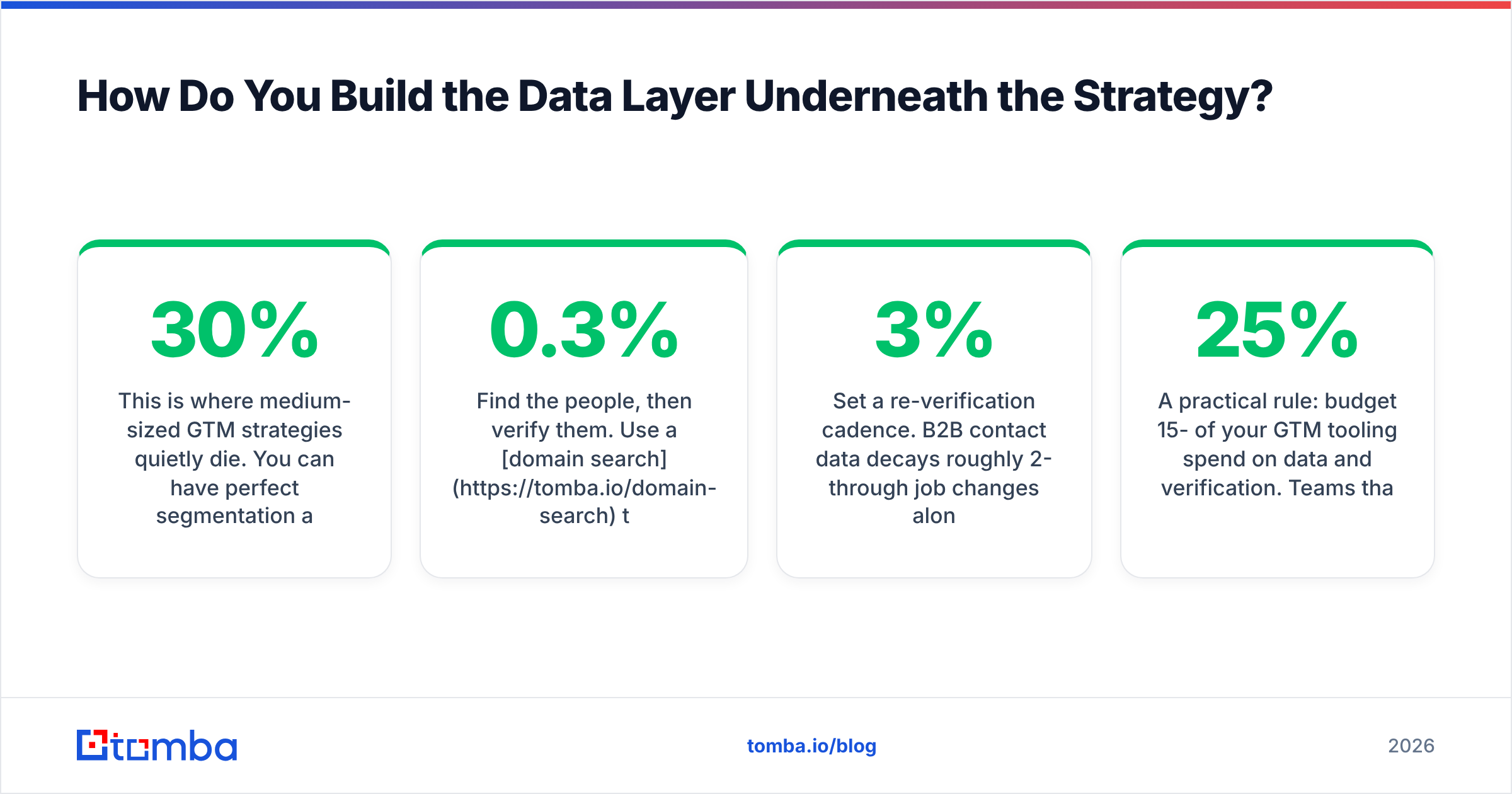
This is where medium-sized GTM strategies quietly die. You can have perfect segmentation and a well-picked motion, and still miss plan because 30% of your contact records are wrong.
Work the layer in this order:
- Define the account universe first, not the contacts. Filter by firmographic criteria you can actually verify — industry, headcount band, tech stack, geography. If the list is over 10,000 accounts for a medium-sized team, your ICP is too loose.
- Resolve companies to domains. Every enrichment step downstream keys off the domain. Company names are ambiguous; domains are not.
- Find the people, then verify them. Use a domain search to pull the roles at each target account, then run every address through an email verifier before it touches a sequence. Verification is not optional at medium scale. Google and Yahoo's bulk sender rules put a hard 0.3% spam-complaint ceiling on senders, and bounced sends push you toward it fast.
The last two steps are the ones teams skip. They are also the cheapest.
- Enrich for personalisation, not for vanity fields. Job title, seniority, and one trigger event beat forty empty columns. Contact enrichment is worth paying for only where it changes what the first line of your email says.
- Set a re-verification cadence. B2B contact data decays roughly 2-3% per month through job changes alone. A list you built in January is materially wrong by June.
A practical rule: budget 15-25% of your GTM tooling spend on data and verification. Teams that spend 5% on data and 60% on sequencing software consistently underperform teams with the inverse ratio. The sequencer only multiplies whatever list quality you feed it.
What Does a Medium-Business Go-To-Market Stack Cost in 2026?#
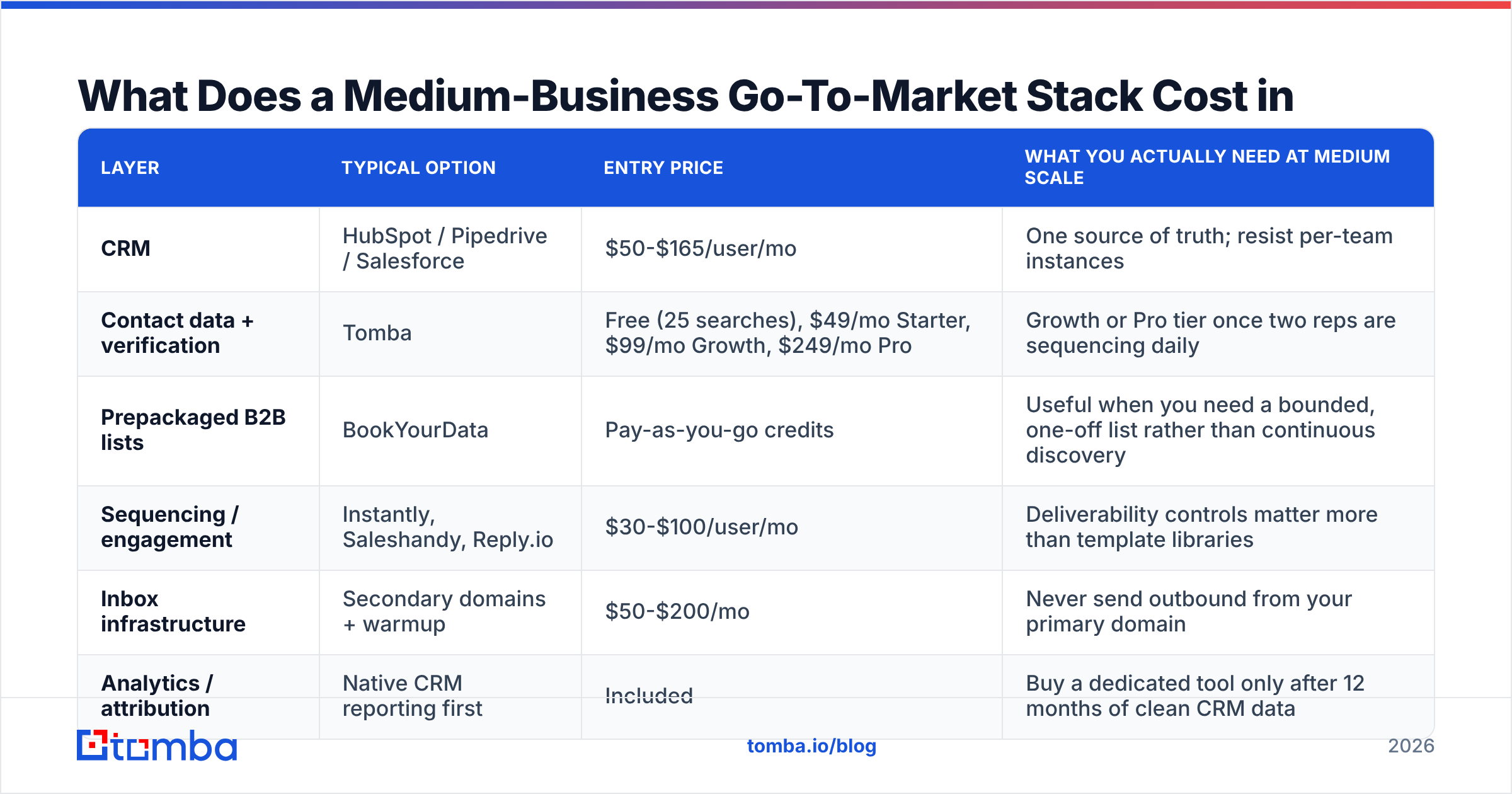
Here is a realistic build for a team running outbound-primary with inbound support, at roughly 8-15 quota-carrying and marketing people.
| Layer | Typical option | Entry price | What you actually need at medium scale |
|---|---|---|---|
| CRM | HubSpot / Pipedrive / Salesforce | $50-$165/user/mo | One source of truth; resist per-team instances |
| Contact data + verification | Tomba | Free (25 searches), $49/mo Starter, $99/mo Growth, $249/mo Pro | Growth or Pro tier once two reps are sequencing daily |
| Prepackaged B2B lists | BookYourData | Pay-as-you-go credits | Useful when you need a bounded, one-off list rather than continuous discovery |
| Sequencing / engagement | Instantly, Saleshandy, Reply.io | $30-$100/user/mo | Deliverability controls matter more than template libraries |
| Inbox infrastructure | Secondary domains + warmup | $50-$200/mo | Never send outbound from your primary domain |
| Analytics / attribution | Native CRM reporting first | Included | Buy a dedicated tool only after 12 months of clean CRM data |
Total for a realistic medium-sized team: $1,200-$4,000/month. If you are above $6,000/month with fewer than 15 GTM people, you have overlapping tools — most commonly two enrichment vendors and two sequencers, bought by different teams eight months apart.
Two notes on the table. First, Tomba pricing is credit-based rather than per-seat. That matters at medium scale, because you usually have more people who occasionally need a lookup than people who need one daily. Second, prepackaged list vendors like BookYourData and continuous-discovery tools solve different problems. A fixed list is fine for a one-off campaign into a bounded market. Continuous discovery is what you need when your ICP keeps producing new accounts. Plenty of medium-sized teams run both.

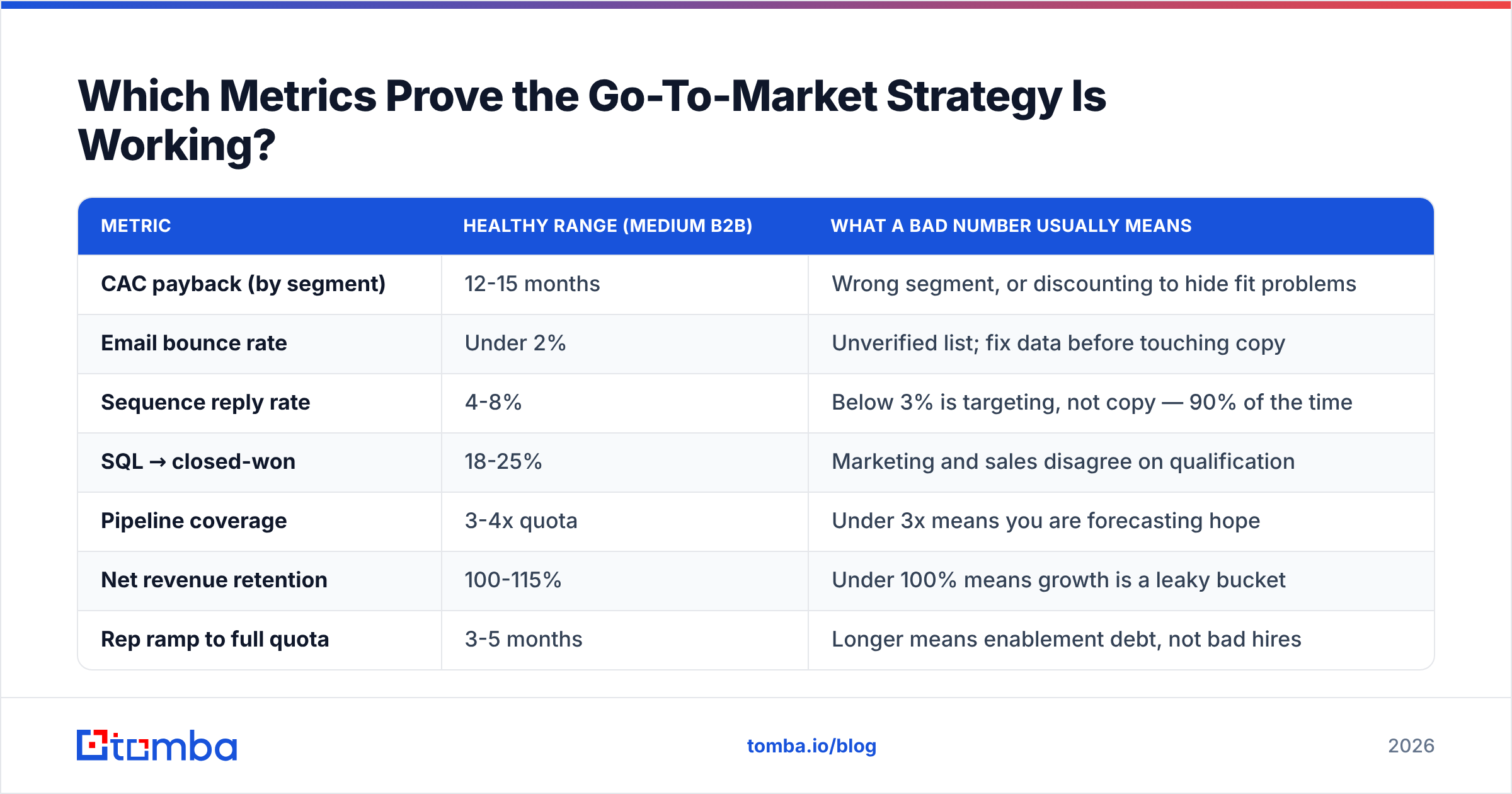
Which Metrics Prove the Go-To-Market Strategy Is Working?#
Blended metrics lie at medium scale, because you almost certainly have one segment subsidising another. Break every number by segment and by motion.
| Metric | Healthy range (medium B2B) | What a bad number usually means |
|---|---|---|
| CAC payback (by segment) | 12-15 months | Wrong segment, or discounting to hide fit problems |
| Email bounce rate | Under 2% | Unverified list; fix data before touching copy |
| Sequence reply rate | 4-8% | Below 3% is targeting, not copy — 90% of the time |
| SQL → closed-won | 18-25% | Marketing and sales disagree on qualification |
| Pipeline coverage | 3-4x quota | Under 3x means you are forecasting hope |
| Net revenue retention | 100-115% | Under 100% means growth is a leaky bucket |
| Rep ramp to full quota | 3-5 months | Longer means enablement debt, not bad hires |
Report these monthly, by segment, in one place. The most common RevOps failure at medium scale is simple. Each team keeps its own definition of a qualified lead, so the funnel numbers never reconcile and leadership stops trusting the dashboard.
If you are formalising this, HubSpot's sales and marketing research library has solid benchmark data for the funnel stages above, and G2's sales intelligence category is a reasonable neutral source for tool-level reviews when you evaluate vendors.
What Are the Five Mistakes That Kill Medium-Business GTM?#
- Running four motions at 25% funding each. The most common and most expensive mistake. Cut to two. The two you keep should get the budget from the two you cut, not a reduced share.
- Hiring SDRs to fix a data problem. If your list is 30% invalid, adding headcount multiplies the waste. Fix the email finder and verification layer first, then hire. A team of three reps on clean data outperforms eight on a decayed list, and costs a fraction as much.
The next three are quieter. They cost you a year each.
- Segmenting by company size only. Headcount is a proxy, not a segment. Two 200-person companies in different industries with different buying committees are not the same customer. Segment by problem and buying process.
- Buying enterprise tooling on a medium budget. An annual six-figure platform that nobody has time to configure is worse than a $99/month tool that runs daily. Implementation capacity, not feature lists, should drive vendor choice at this scale.
- Not writing the strategy down. If your GTM strategy exists only in the CRO's head, it changes every board meeting. One page: ICP definition, two funded motions, three metrics, the kill criteria for each motion. Review it quarterly, change it annually.
How Do You Sequence the First 90 Days?#
Days 1-30 — Decide and clean. Write the one-page strategy. Pick your two motions. Audit your CRM: how many contacts are unverified, how many accounts are outside ICP, how many duplicate records exist. Deduplicate and re-verify before you build anything new.
Days 31-60 — Build the pipes. Stand up the account list against the tightened ICP. Enrich and verify. Configure sending infrastructure — secondary domains, SPF and DKIM, warmup. Connect data tooling to the CRM so nobody is exporting CSVs by hand; a HubSpot integration or equivalent removes the most common source of record drift.
Days 61-90 — Run and instrument. Launch the primary motion at real volume. Instrument the seven metrics above by segment. Set the kill criteria: if the supporting motion has not produced X qualified opportunities by day 180, it gets cut and the budget moves.
That is the whole discipline. Medium-scale GTM is not about finding a clever new channel. It is about being honest regarding how many things your team can do well at once, and being ruthless about funding those things properly.
Where Should You Start?#
Start with the data layer. It is the cheapest fix with the largest downstream effect. Every go to market strategy medium teams run rests on contact data that is actually deliverable. So before you restructure territories, rewrite messaging, or sign another platform contract, find out what share of your records are correct. Most medium-sized teams are surprised, and not pleasantly.
Tomba Email Finder is a sensible place to run that audit. The free tier gives you 25 searches to spot-check your existing list quality before committing, and the $49/month Starter plan covers a two-rep outbound motion comfortably. Verify what you have, fix what is broken, then scale the motion you actually chose.
Related guides#
Ready to find emails that actually work?
Join 150,000+ professionals who stopped guessing and started sending. Free credits on signup — no credit card required.
Get the Tomba newsletter
Practical outbound tactics and product updates — once every two weeks.
About the author