Go To Market Strategy PPT Free Download: 2026 Templates
Free GTM PowerPoint templates are everywhere, but most collapse the moment a CFO asks for numbers. Here's which ones hold up, what to fill each slide with, and where the data comes from.
TL;DR
- Free go-to-market strategy PPT templates are easy to find — HubSpot, Slidesgo, Canva, and SlideModel all give away usable decks. The scarcity is not slides, it's the data you put in them.
- A GTM deck that survives an exec review needs nine specific slides: problem, ICP, segmentation, positioning, pricing, channel mix, launch timeline, budget, and metrics. Anything else is decoration.
- Most free templates are design-first: pretty layouts, zero guidance on what belongs in each box. Paid template libraries mostly sell you more layouts, not more rigor.
- The slide that kills the most GTM decks is the ICP slide, because "mid-market SaaS companies in North America" is not an ICP — a countable list of named accounts is.
- Budget roughly 2 hours for the deck and 2 days for the research behind it. Reverse that ratio and you get a beautiful document nobody funds.
What is a go-to-market strategy PPT, and why does everyone want a free one?#
A go-to-market strategy PPT is the internal sales document for your launch plan. It's the artifact you use to get budget, headcount, and cross-functional alignment before you spend a dollar on demand gen.
The reason "go to market strategy ppt free download" gets searched thousands of times a month is simple: nobody wants to design a 20-slide deck from scratch at 11pm before a Monday leadership review. You want a skeleton with the right sections already labelled, so you can spend your time on substance instead of picking fonts.
That instinct is correct. The failure mode is what happens next — people download the template, fill it with plausible-sounding sentences, and present a deck that has no numbers a CFO can test. A template solves the structure problem. It does not solve the evidence problem.
Think of it like a tax form. The form tells you which boxes exist. It does not tell you what your income was, and filling in round numbers because the box looked empty is how you get audited.

Where can you actually download a free GTM strategy template?#
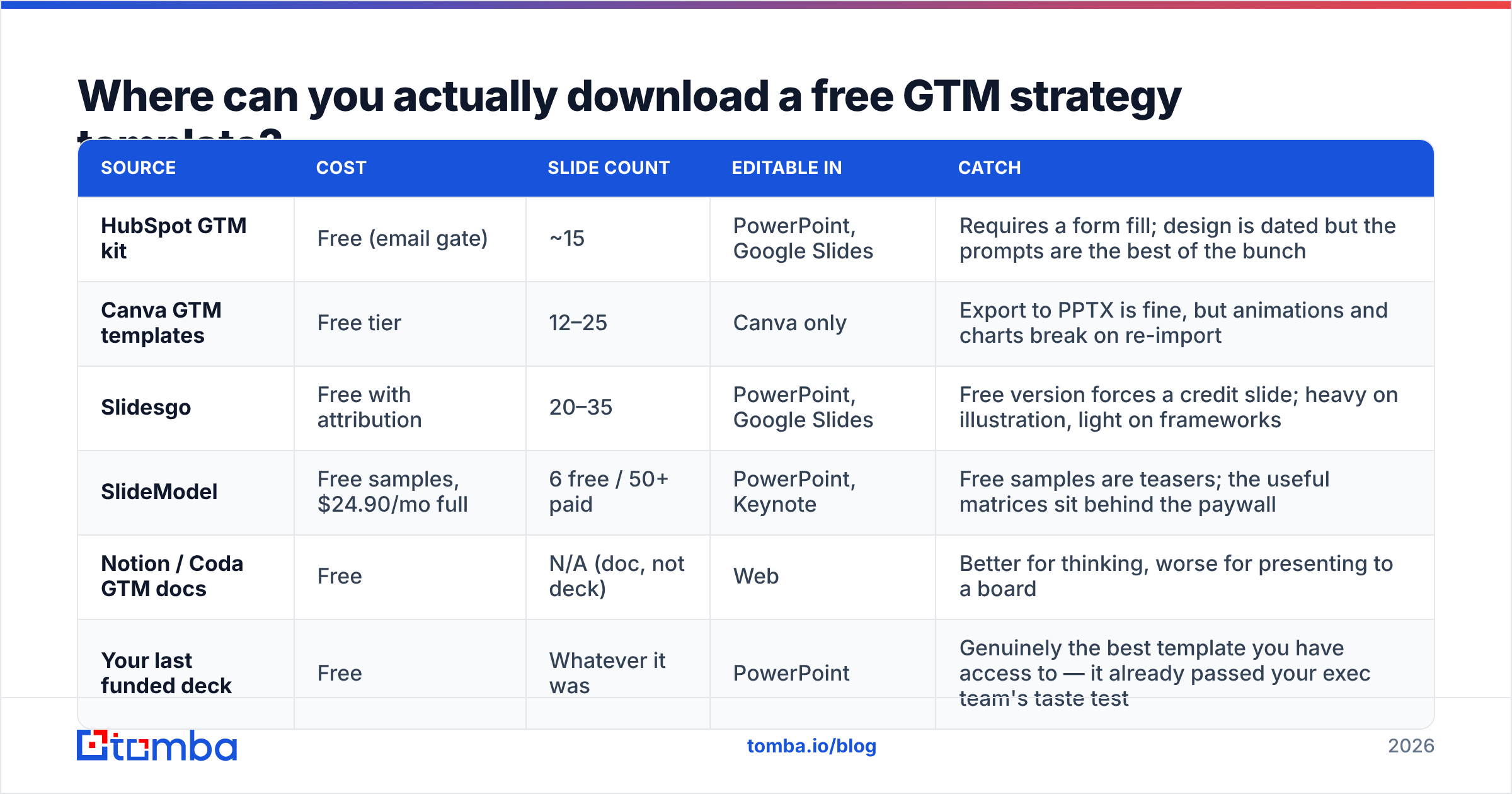
Here's the honest landscape. All of these are real, all are free at some tier, and all have a catch.
| Source | Cost | Slide count | Editable in | Catch |
|---|---|---|---|---|
| HubSpot GTM kit | Free (email gate) | ~15 | PowerPoint, Google Slides | Requires a form fill; design is dated but the prompts are the best of the bunch |
| Canva GTM templates | Free tier | 12–25 | Canva only | Export to PPTX is fine, but animations and charts break on re-import |
| Slidesgo | Free with attribution | 20–35 | PowerPoint, Google Slides | Free version forces a credit slide; heavy on illustration, light on frameworks |
| SlideModel | Free samples, $24.90/mo full | 6 free / 50+ paid | PowerPoint, Keynote | Free samples are teasers; the useful matrices sit behind the paywall |
| Notion / Coda GTM docs | Free | N/A (doc, not deck) | Web | Better for thinking, worse for presenting to a board |
| Your last funded deck | Free | Whatever it was | PowerPoint | Genuinely the best template you have access to — it already passed your exec team's taste test |
If you only try one, start with the HubSpot kit. It is the only widely-available free option that includes written prompts inside each slide explaining what belongs there, which is the part that actually matters. Canva wins on aesthetics; Slidesgo wins on variety; SlideModel wins if you already pay for it.
One thing no free template gives you: a filled-in ICP. That's yours to build.
What nine slides does a GTM deck actually need?#
Strip every free template down and the same nine slides survive. Everything else — the "our journey" timeline, the stock photo of a team high-fiving — is padding.
- Problem and market context. One slide. What's changed in the market that makes this the right moment? A trend line beats an adjective.
- Ideal customer profile. Firmographics, technographics, and trigger events. Then the number: how many companies actually match, by name.
- Segmentation and prioritisation. Which two or three segments you'll attack first and — the harder half — which you're deliberately ignoring this year.
- Positioning and messaging. The alternative you're displacing, your differentiated value, and the proof. Use April Dunford's format if you don't have your own.
- Pricing and packaging. Tiers, price points, and what triggers an upgrade. Include the discount floor you'll authorise for reps.
- Channel mix. Outbound, inbound, partner, PLG — with an expected contribution percentage per channel, not just logos.
- Launch timeline. Milestones with owners and dates. If no name is attached, it won't happen.
- Budget and resourcing. Spend by channel, headcount required, and the CAC you're implicitly assuming.
- Success metrics. Leading and lagging indicators, with the kill criteria — the number at which you stop.
That's it. Nine slides, maybe fifteen with appendices. A 40-slide GTM deck is usually a sign that nobody made a decision.
Why does the ICP slide break most GTM decks?#
Because it's the only slide with a falsifiable claim on it, and most people fill it with adjectives.
"Mid-market B2B SaaS companies in North America with a modern data stack" is a description of a vibe. It cannot be handed to an SDR. Your executive team can't sanity-check it. And when the pipeline number underneath it turns out to be wrong, nobody can trace why.
A defensible ICP slide has three layers:
- The definition. Industry, employee band, revenue band, geography, and technology signals. Specific enough that two people applying it independently produce the same list.
- The count. How many companies exist that match. This is your total addressable market in units, not in an inflated dollar figure copied from a Gartner report.
- The reachability. Of those companies, for how many can you actually name and reach a buyer? This is where most TAM slides quietly fall apart.
That last layer is where the deck meets reality. A market of 8,000 matching companies where you have verified contact data for 900 decision-makers is a very different plan from one where you have 6,000. The budget slide, the channel mix, and the timeline all change depending on that number.
Building the count is unglamorous work: pull a company list matching your criteria, find the right role at each, then verify the contact data before you commit it to a plan. A domain search run across your target list gets you the people and email patterns per company, and a bulk email finder turns a spreadsheet of 2,000 companies into an actual reachable universe. Do this before the deck, not after the launch fails.
Free vs paid GTM templates: what are you actually paying for?#
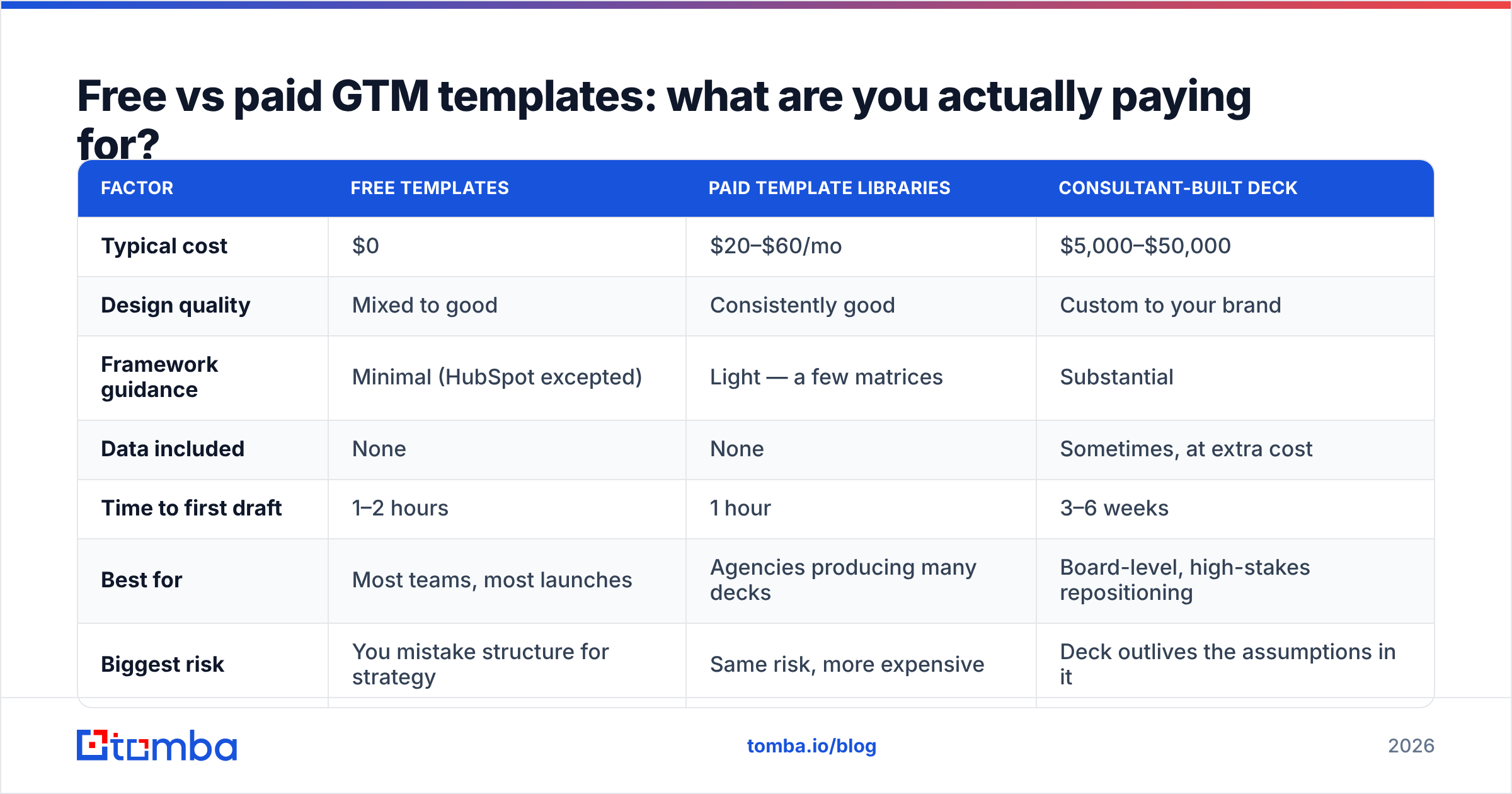
Short answer: you're paying for layouts, not for thinking. Decide accordingly.
| Factor | Free templates | Paid template libraries | Consultant-built deck |
|---|---|---|---|
| Typical cost | $0 | $20–$60/mo | $5,000–$50,000 |
| Design quality | Mixed to good | Consistently good | Custom to your brand |
| Framework guidance | Minimal (HubSpot excepted) | Light — a few matrices | Substantial |
| Data included | None | None | Sometimes, at extra cost |
| Time to first draft | 1–2 hours | 1 hour | 3–6 weeks |
| Best for | Most teams, most launches | Agencies producing many decks | Board-level, high-stakes repositioning |
| Biggest risk | You mistake structure for strategy | Same risk, more expensive | Deck outlives the assumptions in it |
For 90% of launches, a free template plus two days of genuine research beats a paid template plus two hours. The variable that moves outcomes is the quality of your customer evidence, and no PPTX file contains that.
If you want a reference point on what "good" looks like structurally, browse a few highly-rated GTM tools and their template resources on G2 before you commit — the review comments often reveal which frameworks teams actually kept using six months later.
How do you fill the deck with real data instead of placeholders?#
Work backwards from the slides that need numbers. Four of the nine do: ICP, segmentation, channel mix, and budget.
Step 1 — Build the account list. Define your firmographic filters, then produce an actual list. Export from your CRM, a B2B database, or a scrape of an industry directory. You want rows, not estimates.
Step 2 — Find the buyers. For each account, identify the two or three roles that sign or influence. Then get contact data. An email finder resolves name-plus-domain into a working address, and running the result through an email verifier before you count it stops you inflating your reachable market with addresses that bounce.
Step 3 — Sanity-check reachability by segment. If segment A has 70% contact coverage and segment B has 25%, that asymmetry belongs on your prioritisation slide. It's often more decisive than deal size.
Step 4 — Derive the channel mix from coverage, not preference. High coverage plus high intent means outbound leads. Low coverage means you need inbound, partner, or community motion to surface buyers you can't list. This is the reasoning your exec team wants to see, and almost no template prompts you for it.
Step 5 — Attach an assumption to every number. Reply rate, meeting rate, close rate, ACV. Put them in the appendix. When the plan misses, you'll know which assumption broke instead of relitigating the whole strategy.
Step 6 — Write the kill criteria. "If we haven't booked 40 qualified meetings from segment A by end of Q2, we reallocate to segment C." Executives fund plans that specify how they end.
What do reviewers look for in a GTM deck?#
Having sat on both sides of these reviews, the pattern is consistent. Reviewers are scanning for three things:
- Is the market real and countable? They will interrogate the ICP number first. If it's a round figure with no derivation, trust drops for the rest of the deck.
- Is there a decision, or just a survey? Naming what you're not doing is the strongest signal of strategic thinking on the whole deck. Most drafts skip it.
- Can this be measured before it's too late? Leading indicators in weeks, not lagging revenue in quarters.
Beyond that, they're checking whether the pricing slide and the channel slide are consistent. A $600 ACV product with a field sales motion is an arithmetic error dressed as a strategy, and it's the single most common contradiction in GTM decks. Cross-check unit economics against your CAC assumption before you present.
Keep the aesthetic restrained. A clean, boring deck with defensible numbers wins against a beautiful deck with vague ones every time. Your free template is more than good enough on design — the gap is never the gradient.
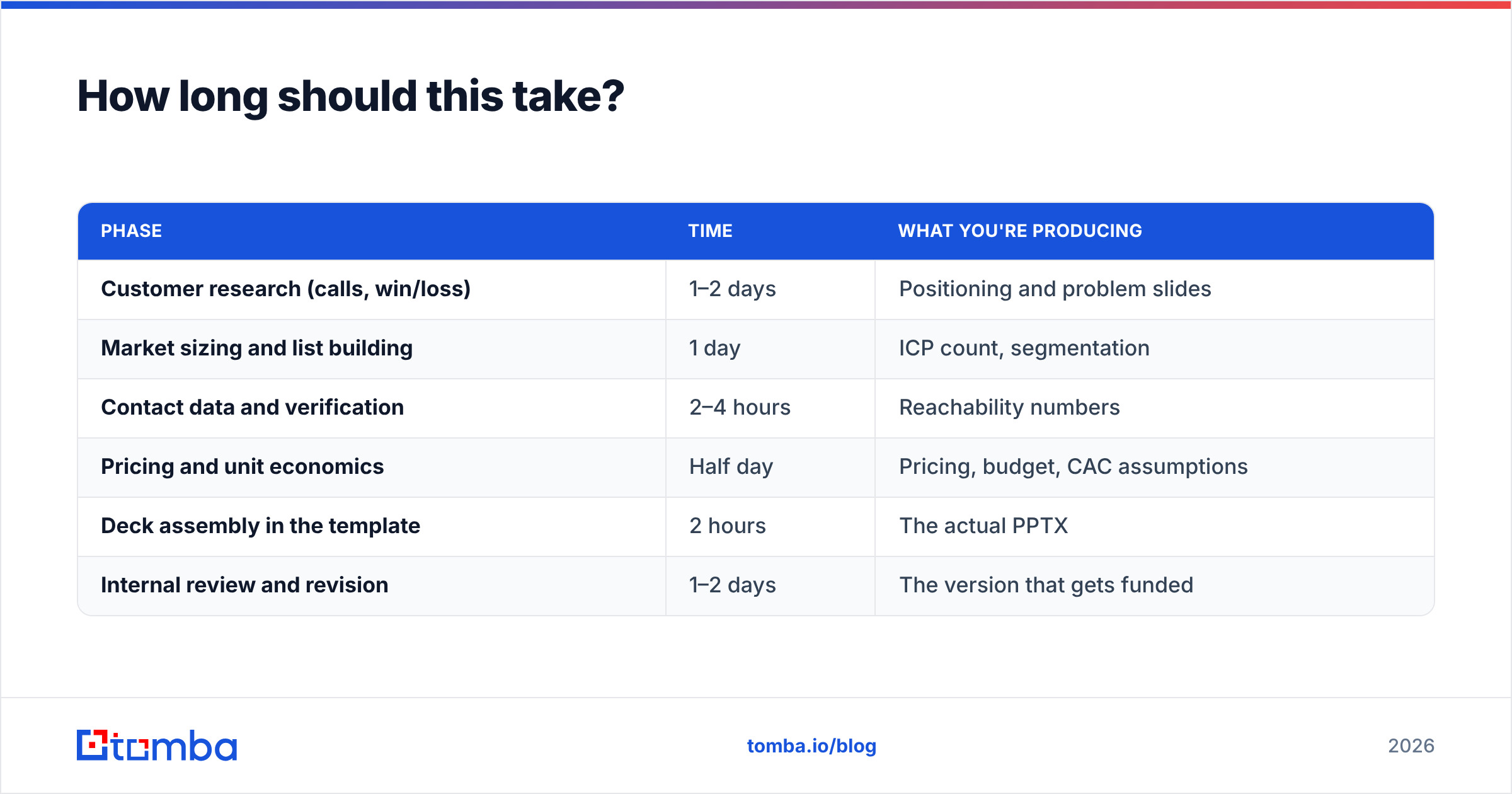
How long should this take?#
A realistic budget for a first-time GTM deck:
| Phase | Time | What you're producing |
|---|---|---|
| Customer research (calls, win/loss) | 1–2 days | Positioning and problem slides |
| Market sizing and list building | 1 day | ICP count, segmentation |
| Contact data and verification | 2–4 hours | Reachability numbers |
| Pricing and unit economics | Half day | Pricing, budget, CAC assumptions |
| Deck assembly in the template | 2 hours | The actual PPTX |
| Internal review and revision | 1–2 days | The version that gets funded |
The deck assembly is the smallest block. If it's your biggest, the template did its job and you skipped yours.
Frequently asked questions#
Can I use a free Slidesgo or Canva template in an investor deck? Yes, with two caveats. Remove attribution slides if the licence permits (Slidesgo's free tier requires credit), and re-skin colours to your brand. Investors don't penalise template use; they penalise generic content.
Should the GTM deck live in PowerPoint or Google Slides? Google Slides if more than two people are editing. PowerPoint if the final consumer is an exec who annotates offline. Both export cleanly enough that this is a workflow question, not a strategy one.
How often should the GTM deck be refreshed? Quarterly for the metrics and channel slides, annually for positioning and ICP — unless a competitor move or a pricing change forces an earlier rewrite.
What's the difference between a GTM strategy and a marketing plan? The GTM strategy decides who you're selling to, why they buy, and through which motion. The marketing plan is the execution detail underneath one of those motions. Don't merge them into one deck; you'll lose both.
The part the template can't give you#
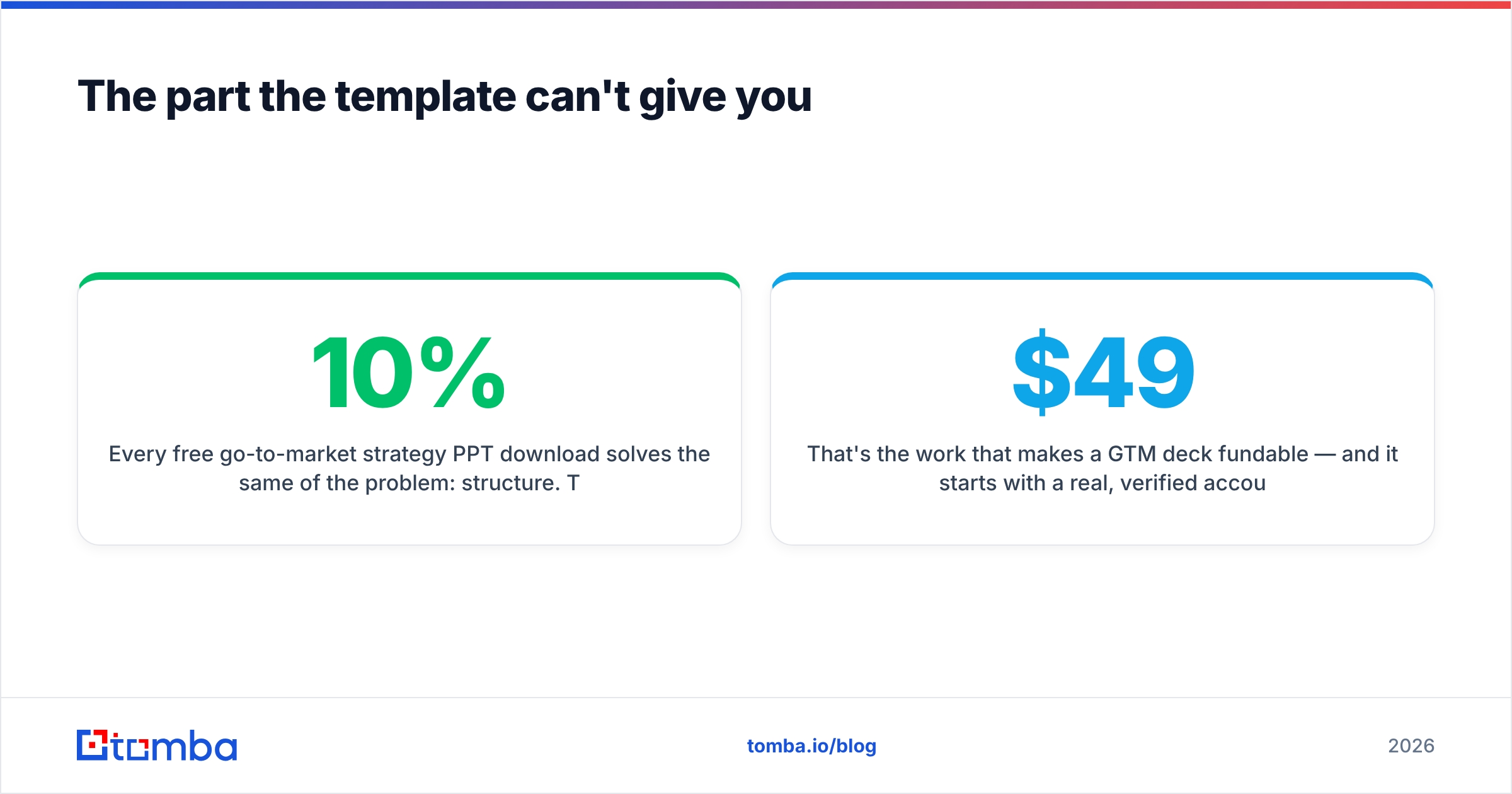
Every free go-to-market strategy PPT download solves the same 10% of the problem: structure. The other 90% is knowing exactly who your buyers are, how many of them exist, and whether you can reach them.
That's the work that makes a GTM deck fundable — and it starts with a real, verified account and contact list rather than a market-size estimate. Use Tomba Email Finder to turn your target-account list into named, verified buyers you can count on the ICP slide, then run the whole list in bulk before you present. The free tier gives you 25 searches a month to test the workflow; Tomba pricing starts at $49/mo on Starter and $99/mo on Growth once you're sizing real segments.
Download the template. Then go get the numbers that make it worth presenting.
Related guides#
Ready to find emails that actually work?
Join 150,000+ professionals who stopped guessing and started sending. Free credits on signup — no credit card required.
Get the Tomba newsletter
Practical outbound tactics and product updates — once every two weeks.
About the author