Go-To-Market Strategy Questions: 27 to Answer First
Most GTM plans fail because nobody asked the uncomfortable questions first. Here are 27 go-to-market strategy questions — grouped by stage — with the evidence you need to answer each one honestly.
TL;DR
- A go-to-market strategy is a set of decisions, not a document. Every decision starts as a question you either answer with evidence or guess at.
- The 27 questions below are grouped into six stages: market, segment, offer, channel, motion, and measurement. Answer them in that order — skipping ahead is why launches stall.
- The single most-skipped question is "can I actually reach these people?" Teams define a beautiful ICP and then discover they cannot build a contact list for it.
- Most GTM failures trace back to three root causes: a segment too broad to message, a channel that does not match the buying process, and unmeasurable success criteria.
- Budget a full week for answering these. It is cheaper than a quarter of misaligned pipeline.
What Is a Go-To-Market Strategy, Really?#
A go-to-market strategy is the answer to one compound question: who are you selling what to, through which channel, at what price, and how will you know it worked?
Think of it like planning a road trip. The destination (revenue target) is the easy part. The strategy is the route — which roads, which stops, how much fuel, and what you do when the bridge is out. Most teams write down the destination, print it on a slide, and start driving.
The questions in this guide are the route planning. They are deliberately uncomfortable, because a GTM plan that survives only friendly questions is not a plan — it is a wish.
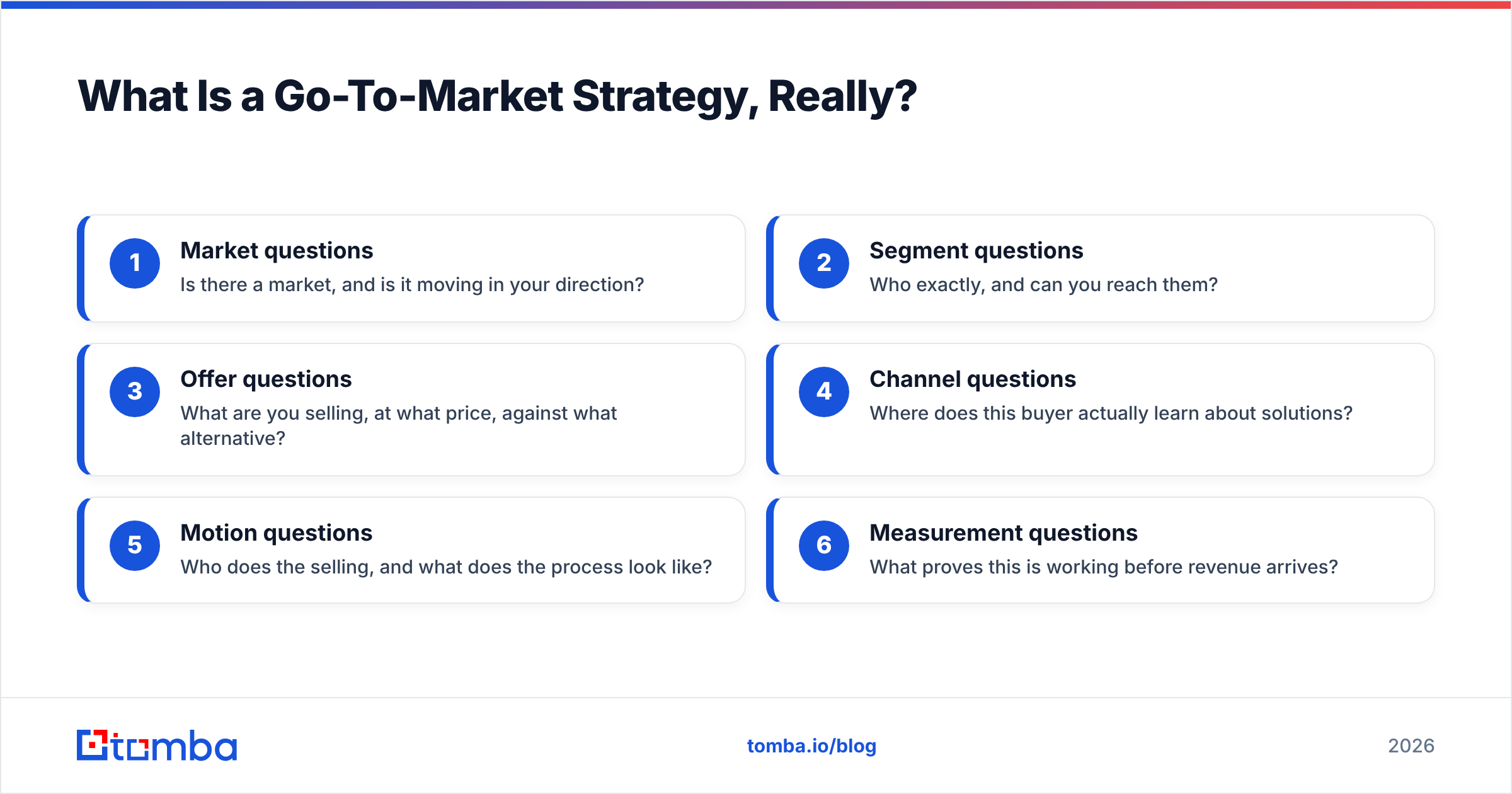
The six stages of GTM questioning:
- Market questions — Is there a market, and is it moving in your direction?
- Segment questions — Who exactly, and can you reach them?
- Offer questions — What are you selling, at what price, against what alternative?
- Channel questions — Where does this buyer actually learn about solutions?
- Motion questions — Who does the selling, and what does the process look like?
- Measurement questions — What proves this is working before revenue arrives?

What Market Questions Should You Answer First?#
Start here because every downstream decision inherits these assumptions.
1. What specific problem are you solving, in the buyer's words? Not your words. If your problem statement uses a term the buyer would never type into a search bar, you have a positioning problem before you have a GTM problem.
2. What are buyers doing today instead? The real competitor is almost never the vendor on your comparison slide. It is a spreadsheet, a contractor, an intern, or nothing at all. Gartner's research on B2B buying consistently finds that "no decision" is the largest single outcome in enterprise deals.
3. Is the market expanding, flat, or consolidating? Expanding markets forgive sloppy targeting. Consolidating markets punish it immediately. Check G2 category growth and review counts over the last eight quarters as a rough proxy.
4. What has to be true about the world for this to work? Write down the two or three external assumptions — a regulation, a platform shift, a budget cycle. If one of them is fragile, your GTM plan is fragile.
5. How long is the market's decision window? Some categories buy on annual cycles. Others buy the week the problem appears. This single fact determines whether your campaign calendar makes sense.
Which Segment Questions Actually Predict Success?#
This is where most GTM strategies quietly break. The segment section usually reads "mid-market SaaS companies in North America" — a description of 40,000 companies, which is a description of nobody.
6. Can you name 25 companies in the segment right now, from memory or a list? If not, the segment is a category, not a segment.
7. What is the trigger event that makes this buyer start looking? New funding round, new VP hire, a compliance deadline, a tooling migration. Trigger-based targeting outperforms static firmographics on nearly every outbound benchmark.
8. Who signs, who uses, and who blocks? Three different people, three different messages. HubSpot's buyer persona research is a reasonable starting framework if you have not built these before.
9. Can you actually build a contact list for this segment? This is the question that separates a strategy from a fantasy. If your ICP is "Heads of Facilities at manufacturing firms with 200-800 employees," you need to prove you can source and verify those contacts before you commit a quarter to it. Run a pilot: pull 200 target companies, run a domain search to see whether the role exists on those domains, and check what percentage of found addresses survive email verification. If the reachable rate is below 40 percent, your segment is real but your channel plan needs rework.
10. What is the segment's replacement cost? How painful is it for them to switch away from what they use now? High switching cost means longer cycles and heavier proof requirements.
11. Is the segment big enough to hit your number at your expected win rate? Do the arithmetic explicitly: addressable accounts × reachable rate × meeting rate × win rate × ACV. If the answer is less than 3x your target, the segment is too small.
How Do You Pressure-Test Your Offer and Pricing?#
12. What is the one-sentence value claim, and can you back it with a number? "Cuts onboarding time from 3 weeks to 4 days" beats "streamlines onboarding" every time.
13. What is your price anchored against? Buyers do not evaluate price in a vacuum. They compare against the incumbent's invoice, an internal headcount cost, or the free alternative.
14. What happens at the free-to-paid boundary? In tools-led categories, the free tier is the GTM strategy. Decide what it includes on purpose.
15. What is the discount floor, and who approves it? Undefined discount policy is the fastest way to destroy a pricing strategy in the first two quarters.
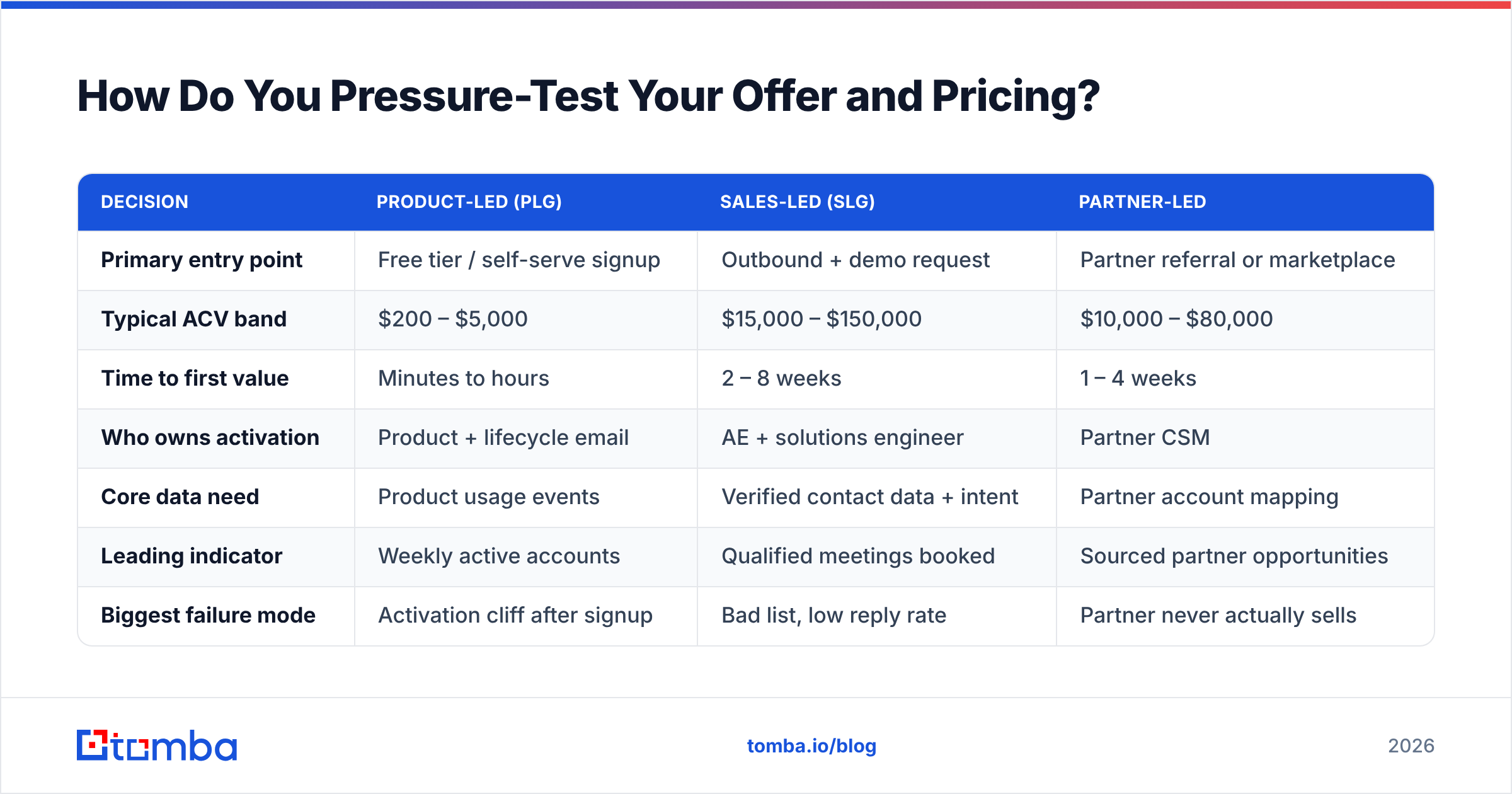
Here is how the same offer changes shape across three common GTM motions:
| Decision | Product-led (PLG) | Sales-led (SLG) | Partner-led |
|---|---|---|---|
| Primary entry point | Free tier / self-serve signup | Outbound + demo request | Partner referral or marketplace |
| Typical ACV band | $200 – $5,000 | $15,000 – $150,000 | $10,000 – $80,000 |
| Time to first value | Minutes to hours | 2 – 8 weeks | 1 – 4 weeks |
| Who owns activation | Product + lifecycle email | AE + solutions engineer | Partner CSM |
| Core data need | Product usage events | Verified contact data + intent | Partner account mapping |
| Leading indicator | Weekly active accounts | Qualified meetings booked | Sourced partner opportunities |
| Biggest failure mode | Activation cliff after signup | Bad list, low reply rate | Partner never actually sells |
| Realistic payback | 6 – 12 months | 12 – 24 months | 9 – 18 months |
Most companies run a hybrid. The mistake is running a hybrid by accident — a PLG funnel with a sales-led price, or an outbound team selling a product with no assisted onboarding.
Which Channel Questions Separate Working GTM From Wasted Budget?#
16. Where does this buyer already spend attention? Not where you prefer to publish. If your buyer lives in a niche Slack community and never opens LinkedIn, your content calendar is decorative.
17. Does the channel match the deal size? A $400 ACV product cannot support a 12-touch outbound sequence with an SDR. A $120,000 ACV product cannot be sold by a self-serve checkout page alone.
18. What is your realistic contact reachability per channel? Outbound email requires deliverable addresses. Cold calling requires accurate direct dials. LinkedIn requires the buyer to actually accept connection requests. Audit each before budgeting.
19. Can you sustain the channel for two full quarters? Channels have ramp curves. SEO takes six to nine months. Outbound takes six to eight weeks to produce reliable reply-rate data. If your runway cannot cover the ramp, pick a faster channel.
20. What is the fallback if the primary channel underperforms by 50 percent? Name it in advance. Deciding under pressure produces panic spending.
A note on data quality as a channel decision#
Outbound is not really a channel — it is a data problem with an email client attached. Your reply rate is a function of list quality far more than copy quality. Before you blame the sequence, check three things: bounce rate (should be under 2 percent), role accuracy (spot-check 20 contacts manually), and sender reputation.
If bounce rate is high, you are burning domain reputation on every send, and no amount of copywriting fixes that. Running lists through a bulk email finder and verification pass before the first send is not optional hygiene — it is a GTM prerequisite.
What Motion Questions Should Leadership Answer?#
21. Who owns the number? One name. Shared ownership of a revenue target means nobody owns it.
22. What is the handoff definition between marketing and sales? Define the marketing qualified lead threshold in writing, with specific criteria, and get both teams to sign it.
23. What does the first 90 days of a rep's week look like? If you cannot describe the daily activity, you cannot hire against it or coach it.
24. Which parts of the motion are automated, and which are human? Map it explicitly. Ambiguity here produces both duplicated work and silent gaps.
How Do You Know the Strategy Is Working Before Revenue Shows Up?#
Revenue is a lagging indicator. In a 90-day sales cycle, waiting for revenue to validate GTM means finding out you were wrong four months late.
25. What are your three leading indicators? Pick metrics that move within two weeks. Common good ones: qualified meetings booked, response rate on outbound, activation rate on signups, second-call rate.
26. What is your kill criterion? Define, in advance, the number that means "stop and rethink." Without it, sunk-cost reasoning takes over by month three.
27. What review cadence holds this accountable? Weekly for leading indicators, monthly for pipeline shape, quarterly for the strategy itself. Put it in calendars before launch.
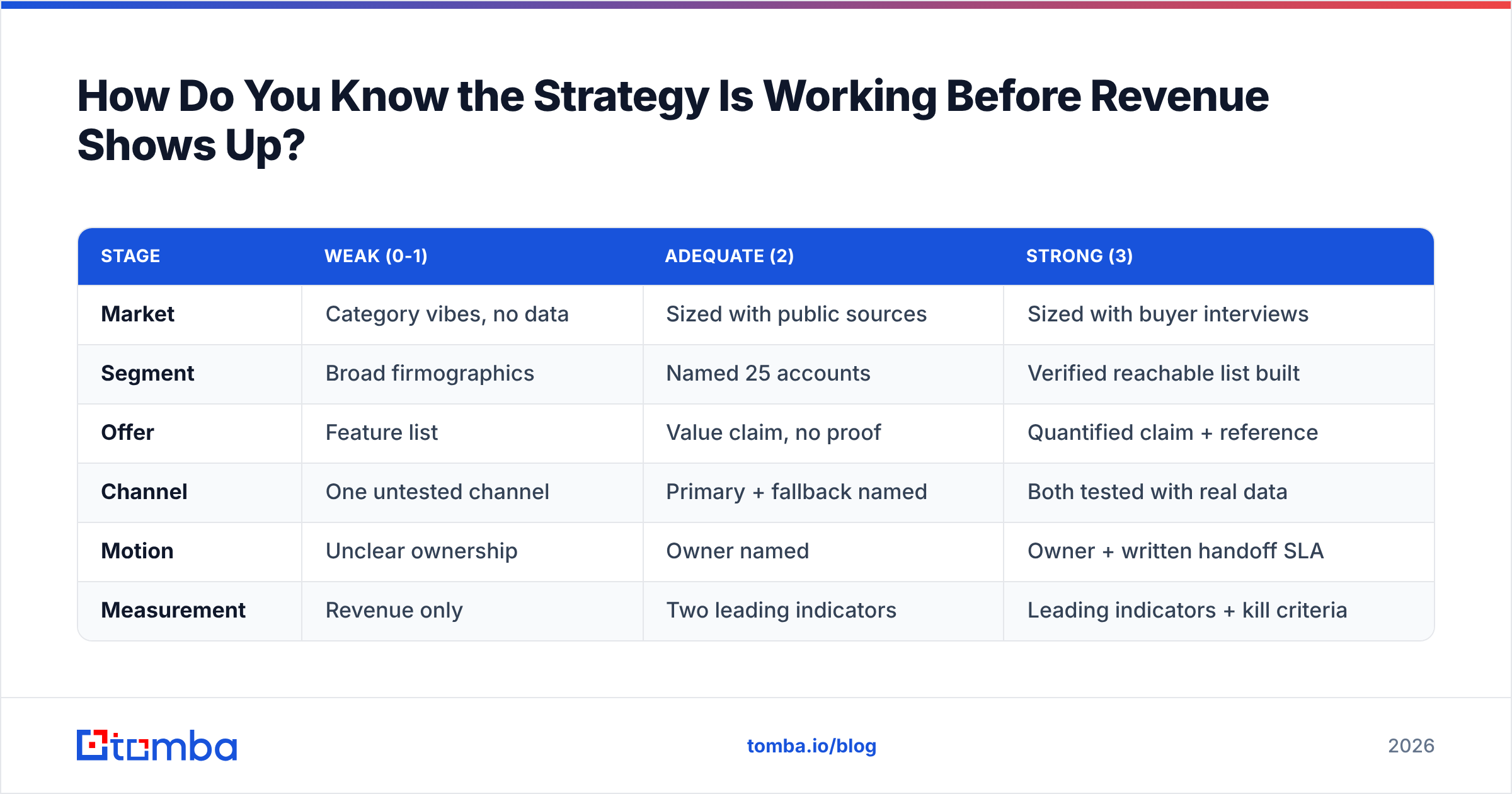
GTM readiness scorecard#
Score each stage honestly from 0 to 3. Anything under 12 total means you are not ready to spend.
| Stage | Weak (0-1) | Adequate (2) | Strong (3) |
|---|---|---|---|
| Market | Category vibes, no data | Sized with public sources | Sized with buyer interviews |
| Segment | Broad firmographics | Named 25 accounts | Verified reachable list built |
| Offer | Feature list | Value claim, no proof | Quantified claim + reference |
| Channel | One untested channel | Primary + fallback named | Both tested with real data |
| Motion | Unclear ownership | Owner named | Owner + written handoff SLA |
| Measurement | Revenue only | Two leading indicators | Leading indicators + kill criteria |
What Are the Most Common Mistakes in Answering These Questions?#
Confusing a category for a segment. "B2B SaaS" is not a segment. "Series B SaaS companies that just hired their first RevOps lead" is.
Answering from inside the building. Every question above should be checked against at least five real buyer conversations. Internal consensus is not evidence.
Treating data sourcing as an execution detail. Whether you can build a clean, verified contact list for your segment is a strategic constraint, not a task for the SDR to figure out later. Teams that discover this in week six lose a quarter.
Writing the plan once. GTM strategy is a living set of answers. Re-run questions 6, 9, 16, and 25 every quarter — those are the ones that go stale fastest.
Skipping the kill criterion. The plan with no defined failure condition always gets extended "one more month," six times.
How Do You Turn These Answers Into a Working Plan?#
Compress the 27 answers into a single page with five sections: segment definition, value claim, channel plan, motion ownership, and leading indicators with thresholds. If it does not fit on one page, you have not made decisions yet — you have made a list of options.
Then pressure-test the riskiest assumption first. For most B2B teams, that is question 9: can you reach the segment at all? Run a 200-account pilot before committing budget. You will learn more in five days of real list-building than in three weeks of planning meetings.
Keep the peer landscape honest as you evaluate tooling. Providers like BookYourData, Apollo, and Clearbit each solve different slices of the data problem, and the right answer depends on whether you need breadth, depth, or verification accuracy. Compare on the dimension your segment actually stresses — not on total record count, which is the least useful number in B2B data.
Ready to answer question 9 with evidence?#
The hardest go-to-market strategy question is whether your ideal segment is reachable, and it is the only one you can answer in an afternoon. Pull your target account list, run it through the Tomba Email Finder to see what percentage of your named roles resolve to verified, deliverable addresses, and let that number shape your channel plan instead of your optimism.
Tomba's free tier gives you 25 searches a month to run the pilot, with paid plans starting at $49/mo for Starter, $99/mo for Growth, and $249/mo for Pro — see full Tomba pricing for credit limits and API access. Test your segment before you fund it.
Related guides#
Ready to find emails that actually work?
Join 150,000+ professionals who stopped guessing and started sending. Free credits on signup — no credit card required.
Get the Tomba newsletter
Practical outbound tactics and product updates — once every two weeks.
About the author