Go-To-Market Strategy Template: A 2026 Framework That Works
Most GTM templates are pretty slides that never survive contact with a real pipeline. Here is a go to market strategy template built around ICP math, channel selection, and the data layer that actually feeds it.
TL;DR
- A go to market strategy template is only useful if it forces decisions: who you sell to, what problem you win on, which two channels you commit to, and what "working" looks like numerically.
- Skip the 40-slide deck. The working version fits on two pages: ICP definition, positioning statement, channel plan, motion (PLG / sales-led / hybrid), pricing, and a metrics contract.
- The step every template ignores is the data layer. A GTM plan that says "target Series B fintech RevOps leaders" and then hands reps a scraped list with 40% bounce rates has already failed.
- Budget the plan against a serviceable obtainable market you can actually build a contact list for — not a TAM number pulled from an analyst PDF.
- Review cadence beats plan quality. A mediocre plan reviewed every 30 days outperforms a brilliant one filed in Notion.
What is a go to market strategy template, really?#
A go to market strategy template is a fixed set of decisions you must make before spending money on demand. It is not a document format. The format is the least interesting part.
Think of it like a flight plan. A pilot does not file a flight plan because the paperwork is fun — they file it because writing down destination, route, fuel load, and alternates forces you to notice that you don't have enough fuel before you're airborne. Most GTM decks skip the fuel math and go straight to the pretty route map.
A usable template answers seven questions in writing:
- Who exactly buys this? Firmographic + technographic + trigger definition, not "mid-market SaaS."
- What do they do today instead? The status quo is your real competitor, not the vendor on the G2 grid.
- Why you, in one sentence? If the sentence works for three competitors, it isn't positioning.
- Which two channels get 80% of budget? Two. Not six.
- What is the sales motion and who owns each stage? Self-serve, SDR-led, partner-led, or hybrid.
- What does the pricing ladder look like? Entry point, expansion trigger, ceiling.
- What numbers prove it's working by day 90? Leading indicators, not ARR.
Everything else in a GTM deck — market maps, competitive quadrants, persona photos — is supporting evidence for those seven answers.
Why do most go-to-market templates fail in the first quarter?#
They fail because they optimize for board readability instead of rep executability.
Three specific failure modes show up over and over:
Failure 1: TAM theater. The plan opens with a $47B market. Nobody can sell to $47B. What matters is the serviceable obtainable market: how many named accounts can you reach, with contact data you actually possess, in the next two quarters? If you can only build a verified list of 3,400 accounts, your plan is a 3,400-account plan. Say so.
Failure 2: Channel spread. New teams commit to outbound, paid search, LinkedIn organic, webinars, partnerships, and content simultaneously. Each gets 15% of the attention required to produce signal. Ninety days later you have six ambiguous results and no decision.
Failure 3: No data contract. The plan names an ICP but never specifies where the contact records come from, what accuracy threshold is acceptable, or who owns list hygiene. Reps improvise. Bounce rates climb. Domain reputation degrades. Then the plan gets blamed for a data problem.
That last one deserves emphasis. According to Gartner's research on B2B buying, buying groups now average six to ten stakeholders. If your data layer surfaces one contact per account, your plan is structurally incapable of reaching the buying group it targets.
What sections belong in the template?#
Here is the two-page version. Copy it directly.
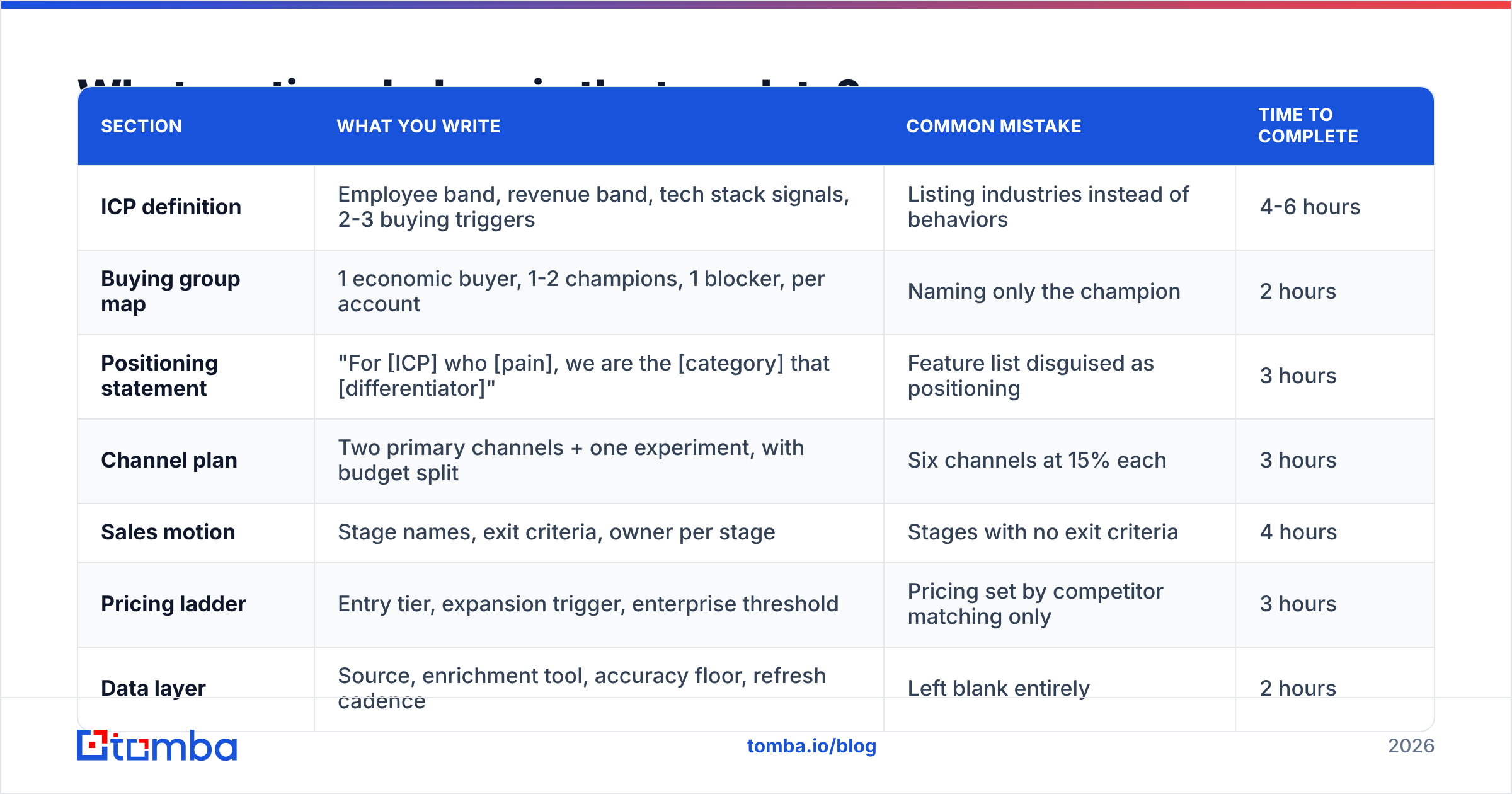
| Section | What you write | Common mistake | Time to complete |
|---|---|---|---|
| ICP definition | Employee band, revenue band, tech stack signals, 2-3 buying triggers | Listing industries instead of behaviors | 4-6 hours |
| Buying group map | 1 economic buyer, 1-2 champions, 1 blocker, per account | Naming only the champion | 2 hours |
| Positioning statement | "For [ICP] who [pain], we are the [category] that [differentiator]" | Feature list disguised as positioning | 3 hours |
| Channel plan | Two primary channels + one experiment, with budget split | Six channels at 15% each | 3 hours |
| Sales motion | Stage names, exit criteria, owner per stage | Stages with no exit criteria | 4 hours |
| Pricing ladder | Entry tier, expansion trigger, enterprise threshold | Pricing set by competitor matching only | 3 hours |
| Data layer | Source, enrichment tool, accuracy floor, refresh cadence | Left blank entirely | 2 hours |
| Metrics contract | 3 leading indicators, 1 lagging, 90-day thresholds | Only tracking closed-won | 2 hours |
Total: roughly three focused working days. If a GTM plan takes six weeks, the extra five weeks were politics, not planning.
How do you define an ICP that survives contact with reality?#
Define it by observable signals you can filter on, not by adjectives.
An ICP written as "innovative mid-market companies that value data" is unusable — no database has a "values data" field. An ICP written as "50-500 employees, uses HubSpot or Salesforce, hired a RevOps role in the last 9 months, has 3+ open SDR reqs" is a query. You can run a query.
The test is simple: hand your ICP definition to someone who has never seen your product and ask them to build a 200-account list. If they can't, your ICP is a mood board.
Practical sequence:
- Pull your last 40 closed-won deals. Ignore everything else.
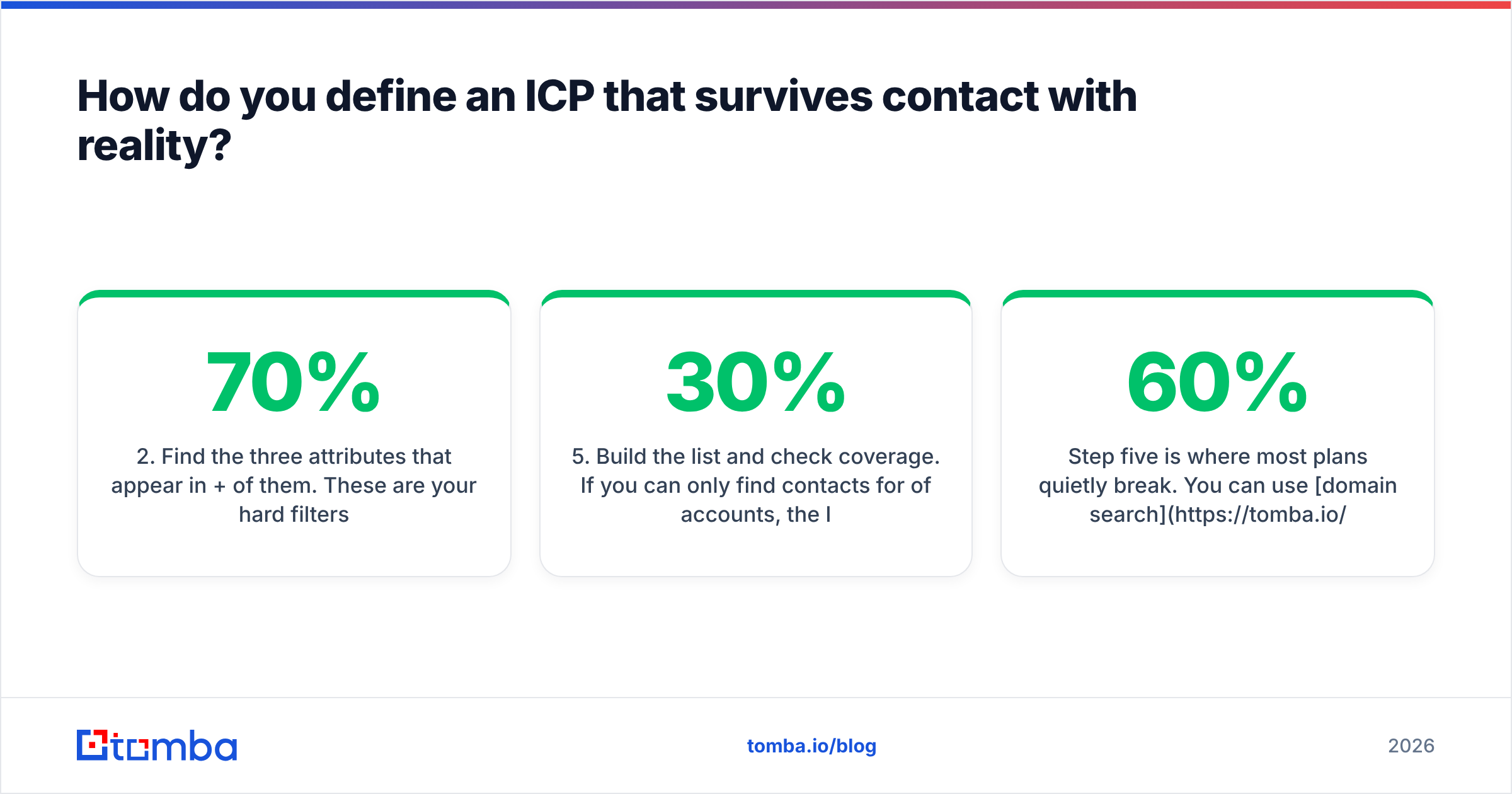
- Find the three attributes that appear in 70%+ of them. These are your hard filters.
- Find the negative signals — attributes present in your churned accounts. These become exclusions.
- Add a trigger layer. Funding round, leadership hire, tech stack change, hiring signal. Triggers turn a static list into a timed one.
- Build the list and check coverage. If you can only find contacts for 30% of accounts, the ICP is fine but your data pipeline isn't.
Step five is where most plans quietly break. You can use domain search to check contact coverage on a sample of 50 target domains before committing the whole quarter to that segment. If the coverage rate is under 60%, either widen the ICP or fix the sourcing before launch — don't discover it in week seven.
Which channel mix should the template commit to?#
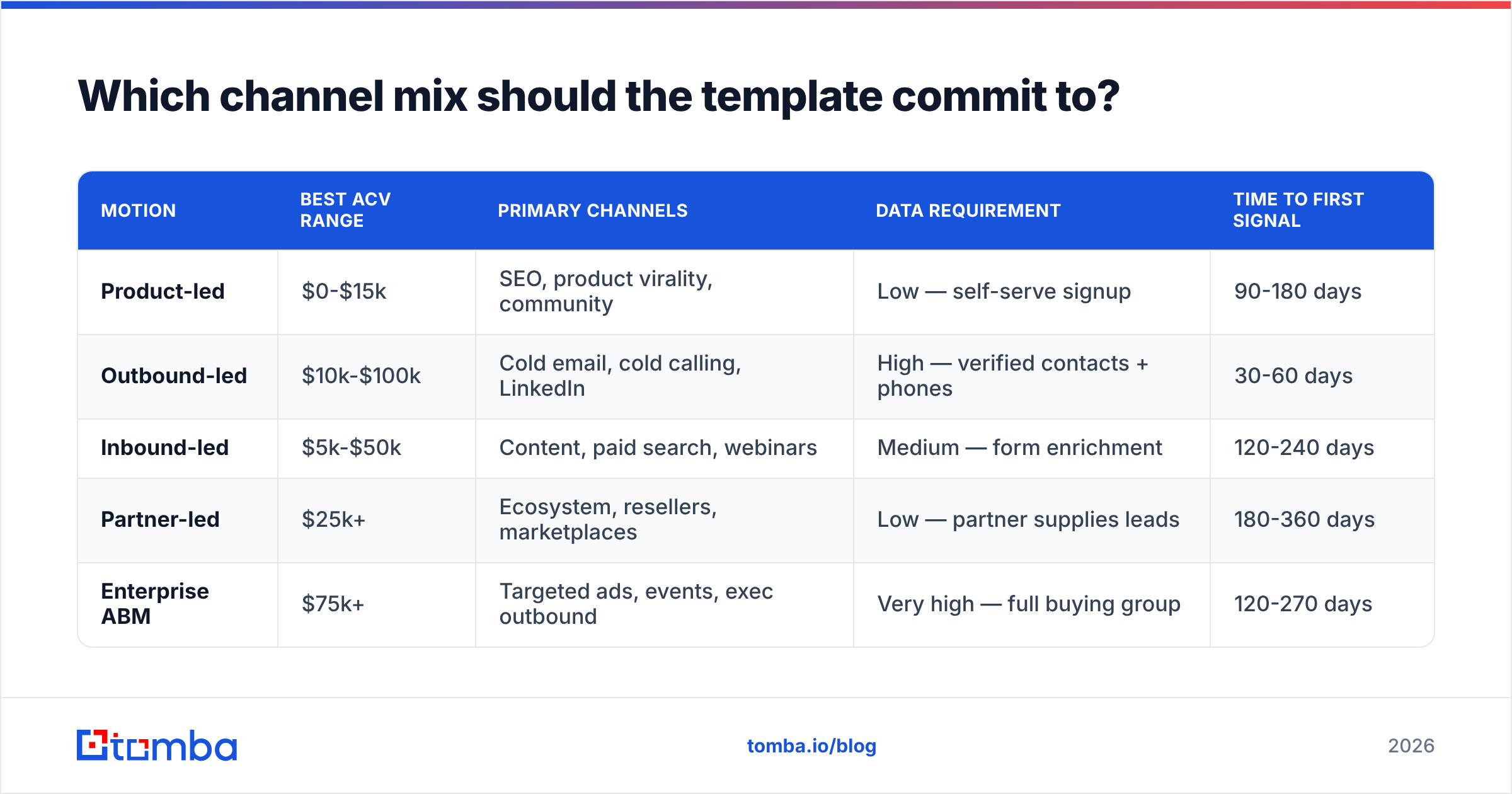
Pick two, based on where your buyer already spends attention and how expensive the product is.
| Motion | Best ACV range | Primary channels | Data requirement | Time to first signal |
|---|---|---|---|---|
| Product-led | $0-$15k | SEO, product virality, community | Low — self-serve signup | 90-180 days |
| Outbound-led | $10k-$100k | Cold email, cold calling, LinkedIn | High — verified contacts + phones | 30-60 days |
| Inbound-led | $5k-$50k | Content, paid search, webinars | Medium — form enrichment | 120-240 days |
| Partner-led | $25k+ | Ecosystem, resellers, marketplaces | Low — partner supplies leads | 180-360 days |
| Enterprise ABM | $75k+ | Targeted ads, events, exec outbound | Very high — full buying group | 120-270 days |
Two things fall out of that table.
First, outbound gives the fastest signal, which is why early-stage teams default to it. That speed is real, but it is entirely contingent on data quality — the one input teams underfund. A verified list of 500 contacts outperforms a raw list of 5,000, and it does so while protecting the sending domain you'll need for the next two years.
Second, PLG and ABM sit at opposite ends of the data-intensity spectrum. If you're running enterprise ABM, you need the full buying group per account: economic buyer, champion, technical evaluator, and often a procurement contact. That's four to eight verified records per account, plus B2B phone numbers for the roles that never answer email. Budget for it explicitly in the template.
What does the data layer section look like?#
This is the section nobody writes and everyone needs. Fill in five fields:
- Source of record. Where does the account list originate? CRM, a purchased database, an enrichment API, inbound signups, or scraped events. Name one primary and one fallback.
- Enrichment method. How does an account row become a contact row? Pattern-based email finding, database lookup, LinkedIn-based sourcing, or manual research. Specify the tool.
- Accuracy floor. What bounce rate is acceptable? Anything above 3% starts damaging sender reputation on cold domains. Write the number down so it becomes a gate, not an opinion.
- Verification step. Every list passes through an email verifier before it touches a sequence. Non-negotiable. Catch-all domains get routed to a separate, slower validation path rather than being blindly included or blindly dropped.
- Refresh cadence. B2B contact data decays roughly 25-30% annually as people change jobs. A list built in January is materially wrong by September. Set a quarterly re-verification job.
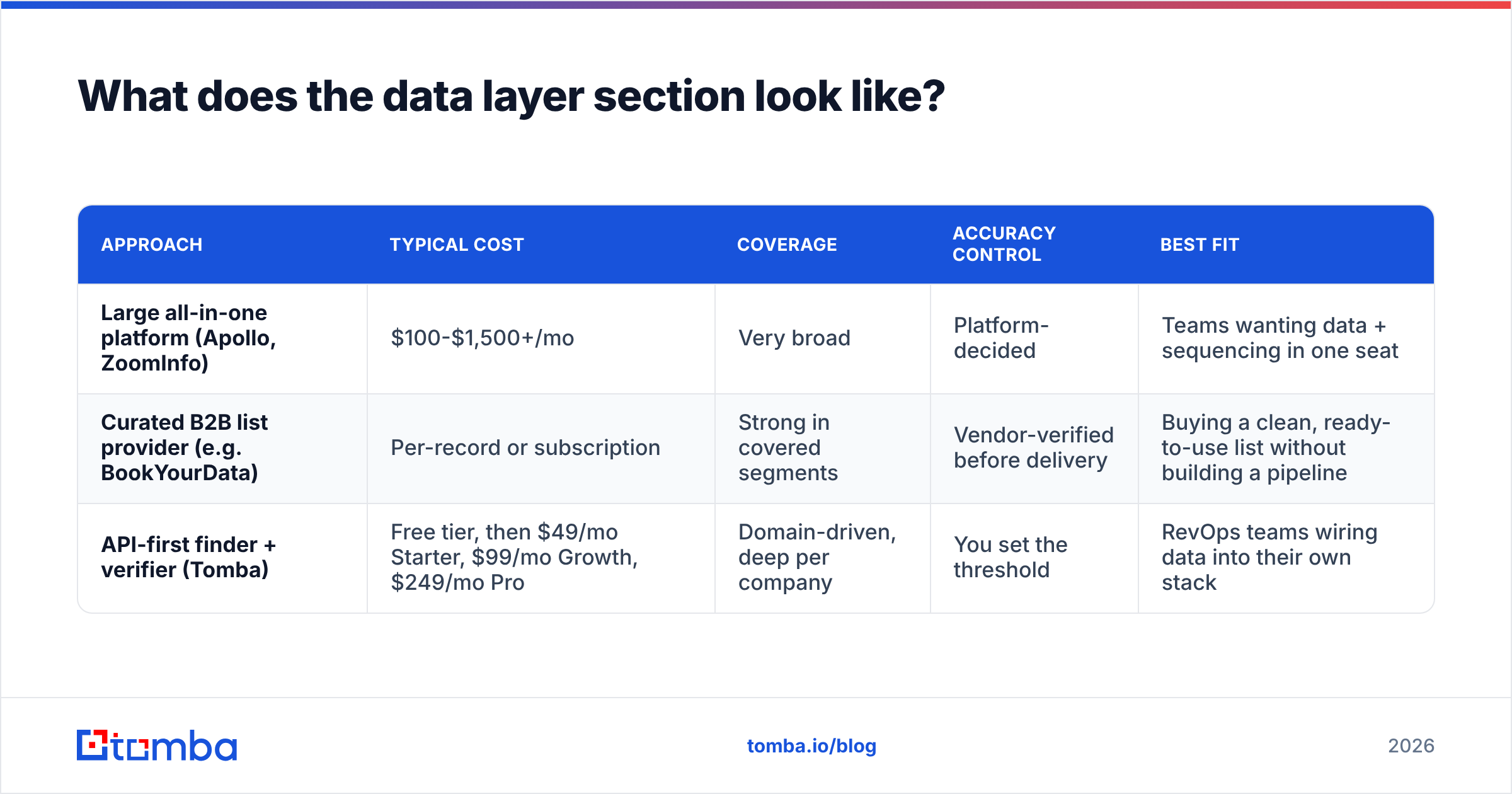
The tooling market here splits into three rough categories, and the template should say which one you're buying into:
| Approach | Typical cost | Coverage | Accuracy control | Best fit |
|---|---|---|---|---|
| Large all-in-one platform (Apollo, ZoomInfo) | $100-$1,500+/mo | Very broad | Platform-decided | Teams wanting data + sequencing in one seat |
| Curated B2B list provider (e.g. BookYourData) | Per-record or subscription | Strong in covered segments | Vendor-verified before delivery | Buying a clean, ready-to-use list without building a pipeline |
| API-first finder + verifier (Tomba) | Free tier, then $49/mo Starter, $99/mo Growth, $249/mo Pro | Domain-driven, deep per company | You set the threshold | RevOps teams wiring data into their own stack |
None of these is universally correct. The all-in-one platforms trade control for convenience. Curated providers like BookYourData are a genuinely good fit when you want verified records handed over rather than assembled, particularly for one-off campaign lists. API-first tools make sense when your GTM motion is programmatic and you want enrichment running inside your own workflows rather than inside someone else's UI. Compare the honest tradeoffs on a G2 category page before you sign anything annual.

How do you set the metrics contract?#
Pick three leading indicators and one lagging indicator, then define a 90-day threshold for each. Lagging-only measurement means you learn about failure in month four.
For an outbound-led plan, a reasonable contract looks like:
- Leading 1 — Deliverability: bounce rate under 3%, spam complaint rate under 0.1%. If this breaks, nothing downstream matters. Sender reputation is the foundation, and it takes far longer to repair than to protect.
- Leading 2 — Reply quality: positive reply rate above 3% on a verified list. Raw reply rate is noisy; count only replies that request information or a meeting.
- Leading 3 — Meeting-to-opportunity conversion: above 40%. Below that, your ICP filter is too loose — you're booking meetings with people who were never going to buy.
- Lagging — Pipeline created per rep per month: set against your ACV and quota math.
For a PLG plan, swap in activation rate, week-4 retention, and free-to-paid conversion. The structure holds; the metrics change.
Write the thresholds before launch. Metrics chosen after you see the data are not metrics, they're rationalizations. HubSpot's sales benchmark data is a reasonable external sanity check if you have no historical baseline of your own.
How often should you revise the template?#
Every 30 days for the first two quarters, then quarterly.
Run a 45-minute review with a fixed agenda:
- Which threshold did we miss? One per meeting, the worst one.
- Is it a plan problem or an execution problem? Wrong ICP versus bad emails are different fixes.
- What single change do we make? One change per cycle. Changing four variables at once destroys attribution.
- What do we stop doing? Every review should kill something. Plans accumulate activity by default.
The teams that win aren't the ones with the best initial plan. They're the ones whose plan is a living document with a version number, reviewed by people who are allowed to say "this segment isn't working, we're cutting it."
What are the common template traps to avoid?#
- Copying a template from a company at a different stage. A Series C playbook applied to a seed-stage team assumes headcount and brand you don't have.
- Writing the positioning statement last. It should come before channel selection, because positioning determines which channels are even coherent.
- Treating the template as a one-time artifact. Version it. Date it. Assign an owner.
- Ignoring the buying group. Single-threaded deals stall. Build multi-contact lists from the start — bulk email finder workflows exist precisely so that finding four contacts per account costs the same effort as finding one.
- Under-specifying the handoff. Marketing-to-sales, SDR-to-AE, AE-to-CS. Each handoff needs an owner, a definition of "qualified," and an SLA measured in hours.
- Skipping the "what would make us abandon this" question. Define the kill criteria upfront, while you're still objective.
Putting the template into motion#
The plan is done when a new rep can read it in twenty minutes and know exactly who to contact, why, through which channel, and what result is expected by when. If it takes longer than twenty minutes, it's a strategy document, not a go-to-market plan.
Once the ICP and channel decisions are locked, the bottleneck moves immediately to contact data — and that is where most quarters get lost. Building the list is the step between a good plan and actual pipeline.
Start with the Tomba Email Finder to turn your target account list into verified, deliverable contacts. Run 25 searches free to test coverage against your ICP before committing budget; from there the Starter plan is $49/mo and Growth is $99/mo, with full pricing details if you're scaling to a larger account list. Validate coverage on 50 accounts first — if the data holds, the rest of the plan has something real to stand on.
Related guides#
Ready to find emails that actually work?
Join 150,000+ professionals who stopped guessing and started sending. Free credits on signup — no credit card required.
Get the Tomba newsletter
Practical outbound tactics and product updates — once every two weeks.
About the author