Go To Market Strategy Uber Used to Win City by City
Uber didn't win with a better app. It won city by city with a supply-first launch playbook, ruthless local density, and subsidies used as a wedge. Here's the teardown — and what actually transfers to B2B.
TL;DR
- The go to market strategy Uber ran was never "launch an app." It was a repeatable city-by-city playbook. Sign up drivers first. Pay riders to try it. Then pull the money back.
- The real asset was the launch template: a 3-person city team, a fixed 90-day plan, and one north-star metric (ETA, not downloads).
- Subsidies worked because they bought a network that lasts. Discounts on their own are not a strategy. Copy the discount without the network and you just buy churn.
- B2B teams can steal four things. Supply first. Density before breadth. A launch checklist that runs without founders. One metric per phase.
- Do not copy this: burning cash ahead of unit economics, fighting regulators, or using growth to paper over weak retention.
Uber is the most quoted and least understood launch story in B2B. The go to market strategy Uber ran gets copied badly, and often. Everyone remembers the free rides. Almost nobody remembers that the free rides came fourth. The first three steps are the parts that transfer to a company selling software.
This is a teardown of the go to market strategy Uber used between 2010 and 2017. That is when the playbook was written, tested in 70+ countries, then partly dropped. After the teardown, we translate it into a launch plan for a B2B pipeline. You will not need $20B of venture money.
What was the go to market strategy Uber actually ran?#
It was a two-sided market cold start, solved one city at a time. That is the whole thing in one line.
A market like this has a chicken-and-egg problem. Riders will not open an app with no cars. Drivers will not sit idle with no riders. Uber saw that the problem is local, not global. Full cars in San Francisco tell you nothing about Lyon. So Uber did not run one launch. It ran hundreds of small, identical ones.
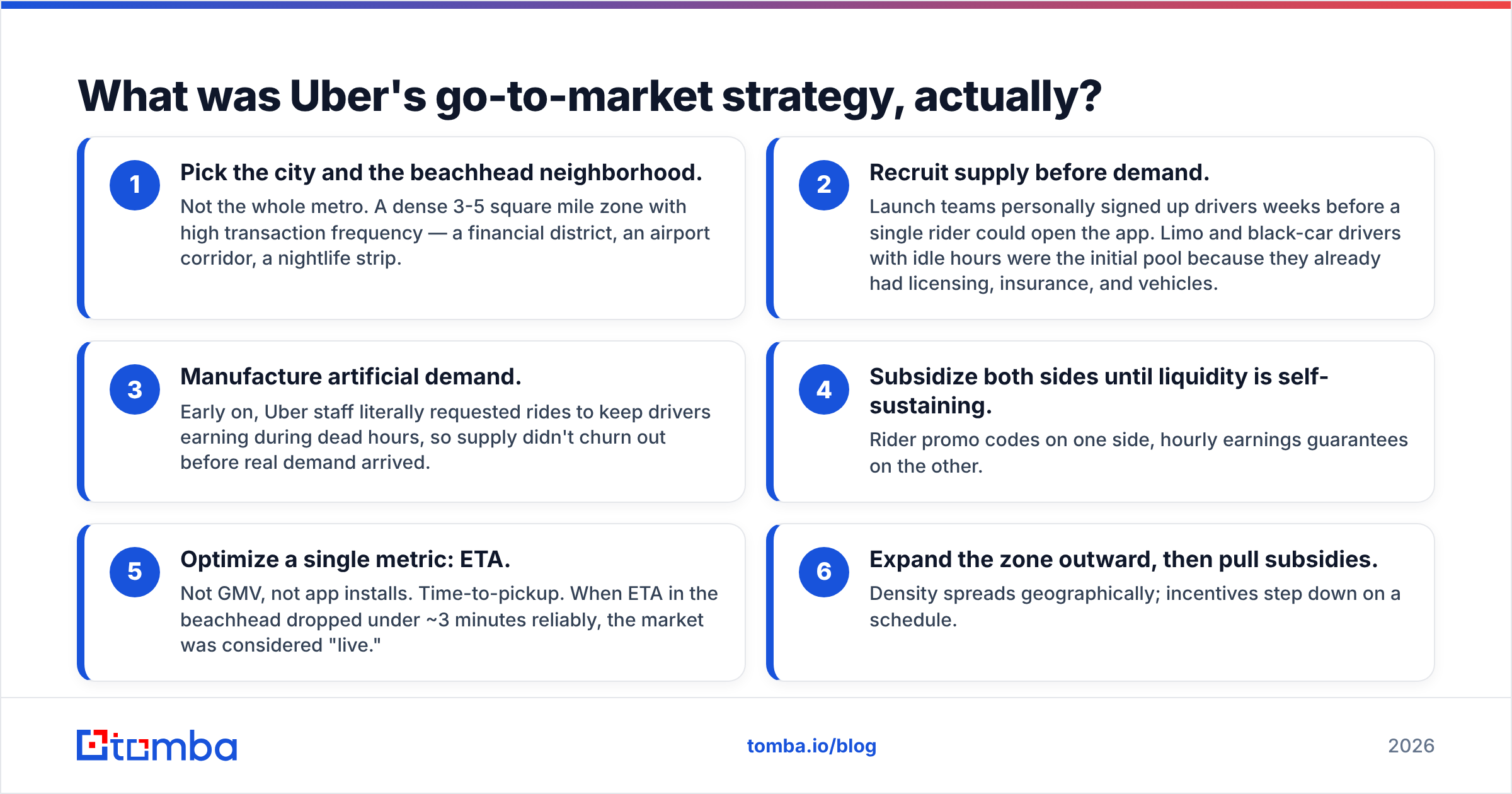
Here is the sequence, in the order it was run:
- Pick the city and the first zone. Not the whole metro. Pick a dense 3-5 square mile area with lots of rides. A finance district, an airport route, a nightlife strip.
- Sign up drivers before riders. Teams signed up drivers weeks before a rider could open the app. Limo and black-car drivers came first. They already had licenses, insurance, and cars.
- Create the first demand by hand. Staff booked rides themselves. That kept drivers earning in dead hours, so they did not quit before real riders arrived.
- Pay both sides until the market holds on its own. Promo codes for riders. Hourly pay guarantees for drivers.
- Track one number: ETA. Not GMV. Not app installs. Time to pickup. Once ETA in the zone stayed under three minutes, the city counted as "live."
- Widen the zone, then cut the payouts. Density spreads out. Incentives step down on a set schedule.
The order matters more than any single tactic. Swap steps 2 and 4 and you get the startup graveyard. Paid demand pours in, and there is no supply to meet it.
Why did Uber launch city by city instead of nationally?#
Because density beats reach when a market has a local network effect. More B2B markets have one than people admit.
A national launch spreads one budget over a huge area. No single market ever fills up. Picture 400 drivers spread over 30 cities. That is 13 cars per city and 20-minute waits. The product feels broken everywhere. Put the same 400 drivers in one district and waits drop under five minutes. Now it feels like magic to everyone who tries it.
Uber wrote this down as the launch playbook. It was a checklist. A three-person team could open a city with no founder in the room: a general manager, a driver ops lead, and a marketing lead. By 2015 the company opened several cities a week off that template.
The B2B version is not about maps. It is segment density:
- Vertical density. Win 20 mid-market orthodontics practices in one state before you touch nearby verticals.
- Account density. Land six teams inside one enterprise before you chase a second logo.
- Persona density. Own "RevOps managers at Series B SaaS" so fully that they hear your name in three Slack groups.
- Channel density. Make one channel pay for itself before you add a second.
The failure mode is the same one marketplaces hit. You spread pipeline over nine ICPs. You reach critical mass in none. Then you decide the product does not land. It lands fine. You never got enough people in one room talking about it.
How did Uber's subsidy model actually work?#
Subsidies are the most copied part of the go to market strategy Uber ran. They are also the most misread. People read them as discounting to buy growth. That is not what they were. They were a short-term purchase of density, with a set end date.
The math is a payback question, not a marketing one. Uber would lose money per ride under two conditions. First, each paid ride had to push the city closer to standing on its own. Second, the riders and drivers it bought had to be worth more over time than the payout.
When both held, the subsidy bought an asset. When they did not, it was just burnt cash. That happened in China and Southeast Asia, where rivals matched every dollar. Uber later sold those operations to Didi and Grab.
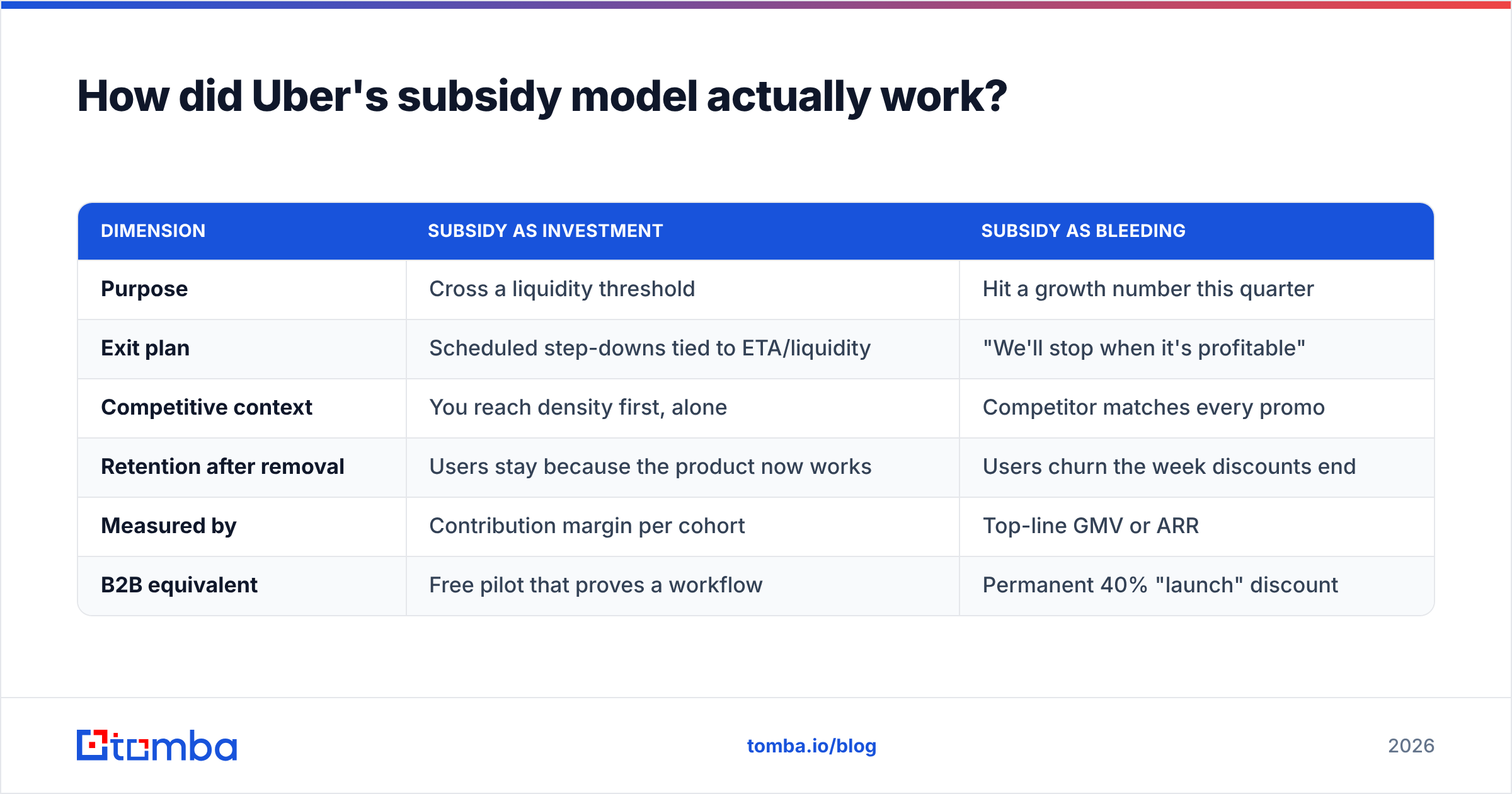
That gap is the whole lesson. Here is how the two look side by side:
| Dimension | Subsidy as investment | Subsidy as bleeding |
|---|---|---|
| Purpose | Cross a density threshold | Hit a growth number this quarter |
| Exit plan | Set step-downs tied to ETA | "We'll stop when it's profitable" |
| Rivals | You reach density first, alone | A rival matches every promo |
| After removal | Users stay; the product works | Users leave the week it ends |
| Measured by | Margin per cohort | Top-line GMV or ARR |
| B2B version | A pilot that proves a workflow | A permanent 40% "launch" discount |
The B2B version is the paid pilot priced below cost. You eat setup and services margin to get a workflow embedded. An embedded workflow keeps paying you back. The failure version is the standing discount reps hand out to close deals. It teaches the market that your list price is fiction.
Want the theory? Both HBR's work on platform competition and the practitioner writing on network effects make the same point. A subsidy is only rational when it buys ground you can hold.
Which metrics did Uber track at each stage?#
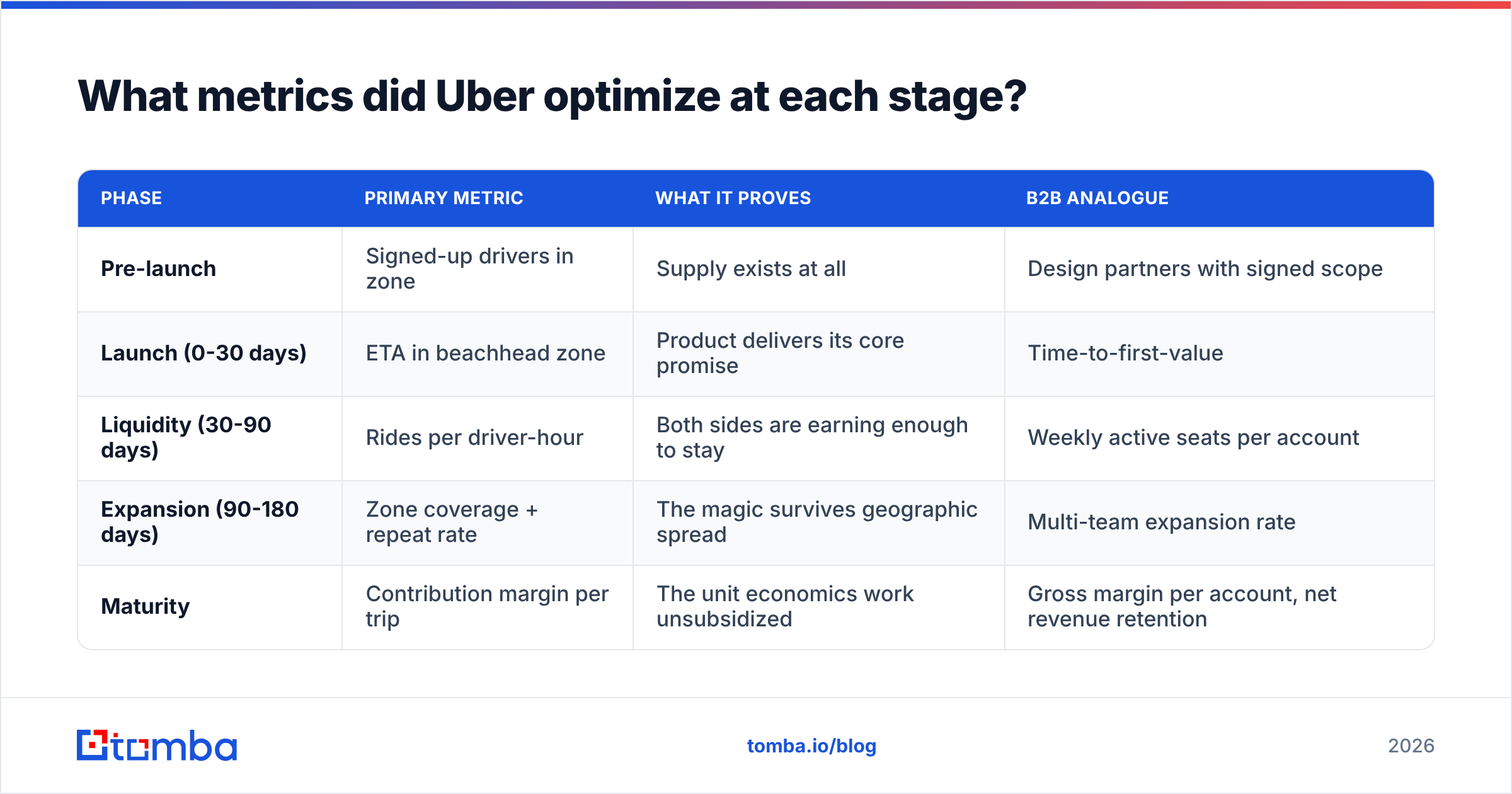
One metric per phase. It is the most underrated part of the go to market strategy Uber ran. It is also the easiest piece to copy tomorrow.
| Phase | Main metric | What it proves | B2B version |
|---|---|---|---|
| Pre-launch | Drivers signed up in the zone | Supply exists at all | Design partners with signed scope |
| Launch (0-30 days) | ETA in the zone | The core promise works | Time to first value |
| Density (30-90 days) | Rides per driver-hour | Both sides earn enough to stay | Weekly active seats per account |
| Expansion (90-180 days) | Zone coverage and repeat rate | The magic survives a wider map | Multi-team expansion rate |
| Maturity | Margin per trip | It works without subsidies | Gross margin, net revenue retention |
Notice what is missing. No app downloads. No press mentions. No funding news. Uber's launch teams were not judged on vanity numbers. Neither should your market-entry teams be. If your new-segment dashboard leads with "MQLs generated," you copied the marketing and skipped the strategy. A marketing qualified lead is an input, not proof of market entry.
Is the Uber playbook still relevant in 2026?#
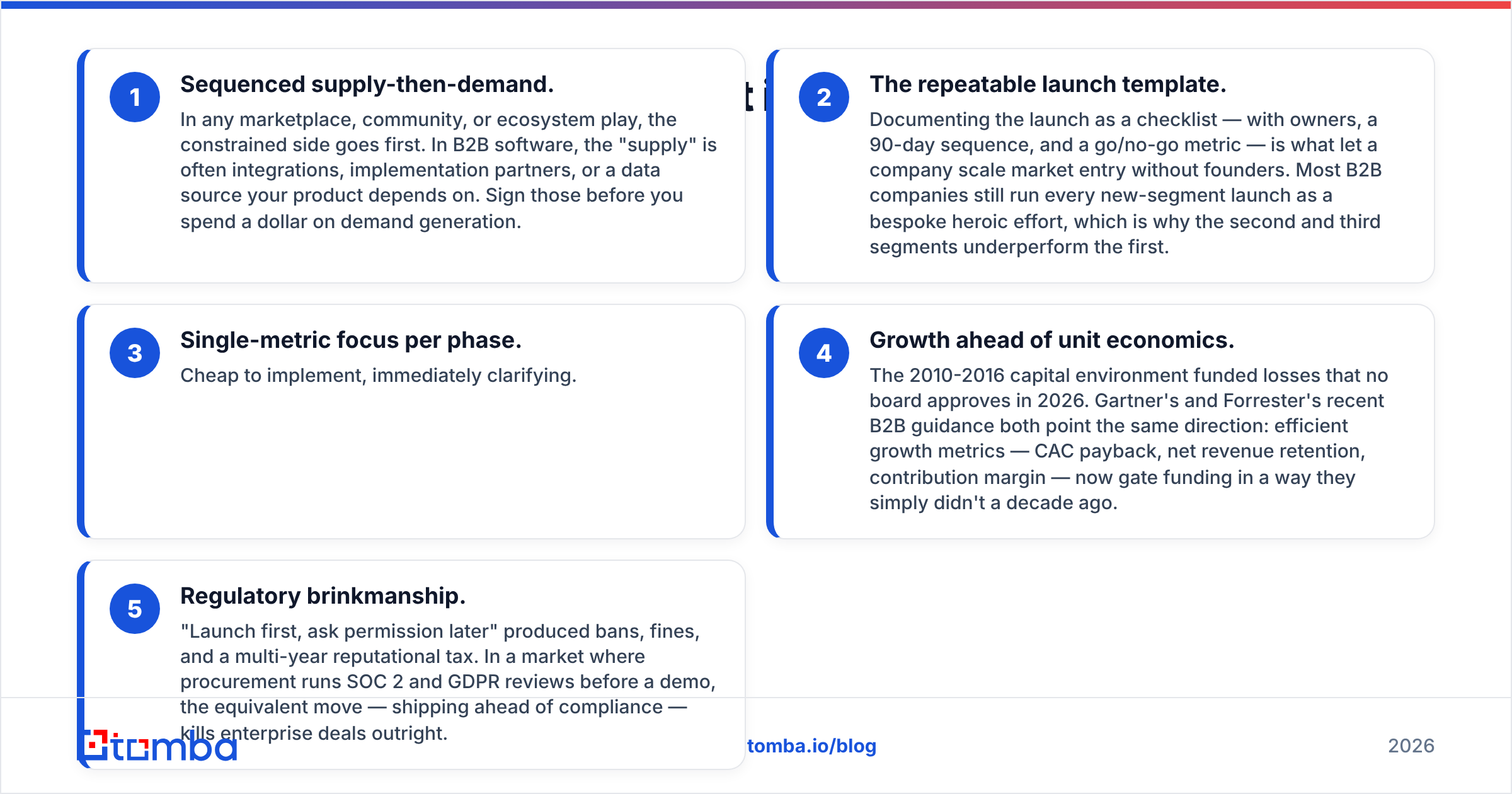
Partly. Three parts of the go to market strategy Uber ran aged well. Two aged badly.
Aged well — steal these:
- Supply first, then demand. In any marketplace or ecosystem play, the tight side goes first. In B2B software that "supply" is often integrations, partners, or a data source you depend on. Lock those in before you spend on demand.
- The repeatable launch template. Write the launch down as a checklist. Name owners, set a 90-day sequence, pick a go/no-go number. That is what let Uber open markets without founders. Most B2B teams still treat each new segment as a heroic one-off. That is why segments two and three miss.
- One metric per phase. Cheap to set up. Clarifying on day one.
Aged badly — do not steal these:
- Growth ahead of unit economics. The 2010-2016 money market paid for losses that no board signs off on in 2026. Gartner's and Forrester's recent B2B guidance point the same way. CAC payback, net revenue retention, and margin now gate funding.
- Fighting regulators. "Launch first, ask later" bought bans, fines, and years of bad press. Today buyers run SOC 2 and GDPR checks before a demo. Shipping ahead of compliance kills enterprise deals outright.
How do you run an Uber-style launch for a B2B product?#
Here is the go to market strategy Uber ran, translated. Ninety days, one segment, one metric per phase.
Days 1-15 — Pick the beachhead and lock in supply.
Pick one segment. It should be narrow enough to name 200 target accounts. It should be big enough to be worth $2M+ in ARR. Then find your tight side. For most B2B products it is not customers. It is the thing that makes the product work on day one. A data integration, a reference customer, a partner, or good contact data. Secure that first.
Build the target list before anything else. This is where segment launches quietly fail. The team spends 30 days on positioning, then finds it has 40 verified contacts, not 400. Run a domain search across your 200 accounts to map the org charts. Then use a bulk email finder to build the list in one pass.
Days 16-30 — Create the first demand by hand.
Uber staff booked rides to keep drivers busy. Your version is warm intros, design partners, and outbound a human runs. Keep the list small enough that a founder or senior AE touches every account. Do not automate this phase. The goal is learning, not efficiency. You want to know which message lands. A 5,000-contact blast will not tell you.
Days 31-60 — Measure time to first value.
ETA was Uber's proxy for "does this feel like magic." Yours is time to first value. That is the gap between signature and the first result the customer would miss. Measure it. Post it where the team can see it. Then cut it in half. The rest of the funnel improves once this number drops.
Days 61-90 — Expand, subsidize, or kill.
Three honest outcomes. If time to first value is short and usage repeats, widen the zone. Add nearby sub-segments, more accounts, a second channel. If usage is there but conversion is not, a timed subsidy may be rational. Write the step-down schedule first. If neither holds, kill the segment and move the budget. Uber shut down cities that never took off. So should you.
A note on the data layer. Every step assumes you can reach people in your beachhead. Density is impossible if 60% of your contact data is stale. You will spend the whole 90 days building a list instead of testing a market. Verify before you send. Email verification up front protects the sender reputation you need for every launch after this one.
What are the honest criticisms of the Uber playbook?#
Three, and they are worth saying plainly. Most write-ups of this case read like fan mail.
It is survivorship bias at scale. Uber ran the same playbook everywhere and lost several big markets. China, Russia, Southeast Asia. The playbook is real. It was not enough. Deep pockets and local rivals decided as much as the process did.
The subsidies were partly a war tax. Where a well-funded local rival existed, neither side could stop paying without losing share. So both burned cash to a draw. That is a standoff, not a strategy. The same thing happens when three B2B vendors discount each other into commodity pricing.
The culture costs were real. The push-hard mindset that made the go to market strategy Uber ran so fast also led to the 2017 governance crisis. Copy the tempo without the guardrails and you inherit both.
None of this kills the sequencing lesson. "Be like Uber" is bad advice. "Sequence supply before demand, win density before breadth, and put one metric on each phase" is good advice.
What should you actually do Monday morning?#
Pick one segment. Name 200 accounts in it. Find your tight side and lock it in before you spend on demand. Set one metric for the next 30 days and ignore the rest of the dashboard. Write the launch down as a checklist. The second segment should not need the same heroics as the first.
Then build the list. Do it once, properly, with verified contacts instead of scraped guesses. That is the dull foundation under every city Uber ever opened. Someone knew exactly who to call, and the calls connected.
Start with the contact layer. Map every decision-maker in your beachhead with the Tomba Email Finder. Search by domain, name, or company. Verify before you send. Export straight into your sequencer or CRM. The free tier gives you 25 searches a month to test a segment. The Starter plan runs $49/mo when you are ready for the full 200-account list. Full Tomba pricing is public, and there is no sales call.
Related guides#
Ready to find emails that actually work?
Join 150,000+ professionals who stopped guessing and started sending. Free credits on signup — no credit card required.
Get the Tomba newsletter
Practical outbound tactics and product updates — once every two weeks.
About the author