Go to Market Strategy vs Marketing Strategy: 2026 Guide
One is a launch plan with an expiry date. The other is a permanent demand engine. Confusing them is why most B2B launches stall — here is the practical split, with a decision table.
Go to market strategy vs marketing strategy comes down to one thing: time. A GTM plan launches one product to one buyer, then it ends. A marketing strategy runs the whole company's demand, year after year. Mix them up and your launch stalls.
TL;DR
- A go-to-market (GTM) strategy is a time-boxed launch plan for one product, one segment, one motion. A marketing strategy is a permanent system for creating and capturing demand across everything you sell.
- GTM answers "how does this specific thing reach this specific buyer and convert?" Marketing answers "why does anyone in this category think of us at all?"
- GTM owns pricing, packaging, channel choice, sales enablement, and launch sequencing. Marketing owns positioning, brand, content, campaigns, and lifecycle.
- You need both. Most teams under 50 people should write the GTM strategy first and let the marketing strategy be the durable layer that survives it.
- Both plans die on the same rock: bad contact data. Segments you cannot reach are hypotheses, not pipelines.
What is a go-to-market strategy?#
A go-to-market strategy is the plan for putting a specific offer in front of a specific buyer. It runs through one specific motion, inside a set window.
Think of it like opening a single restaurant location. You are not deciding what your restaurant brand stands for — that is already settled. You are deciding a short list: which neighborhood, what the opening menu is, what the prices are, and who staffs the front. Then two more: how you fill tables in week one, and what a good opening looks like by day 90.
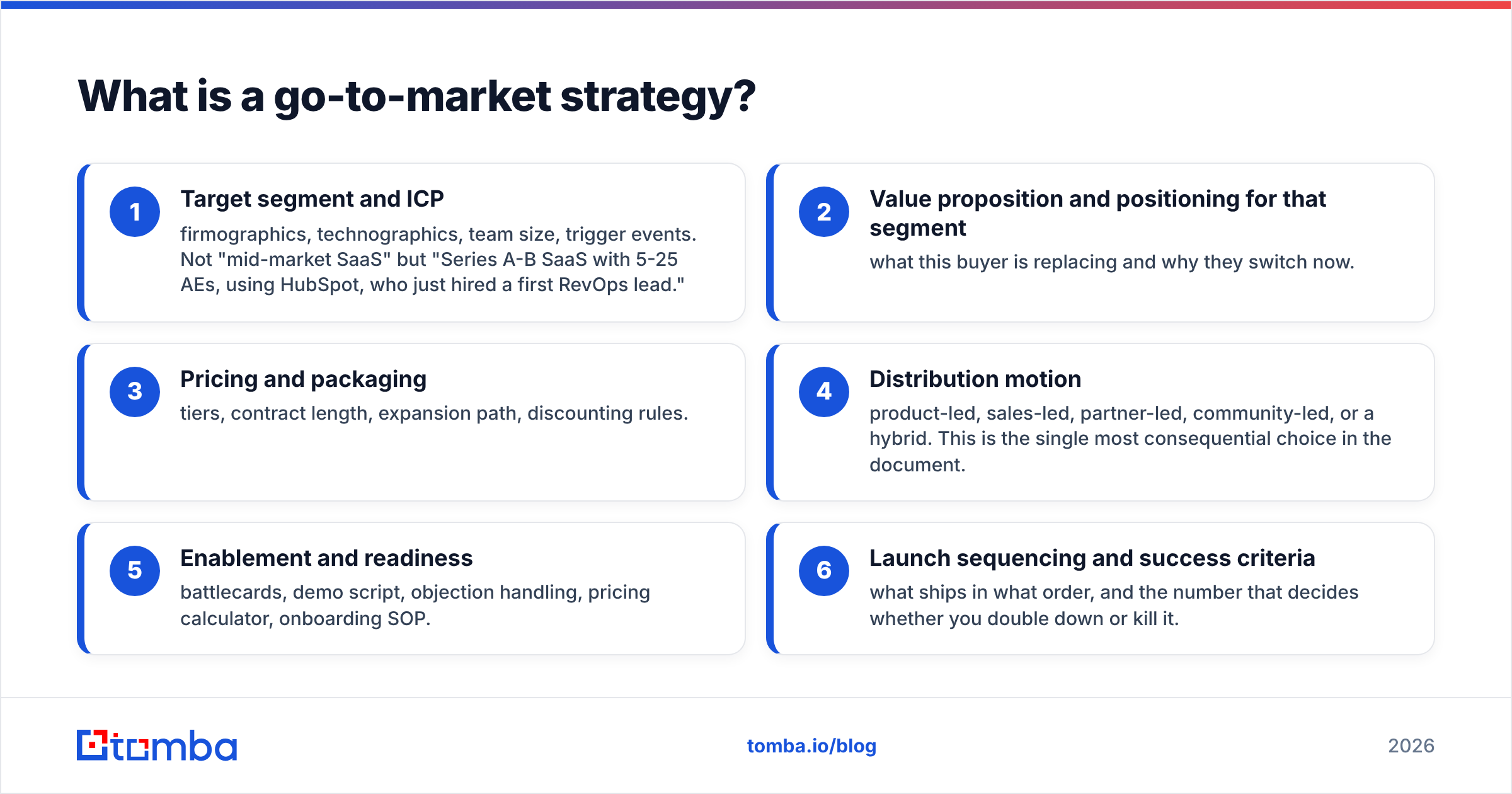
A real GTM strategy contains, at minimum:
- Target segment and ICP — firmographics, technographics, team size, trigger events. Not "mid-market SaaS" but "Series A-B SaaS with 5-25 AEs, using HubSpot, who just hired a first RevOps lead."
- Value proposition and positioning for that segment — what this buyer is replacing and why they switch now.
- Pricing and packaging — tiers, contract length, expansion path, discounting rules.
- Distribution motion — product-led, sales-led, partner-led, community-led, or a hybrid. This is the single most consequential choice in the document.
- Enablement and readiness — battlecards, demo script, objection handling, pricing calculator, onboarding SOP.
- Launch sequencing and success criteria — what ships in what order, and the number that decides whether you double down or kill it.
Notice what is missing: brand voice, category narrative, annual content calendar, agency relationships. Those live upstream, and they outlast any single launch.
Gartner's research on B2B buying finds that buyers spend little of the purchase cycle with a sales rep. Most of the journey happens in channels you do not control. That is a GTM design constraint: your motion has to work when nobody is in the room. You can read Gartner's ongoing coverage of the B2B buying journey for the underlying data.
What is a marketing strategy?#
A marketing strategy is the standing system behind awareness, preference, and demand for the company. It spans all products and all segments, over years.
Back to the restaurant analogy: the marketing strategy is the restaurant group's reputation. What kind of food you are known for. Why food critics call you. Why people already know your name before location number four opens. Any single opening borrows from that reservoir; a bad opening drains it.
The components are structurally different from GTM:
- Category and positioning — what market you claim, who you are explicitly not for.
- Audience research and messaging architecture — the durable claims, proof points, and language.
- Channel portfolio — SEO, paid, events, community, partnerships, lifecycle email, with budget splits and a stated time horizon per channel.
- Brand system — voice, visual identity, thought-leadership point of view.
- Measurement model — attribution approach, MQL definition, pipeline contribution targets, and how you treat brand spend that will not show up in a 30-day report.
- Operating cadence — quarterly planning, campaign calendar, budget reallocation rules.
A useful test: if you shipped no new product for 18 months, your marketing strategy would still have a full workload. Your GTM strategy would be finished.
Go to market strategy vs marketing strategy: what actually differs?#
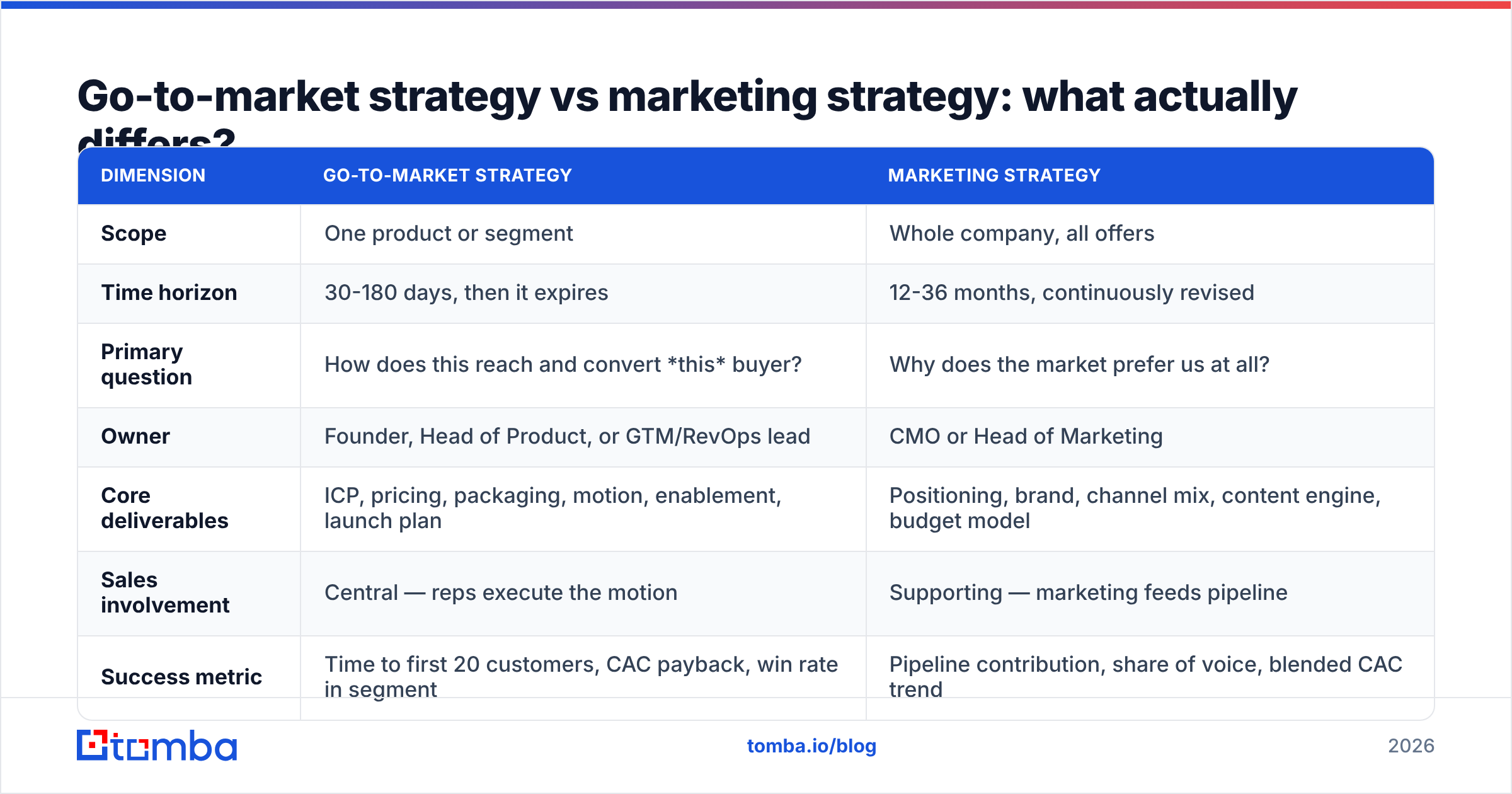
Here is the go to market strategy vs marketing strategy split most teams need pinned to a wall.
| Dimension | Go-to-market strategy | Marketing strategy |
|---|---|---|
| Scope | One product or segment | Whole company, all offers |
| Time horizon | 30-180 days, then it expires | 12-36 months, continuously revised |
| Primary question | How does this reach and convert this buyer? | Why does the market prefer us at all? |
| Owner | Founder, Head of Product, or GTM/RevOps lead | CMO or Head of Marketing |
| Core deliverables | ICP, pricing, packaging, motion, enablement, launch plan | Positioning, brand, channel mix, content engine, budget model |
| Sales involvement | Central — reps execute the motion | Supporting — marketing feeds pipeline |
| Success metric | Time to first 20 customers, CAC payback, win rate in segment | Pipeline contribution, share of voice, blended CAC trend |
| Failure mode | Great product, wrong channel, no traction | Strong brand, unclear offer, weak conversion |
| Data dependency | Very high — needs reachable, verified contacts | Moderate — audience-level, less person-level |
| Reusable? | Rarely. Rewrite per launch | Yes. It is the durable asset |
The row that catches most teams out is data dependency. A marketing strategy can survive on audience-level guesses for a quarter. A GTM strategy cannot. Commit to an outbound or hybrid motion and "2,400 companies match our ICP" has to become 2,400 named people with working inboxes. That translation step is where launches quietly die.
Which one do you build first?#
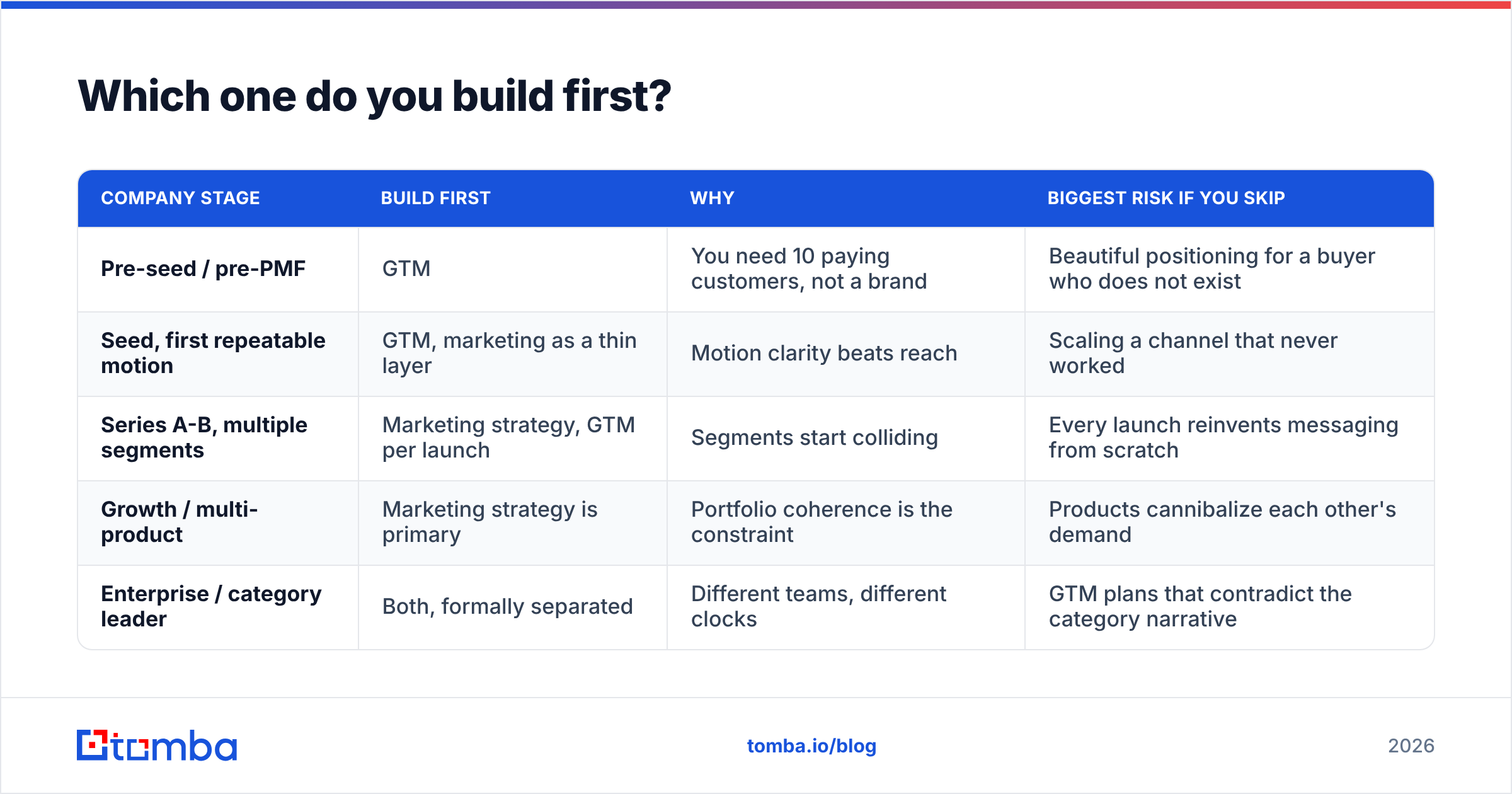
Build the GTM strategy first if you are pre-product-market-fit. Build the marketing strategy first if you have fit and are scaling. The dividing line is simple: do you still need to learn who buys?
| Company stage | Build first | Why | Biggest risk if you skip |
|---|---|---|---|
| Pre-seed / pre-PMF | GTM | You need 10 paying customers, not a brand | Beautiful positioning for a buyer who does not exist |
| Seed, first repeatable motion | GTM, marketing as a thin layer | Motion clarity beats reach | Scaling a channel that never worked |
| Series A-B, multiple segments | Marketing strategy, GTM per launch | Segments start colliding | Every launch reinvents messaging from scratch |
| Growth / multi-product | Marketing strategy is primary | Portfolio coherence is the constraint | Products cannibalize each other's demand |
| Enterprise / category leader | Both, formally separated | Different teams, different clocks | GTM plans that contradict the category narrative |
A shortcut for founders: write your ICP in one sentence. If a stranger could not use it to rule a company out, you are not ready for a marketing strategy. Go do GTM discovery.
What does GTM include that marketing does not?#
Four things, and they are the four that marketing teams routinely have no authority over.
- Pricing and packaging. Marketing communicates price; GTM sets it. Tier boundaries, seat vs usage, annual discount, and the free-tier line are GTM calls with permanent revenue consequences.
- Sales motion design. Self-serve, inside sales, or field sales — that choice sets your whole cost structure. Choose PLG and your CAC target changes by an order of magnitude.
- Enablement artifacts. Battlecards, discovery frameworks, objection scripts, ROI calculators. These are GTM deliverables even when marketing writes them.
- Target account list construction. The literal named list of companies and contacts you will pursue this quarter. Marketing thinks in audiences; GTM thinks in rows.
That last one is where strategy meets a spreadsheet. You can define a perfect segment and still be stuck. You have company names, but no way to reach a decision-maker. Building the list means resolving domains to people, people to titles, and titles to verified addresses. Teams use a B2B database for coverage. Then a bulk email finder turns the account list into contactable rows. Verify before anything gets sent.
How do the two work together in practice?#
The clean mental model: marketing strategy is the road; GTM strategy is the vehicle. New roads take years and serve every vehicle. Vehicles get built, driven hard, and replaced.
Here is what a coordinated 90-day launch looks like when both exist:
- Days -30 to 0 — GTM defines, marketing translates. GTM locks segment, pricing, and motion. Marketing checks the positioning against the standing category narrative and flags contradictions before anything ships.
- Days 1-14 — list and enablement. GTM builds the named account list and verifies contacts. Marketing ships the landing page, one anchor asset, and the sequence copy. Nothing sends until bounce rate on a test slice is under 2%.
Then the launch runs, and you read what it tells you:
- Days 15-45 — motion runs hot. Outbound and paid run against the named list. Marketing runs the awareness layer for the same segment, so cold outreach lands on warm-ish ground.
- Days 46-75 — read the signal. GTM looks at reply rate, meeting rate, and win rate within the segment only. Marketing looks at whether the segment's organic and direct traffic moved at all.
- Days 76-90 — decide and absorb. Kill, iterate, or scale. Whatever messaging won gets promoted into the permanent messaging architecture. That promotion step is how GTM experiments compound instead of evaporating.
Most teams call the failure here "marketing and sales misalignment." It is usually simpler: step 5 never happens. Every launch starts from zero because nothing learned in GTM gets written back into the marketing strategy. HubSpot's annual State of Marketing data keeps surfacing the same gap between campaign learning and durable strategy.
What metrics prove each one is working?#
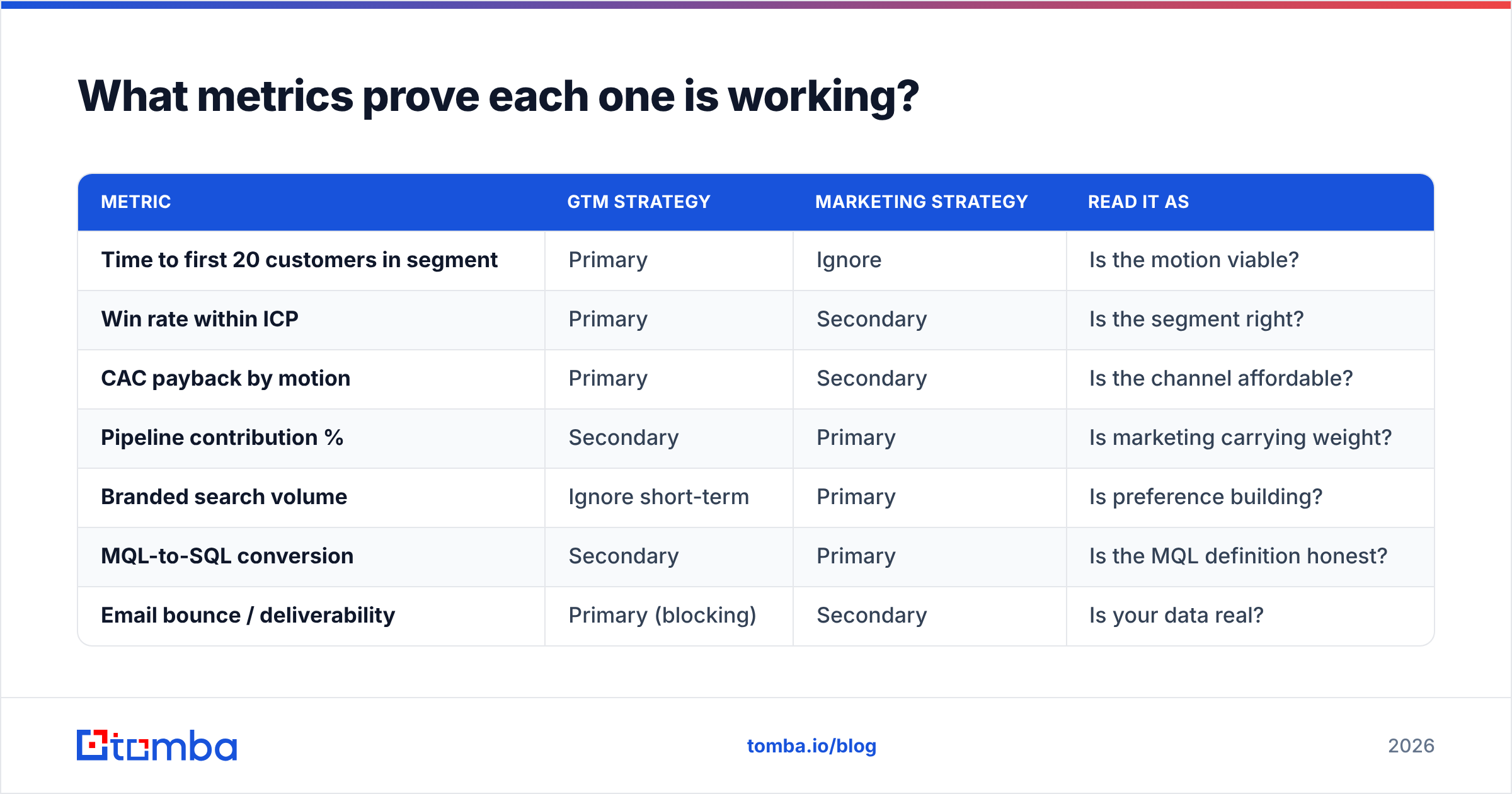
Do not judge a GTM strategy with marketing metrics. You will kill working launches and protect dead ones.
| Metric | GTM strategy | Marketing strategy | Read it as |
|---|---|---|---|
| Time to first 20 customers in segment | Primary | Ignore | Is the motion viable? |
| Win rate within ICP | Primary | Secondary | Is the segment right? |
| CAC payback by motion | Primary | Secondary | Is the channel affordable? |
| Pipeline contribution % | Secondary | Primary | Is marketing carrying weight? |
| Branded search volume | Ignore short-term | Primary | Is preference building? |
| MQL-to-SQL conversion | Secondary | Primary | Is the MQL definition honest? |
| Email bounce / deliverability | Primary (blocking) | Secondary | Is your data real? |
| Net revenue retention | Secondary | Ignore | Did GTM target the right buyer? |
Two notes. First, branded search lags by 6-12 months. Holding a GTM launch accountable to it is malpractice. Second, deliverability is blocking for GTM. A launch with a 12% bounce rate is not underperforming — it is not running. Clean your list with an email verifier before the first send, not after the first domain reputation problem.
Do these metrics still sit in separate departments, on separate dashboards? Then the fix is organizational. That is the problem revenue operations exists to solve.
What are the most common mistakes?#
Writing a marketing strategy and calling it GTM. If the document has a brand section and no pricing section, it is a marketing strategy in a costume. Check for pricing, motion, and a named account list. If all three are missing, you have not written a GTM plan.
Treating GTM as a one-time event. GTM is per launch, per segment, per motion. Entering a new geography is a new GTM strategy, even for an existing product.
Building the list last. Teams spend six weeks on messaging and two days on contact data. Then they wonder why reply rates are 0.4%. Invert it. Prove the segment is reachable before you invest in creative — a segment you cannot contact is not a segment.
Confusing channel choice with motion choice. "We'll do LinkedIn" is a channel. "Inside sales team, 40 accounts per rep, two-call close" is a motion. Channels serve motions, not the reverse.
Never promoting learnings upward. Run the step-5 absorption every single launch. It takes 90 minutes. It is the difference between a marketing strategy that gets sharper each year and one that each new CMO rewrites.
Frequently asked questions#
Is GTM part of marketing? Partially. GTM is cross-functional by definition — product, sales, marketing, and finance all own pieces. In small companies marketing runs it. In larger ones a dedicated GTM or RevOps function does. Sites like G2 now list go-to-market platforms as their own software category, so the discipline has clearly split from marketing in practice.
Can a company have several GTM strategies at once? Yes, and most growth-stage companies do — one per product line or segment. They should share one marketing strategy. If they need different positioning, you may have two companies.
How long should a GTM document be? Under 10 pages. If it is longer, it contains marketing strategy that belongs elsewhere.
Which one do investors ask about? GTM, almost always, at early stage. They want evidence of a repeatable motion, not a brand book.
Turn the strategy into a contactable list#
The go to market strategy vs marketing strategy question ends in one place: can you reach the buyer you just spent three weeks defining? Named accounts without verified contacts are a wish list. No amount of positioning work fixes a 15% bounce rate.
Start with the Tomba Email Finder. Feed it the domains and names from your ICP work, and get back verified, deliverable addresses. Your first launch send then actually lands.
The free tier gives you 25 searches a month, enough to check whether your target segment is reachable at all. Paid plans start at $49/mo when you are ready to build the full list. Check current Tomba pricing to match a tier to your launch volume.
Related guides#
Ready to find emails that actually work?
Join 150,000+ professionals who stopped guessing and started sending. Free credits on signup — no credit card required.
Get the Tomba newsletter
Practical outbound tactics and product updates — once every two weeks.
About the author