Go4Database vs Apollo.io (2026): Which B2B Data Wins?
Go4Database sells static contact lists; Apollo.io rents you a live prospecting platform. We compare pricing, data accuracy, compliance risk, and which one actually belongs in your 2026 stack.
Go4Database vs Apollo.io is a choice between two different things. One sells you a file. The other rents you a platform. This guide breaks down price, data freshness, and legal risk so you can pick the right one.
TL;DR
- Go4Database sells you a file. Apollo.io rents you a platform. Go4Database is a list vendor. You pay once for a CSV of contacts. Apollo.io is a subscription sales-intelligence tool with a 275M+ contact database, sequencing, and a light CRM layer.
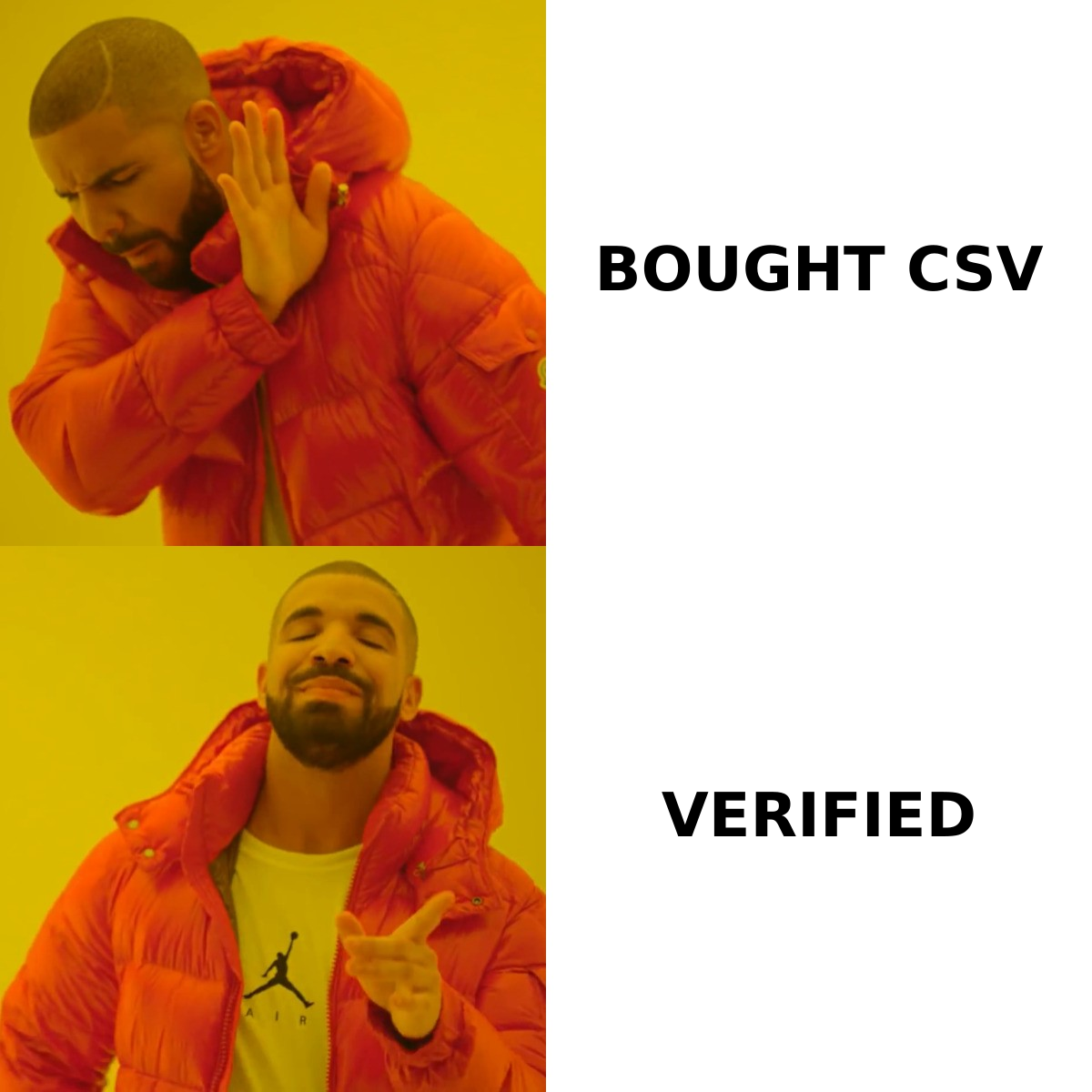
- Apollo wins on freshness and workflow. Its data refreshes all the time and feeds your sequences. A bought list starts going stale the moment it lands — B2B contact data decays at roughly 25–30% per year.
- Go4Database wins on one narrow thing: bulk volume for a flat fee. That only holds if you already verify data and review compliance yourself.
- Both need a verifier on top. Apollo's email accuracy runs below its marketing claims on long-tail domains. Bought lists are worse. Budget for email verification either way.
- The honest 2026 answer on Go4Database vs Apollo.io: use Apollo for the platform, a dedicated finder like Tomba for accuracy on the accounts that matter, and static lists only when you know exactly what you are buying.
What is Go4Database and who actually buys it?#
Go4Database is a B2B contact list vendor. You name the industry, job titles, region, and company size you want. They quote a price for a file of matching records — name, title, company, email, sometimes a direct phone. Delivery is usually a CSV or Excel export. Some deals include a limited replacement guarantee on bounces.
The model is old, but it survives because it solves one problem: volume at a fixed, one-time cost. Say you need 50,000 records for a nurture list. If you already run your own enrichment and verification stack, a list purchase can beat any seat-based subscription on cost per record.
The catch is what you are not buying:
- No refresh. The file is a snapshot. People change jobs, and about 1 in 4 B2B contacts goes stale within a year.
- No provenance guarantee. You often cannot audit where a record came from. That matters a lot under GDPR and CCPA.
- No workflow. It is a file. You still need a sequencer, a CRM, and a verification pass.
- No signal data. No intent, no tech stack, no hiring signals — just the static row.
Treat list vendors as a raw-material supplier, not as a sales tool.
What is Apollo.io and what do you get for the subscription?#
Apollo.io is a go-to-market platform built on its own contact database. Its public marketing claims roughly 275 million contacts across 70+ million companies. On top of that database sit the parts list vendors skip: a Chrome extension for LinkedIn, sequence automation, a dialer, meeting scheduling, basic deal tracking, and lead scoring.
The pitch is consolidation. Instead of paying for a data vendor plus a sequencer plus a dialer, you pay Apollo once. For a 5–20 rep team with no existing stack, that bundle is genuinely useful.
The friction shows up in three places:
- Credit economics. Email credits, mobile credits, and export credits sit in separate pools with separate limits. Teams often run dry mid-month.
- Data accuracy varies. Apollo is strong on large US tech companies. It is weaker on SMBs, non-English markets, and long-tail domains. Its G2 reviews say the same thing.
- Per-seat pricing scales badly. Fine at 3 reps. Painful at 30.
Go4Database vs Apollo.io: how do they compare head to head?#
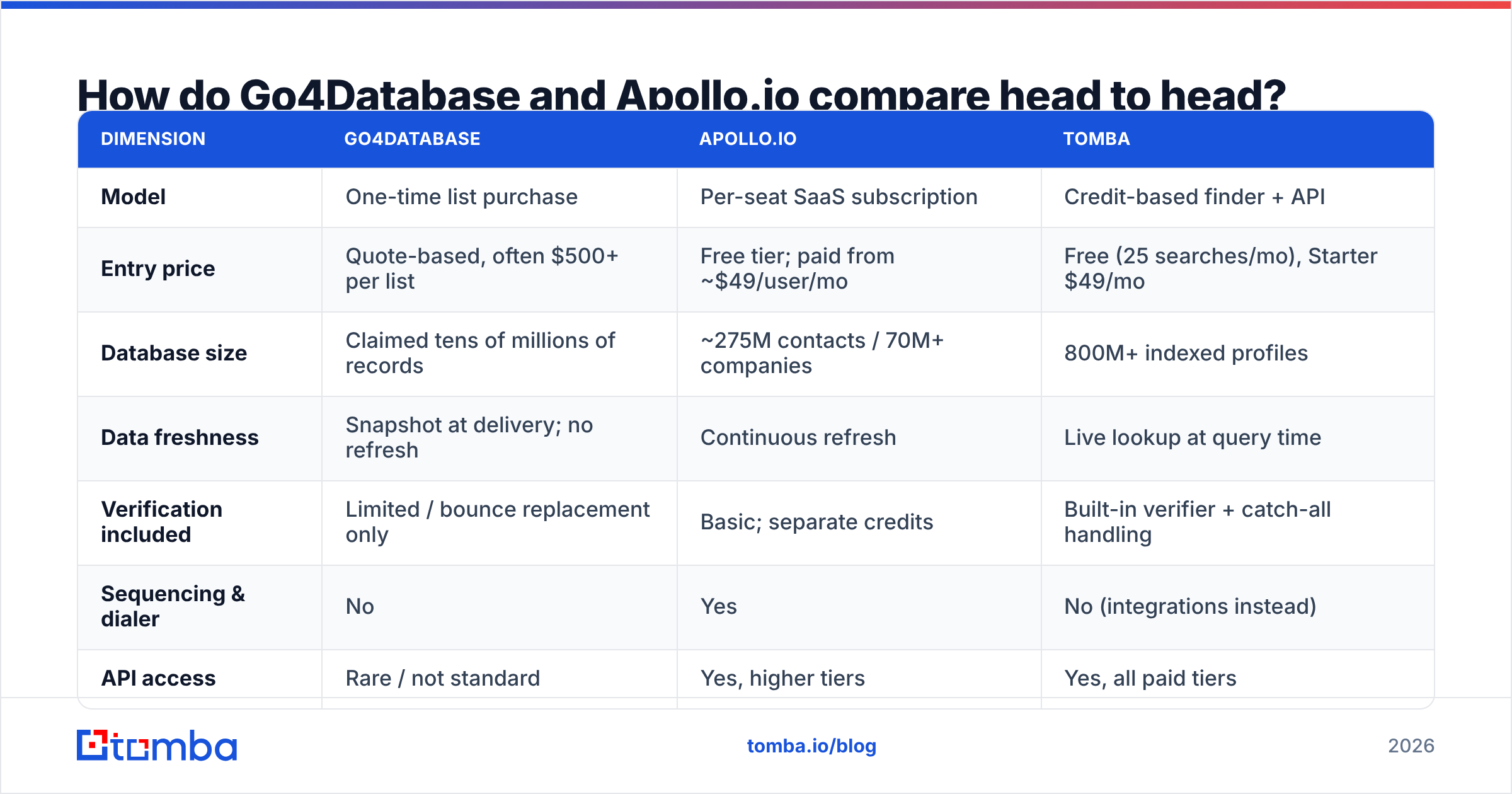
Here is the practical breakdown. Prices are list prices published or commonly quoted in 2026. Confirm them directly, because list vendors quote per project and Apollo runs frequent promotions.
| Dimension | Go4Database | Apollo.io | Tomba |
|---|---|---|---|
| Model | One-time list purchase | Per-seat SaaS subscription | Credit-based finder + API |
| Entry price | Quote-based, often $500+ per list | Free tier; paid from ~$49/user/mo | Free (25 searches/mo), Starter $49/mo |
| Database size | Claimed tens of millions of records | ~275M contacts / 70M+ companies | 800M+ indexed profiles |
| Data freshness | Snapshot at delivery; no refresh | Continuous refresh | Live lookup at query time |
| Verification included | Limited / bounce replacement only | Basic; separate credits | Built-in verifier + catch-all handling |
| Sequencing & dialer | No | Yes | No (integrations instead) |
| API access | Rare / not standard | Yes, higher tiers | Yes, all paid tiers |
| Compliance transparency | Varies by vendor — audit before buying | Documented sources, opt-out flow | Published data sources |
| Best for | Bulk volume with own enrichment stack | Small teams wanting one platform | Accuracy-first targeted prospecting |
The table makes the real split obvious. These two products are not rivals so much as different layers of the same stack. Go4Database is a data purchase. Apollo is a workflow purchase that happens to include data.
Is a purchased list ever better than a subscription?#
Yes — in four cases, and only four.
- You need one-time volume at a fixed cost. A 40,000-record list for a single ABM campaign can cost less than three months of Apollo seats plus export credits.
- You already have verification and enrichment. Send the CSV straight into a verifier and an enrichment API. The freshness problem shrinks from fatal to manageable.
- Platforms cover your market poorly. Regional manufacturers, government suppliers, and non-English SMBs are often thin in Apollo. Specialist brokers cover them well.
- You are not cold-emailing the list. Direct mail, ad audience matching, and account-list building carry far less risk than blasting cold email at a bought file.
If none of those four apply, a subscription wins on outcome per dollar. You pay for the data to stay correct, instead of paying once and watching it rot.
One more warning. Cold-emailing a purchased list is the fastest way to wreck a sending domain. Bounce rates above 3–5% damage your reputation with the mailbox providers. Stale lists routinely bounce at 15–30%.
So verification is not optional here. It is the difference between a campaign and a blacklisting. Run the file through an email verifier first. Then check your domain with a blacklist checker before you send a single message.
How accurate is the data on each side?#
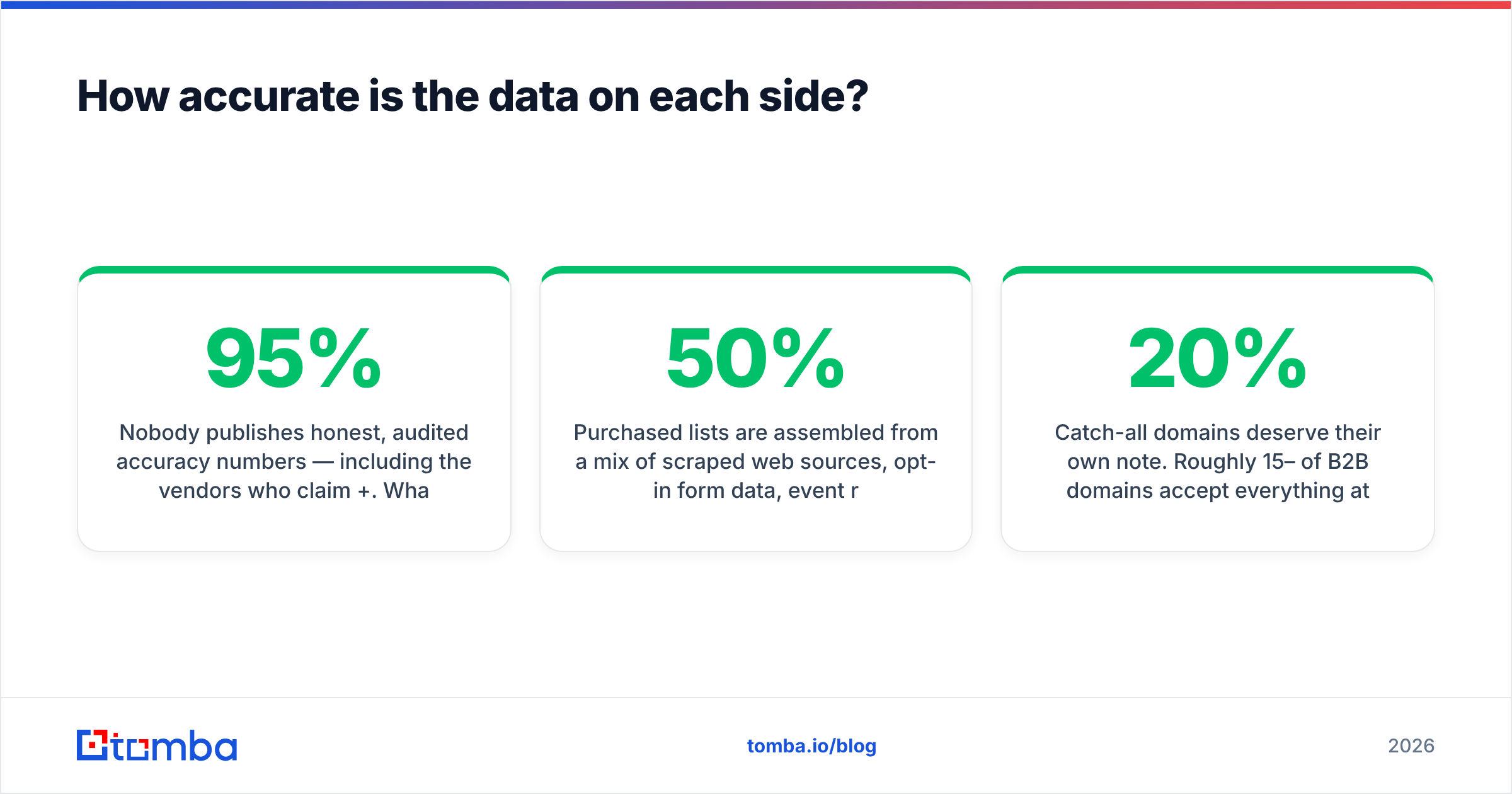
Nobody publishes honest, audited accuracy numbers — including the vendors claiming 95%+. What you can do is reason about the mechanics.
Purchased lists come from scraped web sources, opt-in forms, event registrations, and resold third-party files. Quality swings wildly between brokers. The record was accurate on the day it was compiled, not the day you bought it. Expect 50–80% real deliverability on a fresh file, and much worse on anything recycled.
Apollo's database is a crowd-contributed and scraped hybrid, updated continuously. Email accuracy is good on large US tech firms and softer everywhere else. Its verified flag means the address passed a pattern-and-SMTP check, not that a human confirmed it.
Dedicated finders — Tomba, Hunter, Findymail and similar — work the other way. The apparent database is smaller, but they resolve the email at query time against the live domain instead of serving a cached row. That is why a domain search on a company you care about often beats a bulk platform export.

The rule is simple: treat every source as a guess, and verify before you send. That includes Apollo. It especially includes any purchased file.
Catch-all domains deserve a note of their own. Roughly 15–20% of B2B domains accept every address at the SMTP layer. A standard verifier returns unknown, and most tools give up there. A catch-all verifier earns its cost on exactly those records. They are often your best enterprise accounts, so throwing them away is expensive.
Go4Database vs Apollo.io: what does each option cost in 2026?#
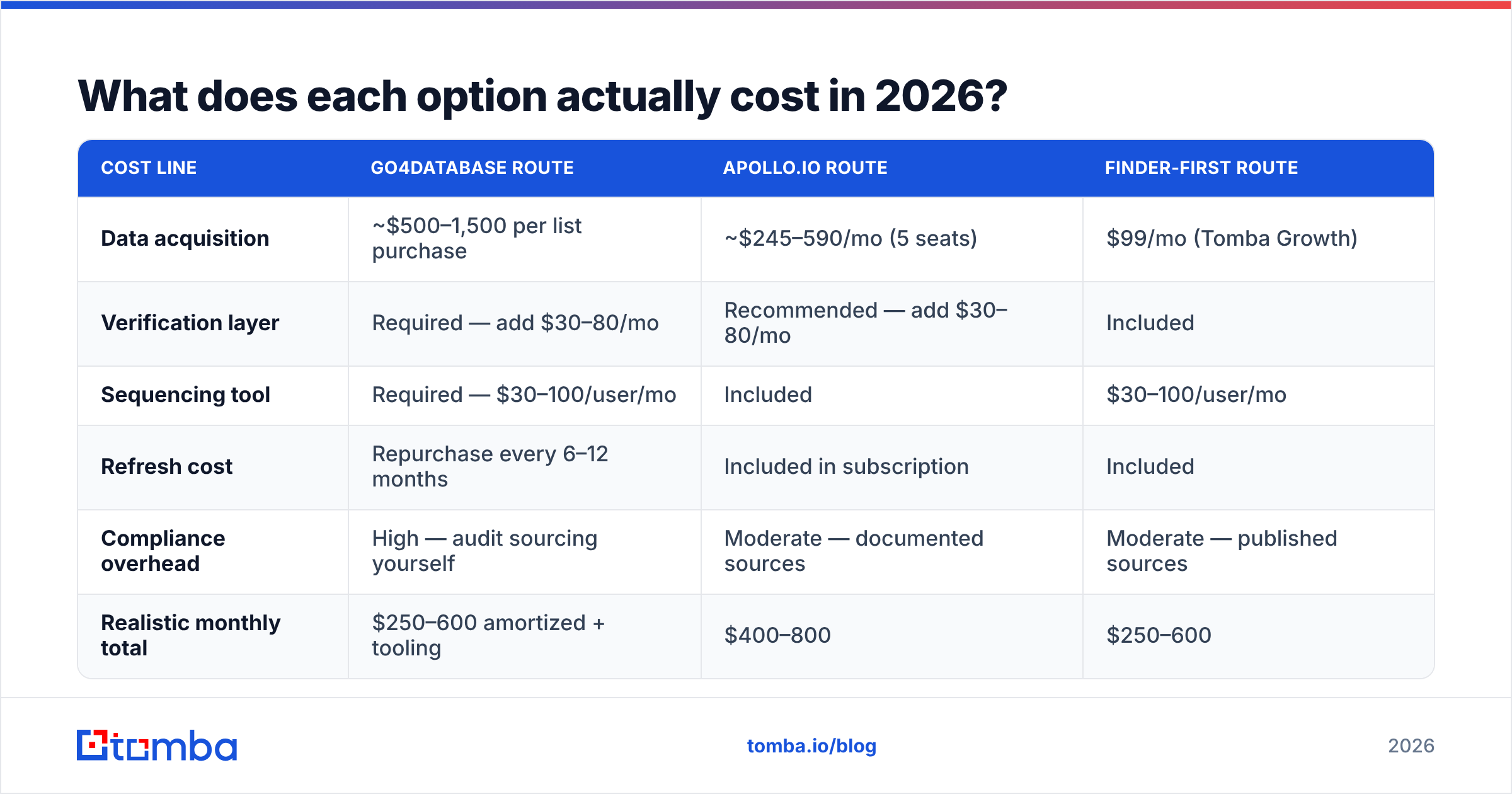
Cost is where the two models stop being comparable. So here is a concrete scenario: a 5-person outbound team that needs ~3,000 new verified contacts per month.
| Cost line | Go4Database route | Apollo.io route | Finder-first route |
|---|---|---|---|
| Data acquisition | ~$500–1,500 per list purchase | ~$245–590/mo (5 seats) | $99/mo (Tomba Growth) |
| Verification layer | Required — add $30–80/mo | Recommended — add $30–80/mo | Included |
| Sequencing tool | Required — $30–100/user/mo | Included | $30–100/user/mo |
| Refresh cost | Repurchase every 6–12 months | Included in subscription | Included |
| Compliance overhead | High — audit sourcing yourself | Moderate — documented sources | Moderate — published sources |
| Realistic monthly total | $250–600 amortized + tooling | $400–800 | $250–600 |
The finder-first column is why Go4Database vs Apollo.io rarely resolves to a single winner. Most teams that get this right run a platform for workflow and a specialist finder for accuracy. Forcing one tool to do both jobs usually means doing both badly. Tomba's pricing sits in that second slot: free at 25 searches/month, Starter $49/mo, Growth $99/mo, Pro $249/mo.

What about compliance and legal risk?#
This is the part list-buying guides skip. It is also the part that costs money.
Under GDPR, you need a lawful basis to process personal data. A work email like first.last@company.com counts as personal data. Legitimate interest can cover B2B outreach. But you must document the source, honor deletion requests, and show your balancing test. A broker who will not reveal provenance makes that impossible.
Under CAN-SPAM (US), cold B2B email is legal. You must include a physical address, an honest subject line, and a working opt-out. That applies to both routes.
Under CCPA/CPRA, California residents can ask where you got their data and demand deletion. Same problem again: unauditable sourcing means unanswerable requests.
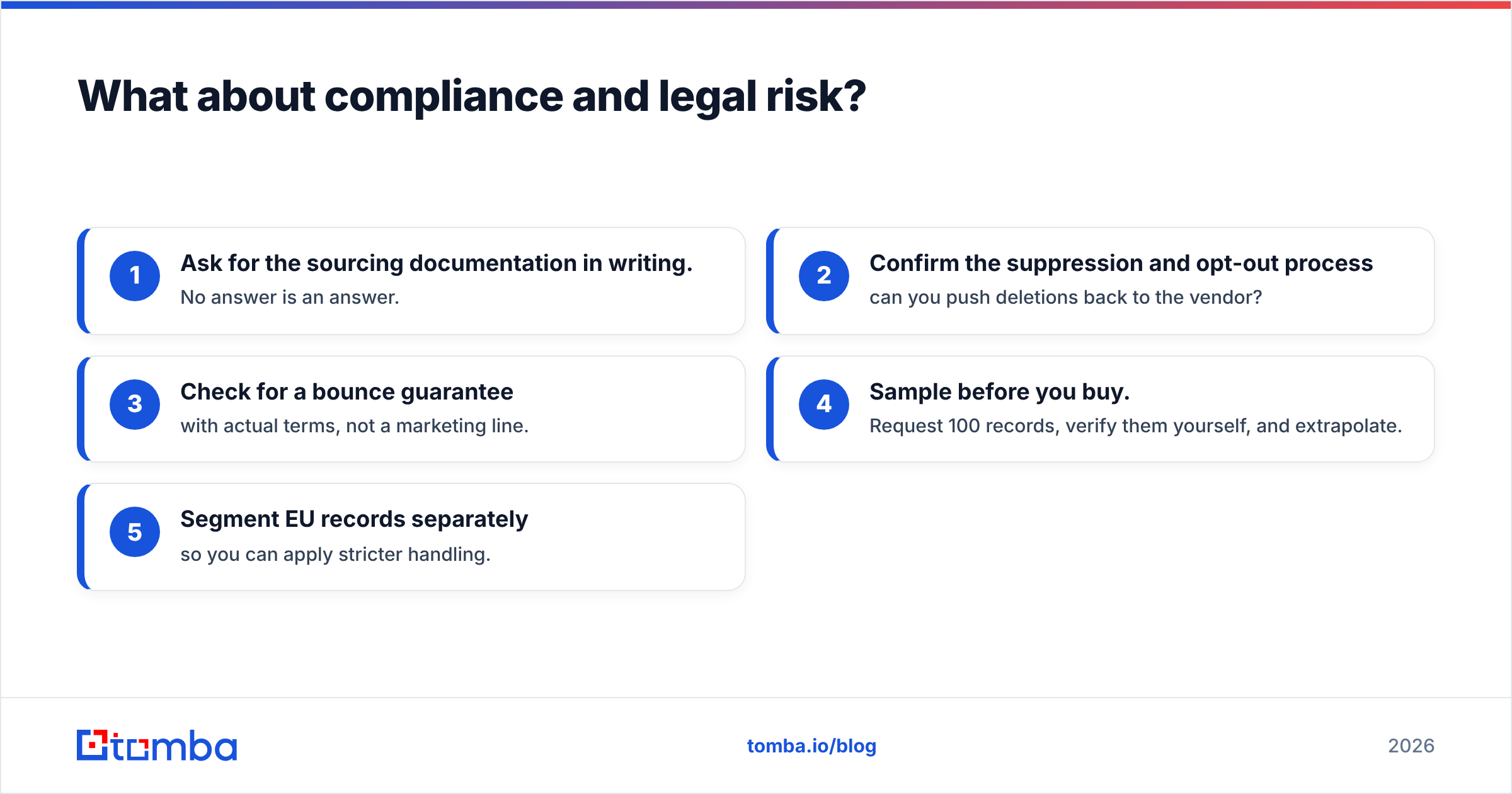
Checklist before you buy any list:
- Ask for the sourcing documentation in writing. No answer is an answer.
- Confirm the suppression and opt-out process. Can you push deletions back to the vendor?
- Check the bounce guarantee for real terms, not a marketing line.
- Sample before you buy. Request 100 records, verify them yourself, then extrapolate.
- Segment EU records so you can handle them more strictly.
Apollo publishes its sourcing and runs an opt-out flow. That reduces the exposure, though it does not erase it. Review sites like G2 help you check whether a vendor's compliance claims match customer experience.
Which should you choose for your team?#
Match the tool to the shape of your problem.
- Solo founder or 1–3 reps, no stack yet — Apollo.io. The bundled sequencer and dialer justify the seat price, and you will outgrow the free tier before the platform.
- Established team with a sequencer already (Instantly, Smartlead, Lemlist) — skip Apollo's platform tax. Buy data from a dedicated finder and keep your sending tool. A bulk email finder plus your sequencer is usually cheaper and more accurate.
- 20k+ records for a one-off campaign in a niche vertical — a list purchase from a broker like Go4Database can be the cheapest path. Verify everything and audit the sourcing first.
- Engineering-led GTM, enriching a product database — go API-first. Use programmatic lookups via a Tomba API so enrichment runs inside your own systems.
- Regulated industry (finance, health, EU-heavy) — avoid opaque list purchases. The paperwork burden outweighs the savings.
- ABM with fewer than 500 target accounts — quality beats volume by a mile. Use domain search on named accounts and verify each contact by hand.
What does a sane 2026 data stack look like?#
Three layers. You should be able to name the tool in each.
Layer 1 — Discovery. Where do target accounts come from? Apollo's filters, LinkedIn Sales Navigator, a purchased vertical list, or your own site traffic via visitor identification.
Layer 2 — Contact resolution. Turning an account plus a person into a working email or phone. Dedicated finders beat bundled platforms here, especially on non-US and long-tail domains.
Layer 3 — Verification and hygiene. Verify before every send, not once at import. Re-verify anything older than 90 days. Handle catch-alls on purpose instead of discarding them.
Most teams assume one vendor covers all three well. That is the mistake. Apollo is strong at layer 1 and adequate at 2 and 3. Go4Database is a layer-1 supplier only. A finder like Tomba is built for layers 2 and 3, and it does not try to be your sequencer.
Get the layers right and the Go4Database vs Apollo.io question mostly dissolves. You will know which one you are buying, and why.
Final verdict on Go4Database vs Apollo.io#
Choose Apollo.io if you want one subscription for finding, sequencing, and calling. It fits best when your targets skew toward US tech companies and your team is under 20 reps.
Choose a purchased list from Go4Database only when you need bulk volume in a vertical the platforms cover poorly. Audit the sourcing first, and have a verification layer ready. Treat it as raw material, never as a send-ready list.
Choose neither as your only tool. On the accounts that matter, the accuracy gap is worth closing with a specialist.
Is your bottleneck finding correct addresses for specific people at specific companies, rather than buying more rows? Then start with the Tomba Email Finder. The free tier gives you 25 searches a month, so you can test accuracy against a sample from whichever vendor you pay today. Starter is $49/mo, and verification is built in rather than sold as a separate credit pool. Run the same 100 contacts through both and let the bounce rate decide.
Related guides#
Ready to find emails that actually work?
Join 150,000+ professionals who stopped guessing and started sending. Free credits on signup — no credit card required.
Get the Tomba newsletter
Practical outbound tactics and product updates — once every two weeks.
About the author