Goagentic Reviews 2026: Honest Verdict, Pricing & Limits
An independent look at Goagentic: what its AI GTM agents actually automate, where the output still needs a human, what the quote-based pricing hides, and which teams should skip it entirely.
TL;DR
- Goagentic sits in the "agentic GTM" category: AI agents that research accounts, draft outbound, and push tasks into your CRM instead of you doing it manually.
- The strongest use case is mid-funnel busywork — account research, list triage, first-draft personalization — not raw contact data quality.
- Pricing is quote-based rather than published, which makes side-by-side comparison hard and usually means an annual commitment conversation.
- Agentic tools inherit the quality of whatever data you feed them. If your emails are stale, the agents just personalize their way into a bounce.
- Best fit: teams with a working ICP and 3+ SDRs. Poor fit: solo founders who need 200 verified emails this week and nothing else.
What is Goagentic?#
Goagentic markets itself as an agentic go-to-market platform — software that runs AI agents across the top of your funnel instead of giving you a static database and a send button. In practice, that means you define a job ("find accounts hiring for RevOps roles, research their stack, draft a first-touch email, log it in HubSpot") and the agent chains those steps together.
That's the category, and the category is real. Agentic AI — systems that plan and execute multi-step tasks with limited supervision — went from a research term to a sales-tooling line item in about eighteen months. Every serious vendor on G2 now has an "agent" tab.
The honest framing for any review in this space: you are not buying a database, and you are not buying a sequencer. You are buying orchestration on top of both. Whether that's worth a line in your budget depends entirely on whether the orchestration is the actual bottleneck for your team.
One caveat before we go further, and it matters for how you read this piece: Goagentic is a younger vendor with a smaller public review footprint than Apollo or Clay. There is far less third-party verification available. Treat any specific claim — including pricing — as something to confirm on a call, not something to take from a blog post. That's true of this post too.

How do Goagentic's AI agents actually work?#
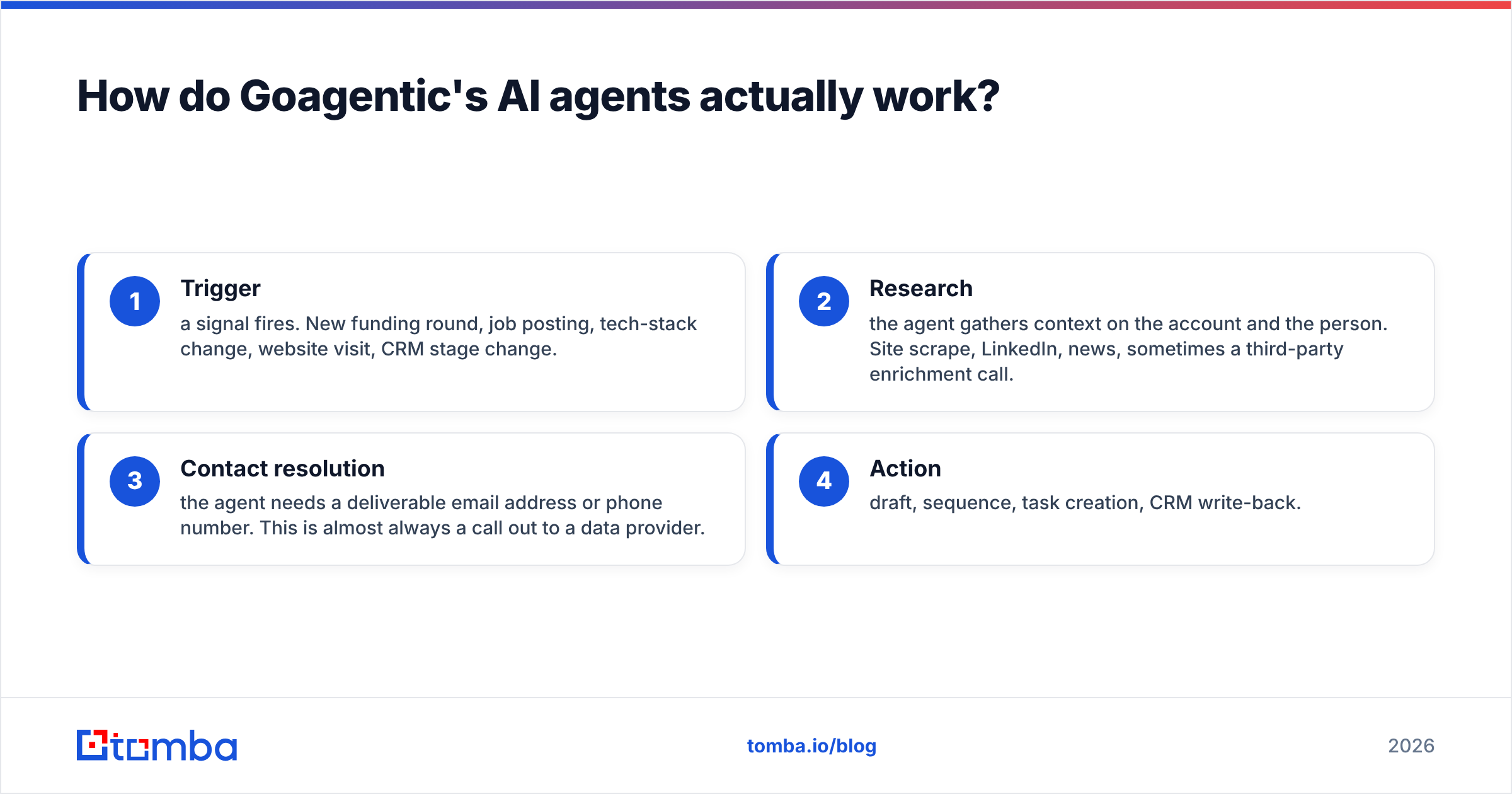
Strip the marketing away and agentic GTM platforms nearly all follow the same four-stage loop. Understanding the loop tells you where any given vendor is strong:
- Trigger — a signal fires. New funding round, job posting, tech-stack change, website visit, CRM stage change.
- Research — the agent gathers context on the account and the person. Site scrape, LinkedIn, news, sometimes a third-party enrichment call.
- Contact resolution — the agent needs a deliverable email address or phone number. This is almost always a call out to a data provider.
- Action — draft, sequence, task creation, CRM write-back.
Most vendors in this category are genuinely good at stages 1, 2, and 4. Stage 3 is where the whole chain quietly breaks, because it's the one step that can't be reasoned about — an email address is either real or it isn't. No amount of model quality fixes a wrong mailbox.
This is why serious teams run agentic orchestration on top of a dedicated contact layer rather than trusting whatever's bundled. A bulk email finder that resolves and verifies before the agent drafts anything means your personalization budget gets spent on addresses that exist. Reversed, you get beautifully researched messages bouncing off dead inboxes at scale.
What do Goagentic reviews say about the strengths?#
Pulling together what's publicly available plus the patterns that hold across this whole category, the consistent positives:
Research compression. The single clearest win. Work that eats an SDR 8–12 minutes per account — reading the site, checking recent news, finding the right persona — compresses to seconds. If your reps spend more than a third of their day on pre-call research, this is real recovered capacity.
Signal-driven targeting. Agents that watch for triggers beat static list-pulling on relevance. Reaching out three days after a funding announcement outperforms reaching out on a Tuesday because it's Tuesday.
Draft quality above template quality. AI-drafted first touches with real account context read better than the merge-tag templates most teams ship. Not better than a great rep writing manually — better than the median rep at volume, which is the honest comparison.
Workflow consolidation. Fewer tabs. Research, drafting, and CRM logging in one place removes the copy-paste tax that makes SDRs quietly hate their stack.
Fast time-to-first-output. Agentic tools demo well and produce something usable in the first session, which matters when you're evaluating on a two-week window.
Where does Goagentic fall short?#
Every review that only lists strengths is a brochure. Here's the other side, framed as questions you should push on during a demo.
Data quality is inherited, not solved. If the platform resolves contacts through a bundled provider, ask which one, ask for the bounce rate on a sample of 500, and run the same sample through an independent email verifier before you believe the number. Catch-all domains in particular are where bundled providers get sloppy — they return "valid" because the server accepts everything.
Output still needs a human. Agent-drafted copy at volume develops a texture. Prospects who receive twelve of these a week start recognizing the shape of the sentences. The teams getting results treat agent output as a strong first draft, not a send-ready email.
Review depth is thin. Fewer verified reviews means less signal on support responsiveness, uptime, and what year two of the contract feels like. That's a genuine risk factor, not a knock on the product.
Attribution gets murky. When an agent does research, drafting, and sending, isolating what actually drove reply-rate lift is hard. Insist on holdout groups from day one or you'll be renewing on vibes.
Setup is not zero. "Autonomous" reads as plug-and-play. In reality you're spending the first two weeks writing ICP definitions, connecting CRM fields, and correcting agent behavior. Budget for it.
How does Goagentic compare to other GTM tools?#
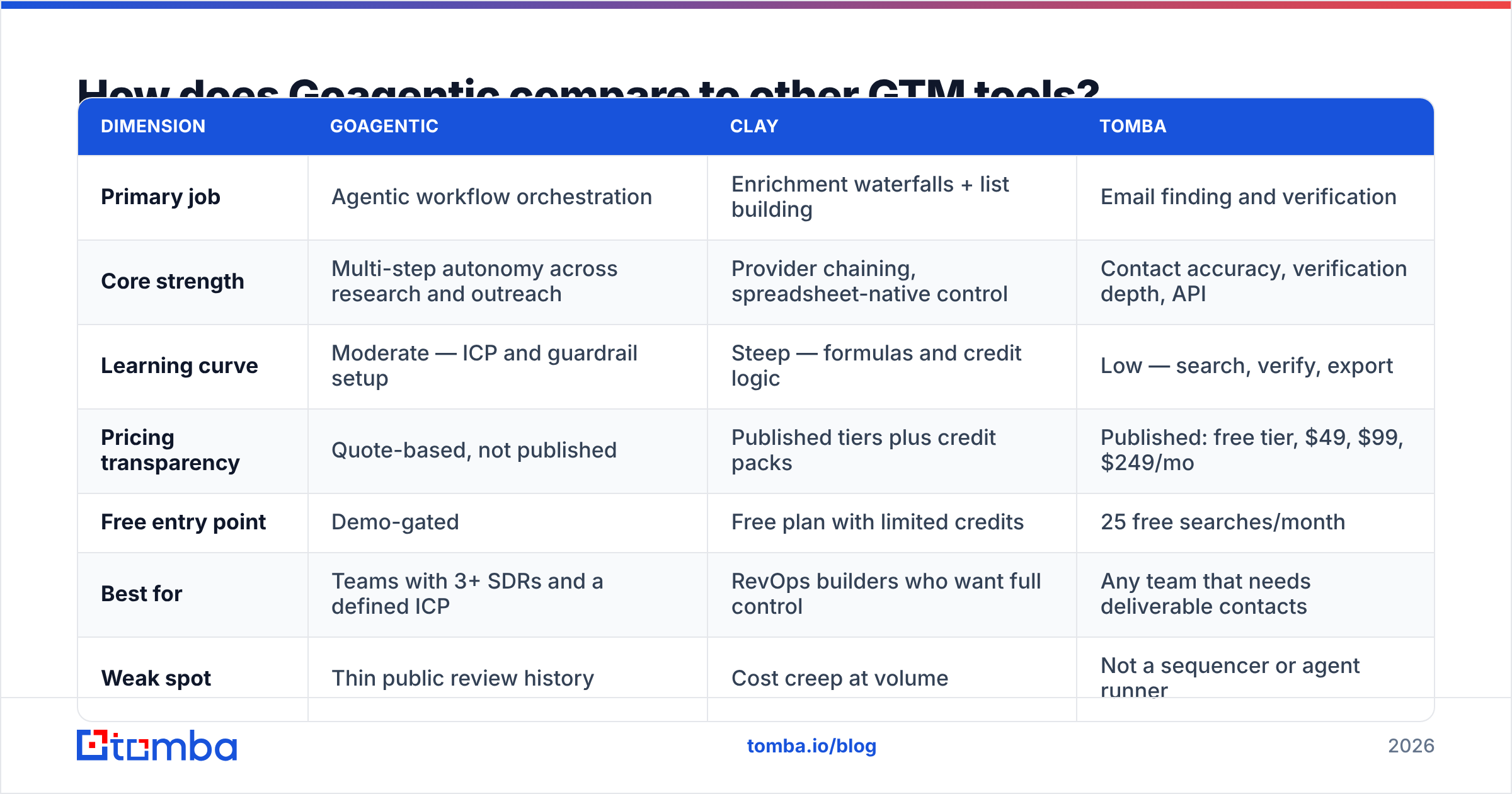
Different layers of the stack, not direct substitutes. Read this table as "what job is this thing actually for":
| Dimension | Goagentic | Clay | Tomba |
|---|---|---|---|
| Primary job | Agentic workflow orchestration | Enrichment waterfalls + list building | Email finding and verification |
| Core strength | Multi-step autonomy across research and outreach | Provider chaining, spreadsheet-native control | Contact accuracy, verification depth, API |
| Learning curve | Moderate — ICP and guardrail setup | Steep — formulas and credit logic | Low — search, verify, export |
| Pricing transparency | Quote-based, not published | Published tiers plus credit packs | Published: free tier, $49, $99, $249/mo |
| Free entry point | Demo-gated | Free plan with limited credits | 25 free searches/month |
| Best for | Teams with 3+ SDRs and a defined ICP | RevOps builders who want full control | Any team that needs deliverable contacts |
| Weak spot | Thin public review history | Cost creep at volume | Not a sequencer or agent runner |
Worth naming the fourth option too: sometimes you don't need agents or waterfalls, you need a clean list right now. Purpose-built B2B data vendors like BookYourData sell verified contacts outright, which is a perfectly rational purchase when your bottleneck is coverage in a specific vertical rather than workflow. Different tool, different problem — and cheaper than deploying an agent stack to solve a list problem.
The pattern that works in practice: a contact layer you trust, an enrichment or agent layer on top, and a sequencer at the end. Teams that try to make one vendor do all three usually end up with a tool that's mediocre at the part that matters most to them.
What does Goagentic cost?#
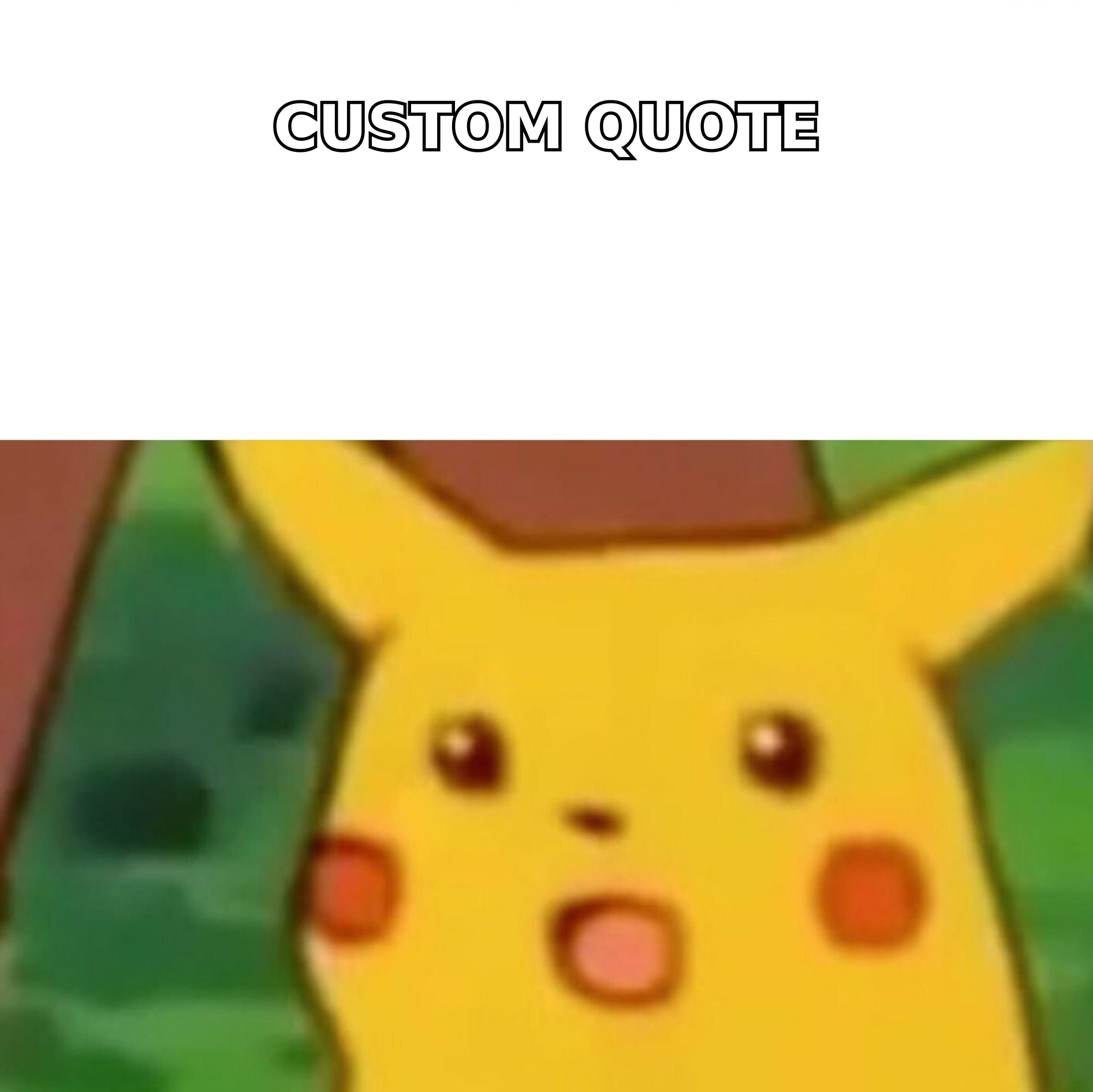
At the time of writing, Goagentic does not publish standard pricing — you go through a demo and get a quote. Check goagentic.com for current terms, since this changes.
Quote-based pricing isn't a red flag by itself. It is, however, a signal about how the buying process will go. What it usually means in this category:
- Annual commitment as the default. Monthly is often available but priced to discourage it.
- Seat minimums. Sub-5-seat teams frequently get quoted above published-competitor rates.
- Credit-based consumption on top of seats. Agent runs, enrichment calls, and API usage often meter separately. Ask for the overage rate in writing.
- Onboarding or implementation fees on larger deals.
Three questions to ask on the call, in this order: What's the total year-one cost including onboarding and expected overage? What happens to my data if I don't renew? Is there a pilot term shorter than twelve months?
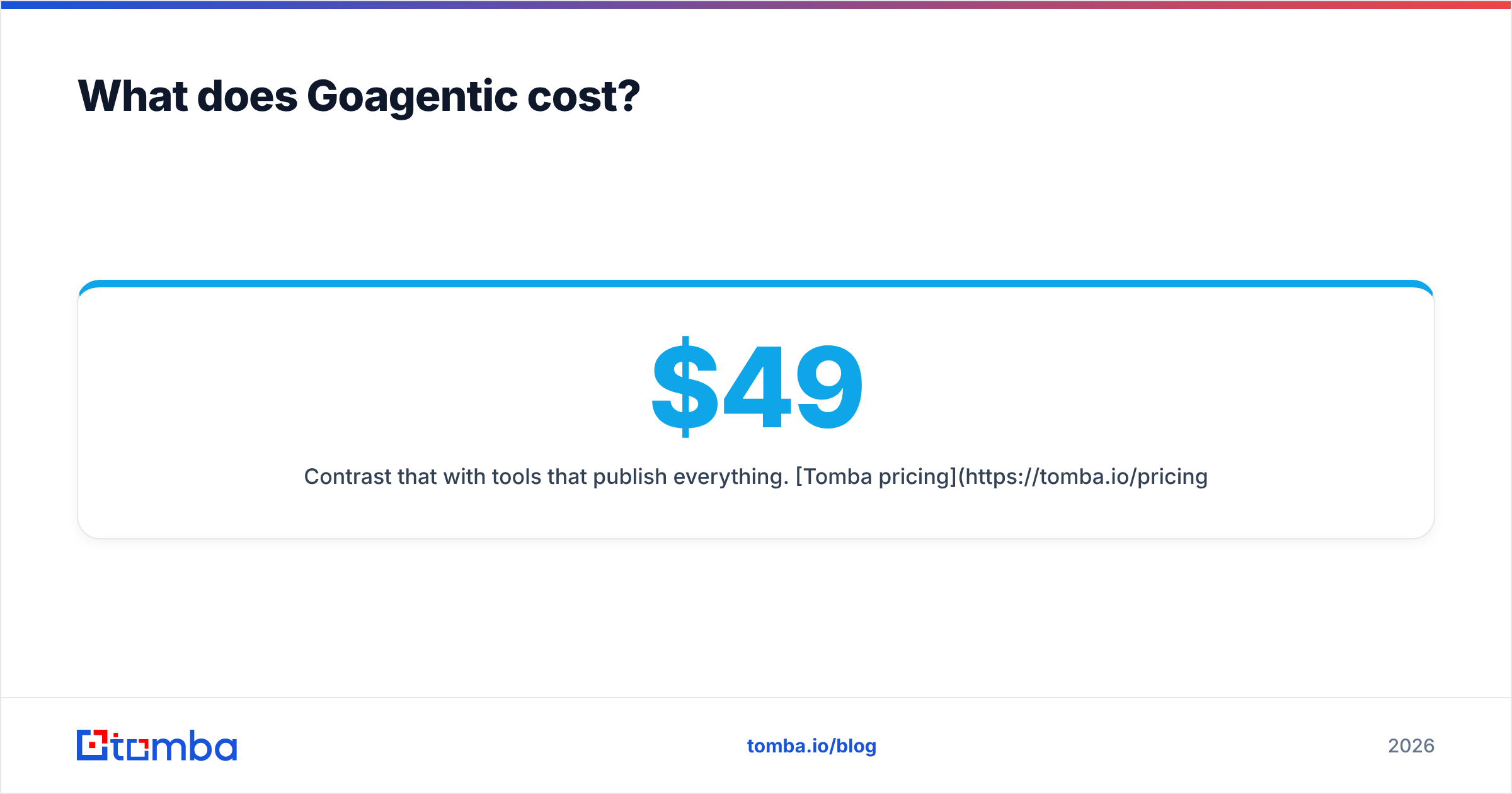
Contrast that with tools that publish everything. Tomba pricing runs a free tier at 25 searches per month, Starter at $49/mo, Growth at $99/mo, and Pro at $249/mo — you can model your spend before anyone calls you. Neither model is inherently better, but transparent pricing removes an entire negotiation phase, and for a first purchase in a new category that's worth something.
Who should use Goagentic, and who should skip it?#
Good fit:
- Teams with 3+ SDRs where research time is measurably eating selling time.
- A defined, stable ICP. Agents amplify your targeting logic. Vague logic gets amplified into vague outreach.
- An existing CRM discipline. If your HubSpot or Salesforce data is a swamp, agents write back into a swamp.
- Signal-led motions — funding, hiring, tech-stack triggers — where timing genuinely changes reply rates.
Skip it if:
- You're a solo founder or two-person team. The setup cost and likely seat minimum outweigh the recovered hours. Buy an email finder and write the emails yourself; your reply rate will be higher anyway.
- Your problem is contact coverage, not workflow. No agent fixes a missing email address.
- You need a published price to get budget approval. Quote-based procurement adds weeks.
- You haven't found product-market fit. Automating outreach for a message that isn't landing yet just burns domains faster.
How should you test it in 14 days?#
Don't evaluate on demo output. Evaluate on your own accounts, with a control group:
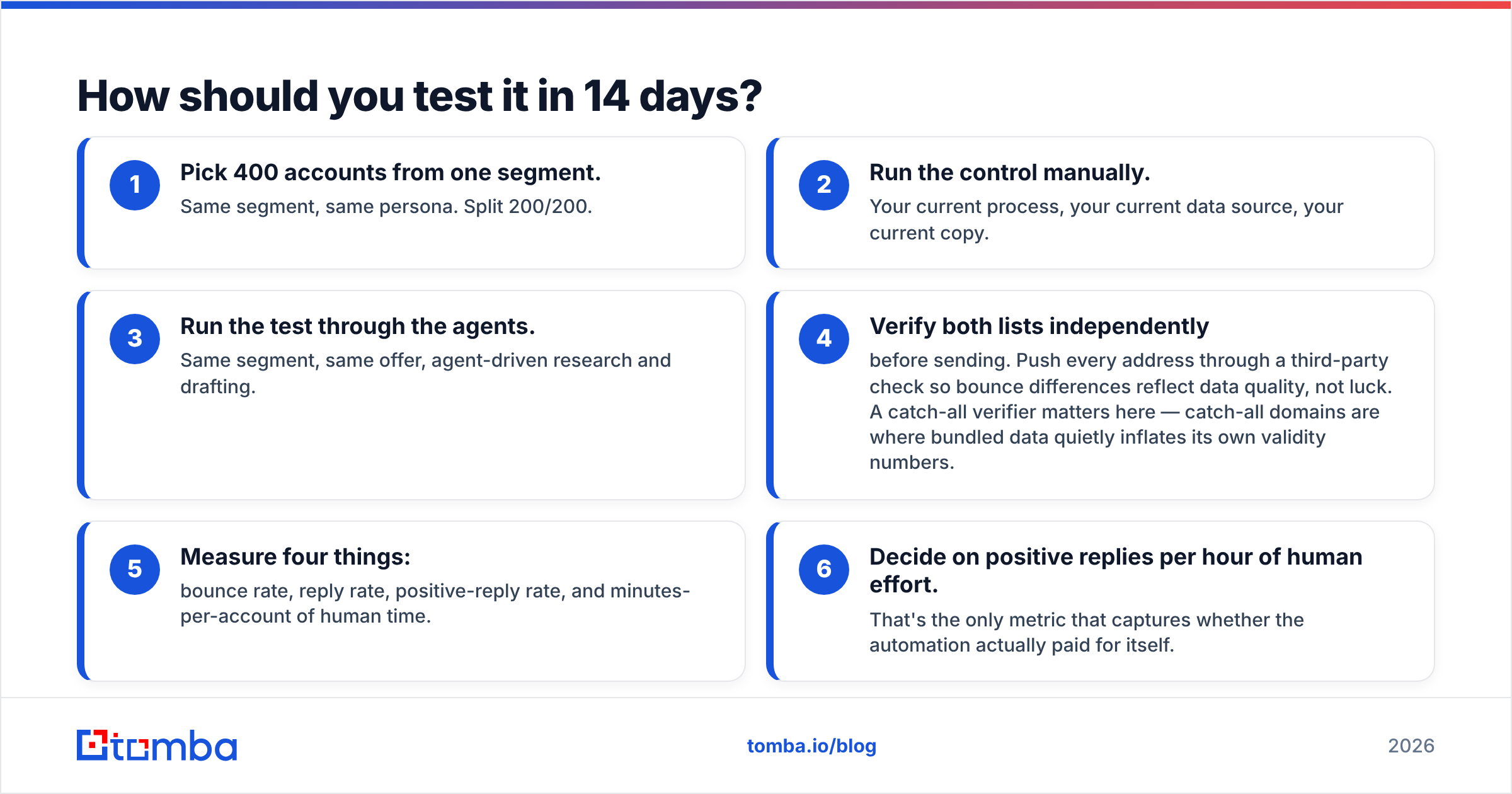
- Pick 400 accounts from one segment. Same segment, same persona. Split 200/200.
- Run the control manually. Your current process, your current data source, your current copy.
- Run the test through the agents. Same segment, same offer, agent-driven research and drafting.
- Verify both lists independently before sending. Push every address through a third-party check so bounce differences reflect data quality, not luck. A catch-all verifier matters here — catch-all domains are where bundled data quietly inflates its own validity numbers.
- Measure four things: bounce rate, reply rate, positive-reply rate, and minutes-per-account of human time.
- Decide on positive replies per hour of human effort. That's the only metric that captures whether the automation actually paid for itself.
If the agent variant doesn't beat your control on positive replies per hour by a clear margin, the bottleneck was never workflow. Industry benchmarks from sources like the HubSpot sales blog are useful context, but your own holdout is the only number that should drive the renewal decision.
What's the verdict on Goagentic reviews for 2026?#
Conditionally positive, with a caveat about maturity. Goagentic is a credible entry in a category that genuinely saves time for teams whose bottleneck is research and drafting volume. The agentic loop is not hype — compressing account research from ten minutes to ten seconds is real leverage when you have reps to leverage.
But it's a workflow purchase, not a data purchase, and the public review history is thin enough that you should negotiate for a short pilot rather than a twelve-month leap. Push hard on the data question specifically: ask what happens at stage three of the loop, who supplies the contacts, and what the verified bounce rate is on your segment. If the answer is vague, plan to bring your own contact layer.
That's the practical setup for most teams anyway. Resolve and verify contacts first, then let the agents do the research and drafting on top of addresses you know are real.
Start with the layer everything else depends on. Tomba Email Finder resolves professional email addresses by domain, name, or company, with verification built into the same workflow and a full API for wiring it into whatever agent stack you end up choosing. The free tier gives you 25 searches a month to test accuracy on your own ICP before you spend anything — run it against a segment you know well and see how the results compare to what your current provider returns.
Related guides#
Ready to find emails that actually work?
Join 150,000+ professionals who stopped guessing and started sending. Free credits on signup — no credit card required.
Get the Tomba newsletter
Practical outbound tactics and product updates — once every two weeks.
About the author