Goals for Sales Reps in 2026: How to Set Quotas That Work
Most rep goals fail because they measure revenue and nothing else. Here is a framework for activity, pipeline, and outcome goals that actually move quota attainment — with real numbers.
TL;DR
- Revenue-only goals are lagging indicators. By the time a rep misses quota, the quarter is already gone — you need leading goals stacked underneath.
- The goal stack that works: activity goals (controllable) → pipeline goals (semi-controllable) → outcome goals (uncontrollable but accountable).
- Benchmarks worth anchoring to in 2026: ~3x pipeline coverage, 20-25% opportunity win rate, 45-60 quality touches per rep per day, and quota attainment of 50-60% of reps hitting number.
- Bad data silently destroys activity goals. A rep hitting "100 emails/day" against a 35% bounce list is hitting zero real goals.
- Review goals weekly, reset them quarterly, and never set more than five per rep. Six goals means no goals.
Why do most goals for sales reps fail?#
Because they only measure the thing the rep controls least.
Tell a rep "close $250K this quarter" and you have given them a scoreboard, not a plan. Revenue is the output of maybe fifteen upstream behaviours — list quality, contact accuracy, touch cadence, discovery depth, multithreading, follow-up discipline — and the rep can't debug any of them from a single number that arrives 90 days late.
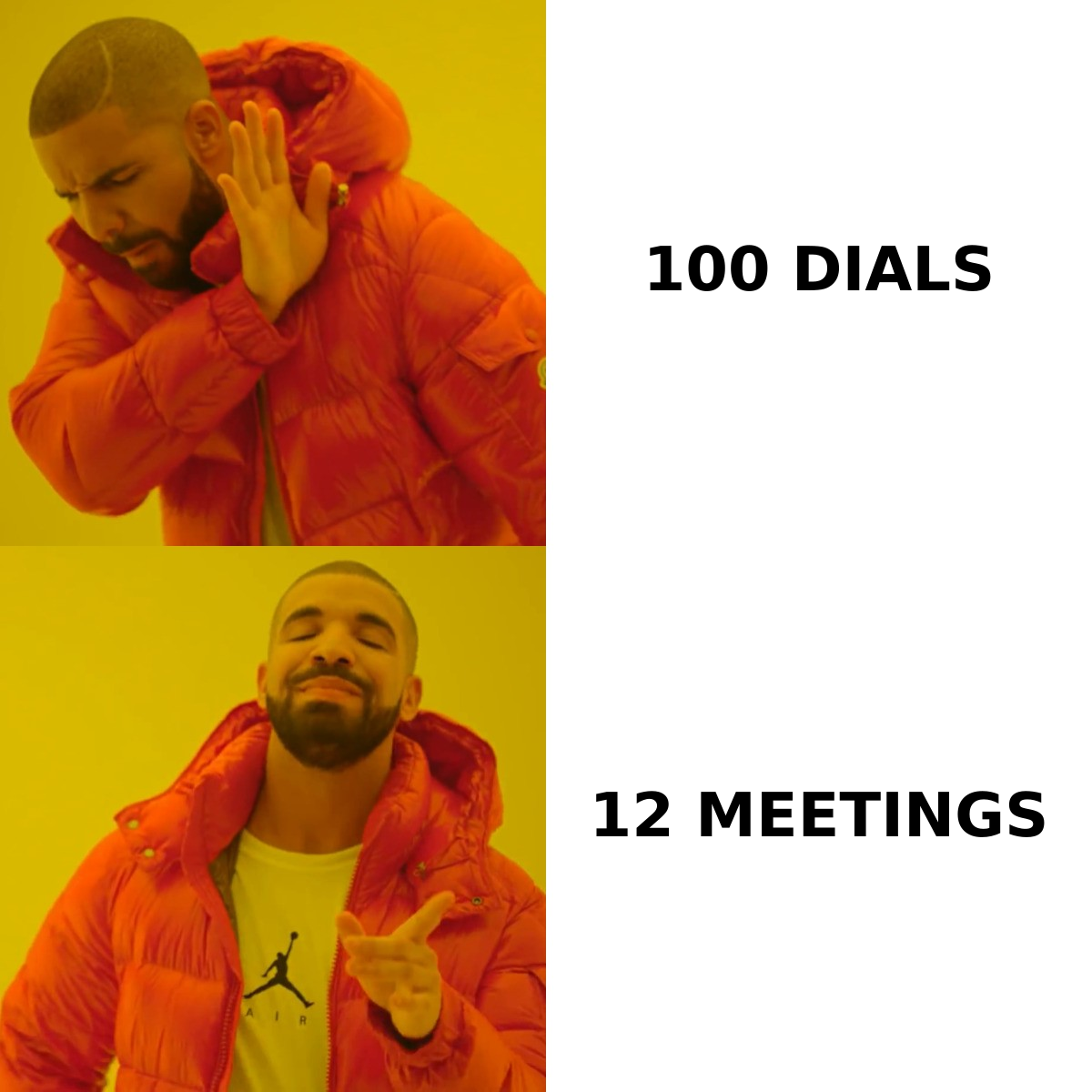
The other failure mode is the opposite extreme: goals so granular the rep games them. "150 dials per day" produces 150 dials. It does not produce conversations, and it definitely does not produce pipeline. Anyone who has managed an SDR team has watched a rep hit 150 dials by hammering a disconnected number list at 4:45pm.
Good goals for sales reps solve both problems at once. They are specific enough to act on tomorrow morning, and they ladder up to something the business actually cares about.
What are the three types of sales rep goals?#
Every goal you set falls into one of three tiers based on how much control the rep has over it. Setting all three — and weighting them correctly — is the whole game.
- Activity goals (100% controllable). Dials placed, personalised emails sent, LinkedIn touches, discovery calls booked, follow-up sequences completed. The rep decides these entirely. Use them for ramping reps and for diagnosing slumps.
- Pipeline goals (partially controllable). Qualified opportunities created, pipeline dollars generated, meetings held, stage-2 conversion rate, average deal size. Rep behaviour drives these, but market and ICP fit interfere.
- Outcome goals (least controllable). Closed-won revenue, quota attainment, net retention on their book, logo count. These are what leadership reports on, but they're the worst diagnostic tool.
- Skill goals (developmental). Objection handling scores, call review ratings, demo certification, product knowledge assessments. These have no revenue number attached and are the first thing managers cut — which is why teams plateau.
- Hygiene goals (non-negotiable). CRM update within 24 hours of a call, next step logged on every open opportunity, accurate close dates. Boring, and the reason forecast accuracy dies without them.
The mistake is weighting tier 3 at 100%. A defensible split for a full-cycle AE looks roughly like 50% outcome, 30% pipeline, 15% activity, 5% skill/hygiene. For an SDR, invert it: 50% pipeline (meetings held), 35% activity, 15% skill.
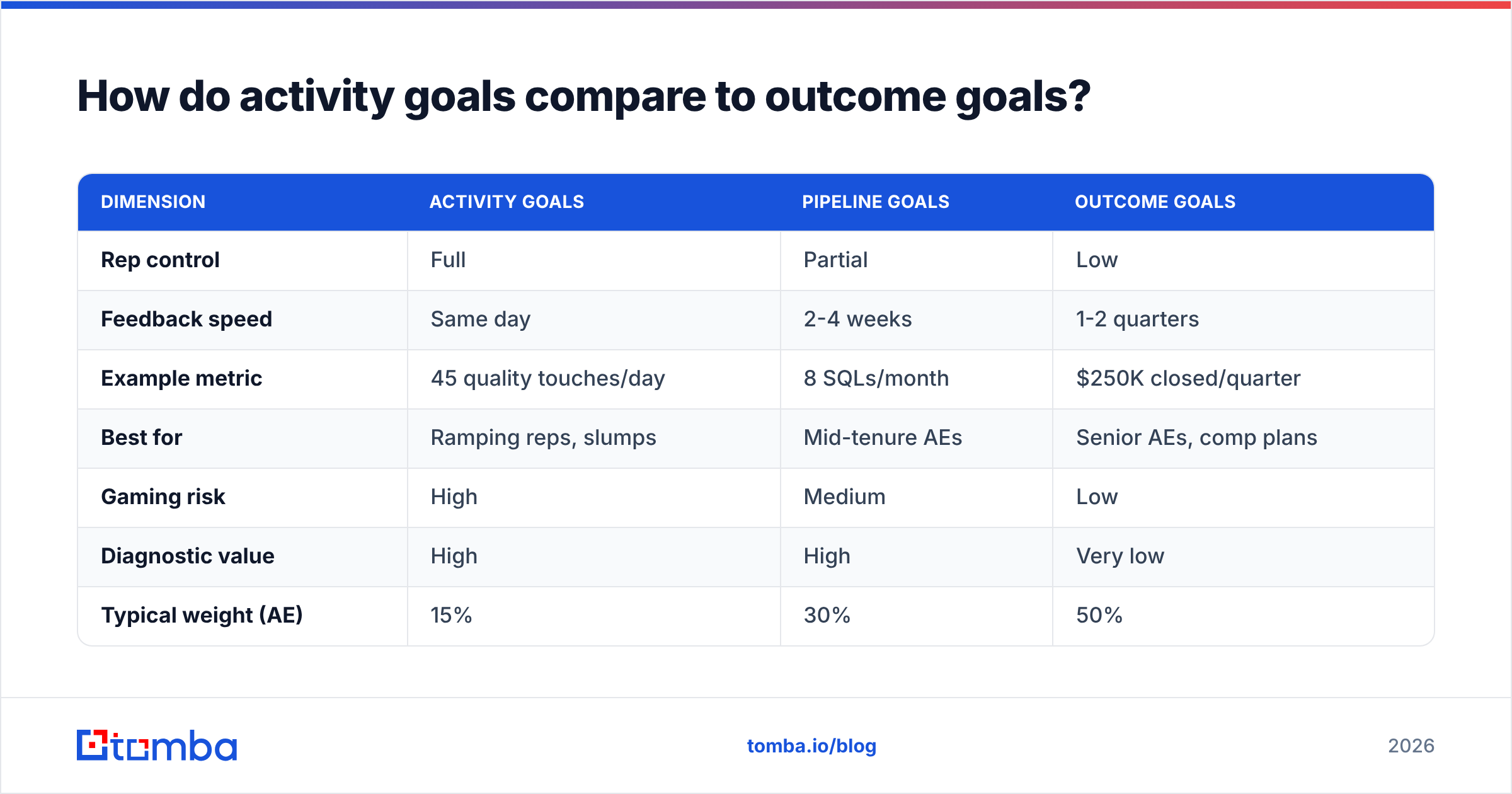
How do activity goals compare to outcome goals?#
| Dimension | Activity goals | Pipeline goals | Outcome goals |
|---|---|---|---|
| Rep control | Full | Partial | Low |
| Feedback speed | Same day | 2-4 weeks | 1-2 quarters |
| Example metric | 45 quality touches/day | 8 SQLs/month | $250K closed/quarter |
| Best for | Ramping reps, slumps | Mid-tenure AEs | Senior AEs, comp plans |
| Gaming risk | High | Medium | Low |
| Diagnostic value | High | High | Very low |
| Typical weight (AE) | 15% | 30% | 50% |
| Typical weight (SDR) | 35% | 50% | 10% |
Read the "feedback speed" row twice. That's the entire argument for keeping activity goals alive even on senior reps: it's the only tier that tells you something is broken while you can still fix it.
What benchmarks should you set goals against in 2026?#
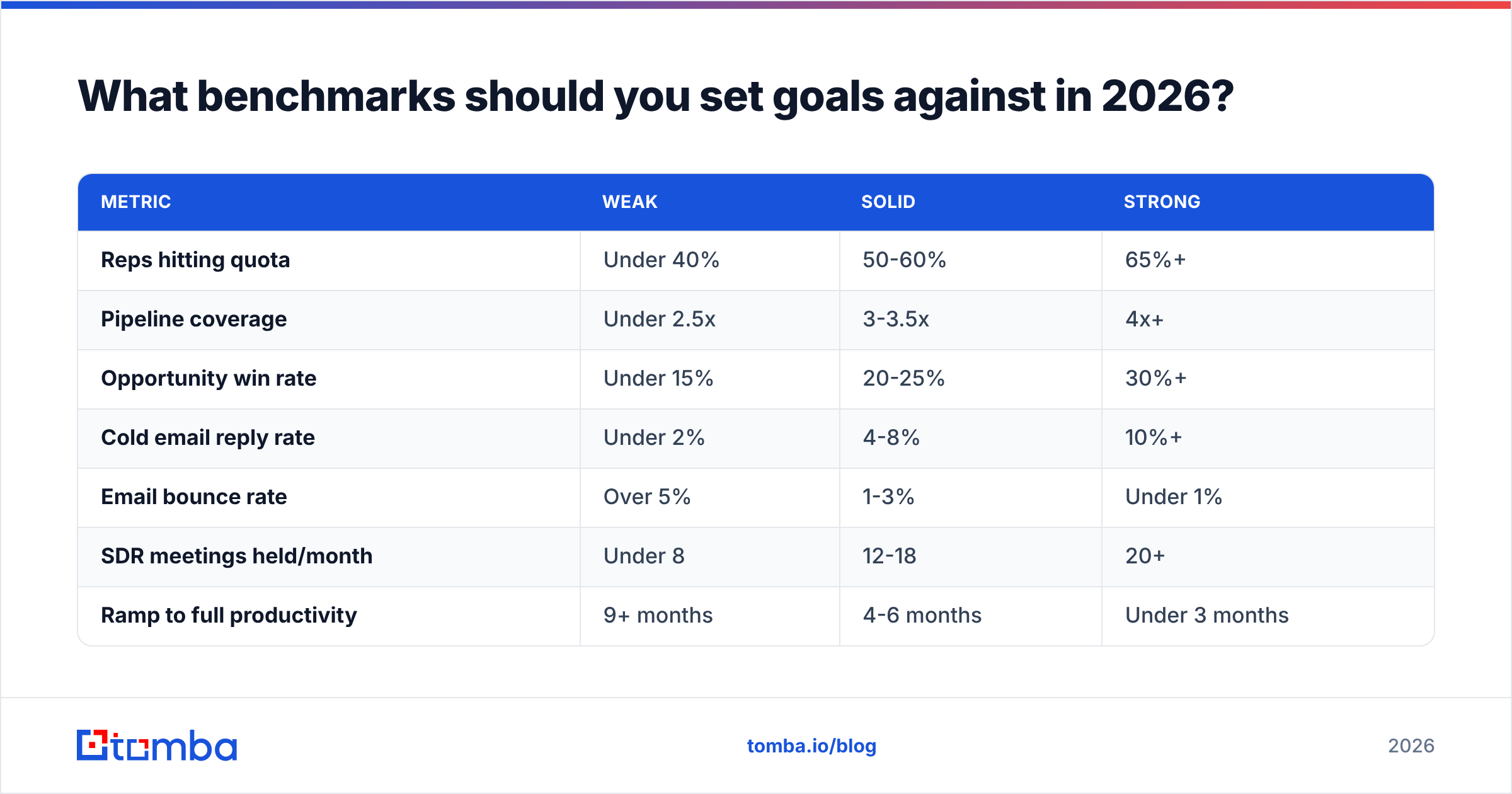
Pull your own historicals first — your funnel beats anyone's blog post. But if you're starting cold, these are the ranges most B2B SaaS teams operate inside:
| Metric | Weak | Solid | Strong |
|---|---|---|---|
| Reps hitting quota | Under 40% | 50-60% | 65%+ |
| Pipeline coverage | Under 2.5x | 3-3.5x | 4x+ |
| Opportunity win rate | Under 15% | 20-25% | 30%+ |
| Cold email reply rate | Under 2% | 4-8% | 10%+ |
| Email bounce rate | Over 5% | 1-3% | Under 1% |
| SDR meetings held/month | Under 8 | 12-18 | 20+ |
| Ramp to full productivity | 9+ months | 4-6 months | Under 3 months |
Two notes on reading this table. First, "reps hitting quota" being 50-60% is by design — if 95% of your team hits number, your quotas are too low and you're overpaying for expected performance. Second, the bounce rate row is the one most teams ignore, and it quietly poisons every other row above it. Gartner's sales research has been flagging data decay as a top-three seller productivity drag for years, and roughly 25-30% of B2B contact data goes stale annually as people change jobs.
How do you make activity goals immune to gaming?#
Attach a quality gate to every volume number.
"100 emails per day" is gameable. "100 emails per day to verified contacts at ICP-fit accounts, with a bounce rate under 2%" is not — because the rep now has to source real, current contacts before the volume even counts. The gate does the work.
Here's how that looks per activity type:
- Dials → not "150 dials" but "60 dials to direct lines with a connect rate above 8%." Direct numbers convert several times better than switchboard numbers, so the gate changes sourcing behaviour. A phone finder that returns direct dials rather than main-office numbers moves this metric more than any coaching session will.
- Emails → not "raw sends" but "sends to addresses that passed verification in the last 30 days." Run the list through an email verifier before it counts toward the goal.
- LinkedIn touches → not "connection requests sent" but "requests sent with a personalised note referencing a trigger event."
- Meetings booked → not "booked" but "held and qualified," which kills the no-show padding problem instantly.
- Follow-ups → not "sequence enrolled" but "sequence completed through step 5." Most reps quit at step 2; the deals live at step 5-8.

What happens when goals sit on top of bad data?#
The goal structure collapses, quietly, and everyone blames the rep.
Run the arithmetic. A rep with a 1,000-contact list, a 38% bounce rate, and a 4% reply rate on delivered mail gets 620 delivered emails and ~25 replies. The same rep with a verified list at a 2% bounce rate gets 980 delivered and ~39 replies — a 56% lift with zero change in effort, messaging, or skill. The activity goal reads identically on the dashboard in both scenarios.
Worse, the high-bounce version damages email deliverability for the whole domain. Sustained bounce rates above 5% get you throttled by Google and Microsoft, at which point your good emails stop landing too. You have now converted a data problem into an infrastructure problem, and no amount of activity goal-setting fixes it.
So before you set a single number, audit the input layer:
- What percentage of contacts in your CRM were verified in the last 90 days?
- What's your true bounce rate — not the sequencer's "delivered" number, which counts catch-all acceptances as wins?
- How many accounts have only one contact? Single-threaded deals lose at roughly twice the rate of multithreaded ones.
- How many "direct dials" in your CRM are actually main switchboards?
Teams building lists from scratch usually pair a domain search to map every reachable contact at a target account with a catch-all verification pass to filter the addresses that only appear valid. Providers like BookYourData take the pre-built database route with pay-as-you-go credits, which suits teams that want a finished list rather than a sourcing workflow — both approaches are legitimate; the wrong move is skipping verification entirely.
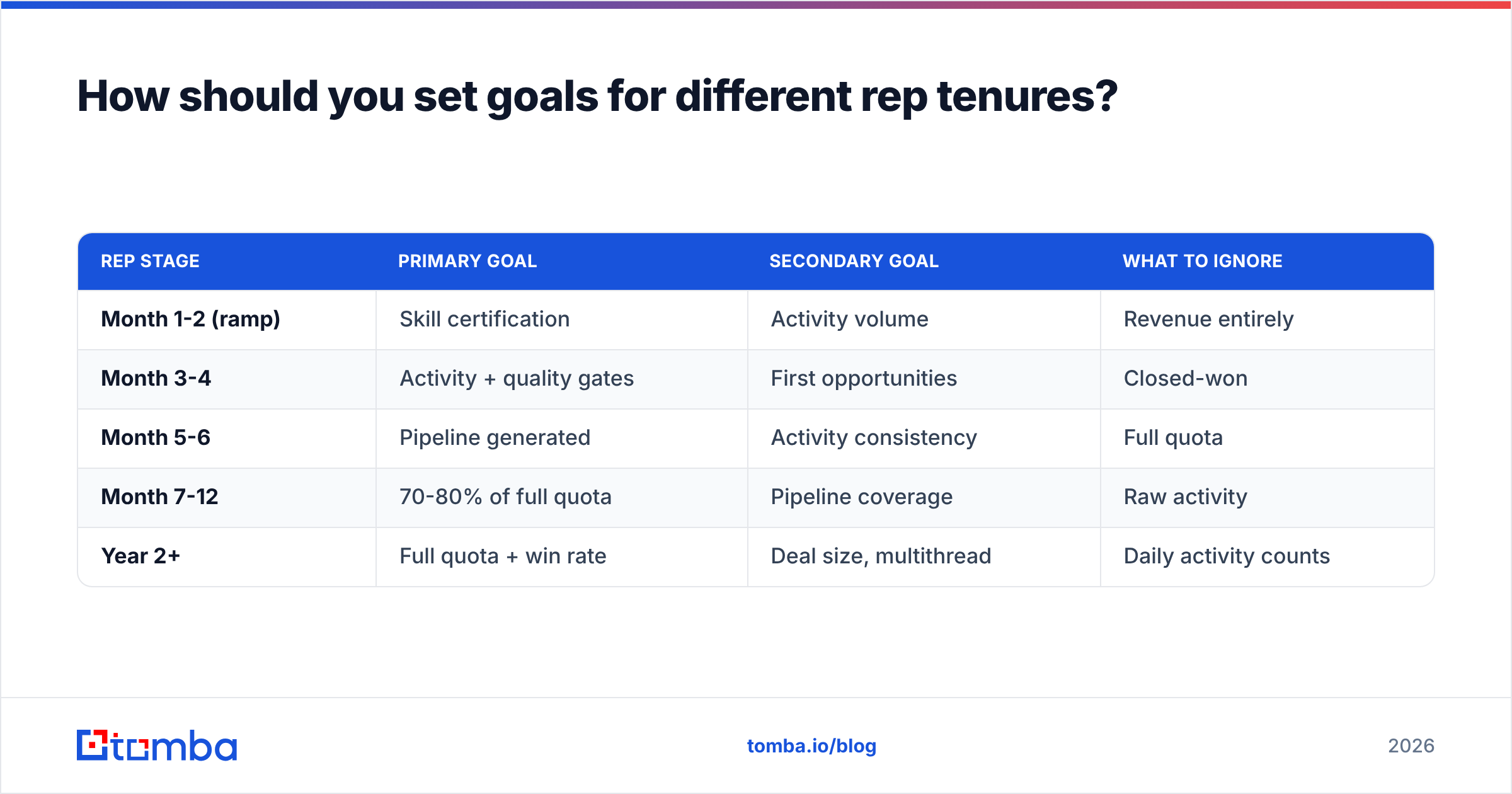
How should you set goals for different rep tenures?#
One goal sheet for the whole team is lazy management. Tenure changes what's diagnostic.
| Rep stage | Primary goal | Secondary goal | What to ignore |
|---|---|---|---|
| Month 1-2 (ramp) | Skill certification | Activity volume | Revenue entirely |
| Month 3-4 | Activity + quality gates | First opportunities | Closed-won |
| Month 5-6 | Pipeline generated | Activity consistency | Full quota |
| Month 7-12 | 70-80% of full quota | Pipeline coverage | Raw activity |
| Year 2+ | Full quota + win rate | Deal size, multithread | Daily activity counts |
The most common error is putting a month-3 rep on a full quota "for motivation." It doesn't motivate. It teaches them that the number is fiction, which is a lesson they carry into year two when the number stops being fiction.
The second most common error is the reverse: still micromanaging daily dial counts for a rep in year three who's at 120% attainment. If the outcome is there, the activity goal has served its purpose — retire it and replace it with a win-rate or deal-size goal.
How do you review goals without turning it into a status meeting?#
Weekly, 20 minutes, three questions. That's the whole ritual.
- What did the numbers do? Activity and pipeline metrics only — closed-won is a monthly conversation, not a weekly one.
- Which leading indicator moved in the wrong direction? One metric. Not a dashboard tour.
- What's the single change for next week? One behavioural adjustment, written down, checked at the next review.
Anything that takes longer than 20 minutes has become a status update, and status updates belong in the CRM. Salesforce's own sales productivity research consistently finds reps spend under a third of their time actually selling — every meeting you add makes that worse.
Quarterly, do the harder thing: re-set the numbers. Goals that carry unchanged for four quarters are decoration. If win rate improved from 18% to 24%, the pipeline coverage goal should drop from 4x to 3.2x, freeing the rep to spend time on quality rather than volume. That trade — earned by performance — is what makes goal-setting feel like a system rather than a leash.
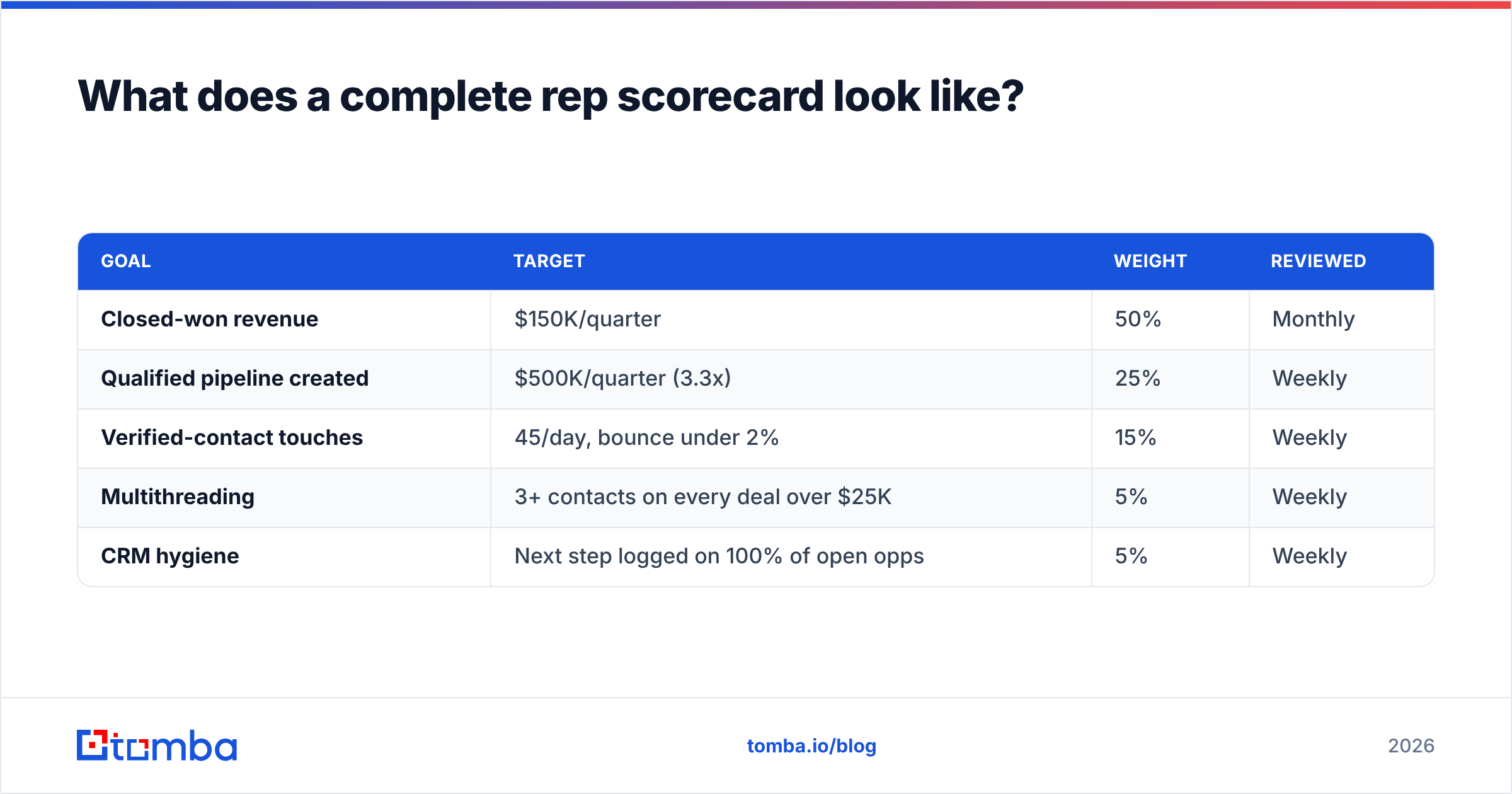
What does a complete rep scorecard look like?#
Five goals. Not six. Here's a copyable AE scorecard for a $600K annual quota:
| Goal | Target | Weight | Reviewed |
|---|---|---|---|
| Closed-won revenue | $150K/quarter | 50% | Monthly |
| Qualified pipeline created | $500K/quarter (3.3x) | 25% | Weekly |
| Verified-contact touches | 45/day, bounce under 2% | 15% | Weekly |
| Multithreading | 3+ contacts on every deal over $25K | 5% | Weekly |
| CRM hygiene | Next step logged on 100% of open opps | 5% | Weekly |
Note what's not on there: no dial counts, no email opens, no "activities logged." Opens have been unreliable since Apple Mail Privacy Protection made them meaningless, and any metric a rep can hit without talking to a human doesn't belong on a scorecard.
For an SDR on the same team, swap the top two rows for "18 meetings held/month" and "$450K sourced pipeline/quarter," and raise the activity weight to 35%. Same structure, different centre of gravity. Comparing structures across teams is easy on peer-review sites like G2's sales enablement category, where scorecard templates ship with most tools in the space.
Where should you start this quarter?#
Fix the input layer before you touch the goal sheet. Pull one rep's list, run it through verification, and look at the real bounce rate. If it's over 5%, no goal you write this quarter will survive contact with reality — you're setting targets on a foundation that's already 30% fiction.
Once the data is clean, cut every rep down to five goals, weight them by tenure, and hold the 20-minute weekly review without exception for a full quarter. Most teams see the win-rate and coverage numbers move within two cycles, not because the reps got better, but because they finally know which number to move on Monday morning.
If your activity goals are running on stale contacts, start there. The Tomba Email Finder sources verified professional addresses by domain, name, or company, so "45 touches per day" means 45 emails that actually land instead of 28 plus a deliverability problem. The free tier covers 25 searches a month if you just want to audit a sample list first, and Tomba pricing starts at $49/mo on Starter when you're ready to run it across the full team.
Related guides#
Ready to find emails that actually work?
Join 150,000+ professionals who stopped guessing and started sending. Free credits on signup — no credit card required.
Get the Tomba newsletter
Practical outbound tactics and product updates — once every two weeks.
About the author