GodmodeHQ Pros and Cons: An Honest 2026 Review for GTM Teams
GodmodeHQ sells autonomous GTM agents that research accounts and draft outreach for you. Here's where that actually works, where it quietly breaks, and what it costs you in data quality if you skip the fundamentals.
TL;DR
- GodmodeHQ is an agentic go-to-market platform: AI agents monitor signals, research accounts, and draft outreach instead of you doing it manually in ten tabs.
- The strongest pro is research compression — work that took an SDR 15 minutes per account collapses to seconds, and the account briefs are genuinely usable.
- The biggest con is that agent output inherits your data quality. Feed it stale contacts and you get beautifully personalized emails to people who left in 2023.
- Pricing is quote-based rather than transparent self-serve, which makes it a poor fit for solo founders and sub-5-person sales teams testing a motion.
- Best fit: mid-market GTM teams with a defined ICP, a working sequencer, and a verified contact layer already in place. Everyone else should fix the data first.
What is GodmodeHQ, and what does it actually do?#
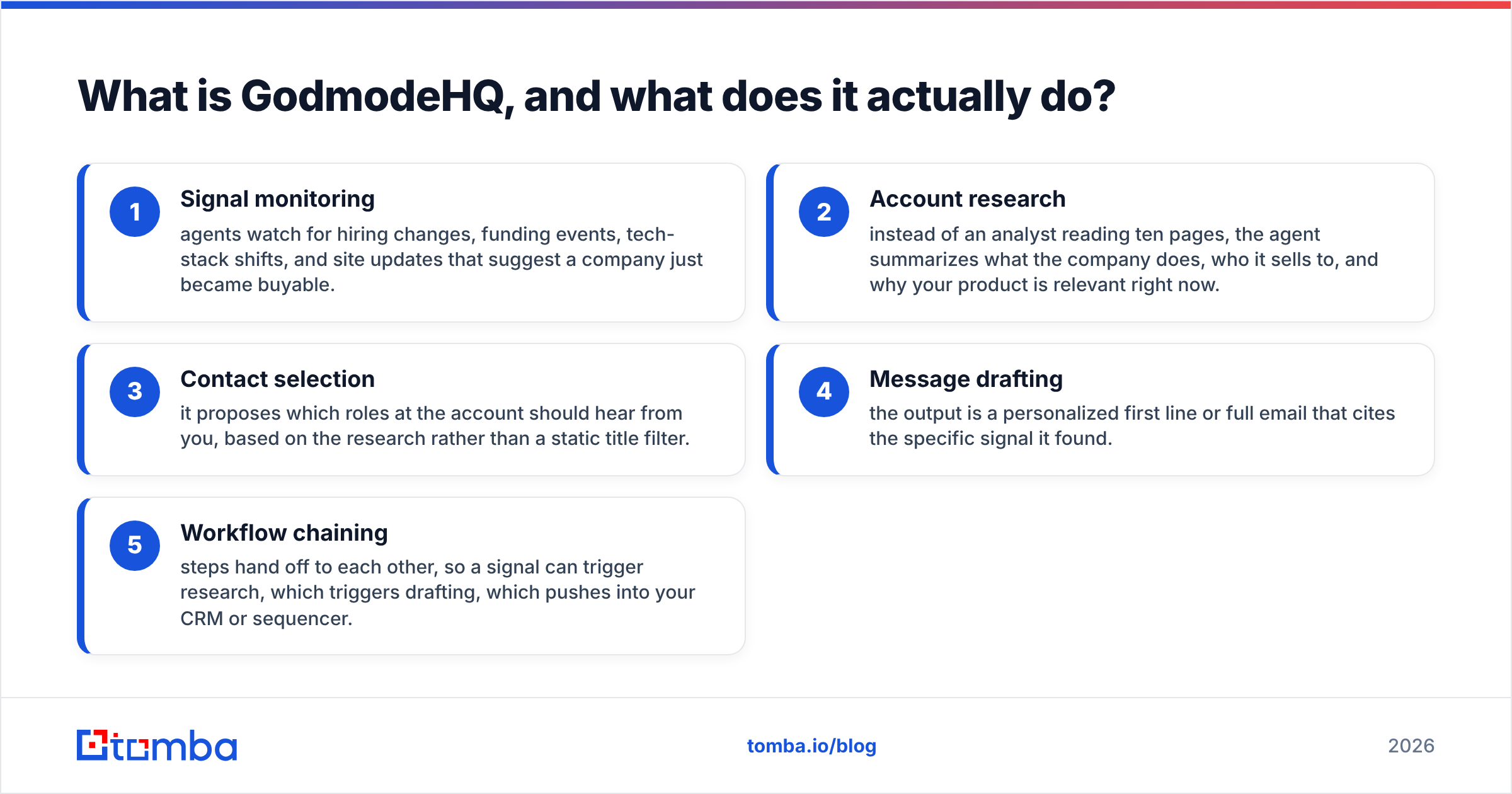
GodmodeHQ (godmodehq.com) sits in the category people now call "agentic GTM" — software that doesn't just store data or send emails, but runs multi-step research and outreach workflows on your behalf. You describe an ideal customer profile and a trigger; the agents go find matching accounts, read their websites, funding news, job posts, and product changes, then produce a brief and a first-touch message.
That is a meaningfully different product from a database or a sequencer, and the distinction matters when you evaluate it:
- Signal monitoring — agents watch for hiring changes, funding events, tech-stack shifts, and site updates that suggest a company just became buyable.
- Account research — instead of an analyst reading ten pages, the agent summarizes what the company does, who it sells to, and why your product is relevant right now.
- Contact selection — it proposes which roles at the account should hear from you, based on the research rather than a static title filter.
- Message drafting — the output is a personalized first line or full email that cites the specific signal it found.
- Workflow chaining — steps hand off to each other, so a signal can trigger research, which triggers drafting, which pushes into your CRM or sequencer.
What it is not: a system of record, a verified contact database, or a deliverability platform. GodmodeHQ assumes those layers exist. That assumption is the source of roughly half the complaints you'll read in review threads.
What are GodmodeHQ's biggest pros?#
Research compression is real. This is the honest headline. A competent SDR spends 10–20 minutes building a defensible point of view on an enterprise account. Agentic research gets you 70–80% of that in under a minute. For a team running 200 accounts a month, that's the difference between one researcher and none. The briefs are not always right, but they are almost always a better starting point than a blank doc.
Trigger-based prospecting without a data engineer. Building signal pipelines yourself means scrapers, job-board APIs, funding feeds, and a queue to reconcile them. GodmodeHQ packages that. If your ICP is genuinely event-driven — you sell to companies that just raised, just hired a VP, or just adopted a competing tool — the packaging saves real engineering months.
Output quality beats generic AI writers. Because the drafting step is grounded in retrieved account facts rather than a title and a company name, the messages read like someone looked. That's a low bar in cold email, and clearing it moves reply rates more than any subject-line trick. If you want a baseline to compare against, run the same accounts through a generic AI cold email writer and read both outputs side by side — the gap is obvious.
It forces ICP discipline. You cannot configure a useful agent with a vague ICP. Teams report that the setup process itself surfaced how sloppy their targeting was. That's a real, if unintended, benefit.
Reduces context-switching for AEs. Rep-facing briefs delivered before a call are consistently the feature people keep after the pilot ends, even when they drop the outbound agents.
What are the cons you should know before buying?#
Garbage in, confidently-worded garbage out. Agents do not know when a contact record is stale. They will write a warm, specific email to a Head of Growth who left eight months ago, and it will look perfect right up until it bounces. Agentic tooling amplifies whatever your data layer already is. If your bounce rate is above 3%, an AI agent makes that worse, not better, because it increases volume against the same bad list.
Verification is not the same as enrichment. Many agentic platforms enrich from aggregated sources and pass the result along without an SMTP-level check. You still need a real email verifier in the path before anything hits a sending domain — and a catch-all verifier for the roughly 15–20% of B2B domains that accept everything and tell you nothing.
Opaque pricing. There's no clean self-serve tier you can swipe a card for and test on a Tuesday afternoon. Sales-led pricing means a demo, a scoping call, and usually an annual commitment before you know whether the agents work on your ICP. For a category this new, that's a lot of risk to front-load.
Review depth is thin. Compared to established categories, third-party validation on G2 and similar sites is limited. You're buying partly on demo quality and partly on faith, which is normal for emerging tools but should shape how much you commit up front.
Hallucination tax. Agents occasionally assert things about an account that aren't true — a product it doesn't sell, a funding round that was a rumor. At low volume you catch it. At 500 emails a week, you don't, and one confidently wrong claim to a VP costs more than the ten correct ones earned.
Deliverability is still your problem. No agent platform manages your SPF records, warmup schedule, or domain reputation. If you're scaling volume, run an SPF checker and treat email deliverability as an entirely separate workstream.
How does GodmodeHQ compare to other GTM stacks?#
The useful comparison isn't "GodmodeHQ vs. one competitor" — it's "which layer of the stack am I actually buying?" Most teams that churn off agentic tools did so because they bought an agent when they needed a data layer.
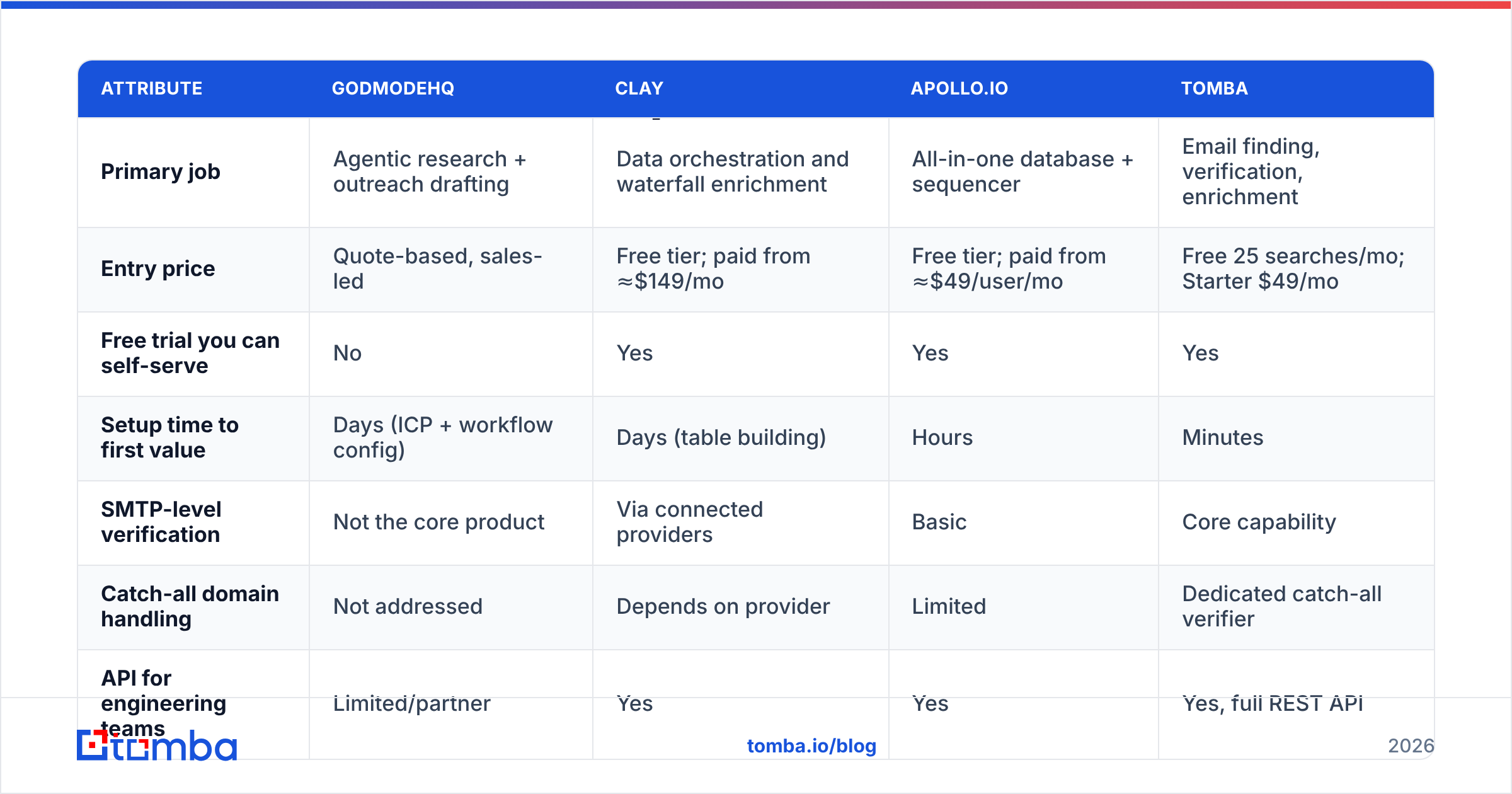
| Attribute | GodmodeHQ | Clay | Apollo.io | Tomba |
|---|---|---|---|---|
| Primary job | Agentic research + outreach drafting | Data orchestration and waterfall enrichment | All-in-one database + sequencer | Email finding, verification, enrichment |
| Entry price | Quote-based, sales-led | Free tier; paid from ≈$149/mo | Free tier; paid from ≈$49/user/mo | Free 25 searches/mo; Starter $49/mo |
| Free trial you can self-serve | No | Yes | Yes | Yes |
| Setup time to first value | Days (ICP + workflow config) | Days (table building) | Hours | Minutes |
| SMTP-level verification | Not the core product | Via connected providers | Basic | Core capability |
| Catch-all domain handling | Not addressed | Depends on provider | Limited | Dedicated catch-all verifier |
| API for engineering teams | Limited/partner | Yes | Yes | Yes, full REST API |
| Best for | Mid-market teams with a working stack | RevOps builders who like spreadsheets | SMB teams wanting one bill | Any team needing accurate contact data |
Pricing on all four moves; check each vendor's current page before you budget. Tomba's plans run Free (25 searches/mo), Starter $49/mo, Growth $99/mo, Pro $249/mo, and Enterprise custom — published, no demo required.
Read that table as a stack diagram, not a leaderboard. GodmodeHQ and Tomba are not substitutes; one produces the reasoning, the other produces the verified contact the reasoning gets sent to. Teams running both tend to be happier than teams running either alone.
Who is GodmodeHQ actually right for?#
Good fit if:
- You sell to mid-market or enterprise where a single account justifies 15 minutes of research.
- Your ICP is genuinely trigger-driven — funding, hiring, tech adoption, expansion.
- You already have a sequencer, a warmed domain, and verified contacts. The agent is the last layer you add, not the first.
- You have someone who owns the workflow. Agentic tools decay without an operator, the same way a CRM decays without an admin.
Poor fit if:
- You're pre-product-market-fit and still discovering the ICP. Agents automate a hypothesis; you don't have one yet.
- You sell high-volume, low-ACV SMB. The research premium doesn't clear the unit economics.
- Your contact data is a CSV someone exported last quarter. Fix that first — the ROI on cleaning a list beats the ROI on any agent, every time.
- You need transparent, month-to-month pricing to justify the spend.
Analyst coverage from firms like Gartner has been consistent on this point across the last two hype cycles: automation multiplies the quality of the process underneath it. It does not create one.
How do you pilot it without wasting a quarter?#
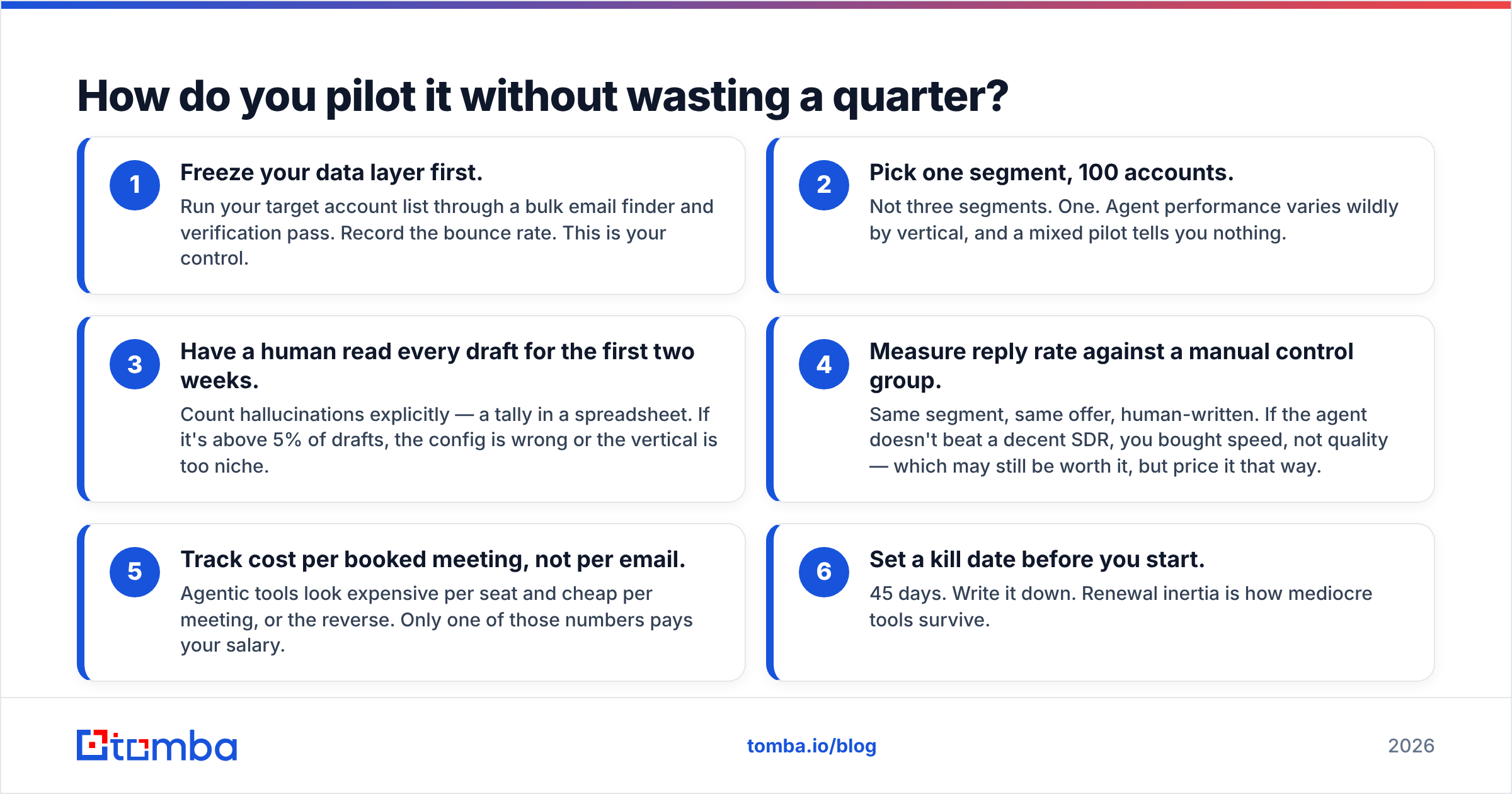
- Freeze your data layer first. Run your target account list through a bulk email finder and verification pass. Record the bounce rate. This is your control.
- Pick one segment, 100 accounts. Not three segments. One. Agent performance varies wildly by vertical, and a mixed pilot tells you nothing.
- Have a human read every draft for the first two weeks. Count hallucinations explicitly — a tally in a spreadsheet. If it's above 5% of drafts, the config is wrong or the vertical is too niche.
- Measure reply rate against a manual control group. Same segment, same offer, human-written. If the agent doesn't beat a decent SDR, you bought speed, not quality — which may still be worth it, but price it that way.
- Track cost per booked meeting, not per email. Agentic tools look expensive per seat and cheap per meeting, or the reverse. Only one of those numbers pays your salary.
- Set a kill date before you start. 45 days. Write it down. Renewal inertia is how mediocre tools survive.
Does an AI agent replace your contact data provider?#
No, and the vendors themselves generally don't claim it does. An agent decides who to contact and what to say. It still needs a source of truth for how to reach them — the actual, currently-valid email address.
This is where most agentic pilots quietly fail. The agent produces a brilliant brief on a Series B logistics company, identifies the right VP of Operations, drafts a message referencing their new warehouse in Rotterdam — and sends it to an inferred address that was never verified. The email bounces, your domain reputation takes a small hit, and the analytics dashboard records it as a "sent" with no reply.
Keep the layers separate and instrument each one. Use a dedicated data enrichment and verification step between "agent decided" and "sequencer sent," and check the pass rate weekly. If you're building this programmatically, the Tomba API slots into that gap as a single call — find, verify, return a confidence score, then let the agent proceed only on green results.
What's the honest verdict on GodmodeHQ pros and cons?#
GodmodeHQ is a legitimate product solving a real bottleneck — account research is expensive, repetitive, and genuinely well-suited to agents. If you're a mid-market team with a defined ICP and a stack that already works, a scoped pilot is a reasonable use of a quarter.
But it is a top-of-stack tool. It multiplies what's underneath it, in both directions. The teams that got value bought it after their data was clean; the teams that churned bought it hoping it would compensate for data that wasn't. That pattern is consistent enough to be a rule.
If you're at the stage where your list is the problem — bounces above 3%, contacts you can't confirm, catch-all domains you're guessing at — start there. Run your target domains through the Tomba Email Finder and get verified, source-attributed addresses before you spend a cent on agents that will happily email the wrong people faster than you ever could. The free tier covers 25 searches a month, which is enough to audit a segment and see exactly how much of your pipeline problem is actually a data problem.
Related guides#
Ready to find emails that actually work?
Join 150,000+ professionals who stopped guessing and started sending. Free credits on signup — no credit card required.
Get the Tomba newsletter
Practical outbound tactics and product updates — once every two weeks.
About the author