GodmodeHQ Reviews 2026: Features, Pricing and Real Limits
An independent look at GodmodeHQ: what the AI GTM agent actually automates, where the research quality holds up, what buyers complain about, and the contact-data gap you still have to fill yourself.
TL;DR
- GodmodeHQ is an AI GTM agent platform: it researches accounts, watches for buying signals, and drafts personalized outreach so a small team can behave like a much bigger one.
- The strongest reviews come from lean B2B teams with a complex product and a fuzzy ICP — the research layer is where the money actually goes.
- Pricing is not fully published. Expect a sales conversation, an annual commitment, and a per-seat or per-workflow structure rather than a self-serve $49 checkout.
- The recurring complaint across AI GTM tools of this shape is the same one: the agent is only as good as the contact data underneath it, and enriched emails still need independent verification.
- Best fit: seed-to-Series-B teams replacing manual SDR research. Bad fit: anyone who mainly needs accurate emails at volume — that is a cheaper, different purchase.
What is GodmodeHQ?#
GodmodeHQ (godmodehq.com) sells an AI agent for go-to-market work. Instead of shipping another list-building UI, it positions itself as a coworker: you describe your ideal customer, the agent goes and finds companies matching that description, reads what they publish, connects that to a reason to reach out, and drafts the message.
The analogy that lands best: most prospecting tools are a filing cabinet — filters, checkboxes, exports. GodmodeHQ is pitched as a junior researcher who reads the filing cabinet for you and comes back with a one-paragraph brief and a draft email. You still approve the work. You just don't do the reading.
That framing matters for how you evaluate it. A filing cabinet is judged on coverage and price per record. A researcher is judged on judgment quality — did it pick the right accounts, and is the "why now" real or invented? Every honest GodmodeHQ review has to answer that second question, because it's where the category lives or dies.
The product sits in what G2 now files under AI sales assistants, a category that barely existed in 2022 and is crowded by 2026. Gartner's own sales-tech coverage has been flagging the same consolidation pressure: buyers want fewer point tools and more outcomes. GodmodeHQ is a bet that the outcome — qualified, researched, contextual outreach — is the thing worth paying for.
How does GodmodeHQ actually work day to day?#
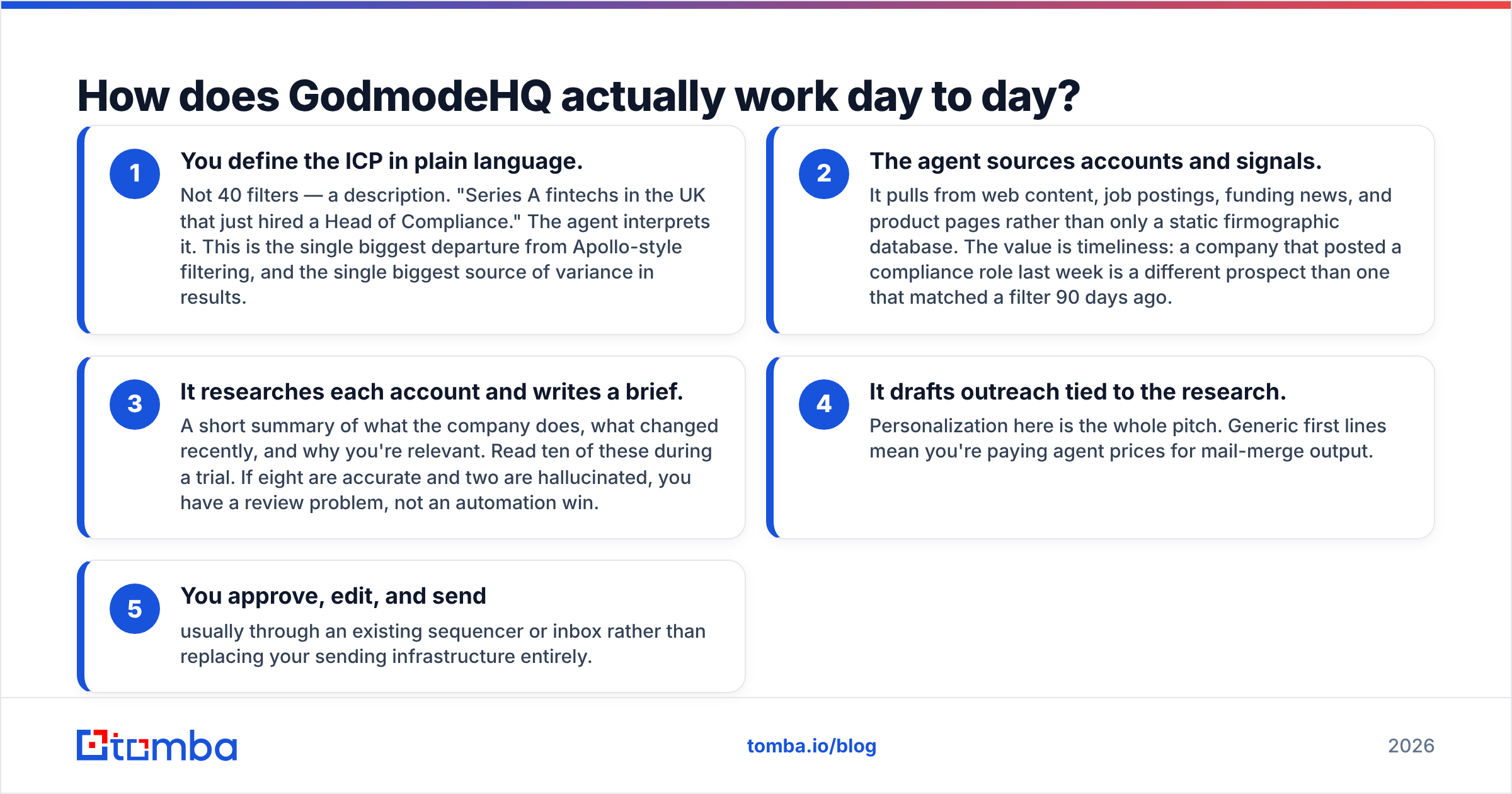
The workflow, stripped of marketing language, runs in five stages. This is the shape you should test during a trial:
- You define the ICP in plain language. Not 40 filters — a description. "Series A fintechs in the UK that just hired a Head of Compliance." The agent interprets it. This is the single biggest departure from Apollo-style filtering, and the single biggest source of variance in results.
- The agent sources accounts and signals. It pulls from web content, job postings, funding news, and product pages rather than only a static firmographic database. The value is timeliness: a company that posted a compliance role last week is a different prospect than one that matched a filter 90 days ago.
- It researches each account and writes a brief. A short summary of what the company does, what changed recently, and why you're relevant. Read ten of these during a trial. If eight are accurate and two are hallucinated, you have a review problem, not an automation win.
- It drafts outreach tied to the research. Personalization here is the whole pitch. Generic first lines mean you're paying agent prices for mail-merge output.
- You approve, edit, and send — usually through an existing sequencer or inbox rather than replacing your sending infrastructure entirely.
Notice what is not in that list: contact discovery and verification as a first-class, auditable step. Most AI GTM platforms resolve emails through a bundled or resold enrichment layer, and the quality varies by geography and company size far more than the marketing admits. That's the seam where teams get burned, and it's the reason experienced buyers pair a research agent with a dedicated email finder instead of trusting one vendor for both.
What do GodmodeHQ reviews actually say?#
Aggregating public sentiment across review sites, founder communities, and RevOps threads, the pattern is consistent enough to summarize honestly:
What reviewers praise
- Research depth. The account briefs are the most-cited positive. Teams report the agent surfaces context an SDR would have needed 15–20 minutes to assemble.
- Time-to-first-list. Getting from a described ICP to a working target list is fast compared to building the same thing manually in a data platform.
- Fit for fuzzy ICPs. If your buyers aren't cleanly defined by SIC code and headcount, filter-based tools fail and a language-based agent does better.
- Responsive team. Early-stage vendors usually win on support, and GodmodeHQ gets that credit repeatedly.
What reviewers criticize
- Opacity of pricing. Buyers dislike having to book a call to learn what something costs, and it filters out self-serve teams entirely.
- Output requires editing. "80% there" is the most common phrasing. That's genuinely useful, but it is not zero-touch.
- Contact data gaps. Emails for smaller companies, non-US regions, and non-obvious roles are where coverage thins.
- Attribution difficulty. When the agent picks accounts and writes copy, isolating what caused a reply becomes harder. Some RevOps leads find that uncomfortable.
Treat the criticism section as the honest part. Every AI GTM tool in this generation shares roughly the same weaknesses — they're properties of the approach, not defects unique to one vendor.
How much does GodmodeHQ cost?#
Straight answer: GodmodeHQ does not publish a full self-serve price list, so any specific number you read online should be treated as stale or secondhand. Expect a demo-gated quote, likely structured around seats plus usage (accounts researched, messages generated), with meaningful discounts for annual commitment.
Practically, that puts it in the "AI GTM platform" budget bracket rather than the "tool" bracket. Budget accordingly, and ask these four questions before signing:
- What is the unit of consumption — accounts, contacts, messages, or seats — and what happens when we exceed it mid-month?
- Is contact enrichment included in the quote, or metered separately?
- What is the minimum term, and is there a monthly option for the first quarter?
- Can we export our researched accounts and contacts if we churn?
That last one matters more than people expect. A research agent generates a lot of institutional knowledge about your market. If it's locked in the vendor's UI, you're renting your own memory.
How does GodmodeHQ compare to other GTM tools?#
The mistake buyers make is comparing GodmodeHQ to email finders. They solve adjacent problems. Here's the honest layout:
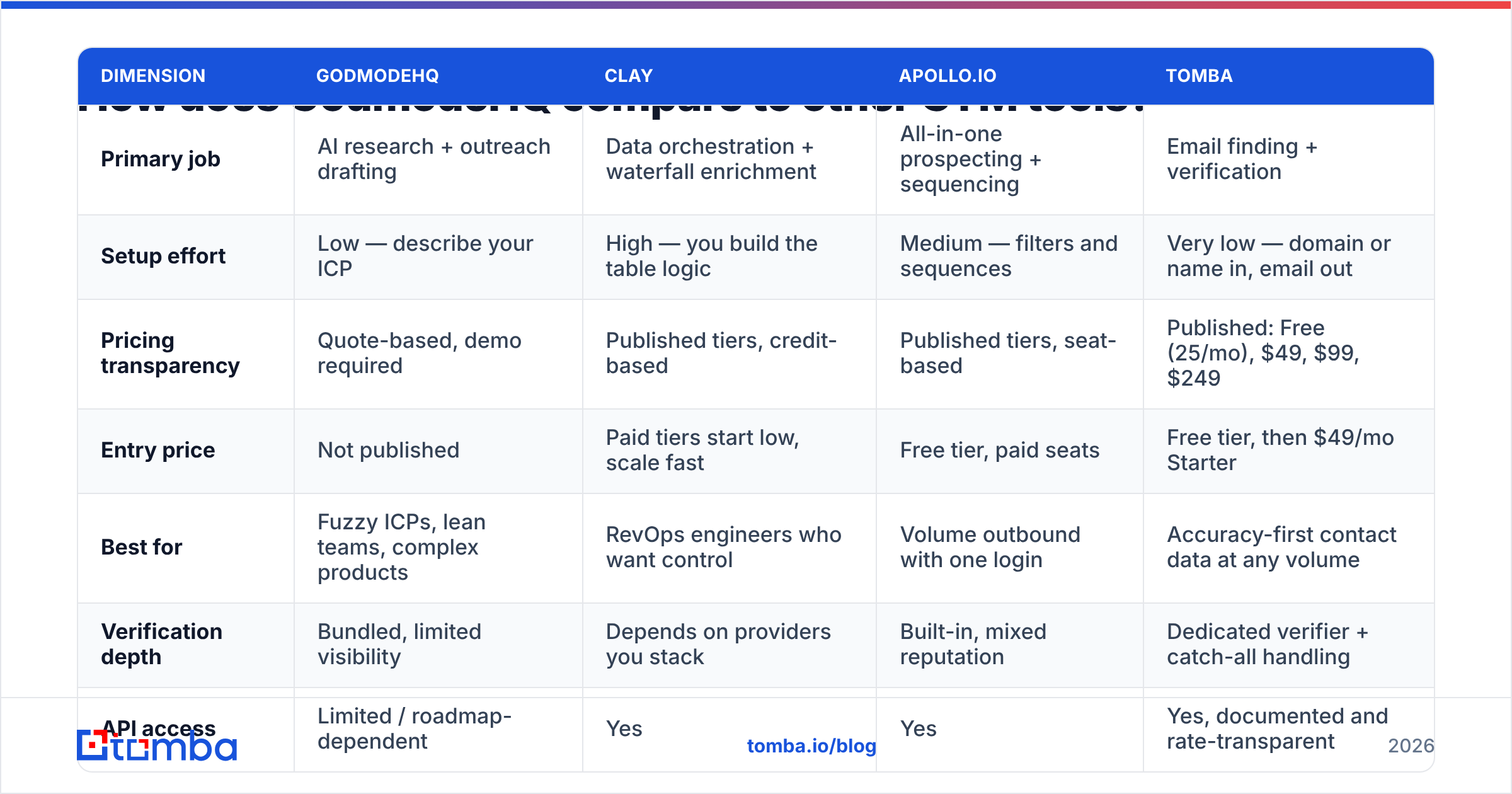
| Dimension | GodmodeHQ | Clay | Apollo.io | Tomba |
|---|---|---|---|---|
| Primary job | AI research + outreach drafting | Data orchestration + waterfall enrichment | All-in-one prospecting + sequencing | Email finding + verification |
| Setup effort | Low — describe your ICP | High — you build the table logic | Medium — filters and sequences | Very low — domain or name in, email out |
| Pricing transparency | Quote-based, demo required | Published tiers, credit-based | Published tiers, seat-based | Published: Free (25/mo), $49, $99, $249 |
| Entry price | Not published | Paid tiers start low, scale fast | Free tier, paid seats | Free tier, then $49/mo Starter |
| Best for | Fuzzy ICPs, lean teams, complex products | RevOps engineers who want control | Volume outbound with one login | Accuracy-first contact data at any volume |
| Verification depth | Bundled, limited visibility | Depends on providers you stack | Built-in, mixed reputation | Dedicated verifier + catch-all handling |
| API access | Limited / roadmap-dependent | Yes | Yes | Yes, documented and rate-transparent |
| Learning curve | Hours | Weeks | Days | Minutes |
Read that table as a stack, not a bracket. GodmodeHQ answers who to contact and why now. Clay answers how to orchestrate data. Tomba answers what is this person's real, deliverable email address. Teams that buy one expecting all three end up disappointed with whichever one they bought.
For comparison shopping on the adjacent layer, the Apollo alternative breakdown covers the all-in-one tradeoff in more detail.
Is the contact data good enough on its own?#
This is the question that decides whether GodmodeHQ pays for itself.
An AI agent can write a flawless, deeply researched email to firstname.lastname@company.com and it will bounce if the company actually uses flast@company.com. Bounces don't just waste that one send — they compound into sender reputation damage that suppresses the campaigns that were correctly targeted. Google and Microsoft both tightened bulk-sender enforcement, and the tolerance for sloppy list hygiene is now close to zero.
So the practical stance: use the agent for targeting and messaging, and route every email address it produces through an independent email verifier before it touches your sequencer. It's a cheap step. A 2–3% bounce rate versus a 0.4% bounce rate is the difference between a healthy domain and a rebuild.

Three specific data checks worth running during any GodmodeHQ trial:
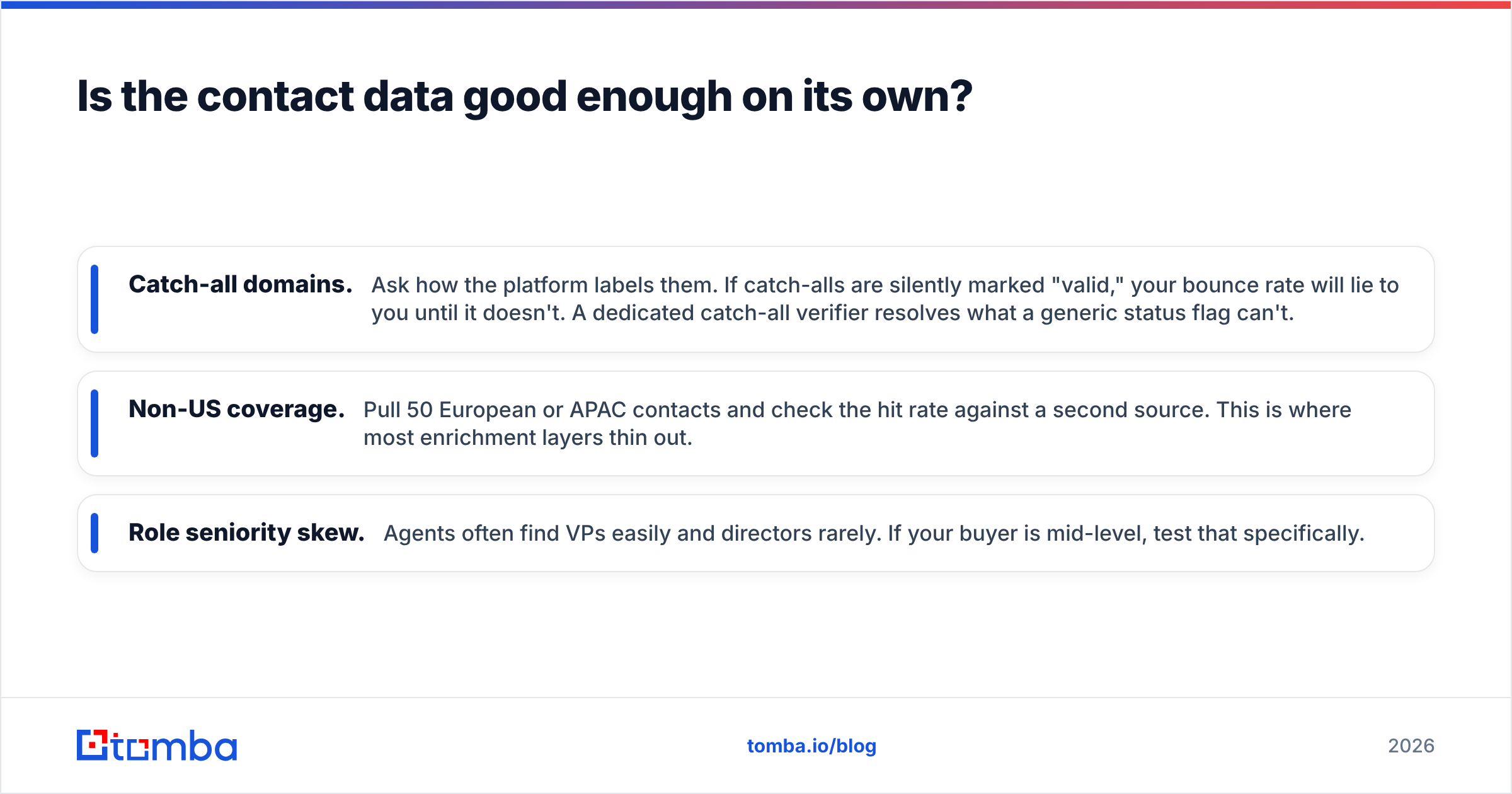
- Catch-all domains. Ask how the platform labels them. If catch-alls are silently marked "valid," your bounce rate will lie to you until it doesn't. A dedicated catch-all verifier resolves what a generic status flag can't.
- Non-US coverage. Pull 50 European or APAC contacts and check the hit rate against a second source. This is where most enrichment layers thin out.
- Role seniority skew. Agents often find VPs easily and directors rarely. If your buyer is mid-level, test that specifically.
Who should buy GodmodeHQ — and who shouldn't?#
Buy it if:
- You're a founder or two-person GTM team doing the research yourself and it's eating your week.
- Your ICP resists filters — you sell to "companies doing X," not "companies with Y employees."
- Your product is complex enough that generic outreach genuinely doesn't work, so personalization has real ROI.
- You have someone who will actually review the agent's output rather than auto-sending it.
Skip it if:
- Your bottleneck is contact accuracy or volume, not research. That's a $49/month problem, not a platform problem.
- You need transparent, self-serve pricing to get budget approved.
- You already run Clay and have the RevOps skill to build equivalent workflows yourself.
- Your outbound motion is high-volume and lightly personalized. The agent's main advantage is wasted.
The uncomfortable truth about this category in 2026: AI research agents raise the ceiling on what a good outbound team can do, but they don't raise the floor. If your targeting, offer, and data hygiene are weak, an agent produces more articulate versions of messages that were never going to work.
What should you test during a GodmodeHQ trial?#
Run a structured pilot, not a vibes check. Two weeks, one segment, and these five measurements:
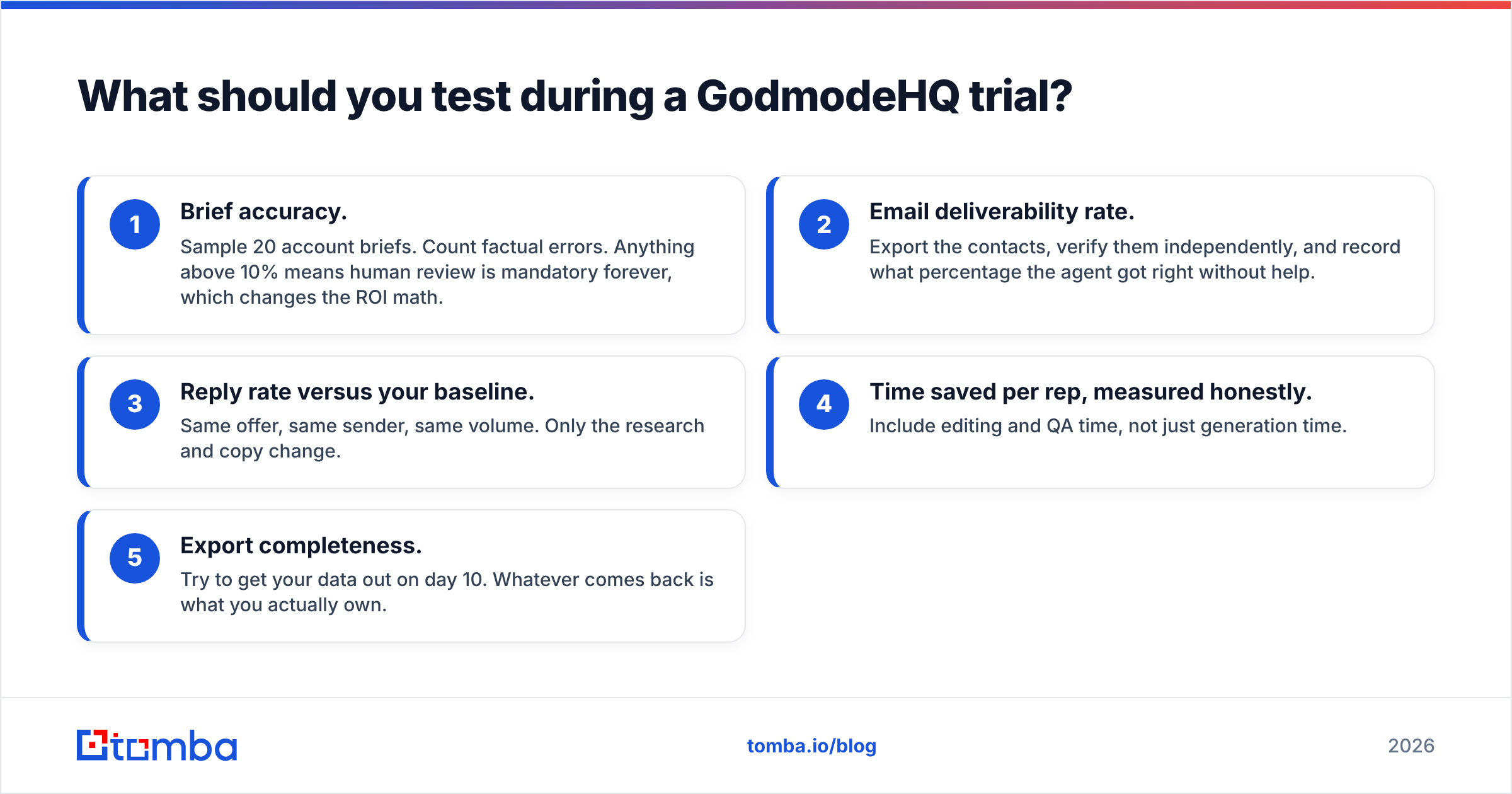
- Brief accuracy. Sample 20 account briefs. Count factual errors. Anything above 10% means human review is mandatory forever, which changes the ROI math.
- Email deliverability rate. Export the contacts, verify them independently, and record what percentage the agent got right without help.
- Reply rate versus your baseline. Same offer, same sender, same volume. Only the research and copy change.
- Time saved per rep, measured honestly. Include editing and QA time, not just generation time.
- Export completeness. Try to get your data out on day 10. Whatever comes back is what you actually own.
If you want to enrich the exported list independently during the pilot, a bulk email finder run against the same account set gives you a clean control group to compare hit rates against.
The verdict#
GodmodeHQ is a credible, well-built AI GTM agent that solves a real problem: research is the most expensive and least scalable part of outbound, and it automates most of it convincingly. Lean teams with complex products and hard-to-filter ICPs get the most out of it. The research quality is the reason to buy; the opaque pricing and the dependency on bundled contact data are the reasons to negotiate carefully.
What it is not is a data platform. No AI agent — this one included — removes the need for accurate, independently verified contact records underneath the intelligence layer. Buy the agent for judgment. Buy your email data from something that does nothing else.
If contact accuracy is the part of your stack that's actually leaking, start there. Tomba Email Finder resolves professional emails by domain, name, or company, with a dedicated verifier and catch-all handling behind it — free for your first 25 searches per month, $49/month on Starter, with published Tomba pricing all the way up. Pair it with whatever research agent you choose, and stop letting good targeting die at the bounce.
Related guides#
Ready to find emails that actually work?
Join 150,000+ professionals who stopped guessing and started sending. Free credits on signup — no credit card required.
Get the Tomba newsletter
Practical outbound tactics and product updates — once every two weeks.
About the author