GoldMine Pricing Reviews Pros and Cons: A 2026 Breakdown
GoldMine still sells perpetual licenses in a subscription world. Here is what it actually costs in 2026, what reviewers praise and complain about, and when a modern CRM plus a real data layer beats it.
Is GoldMine still worth buying in 2026? This breakdown covers GoldMine pricing reviews pros and cons in plain terms. GoldMine sells a license you own in a market that rents software by the month. That one choice explains every number below.
TL;DR
- Perpetual license. GoldMine is one of the oldest CRMs still sold. It is also one of the few that still sells a license you own outright.
- Price. Budget about $65/user/month for GoldMine Cloud. On-premise runs $1,500–$1,800/user one time, plus roughly 20% a year. Quotes come from resellers, so yours will differ.
- Reviews split by tenure. Veterans praise the speed and the data ownership. Newer users call the interface dated.
- The gap. GoldMine stores contacts. It does not find, verify, or refresh them.
- Best fit. Teams of 10–50 seats with an existing GoldMine database and a reason to keep data on their own server.
- Worst fit. Outbound teams that need fresh contact data every week.
What is GoldMine CRM in 2026?#
GoldMine is a contact management and CRM platform that has been shipping since 1990. It predates Salesforce by nearly a decade. It has also passed through several owners — the original GoldMine Software Corp, then FrontRange Solutions, then Ivanti — before landing at its current home on goldmine.com, sold largely through a reseller channel.
Think of GoldMine as the diesel pickup of the CRM world. It is not pretty, nobody posts screenshots of it, and it has none of the AI features the category spent 2025 bolting on. But it starts every morning, you own it outright, and it does not send you an invoice every 30 days.
The product line has three pieces worth knowing:
- GoldMine Premium Edition — the on-premise core. Installed on your own Windows server, backed by Microsoft SQL Server, licensed per user.
- GoldMine Connect (GoldMine Web) — browser and mobile access to that same on-premise database. It is a front-end, not a separate CRM.
- GoldMine Cloud — GoldMine hosted for you, billed per user per month. Functionally similar, different cost structure.
That structure matters more than any feature list, because it is the source of every pricing surprise buyers report.
How much does GoldMine cost in 2026?#
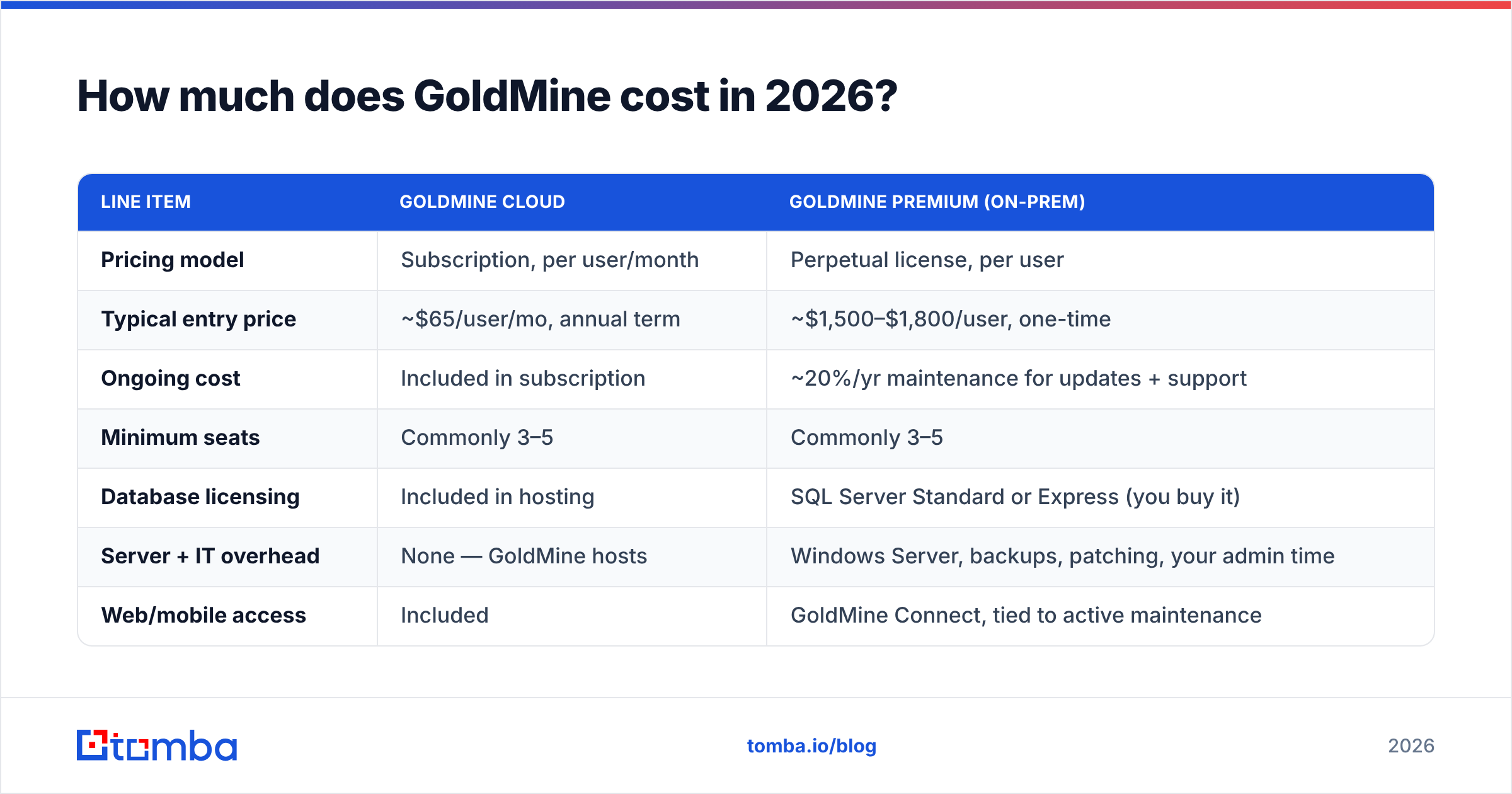
Short answer: budget $65/user/month for cloud, or roughly $1,695 per user one-time plus about 20% annually for on-premise. Then add 20–40% on top of year one for SQL Server, implementation, and data migration.
GoldMine does not publish a clean self-serve pricing page the way HubSpot or Pipedrive do. Deals go through resellers, minimum seat counts apply, and discounting is normal above roughly 20 seats. Treat every number below as a planning estimate, then get a written quote.
| Line item | GoldMine Cloud | GoldMine Premium (on-prem) |
|---|---|---|
| Pricing model | Subscription, per user/month | Perpetual license, per user |
| Typical entry price | ~$65/user/mo, annual term | ~$1,500–$1,800/user, one-time |
| Ongoing cost | Included in subscription | ~20%/yr maintenance for updates + support |
| Minimum seats | Commonly 3–5 | Commonly 3–5 |
| Database licensing | Included in hosting | SQL Server Standard or Express (you buy it) |
| Server + IT overhead | None — GoldMine hosts | Windows Server, backups, patching, your admin time |
| Web/mobile access | Included | GoldMine Connect, tied to active maintenance |
| Implementation/migration | Reseller quote, often $1,500–$10,000 | Reseller quote, often $2,500–$15,000 |
| Break-even vs cloud | — | Roughly 26–30 months at list |
That last row is the honest headline of any GoldMine pricing reviews pros and cons comparison. A perpetual license only wins if you keep the system for about three years or more. Teams that churn CRMs every 18 months will lose money on it, full stop.
What are the hidden costs buyers miss?#
- SQL Server. GoldMine Premium runs on Microsoft SQL. The free Express edition caps database size at 10 GB, which a busy team with attachments and email logging will hit. Standard licensing is a real line item.
- The reseller layer. Most implementations, customizations, and training come from a partner, not from GoldMine directly. Quality and hourly rates vary widely.
- Maintenance lapses. Let maintenance expire and you keep running the software you own, but you lose upgrades, support, and in practice the web client. Reinstating usually costs back-maintenance.
- Data migration. Moving a 100,000-record legacy database with custom fields is never a weekend job.
- The data itself. GoldMine will happily store an email address that bounced in 2019. Nothing in the license refreshes it.
What do GoldMine reviews actually say?#
Public reviews on G2 and Capterra settle into a pattern that has held for years. The scores hover in the mid-3s out of 5 — not a disaster, not a leader. The written feedback splits along one line: how long the reviewer has used it.
What long-time users praise:
- Speed on local data. Searching a 200,000-record database on a local SQL server is instant. No spinner, no API rate limit.
- Ownership. The database is yours. Export it, back it up, audit it, keep it inside a regulated network.
- No renewal cliff. Nobody can triple the price at renewal on software you already bought.
- Deep email and history logging. GoldMine's activity history is genuinely thorough, and it has been thorough since before "activity capture" was a category.
What newer users complain about:
- The interface looks its age. Dense toolbars, modal windows, and a learning curve that assumes someone will train you.
- Onboarding is not self-serve. You do not sign up on a Tuesday and run a pipeline review on Wednesday.
- Native integrations are thin. Compared to a modern CRM's app marketplace, GoldMine's ecosystem is small and often reseller-built.
- Support quality depends on your partner. Reviews about support are really reviews about whichever reseller sold the license.
- Mobile is functional, not delightful. GoldMine Connect works. It does not feel like a 2026 app.
The fair summary: GoldMine reviews are not the reviews of a failing product. They are the reviews of a product that stopped chasing the mainstream around 2012 and kept serving the customers who never wanted it to change.
What are GoldMine's pros and cons?#
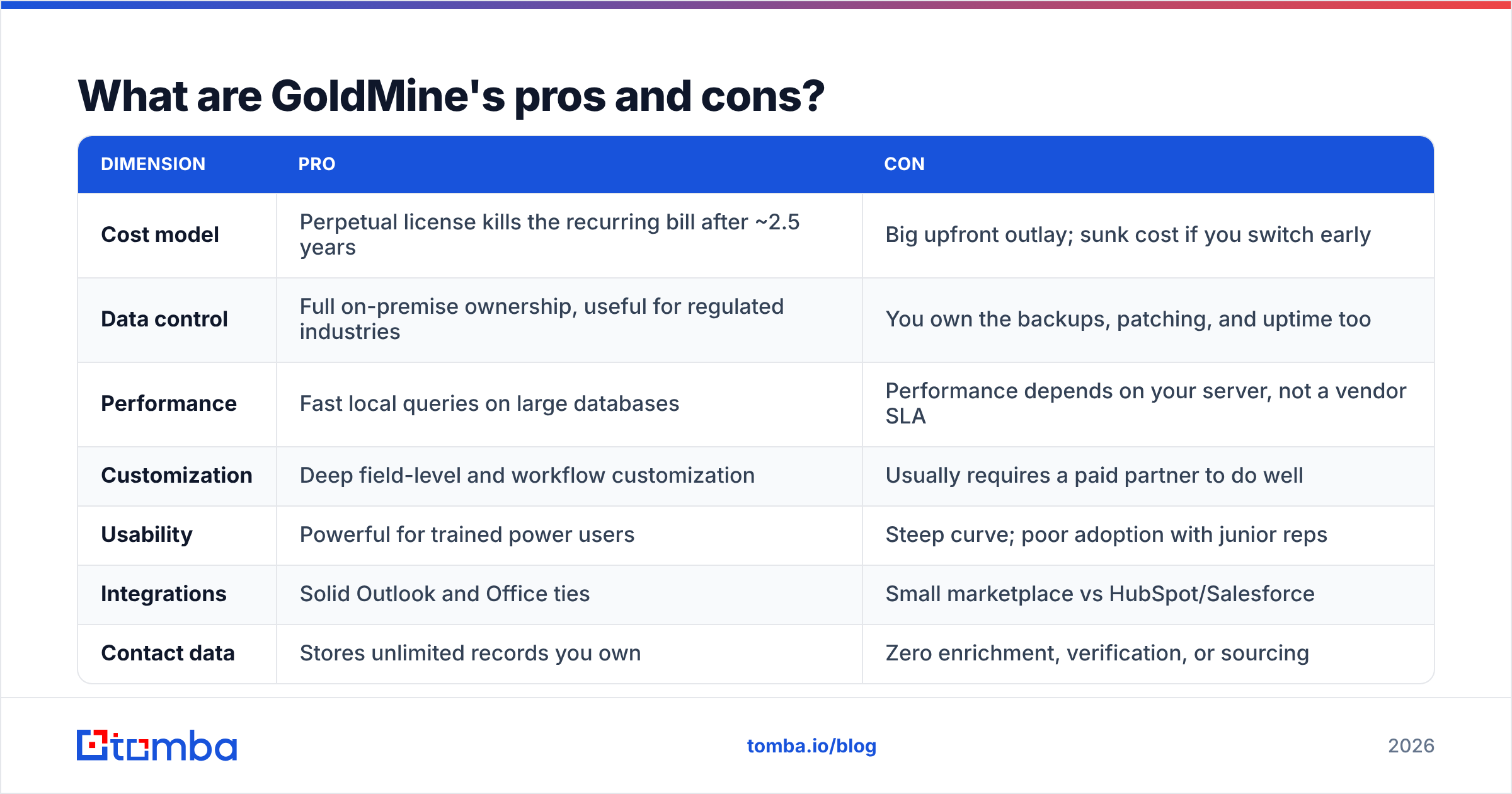
| Dimension | Pro | Con |
|---|---|---|
| Cost model | Perpetual license kills the recurring bill after ~2.5 years | Big upfront outlay; sunk cost if you switch early |
| Data control | Full on-premise ownership, useful for regulated industries | You own the backups, patching, and uptime too |
| Performance | Fast local queries on large databases | Performance depends on your server, not a vendor SLA |
| Customization | Deep field-level and workflow customization | Usually requires a paid partner to do well |
| Usability | Powerful for trained power users | Steep curve; poor adoption with junior reps |
| Integrations | Solid Outlook and Office ties | Small marketplace vs HubSpot/Salesforce |
| Contact data | Stores unlimited records you own | Zero enrichment, verification, or sourcing |
| AI features | Not a distraction | Effectively none in 2026 |
How does GoldMine pricing compare to modern CRMs?#
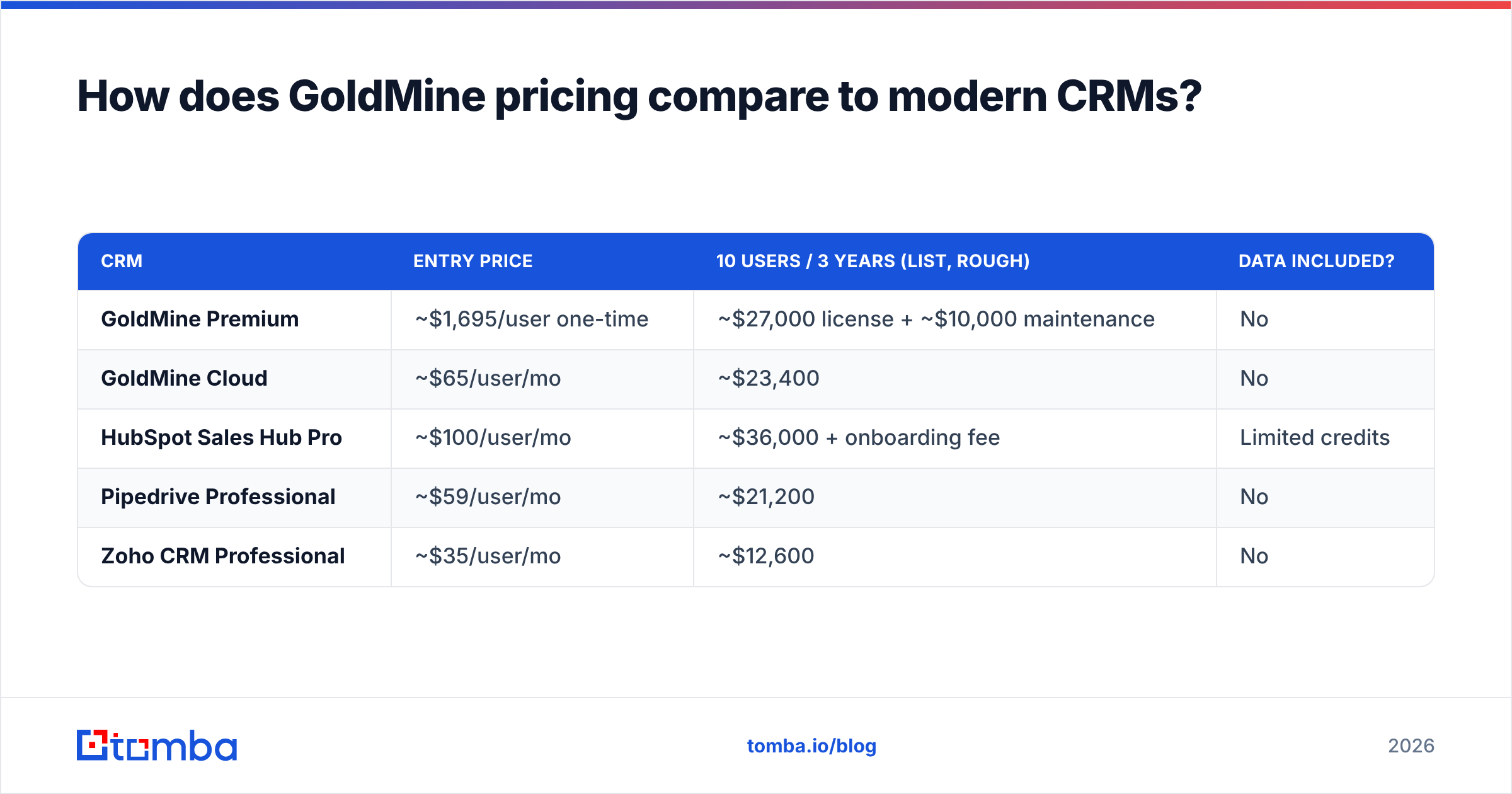
Compare three years of total cost, not the sticker price. A 10-seat team looks roughly like this at list:
| CRM | Entry price | 10 users / 3 years (list, rough) | Data included? |
|---|---|---|---|
| GoldMine Premium | ~$1,695/user one-time | ~$27,000 license + ~$10,000 maintenance | No |
| GoldMine Cloud | ~$65/user/mo | ~$23,400 | No |
| HubSpot Sales Hub Pro | ~$100/user/mo | ~$36,000 + onboarding fee | Limited credits |
| Pipedrive Professional | ~$59/user/mo | ~$21,200 | No |
| Zoho CRM Professional | ~$35/user/mo | ~$12,600 | No |
Two things fall out of that table.
First, GoldMine is not the cheap option. Zoho and Pipedrive undercut it on three-year total cost while offering a modern interface and a far bigger integration ecosystem. If your only motivation is saving money, the perpetual license is not the win people assume it is — check HubSpot's own pricing page and Zoho's side by side before you sign.
Second, none of them include usable contact data. Every row in that table is a container. You still have to fill it, and the filling is where outbound teams actually spend their money.
Who should buy GoldMine — and who should walk away?#
Buy GoldMine if:
- You already run GoldMine and have 50,000+ records with custom fields you would rather not migrate.
- A compliance, legal, or air-gapped-network requirement means customer data cannot sit in a vendor's cloud.
- Your team is 5–50 people, stable, and trained — turnover is what makes a steep UI expensive.
- You plan to keep the system five-plus years and want capex, not opex.
- You have a reseller you trust. This one is not optional.
Walk away if:
- You are a startup or an outbound-heavy team that changes its stack yearly.
- You need self-serve onboarding and a rep productive in a day.
- Your workflow depends on a long tail of SaaS integrations.
- You want AI summarization, conversation intelligence, or native sequencing.
- Your bottleneck is finding new contacts, not organizing existing ones.
That last bullet is the one most GoldMine evaluations skip, so let us give it its own section.
Does GoldMine solve your actual data problem?#
No — and neither does any other CRM on that comparison table. This is the structural point that decides whether GoldMine is a reasonable purchase or an expensive filing cabinet.
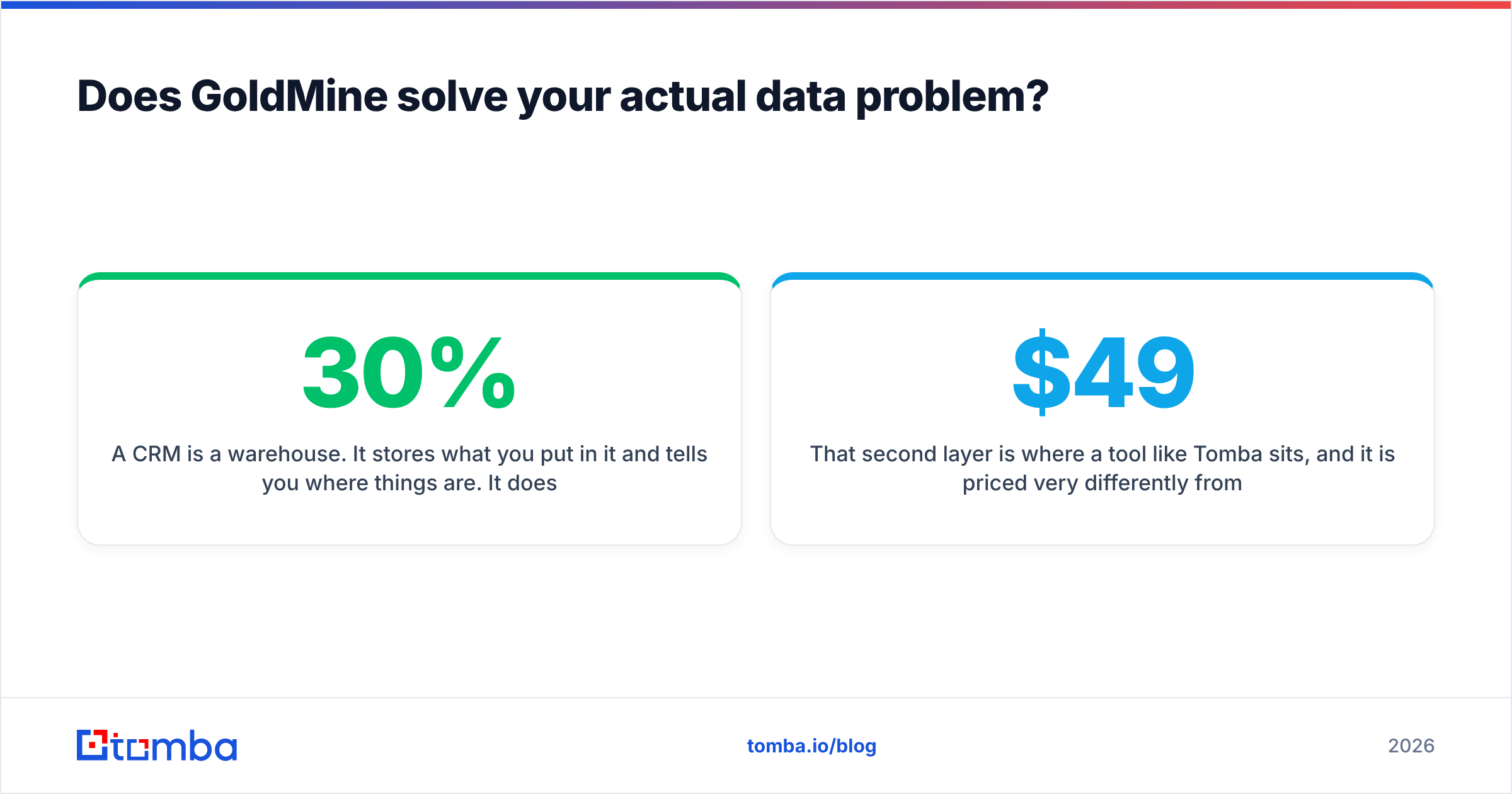
A CRM is a warehouse. It stores what you put in it and tells you where things are. It does not manufacture inventory. B2B contact data decays at roughly 20–30% per year. People change jobs, companies rebrand, and mailboxes get retired. A perpetual license does nothing to slow that. Five years into a GoldMine deployment, a large share of the records you "own" are archaeology.
So the sensible 2026 architecture is two layers:
- A system of record — GoldMine, Pipedrive, HubSpot, whatever fits your budget and compliance posture.
- A data layer that feeds and cleans it — sourcing new contacts, verifying deliverability, and re-enriching stale rows on a schedule.
That second layer is where a tool like Tomba sits. It is priced very differently from a CRM seat. Tomba runs a free tier at 25 searches per month. Paid plans start at $49/mo for Starter, then $99/mo for Growth and $249/mo for Pro — see the full Tomba pricing breakdown. You are buying lookups and verifications, not chairs.
Practically, that looks like:
- Sourcing — use domain search to pull the decision-makers at a target account before you create the company record in GoldMine.
- Verification — run every address through an email verifier before it hits your sequencing tool, so your sender reputation survives.
- Refreshing — push existing CRM rows through data enrichment quarterly and flag the ones that no longer resolve.
- Automation — wire it with the Tomba API so the cycle runs without an analyst copying spreadsheets.
Do that, and the CRM question gets much less dramatic. GoldMine becomes a defensible choice for teams with a real on-premise requirement. The thing that actually drives pipeline — accurate, current contacts — is handled somewhere else. And it travels with you if you ever migrate.
The verdict on GoldMine pricing reviews pros and cons#
GoldMine in 2026 is a niche product that knows exactly what its niche is. If you value data ownership and a one-time license above modern UX and integrations, it is a rational purchase. The three-year math holds up against HubSpot. If you are buying it because you assume "perpetual = cheaper," run the numbers against Zoho and Pipedrive first. You will probably be surprised. Weigh the GoldMine pricing reviews pros and cons above against three years of total cost, not the sticker price.
But do not let the CRM debate eat your whole budget. A $65/user/month CRM stocked with three-year-old email addresses will underperform a $35/user/month CRM stocked with verified ones, every single quarter.
Fix the data layer first. Start with the Tomba Email Finder — find verified professional email addresses by name, company, or domain, and feed your CRM records that are actually worth calling. The free tier is 25 searches a month, no card required. That is enough to test your worst-decayed account list before you spend a dollar on new CRM seats.
Related guides#
Ready to find emails that actually work?
Join 150,000+ professionals who stopped guessing and started sending. Free credits on signup — no credit card required.
Get the Tomba newsletter
Practical outbound tactics and product updates — once every two weeks.
About the author