Good Discovery Questions: 30 Prompts That Close Deals
Most discovery calls collect polite answers and zero commitment. Here are 30 good discovery questions, the frameworks behind them, and the follow-ups that turn a friendly chat into a forecastable deal.
TL;DR
- A good discovery question forces the buyer to think, not to confirm. If they can answer it in one word, rewrite it.
- The highest-signal questions are about consequence ("what happens if you do nothing?") and process ("who else signs off?"), not about features.
- BANT, SPIN, and MEDDIC are not competing religions. Use SPIN for the conversation, MEDDIC for the qualification notes, BANT only as a sanity check.
- Discovery starts before the call. Ten minutes of research changes the first question from "so, tell me about your company" to something that earns attention.
- Book the next step inside the call. A discovery call without a scheduled follow-up is a conversation, not a pipeline entry.
What makes a discovery question "good"?#
A good question changes what the buyer knows about their own business.
That is the whole test. Weak questions extract facts you could have pulled from a website — headcount, tech stack, funding round. Good discovery questions make the prospect pause, reconsider a number they had accepted, or admit a cost they had never quantified. When someone says "huh, I've never actually added that up," you are running real discovery.
Three properties show up in almost every question that works:
- It cannot be answered yes or no. "Are you happy with your current provider?" gets you a defensive "yeah, it's fine." "What would have to change about your current provider for you to renew without thinking about it?" gets you a list of grievances.
- It asks about consequence, not condition. Knowing they run manual data entry is a condition. Knowing it costs a rep six hours a week and delayed two renewals last quarter is a consequence — and consequences are what get budget approved.
- It is specific enough to be uncomfortable. Vague questions get vague answers. "How's lead gen going?" is a greeting. "How many of the leads your SDRs worked last month were bounced or wrong-titled?" is discovery.
The second half of the test is what you do with the answer. Most reps ask a good question, get a good answer, and then move to the next item on their list instead of asking "why?" one more time. The follow-up is where the deal is.

What should you actually learn in a discovery call?#
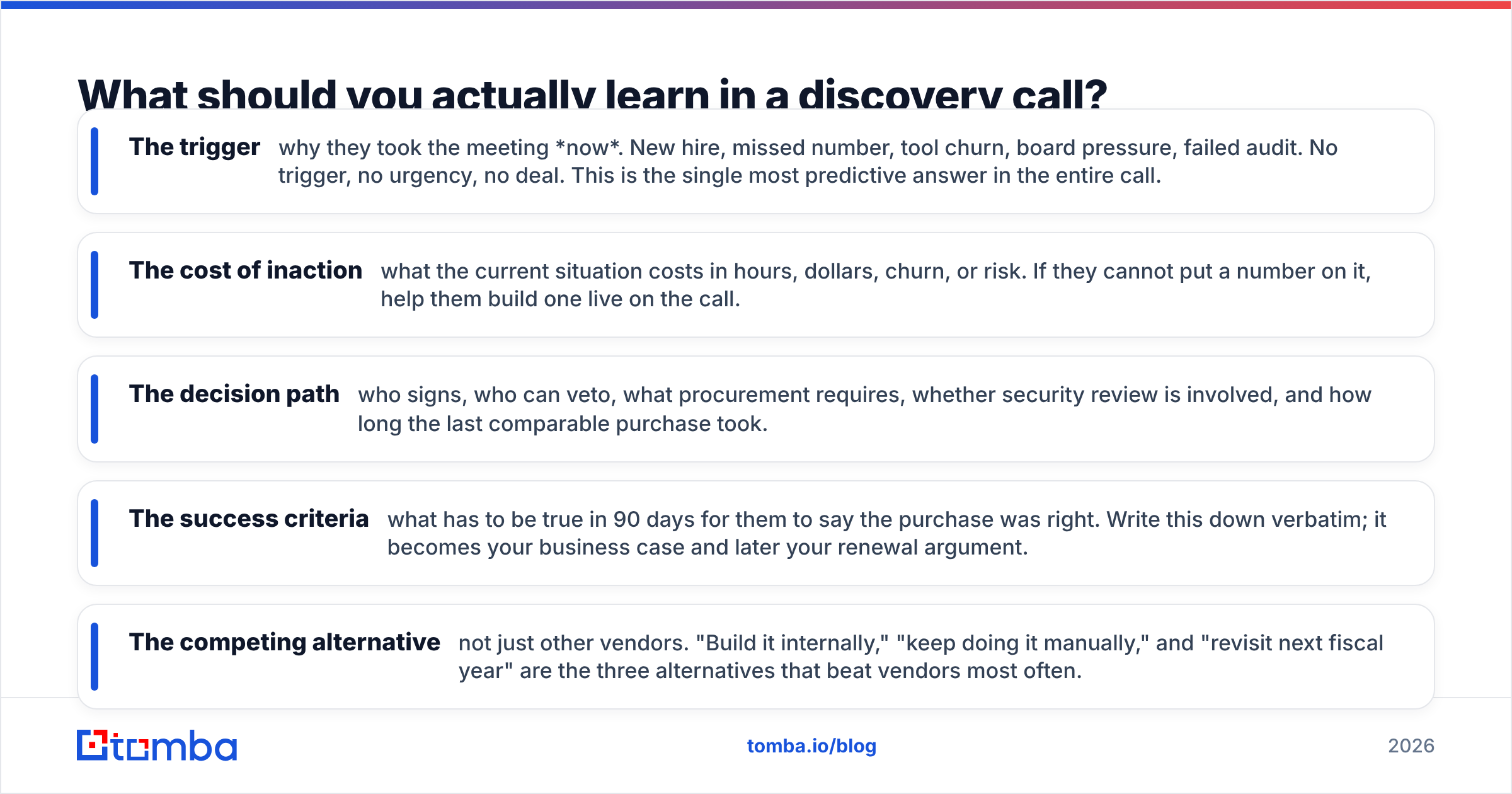
Not "everything." A first call has maybe 30 usable minutes. Prioritize the five things that decide whether this deal exists.
- The trigger — why they took the meeting now. New hire, missed number, tool churn, board pressure, failed audit. No trigger, no urgency, no deal. This is the single most predictive answer in the entire call.
- The cost of inaction — what the current situation costs in hours, dollars, churn, or risk. If they cannot put a number on it, help them build one live on the call.
- The decision path — who signs, who can veto, what procurement requires, whether security review is involved, and how long the last comparable purchase took.
- The success criteria — what has to be true in 90 days for them to say the purchase was right. Write this down verbatim; it becomes your business case and later your renewal argument.
- The competing alternative — not just other vendors. "Build it internally," "keep doing it manually," and "revisit next fiscal year" are the three alternatives that beat vendors most often.
Miss any one of these and you will build a forecast on sand. Gartner's sales research has been flagging the same failure for years: buyers stall not because they dislike the vendor but because the internal case was never built. Discovery is where you build it — or fail to.
Which framework should you use: BANT, SPIN, or MEDDIC?#
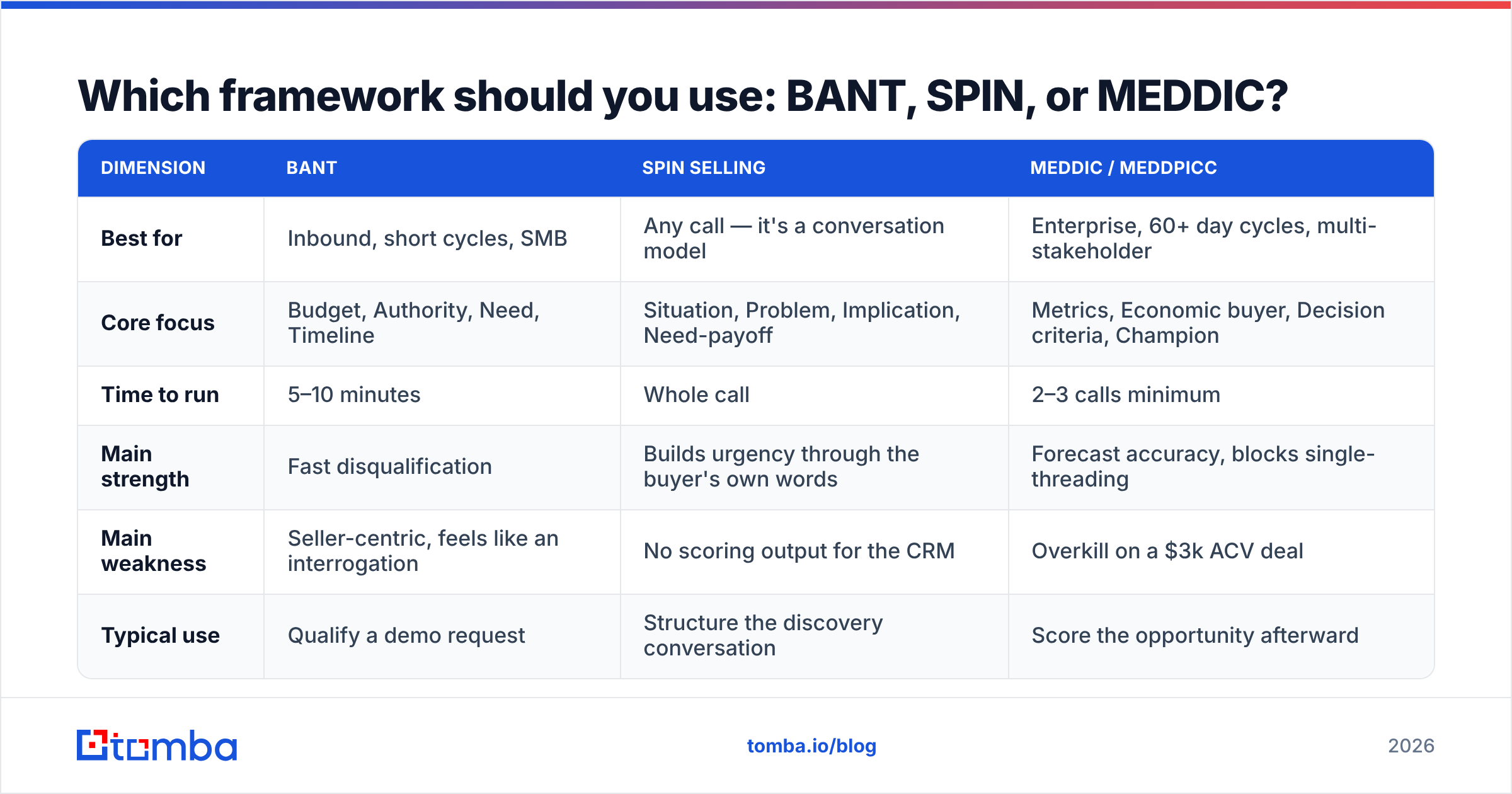
Pick based on deal size and cycle length, not on what your last company used.
| Dimension | BANT | SPIN Selling | MEDDIC / MEDDPICC |
|---|---|---|---|
| Best for | Inbound, short cycles, SMB | Any call — it's a conversation model | Enterprise, 60+ day cycles, multi-stakeholder |
| Core focus | Budget, Authority, Need, Timeline | Situation, Problem, Implication, Need-payoff | Metrics, Economic buyer, Decision criteria, Champion |
| Time to run | 5–10 minutes | Whole call | 2–3 calls minimum |
| Main strength | Fast disqualification | Builds urgency through the buyer's own words | Forecast accuracy, blocks single-threading |
| Main weakness | Seller-centric, feels like an interrogation | No scoring output for the CRM | Overkill on a $3k ACV deal |
| Typical use | Qualify a demo request | Structure the discovery conversation | Score the opportunity afterward |
The practical answer for most B2B teams: run the call with SPIN, record it with MEDDIC, use BANT as a five-minute gut check on inbound. They operate at different layers. SPIN tells you what to say next. MEDDIC tells you whether the deal is real. BANT tells you whether to spend another hour.
The one framework rule worth enforcing: whatever you use, the fields must land in your CRM as structured data, not as a paragraph in the notes box. A champion's name in a free-text field is invisible to your pipeline review.
What are 30 good discovery questions, by stage?#
Use these as raw material, not as a script. Pick eight, ask them in the order the conversation offers, and follow every interesting answer with "tell me more about that."
Opening — establish the trigger (5)
- What made you take this call now, as opposed to three months ago?
- What changed internally in the last quarter that put this on your list?
- Who asked you to look into this, and what did they say exactly?
- Walk me through the last time this problem cost you something visible.
- If we hadn't reached out, what would you have done about this?
Situation — map the current state (5)
- Walk me through how this works today, step by step, from first touch to closed.
- Who touches this process, and where does it usually stall?
- What have you already tried, and why did it stop working?
- What tools are in the stack for this, and which one do people actually open every day?
- What does a good week look like versus a bad week for this team?
Problem and implication — quantify pain (6)
- How many hours a week does your team lose to this?
- What does that translate to in pipeline or revenue over a quarter?
- Who feels this the most — and how do they talk about it?
- What's the downstream effect when this breaks? Who else gets blocked?
- What happens to your number if nothing changes for another six months?
- Has this ever cost you a specific deal or customer? What happened?
Decision process — find the real path (6)
- Who else needs to weigh in before a decision like this gets made?
- How did you buy the last tool in this category? Walk me through it.
- What does procurement or security require from a vendor at your size?
- What's the approval threshold where this needs a VP or CFO signature?
- Who, if anyone, would be against doing this — and why?
- What typically kills projects like this internally?
Criteria and alternatives — understand the bar (4)
- If you evaluate three vendors, what will actually separate them for you?
- What would make you rule us out in the first week?
- Is building this internally on the table? Who would own it?
- What's the strongest argument for doing nothing this year?
Closing the call — commit to a next step (4)
- Based on what we covered, what's the piece you're least sure about?
- What would you need to see to bring this to [economic buyer's name]?
- Who should be on the next call for it to be worth their time?
- Does Thursday at 2 work, or is Friday morning better?
That last one matters more than it looks. Ending with a vague "I'll send some info over" is how 40% of first calls quietly die. Ask for the calendar slot while the pain is still fresh.
How do you ask about budget without killing the call?#
Stop asking "what's your budget?" on a first call. You will get either a made-up number or a defensive non-answer, and both are useless.
Ask about cost and precedent instead:
- "What did you spend on the last tool you bought for this team?"
- "Is there money allocated for this already, or would it need to be found?"
- "At what number does this stop being your decision?"
- "If this saved your team six hours a week, what would that be worth to you annually?"
The last question is the one that works. It flips the frame from "how much will you give me" to "what is this worth," and it hands the buyer the arithmetic they will need to sell it internally. HubSpot's sales blog has documented the same pattern across thousands of calls: value-anchored budget questions get answered far more often than direct ones.
One caveat. If your product has public pricing, put the range on the table early. Hiding it wastes both calendars, and buyers who have read G2 reviews already know roughly what you cost.
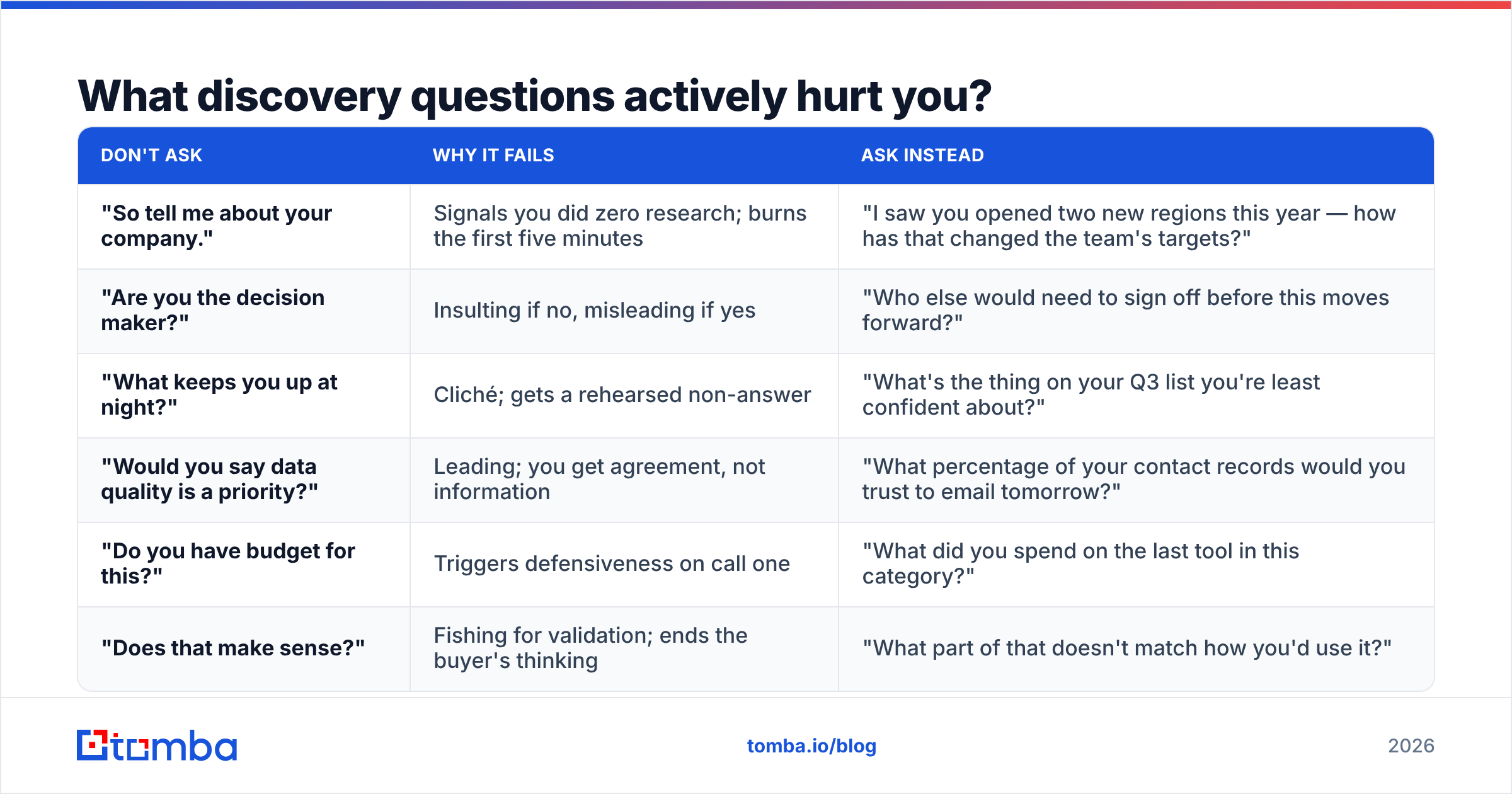
What discovery questions actively hurt you?#
Some questions do measurable damage. Here is the swap list.
| Don't ask | Why it fails | Ask instead |
|---|---|---|
| "So tell me about your company." | Signals you did zero research; burns the first five minutes | "I saw you opened two new regions this year — how has that changed the team's targets?" |
| "Are you the decision maker?" | Insulting if no, misleading if yes | "Who else would need to sign off before this moves forward?" |
| "What keeps you up at night?" | Cliché; gets a rehearsed non-answer | "What's the thing on your Q3 list you're least confident about?" |
| "Would you say data quality is a priority?" | Leading; you get agreement, not information | "What percentage of your contact records would you trust to email tomorrow?" |
| "Do you have budget for this?" | Triggers defensiveness on call one | "What did you spend on the last tool in this category?" |
| "Does that make sense?" | Fishing for validation; ends the buyer's thinking | "What part of that doesn't match how you'd use it?" |
How do you prepare so the first question already lands?#
The best discovery question in the world fails if you open with "so, what do you guys do?"
Ten minutes of prep changes the entire call. Before you dial, you should know: the prospect's exact title and tenure, the company's headcount trend, one recent public event (funding, launch, hire, layoff), and the tools they already use. That's enough to build a first question that proves you did the work.
The mechanical side of this is where most teams leak time. Reps spend hours a week hunting for contact details and verifying whether an address will even land. Push that work upstream:
- Use data enrichment to fill in title, seniority, company size, and location before the list ever reaches a rep, so segmentation is possible.
- Verify addresses in bulk with an email verifier so your invitation actually arrives — a discovery call you never book has a 0% close rate.
- Pull direct dials with a phone finder for accounts where email response has stalled and you need a live conversation to run real discovery.
Prep also sets your response rate baseline. Reps who reference a specific, verifiable detail in the first sentence book noticeably more calls than reps who open with a value proposition — and they walk into discovery with permission to ask harder questions.
How do you keep discovery consistent across a team?#
Consistency comes from required fields, not from scripts.
Scripts produce reps who read. Required fields produce reps who ask. Define six mandatory pieces of information a deal must contain before it can move to stage two — trigger, quantified pain, economic buyer, decision process, success criteria, next step booked — and enforce them in the CRM. The questions each rep uses to get there can vary. The output cannot.
Then review the answers, not the activity. In pipeline reviews, stop asking "did you have discovery?" and start asking "what did they say the cost of inaction was?" If the rep cannot quote the buyer, discovery did not happen. This single change in review language does more for forecast accuracy than any framework rollout.
Finally, record and revisit. Listening to three of your own calls a month, specifically counting how many times you asked a follow-up versus moving to the next question, is the cheapest coaching available. Most reps discover they average less than one follow-up per topic. Two is where deals start turning.
Where should you start tomorrow?#
Take your next five scheduled calls. For each one, write down a single opening question built on something specific you found about that company — not a category-level question, a company-level one. Then pick four questions from the list above: one trigger, one implication, one decision-path, one next-step. That's it. Nine questions total, four of them planned.
You will run out of call time before you run out of questions, which is exactly the position you want to be in.
If the bottleneck is earlier than the call — you have great questions but not enough of the right people to ask them — fix the top of the funnel first. The Tomba Email Finder locates verified professional addresses by name, domain, or company, so your reps spend their hours running discovery instead of hunting for contact details. The free tier covers 25 searches a month, Starter runs $49/mo, and Growth is $99/mo — check current Tomba pricing for full credit limits. Build a clean, verified list, then go ask better questions.
Related guides#
Ready to find emails that actually work?
Join 150,000+ professionals who stopped guessing and started sending. Free credits on signup — no credit card required.
Get the Tomba newsletter
Practical outbound tactics and product updates — once every two weeks.
About the author