How to Build a Good Sales Pitch in 2026 (Framework + Examples)
Most sales pitches fail in the first 15 seconds because they lead with the seller, not the buyer. Here's the structure, timing, and data behind pitches that actually book meetings in 2026.
TL;DR
- A good sales pitch is not a monologue about your product — it is a compressed, testable claim about the buyer's problem that earns you the next 10 minutes.
- The first 15 seconds decide the outcome. If your opener does not name a situation the buyer recognizes, nothing after it lands.
- The four-part structure that works across channels: Trigger → Tension → Proof → Micro-ask. Everything else is decoration.
- Pitch length should match channel: 30–60 words for cold email, 20–30 seconds for a cold call opener, 4–6 minutes for a discovery recap.
- The single biggest killer of good pitches is a bad list. A perfect pitch sent to the wrong 500 people still fails — which is why targeting and data hygiene come before copy.
What Is a Good Sales Pitch, Actually?#
A good sales pitch is a short, buyer-centered argument that makes continuing the conversation feel like the obvious next step.
That definition matters because most reps optimize for the wrong outcome. They write a pitch designed to explain the product completely. Buyers do not want completeness — they want relevance, fast. The pitch is a door, not a house tour.
Think of it like a movie trailer. A trailer that showed you every scene would be a bad trailer, no matter how good the film. Its only job is to make you want the ticket. Your pitch's only job is to make the buyer want the next meeting.
Three things separate a good pitch from a mediocre one:
- It starts with the buyer's world, not yours. The first sentence should be something the buyer could have written about their own situation.
- It makes a falsifiable claim. "We help companies grow" is unfalsifiable and therefore ignorable. "Your SDRs are probably burning 6 hours a week on manual list building" can be argued with — which means it can be engaged with.
- It asks for something small. Not a demo. Not a 45-minute call. A reply, a yes/no, a 10-minute slot.
Why Do Most Sales Pitches Fail in the First 15 Seconds?#
Because they fail a filtering test the buyer runs unconsciously: is this about me, or about them?
Buyers are pattern-matching machines by 2026. They have seen thousands of AI-generated cold emails and heard hundreds of cold-call openers. The moment your first clause contains "I'm reaching out because we're a leading platform that," the pattern matches "ignore" and attention closes. You do not get a second chance in the same message.
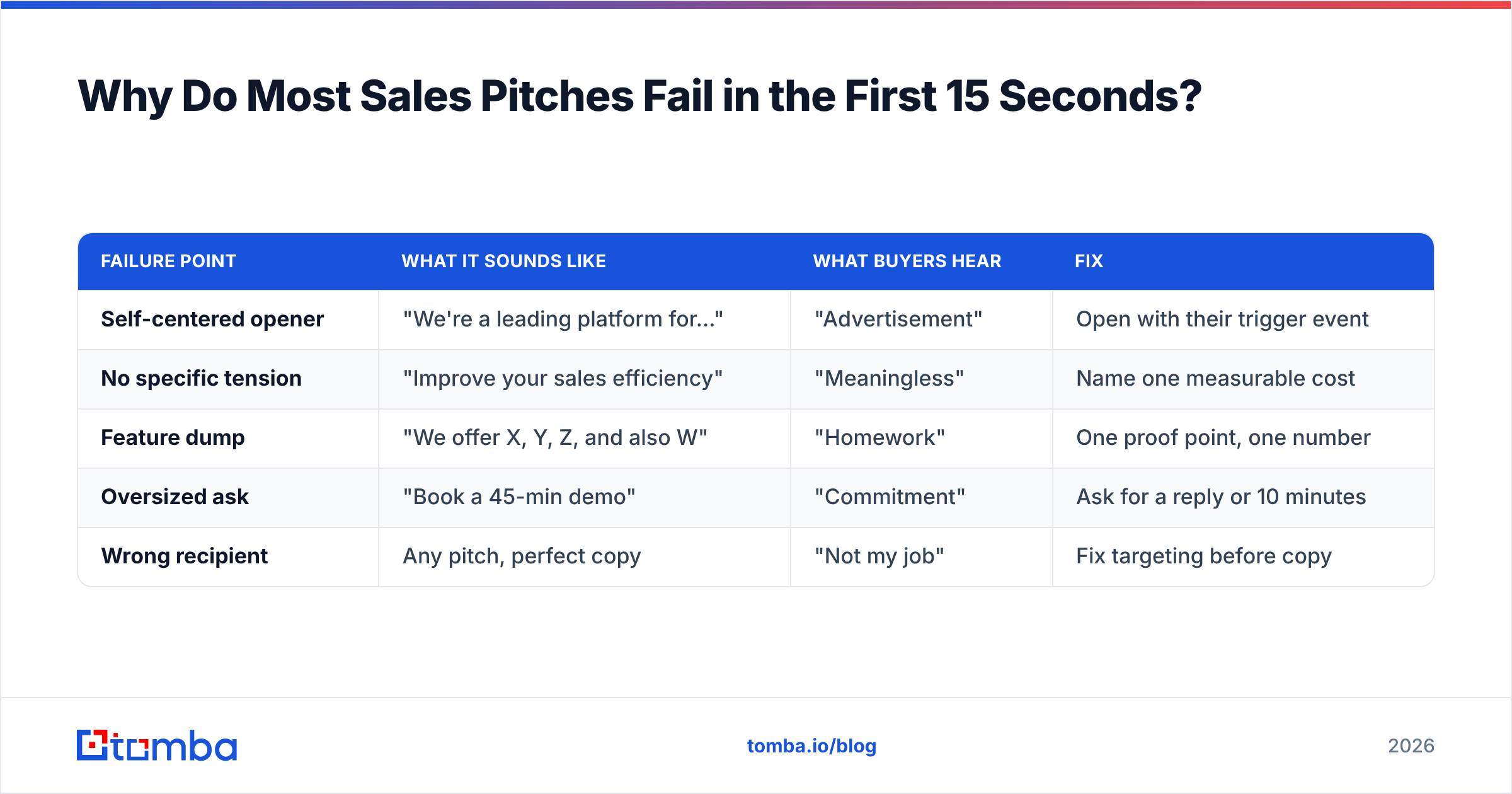
Here is the honest breakdown of where pitches die:
| Failure point | What it sounds like | What buyers hear | Fix |
|---|---|---|---|
| Self-centered opener | "We're a leading platform for..." | "Advertisement" | Open with their trigger event |
| No specific tension | "Improve your sales efficiency" | "Meaningless" | Name one measurable cost |
| Feature dump | "We offer X, Y, Z, and also W" | "Homework" | One proof point, one number |
| Oversized ask | "Book a 45-min demo" | "Commitment" | Ask for a reply or 10 minutes |
| Wrong recipient | Any pitch, perfect copy | "Not my job" | Fix targeting before copy |
That last row deserves emphasis. In audits of underperforming outbound programs, targeting and data quality explain more variance in reply rate than copy does. A brilliant pitch aimed at a junior analyst who cannot buy will underperform a mediocre pitch aimed at the person who owns the budget line.

What Is the Four-Part Structure of a Good Sales Pitch?#
Use Trigger → Tension → Proof → Micro-ask. It scales from a 40-word email to a 20-minute board presentation, because it mirrors how humans accept new information: context, problem, evidence, action.
- Trigger — the observable reason you are contacting this person now. A hiring post, a funding round, a product launch, a tech-stack change, a competitor's move. If you cannot name a trigger, you are spraying.
- Tension — the specific cost of the status quo, stated in their units (hours, dollars, headcount, churn, cycle time). One tension, not three.
- Proof — the smallest credible evidence you have. A named customer in their segment, a single metric, a benchmark. Numbers beat adjectives every time.
- Micro-ask — the smallest next step that still moves the deal. "Worth a look?" outperforms "Can we schedule 45 minutes Tuesday?" by a wide margin in cold contexts.
Here is what that looks like in a cold email, at 58 words:
Saw you posted two SDR roles last week (trigger). Most teams scaling from 3 to 5 SDRs lose the first quarter to list building — roughly 6 hours per rep per week on manual research (tension). We cut that to under an hour for a 40-person team at [Company] (proof). Worth a 10-minute look? (micro-ask)
And the same structure as a cold-call opener, at 22 seconds:
"Hi Sarah — Amine from Tomba. I'll be quick and you can tell me to go away. I noticed you're hiring two SDRs. When teams do that, the ramp usually stalls on list building rather than on calls. Is that what's happening, or is your data already clean?"
Notice the call opener ends with a genuine question, not a pitch. That is deliberate. On the phone, the fastest route to a good pitch is to earn permission to give one.
How Long Should a Sales Pitch Be by Channel?#
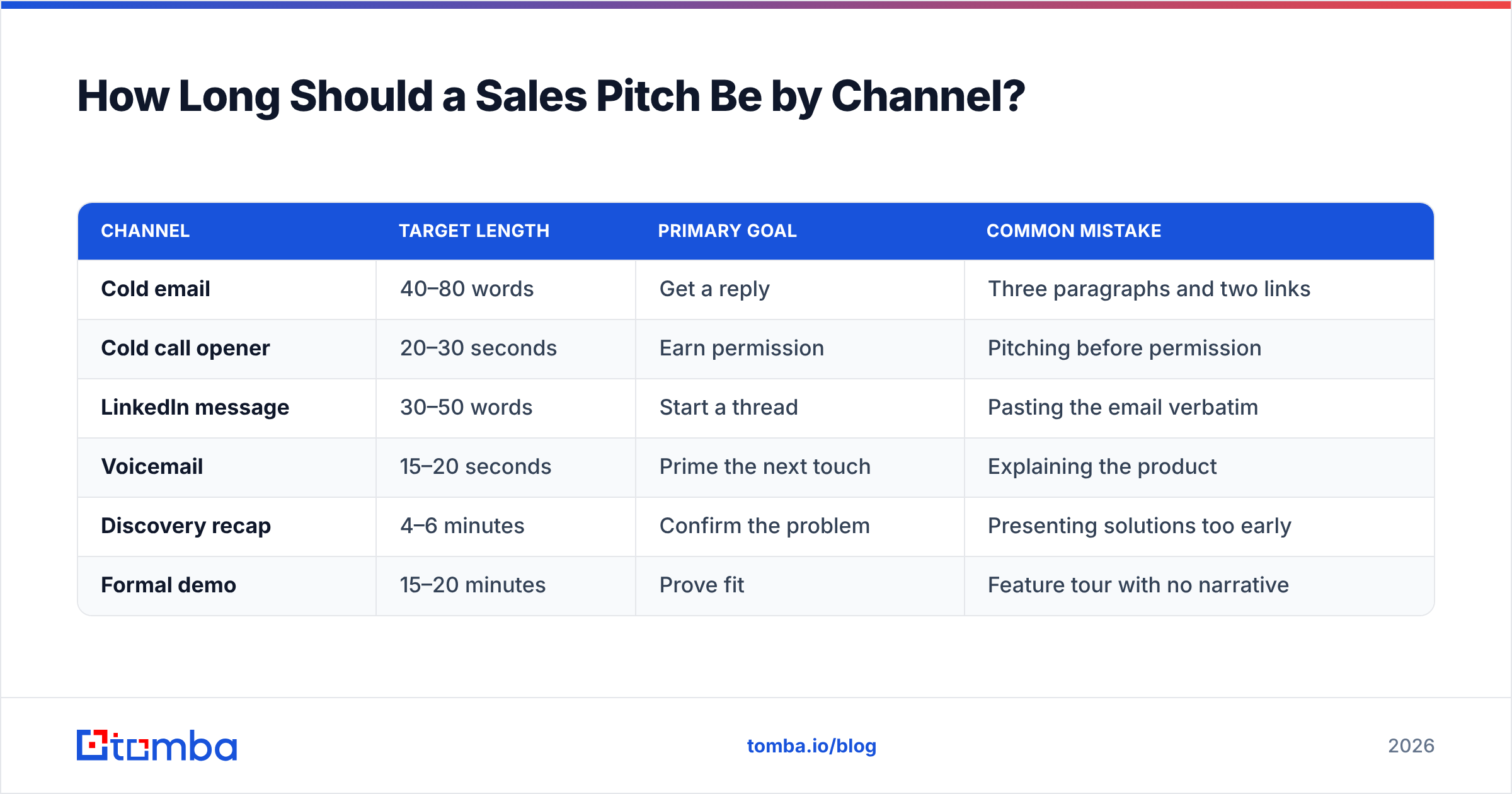
Match length to the channel's attention budget. Overrunning it is the most common self-inflicted wound in outbound.
| Channel | Target length | Primary goal | Common mistake |
|---|---|---|---|
| Cold email | 40–80 words | Get a reply | Three paragraphs and two links |
| Cold call opener | 20–30 seconds | Earn permission | Pitching before permission |
| LinkedIn message | 30–50 words | Start a thread | Pasting the email verbatim |
| Voicemail | 15–20 seconds | Prime the next touch | Explaining the product |
| Discovery recap | 4–6 minutes | Confirm the problem | Presenting solutions too early |
| Formal demo | 15–20 minutes | Prove fit | Feature tour with no narrative |
The discovery recap deserves special attention because it is where good reps win deals quietly. Before you present anything, play back what you heard: "Here's what I understood about your situation — correct me where I'm wrong." Buyers who hear their own problem stated accurately by a stranger tend to assume that stranger can solve it. That is worth more than any slide.
For remote pitches, HubSpot's sales research has consistently found that talk-to-listen ratios favoring the buyer correlate with higher close rates. If you are speaking more than 45% of a discovery call, your pitch is too long regardless of its word count.
What Should You Do Before You Write the Pitch?#
Fix the list. A good sales pitch is downstream of good targeting, and targeting is downstream of good contact data.
Run this sequence before writing a single line of copy:
- Define the trigger you're playing. One campaign, one trigger. "Companies that just hired a VP of Sales" is a campaign. "B2B SaaS" is not.
- Identify the person who owns the pain, not the person who feels it. These are often different humans, and pitching the wrong one wastes the copy.
- Find and verify the contact. Use a domain search to map the org's email pattern, then confirm each address through an email verifier before sending. Bounces do not just waste a pitch — they damage the sending domain that carries every future pitch.
- Enrich with the trigger data itself. Job changes, headcount deltas, tech installs. Data enrichment turns a name and an email into a reason to write.
- Segment small. Fifty highly similar prospects with one shared trigger beat 2,000 mixed ones. Small segments let you write a specific pitch, and specific pitches are the only kind that work.
This is where "just write better copy" advice falls apart. You cannot personalize what you do not know, and you cannot know it if your data layer is a stale CSV from last year.
How Do You Handle the Moment the Pitch Gets Pushback?#
Treat objections as requests for information, not rejections. The pitch is not over when the buyer pushes back — that is usually the first moment they are actually engaged.
Four responses that keep the conversation alive:
- "We already use [competitor]." → "Good — that means the problem is real for you. What made you pick them, and what's the one thing you wish it did differently?" You are now doing discovery for free.
- "Send me some information." → "Happy to. So I send the right thing rather than a brochure — is the issue more on data coverage or on deliverability?" This converts a brush-off into a qualifying question.
- "No budget." → "Understood. Is that a this-quarter problem or a this-year problem?" Timing objections and authority objections look identical until you ask.
- "Not interested." → "Fair enough. Out of curiosity, is that because list building isn't a pain point, or because you've already solved it?" One question, no pressure, and you learn whether to nurture or drop.
The common thread: every response ends in a question, and none of them defend the product. Defending the product is the fastest way to lose the frame.
Which Tools Support a Good Sales Pitch in 2026?#
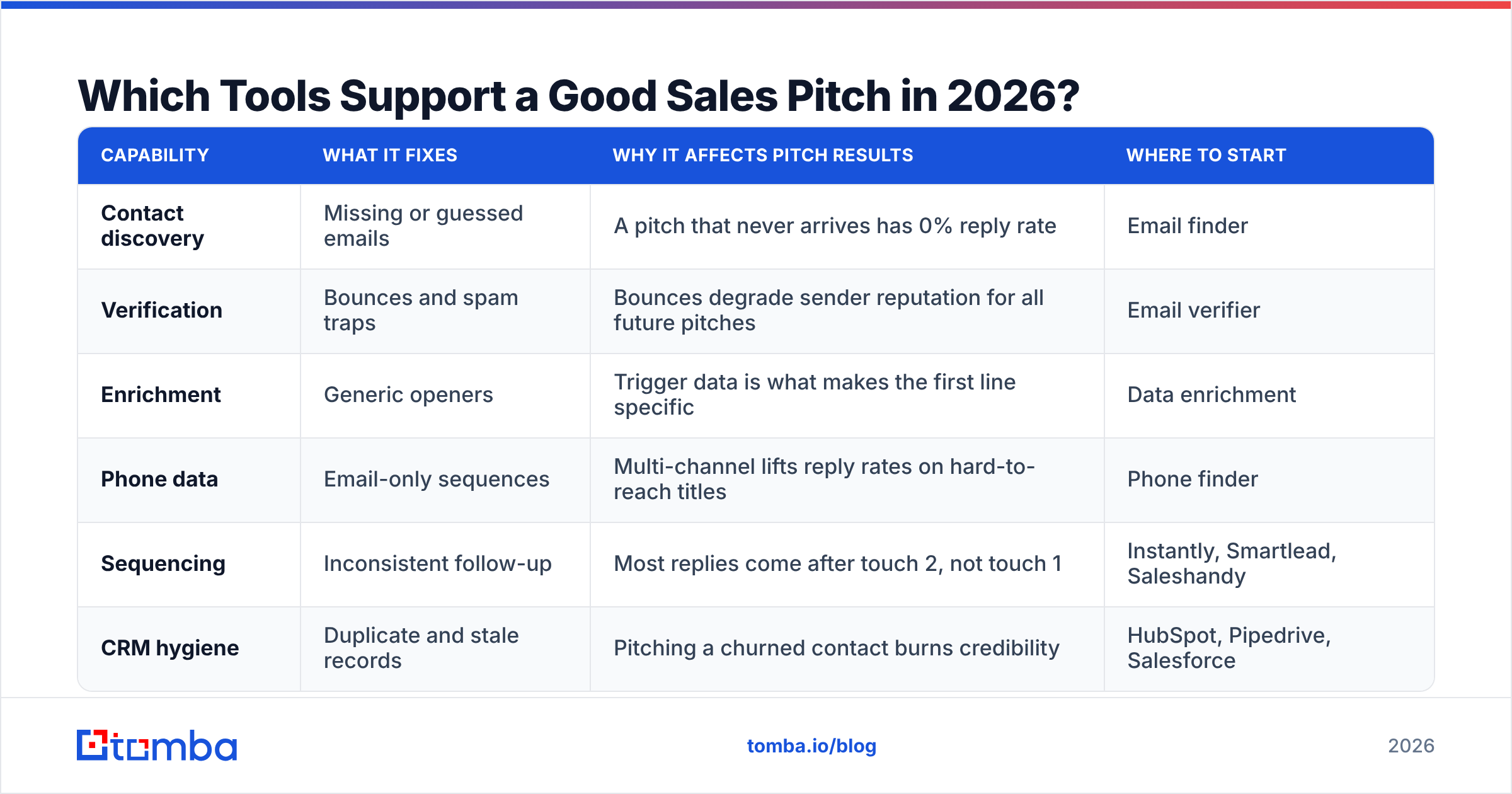
Tooling does not write your pitch, but it determines whether the pitch reaches a real human who cares. Here is how the main categories compare on what actually matters for pitch performance.
| Capability | What it fixes | Why it affects pitch results | Where to start |
|---|---|---|---|
| Contact discovery | Missing or guessed emails | A pitch that never arrives has 0% reply rate | Email finder |
| Verification | Bounces and spam traps | Bounces degrade sender reputation for all future pitches | Email verifier |
| Enrichment | Generic openers | Trigger data is what makes the first line specific | Data enrichment |
| Phone data | Email-only sequences | Multi-channel lifts reply rates on hard-to-reach titles | Phone finder |
| Sequencing | Inconsistent follow-up | Most replies come after touch 2, not touch 1 | Instantly, Smartlead, Saleshandy |
| CRM hygiene | Duplicate and stale records | Pitching a churned contact burns credibility | HubSpot, Pipedrive, Salesforce |
Pricing context matters when you're choosing a data layer. Tomba runs a free tier at 25 searches per month, then Starter at $49/mo, Growth at $99/mo, Pro at $249/mo, and custom Enterprise — see full Tomba pricing for credit allocations. Peer platforms sit in a similar band: BookYourData offers pay-as-you-go credits with no subscription lock-in, which suits teams running occasional campaigns rather than continuous outbound. Both are legitimate choices; the deciding factor is usually whether your motion is bursty or continuous.
Independent review data on G2 is a useful sanity check here — filter by company size, because a tool that works for a 500-seat enterprise team is often overkill for a five-person startup running its first outbound motion.
How Do You Test Whether Your Pitch Is Any Good?#
Measure the right thing at the right stage. Most teams measure open rate, which in 2026 is close to meaningless thanks to privacy proxies and prefetching.
Track this instead:
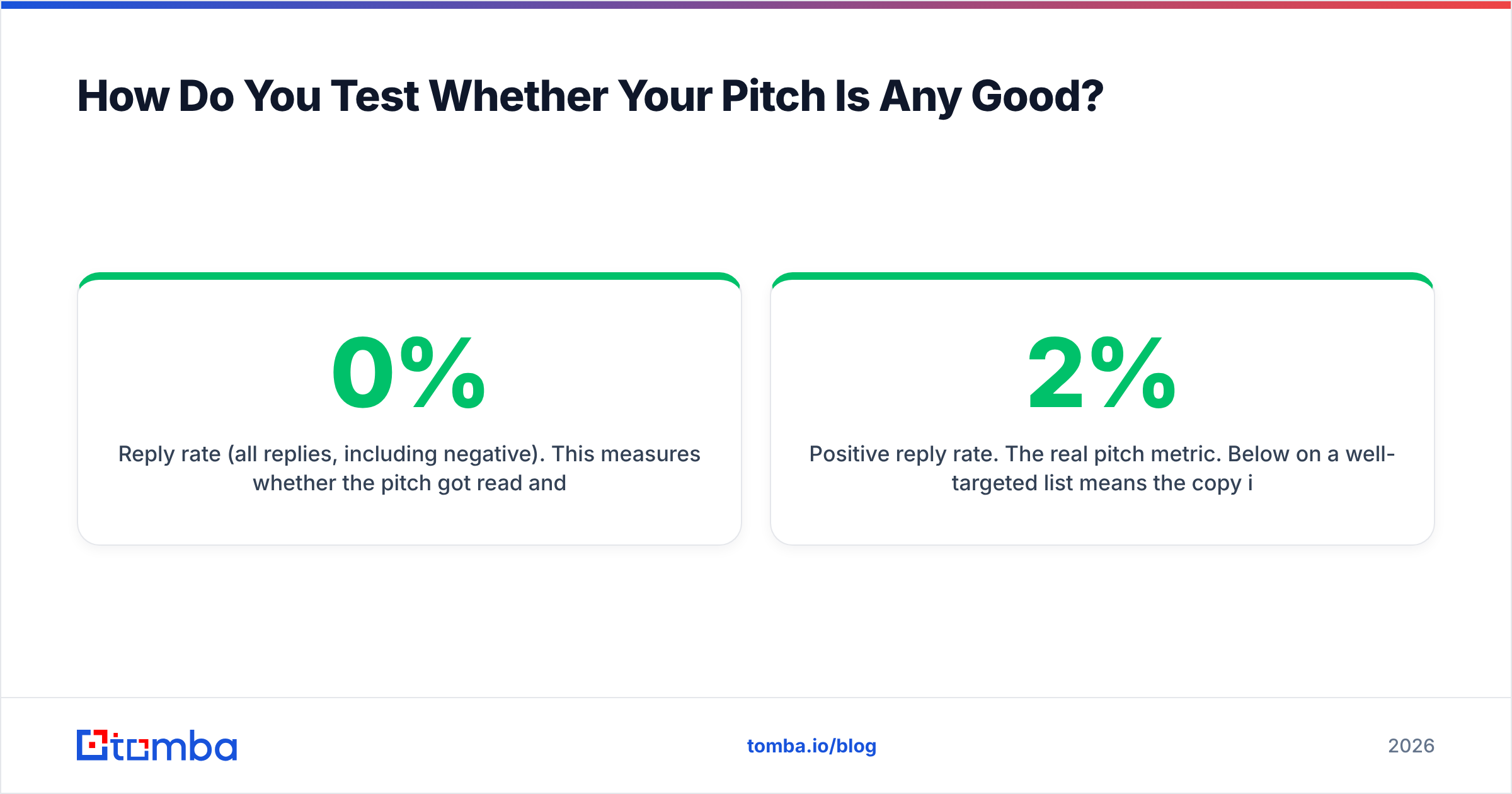
- Reply rate (all replies, including negative). This measures whether the pitch got read and processed. Negative replies are signal, not noise — a 0% reply rate is worse than a 4% rate with half of them saying no.
- Positive reply rate. The real pitch metric. Below 2% on a well-targeted list means the copy is the problem. Below 2% on a bad list means the list is the problem.
- Meeting-held rate, not meeting-booked. Booked meetings that no-show usually mean the pitch overpromised.
- Stage-2 conversion. If meetings happen but never advance, your pitch is attracting the wrong problem-owner.
Run one variable at a time. Change the opener, hold everything else. Change the ask, hold everything else. Teams that rewrite the entire email between tests learn nothing, because they cannot attribute the movement. And give each test enough volume — 50 sends is a hunch, 400 is a signal.
One more discipline: keep a swipe file of the pitches that got replies, with the trigger attached. Over a quarter this becomes the most valuable asset your team owns, and it beats any generic template library. If you want a starting point while you build yours, the cold email templates library is a reasonable scaffold — just replace the placeholders with your own trigger language before sending.
What Does a Good Sales Pitch Look Like End to End?#
Here is a complete sequence for one segment — SaaS companies that just posted SDR roles — showing how the pitch evolves across touches rather than repeating itself.
Touch 1 (email, day 1): Trigger + tension + micro-ask. 58 words. No links, no attachments.
Touch 2 (LinkedIn, day 3): Connection request with one line referencing the same trigger. No pitch. You are building recognition, not selling.
Touch 3 (call, day 5): Permission-based opener referencing the email. "I sent you a note Monday about the SDR hires — did it land, or should I give you the 20-second version?"
Touch 4 (email, day 8): New angle on the same tension, with a different proof point. Never "just bumping this."
Touch 5 (email, day 14): The polite close. "Sounds like this isn't a priority right now — I'll stop here. If list building becomes a problem next quarter, my line's open."
That last email consistently produces replies, because it removes pressure and gives the buyer an easy, low-cost way to respond honestly. Roughly a fifth of positive responses in well-run sequences arrive on the breakup touch.
Ready to Build Pitches on Real Data?#
A good sales pitch is a small, specific argument delivered to exactly the right person at a moment when it matters. The copy is the visible half. The invisible half — knowing who to write to, having a verified address, and having a trigger worth mentioning — is what determines whether the copy ever gets a chance.
Start with the data layer. Use the Tomba Email Finder to find and verify decision-maker emails by domain, name, or company, so every pitch you write lands in a real inbox belonging to someone who can actually say yes. The free tier gives you 25 searches a month to test the workflow before you commit to a plan.
Related guides#
Ready to find emails that actually work?
Join 150,000+ professionals who stopped guessing and started sending. Free credits on signup — no credit card required.
Get the Tomba newsletter
Practical outbound tactics and product updates — once every two weeks.
About the author