Good Subject Lines for Networking Emails: 40+ Examples
Networking emails live or die in the inbox preview. Here are 40+ tested subject lines, the open-rate patterns behind them, and the mistakes that send you to the archive.
TL;DR
- The best networking email subject lines are 3-7 words, lowercase-friendly, and reference a shared context (person, event, company, article) — not a pitch.
- Curiosity beats cleverness. "Question about your Series B post" outperforms "Let's connect!" because it names something specific and real.
- Personalized subject lines lift open rates meaningfully, but the effect collapses if the personalization is fake or scraped badly.
- Subject line quality can't rescue a wrong or unverified email address — deliverability comes first, wording second.
- Below: 40+ copy-paste subject lines sorted by scenario (alumni, event follow-up, cold intro, referral, reconnect, mentorship, job search).
What Makes Good Subject Lines for Networking Emails?#
A networking email is not a sales email, and treating it like one is why most of them die unread. You are not asking for money. You are asking for 10 minutes, an introduction, or an answer. The subject line's only job is to make that ask look small, human, and relevant.
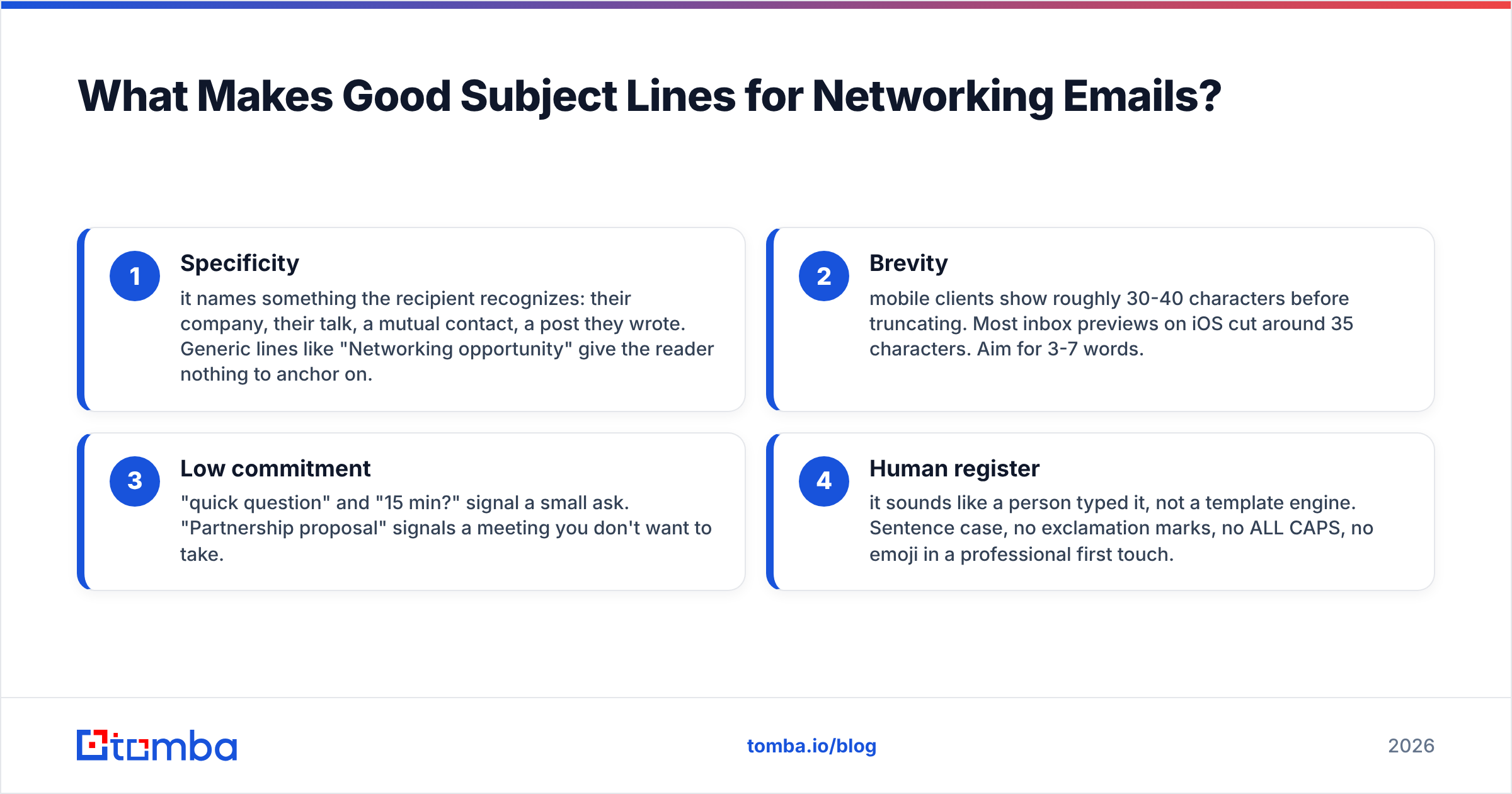
Four attributes show up in almost every networking subject line that gets opened:
- Specificity — it names something the recipient recognizes: their company, their talk, a mutual contact, a post they wrote. Generic lines like "Networking opportunity" give the reader nothing to anchor on.
- Brevity — mobile clients show roughly 30-40 characters before truncating. Most inbox previews on iOS cut around 35 characters. Aim for 3-7 words.
- Low commitment — "quick question" and "15 min?" signal a small ask. "Partnership proposal" signals a meeting you don't want to take.
- Human register — it sounds like a person typed it, not a template engine. Sentence case, no exclamation marks, no ALL CAPS, no emoji in a professional first touch.
The classic error is confusing "clever" with "compelling." A pun makes the sender feel smart; a concrete reference makes the recipient feel known. If your subject line could be sent to 500 people unchanged, it is not a networking subject line — it is a broadcast.

Which Subject Line Formats Actually Get Opened?#
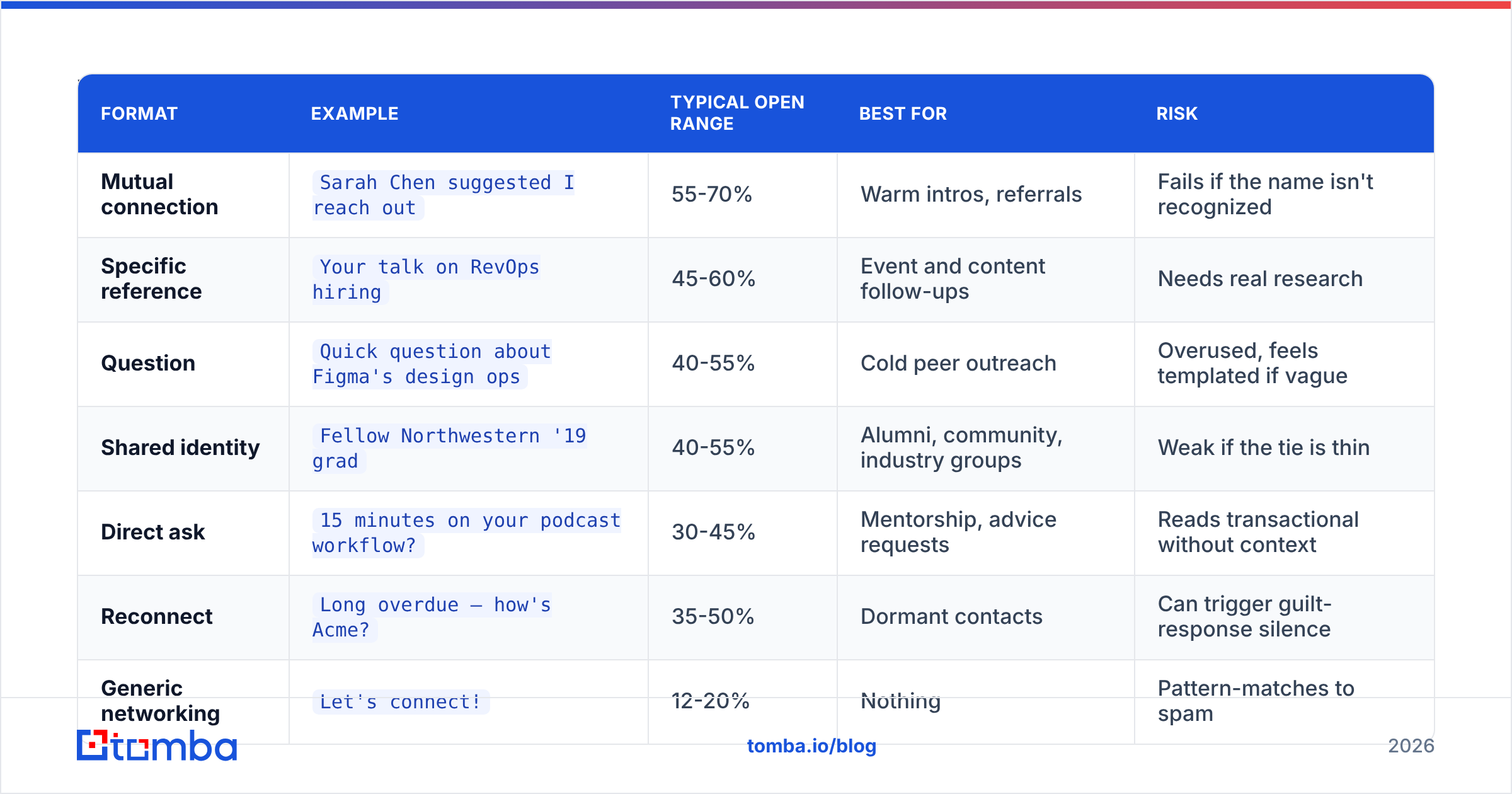
Here's how the main formats compare in practice. Treat the open-rate column as directional ranges reported across B2B outreach benchmarks, not guarantees — your list quality moves these numbers more than your wording does.
| Format | Example | Typical open range | Best for | Risk |
|---|---|---|---|---|
| Mutual connection | Sarah Chen suggested I reach out |
55-70% | Warm intros, referrals | Fails if the name isn't recognized |
| Specific reference | Your talk on RevOps hiring |
45-60% | Event and content follow-ups | Needs real research |
| Question | Quick question about Figma's design ops |
40-55% | Cold peer outreach | Overused, feels templated if vague |
| Shared identity | Fellow Northwestern '19 grad |
40-55% | Alumni, community, industry groups | Weak if the tie is thin |
| Direct ask | 15 minutes on your podcast workflow? |
30-45% | Mentorship, advice requests | Reads transactional without context |
| Reconnect | Long overdue — how's Acme? |
35-50% | Dormant contacts | Can trigger guilt-response silence |
| Generic networking | Let's connect! |
12-20% | Nothing | Pattern-matches to spam |
Two takeaways. First, every high-performing format encodes a reason the email exists. Second, the bottom row is what most people actually send.
What Are the Best Networking Email Subject Lines by Scenario?#
Copy these, then swap the brackets for real details. Do not send any of them with the brackets intact — that mistake is more common than you'd think.
Alumni and shared background
Fellow [University] '[year] — quick question[University] grad now in [industry]Saw you also came up through [company]Ex-[Company] to ex-[Company]Both [City] → [City] transplants, apparently
Event follow-up
Your [topic] talk at [Event]We spoke at [Event] booth [X]Following up from [Conference], [Month]The [topic] question I asked after your panel[Event] hallway conversation — one more thought
Content and post follow-up
Your post on [specific topic]Question about your [publication] pieceDisagreeing (politely) with your take on [topic]Your [topic] framework — one edge caseRead your [year] retro twice
Referral and mutual connection
[Mutual name] suggested I email youIntro via [Mutual name][Mutual name] said you'd know about [topic]Referred by [Mutual name] re: [topic]
Cold peer outreach
Quick question about [their tool/process]How does [Company] handle [problem]?[Their company] → [your company], similar stageOne question on [specific workflow]Comparing notes on [shared challenge]?
Reconnecting after a gap
Long overdue helloBeen a while — how's [Company]?Still thinking about your [old project] adviceReviving a very old threadCongrats on [recent news]
Mentorship and advice
15 minutes on breaking into [field]?Advice request from a [role] two steps behind youOne question about your path to [role]Your career move from [A] to [B]
Job search networking
[Role] at [Company] — worth a quick chat?Considering [Company], would love your readYour experience on the [team name] teamApplied to [Role] — one question first
Follow-up (second and third touch)
Re: [original subject]Bumping this onceStill curious about [topic]Last note from me on this
How Do You Personalize Without Sounding Automated?#
Personalization has an uncanny valley. "I loved your recent LinkedIn post!" with no post named is worse than no personalization at all, because it proves a template exists.
The fix is to personalize on things that are hard to fake:
- A specific sentence, not a whole piece.
Your line about "hiring ahead of revenue"is verifiable and flattering. - A decision, not a title.
Why'd you keep sales ops in-house?shows you read something. - A timeline, not a company.
Six months into the [Company] rebrandproves you've been paying attention. - A constraint you share, not a compliment.
Also selling into hospital procurementearns a reply from empathy, not ego.
At any volume above a handful of emails a day, that research has to be systematized. Pull the article byline with an author finder, enrich the company row with data enrichment, and keep one custom field per contact that is genuinely custom. One real detail beats five merge tags.
A useful rule: if the personalization token could be swapped for a different person's data and the sentence would still make sense, the token isn't doing any work.
Why Does Deliverability Matter More Than Wording?#
Because an unopened email and an undelivered email look identical in your reporting, and only one of them is fixable with better copy.
Networking emails skew toward guessed addresses — you found someone on a podcast, a conference roster, a byline, or a company page, and you inferred first.last@company.com. That guess is wrong often enough that a meaningful chunk of "low open rate" is actually bounce rate in disguise. Hard bounces above roughly 2% start damaging your sender reputation, and once reputation drops, even your perfect subject line lands in Promotions or Spam.
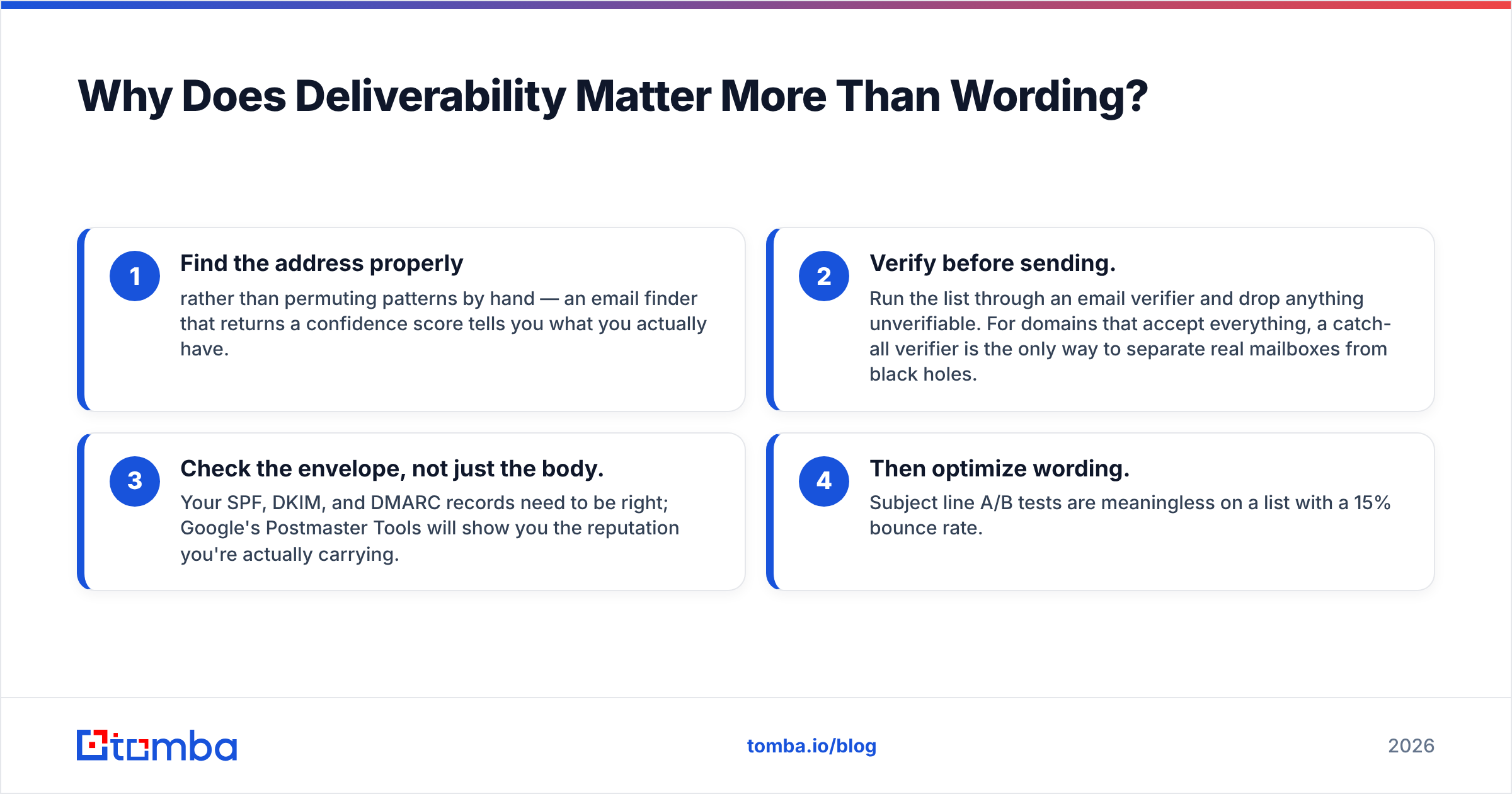
The sequencing that works:
- Find the address properly rather than permuting patterns by hand — an email finder that returns a confidence score tells you what you actually have.
- Verify before sending. Run the list through an email verifier and drop anything unverifiable. For domains that accept everything, a catch-all verifier is the only way to separate real mailboxes from black holes.
- Check the envelope, not just the body. Your SPF, DKIM, and DMARC records need to be right; Google's Postmaster Tools will show you the reputation you're actually carrying.
- Then optimize wording. Subject line A/B tests are meaningless on a list with a 15% bounce rate.
Industry review sites like G2 are full of teams who blamed copy for a data problem. Fix the pipes first.

What Subject Line Mistakes Kill Networking Emails?#
- "Touching base" / "Checking in" / "Circling back." These say nothing and read as filler. Recipients have been trained to archive them.
- Fake urgency. "Time-sensitive" on a networking ask destroys trust the moment they open it and find no deadline.
- Fake replies.
RE:on a thread that never existed is a dark pattern. Some clients flag it, and everyone resents it. - Company name only.
Acme Corptells them nothing about why you wrote. - Over 50 characters. Anything past that truncates on mobile, where more than half your opens happen.
- Question marks in the wrong place.
Interested??reads desperate. One question mark, or none. - Your own pitch as the subject.
AI-powered pipeline acceleration for [Company]is a cold sales email wearing a networking hat. Recipients can tell. - Emoji in a first professional touch. Fine for a newsletter, risky for someone who has never heard of you.
One more subtle one: subject lines that promise more than the body delivers. If your subject says Question about your pricing model and the body pivots into a demo request, you've spent your credibility on the first line and got nothing for it.
How Should You Test and Iterate Subject Lines?#
Networking outreach volumes are usually too low for statistically clean A/B tests, so run it as a qualitative loop instead of a spreadsheet exercise.
- Batch by scenario, not by wording. Group all your alumni emails together, all your event follow-ups together. Formats behave differently by context, and mixing them makes the data noise.
- Change one variable per batch. Length, or specificity, or question-vs-statement. Not all three.
- Track replies, not opens. Open tracking has been unreliable since Apple Mail Privacy Protection started pre-fetching images. Reply rate is the metric that survives.
- Set a floor of 30 sends per variant before you draw any conclusion, and treat anything below that as anecdote.
- Keep a swipe file of what got replies — your own winners beat any generic list, including this one.
If your reply rate is under 5% on genuinely warm networking outreach, the problem is almost never the subject line. It's list quality, timing, or a body paragraph that asks for too much. Check the response rate benchmarks for your motion before you rewrite anything.
Vendor guides from established players are worth reading here too — HubSpot's outreach research publishes regular benchmark updates that are more current than most blog roundups.
Does Send Time Change Which Subject Line Works?#
Somewhat, and less than people claim.
Tuesday-through-Thursday mornings remain the default recommendation, which means everyone else is also sending then. For networking specifically — where you're competing against sales sequences, not other networkers — the counterintuitive slots often work better: late afternoon, or a Sunday evening for founders and executives who triage on weekends.
What matters more is urgency alignment. A subject line like Bumping this once sent 48 hours after the first email reads as attentive. Sent 3 weeks later, it reads as confusing. Match the tempo of the wording to the tempo of the thread.
For time-sensitive scenarios — an event follow-up, a job application, a mutual introduction that's cooling off — send within 24-48 hours and say so in the subject: [Event] follow-up, as promised. Promptness itself is a personalization signal.
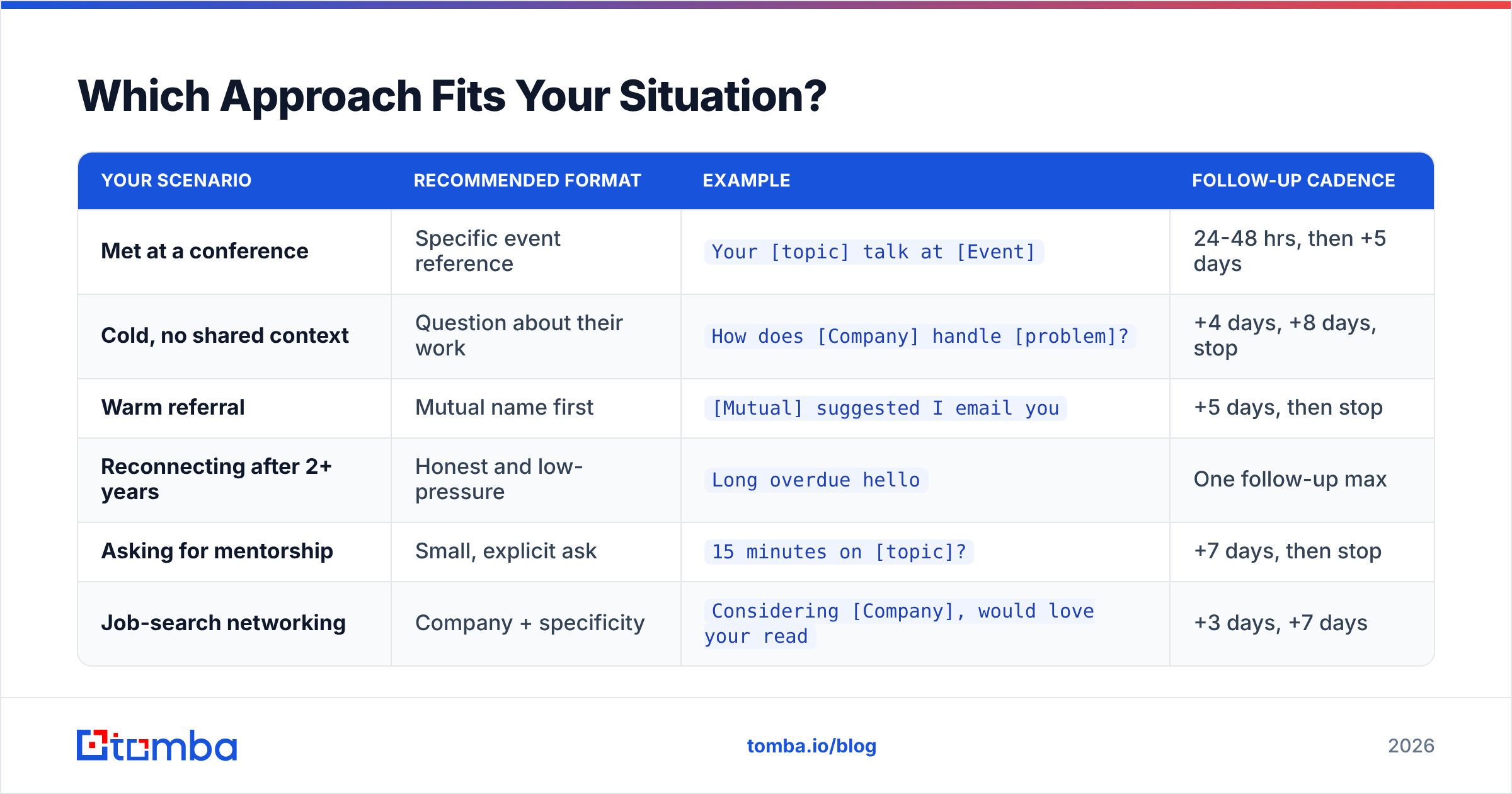
Which Approach Fits Your Situation?#
| Your scenario | Recommended format | Example | Follow-up cadence |
|---|---|---|---|
| Met at a conference | Specific event reference | Your [topic] talk at [Event] |
24-48 hrs, then +5 days |
| Cold, no shared context | Question about their work | How does [Company] handle [problem]? |
+4 days, +8 days, stop |
| Warm referral | Mutual name first | [Mutual] suggested I email you |
+5 days, then stop |
| Reconnecting after 2+ years | Honest and low-pressure | Long overdue hello |
One follow-up max |
| Asking for mentorship | Small, explicit ask | 15 minutes on [topic]? |
+7 days, then stop |
| Job-search networking | Company + specificity | Considering [Company], would love your read |
+3 days, +7 days |
Notice that the cadence column shrinks as the relationship warms. Warm contacts don't need chasing; cold contacts you shouldn't chase more than twice. Nobody has ever built a relationship on the fourth follow-up.
Frequently Asked Questions#
How long should a networking email subject line be? Three to seven words, ideally under 45 characters. Mobile previews truncate around 35-40 characters, and the majority of professional email is first triaged on a phone.
Should I use the recipient's first name in the subject line? Only when it's doing real work — for example, when there's ambiguity about who you're writing to. Otherwise it reads as a merge tag, because it usually is one.
Are lowercase subject lines a good idea? Lowercase can read as casual and human in founder-to-founder or startup contexts. In enterprise, legal, healthcare, and finance, use sentence case. Match the register of the world you're writing into.
Is it okay to reuse a subject line that worked? Yes, across different recipients. Just don't reuse the same one on the same person twice — inboxes thread by subject, and your "new" email will hide inside an old conversation.
What about subject lines for LinkedIn versus email? LinkedIn messages have no subject line, so the first sentence does that job. The principles carry over: specific, short, low-commitment. See our notes on LinkedIn outreach for the format differences.
Start With the Right Address#
A great subject line delivered to a mailbox that doesn't exist earns you nothing but a bounce and a slightly worse sender reputation. Before you spend an hour polishing seven words, spend five minutes confirming you're writing to a real person at a real address.
The Tomba Email Finder resolves professional addresses by name and domain and returns a confidence score, so you know which contacts are safe to send to and which need verification first. The free tier covers 25 searches a month, which is enough to test the workflow on your actual networking list; paid plans start at $49/mo on Starter, with Growth at $99/mo — full Tomba pricing is on the site. Get the address right, then write something worth opening.
Related guides#
Ready to find emails that actually work?
Join 150,000+ professionals who stopped guessing and started sending. Free credits on signup — no credit card required.
Get the Tomba newsletter
Practical outbound tactics and product updates — once every two weeks.
About the author