Google Ads for B2B in 2026: A Practical Playbook That Converts
B2B Google Ads punish the tactics that work in e-commerce. Here is how bid strategy, offline conversions, and lead quality actually work when your sales cycle is nine months long.
TL;DR
- Google Ads for B2B fails when you run it like e-commerce: the platform optimizes toward the signal you feed it, and "form fill" is not revenue.
- Expect $80–$400 cost per lead in competitive B2B software categories, and expect 40–70% of raw form fills to be unqualified without gating.
- Offline Conversion Import (feeding closed-won data back from your CRM) is the single highest-leverage change most B2B accounts never make.
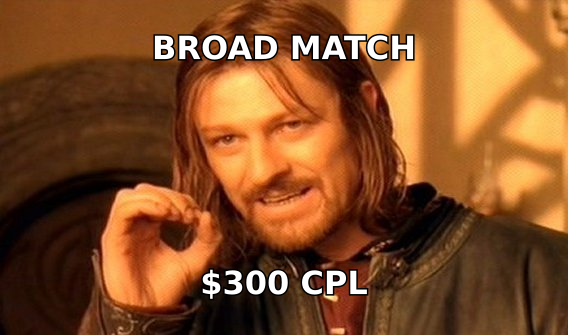
- Broad match plus Smart Bidding with no conversion quality signal is the fastest way to burn a quarter's budget on students, competitors, and job seekers.
- Paid search works best as a capture channel for existing demand. Pair it with outbound enrichment so the 97% of visitors who never fill a form still become pipeline.
What makes Google Ads for B2B different from B2C?#
The mechanics are identical. The economics are not.
In e-commerce, a click converts to revenue in the same session, and the feedback loop closes in hours. Google's Smart Bidding gets thousands of clean revenue signals per week and gets very good, very fast. In B2B, a click converts to a demo request in week one, a qualified opportunity in week four, and a closed deal in month seven — if it converts at all. The algorithm is being asked to optimize a system where the outcome arrives two quarters after the auction.
Three structural differences drive nearly every B2B paid search mistake:
- Tiny conversion volume. Smart Bidding wants roughly 30+ conversions per campaign per 30 days to stabilize. Plenty of B2B accounts generate 12 demo requests a month total. You are asking a machine learning system to learn from noise.
- Conversion quality varies wildly. A form fill from a Fortune 500 VP of Engineering and a form fill from a bootcamp student look identical to Google. Both are "1 conversion." Without a quality signal, the algorithm will happily chase the cheaper one.
- The buying committee is not the searcher. The person googling "best CRM for manufacturing" is often a mid-level researcher who will not sign anything. Your ad reaches one node in a 6–10 person committee, which is why paid search rarely closes deals on its own.
- Search volume is thin. Your exact-match money keywords might have 200 monthly searches. There is no volume to scale into, which pushes advertisers toward broad match — and broad match without guardrails is where B2B budgets go to die.

Is Google Ads worth it for B2B in 2026?#
Yes, for bottom-funnel demand capture. No, as your primary demand generation engine.
Here is the honest split. Google Ads excels when someone is already searching for a category you compete in — "email verification API," "SOC 2 compliance software," "freight brokerage TMS." That is existing demand, and capturing it is usually cheaper than creating it. Google Ads is poor at creating demand for a category nobody knows exists, because nobody is searching for it.
The benchmark data supports the caution. WordStream's ongoing benchmark analysis puts B2B and industrial services among the highest cost-per-click categories, and legal, insurance, and enterprise software regularly clear $20+ per click on commercial-intent terms. At a 4% landing page conversion rate, that is $500 per raw lead before you account for qualification loss.
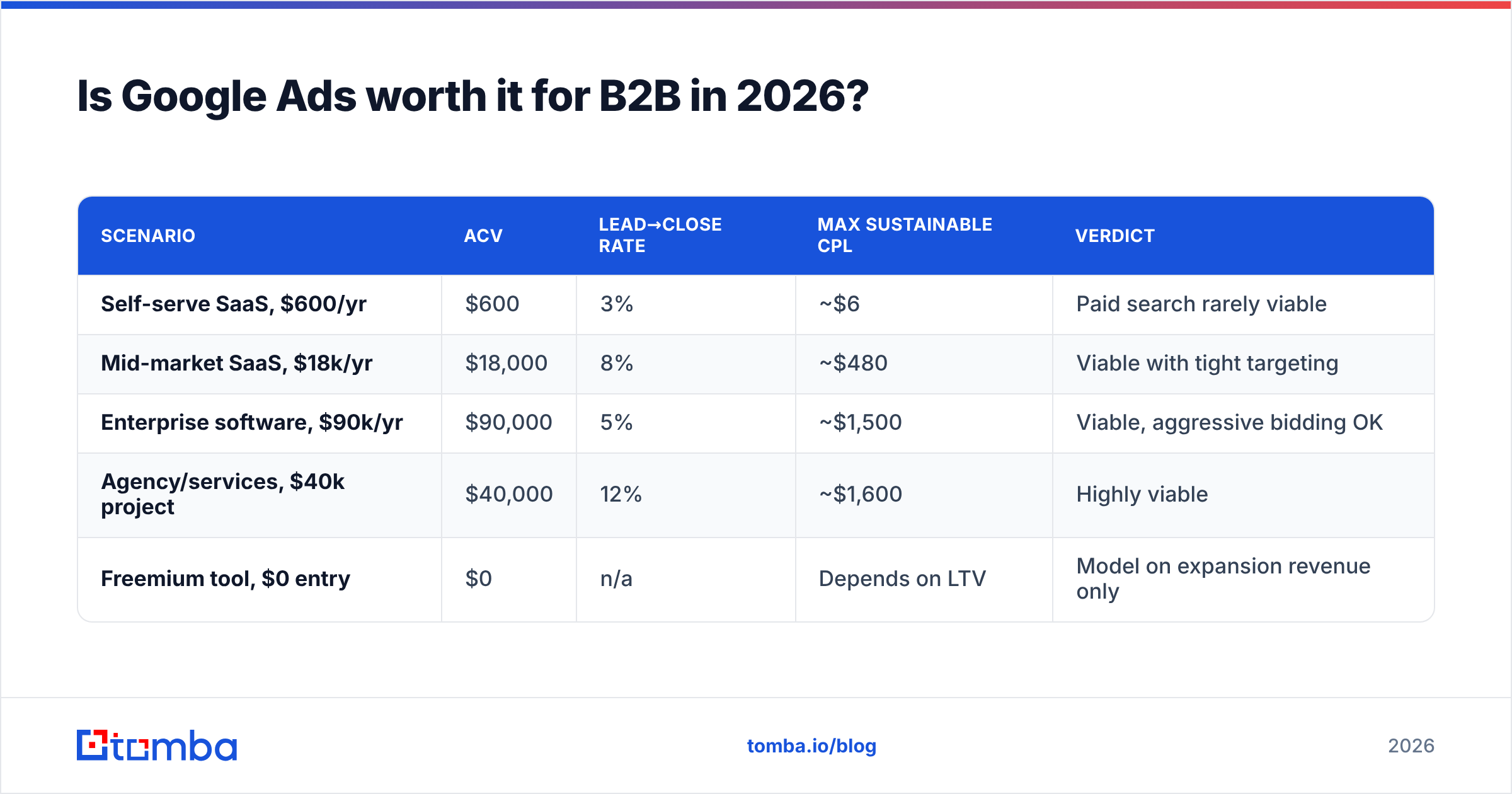
That math only works if your average contract value can absorb it. Run this before you spend anything:
The viability test. Take your average contract value, multiply by gross margin, multiply by your historical lead-to-close rate, then divide by three. If the resulting number is below your expected cost per lead, paid search will not work at your current funnel efficiency — fix the funnel first.
| Scenario | ACV | Lead→close rate | Max sustainable CPL | Verdict |
|---|---|---|---|---|
| Self-serve SaaS, $600/yr | $600 | 3% | ~$6 | Paid search rarely viable |
| Mid-market SaaS, $18k/yr | $18,000 | 8% | ~$480 | Viable with tight targeting |
| Enterprise software, $90k/yr | $90,000 | 5% | ~$1,500 | Viable, aggressive bidding OK |
| Agency/services, $40k project | $40,000 | 12% | ~$1,600 | Highly viable |
| Freemium tool, $0 entry | $0 | n/a | Depends on LTV | Model on expansion revenue only |
How should you structure B2B Google Ads campaigns?#
Structure by intent tier, not by product line. This is the change that fixes the most accounts.
Most B2B advertisers build one campaign per product and dump every related keyword into it. That mixes a "what is X" researcher with a "X pricing" buyer in the same bid strategy, and Smart Bidding averages them into mediocrity. Split by how close the searcher is to buying instead:
- Tier 1 — Competitor and alternative terms. "[Competitor] alternative," "[Competitor] vs [Competitor]," "[Competitor] pricing." Highest intent, highest CPC, lowest volume. These people are actively shopping. Bid aggressively and send them to a direct comparison page, not your homepage.
- Tier 2 — Category and solution terms. "B2B email finder," "sales engagement platform," "lead enrichment API." Solid intent, moderate cost. Send to a product page with a specific proof point above the fold.
- Tier 3 — Problem and symptom terms. "how to find someone's work email," "reduce email bounce rate." Early stage. Lower bids, gated content or a free tool offer, and expect long lag to revenue.
- Tier 4 — Branded. Your own name. Cheap, high converting, and constantly argued about. Run it — competitors will bid on your brand whether you defend it or not, and conquesting is standard practice.
- Tier 5 — Retargeting on Search (RLSA). Layer your site visitors as an audience on broader keywords you would never bid on cold. This is how you use broad match safely.
Keep each tier in its own campaign with its own budget so a cheap Tier 3 click never cannibalizes a Tier 1 opportunity.
How do you stop paying for garbage leads?#
Feed the algorithm quality data instead of quantity data. Everything else is a patch.
The default setup — a "Contact Us" form firing a conversion on thank-you page load — teaches Google that all form fills are equally valuable. It will then find you more of the cheapest form fills available, which are students, job applicants, competitors doing research, and people from countries you do not sell into. The account looks like it is improving. Pipeline does not move.
Three fixes, ordered by impact:
1. Offline Conversion Import (OCI). Capture the Google Click ID (GCLID) on your form, store it in your CRM, and push conversion events back when a lead becomes an SQL and again when it closes. Google's offline conversion tracking documentation covers the setup, and native connectors exist for Salesforce and HubSpot. Once OCI is live, switch your bid strategy to optimize toward "SQL" instead of "form fill." Most accounts see cost per qualified lead drop 30–50% within eight weeks — not because you spent less, but because the algorithm finally knows what good looks like.
2. Value-based bidding with tiered conversion values. If OCI is too heavy a lift right now, assign static values in the meantime: demo request = 100, trial signup = 40, ebook download = 5. Use Maximize Conversion Value instead of Maximize Conversions. It is crude, but it stops the account chasing whichever conversion is cheapest.
3. Aggressive negative keyword hygiene. Build a standing negative list before launch, not after. The B2B universals: free, cheap, jobs, career, salary, internship, course, tutorial, template, download free, reddit, wikipedia, meaning, definition, example, open source, github, login, crack, torrent. Then review the search terms report weekly for the first three months. In a new B2B account, expect to add 20–40 negatives a week early on.
Which bidding strategy works for low-volume B2B accounts?#
Start manual or Maximize Clicks with a CPC cap, then graduate. Do not launch on Target CPA.
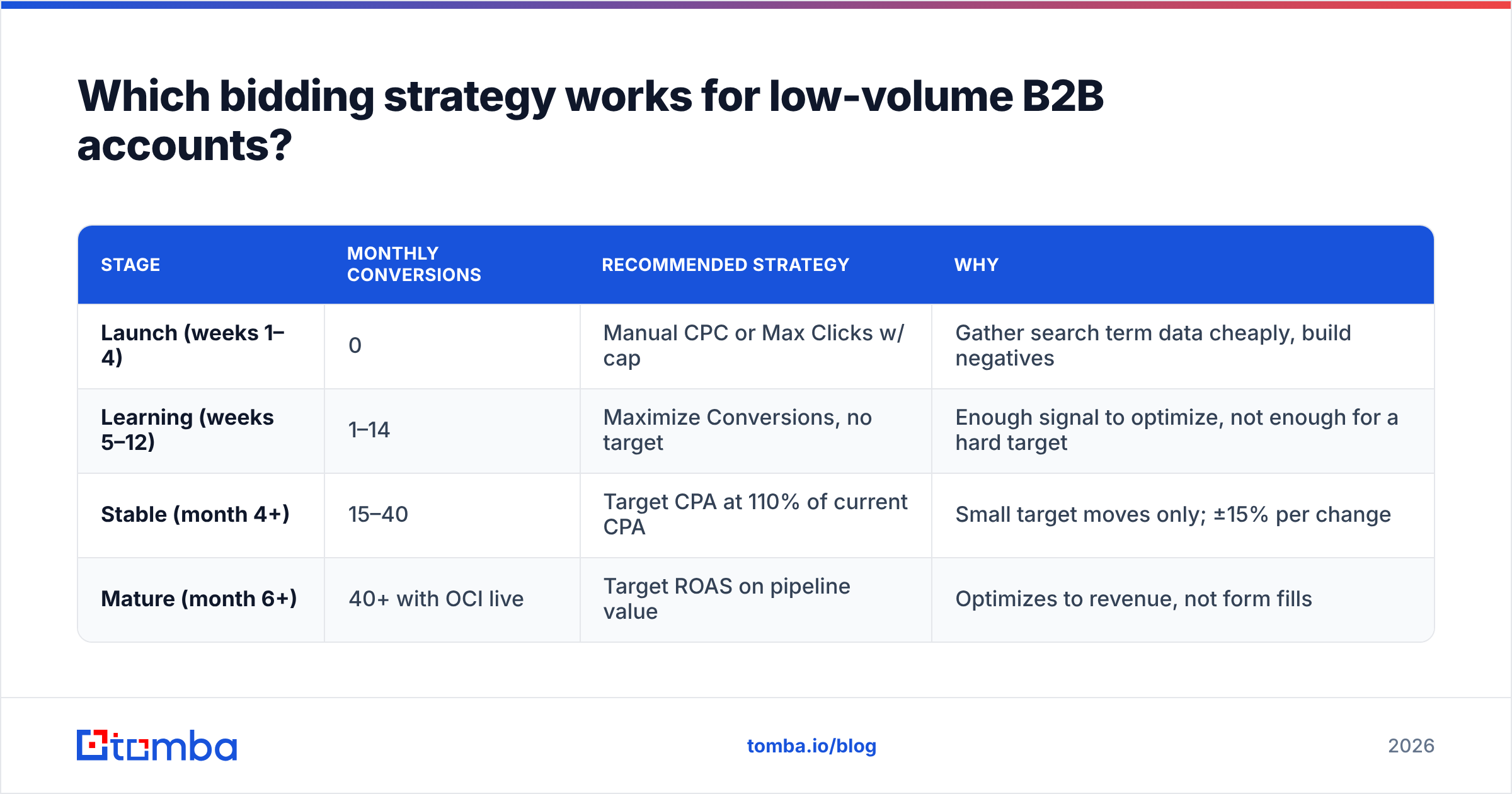
Smart Bidding is genuinely excellent once it has data. Launching on it with zero conversion history means Google is guessing, and it guesses expensively. The progression that works:
| Stage | Monthly conversions | Recommended strategy | Why |
|---|---|---|---|
| Launch (weeks 1–4) | 0 | Manual CPC or Max Clicks w/ cap | Gather search term data cheaply, build negatives |
| Learning (weeks 5–12) | 1–14 | Maximize Conversions, no target | Enough signal to optimize, not enough for a hard target |
| Stable (month 4+) | 15–40 | Target CPA at 110% of current CPA | Small target moves only; ±15% per change |
| Mature (month 6+) | 40+ with OCI live | Target ROAS on pipeline value | Optimizes to revenue, not form fills |
Two rules that save money at every stage. First, change one thing at a time and wait a full conversion cycle — in B2B that is often three weeks, not three days. Second, never cut a Target CPA by more than 15% in one move; larger cuts throw the campaign back into learning and volume collapses.
What should B2B landing pages actually do?#
Match the keyword tier and reduce friction to one specific next step.
Sending every campaign to your homepage is the most common conversion killer in B2B paid search. A visitor who searched "[competitor] alternative" wants a comparison, immediately. A visitor who searched "how to verify email addresses" wants an explanation and maybe a free tool.
What consistently moves conversion rate in B2B:
- Message match in the H1. If the ad says "Find Verified B2B Emails," the page headline says that too. Not your brand tagline.
- Fewer form fields, enriched afterward. Ask for work email only, then fill in company, headcount, industry, and tech stack automatically with data enrichment. A 7-field form does not qualify leads; it just loses good ones. Enrich after capture instead.
- Real proof above the fold. Named logos, a specific number, or a third-party rating from G2. "Trusted by thousands" is noise.
- A secondary low-commitment path. Not everyone is demo-ready. A free tool or calculator captures the researcher who will be buying in six months.
- Sub-2-second load on mobile. Roughly half of B2B research now starts on a phone, even when the purchase completes on desktop.
One more thing: verify the email addresses your forms collect before they hit your sequences. A meaningful share of B2B form fills contain typos or throwaway addresses, and routing those into an automated nurture damages email deliverability for every other campaign you run. Running submissions through an email verifier at capture is a five-minute integration that protects your sending domain.
How does paid search fit with outbound?#
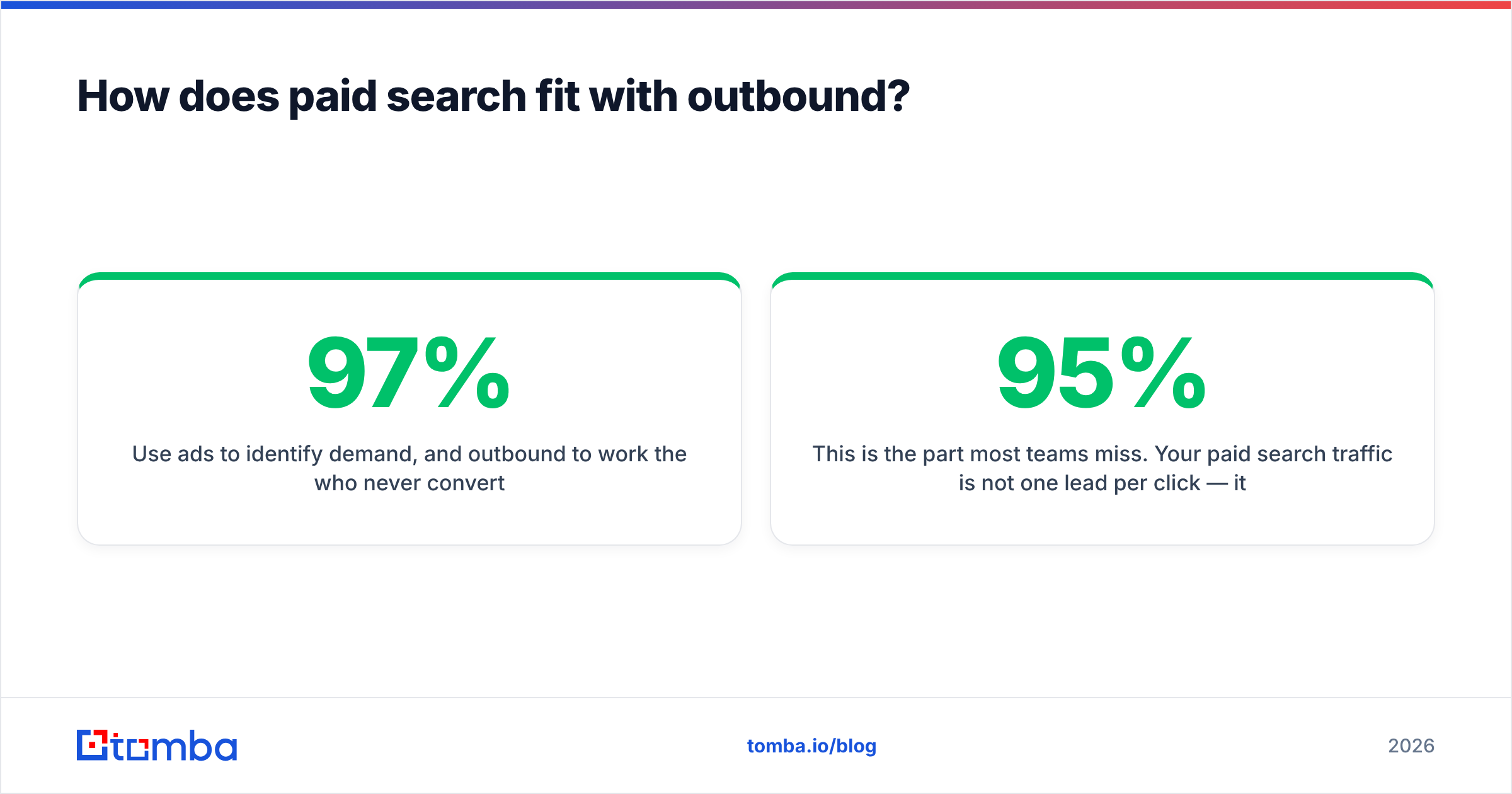
Use ads to identify demand, and outbound to work the 97% who never convert.
This is the part most teams miss. Your paid search traffic is not one lead per click — it is a stream of in-market accounts, of whom a small fraction fill out a form. Between 95% and 98% of B2B site visitors leave without identifying themselves. You paid for all of them.
The compounding play:
- Identify the companies visiting. Reverse-IP visitor identification turns anonymous paid traffic into a list of accounts that were interested enough to click a commercial-intent ad.
- Build the buying committee. For each account, find the 3–6 people who actually influence the decision. A domain search returns verified contacts by role, so you are not guessing at email formats.
- Reference the intent, don't reveal the tracking. "Saw your team is evaluating options in this space" works. "I see you visited our pricing page at 2:14pm" does not.
- Feed the results back into bidding. Accounts that convert through this motion should have their GCLIDs pushed into OCI as well, so the ad account learns which keywords produce real accounts even when nobody filled a form.
Done well, this roughly doubles the effective yield of the same ad spend, because you stop paying for clicks you only monetize when a form gets filled.
What does a realistic B2B Google Ads budget look like?#
Plan for a three-month learning tax and a floor spend below which the channel cannot function.
The floor: you need enough clicks per month to generate statistically usable search term data. At a $25 average CPC, $3,000/month buys 120 clicks. At a 5% conversion rate, that is six leads — not enough for Smart Bidding, barely enough to judge quality. Below roughly $4,000–$5,000/month in a competitive B2B category, treat paid search as an experiment rather than a channel.
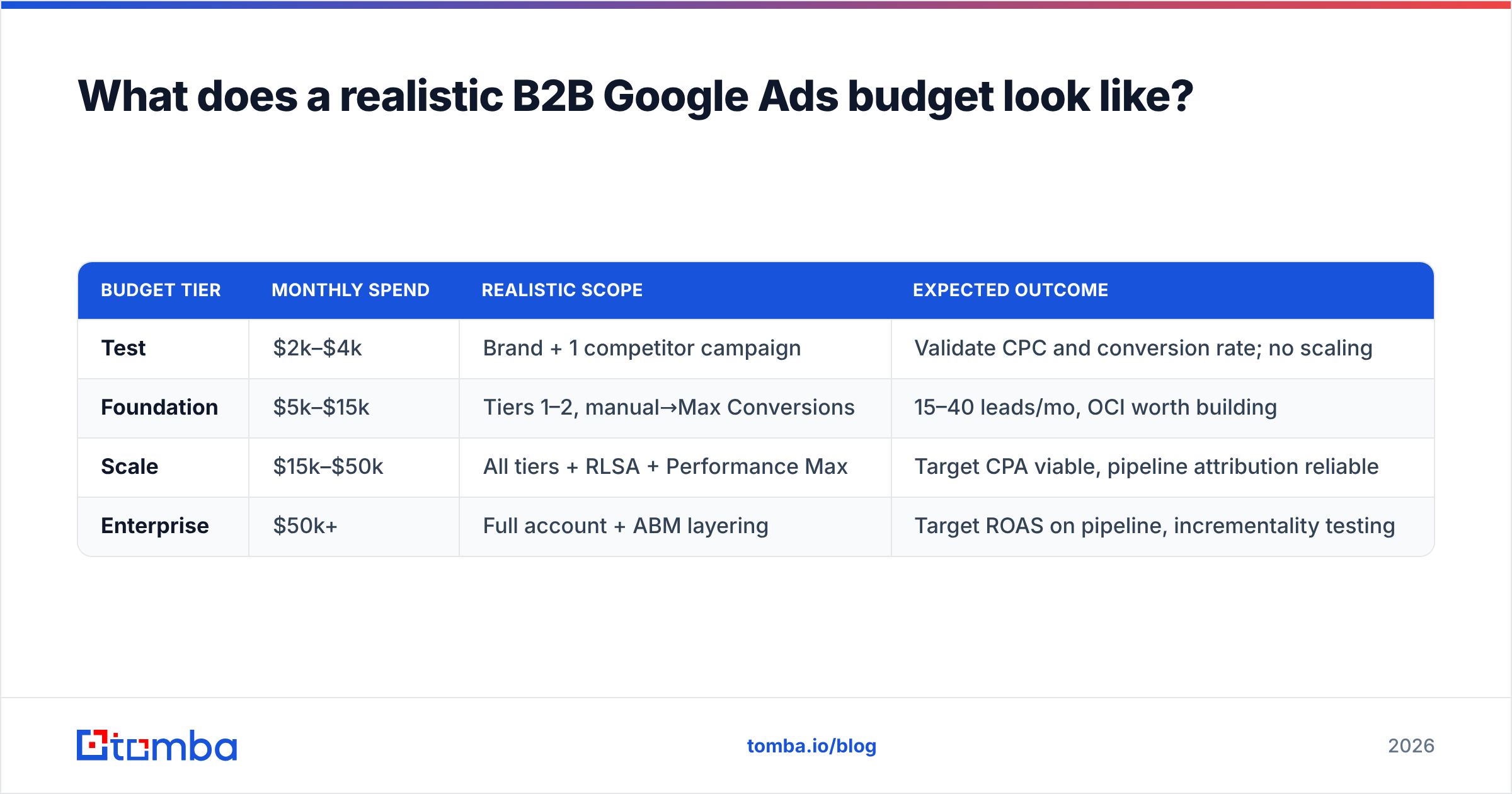
| Budget tier | Monthly spend | Realistic scope | Expected outcome |
|---|---|---|---|
| Test | $2k–$4k | Brand + 1 competitor campaign | Validate CPC and conversion rate; no scaling |
| Foundation | $5k–$15k | Tiers 1–2, manual→Max Conversions | 15–40 leads/mo, OCI worth building |
| Scale | $15k–$50k | All tiers + RLSA + Performance Max | Target CPA viable, pipeline attribution reliable |
| Enterprise | $50k+ | Full account + ABM layering | Target ROAS on pipeline, incrementality testing |
Reserve 15% of budget for testing new keyword clusters and ad variants. Accounts that spend 100% on proven terms stop finding new pockets of demand and slowly get more expensive as competitors bid up the same 40 keywords.
What are the most common B2B Google Ads mistakes?#
- Optimizing to form fills instead of revenue. Covered above; it is the root cause of most other symptoms.
- Running Performance Max too early. PMax needs strong conversion signal and clean exclusions. In a low-volume B2B account without OCI, it will find you cheap conversions in placements you would never have chosen.
- Ignoring the search terms report. Broad and phrase match drift constantly. A weekly 20-minute review is the highest ROI recurring task in the account.
- Geo-targeting "Presence or interest." Change it to "Presence" only, or you will pay for clicks from regions you cannot sell into.
- No ad schedule. B2B searches on Saturday at 11pm convert far worse than Tuesday at 10am. Check the hour-of-day report after 90 days and adjust.
- Treating attribution as truth. Last-click undercounts everything upstream. Compare self-reported attribution ("How did you hear about us?" on the form) against platform data and expect them to disagree.
Final take#
Google Ads for B2B rewards patience and punishes autopilot. The accounts that work share three traits: they capture existing demand rather than trying to create it, they feed closed-won data back into the bid algorithm, and they treat every paid click as an account signal rather than a single lead.
The last part is where most of the untapped upside sits. If you are already paying for high-intent clicks, the companies behind those clicks are the warmest outbound list you will ever build. Use the Tomba Email Finder to turn those accounts into verified contacts across the buying committee, so the 97% who never filled your form still turn into pipeline. Free plan covers 25 searches a month to test the workflow, and Tomba pricing starts at $49/mo when you are ready to run it at volume.
Related guides#
Ready to find emails that actually work?
Join 150,000+ professionals who stopped guessing and started sending. Free credits on signup — no credit card required.
Get the Tomba newsletter
Practical outbound tactics and product updates — once every two weeks.
About the author