GoZen Pricing, Reviews, Pros and Cons: An Honest 2026 Breakdown
GoZen sells five separate marketing tools under one brand, and the pricing math surprises people. Here is what each product actually costs, what reviewers praise, where it breaks down, and when a focused stack wins.
TL;DR
- GoZen is not one product. It is a family of five separate tools (Growth, Forms, Optinly, Content.ai, Engage), each with its own plan, its own billing unit, and its own free tier. That single fact explains most of the confusion around GoZen pricing.
- Entry pricing is genuinely cheap per tool — most products start in the low double digits per month — but costs scale on contacts, form responses, or AI word credits, so two tools at scale can quietly cost more than one mid-tier all-in-one.
- Reviewers on G2 and Capterra consistently praise value-for-money, the no-code builders, and responsive support. The recurring complaints are UI inconsistency between products, thin native integrations, and deliverability that depends heavily on your own list hygiene.
- GoZen has no prospecting or contact-data layer. It helps you convert traffic you already have. It does not help you find people who have never heard of you.
- Best fit: solo marketers and small teams running inbound capture on a tight budget. Weak fit: outbound sales teams who need verified contact data, CRM sync, and deep reporting.
What is GoZen, and what are you actually buying?#
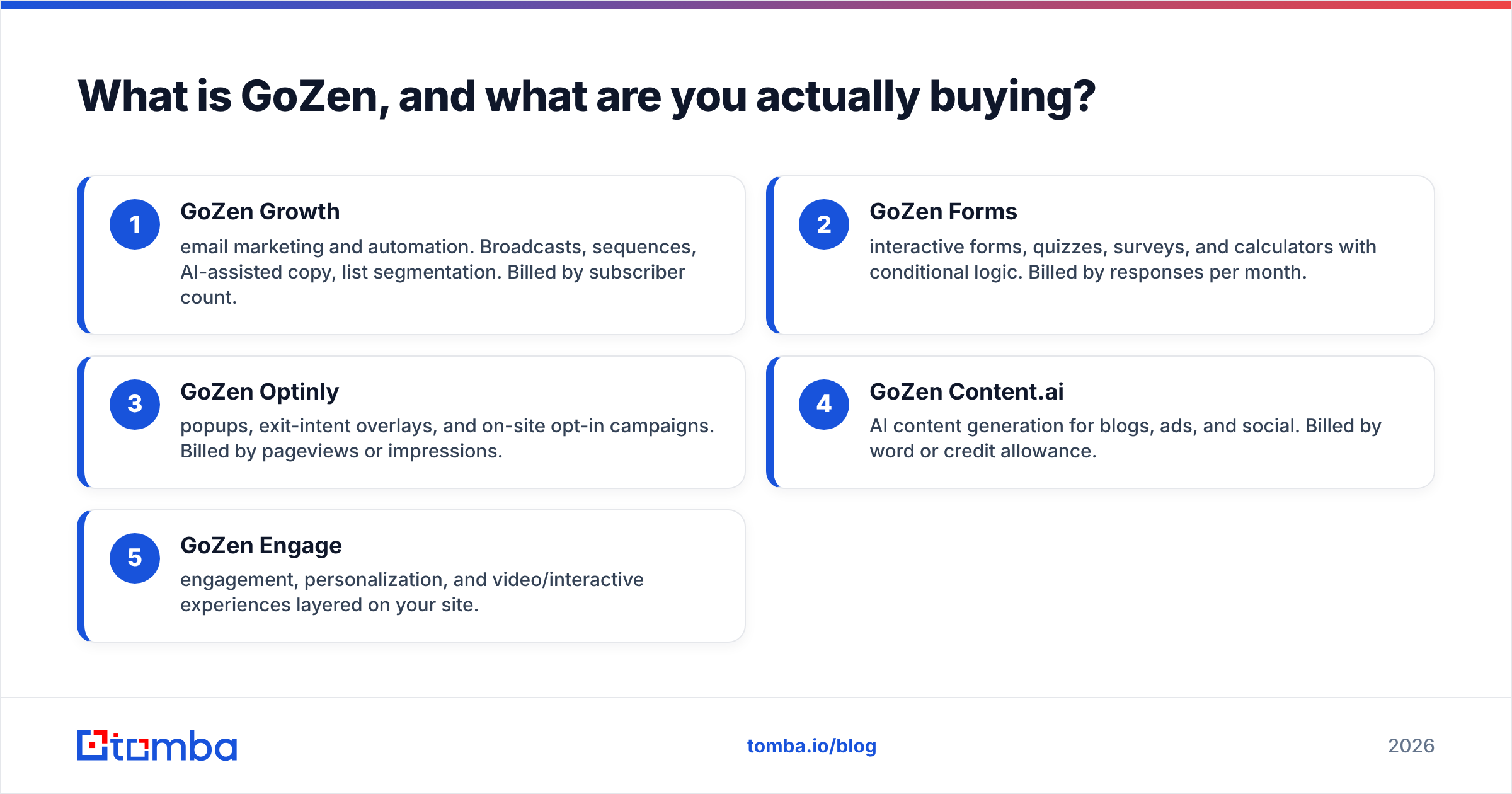
GoZen is a bundle of marketing SaaS products sold under a shared brand at gozen.io. The key thing to understand before you look at a single price: you are not buying "GoZen." You are buying one or more of these:
- GoZen Growth — email marketing and automation. Broadcasts, sequences, AI-assisted copy, list segmentation. Billed by subscriber count.
- GoZen Forms — interactive forms, quizzes, surveys, and calculators with conditional logic. Billed by responses per month.
- GoZen Optinly — popups, exit-intent overlays, and on-site opt-in campaigns. Billed by pageviews or impressions.
- GoZen Content.ai — AI content generation for blogs, ads, and social. Billed by word or credit allowance.
- GoZen Engage — engagement, personalization, and video/interactive experiences layered on your site.
Each of these competes in a different category. Growth is up against Mailchimp and Brevo. Forms is up against Typeform and Jotform. Optinly is up against OptinMonster and Privy. Content.ai is up against Jasper and Copy.ai. That matters because you should benchmark GoZen product-by-product, not as a single suite, and because "GoZen is cheap" can be true for one product and false for your specific combination.

How does GoZen pricing work in 2026?#
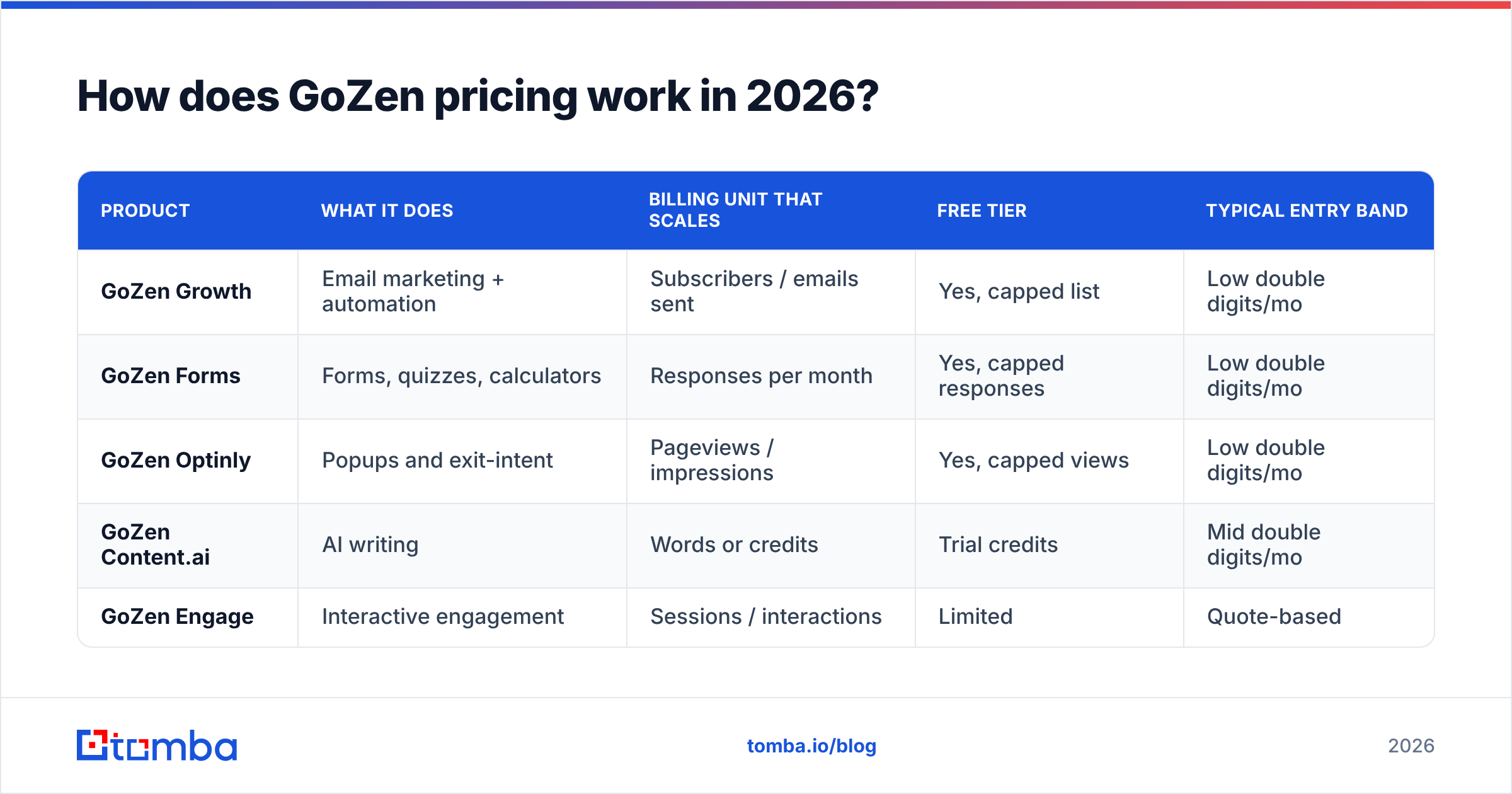
The structure is consistent even when the numbers move: every product has a usable free tier, a low-cost entry plan, and a metered variable that inflates the bill as you grow. The metered variable is different for every product, which is the part most buyers miss.
| Product | What it does | Billing unit that scales | Free tier | Typical entry band |
|---|---|---|---|---|
| GoZen Growth | Email marketing + automation | Subscribers / emails sent | Yes, capped list | Low double digits/mo |
| GoZen Forms | Forms, quizzes, calculators | Responses per month | Yes, capped responses | Low double digits/mo |
| GoZen Optinly | Popups and exit-intent | Pageviews / impressions | Yes, capped views | Low double digits/mo |
| GoZen Content.ai | AI writing | Words or credits | Trial credits | Mid double digits/mo |
| GoZen Engage | Interactive engagement | Sessions / interactions | Limited | Quote-based |
Published prices change frequently and GoZen runs aggressive promotions, so treat the bands above as shape, not gospel — confirm the current numbers on the vendor's own pricing page before you commit. What does not change is the shape: cheap to start, metered to scale, and priced per product.
Three practical consequences:
- Annual billing is where the real discount lives. Like most SMB SaaS, the monthly sticker is meaningfully higher than the annualized rate. If you are testing, stay monthly and eat the premium.
- Two products is the common trap. Teams sign up for Forms, then add Optinly, then add Growth to email the leads they captured. Three low bills stack into a mid-tier bill, and you now manage three dashboards.
- Overages are the variable you must model. A viral quiz or a traffic spike moves you up a tier on response or pageview count, not on seats. Budget from your traffic ceiling, not your average.
What do GoZen reviews actually say?#
Pull the review corpus on G2 and Capterra and the sentiment clusters tightly. Ratings skew high — this is a well-liked SMB product — but the praise and the criticism are both specific.
What reviewers consistently praise:
- Price-to-capability ratio. The most repeated phrase across reviews is some version of "does what the expensive tool does for a fraction." For form builders and popups specifically, this holds up.
- Speed to first campaign. The no-code builders are genuinely quick. Reviewers report shipping a working quiz or exit popup in under an hour with no developer.
- Support responsiveness. Small-vendor advantage. Multiple reviews mention getting a human quickly, including on lower-tier plans — something you will not get from a $500/month enterprise platform.
- Template libraries. Both Forms and Optinly ship enough templates that most SMB users never start from scratch.
What reviewers consistently criticize:
- The suite does not feel like a suite. Because the products were built and acquired separately, the UI, terminology, and settings differ between them. Cross-product data flow is weaker than the marketing suggests.
- Integration depth. Native connectors exist for the big names, but reviewers routinely fall back to Zapier or webhooks for anything specific — which adds a fourth bill.
- Reporting is shallow. You get campaign-level metrics. You do not get cohort analysis, attribution, or the kind of revenue reporting a RevOps lead will ask for.
- Deliverability variance. Complaints about inbox placement in Growth almost always trace back to list quality rather than the platform. If you import a stale or unverified list, no ESP saves you. Run the list through an email verifier before the first send and most of these complaints evaporate.
Read the one-star reviews with that last point in mind. A meaningful share of "GoZen ruined my deliverability" reports are really "I uploaded a two-year-old scraped list" reports.
What are the pros of GoZen?#
- Lowest realistic cost of entry in its categories. If your budget for lead capture is under $50/month total, GoZen is one of very few credible options that is not a stripped free plan.
- Genuinely usable free tiers. Not 7-day trials — persistent free plans with real caps. You can validate the fit before paying anything.
- Interactive forms are the standout product. Quizzes and calculators with conditional logic convert better than static forms, and GoZen Forms delivers that without Typeform-tier pricing.
- AI features are bundled, not upsold. Copy assistance sits inside Growth and Content.ai rather than behind a separate AI add-on SKU, which is increasingly rare.
- Frequent lifetime and promotional deals. GoZen has a long history of one-time-payment offers. For a tool you will use for years at low volume, that math can be excellent.
What are the cons of GoZen?#
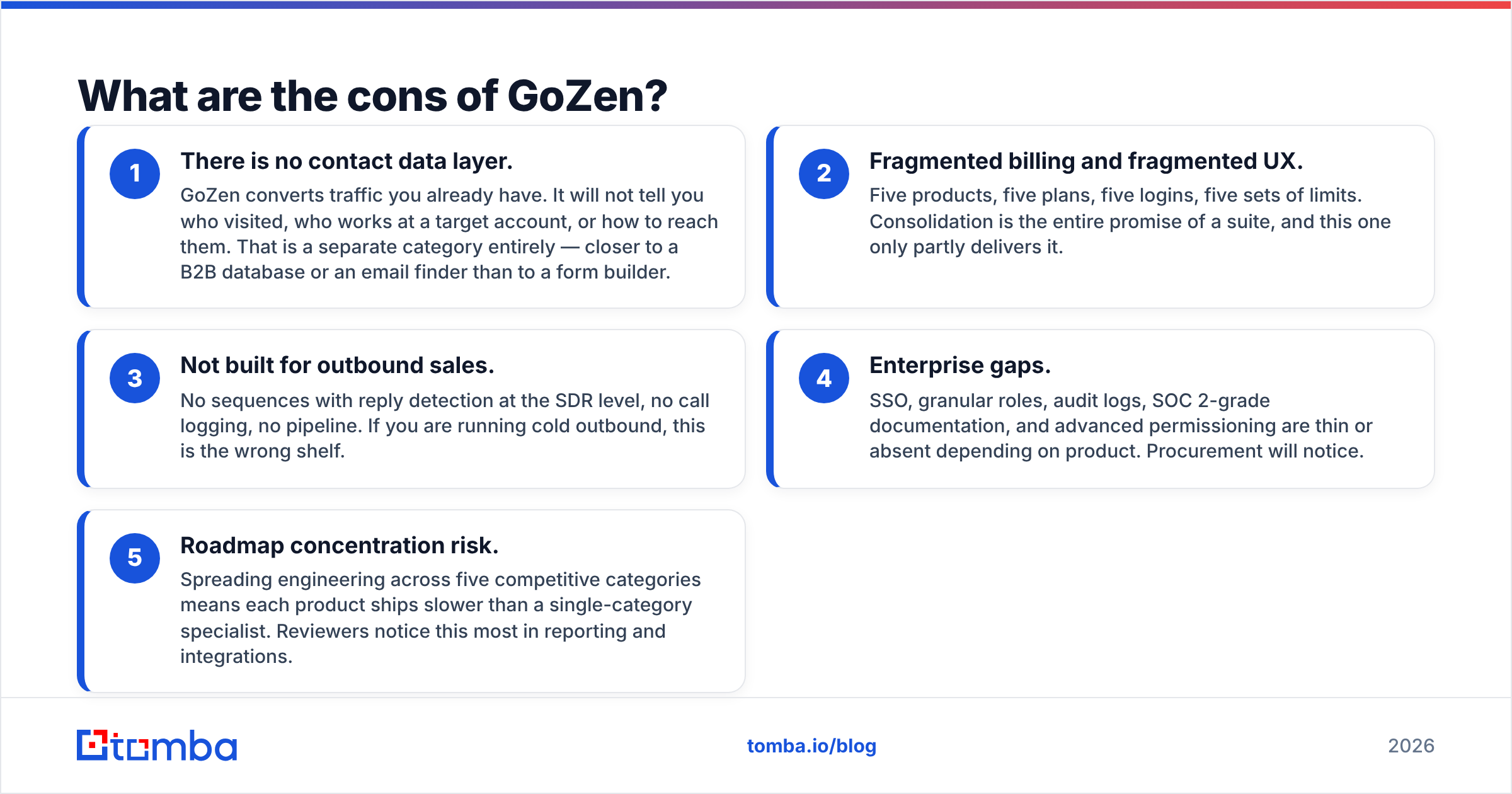
- There is no contact data layer. GoZen converts traffic you already have. It will not tell you who visited, who works at a target account, or how to reach them. That is a separate category entirely — closer to a B2B database or an email finder than to a form builder.
- Fragmented billing and fragmented UX. Five products, five plans, five logins, five sets of limits. Consolidation is the entire promise of a suite, and this one only partly delivers it.
- Not built for outbound sales. No sequences with reply detection at the SDR level, no call logging, no pipeline. If you are running cold outbound, this is the wrong shelf.
- Enterprise gaps. SSO, granular roles, audit logs, SOC 2-grade documentation, and advanced permissioning are thin or absent depending on product. Procurement will notice.
- Roadmap concentration risk. Spreading engineering across five competitive categories means each product ships slower than a single-category specialist. Reviewers notice this most in reporting and integrations.
How does GoZen compare to a focused stack?#
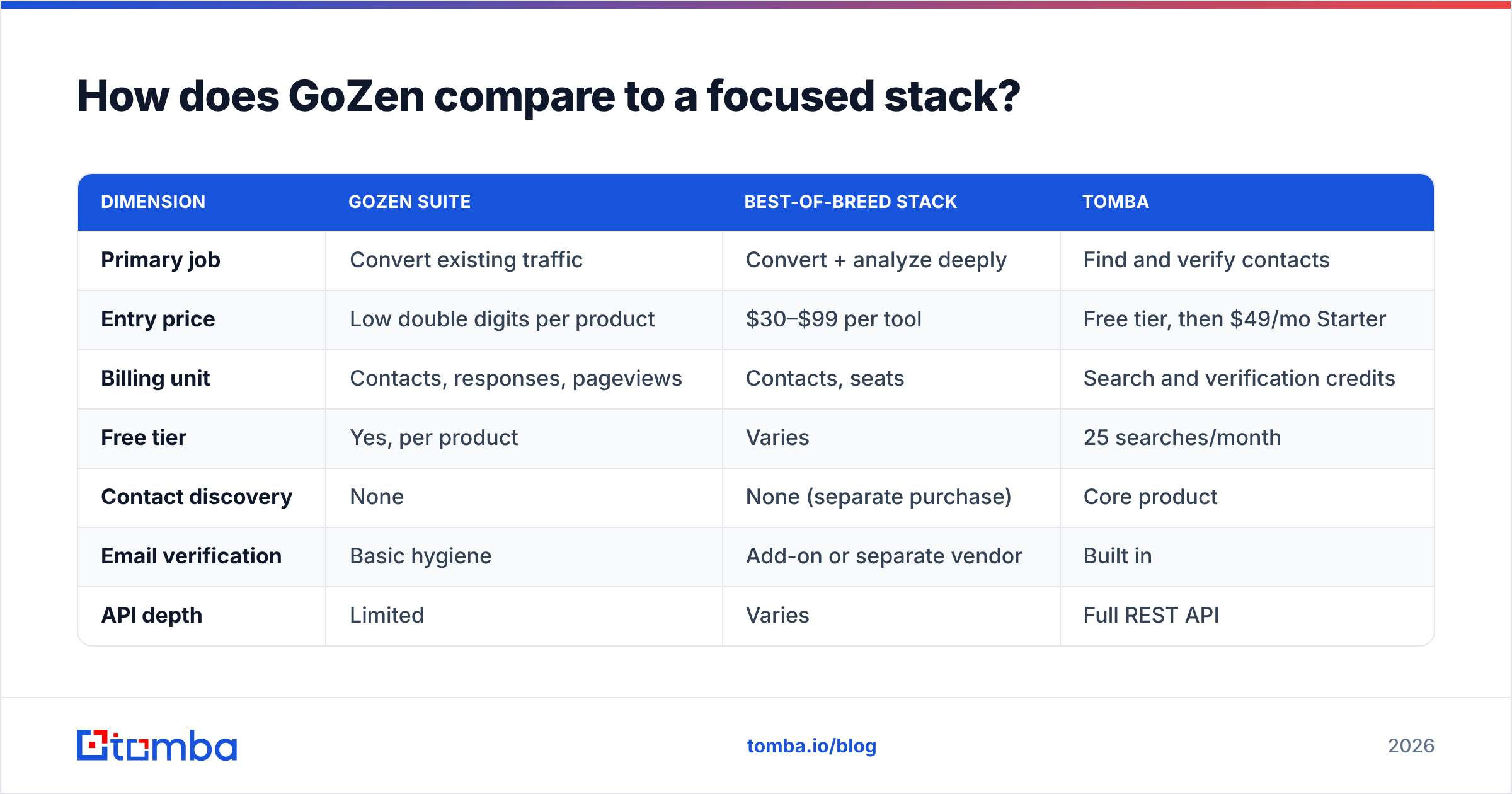
The honest comparison is not "GoZen vs one competitor." It is "GoZen suite vs the two or three tools you would otherwise buy." Here is how the categories line up.
| Dimension | GoZen suite | Best-of-breed stack | Tomba |
|---|---|---|---|
| Primary job | Convert existing traffic | Convert + analyze deeply | Find and verify contacts |
| Entry price | Low double digits per product | $30–$99 per tool | Free tier, then $49/mo Starter |
| Billing unit | Contacts, responses, pageviews | Contacts, seats | Search and verification credits |
| Free tier | Yes, per product | Varies | 25 searches/month |
| Contact discovery | None | None (separate purchase) | Core product |
| Email verification | Basic hygiene | Add-on or separate vendor | Built in |
| API depth | Limited | Varies | Full REST API |
| Best for | SMB inbound on a budget | Scaling teams with budget | Outbound and enrichment |
And on the pure pricing axis, against the tools people actually shortlist alongside it:
| Plan level | GoZen (per product) | Typical SMB alternative | Tomba |
|---|---|---|---|
| Free | Capped but persistent | Often trial only | 25 searches/mo |
| Entry paid | ~$10–$30/mo | $29–$49/mo | $49/mo Starter |
| Mid tier | Scales with usage metric | $79–$149/mo | $99/mo Growth |
| High tier | Custom | $300+/mo | $249/mo Pro |
| Enterprise | Quote | Quote | Custom |
Two conclusions fall out of that. First, for a single product at low volume, GoZen is hard to beat on price. Second, the moment you need three of the five products, the arithmetic advantage narrows sharply — and you inherit the integration tax of a suite that is not fully integrated.
If your gap is on the data side rather than the capture side, these are not competitors at all. GoZen and a contact-data tool sit in the same funnel at different stages: one finds the person, the other converts them. Compare Tomba pricing against a data vendor, not against a form builder. For teams that prefer to buy prepaid, pre-built lists instead of searching domain by domain, BookYourData is a well-regarded option in that adjacent category and worth a look alongside credit-based finders.
Is the GoZen lifetime deal worth it?#
Sometimes — and the test is boring but reliable.
- Divide the one-time price by the monthly plan it replaces. If the payback period is under 14 months and you are confident you will still be running this motion next year, it is a good deal.
- Check what the LTD tier caps. Lifetime deals almost always freeze you at a specific usage tier. If you outgrow the response or subscriber cap in six months, you are paying twice.
- Confirm whether future products are included. "Lifetime access to GoZen" and "lifetime access to GoZen Forms" are very different purchases.
- Assume no roadmap guarantee. You are buying today's product. Treat future features as upside, not as part of the valuation.
For a solo operator running one quiz funnel and a popup, an LTD is often the single best-value purchase on this list. For a team expecting 10x traffic growth, it is a tier you will blow past.
What should you check before you buy GoZen?#
Run these five checks in order. Each one takes under twenty minutes and each has killed a purchase for someone.
- Model your worst month, not your average. Take your highest traffic month from the last year and price the plan at that volume. That is your real cost.
- Test the one integration you cannot live without. Usually your CRM. Build it in the free tier before you pay. If it needs Zapier, add that cost to the comparison.
- Send a real campaign to a seed list. Check inbox placement across Gmail, Outlook, and one corporate domain. Verify your list first so you are testing the platform and not your own data.
- Export your data on day one. Confirm you can get contacts and responses out in a clean CSV. Portability is your only leverage later.
- Decide whether your bottleneck is capture or supply. If your forms convert fine but too few people see them, a better popup tool will not fix it. That is a top-of-funnel supply problem, and it needs prospecting or data enrichment, not another builder.
That last point is where most GoZen buyer's remorse comes from. The suite is competent at what it does. It just does not do the thing many buyers actually needed.
The verdict#
GoZen is a legitimately good-value set of SMB marketing tools with an unusual go-to-market: five products, five prices, one brand. If you need interactive forms or exit-intent popups on a small budget, it earns a place on the shortlist and the free tiers make evaluation risk-free. If you need deep reporting, enterprise controls, or a genuinely unified platform, the suite's seams will show within a quarter.
What it will not do — under any plan, at any price — is fill your pipeline with people who do not already visit your site.
That is the gap worth closing next. If your capture layer works but the top of the funnel is thin, start with contact supply: the Tomba Email Finder turns a target company domain into verified, deliverable contacts, with verification built into the same workflow so nothing lands on a bounced address. The free tier gives you 25 searches a month to test against your own target list before you spend anything — pair it with whatever capture tool you choose, and you finally have both halves of the funnel covered.
Related guides#
Ready to find emails that actually work?
Join 150,000+ professionals who stopped guessing and started sending. Free credits on signup — no credit card required.
Get the Tomba newsletter
Practical outbound tactics and product updates — once every two weeks.
About the author