9 Best Grata Alternatives in 2026 for Deal Sourcing Teams
Grata is strong at finding private companies nobody has heard of — and priced for funds, not teams. Here are nine Grata alternatives ranked by data depth, contact accuracy and what they actually cost.
TL;DR
- Grata's edge is discovery. It finds bootstrapped, never-funded firms that Crunchbase and PitchBook never indexed. Its weak spot is contact data.
- The other weak spot is price. Quotes are annual and sized for funds, not four-person deal teams.
- Want the same search at a lower cost? The best Grata alternatives for that are Sourcescrub, Inven, and Cyndx.
- Need funded companies and real financials? PitchBook and Crunchbase are the honest swaps.
The rest of the list solves the other half of the job.
- Already have a target list? Then you need verified emails and phones. Tomba, Cognism, and BookYourData cost a fraction of a Grata seat.
- Most teams overbuy. One search tool plus one contact tool, joined by an API, runs under $500 a month.
- No drop-in clone exists. Pick by your real bottleneck: find the company, or reach the human.
Grata built its name on a hard problem. Most interesting private companies are invisible. They never raised money, never filed, and never showed up in a funding database. Grata crawls company websites and indexes what they say. So you can search "companies that install commercial HVAC systems in the Southeast" and get a real list. A funding database cannot do that.
That part works. But Grata does not publish prices. Contracts run a year. Buyers report five-figure commitments. If you run a middle-market PE firm with a full sourcing team, the math holds. If you are a corp dev team of two, an M&A boutique, or a B2B sales org, it usually does not.
This guide ranks nine Grata alternatives. For each one you get what it does better, and who it fits.
What does Grata actually do — and where does it stop?#
Grata is a search engine for private companies. Three things define it:
- Website-derived taxonomy. Companies report SIC and NAICS codes badly. Grata reads what a firm says it does on its own site, then groups similar firms from that text.
- Long-tail coverage. The index leans small, private, and never venture-backed. That is the exact segment funding-first databases miss.
- Deal-team workflow. Lists, similar-company search, CRM sync, and outreach tracking are built for sourcing, not for marketing.
Where it stops is just as clear:
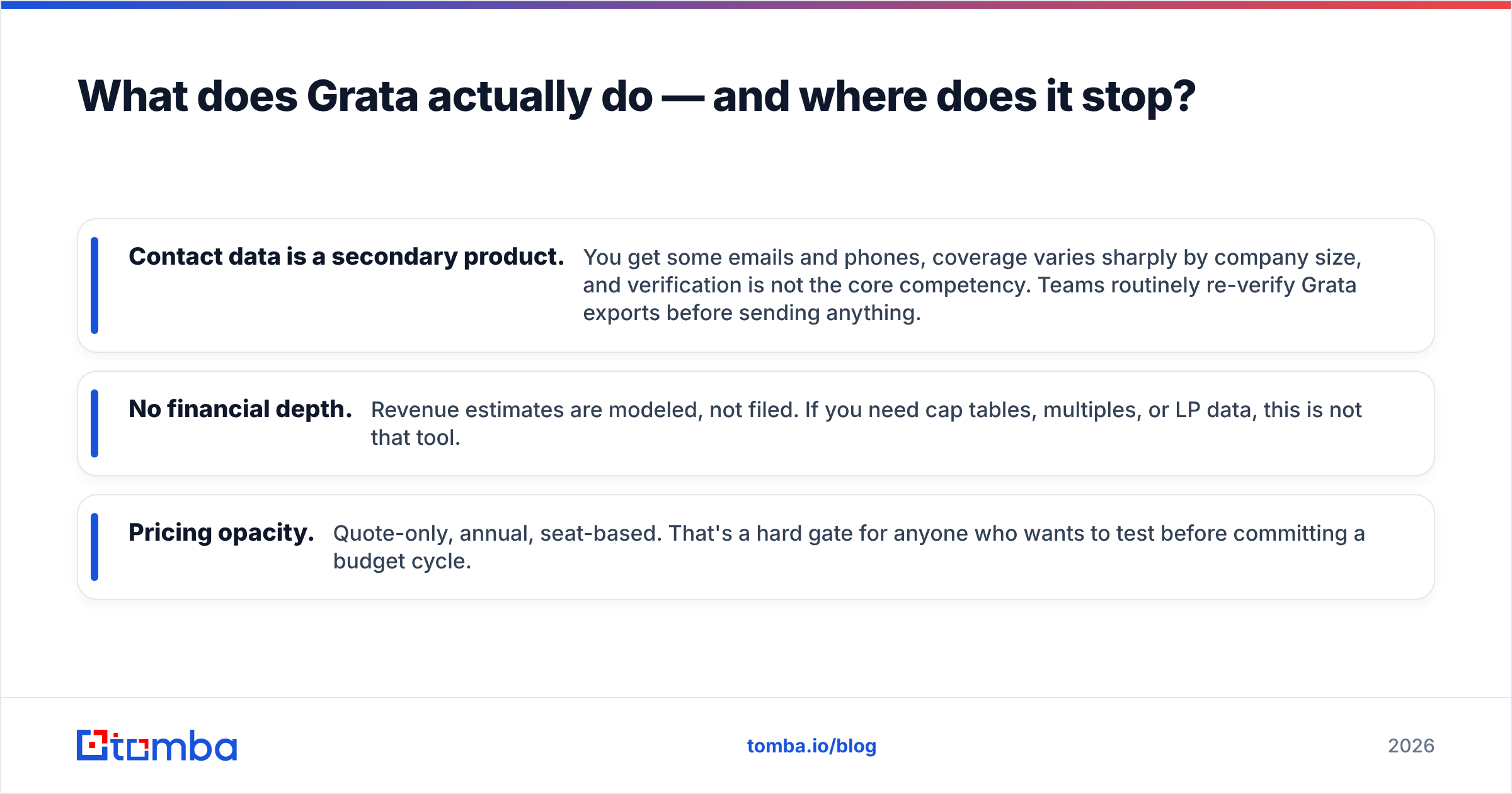
- Contact data is a side product. You get some emails and phones. Coverage swings by company size. Most teams re-verify Grata exports before they send.
- No financial depth. Revenue figures are modeled, not filed. For cap tables, multiples, or LP data, look elsewhere.
- Hidden pricing. Quote only, annual, per seat. That blocks anyone who wants to test first.
Ask one question before you shop for Grata alternatives: are you failing to find companies, or failing to reach people at companies you already found? Those are two different products. Mixing them up is why so much software budget gets burned.
Which Grata alternatives are worth comparing in 2026?#
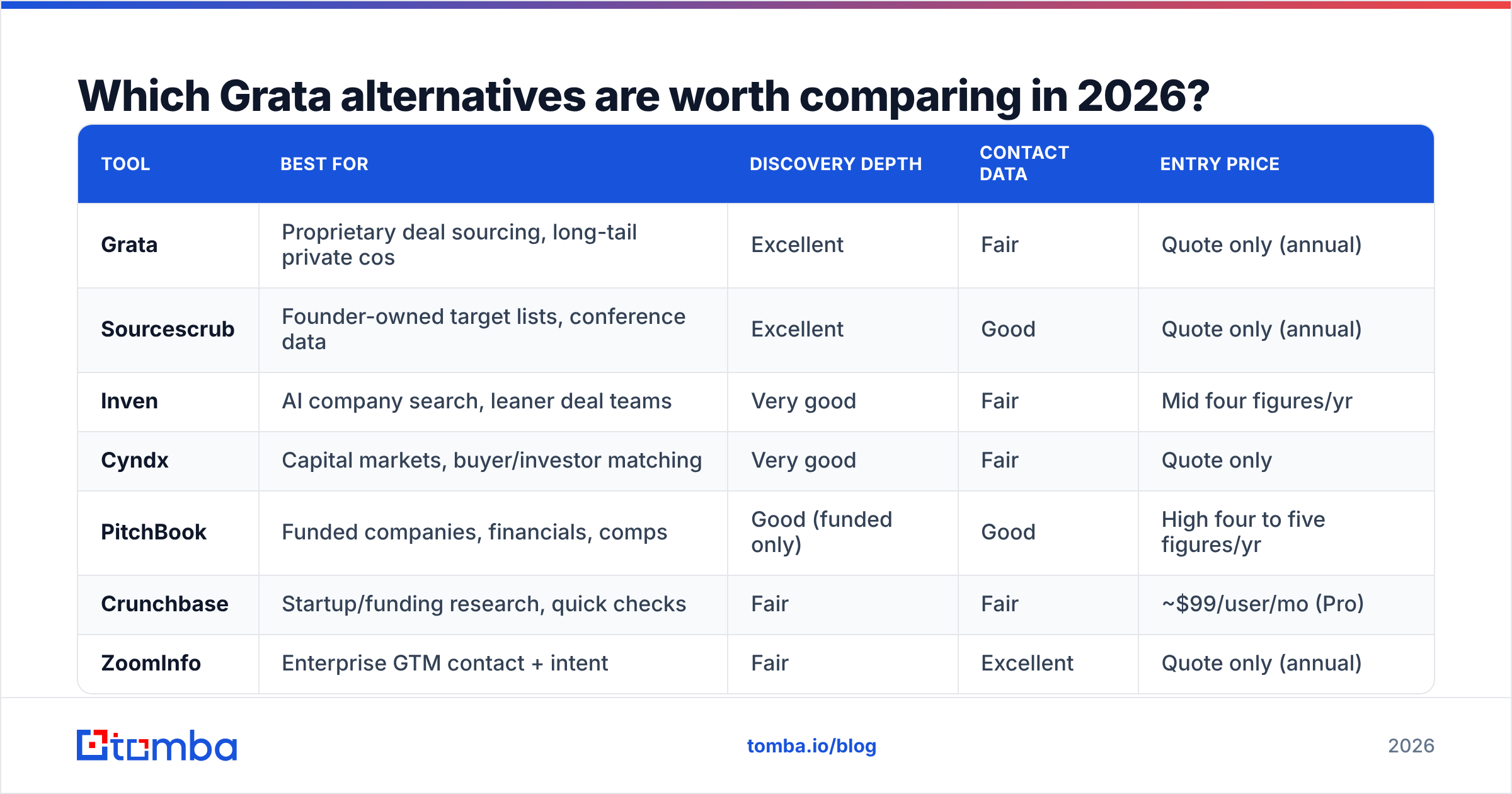
| Tool | Best for | Discovery depth | Contact data | Entry price |
|---|---|---|---|---|
| Grata | Proprietary deal sourcing, long-tail private cos | Excellent | Fair | Quote only (annual) |
| Sourcescrub | Founder-owned target lists, conference data | Excellent | Good | Quote only (annual) |
| Inven | AI company search, leaner deal teams | Very good | Fair | Mid four figures/yr |
| Cyndx | Capital markets, buyer/investor matching | Very good | Fair | Quote only |
| PitchBook | Funded companies, financials, comps | Good (funded only) | Good | High four to five figures/yr |
| Crunchbase | Startup/funding research, quick checks | Fair | Fair | ~$99/user/mo (Pro) |
| ZoomInfo | Enterprise GTM contact + intent | Fair | Excellent | Quote only (annual) |
| Cognism | EU/UK phone-verified outbound | Fair | Excellent | Quote only (annual) |
| BookYourData | Pay-as-you-go verified B2B lists | N/A (list-first) | Excellent | Credit packs, no contract |
| Tomba | Email finding + verification + enrichment API | N/A (domain-first) | Excellent | Free tier, then $49/mo |
Read the Grata alternatives table as two groups. The top half helps you find the company. The bottom half helps you reach the human. Grata sits in the middle. It charges search-tier prices for contact data that most buyers top up anyway.
Which Grata alternatives replace the discovery engine?#
Sourcescrub#
This is the closest rival in spirit. Sourcescrub indexes bootstrapped and founder-owned firms. It adds one thing Grata does not push: conference and trade-show attendee lists. It also curates source lists, such as award winners, industry rankings, and association directories. For split-up markets like home services, specialty manufacturing, or niche software, that source layer is a real edge. Pricing is quote-only and annual too. So this is a sideways move on cost, not a cut.
Pick it if: your sourcing thesis runs through trade groups and industry events, not funding rounds.
Inven#
Inven is a newer AI-native tool. It aims at teams that balked at Grata's price. You get plain-language company search, list building, and CRM export. Deep long-tail coverage still trails Grata and Sourcescrub in some verticals. For broad searches it holds up, and entry pricing is much lower. Of the Grata alternatives here, it is the closest match on daily workflow.
Pick it if: you liked the Grata demo and choked on the quote.
Cyndx#
Cyndx works from a different angle. It matches capital-markets parties: buyers, investors, and targets that fit one deal. Your job may be to answer "who would buy this business." If so, Cyndx fits that shape better than a search index does.
Pick it if: you are on the sell side or raising capital, not building an acquisition funnel.
PitchBook and Crunchbase#
Both are the honest answer when your targets are funded. PitchBook gives you deal history, valuations, comps, investor ties, and financials. No website crawler matches that rigor. Crunchbase is far cheaper and far thinner. It is fine for quick company checks and startup landscape maps.
Neither will find the $14M-revenue industrial coatings firm in Ohio that never raised a dollar. That is the trade.
Pick them if: backed companies are your universe and you need numbers for a memo.
Which Grata alternatives replace the contact data?#
This is where most of the wasted money sits. A deal team buys a search platform. They export 400 companies. Then they find the contact fields half empty or stale. So they buy a second tool anyway.
You may already have your target universe. It might come from a search tool, a trade directory, a conference list, or a scraped set of domains. If so, skip the five-figure platform. You need a contact layer instead.
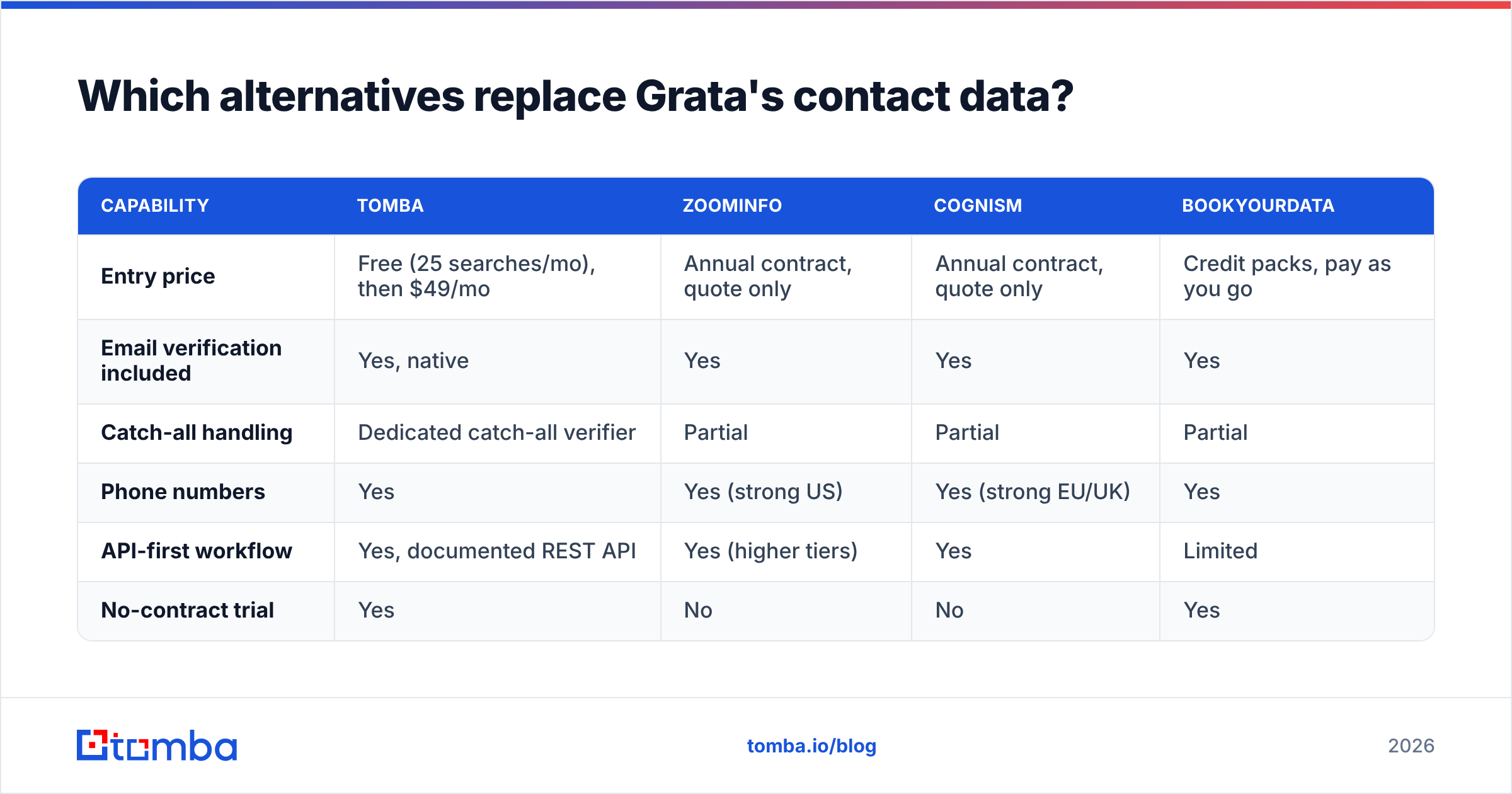
| Capability | Tomba | ZoomInfo | Cognism | BookYourData |
|---|---|---|---|---|
| Entry price | Free (25 searches/mo), then $49/mo | Annual contract, quote only | Annual contract, quote only | Credit packs, pay as you go |
| Email verification included | Yes, native | Yes | Yes | Yes |
| Catch-all handling | Dedicated catch-all verifier | Partial | Partial | Partial |
| Phone numbers | Yes | Yes (strong US) | Yes (strong EU/UK) | Yes |
| API-first workflow | Yes, documented REST API | Yes (higher tiers) | Yes | Limited |
| No-contract trial | Yes | No | No | Yes |
Tomba is domain-first. Give it a company domain. It returns the people and the email pattern, then checks deliverability before you send. The domain search pairs well with a Grata-style export. You have the company; you need the humans. Pricing is public. It starts with a free tier of 25 searches a month, then $49/mo Starter, $99/mo Growth, and $249/mo Pro. For a boutique sending 200 emails a month, that is a rounding error next to a search seat.
ZoomInfo still holds the deepest US contact and intent data. For an enterprise sales org it is a fair buy. It is not cheaper than Grata. It is not better at private-company search.
Cognism is the pick if your targets sit in Europe. Phone-verified mobiles and GDPR-aware sourcing are its real edge.
BookYourData goes pay as you go. Buy verified contact credits when you need them. There is no annual lock-in, and an accuracy guarantee comes with it. Some teams have lumpy needs: one big list this quarter, nothing next. That model fits them better than any subscription.
How do you actually build a cheaper stack than Grata?#
The cheapest stack of Grata alternatives has two layers plus glue. Here is the order most sub-enterprise teams land on:
- Search layer. Pick one. Inven for AI search on a budget. Sourcescrub for a trade-show thesis. Crunchbase for funded targets. Export domains, not contacts.
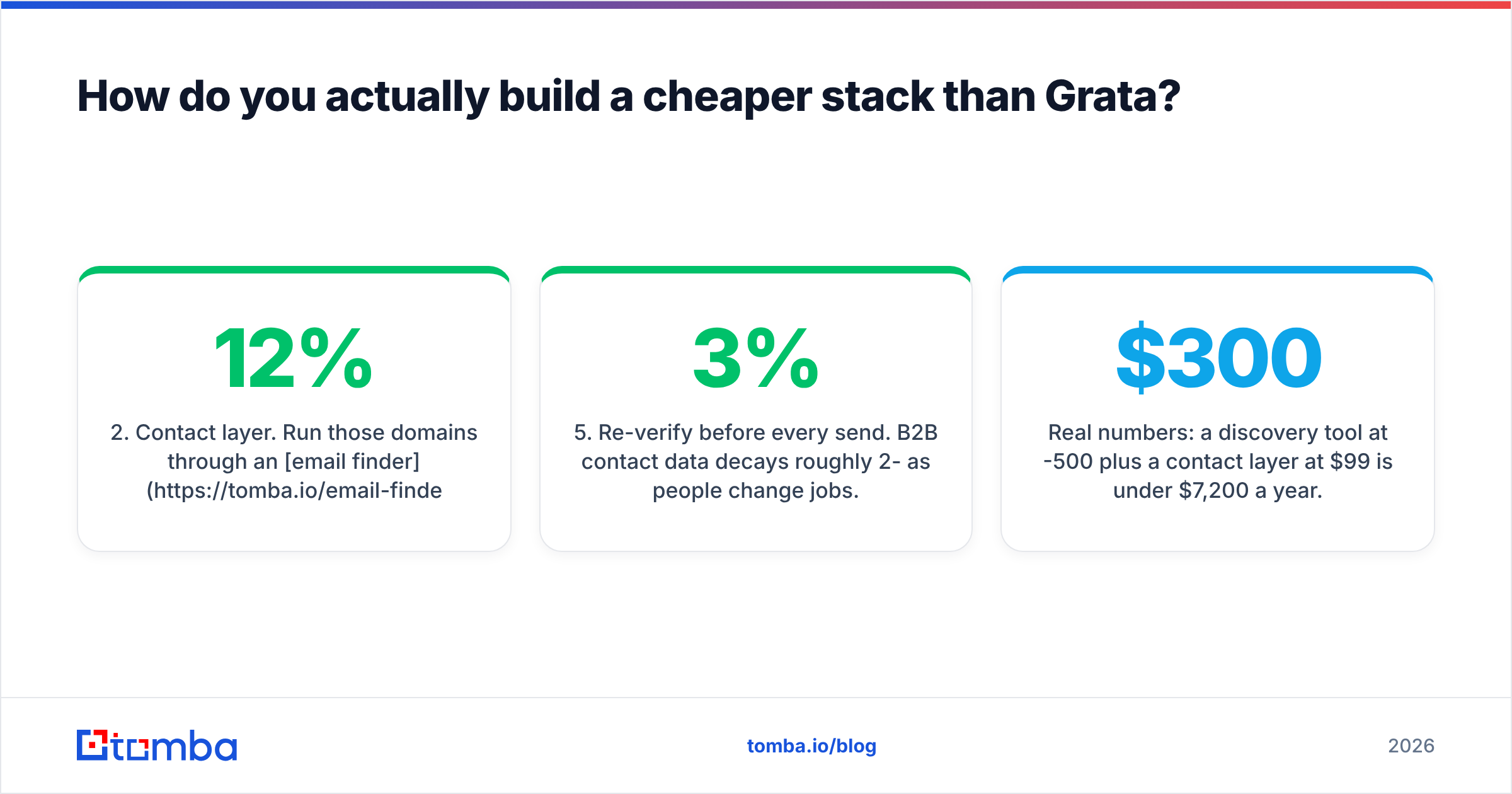
- Contact layer. Run those domains through an email finder, then verify. Accuracy is won or lost here. A 12% bounce rate hurts your sending domain fast.
- Enrichment and sync. Push clean rows into your CRM. Data enrichment adds headcount, tech stack, and social profiles.
Two habits keep the stack honest:
- Automate the bulk work. Processing hundreds of domains a week? Use the Tomba API or a bulk job. Copy-paste is the cost nobody budgets for.
- Re-verify before every send. B2B contact data decays 2-3% a month as people switch jobs. A list built in March is wrong by September.
Real numbers help. A search tool at $300-500 a month plus a contact layer at $99 a month is under $7,200 a year. One Grata seat usually costs more. The trade is simple. You manage two vendors and one integration instead of one login. For a small team, that is a fair swap.
When is Grata still the right call?#
Be honest here. Grata alternatives are not always the answer. Grata wins when:
- Proprietary sourcing is the whole business model. If your edge is off-market deals, the index pays for itself on one close.
- Your verticals are obscure. The more niche and unlisted the target, the wider Grata's lead.
- Several analysts share lists. Collaboration and CRM workflow matter more at five seats than at one.
- Budget cycles are annual anyway. If you already sign for PitchBook or Sourcescrub, one more annual contract changes little.
Grata's G2 reviews show the same split. Search quality and similar-company matching score high. Contact coverage and pricing clarity score low. Read them before the demo. Then ask about contact coverage in your vertical, using your own sample list.
What should you do next?#
Start by naming your bottleneck. Pull your last 100 outbound attempts. Could you not build the target list? That is a search problem. Weigh the Grata alternatives above on coverage, then negotiate on seat count. Did you have the list but reach nobody? That is a contact problem, and more search spend will not fix it.
The second case is the common one. The fast path: take your existing list of company domains and run it through the Tomba Email Finder. You get verified, deliverable contacts on companies you already picked. A free tier lets you test accuracy on your own targets first. Transparent pricing starts at $49 a month if it works. Test 50 domains from your current pipeline. Compare the bounce rate to your current platform. That one test answers the buying question faster than any vendor demo.
Related guides#
Ready to find emails that actually work?
Join 150,000+ professionals who stopped guessing and started sending. Free credits on signup — no credit card required.
Get the Tomba newsletter
Practical outbound tactics and product updates — once every two weeks.
About the author