Grata vs Kipplo (2026): Which Deal Sourcing Tool Wins?
Grata and Kipplo both promise to surface private companies you cannot find in a CRM. One is an enterprise deal-sourcing engine, the other a lighter, cheaper search layer. Here is where each one actually holds up — and where both leave you short.
Grata vs Kipplo comes down to depth versus speed. Grata digs deeper into private-company data. Kipplo builds lists faster and costs less. Here is the short version.
TL;DR
- Grata is the established private-company search engine for M&A, private equity and corporate development teams. It brings deep coverage of the long tail, similarity search, and a sourcing workflow layer. Pricing is enterprise, annual, and quote-only.
- Kipplo is the lighter, newer entrant. It sells a cheaper company-discovery and list-building layer. It is faster to trial, but it publishes far less, and its deal-workflow tooling is thin.
- Neither is an email tool. Both hand you companies and rough contact records. Neither one checks that a mailbox still accepts mail. That gap is where most sourcing sequences quietly die.
- Pick Grata if sourcing is the job and a five-figure annual contract is normal for you. Pick Kipplo if you need a list-building layer and your budget is per seat, per month.
- Layer a dedicated finder and verifier either way. A bulk email finder and email verifier turn a company list into an outreach list — without a second five-figure line item.
What are Grata and Kipplo, exactly?#
They solve the same first-mile problem from opposite ends of the market.
Grata launched in 2016 as a search engine for private companies. It targets the ones that never file, never appear in Crunchbase, and never show up in a standard CRM enrichment pass. The core bet was simple. You describe a business in plain language — "industrial IoT retrofit for HVAC, US, under 200 employees" — and you get a defensible list back.
Grata was acquired by Datasite in 2025. That deal pushed it toward the full M&A workflow: source, track, diligence, close. The change matters for your decision. Grata is now part of a deal platform, not a standalone data subscription.
Kipplo sits in the newer wave of AI-assisted discovery tools. Describe an ideal customer or acquisition target, get a ranked list, export it. It competes on setup speed and price, not on depth of coverage or workflow.
One point deserves blunt treatment. Kipplo publishes far less public information than Grata does. There are fewer methodology notes, less pricing transparency, and thinner review volume on G2. Treat every Kipplo claim here as directional. Confirm the specifics on a live demo before you sign anything.
That asymmetry is itself a data point. When you buy a data product, the vendor's willingness to document its sources is part of the product.

Grata vs Kipplo: how do they compare head-to-head?#
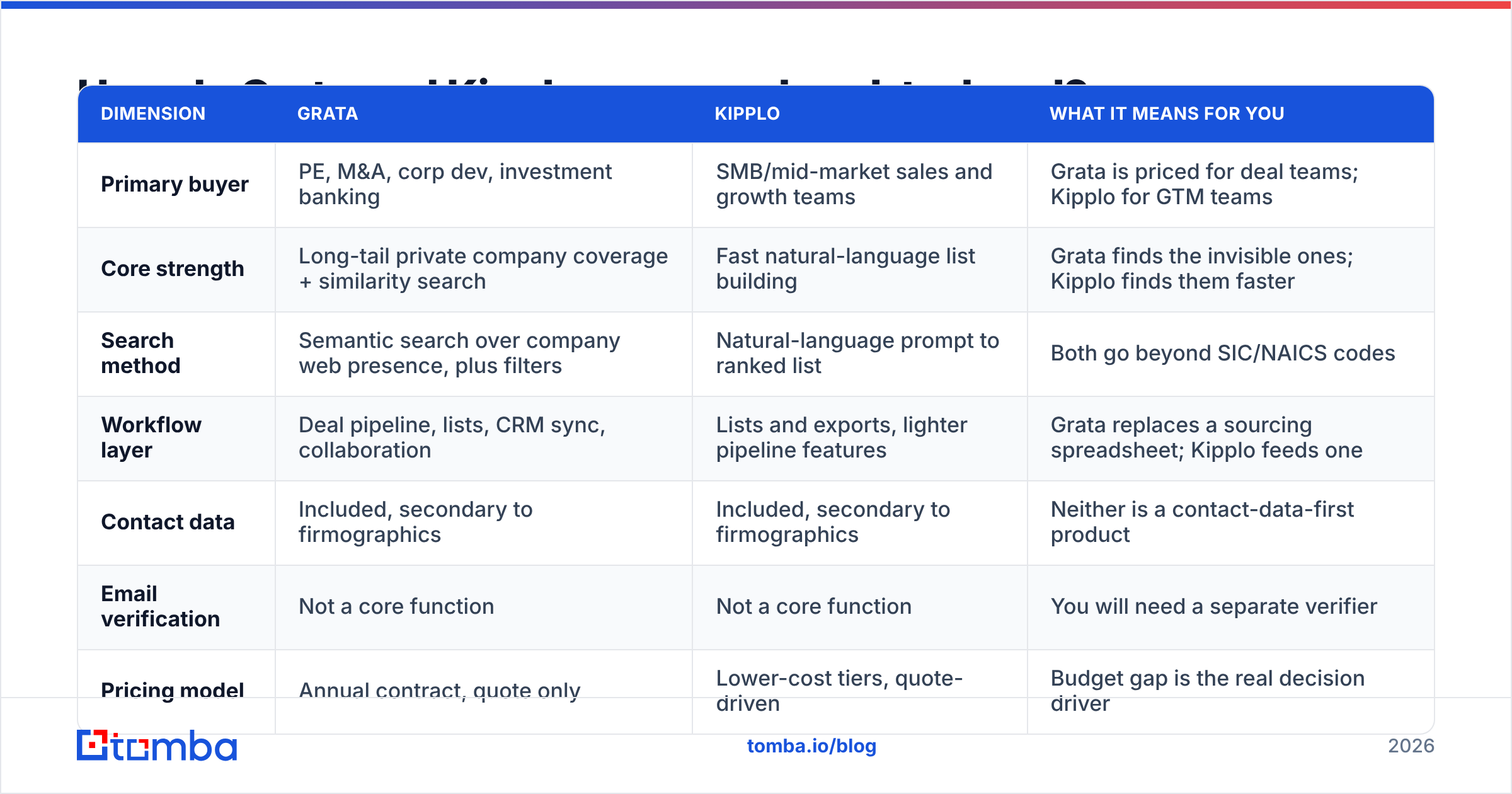
Here is the honest side-by-side. Where a vendor does not publish a number, the table says so. Invented precision is worse than an admitted gap.
| Dimension | Grata | Kipplo | What it means for you |
|---|---|---|---|
| Primary buyer | PE, M&A, corp dev, investment banking | SMB/mid-market sales and growth teams | Grata is priced for deal teams; Kipplo for GTM teams |
| Core strength | Long-tail private company coverage + similarity search | Fast natural-language list building | Grata finds the invisible ones; Kipplo finds them faster |
| Search method | Semantic search over company web presence, plus filters | Natural-language prompt to ranked list | Both go beyond SIC/NAICS codes |
| Workflow layer | Deal pipeline, lists, CRM sync, collaboration | Lists and exports, lighter pipeline features | Grata replaces a sourcing spreadsheet; Kipplo feeds one |
| Contact data | Included, secondary to firmographics | Included, secondary to firmographics | Neither is a contact-data-first product |
| Email verification | Not a core function | Not a core function | You will need a separate verifier |
| Pricing model | Annual contract, quote only | Lower-cost tiers, quote-driven | Budget gap is the real decision driver |
| Free trial | Demo-gated | Demo-gated / limited self-serve | Neither lets you fully test at scale for free |
| API access | Yes, on higher tiers | Limited | Matters if you automate sourcing |
The pattern is clear. Grata is the heavier, more complete system, and its buyer measures ROI in closed deals. Kipplo is the lighter tool, and its buyer measures ROI in meetings booked. Comparing them on raw company counts misses the point. They compete for different budget lines.
Which one actually finds better companies?#
Grata, for the long tail. Kipplo, for speed.
Grata's edge is coverage of companies with almost no structured footprint. Think of the $8M-revenue manufacturer with a five-page website and no funding history. Grata builds its index from company websites rather than filings or funding databases. That is why it surfaces businesses that funding-data tools never see.
Its "find similar companies" function is the feature users cite most. Feed it three portfolio companies and get back a ranked universe of lookalikes. For thesis-driven sourcing, that is the whole product.
Kipplo's edge is time-to-first-list. Natural-language prompts cut out the filter-tuning cycle that eats an afternoon on older platforms. Say your job is to build 20 segment lists this quarter and test which one converts. That speed compounds. Say your job is to map every company in a fragmented niche and miss nothing. It does not.
Four practical tests to run in any trial, in this order:
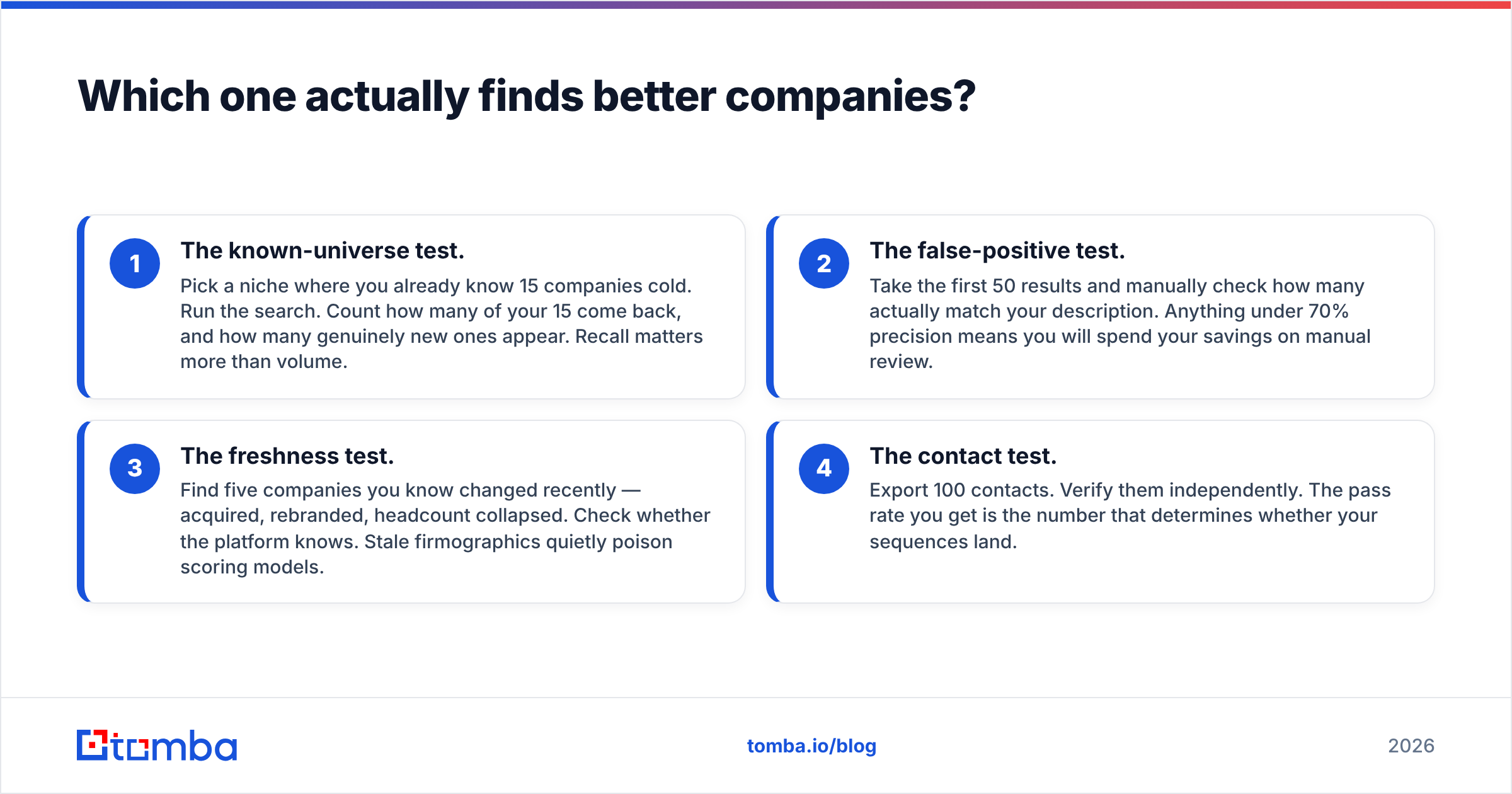
- The known-universe test. Pick a niche where you already know 15 companies cold. Run the search. Count how many of the 15 come back, and how many new ones appear. Recall matters more than volume.
- The false-positive test. Take the first 50 results. Check by hand how many really match your description. Under 70% precision means you will spend your savings on manual review.
- The freshness test. Find five companies you know changed recently — acquired, rebranded, headcount collapsed. See whether the platform knows. Stale firmographics quietly poison scoring models.
- The contact test. Export 100 contacts. Verify them somewhere else. That pass rate decides whether your sequences land.
The fourth test is where both products fall short of their own firmographic quality. It deserves its own section.
Whose contact data can you actually email?#
Neither vendor's — not without a verification step in between.
This is not a knock on either company. It is a structural fact about company-intelligence platforms. Their index is built to find and describe businesses. Contact records are a convenience layer bolted on top, and they refresh on a slower cycle than the firmographics.
So you get a real person at a real company, with an email address that worked fourteen months ago and bounces today.
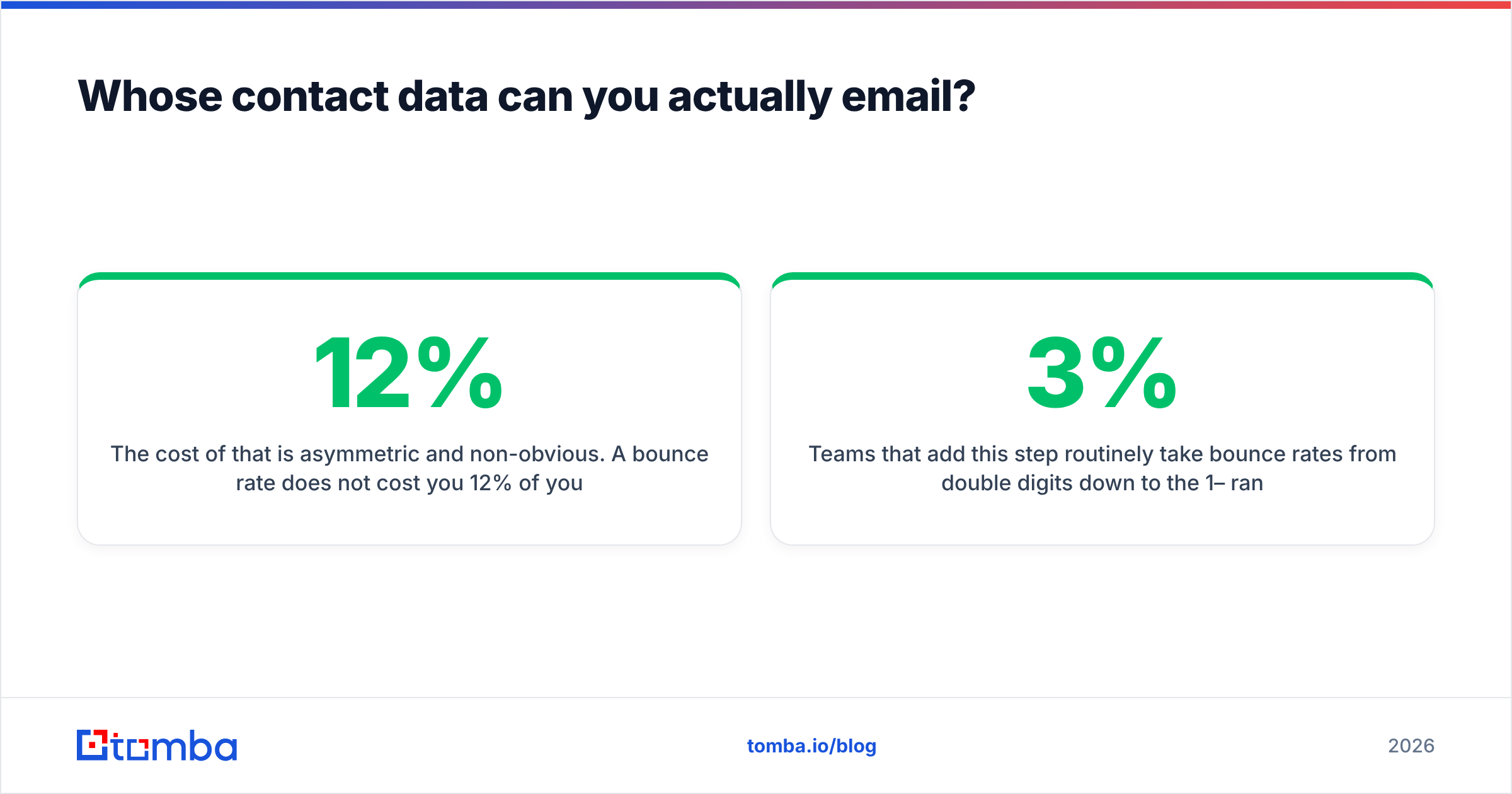
The cost is asymmetric and easy to miss. A 12% bounce rate does not cost you 12% of your pipeline. It costs you your sender reputation. That drop then suppresses delivery for the 88% of contacts who were perfectly valid. One bad import can degrade a domain for weeks.
The fix is a four-step pattern that costs a fraction of either platform's license:
- Step 1 — Re-find, don't trust. Run the exported domains through a dedicated email finder or domain search. You get current patterns and current people instead of a cached record.
- Step 2 — Verify before send. Push every address through an email verifier with SMTP-level checking. Route catch-all domains to a catch-all verifier instead of guessing.
- Step 3 — Enrich what survives. Add job titles, seniority and phone data to the verified subset only, via data enrichment. Enriching records you will never email is pure waste.
- Step 4 — Automate the loop. Wire it through the Tomba API. The sequence then runs on every new export, not whenever someone remembers.
Teams that add this step routinely cut bounce rates from double digits to the 1–3% range. That is not a small deliverability tweak. It is the difference between a sequence that lands and one that gets your domain filtered.

How does pricing compare?#
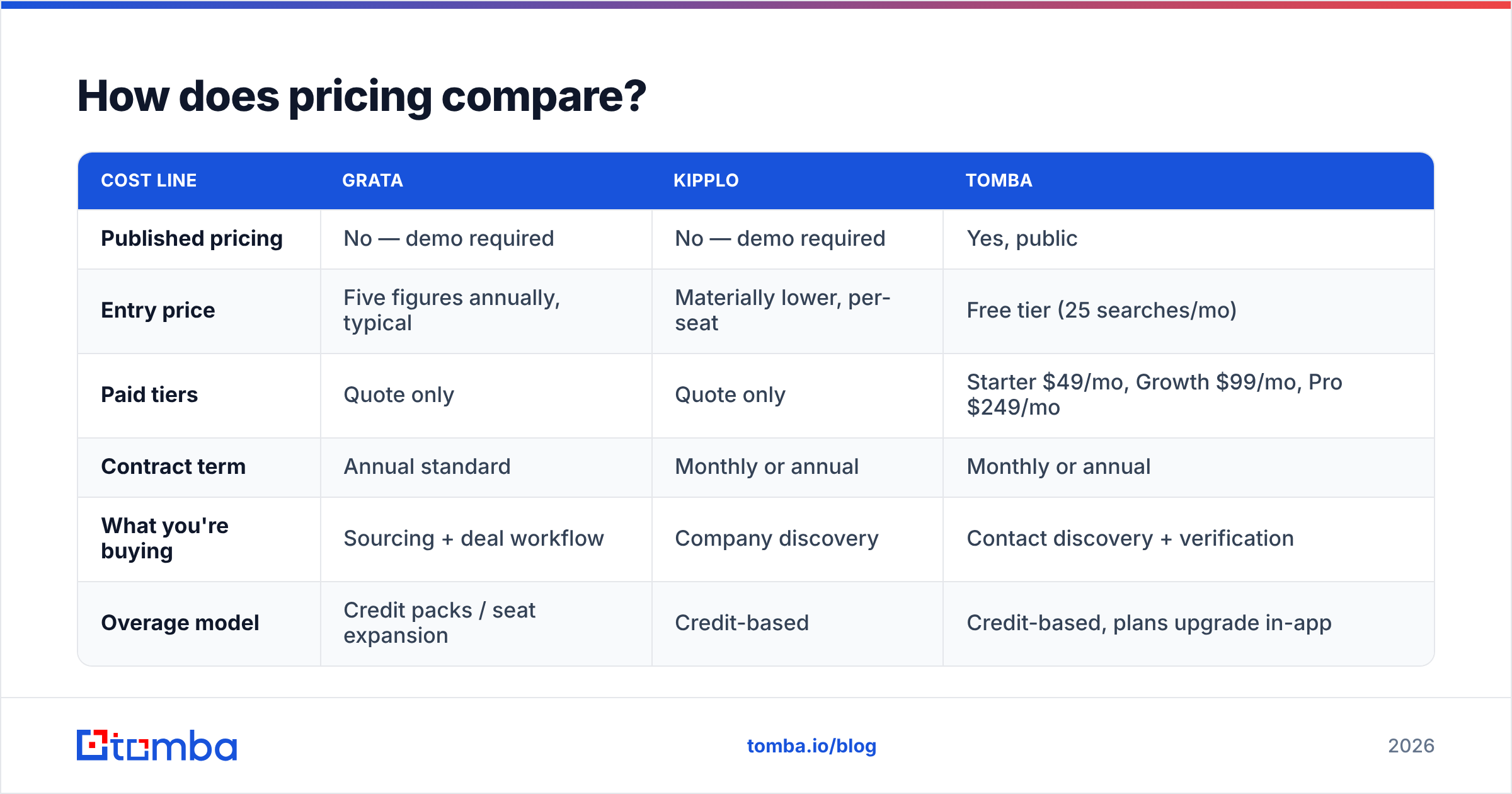
The Grata vs Kipplo budget gap is the real decision driver for most teams. Neither vendor publishes a price list. Both are quote-driven. Both will price you on seats, credits, and how badly they think you need the tool. Here is the shape of the market, next to the contact-data layer you will need either way.
| Cost line | Grata | Kipplo | Tomba |
|---|---|---|---|
| Published pricing | No — demo required | No — demo required | Yes, public |
| Entry price | Five figures annually, typical | Materially lower, per-seat | Free tier (25 searches/mo) |
| Paid tiers | Quote only | Quote only | Starter $49/mo, Growth $99/mo, Pro $249/mo |
| Contract term | Annual standard | Monthly or annual | Monthly or annual |
| What you're buying | Sourcing + deal workflow | Company discovery | Contact discovery + verification |
| Overage model | Credit packs / seat expansion | Credit-based | Credit-based, plans upgrade in-app |
Two things are worth naming. First, "quote only" is a negotiating position, not a technical limit. Both vendors discount at year-end, and both move on multi-year deals.
Second, these categories are not substitutes. Buying Grata does not remove your need for verification. Buying a verifier does not give you a sourcing universe. Compare Tomba pricing against the contact-data slice of either quote, and the math usually favors unbundling.
Which should you choose for your use case?#
Match the tool to the job, not to the feature list.
- Thesis-driven M&A or PE sourcing — Grata. Long-tail coverage and similarity search are the product. The Datasite path also keeps sourcing and diligence closer together. One closed deal justifies the year.
- Corporate development at a mid-size acquirer — Grata, if you run continuous market maps. Kipplo, if you look at two or three targets a year and mostly need a list.
- B2B sales prospecting into fragmented niches — Kipplo. You need fast, repeatable segment lists, not a deal pipeline. Pair it with a finder and a verifier, and your cost per usable contact drops sharply.
- Agency or consultancy building client lists — Kipplo for discovery, plus a bulk email finder for the contact layer. Client margins rarely survive an enterprise sourcing contract.
- Automated, API-first GTM workflows — Grata, if your tier includes API access. Otherwise build the pipeline on a contact API and use whichever discovery tool exports cleanly.
- Under $500 a month in total tooling — Neither, as your main spend. Start with domain search and a verifier. Build the company list by hand. Upgrade discovery once list-building becomes the real bottleneck.
What does a realistic 2026 stack look like?#
Layered, not monolithic. Data quality is now the differentiator, not data breadth. The single-vendor pitch has weakened as a result.
A workable shape:
- Discovery layer — Grata or Kipplo. Choose by budget, and by whether you need deal workflow or just lists.
- Contact layer — a dedicated finder and verifier, run on every export. This layer decides whether anything reaches an inbox.
- Enrichment layer — applied only to verified contacts, so credit burn matches real outreach.
- Sequencing layer — your existing sending tool, fed only clean addresses.
Most teams hit the same failure mode. They assume the discovery vendor covers all four layers, because the demo showed a contact record. It showed a record. It did not show a delivery guarantee.
Build the verification step in from day one, not after your first reputation incident. And check where the data comes from for every vendor in the chain. Sourcing methodology is the best predictor of how fast a record goes stale.
Verdict: Grata vs Kipplo, which one wins?#
Grata wins on depth. Kipplo wins on cost-to-start. The contact layer is on you either way.
Is sourcing private companies a core part of your job, with a budget to match? Then Grata is the more complete product and the safer institutional choice. Its coverage of businesses with no structured footprint is genuinely hard to replicate, and the deal workflow saves real hours.
Are you building segment lists for outbound with no room for a five-figure contract? Then Kipplo gets you a usable list faster and cheaper. Just verify its coverage claims yourself during a trial. Do not take marketing copy at face value.
Neither one solves the last mile. A company list is not a pipeline until you have a name, a current email address, and proof that the mailbox exists.
Start there. Run your next export through the Tomba Email Finder. The free tier includes 25 searches per month, and Starter is $49/mo. One batch will tell you how much of your expensive company data was actually mailable.
Related guides#
Ready to find emails that actually work?
Join 150,000+ professionals who stopped guessing and started sending. Free credits on signup — no credit card required.
Get the Tomba newsletter
Practical outbound tactics and product updates — once every two weeks.
About the author