Grata vs Nymeria in 2026: Company Data vs Contact Data
Grata finds the companies. Nymeria finds the people inside them. Here is how the two platforms actually compare on data model, pricing, accuracy and workflow fit — and when neither is what your outbound team needs.
TL;DR — Grata vs Nymeria in one minute
- Grata vs Nymeria is not a real head-to-head. Grata is a private-company search engine built for deal sourcing and account discovery. Nymeria is a contact-data tool. It returns emails, phone numbers and social profiles for individual people.
- Pick Grata if your bottleneck is which companies exist — niche manufacturers, bootstrapped SaaS, PE targets that never raised a round and never show up in Crunchbase.
- Pick Nymeria if your bottleneck is how to reach the person, once you already know the company and the name.
- The price gap is huge. Nymeria costs tens of dollars per month. Grata is a quote-only annual contract, and it usually lands in five figures. They are not swappable line items.
- Most outbound teams need neither at full price. If you already have your ICP account list, a dedicated email finder plus verification covers 80% of the job for a fraction of either bill.
What problem does each tool actually solve?#
Start here. Most people who search "Grata vs Nymeria" are comparing two tools from opposite ends of the go-to-market data stack.
Grata answers one question: who are the 400 companies in North America that do industrial coatings for aerospace, have 50-200 employees, and are not PE-owned yet? It crawls private company websites and reads them. Then it lets you search that index in plain language. Its buyers are private equity associates, M&A advisors, corp dev teams, and sales teams hunting in messy markets. See grata.com for their own framing.
Nymeria answers a different question: what is Jane Kowalski's work email and mobile number? It is a contact-enrichment layer. You get a browser extension plus an API. Both turn a person — usually a LinkedIn profile — into emails, phones and social handles. Its buyers are recruiters, SDRs and developers who need person-level records in bulk. Their site is nymeria.io.
Teams make one mistake here. They buy one tool and expect it to do the other job. Grata will show you a clean list of 380 target accounts with almost no usable emails attached. Nymeria will hand you a verified mobile number for a person you had to find somewhere else.

Grata vs Nymeria: how do they compare head to head?#
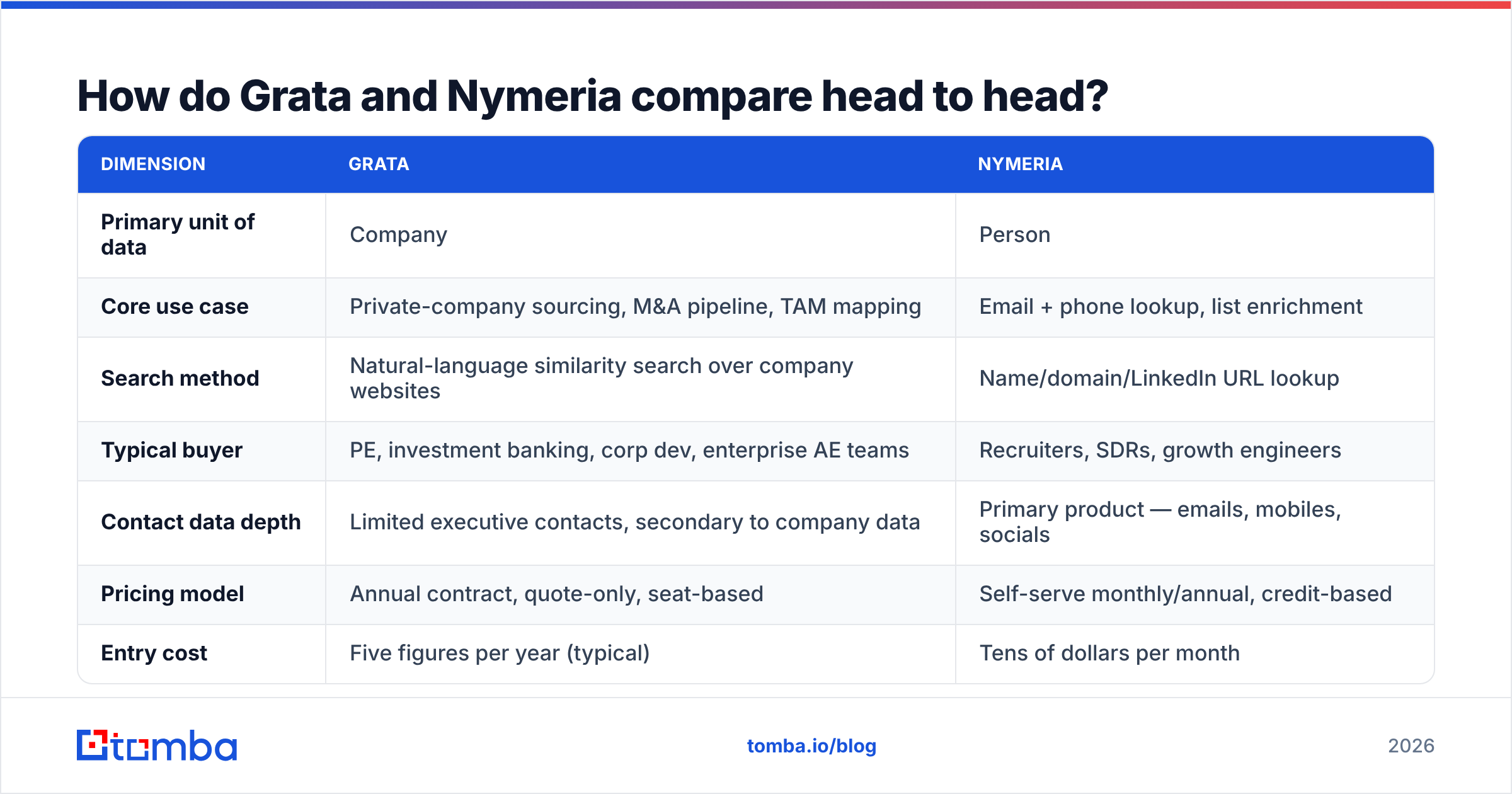
| Dimension | Grata | Nymeria |
|---|---|---|
| Primary unit of data | Company | Person |
| Core use case | Private-company sourcing, M&A pipeline, TAM mapping | Email + phone lookup, list enrichment |
| Search method | Natural-language similarity search over company websites | Name/domain/LinkedIn URL lookup |
| Typical buyer | PE, investment banking, corp dev, enterprise AE teams | Recruiters, SDRs, growth engineers |
| Contact data depth | Limited executive contacts, secondary to company data | Primary product — emails, mobiles, socials |
| Pricing model | Annual contract, quote-only, seat-based | Self-serve monthly/annual, credit-based |
| Entry cost | Five figures per year (typical) | Tens of dollars per month |
| Free tier | Demo only | Small free allowance historically offered |
| API | Yes, enterprise tier | Yes, developer-friendly |
| Bulk export | Yes, with contract limits | Yes, CSV and API |
| Best-fit team size | 5+ seats with a sourcing mandate | 1 seat to a whole SDR pod |
Pricing moves on both sides. Grata does not publish rates at all. Nymeria has repriced its credit bundles more than once. Check current numbers on G2 and with each vendor before you budget.
Is Grata worth the enterprise price tag?#
It depends on one thing. Is company discovery your real constraint?
Grata earns its cost in a single scenario. You hunt in a market where the companies you want are invisible to normal databases. Family-owned distributors. Regional MSPs. Specialty chemical shops. Firms with a four-page website, no funding history and no press coverage.
Grata's crawler reads what those sites say about themselves. It then groups them by likeness. Feed it one good example company and you get 200 more that look like it. That is a real capability, and no email-finding tool copies it. In a Grata vs Nymeria bake-off, this is the one job only Grata can do.
Where the price stops making sense:
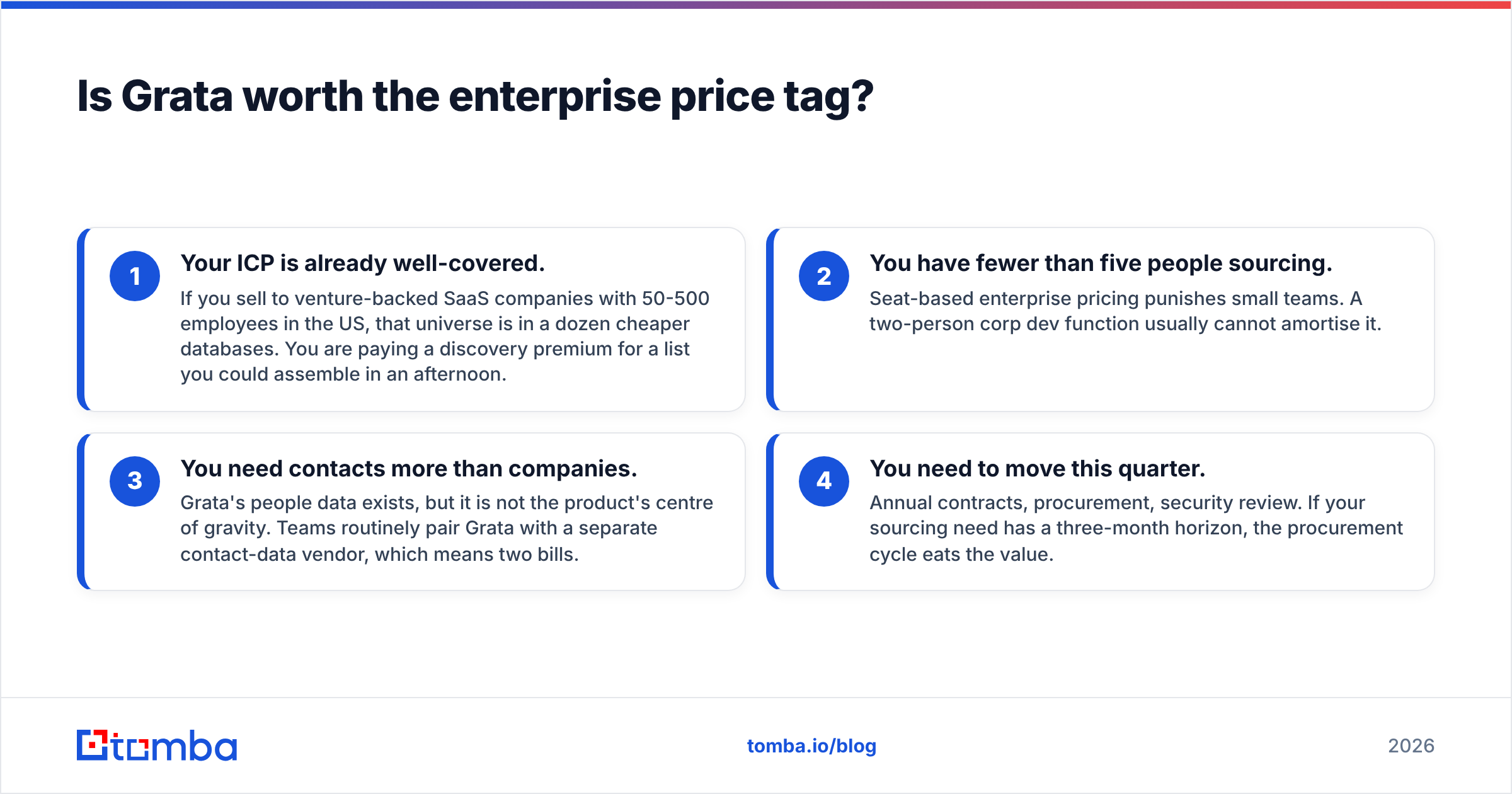
- Your ICP is already well covered. Do you sell to venture-backed SaaS firms with 50-500 staff in the US? That universe sits in a dozen cheaper databases. You would pay a discovery premium for a list you could build in an afternoon.
- You have fewer than five people sourcing. Seat-based pricing punishes small teams. A two-person corp dev function rarely earns the spend back.
- You need contacts more than companies. Grata has people data, but it is not the heart of the product. Teams often pair Grata with a separate contact vendor. That means two bills.
- You need to move this quarter. Annual contracts, procurement and security review all take time. If your need has a three-month horizon, the paperwork eats the value.
Is Nymeria accurate enough for cold outbound?#
Nymeria is solid for a self-serve tool. But it shares the weakness of every people database. It returns what sits in the database, and databases go stale.
B2B contact data decays at roughly 25-30% per year from job changes alone. The CRM vendors publish this themselves, and HubSpot has written about decay many times. A record that was right in 2024 may well be wrong today. A tool that serves cached records without a live check will hand you that dead address with full confidence.
So the accuracy question splits in two:
- Coverage — does the tool have a result for this person? Database tools like Nymeria score well here. They can fall back on old records.
- Deliverability — will that result land in an inbox today? This is where cached databases lose to live checks.
If you run cold email at volume, deliverability is the number that matters. A 12% bounce rate does more than waste sends. It damages your sender reputation and drags down every other campaign on that domain. Whatever you pick, route the output through an email verifier before the first send. Finding and verifying are two jobs, even when one vendor sells both.
What does a realistic stack look like for each use case?#
Do not pick a winner. Map the tool to the job instead. The Grata vs Nymeria choice gets easy once you name the motion:
- Deal sourcing in a fragmented market — Grata for discovery, then a contact layer for outreach. You buy Grata for the list, not the emails. Budget for both.
- Recruiting outreach — Nymeria alone is often enough. You know the target companies already. You need mobiles and personal emails for passive candidates. This is Nymeria's best lane.
- SDR outbound to a defined ICP — neither tool is the obvious answer. You usually have the account list already, from your CRM, a market map or an intent vendor. What you need is to find email addresses at scale, plus verification. That is a $49-$99 per month problem, not a $30,000 per year problem.
- Developer-built enrichment pipeline — Nymeria's API is friendly. Grata's is enterprise-gated. If you wire enrichment into your own product or CRM, API access matters more than raw record count.
- TAM sizing and market mapping — Grata, clearly. Counting companies in a category is what it was built for. No contact-data tool does it.

Where does Tomba fit in this comparison?#
Honest answer: Tomba does not compete with Grata at all. It overlaps with Nymeria only in part.
Tomba is a contact-data platform. It will not tell you that 380 industrial coatings companies exist. If company discovery in obscure markets is your problem, buy Grata and skip this section.
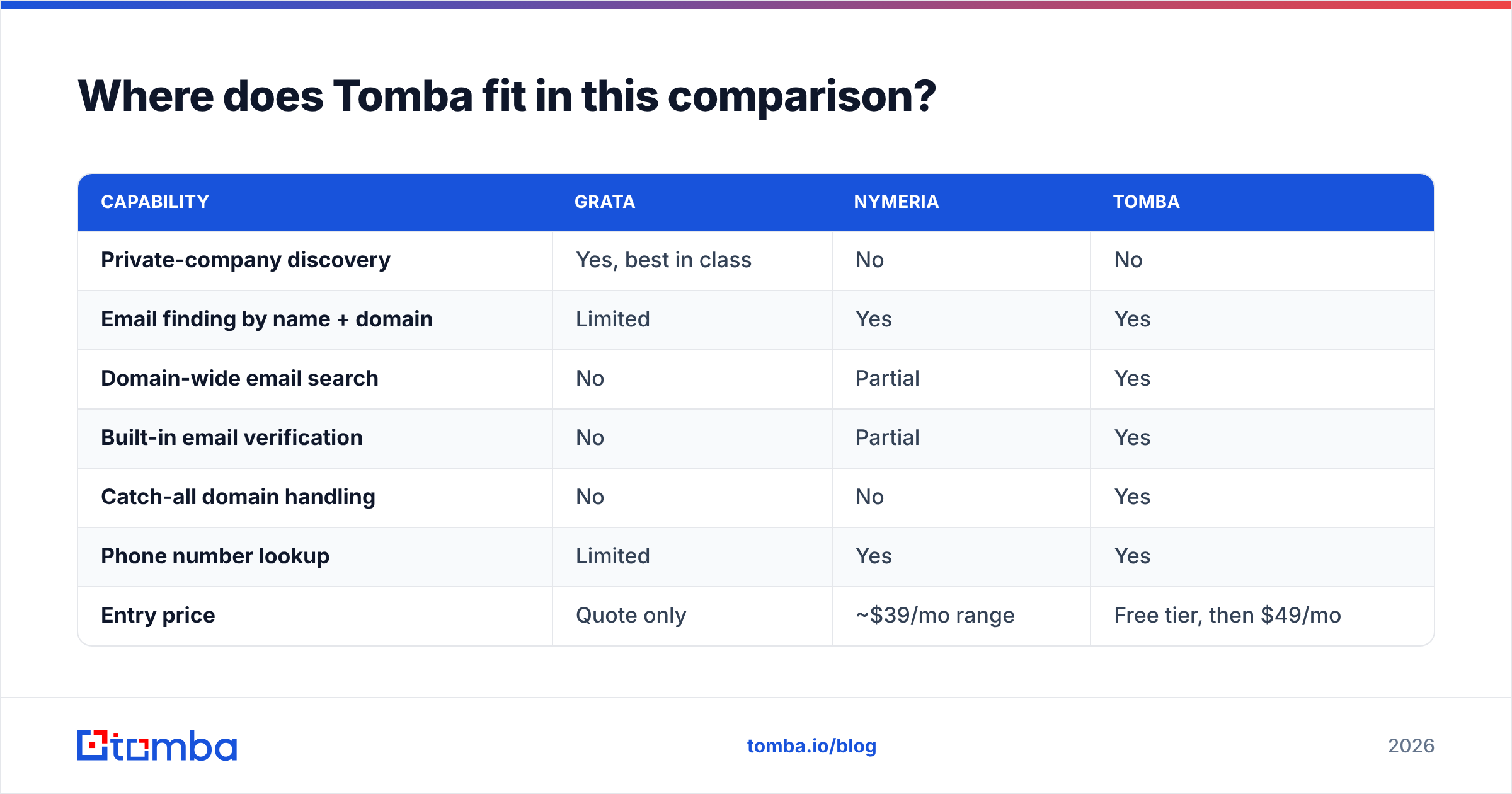
Tomba is comparable on the person-level lookup that Nymeria does. The difference sits in the plumbing. Tomba runs pattern detection plus live SMTP checks at lookup time. It does not serve results from a static cache. Verification is built into the same product, not sold as a second purchase.
| Capability | Grata | Nymeria | Tomba |
|---|---|---|---|
| Private-company discovery | Yes, best in class | No | No |
| Email finding by name + domain | Limited | Yes | Yes |
| Domain-wide email search | No | Partial | Yes |
| Built-in email verification | No | Partial | Yes |
| Catch-all domain handling | No | No | Yes |
| Phone number lookup | Limited | Yes | Yes |
| Entry price | Quote only | ~$39/mo range | Free tier, then $49/mo |
| Self-serve signup | No | Yes | Yes |
| Public API | Enterprise only | Yes | Yes, all paid plans |
Tomba's tiers are public. The free plan gives 25 searches per month. Starter is $49/mo, Growth is $99/mo and Pro is $249/mo, with custom pricing above that. See the Tomba pricing page for the full breakdown. For list-level work, the bulk email finder takes a CSV in and hands verified results back.
The catch-all point deserves emphasis, because it is where most tools quietly fail. A catch-all domain accepts every address at the SMTP layer. A naive verifier then marks everything "valid", and you learn the truth from your bounce report. These domains are common in large companies. A dedicated catch-all verifier uses extra signals to tell real mailboxes from noise. Without it, part of your "verified" list is a guess wearing a green checkmark.
Which one should you actually buy?#
Run through this in order. It settles most Grata vs Nymeria decisions in a minute.
Buy Grata if you cannot name your target companies. If your first question every morning is "who else is out there like this?", and no list you can buy answers it, Grata is the tool. Justify it on sourced deals, not on cost per record.
Buy Nymeria if you are a recruiter or a solo operator. You need mobile numbers and personal emails for people you can already name. You also want a browser extension that works on LinkedIn without a procurement cycle. Nymeria is cheap, quick to adopt and good at that job.
Buy neither if you know your accounts and just need to reach the right people at scale. That is the most common case. Both tools are the wrong shape for it. Grata is priced for a problem you do not have. Nymeria is priced right, but leaves verification to you.
Buy Grata plus a contact layer if you sit in PE or corp dev and need both. This pairing is standard and it works. Just go in knowing you are signing two contracts, not one.
One last check before you sign anything. Run a bake-off on a list of 100 contacts you can verify yourself. Not the vendor's sample data, and not a demo set. Use your real ICP, with names you can confirm. Measure hit rate, bounce rate after a real send, and time to first usable list. Vendors quote accuracy on data they picked. Your list is the only benchmark that predicts your results.
Ready to test the contact-data half yourself?#
Grata vs Nymeria only settles half of your stack. If discovery is already solved, and you need verified contact data at a price that skips procurement, start with the Tomba Email Finder. The free tier gives you 25 searches a month. That is enough to run the 100-contact bake-off above against whatever you pay for today. Feed it your real ICP, send to the results, then compare the bounce report. That number tells you more than any comparison post, including this one.
Related guides#
Ready to find emails that actually work?
Join 150,000+ professionals who stopped guessing and started sending. Free credits on signup — no credit card required.
Get the Tomba newsletter
Practical outbound tactics and product updates — once every two weeks.
About the author