Grata vs RocketReach: Which B2B Data Tool Fits Your Team?
Grata maps private companies for deal sourcing. RocketReach finds contact details at scale. They solve different halves of the same problem — here is which one your team actually needs, and what it costs.
Grata vs RocketReach comes down to one question: do you need to find companies, or find people? Grata maps private companies. RocketReach finds contact details. Here is how the two compare on data, pricing, and fit.
TL;DR
- Grata and RocketReach are not really competitors. Grata is a private-company search engine built for deal sourcing. RocketReach is a contact database built for outreach.
- Choose Grata if your bottleneck is finding the right companies — thesis-driven searches, ownership signals, market maps for M&A, PE, or corp dev.
- Choose RocketReach if your bottleneck is reaching the right people — emails, direct dials, and LinkedIn-adjacent lookups for sales and recruiting.
- Pricing sits at opposite ends. RocketReach publishes self-serve plans in the $39–$249/month range. Grata is quote-only and lands in enterprise annual-contract territory.
- Most teams that "need both" are really paying twice for contact data. A dedicated email finder plus verification is usually the cheaper second half of the stack.
What are Grata and RocketReach, exactly?#
They get compared because both sell "B2B data." That is about as useful as saying a scalpel and a chainsaw both cut things.
Grata is a private-company intelligence platform. You describe a business in plain language — "companies doing HVAC maintenance for commercial buildings in the Southeast, 20–200 employees, founder-owned" — and it returns a list of matching private companies. Each record carries firmographics, funding status, ownership signals, and news. Its buyers are private equity associates, investment bankers, and corp dev teams. Their job is to build a target list nobody else has.
RocketReach is a contact database. You already know the company, or you have a name, and you want the email address and phone number. It indexes hundreds of millions of professional profiles. You get work emails, personal emails, and direct dials. A browser extension handles lookups while you browse LinkedIn or a company site.
The clean way to say it: Grata answers which companies. RocketReach answers which humans, and how do I contact them.
That one difference drives the rest: pricing model, seat count, how each tool fails, and whether you can swap in something cheaper.
Grata vs RocketReach: how do they compare head-to-head?#
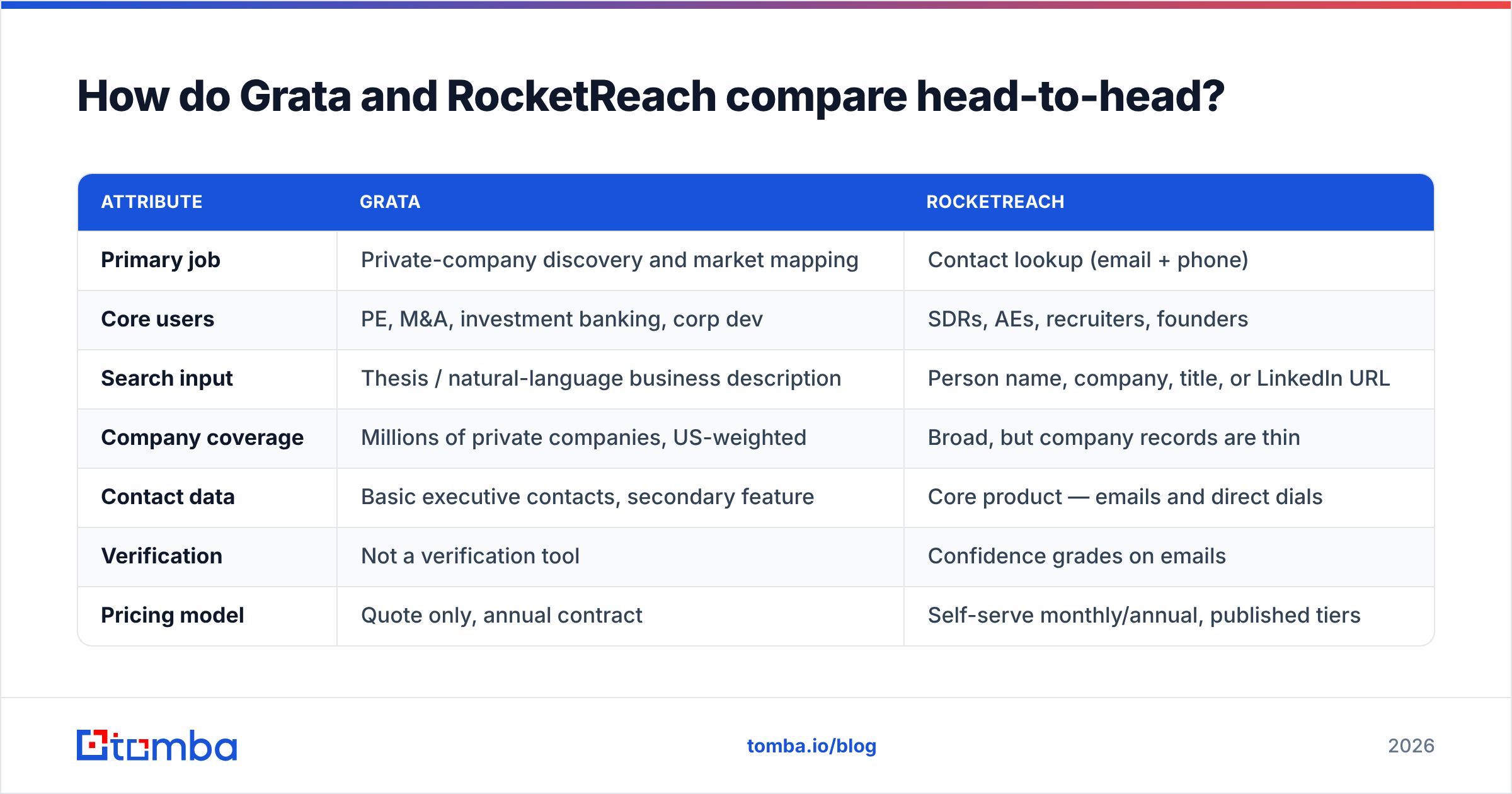
| Attribute | Grata | RocketReach |
|---|---|---|
| Primary job | Private-company discovery and market mapping | Contact lookup (email + phone) |
| Core users | PE, M&A, investment banking, corp dev | SDRs, AEs, recruiters, founders |
| Search input | Thesis / natural-language business description | Person name, company, title, or LinkedIn URL |
| Company coverage | Millions of private companies, US-weighted | Broad, but company records are thin |
| Contact data | Basic executive contacts, secondary feature | Core product — emails and direct dials |
| Verification | Not a verification tool | Confidence grades on emails |
| Pricing model | Quote only, annual contract | Self-serve monthly/annual, published tiers |
| Entry price | Enterprise (five figures/year typical) | ~$39/mo billed annually |
| Free tier | Limited trial via sales | Yes — small monthly lookup allowance |
| API | Yes, enterprise add-on | Yes, on higher tiers |
| Best-fit team size | Deal teams of 3–50 | Individuals up to full sales orgs |
| Weakest point | Cost and narrow use case | Data decay on stale profiles |
A note on pricing. RocketReach figures reflect published self-serve tiers at the time of writing, and they change. Check the vendor page before you budget. Grata does not publish list pricing at all, which is itself a signal about who it is sold to.
What is Grata actually good at?#
Grata earns its price in exactly one scenario: you need to find companies that do not want to be found.
Public-company data is cheap and everywhere. The hard part of deal sourcing is the 30-employee manufacturer in Ohio. One-page website. No funding round. No press coverage. Grata crawls and classifies company websites instead of trusting self-reported profiles. That is why it surfaces businesses a LinkedIn-derived database never will.
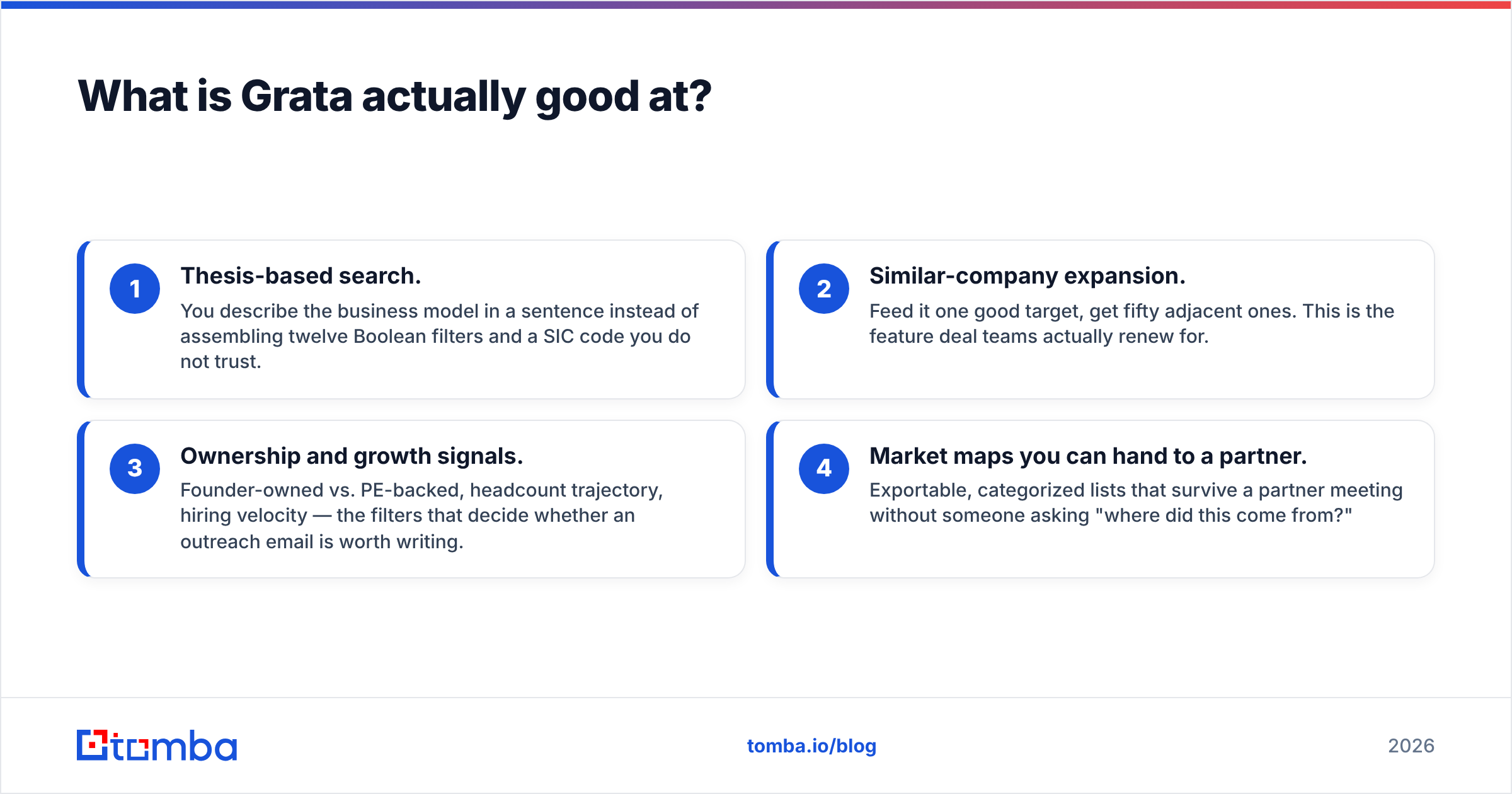
Four things it does well:
- Thesis-based search. You describe the business model in a sentence. No twelve Boolean filters, no SIC code you do not trust.
- Similar-company expansion. Feed it one good target, get fifty adjacent ones. This is the feature deal teams actually renew for.
- Ownership and growth signals. Founder-owned vs. PE-backed, headcount trend, hiring pace — the filters that decide whether an outreach email is worth writing.
- Market maps you can hand to a partner. Exportable, categorized lists that survive a partner meeting without someone asking "where did this come from?"
Where it disappoints: contact data. Grata will hand you a CEO name and often an email. It is not built to give you five verified contacts across four departments at every account. Push it into that role and you will notice the gaps fast.

What is RocketReach actually good at?#
RocketReach is a lookup engine, and a fast one. Paste a LinkedIn URL, get an email. Search a name plus a company, get an email and often a mobile number. The Chrome extension keeps you in the workflow instead of tab-hopping.
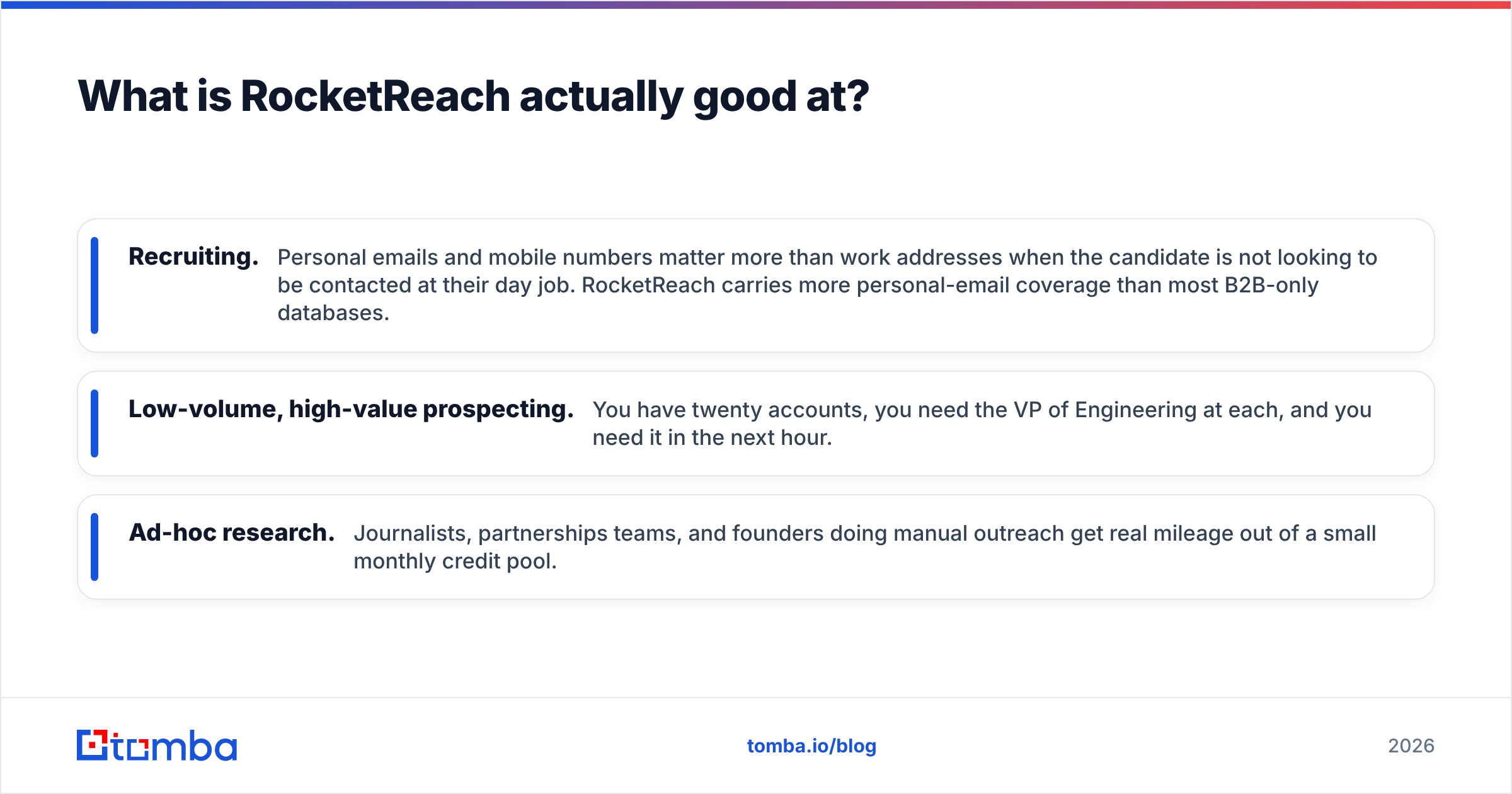
It shines in three situations:
- Recruiting. Personal emails and mobile numbers matter more than work addresses here. The candidate does not want to be contacted at their day job. RocketReach carries more personal-email coverage than most B2B-only databases.
- Low-volume, high-value prospecting. You have twenty accounts, you need the VP of Engineering at each, and you need it in the next hour.
- Ad-hoc research. Journalists, partnerships teams, and founders doing manual outreach get real mileage out of a small monthly credit pool.
Where it disappoints: bulk accuracy and cost at volume. Credits burn on every lookup, usable or not. Profiles pulled from aggregated public data go stale. The company records behind the contacts are also shallow — you get a name and an industry, not the operating detail a deal team needs.
There is a structural cost issue too. RocketReach's cheaper tiers cap monthly lookups hard. Move from twenty contacts a week to two thousand a month, and the cost per usable contact climbs fast. That is the point where teams start comparing a dedicated email finder against the marginal credit price.
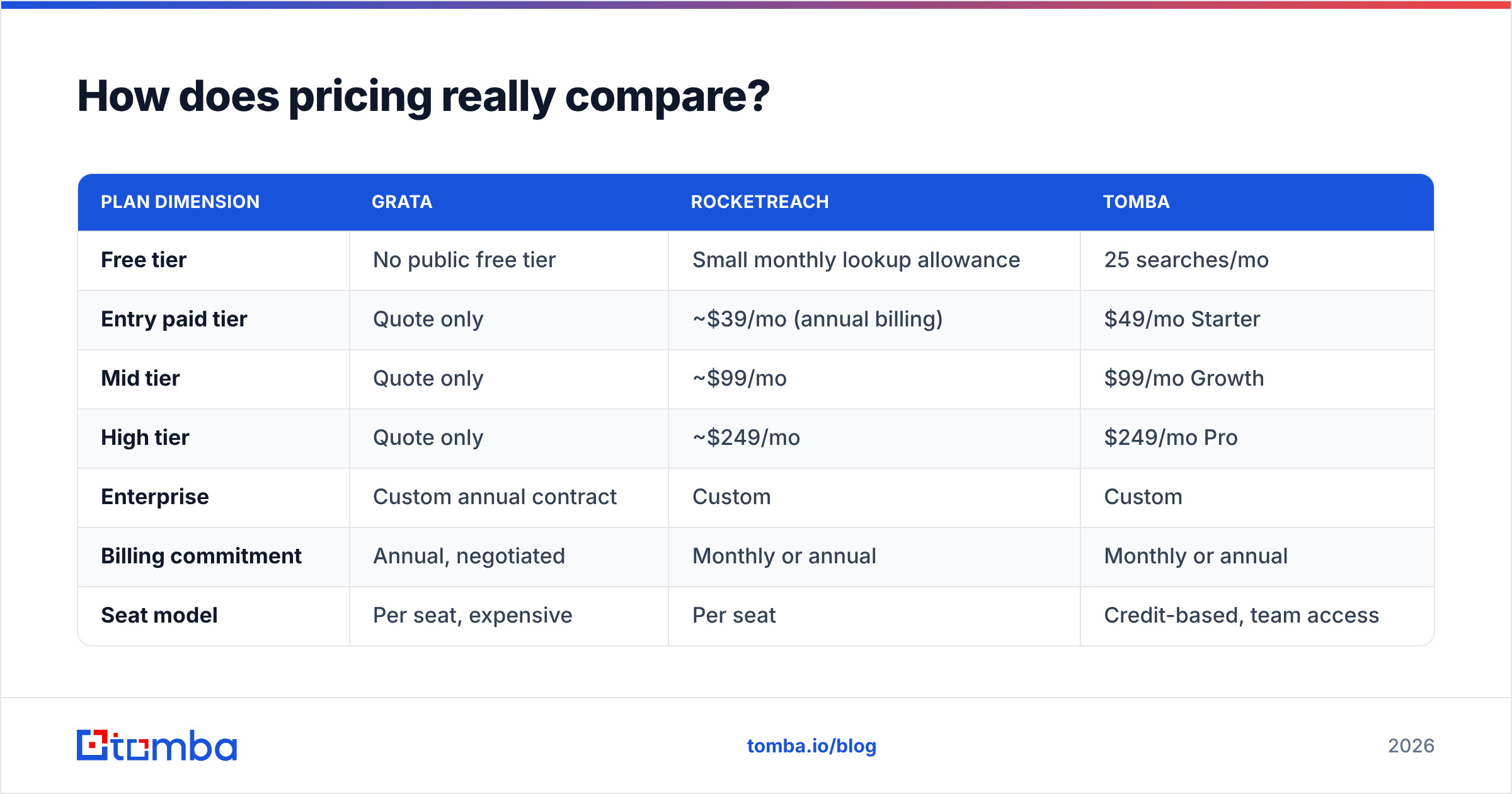
Grata vs RocketReach pricing: how does it really compare?#
| Plan dimension | Grata | RocketReach | Tomba |
|---|---|---|---|
| Free tier | No public free tier | Small monthly lookup allowance | 25 searches/mo |
| Entry paid tier | Quote only | ~$39/mo (annual billing) | $49/mo Starter |
| Mid tier | Quote only | ~$99/mo | $99/mo Growth |
| High tier | Quote only | ~$249/mo | $249/mo Pro |
| Enterprise | Custom annual contract | Custom | Custom |
| Billing commitment | Annual, negotiated | Monthly or annual | Monthly or annual |
| Seat model | Per seat, expensive | Per seat | Credit-based, team access |
| Verification included | No | Confidence score only | Yes — full email verifier |
Two honest observations from this table.
First, Grata's missing price list is not evasion. The product really is custom. A two-person search fund and a $5B PE firm buy very different things. But it does mean you cannot evaluate it on a Tuesday afternoon. Budget for a sales cycle.
Second, RocketReach's headline prices look approachable until you divide by usable contacts. A cheap tier gives you a few hundred lookups a month. Some share of those bounce. Do that math and the real price lands near tools that include verification. Run it against your own bounce rate before you renew. The Tomba pricing page is a reasonable benchmark for what credits plus verification cost elsewhere.
Which one has better data accuracy?#
Wrong question, mostly. The Grata vs RocketReach accuracy debate measures two different things.
Grata's question is classification accuracy. When you search for "commercial HVAC maintenance," how many returned companies actually do that? Grata performs well here, because it reads websites instead of trusting self-reported categories. Reviews on G2 praise the search relevance and criticize the price.
RocketReach's question is deliverability. Of the emails it returns, how many actually land? This is where aggregated-profile databases struggle. B2B data decays at roughly 2–3% per month. People change jobs. Companies change email formats after an acquisition. A record that was right in March bounces in November. RocketReach shows confidence indicators, but a confidence score is a guess, not a check.
The fix is the same no matter which tool sourced the contact: verify before you send. An SMTP-level check plus catch-all handling turns a maybe into a yes or no. Pulling from any aggregated database? Run the output through a catch-all verifier before it reaches your sequencer. It is the highest-ROI step in the pipeline. It protects your sender reputation, which no amount of database spend will buy back.

Do you need both Grata and RocketReach?#
Some Grata vs RocketReach buyers genuinely need both. If you are a private equity firm running proprietary outbound to founder-owned targets, Grata builds the target list and something has to supply the contacts. That is a real two-tool workflow.
But before you buy two subscriptions, check which half you are actually paying for:
- If your list is already defined — you sell to Shopify Plus merchants, or Series B fintechs, or dental groups — you do not need Grata. Your ICP is knowable from public sources. You would be paying enterprise pricing for a problem you already solved on a whiteboard.
- If your list is genuinely undiscoverable — fragmented, offline-heavy, no funding footprint — Grata is hard to replace. Pay for it.
- If contact coverage is the pain, RocketReach is one of several options, not the only one. Its per-credit math stops making sense above a few thousand lookups a month.
The most common mistake we see: teams buy Grata for discovery, then default to whatever contact tool was already in the stack. Nobody audits the second half. The discovery spend gets scrutinized because it is large and annual. The contact spend leaks quietly across seats and credit overages.
What is the cheaper way to build the contact half?#
Once the account list exists — from Grata, from a CRM export, from a conference attendee list — the contact-finding job becomes mechanical. Mechanical jobs should be cheap.
A domain-first workflow beats a person-first workflow at volume. Instead of looking up 500 people one at a time, you feed 500 domains. Pull the email pattern and the relevant roles at each, then enrich from there. That is what domain search and the bulk email finder are built for. It is also why the cost per contact drops so sharply against per-profile credit models.
The three-step version:
- Source companies with whatever tool fits your market — Grata for opaque private markets, a standard filter-based database for known ICPs, or your own scraped list.
- Find contacts by domain, not by profile. Pull the pattern once per company, then generate and validate across every relevant role.
- Verify before sending, catch-all domains included. Route anything unverifiable to LinkedIn or phone instead of burning it on email.
For teams already running this in code, the Tomba API handles steps 2 and 3 in the same call. That removes the export-import shuffle that makes most enrichment workflows fragile.
Grata vs RocketReach: which should you choose in 2026?#
Choose Grata if you are in PE, M&A, investment banking, or corp dev. Your target companies are private and hard to categorize, and your budget assumes annual enterprise contracts. Nothing in the self-serve market replaces thesis-driven private-company search.
Choose RocketReach if you need occasional, high-value contact lookups. Recruiting is the clearest case, where personal emails and mobile numbers matter. Keep your monthly volume modest. It is a good lookup tool at low volume and a poor one at scale.
Choose neither, or supplement both, if your ICP is already defined. Your real problem is then getting verified, deliverable contacts at volume for a predictable price. That is a different product category. Paying deal-sourcing prices for it is how data budgets quietly double.
The honest summary of grata vs rocketreach: they overlap by about fifteen percent, and the overlap is the least impressive part of either product. Buy the one that solves your actual bottleneck. Then be deliberate about the other half instead of letting it default.
Building the contact half of your stack? If your target company list already exists and you just need deliverable emails at a price that scales, start with the Tomba Email Finder. Find emails by domain, name, or company. Verify them in the same workflow. Start free with 25 searches per month, then move to Starter at $49/mo. No annual contract, no sales call to see a price.
Related guides#
Ready to find emails that actually work?
Join 150,000+ professionals who stopped guessing and started sending. Free credits on signup — no credit card required.
Get the Tomba newsletter
Practical outbound tactics and product updates — once every two weeks.
About the author