Grata vs SignalHire 2026: Deal Sourcing vs Contact Data
Grata finds companies. SignalHire finds people. Most teams comparing them are actually solving two different problems — here's the honest breakdown of data, pricing, and fit.
TL;DR — here is the short version of Grata vs SignalHire.
- Grata and SignalHire are not real rivals. Grata is a search engine for private companies. It is built for M&A, private equity, and corp dev teams. SignalHire finds emails and phone numbers. It adds a light ATS for recruiters and SDRs.
- Ask "which companies should we target?" and Grata wins by a wide margin. Ask "what is this person's email and mobile?" and SignalHire is cheaper and faster.
- Price is the sharpest split. Grata is sales-led and usually costs five figures a year. SignalHire is self-serve and starts under $50 a month.
- Neither tool is a good bulk email-verification layer. Both push shaky contacts into your sequencer. That is where deliverability quietly dies.
- The practical 2026 stack: Grata (or a cheaper company-data source) to pick accounts, plus a finder and verifier like Tomba Email Finder for the contact layer.
Grata vs SignalHire: what does each tool do?#
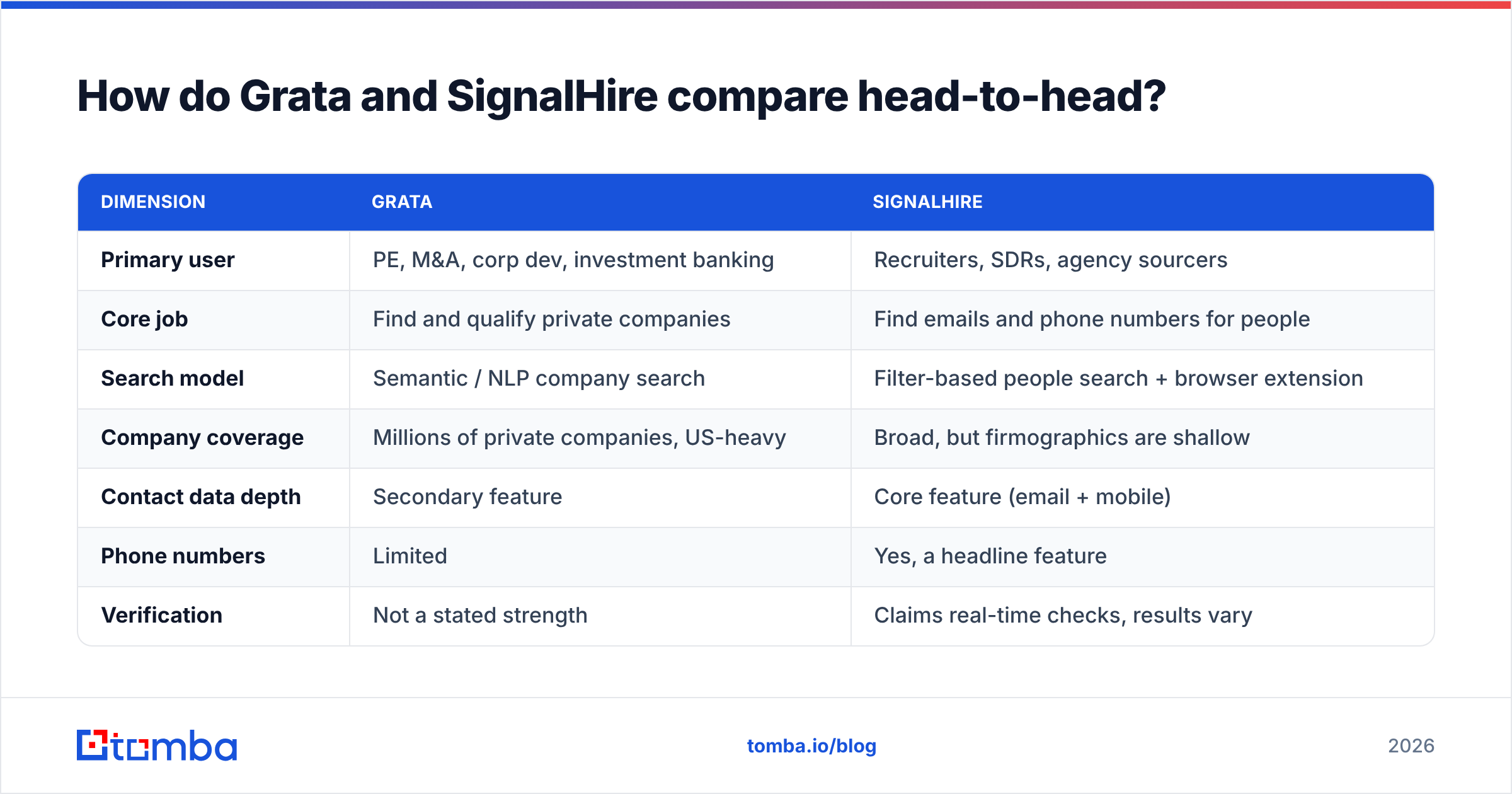
Grata is a private-market search tool. You describe the business you want to find. For example: "vertical SaaS for dental practices, $5M–$30M revenue, US, founder-owned." Grata then returns private companies that match.
It builds that list by reading company websites, not by trusting an old SIC or NAICS code. That semantic search is the core product. Grata was bought by Datasite in late 2024. The deal pushed it further into deal work: sourcing, tracking, and pipeline management.
SignalHire is a contact-data tool. It runs mostly as a Chrome extension over LinkedIn, GitHub, and other public profiles. It reveals work emails, personal emails, and phone numbers. A small applicant-tracking layer sits on top for recruiters. There is also a bulk search in the web app, plus an API.
So the honest frame for Grata vs SignalHire is simple. They sit at opposite ends of one funnel. Grata answers who to go after. SignalHire answers how to reach the person. Teams compare them because both land under "B2B data tools" in a budget sheet. They barely overlap in practice.
Here is where each one works:
- Account discovery — Grata's home turf. Semantic search, lookalike companies, ownership signals, growth signals.
- Company enrichment — both do some of this. Grata goes deeper on money and ownership. SignalHire is thinner and mostly headcount.
- People search — SignalHire's home turf. Title, seniority, skills, and company filters over a big profile index.
- Contact reveal — SignalHire's core value. Grata shows some contacts, but it is a side feature.
- Verification — weak on both. Neither one sells itself as a send-grade verifier.
- Outreach — SignalHire has basic email sequences. Grata expects you to push to a CRM.
Grata vs SignalHire: the head-to-head table#
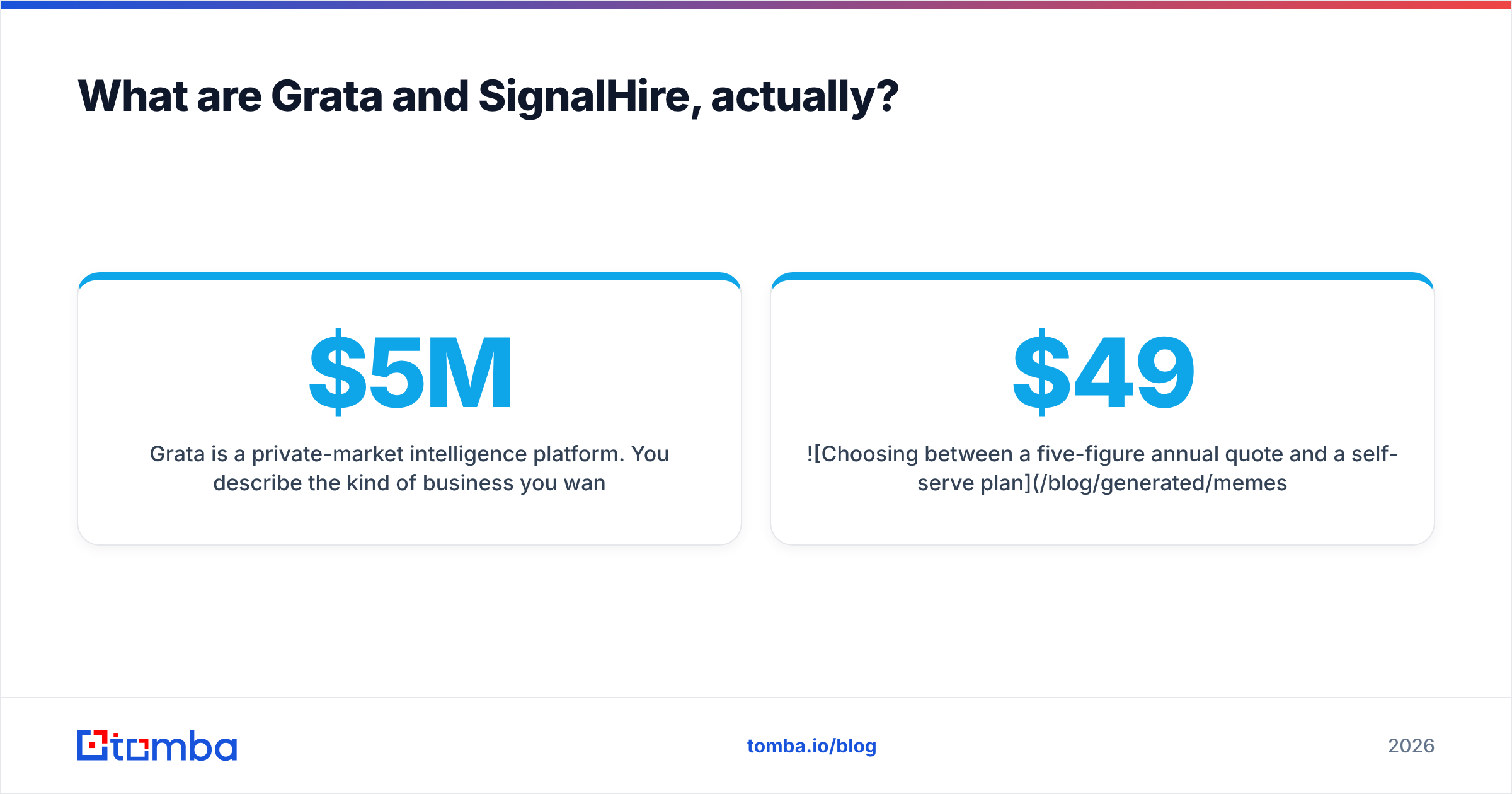
| Dimension | Grata | SignalHire |
|---|---|---|
| Primary user | PE, M&A, corp dev, investment banking | Recruiters, SDRs, agency sourcers |
| Core job | Find and qualify private companies | Find emails and phone numbers for people |
| Search model | Semantic / NLP company search | Filter-based people search + browser extension |
| Company coverage | Millions of private companies, US-heavy | Broad, but company detail is shallow |
| Contact data depth | Secondary feature | Core feature (email + mobile) |
| Phone numbers | Limited | Yes, a headline feature |
| Verification | Not a stated strength | Claims real-time checks, results vary |
| Outreach built in | No — CRM push | Yes, basic email sequences |
| ATS features | No | Yes, lightweight |
| Pricing model | Annual contract, quote only | Self-serve monthly + annual |
| Entry price | Typically five figures per year | Under $50/month |
| Free trial | Demo-gated | Free credits on signup |
| API | Yes, enterprise | Yes |
| Best when | You don't know which companies to target | You know the target and need contact details |
The table makes the choice look simpler than it is. Most teams need something from both columns.
A search fund chasing niche manufacturers needs Grata-style discovery. No amount of contact data helps if you cannot build the target list first. A staffing agency filling 40 roles a month needs SignalHire-style reveal volume. Company intelligence does not matter when the job order already names the accounts.
What does Grata do well?#
Grata reads company websites the way a human analyst would. Most databases file a company under whatever code it picked years ago. Grata reads the actual words on the site instead.
So a search for "companies that install commercial EV charging in the Midwest" returns firms that describe themselves that way. It works even when the formal label says "electrical contractor."
Three things follow from that:
- Lookalike sourcing works. Feed in a portfolio company and get nearby targets. This is the feature dealmakers renew for.
- Small private companies show up. Under $50M revenue, no press, no funding rounds. Public-data tools miss these firms.
- Ownership and growth signals are usable. Founder-owned or PE-backed, headcount trend, hiring signals. These filters cut 4,000 companies down to a 60-company list.
Review sites like G2 flag three weak spots: coverage outside North America, hidden pricing, and thin contact data. You will feel those gaps if you need European mid-market names or verified direct dials.
What does SignalHire do well?#
SignalHire wins on price per reveal and on the browser extension. A sourcer can work a LinkedIn search page and reveal contacts one profile at a time. No tab switching. That loop is fast, and it explains why recruiters still like the tool.
Its practical strengths:
- Mobile numbers. Coverage is not perfect. But when a call beats an email, that is a real edge over pure email finders.
- Cheap entry. You can run a real test for the price of a lunch. Enterprise data platforms do not let you do that.
- Credit rollover and flexible plans. Handy for seasonal or project hiring.
- Light ATS. It will not replace Greenhouse. It is enough for a small agency to track candidates.
The common complaints are steady. Hit rates swing hard by country and seniority. Some revealed emails are personal, not work, addresses. The outreach module is basic, so most teams export to a real sequencer anyway.
How accurate is the contact data on each?#
Be skeptical of every accuracy number you read. That includes vendor claims, and it includes this post. Accuracy depends on your list: country, company size, seniority, and how recently people changed jobs. A tool can hit 92% on US software directors and drop to 50% on European ops managers at 30-person plants.
Here is what you can reason about anyway.
Grata does not sell itself as a contact vendor. Contacts sit on top of company records as a convenience. Expect generic company addresses and a few named executives. Coverage below the C-suite is patchy. Do not buy Grata for emails.
SignalHire does sell itself as a contact vendor. The reveal engine is the product. It has the same weak spot as every profile-scraping tool. The profile may be current, but the guessed email pattern may not be. Formats change after rebrands, buyouts, and domain moves. A record that is not re-checked at send time is a bounce waiting to happen.
That is the case for keeping verification separate from discovery. A dedicated email verifier checks syntax, domain, MX records, and mailbox acceptance right before you send. It does not trust a record cached three months ago.
Is your list heavy on catch-all domains? That is common in enterprise and in regulated markets. Then you also want a catch-all verifier. Standard SMTP checks return "accepted" for every address on those domains, so they tell you nothing.
Grata vs SignalHire pricing in 2026#
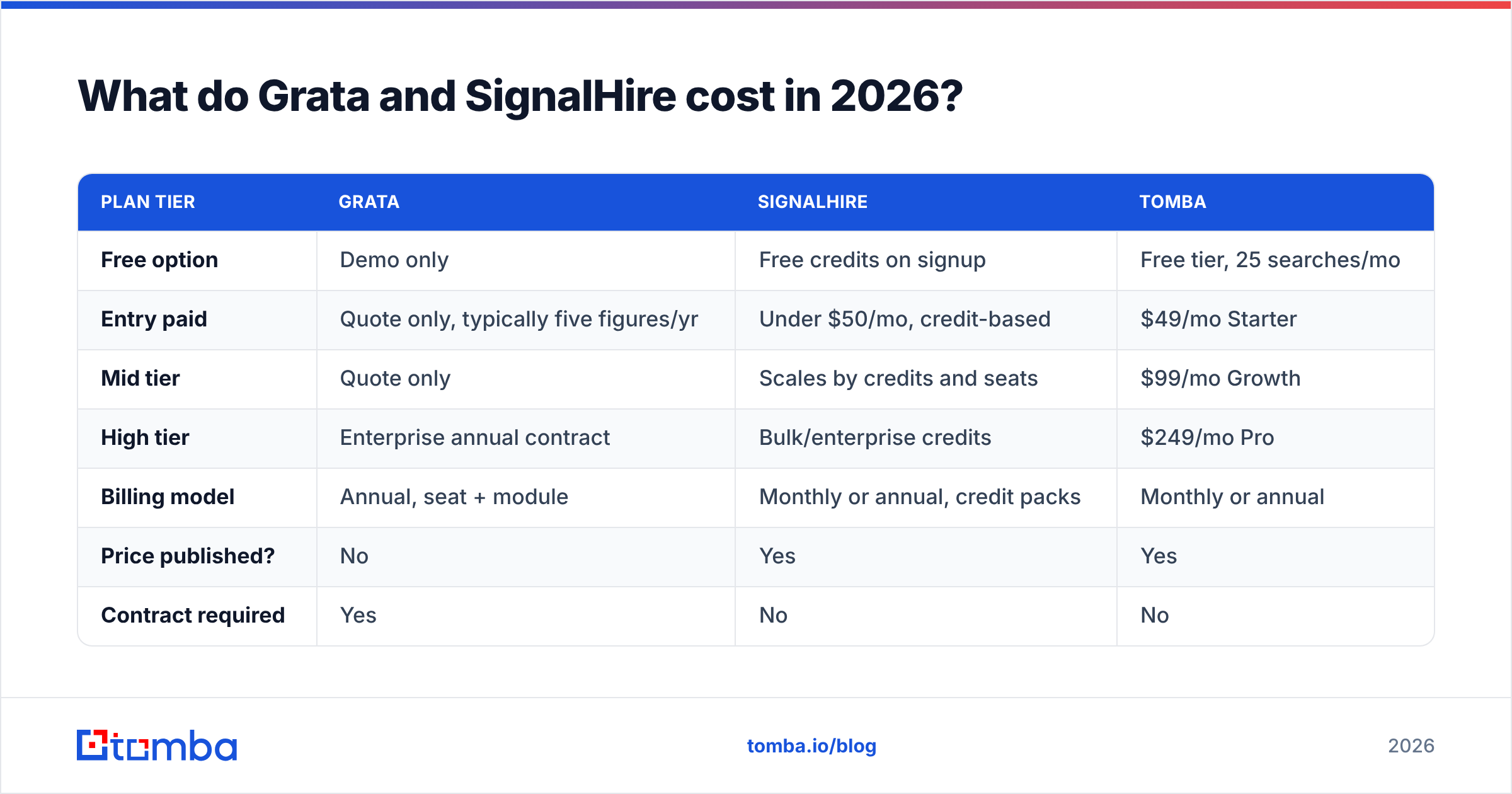
| Plan tier | Grata | SignalHire | Tomba |
|---|---|---|---|
| Free option | Demo only | Free credits on signup | Free tier, 25 searches/mo |
| Entry paid | Quote only, typically five figures/yr | Under $50/mo, credit-based | $49/mo Starter |
| Mid tier | Quote only | Scales by credits and seats | $99/mo Growth |
| High tier | Enterprise annual contract | Bulk/enterprise credits | $249/mo Pro |
| Billing model | Annual, seat + module | Monthly or annual, credit packs | Monthly or annual |
| Price published? | No | Yes | Yes |
| Contract required | Yes | No | No |
Two takeaways here. First, these tools are not in the same budget talk. Comparing a sales-led annual platform with a self-serve credit tool on price alone is meaningless.
Second, published pricing matters more than buyers admit. When a vendor hides numbers, you enter a long procurement cycle before you know if the data works for your niche. So run a live sample against your own list before you sign. A demo built on the vendor's favorite verticals proves nothing about yours.
You can use transparent Tomba pricing as a baseline for what self-serve contact data should cost. Prices on both platforms move, so treat the numbers above as directional. Confirm on each vendor's own page before you budget.
Which one should you pick for your use case?#
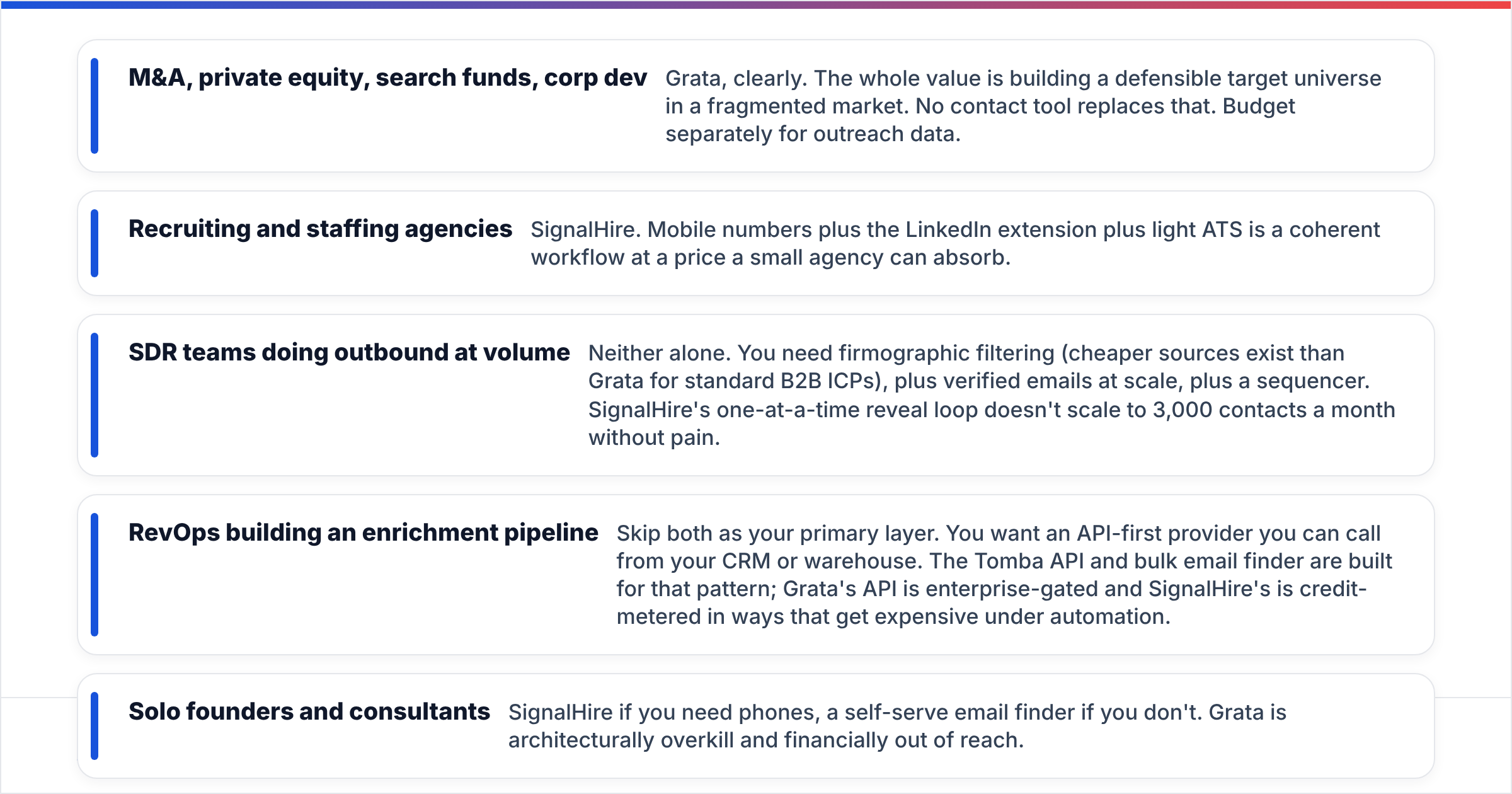
- M&A, private equity, search funds, corp dev — Grata, clearly. The value is building a target list rivals do not have. No contact tool replaces that. Budget for outreach data on the side.
- Recruiting and staffing agencies — SignalHire. Mobile numbers, the LinkedIn extension, and a light ATS make one clean workflow. A small agency can absorb the price.
- SDR teams doing outbound at volume — Neither one alone. You need company filtering, verified emails at scale, and a sequencer. Cheaper filtering sources exist for standard B2B ICPs. And SignalHire's one-at-a-time reveal does not scale to 3,000 contacts a month.
- RevOps building an enrichment pipeline — Skip both as your main layer. You want an API-first provider you can call from your CRM or warehouse. The Tomba API and bulk email finder are built for that. Grata's API is enterprise-gated, and SignalHire's credit meter gets costly under automation.
- Solo founders and consultants — SignalHire if you need phones. A self-serve email finder if you do not. Grata is too big and too costly here.
Where do both tools fall short?#
Grata's gaps: a North America bias, hidden pricing, and no real outreach layer. Contact data is thin, so most users top it up elsewhere. It also assumes you have an analyst on staff. The search box rewards skill, and casual users get mediocre lists.
SignalHire's gaps: uneven coverage outside the US, a mix of personal and work emails, and a thin outreach module. There is no company intelligence at all. It will not tell you which 200 companies fit your ICP.
The gap they share: neither one is a deliverability tool. Both hand you addresses. Neither owns the fallout when 12% bounce and your domain reputation drops.
That matters more in 2026. Under Google and Microsoft bulk-sender rules, a low bounce rate is not hygiene. It decides whether you land in the inbox or get filtered in silence. So run every list through verification before it touches your sequencer. Use domain search to confirm the real email pattern at the company instead of trusting a guess.
Do you still need a dedicated email finder?#
Almost certainly yes, for a boring reason. Tools that are good at discovery are rarely good at verification, and the reverse holds too.
Grata is tuned to find companies you did not know existed. SignalHire is tuned to reveal a contact in two clicks while you sit on a profile. Neither is tuned to take 5,000 names and return deliverable addresses with a confidence score.
A clean split of labor looks like this. Source accounts wherever your niche demands. Source people wherever your workflow is fastest. Then run everything through one verification layer before send. That last step decides your bounce rate. It is the cheapest insurance in the stack.
Building that contact layer now? Start with Tomba Email Finder. The free tier gives you 25 searches a month, so you can test your own list before you spend. Starter is $49 a month, with published pricing and no contract.
The same engine runs through the API, the Chrome extension, Google Sheets, and bulk uploads. So it fits a solo founder revealing one contact at a time, and it fits a RevOps team enriching a warehouse table nightly.
One last test to settle Grata vs SignalHire for your own team. Run your existing export through a verifier and compare the bounce rate. That number tells you more than any comparison table, including this one.
Related guides#
Ready to find emails that actually work?
Join 150,000+ professionals who stopped guessing and started sending. Free credits on signup — no credit card required.
Get the Tomba newsletter
Practical outbound tactics and product updates — once every two weeks.
About the author