Grata vs SMARTe (2026): Which B2B Data Platform Wins?
Grata maps private companies. SMARTe hands you phones and emails. They get compared constantly, but they solve different halves of the same problem. Here is where each one actually wins in 2026.
TL;DR
- Grata is a private-company search engine built for deal sourcing. SMARTe is a contact-data platform built for sales outreach. They are compared constantly because both sell "B2B data," but they answer different questions.
- Pick Grata if your problem is which companies exist and which ones fit my thesis. Pick SMARTe if your problem is who do I email and call at companies I already know.
- Neither publishes transparent self-serve pricing. Grata contracts are typically five-figure annual commitments; SMARTe is credit-and-seat based with a free tier and quote-gated paid plans. Budget accordingly.
- Both tools degrade at the last mile: the specific, deliverable email address. That is where a dedicated finder-plus-verifier layer earns its keep.
- The most common winning stack in 2026 is not "one platform." It is a sourcing engine, a contact layer, and a verification step that runs immediately before send.
Most "Grata vs SMARTe" searches start from a bad premise: that these two products compete head-on. They overlap at the edges, but a private-equity associate building a target list and an SDR building a call list are doing different work with different failure modes. This comparison separates the two jobs, then shows what each platform actually delivers against them.
What is Grata, and what is it actually for?#
Grata is a private-market intelligence platform. Its index is built around private companies — the ones with no filings, no ticker, and often no meaningful web presence beyond a thin site. You search by business description in natural language ("industrial water treatment services in the Southeast, 20-200 employees"), and Grata returns companies matching that description rather than companies matching a SIC code someone typed in 2004.
The buyer is almost always in deal flow: private equity, M&A advisory, corporate development, search funds, and increasingly enterprise sales teams doing account-based targeting into the middle market. The core value is discovery — surfacing companies you did not know existed. Ownership signals, headcount trajectory, funding history, and similar-company expansion are the features that get used daily.
What Grata is not: an outbound execution tool. It surfaces contacts at target companies, but the depth and freshness of person-level data is not the product's center of gravity. Nobody buys Grata to run a 5,000-prospect sequence.
What is SMARTe, and who buys it?#
SMARTe sits in the sales intelligence category alongside the usual names. It sells contact data at scale: work emails, mobile numbers, job titles, company firmographics, and a browser extension that pulls contacts while you browse LinkedIn or a company site. Its differentiators are international coverage (notably strong in EMEA and APAC, where many US-first vendors thin out) and explicit GDPR/CCPA compliance positioning.
The buyer is an SDR leader, a demand-gen manager, or a RevOps person filling a CRM. The job is volume: get 2,000 accurate contacts into the sequencing tool this week without burning the sending domain.
What SMARTe is not: a discovery engine for companies that barely have a digital footprint. If a $12M niche manufacturer has a four-page website and no LinkedIn activity, a contact database is not where you find it.

How do the two engines actually work?#
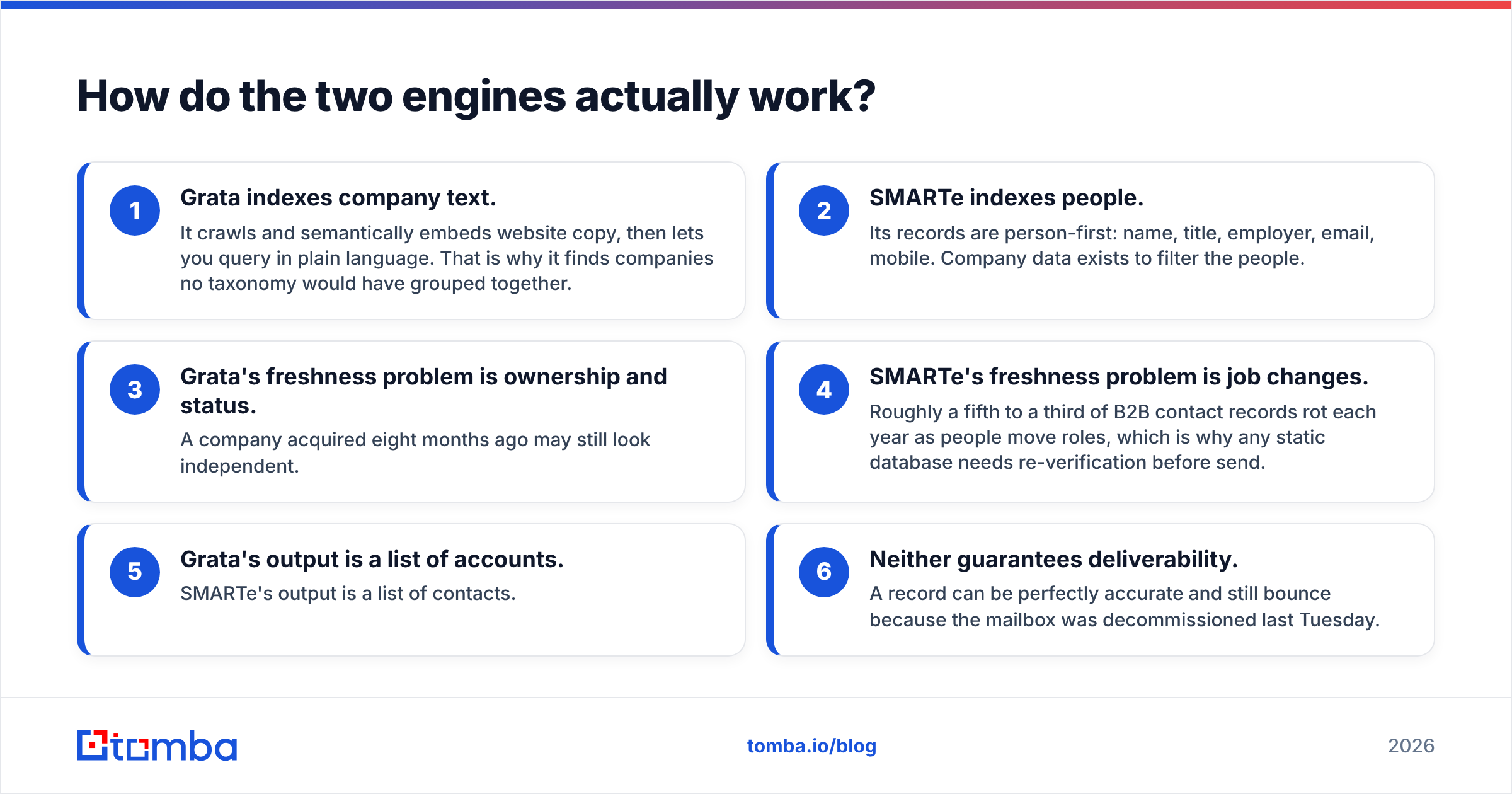
The architectural difference explains almost every practical difference downstream:
- Grata indexes company text. It crawls and semantically embeds website copy, then lets you query in plain language. That is why it finds companies no taxonomy would have grouped together.
- SMARTe indexes people. Its records are person-first: name, title, employer, email, mobile. Company data exists to filter the people.
- Grata's freshness problem is ownership and status. A company acquired eight months ago may still look independent.
- SMARTe's freshness problem is job changes. Roughly a fifth to a third of B2B contact records rot each year as people move roles, which is why any static database needs re-verification before send.
- Grata's output is a list of accounts. SMARTe's output is a list of contacts.
- Neither guarantees deliverability. A record can be perfectly accurate and still bounce because the mailbox was decommissioned last Tuesday.
That last point is the one teams underestimate. Data accuracy and deliverability are not the same metric, and no database vendor can promise the second one from a static index.
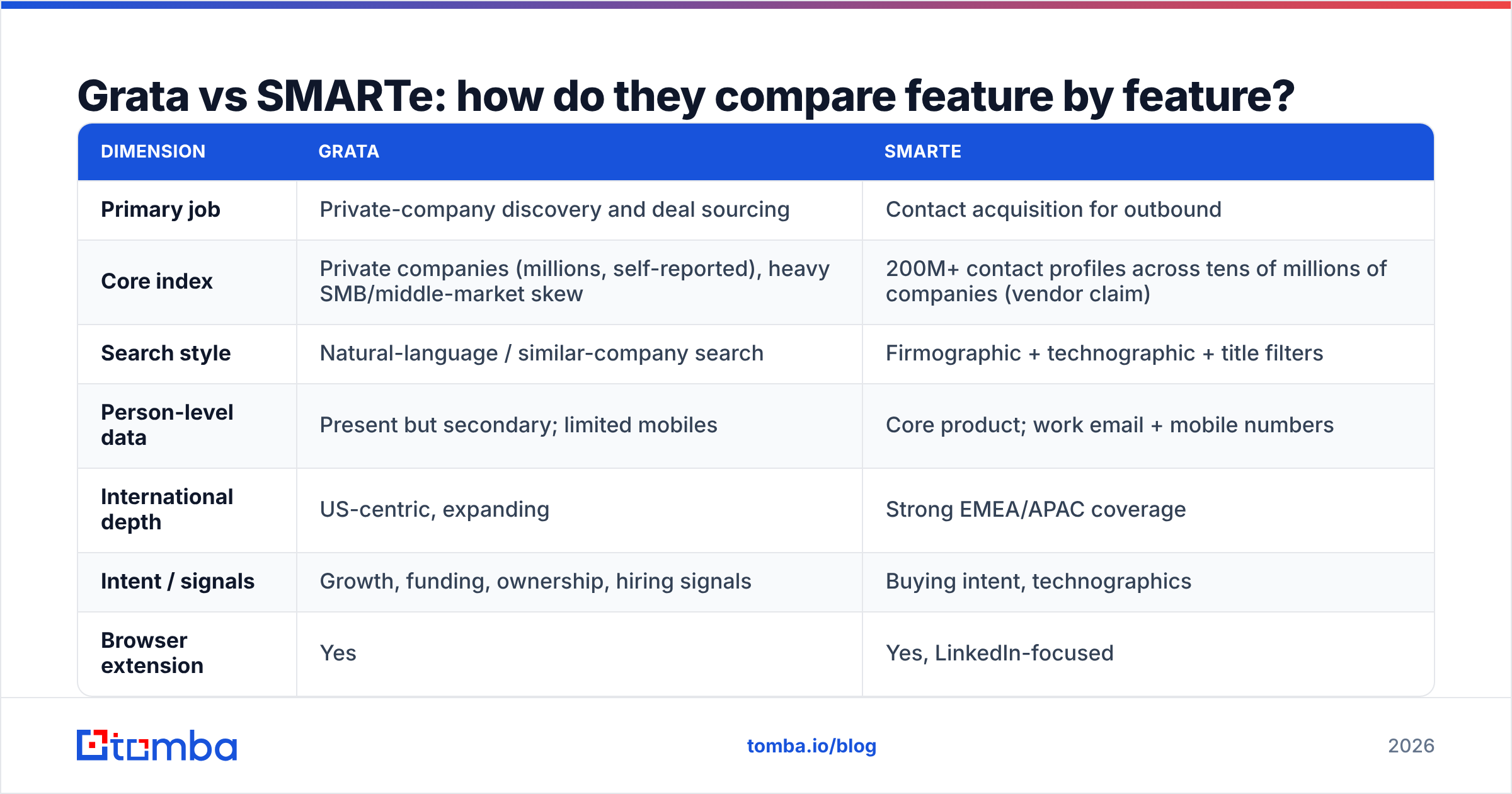
Grata vs SMARTe: how do they compare feature by feature?#
| Dimension | Grata | SMARTe |
|---|---|---|
| Primary job | Private-company discovery and deal sourcing | Contact acquisition for outbound |
| Core index | Private companies (millions, self-reported), heavy SMB/middle-market skew | 200M+ contact profiles across tens of millions of companies (vendor claim) |
| Search style | Natural-language / similar-company search | Firmographic + technographic + title filters |
| Person-level data | Present but secondary; limited mobiles | Core product; work email + mobile numbers |
| International depth | US-centric, expanding | Strong EMEA/APAC coverage |
| Intent / signals | Growth, funding, ownership, hiring signals | Buying intent, technographics |
| Browser extension | Yes | Yes, LinkedIn-focused |
| CRM sync | Salesforce, HubSpot, Affinity, DealCloud | Salesforce, HubSpot, Outreach, Salesloft |
| Typical buyer | PE, M&A, corp dev, ABM strategists | SDR teams, demand gen, RevOps |
| Pricing model | Annual contract, seat-based, quote only | Credits + seats, free tier, quote for scale |
| Self-serve signup | No | Limited free plan |
| Best at | "Which companies should we pursue?" | "Who do I contact at these companies?" |
Read that table as a routing decision, not a scoreboard. If your bottleneck is the top row, Grata wins by default. If it is the fourth row, SMARTe wins by default. Buying the wrong one and trying to force it into the other job is the single most expensive mistake in this category.
Which one has better data accuracy?#
Neither vendor's headline accuracy number should be taken at face value, and that is not a knock on either company. Accuracy claims depend entirely on the sample: measure against Fortune 500 executives and everyone looks good; measure against a 30-person logistics firm in Ohio and the numbers collapse.
Here is a more useful framing. Ask three questions of any vendor:
- What is the coverage rate on my ICP specifically? Not global coverage. Run 50 real accounts from your list through a trial and count fills.
- What percentage of returned emails are deliverable, not merely plausible? Pattern-guessed addresses (
first.last@domain.com) inflate coverage and destroy sender reputation. - How is a catch-all domain reported? Catch-all servers accept everything, so a database can mark them "valid" while the mailbox does not exist.
On the first question, Grata tends to win for hard-to-find private companies and SMARTe tends to win for contactable people at established firms. On the second and third, both are databases, and databases go stale between refresh cycles. This is why serious teams run a verification pass at send time rather than trusting a record that was validated at some unknown point in the past. A dedicated email verifier checking syntax, MX records, and SMTP response immediately before a campaign catches decayed records that any static export will miss, and a catch-all verifier resolves the ambiguous domains neither platform can settle for you.

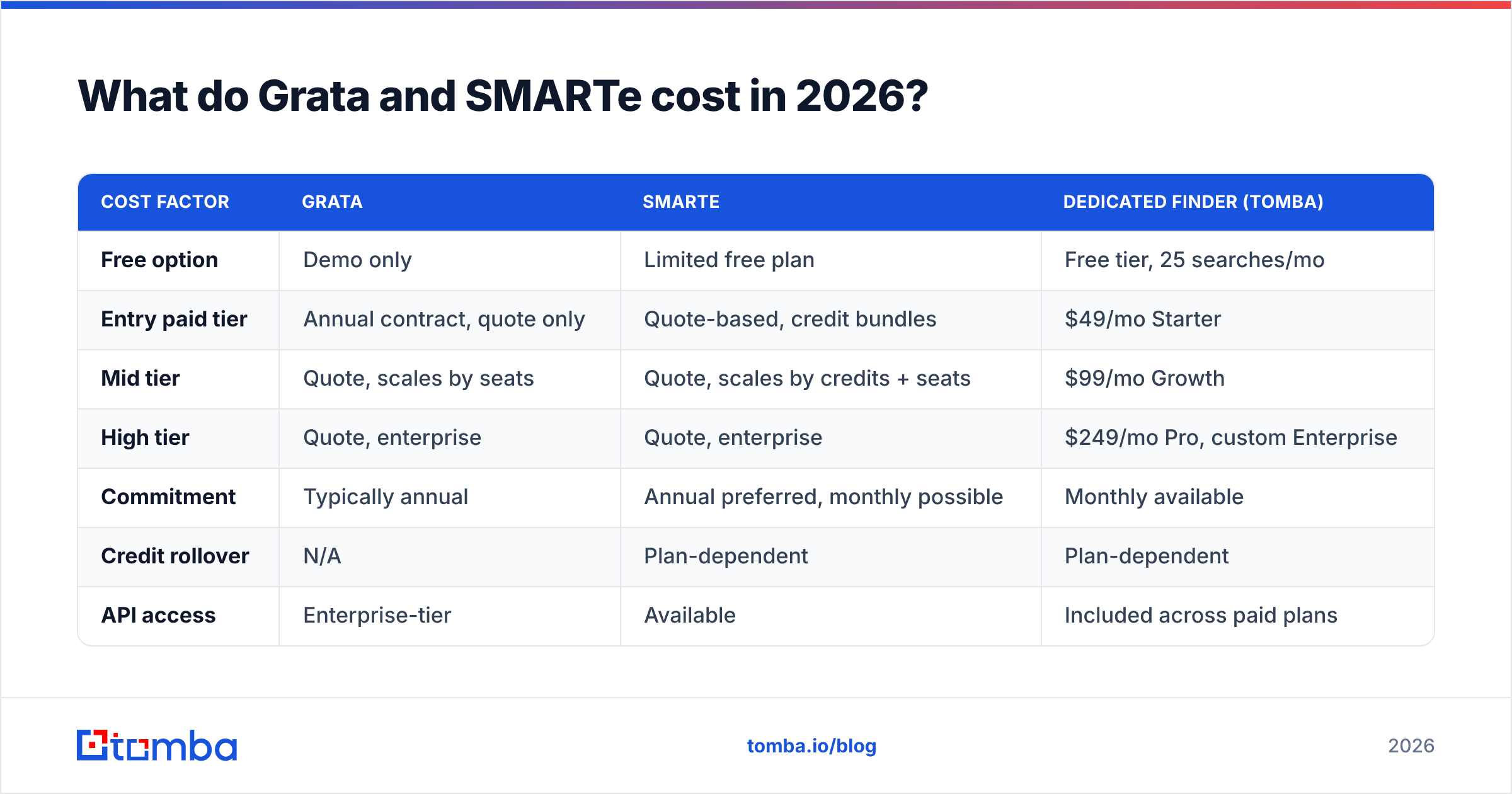
What do Grata and SMARTe cost in 2026?#
Both companies gate pricing behind a sales call, so treat the following as directional ranges from public listings and buyer reports rather than published rate cards. Verify with each vendor.
| Cost factor | Grata | SMARTe | Dedicated finder (Tomba) |
|---|---|---|---|
| Free option | Demo only | Limited free plan | Free tier, 25 searches/mo |
| Entry paid tier | Annual contract, quote only | Quote-based, credit bundles | $49/mo Starter |
| Mid tier | Quote, scales by seats | Quote, scales by credits + seats | $99/mo Growth |
| High tier | Quote, enterprise | Quote, enterprise | $249/mo Pro, custom Enterprise |
| Commitment | Typically annual | Annual preferred, monthly possible | Monthly available |
| Credit rollover | N/A | Plan-dependent | Plan-dependent |
| API access | Enterprise-tier | Available | Included across paid plans |
The pattern is consistent across the sales-intelligence market, which you can confirm on any G2 sales intelligence category page: the more strategic the data, the more opaque the pricing. Grata's value is high per-record but low volume — an associate might look at 300 companies to build one thesis. SMARTe's value is volume-driven, so it is priced on credits.
The practical consequence: if you need 20,000 verified emails a quarter, seat-based deal-sourcing pricing is the wrong instrument entirely. And if you need to know which 40 companies in a fragmented vertical are worth a call, credit-based contact pricing does not answer that question at any volume.
Who should buy Grata?#
Buy Grata if most of these are true:
- Your team evaluates companies before it evaluates people.
- Your targets are private, sub-$100M revenue, and poorly served by standard firmographic filters.
- You need ownership status, acquisition history, and growth signals in the same view.
- You do thesis-driven work: "find me everything that looks like this company."
- Your outreach volume is low and high-touch — dozens of conversations, not thousands of emails.
Buy it and you get a genuine discovery advantage. Buy it hoping for mobile numbers at scale and you will be disappointed, then you will buy a second tool anyway.
Who should buy SMARTe?#
Buy SMARTe if most of these are true:
- Your account list already exists and the gap is contactability.
- You sell internationally, particularly into Europe or Asia-Pacific, where US-centric vendors thin out.
- Mobile numbers matter because your motion includes cold calling.
- Compliance documentation is a procurement requirement.
- You need records flowing into Salesforce, HubSpot, or a sequencer without manual CSV work.
The honest caveat: SMARTe competes in the most crowded segment in B2B software. Run a head-to-head trial against two alternatives on your exact ICP before committing, because category-average benchmarks tell you nothing about your specific vertical.
Do you need both, or is there a cheaper stack?#
For most teams, the answer is a three-layer stack, not a single platform.
Layer 1 — Account discovery. Grata, or a research process, or a niche list source. This layer answers "who is worth pursuing." It is low volume and high judgment.
Layer 2 — Contact resolution. Turn an account into named people with reachable addresses. SMARTe does this. So does a dedicated email finder, often for a fraction of the cost when your volume is moderate. Running domain search against 200 target domains returns the people and email patterns at each one without a per-seat annual commitment, and bulk email finder handles list-scale jobs in one pass.
Layer 3 — Verification at send time. Non-negotiable. Verify immediately before the campaign, not at export. This is what protects the sender reputation you spent months building.
Where teams overspend is layer 2. They buy a full sales-intelligence seat for every rep when what they needed was an API that resolves a name and domain into a verified address. If your workflow already has the account list — from Grata, from a conference roster, from a scraped industry directory — layer 2 is a lookup problem, and lookup problems are cheap to solve. Tomba pricing starts at $49/mo for exactly this shape of work, with a free tier to test coverage on your own accounts before you spend anything.
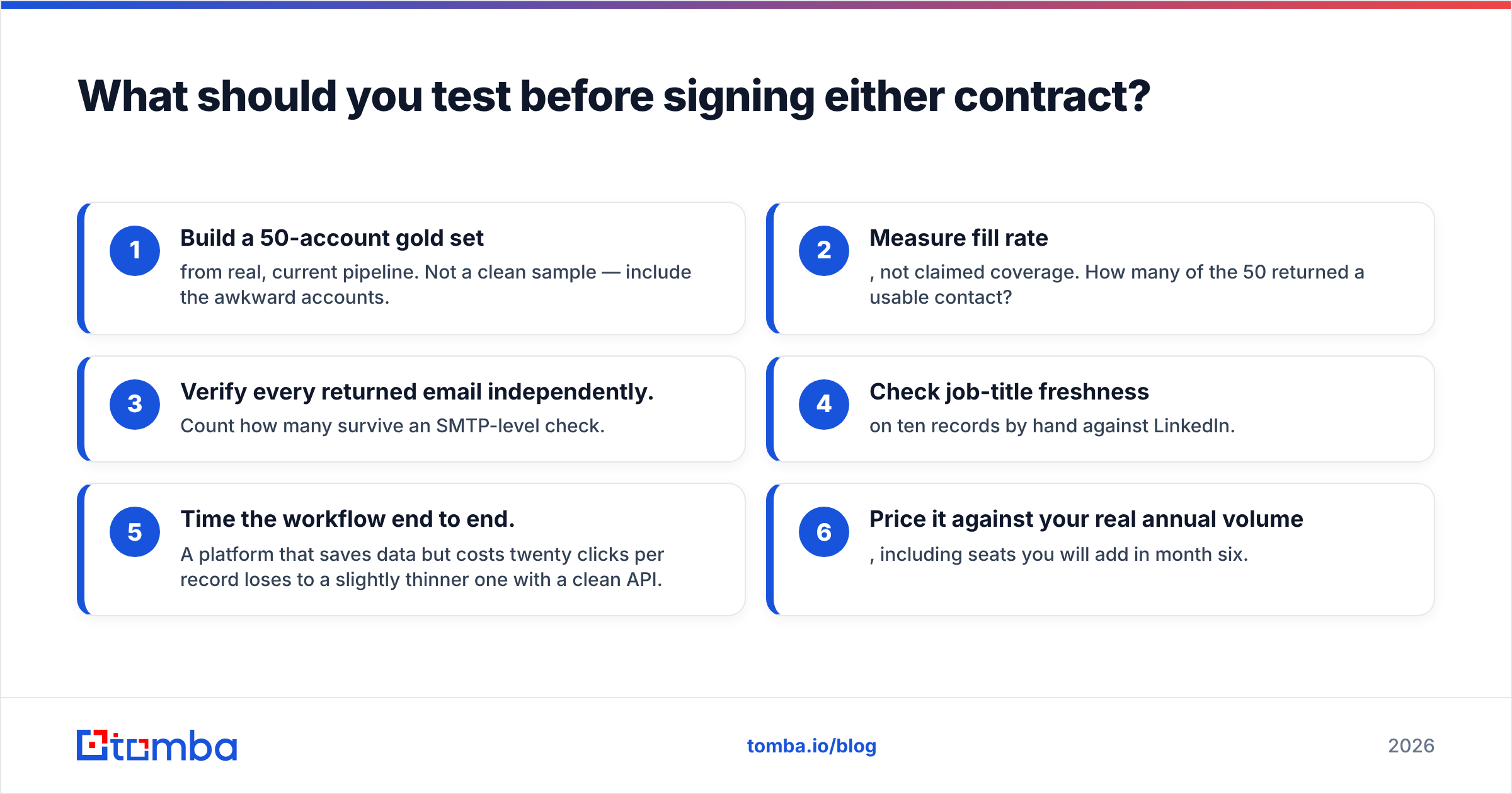
What should you test before signing either contract?#
Run the same trial protocol against both, and against any third option:
- Build a 50-account gold set from real, current pipeline. Not a clean sample — include the awkward accounts.
- Measure fill rate, not claimed coverage. How many of the 50 returned a usable contact?
- Verify every returned email independently. Count how many survive an SMTP-level check.
- Check job-title freshness on ten records by hand against LinkedIn.
- Time the workflow end to end. A platform that saves data but costs twenty clicks per record loses to a slightly thinner one with a clean API.
- Price it against your real annual volume, including seats you will add in month six.
Vendors will resist a structured trial. Insist. A two-week evaluation costs less than one wrong annual contract.
The verdict#
Grata wins on discovery. SMARTe wins on contactability. Neither wins on deliverability, because that is a send-time problem, not a database problem.
If you are a deal team sourcing private companies, Grata is the more defensible purchase and there is no close substitute in its lane. If you are a sales team that already knows its accounts, SMARTe is a reasonable contact layer — and so are several competitors you should trial alongside it. If your actual bottleneck is turning a list of companies and names into addresses that land, you do not need either platform's full price tag.
Start with the Tomba Email Finder on your existing account list. Free tier, 25 searches a month, no sales call. Run your 50-account gold set through it, verify the results, and see how much of the gap you thought needed a $30,000 contract actually needed a $49/mo lookup layer. Then spend the rest of the budget on the layer that genuinely has no substitute.
Related guides#
Ready to find emails that actually work?
Join 150,000+ professionals who stopped guessing and started sending. Free credits on signup — no credit card required.
Get the Tomba newsletter
Practical outbound tactics and product updates — once every two weeks.
About the author