Grata vs SourceScrub (2026): Which Deal Sourcing Tool Wins?
Grata and SourceScrub both promise to surface founder-owned companies before your competitors find them. They get there in very different ways — and one of them is a much worse fit for outbound teams.
Grata vs SourceScrub is a choice between two things: a search engine and a curated dataset. Here is the short answer first.
TL;DR
- Grata is a search engine for private companies. Its edge is AI search. Describe a business in plain English, or paste a competitor URL. It returns lookalikes across millions of private companies.
- SourceScrub is a curated-list machine. Its edge is human-checked data. It pulls from conference attendee lists, awards, accelerator cohorts, and 150,000+ "sources" that show a company is real and growing.
- Neither publishes pricing. Both sell on quote. Expect five figures per year, priced by seats and modules.
- Grata wins on breadth and thesis-driven search. SourceScrub wins on signal quality and list provenance. It also tells you when a founder-owned company is worth a call.
- Both are weak in one costly spot: verified, current email addresses for the person you want to reach. That gap is cheap to close with a dedicated email finder.
Do you run deal sourcing at a private equity firm, a search fund, an M&A advisory, or a corp-dev team? Then you have probably sat through both demos in the same quarter. They pitch the same outcome: proprietary deal flow, fewer bankers, less LinkedIn digging. But they are built on opposite ideas. This is the practical comparison.
What are Grata and SourceScrub, exactly?#
Grata (grata.com) started as a private company search engine. It built its name on plain-language and similarity search. Type "companies that do industrial HVAC maintenance for hospitals in the Southeast." Or drop in a portfolio company's website. Grata returns a ranked list of similar businesses. That includes firms that never file, never raise, and never show up in a funding database. Datasite acquired Grata in late 2024. That deal mostly affects enterprise packaging and roadmap, not the daily search experience.
SourceScrub (sourcescrub.com) attacks the same problem from the data side. Its core asset is a library of curated lists: conference exhibitor rosters, "fastest growing" awards, trade association directories, accelerator cohorts, and industry rankings. Human researchers ingest, clean, and refresh them. When SourceScrub says a company exists and is growing, it can usually point at the source that says so, with a date attached.
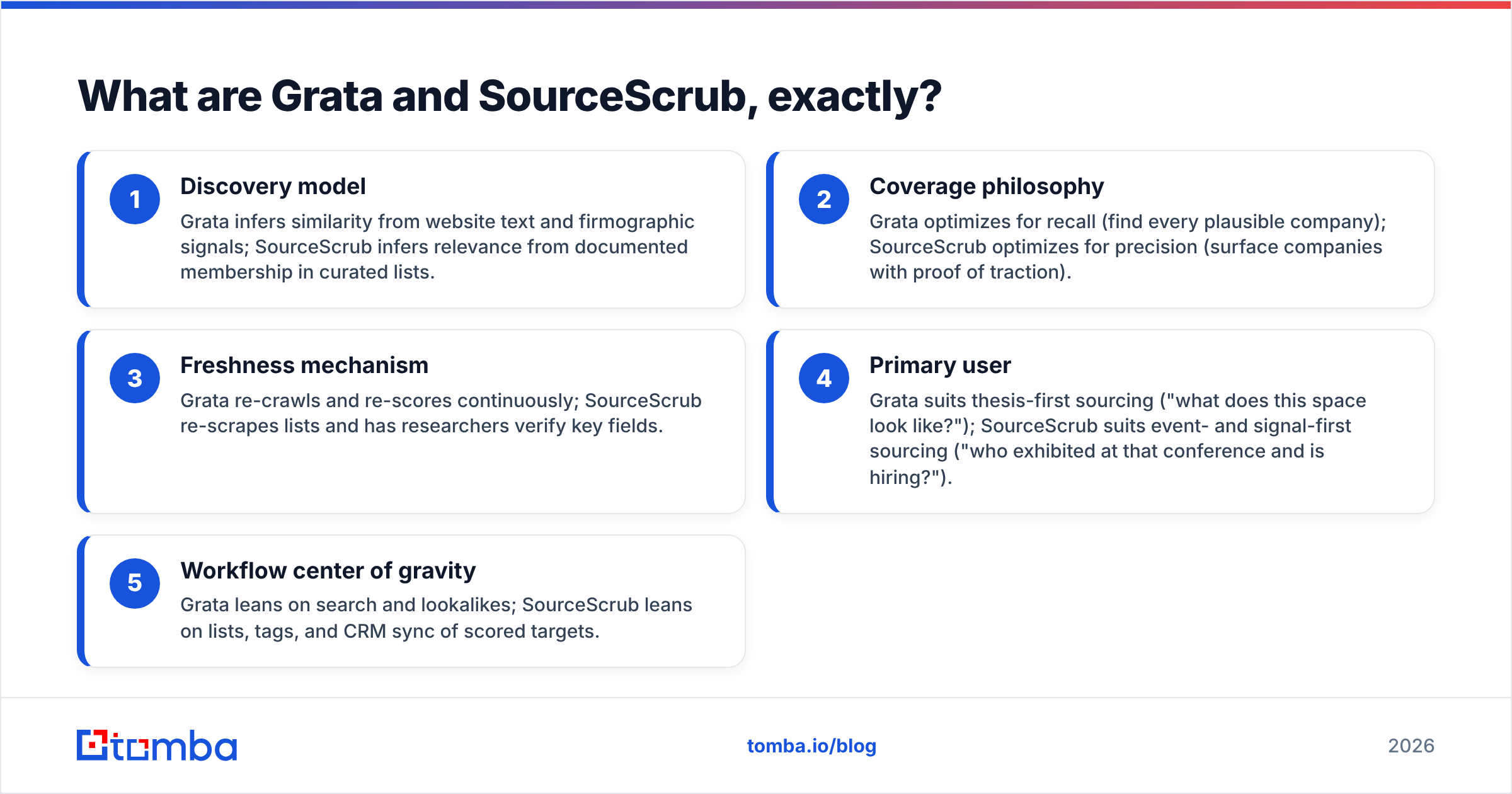
That difference in origin explains almost every other gap between them:
- Discovery model — Grata infers similarity from website text and firmographics. SourceScrub infers relevance from proven list membership.
- Coverage philosophy — Grata aims for recall, so it finds every plausible company. SourceScrub aims for precision, so it surfaces companies with proof of traction.
- Freshness — Grata re-crawls and re-scores all the time. SourceScrub re-scrapes lists, and researchers check the key fields.
- Primary user — Grata suits thesis-first sourcing: "what does this space look like?" SourceScrub suits signal-first sourcing: "who exhibited at that show and is hiring?"
- Workflow center — Grata leans on search and lookalikes. SourceScrub leans on lists, tags, and CRM sync of scored targets.
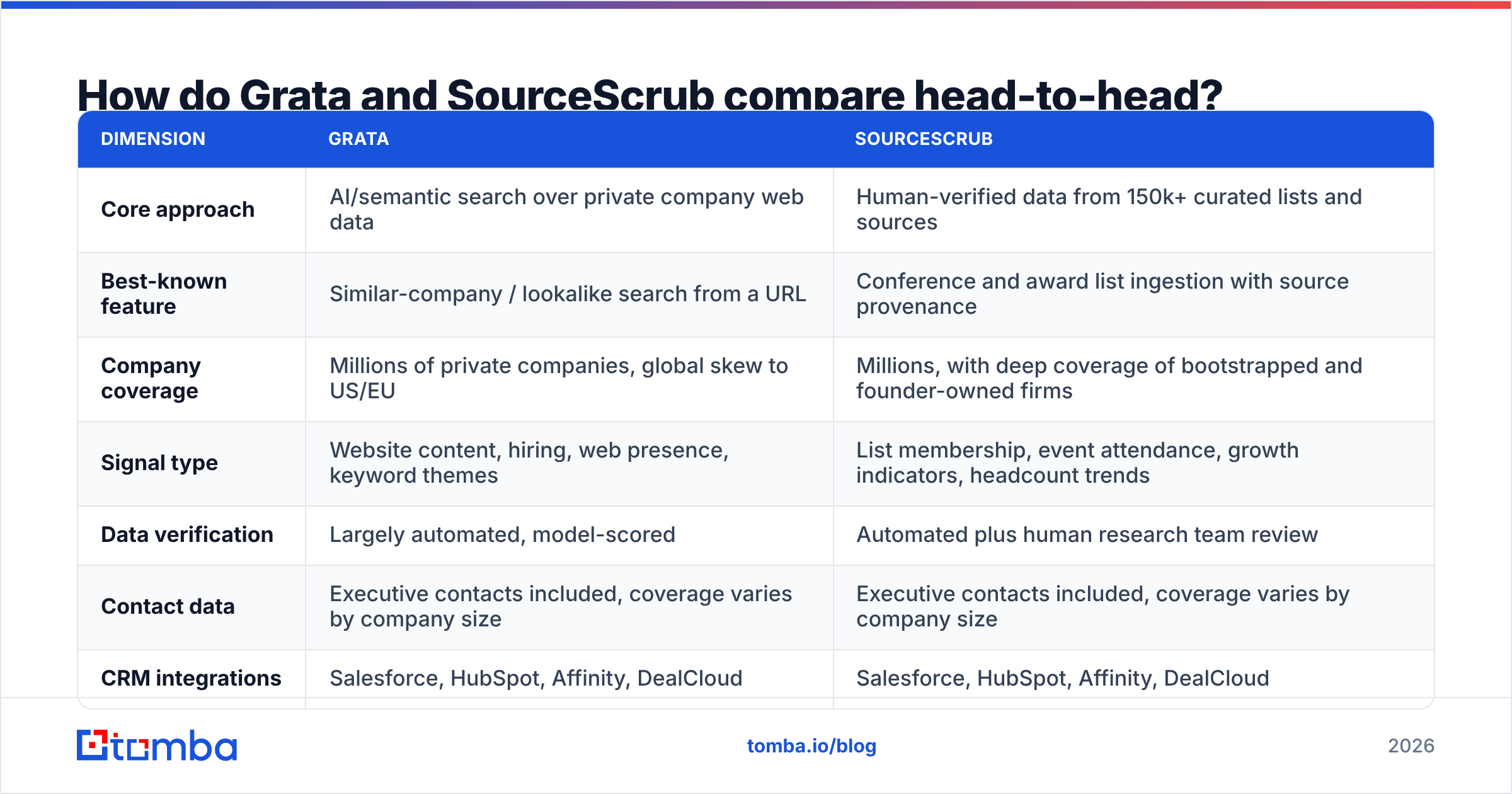
Grata vs SourceScrub: how do they compare head-to-head?#
Pricing for both is quote-only. So the figures below come from buyer reports and review sites, not published rate cards. Check them against your own quote.
| Dimension | Grata | SourceScrub |
|---|---|---|
| Core approach | AI/semantic search over private company web data | Human-verified data from 150k+ curated lists and sources |
| Best-known feature | Similar-company / lookalike search from a URL | Conference and award list ingestion with source provenance |
| Company coverage | Millions of private companies, global skew to US/EU | Millions, with deep coverage of bootstrapped and founder-owned firms |
| Signal type | Website content, hiring, web presence, keyword themes | List membership, event attendance, growth indicators, headcount trends |
| Data verification | Largely automated, model-scored | Automated plus human research team review |
| Contact data | Executive contacts included, coverage varies by company size | Executive contacts included, coverage varies by company size |
| CRM integrations | Salesforce, HubSpot, Affinity, DealCloud | Salesforce, HubSpot, Affinity, DealCloud |
| API access | Yes, enterprise tier | Yes, enterprise tier |
| Typical annual cost | Reported low-to-mid five figures, seat-based | Reported low-to-mid five figures, seat-based |
| Free tier | No — demo and trial only | No — demo and trial only |
| Strongest fit | Thesis-driven mapping, add-on searches, market landscapes | Event-driven sourcing, proprietary list building, founder-owned targets |
Read that table as two different bets. Grata bets that a good model on a lot of web text can find companies nobody has mapped yet. SourceScrub bets that humans already published the map, in exhibitor lists and award pages. The hard part is collecting and cleaning it.
Both bets are fair. Which one pays off depends on how your team actually sources.
Which one finds better companies?#
Neither, in general. They fail in different directions. That is the useful thing to know before you sign.
Grata is better when your search starts with a description. Add-on hunts are the clearest case. You own a company. You want twenty more like it in nearby markets. And you cannot write that as a SIC code. Grata's similarity search handles fuzzy verticals, such as "vertical SaaS for pest control," far better than keyword filters. It also surfaces long-tail companies with thin websites. Those firms rarely appear in funding-driven databases.
The cost of that recall is noise. Semantic search returns companies that look like a match on paper. Some turn out to be a two-person consultancy with a nice website. Grata gives you filters and scores to manage this. Even so, your analysts will still qualify out a real slice of every list.
SourceScrub is better when your search starts with a signal. Say your thesis is "companies that exhibited at three specialty trade shows in the last 18 months and grew headcount 20%." SourceScrub's provenance model is hard to copy there. Every record traces back to a source. That matters when an IC asks why a target is on the list.
The cost of that precision is blind spots. Some companies never appear on a list. No conferences, no awards, no association memberships. Those firms are much harder to find in SourceScrub. Offline, regional businesses are exactly the ones that go missing.
A blunt rule of thumb: if your motion is "map this market," start with Grata. If it is "who showed up where," start with SourceScrub.
How accurate is the data in each platform?#
Both platforms report high accuracy on firmographics: company name, website, industry, location, and rough headcount. In practice, buyer complaints on G2 cluster around the same three fields for both tools:
- Revenue estimates. Private company revenue is modeled, not observed. Treat every figure as a range, not a number. Analysts who screen on modeled revenue drop good targets and keep bad ones.
- Headcount lag. Both derive employee counts from public profiles. In small companies those lag reality by a quarter or more. The trend is more reliable than the exact count.
- Contact records. This is the weakest link in both. Coverage of executives at companies with 200+ employees is decent. At a 25-person founder-owned manufacturer, coverage thins out and records go stale. That is the exact target profile most lower-middle-market firms care about.
That third point is where sourcing teams quietly lose weeks. You paid five figures for a list of 400 perfect targets. Then you found that 40% of the owner emails bounce, are catch-alls, or belong to someone who left in 2024.
The fix is not to switch sourcing platforms. The fix is to stop using a sourcing platform as your contact database. Export the company list. Then resolve contacts with a tool built for that job. Use a domain search to pull the address pattern and current staff for each target domain. Then run email verification before anything enters a sequence.
Grata vs SourceScrub pricing: what do they cost in 2026?#
Neither company publishes a price. Both sell annual contracts with seat-based pricing. Modules cost extra: API access, CRM sync, more users, bigger exports. Reported buyer experience puts both in the same band. Expect low-to-mid five figures a year for a small team. That climbs fast with seats and API.
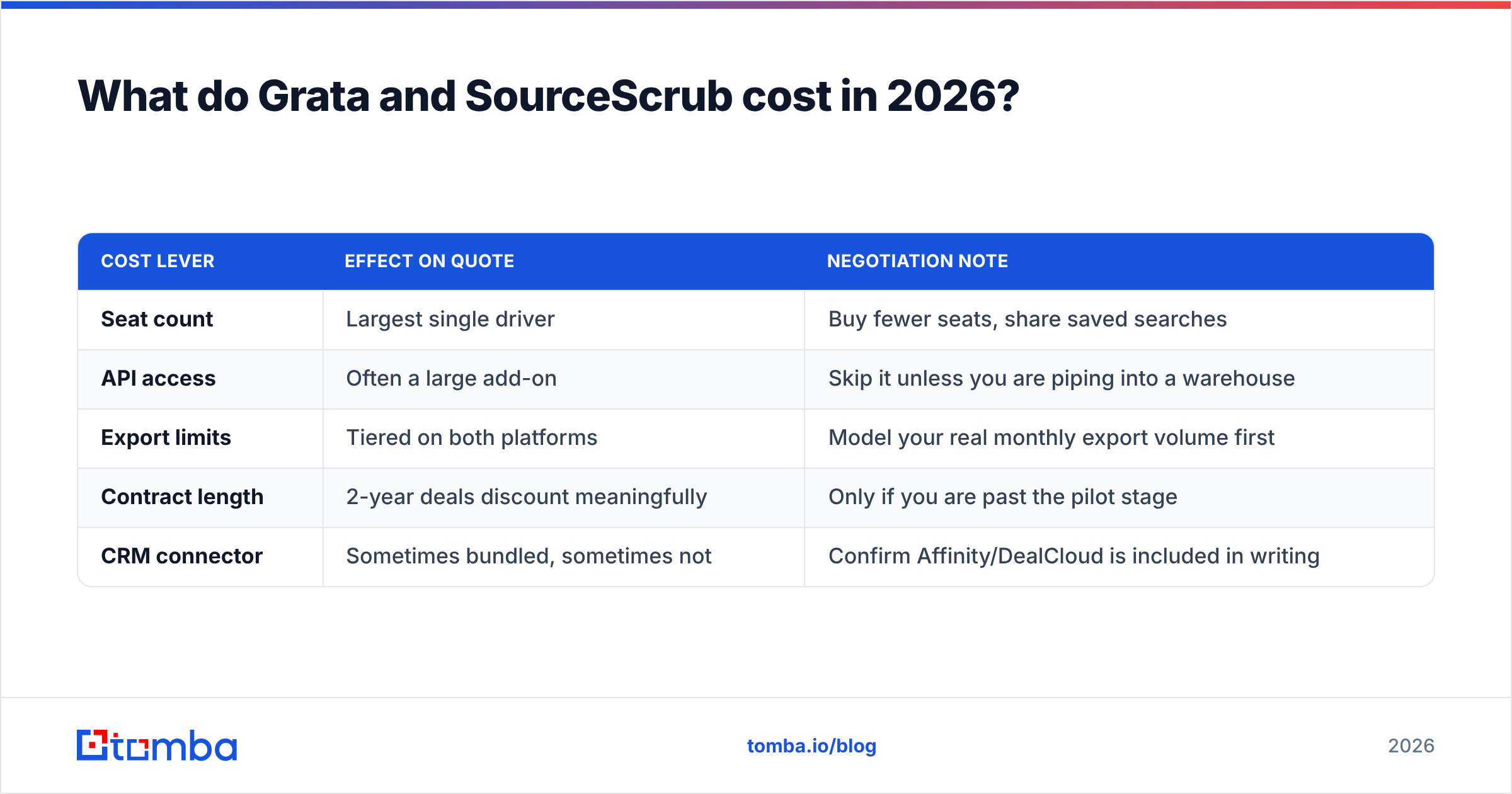
Here is what actually moves the number in a negotiation:
| Cost lever | Effect on quote | Negotiation note |
|---|---|---|
| Seat count | Largest single driver | Buy fewer seats, share saved searches |
| API access | Often a large add-on | Skip it unless you are piping into a warehouse |
| Export limits | Tiered on both platforms | Model your real monthly export volume first |
| Contract length | 2-year deals discount meaningfully | Only if you are past the pilot stage |
| CRM connector | Sometimes bundled, sometimes not | Confirm Affinity/DealCloud is included in writing |
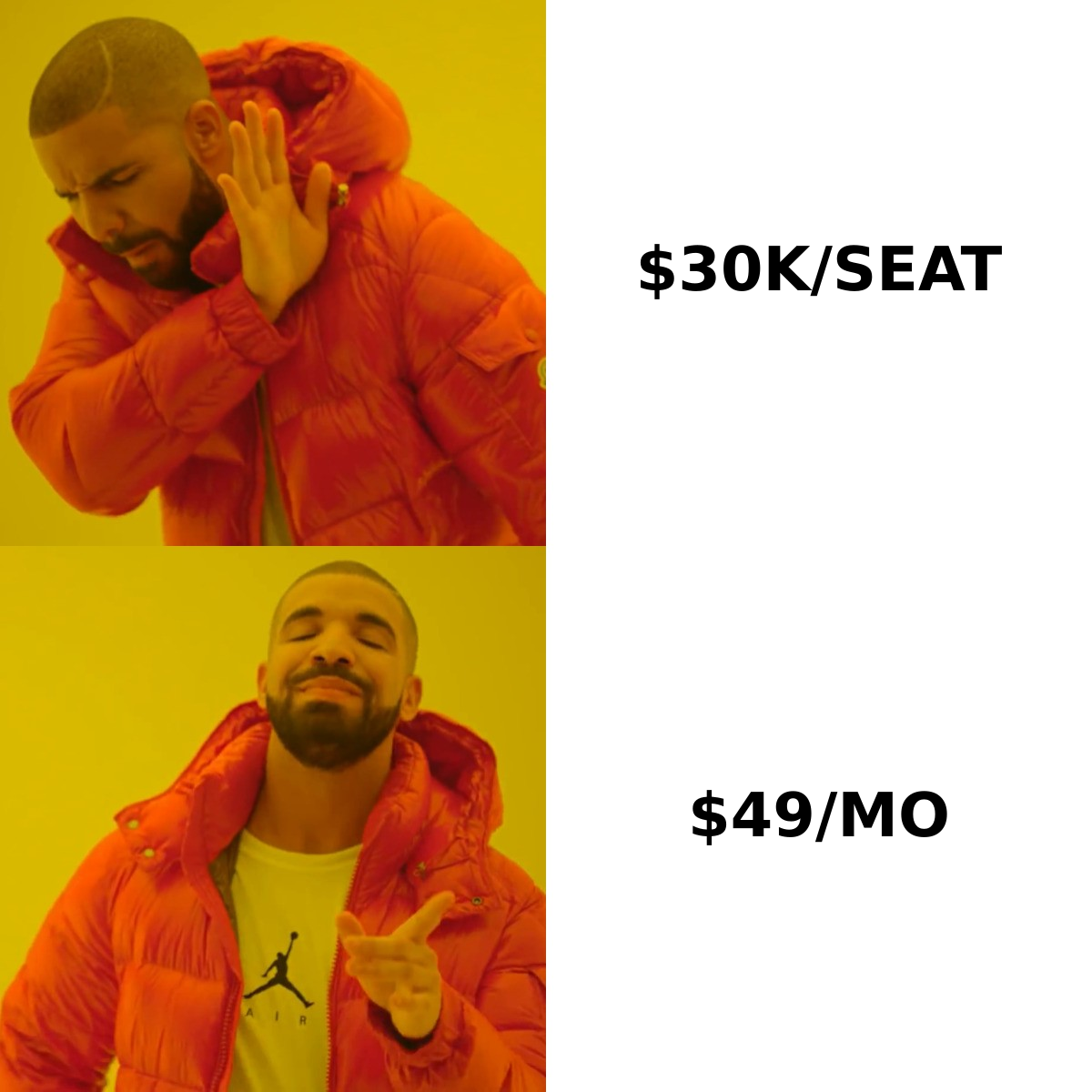
The mistake to avoid is buying both. Firms that run Grata and SourceScrub side by side learn something after two quarters. Analysts default to one tool, and the second license becomes shelfware. Pilot both, pick one, and spend the rest on the contact and outreach layer. That layer costs a fraction of either platform. Tomba's pricing starts at $49/mo for Starter and $99/mo for Growth. A free tier gives you 25 searches per month to test the data first.
Which team should pick which platform?#
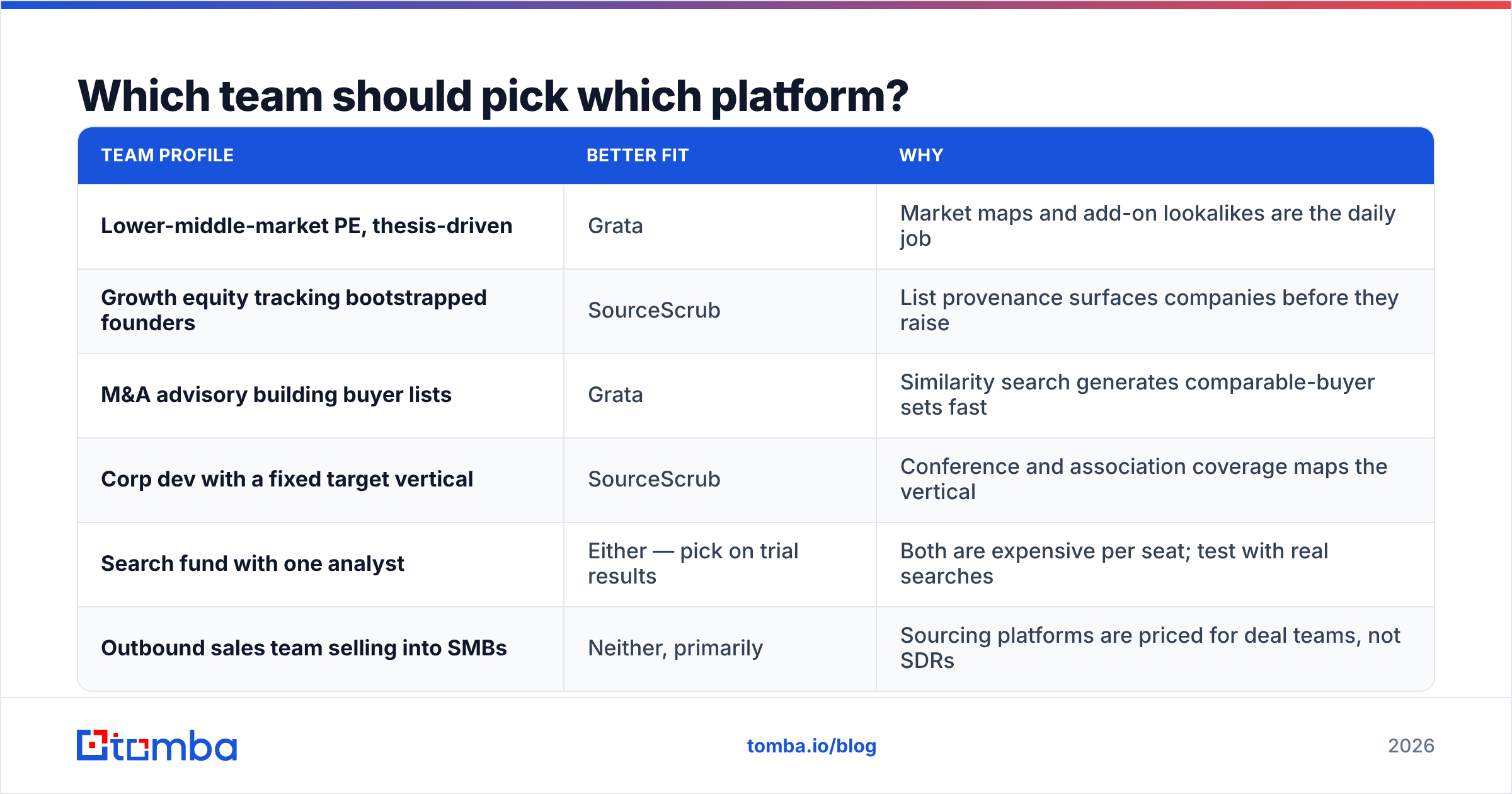
| Team profile | Better fit | Why |
|---|---|---|
| Lower-middle-market PE, thesis-driven | Grata | Market maps and add-on lookalikes are the daily job |
| Growth equity tracking bootstrapped founders | SourceScrub | List provenance surfaces companies before they raise |
| M&A advisory building buyer lists | Grata | Similarity search generates comparable-buyer sets fast |
| Corp dev with a fixed target vertical | SourceScrub | Conference and association coverage maps the vertical |
| Search fund with one analyst | Either — pick on trial results | Both are expensive per seat; test with real searches |
| Outbound sales team selling into SMBs | Neither, primarily | Sourcing platforms are priced for deal teams, not SDRs |
That last row deserves emphasis. Both tools are sold to investors. Sales teams then see the demo and like the company search. But if your job is booking meetings, a $30k/yr company intelligence license is the wrong spend. You need contact volume and verification throughput instead.
What do both platforms miss?#
Three gaps show up no matter which one you sign:
- Contact data at the small end. Under 50 employees, coverage in both platforms drops. Founder-owned targets are usually under 50 employees.
- Verification freshness. A contact record that was right nine months ago is a bounce today. Neither platform is a verification service, and neither claims to be.
- Non-executive coverage. Do you target an operations lead or a plant manager rather than the CEO? Then you are largely on your own.
The usual workaround is a two-layer stack. Use the sourcing platform for which companies. Use dedicated contact tooling for which person and what address. Run your exported list through a bulk email finder to resolve contacts at scale. Or wire the Tomba API into whatever your analysts already use: a warehouse job, a Sheets workflow, or a CRM enrichment step.
How should you run the trial?#
Do not let either vendor demo their own example searches. Run yours.
- Bring five real targets you own or already passed on. Search for each in both tools. If a platform cannot find a company you know exists, that is your coverage answer.
- Run one live thesis. Give both platforms the same brief. Compare the top 50 results for qualified-out rate.
- Export 100 contact records from each and verify them yourself. Measure the real bounce risk, not the stated accuracy.
- Time the workflow. Count clicks from search to CRM-ready list. Analyst hours are the real cost of a sourcing tool.
- Ask about year-two pricing. Both are annual contracts, and early discounts do not always hold.
Two weeks of that gives you a clearer answer than any comparison article, including this one.
The verdict#
The Grata vs SourceScrub verdict is short. Grata is the better search engine. SourceScrub is the better dataset. If your sourcing starts from a thesis and you need breadth, Grata builds the market map faster. If it starts from signals and you need proof on every record, SourceScrub is the stronger pick. Both are priced for deal teams. Both are quote-only. And both leave you with a target list whose contact data is not ready to email.
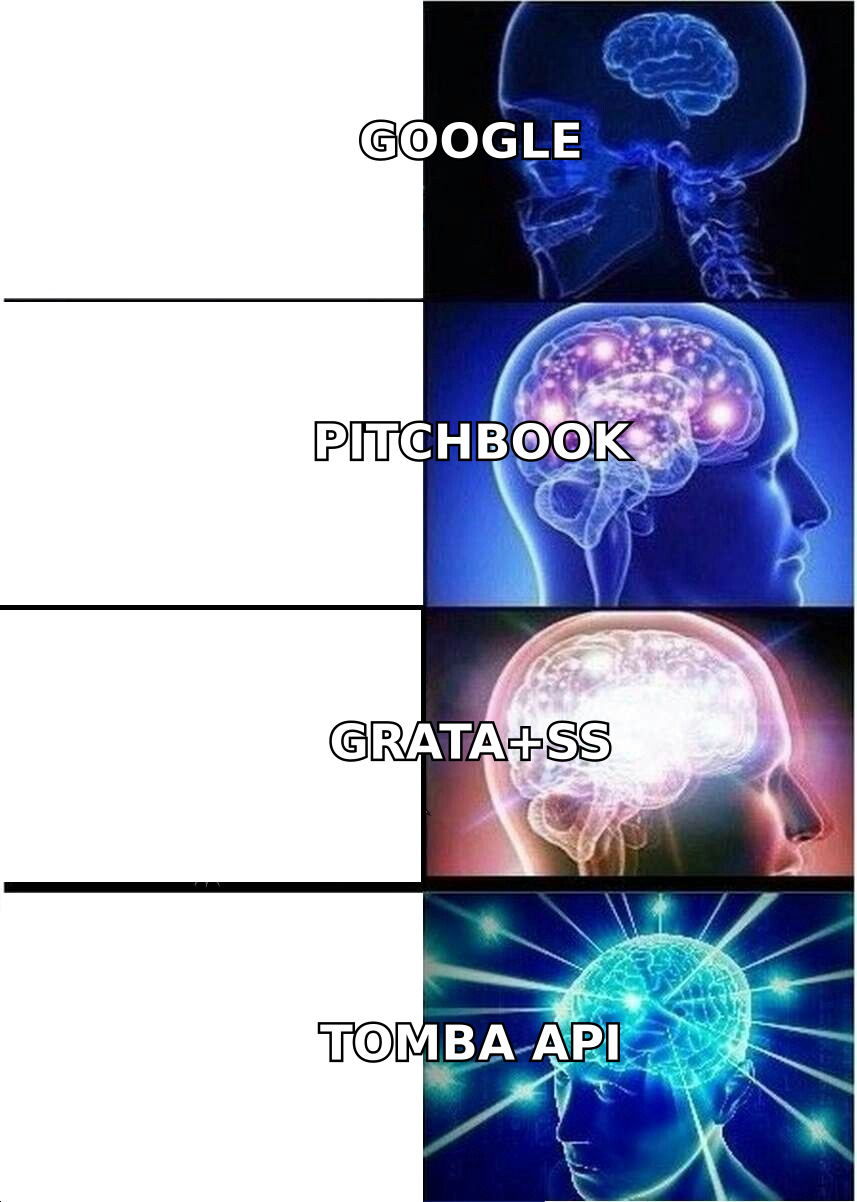
Close that last gap before you spend a quarter on bounced outreach. Run your exported target domains through the Tomba Email Finder. You get verified, current addresses for the decision-makers on your list. Test it on the free tier, then move to the $49/mo Starter plan when you scale. Your sourcing platform tells you who to talk to. Tomba makes sure the message arrives.
Related guides#
Ready to find emails that actually work?
Join 150,000+ professionals who stopped guessing and started sending. Free credits on signup — no credit card required.
Get the Tomba newsletter
Practical outbound tactics and product updates — once every two weeks.
About the author