Grata vs Tomba (2026): Which B2B Data Tool Should You Buy?
Grata maps private companies for dealmakers. Tomba finds and verifies the email addresses behind them. Here is an honest breakdown of pricing, data coverage, and which one actually belongs in your stack in 2026.
TL;DR
- Grata and Tomba solve different halves of the same problem. Grata is a private-company search engine built for M&A and private equity deal sourcing. Tomba is an email finder and verification layer built for outbound contact.
- Grata's strength is discovery: semantic search across millions of private companies, ownership signals, and thesis-based lists. Its weakness is contact depth and price — pricing is quote-only and lands in enterprise territory.
- Tomba's strength is contact data at a transparent price: a free tier at 25 searches/month, Starter at $49/mo, Growth at $99/mo, Pro at $249/mo, plus verification, domain search, and an API.
- If you are sourcing acquisition targets, Grata wins. If you are running outbound to a list you already have, Tomba wins on cost per usable contact by a wide margin.
- The realistic 2026 stack for a lean deal or growth team: build the target list somewhere cheap (or in Grata if you have the budget), then enrich and verify contacts with Tomba before anything hits a sequence.
What are Grata and Tomba, actually?#
Grata is a private-market intelligence platform. It indexes small and mid-market private companies — the ones that never file with the SEC, never publish a funding round, and are invisible to most B2B databases — and lets you search them the way you would describe them to a colleague: "companies that do HVAC maintenance for commercial buildings in the Southeast, founder-owned, 50–200 employees." It was built for private equity associates, corporate development teams, and investment bankers who need a target list before they need a phone number. Grata was acquired by Datasite in 2025, pushing the roadmap further toward end-to-end deal workflows rather than general-purpose sales prospecting.
Tomba is a contact-data platform. Its core is an email finder that returns a verified professional email from a name plus a domain, backed by pattern detection, SMTP checks, and a confidence score. Around that sit a verifier, domain search, catch-all handling, phone lookup, enrichment, and a developer API. It does not tell you which companies to go after. It tells you how to reach the people inside the ones you picked.
That distinction matters more than any feature table, so hold onto it: Grata answers "who should I talk to as a company," Tomba answers "how do I actually reach the human."
How do Grata and Tomba compare feature by feature?#
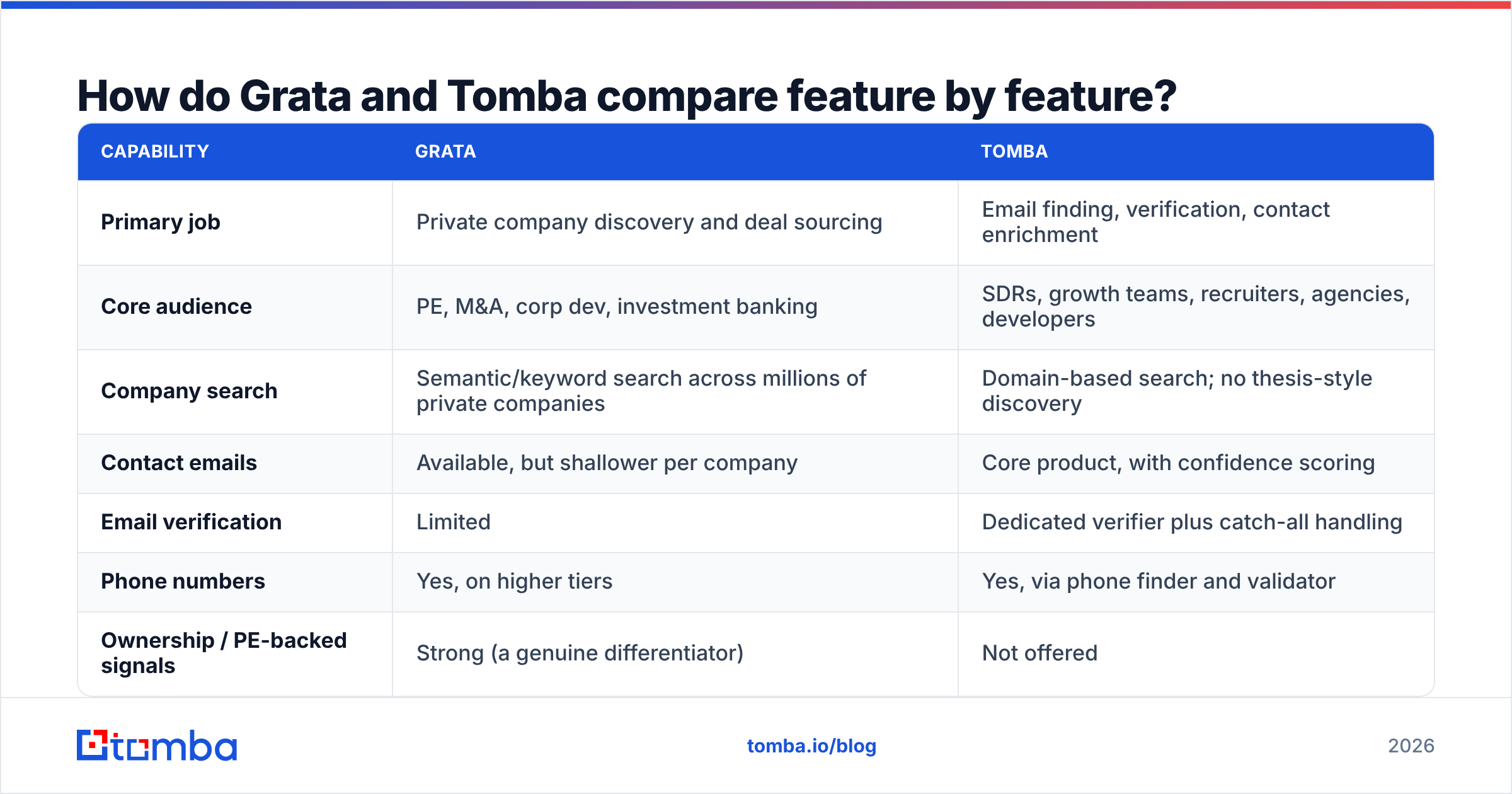
Here is the honest side-by-side. Neither column is a knockout — they overlap on maybe 20% of the surface area.
| Capability | Grata | Tomba |
|---|---|---|
| Primary job | Private company discovery and deal sourcing | Email finding, verification, contact enrichment |
| Core audience | PE, M&A, corp dev, investment banking | SDRs, growth teams, recruiters, agencies, developers |
| Company search | Semantic/keyword search across millions of private companies | Domain-based search; no thesis-style discovery |
| Contact emails | Available, but shallower per company | Core product, with confidence scoring |
| Email verification | Limited | Dedicated verifier plus catch-all handling |
| Phone numbers | Yes, on higher tiers | Yes, via phone finder and validator |
| Ownership / PE-backed signals | Strong (a genuine differentiator) | Not offered |
| Bulk processing | Yes, list building and exports | Yes, bulk finder and verifier |
| API access | Available on higher tiers | Available on all paid tiers |
| Free tier | No — demo-gated | Yes, 25 searches/month |
| Pricing transparency | Quote only, sales-led | Published: $49 / $99 / $249 per month |
| Time to first result | Days (demo, scoping, contract) | Minutes (self-serve signup) |
The row that decides most evaluations is the last one. Grata is a bought product; Tomba is a tried product. If your evaluation process cannot absorb a two-week sales cycle, the comparison ends before the data quality debate starts.
Which one has better data, and better at what?#
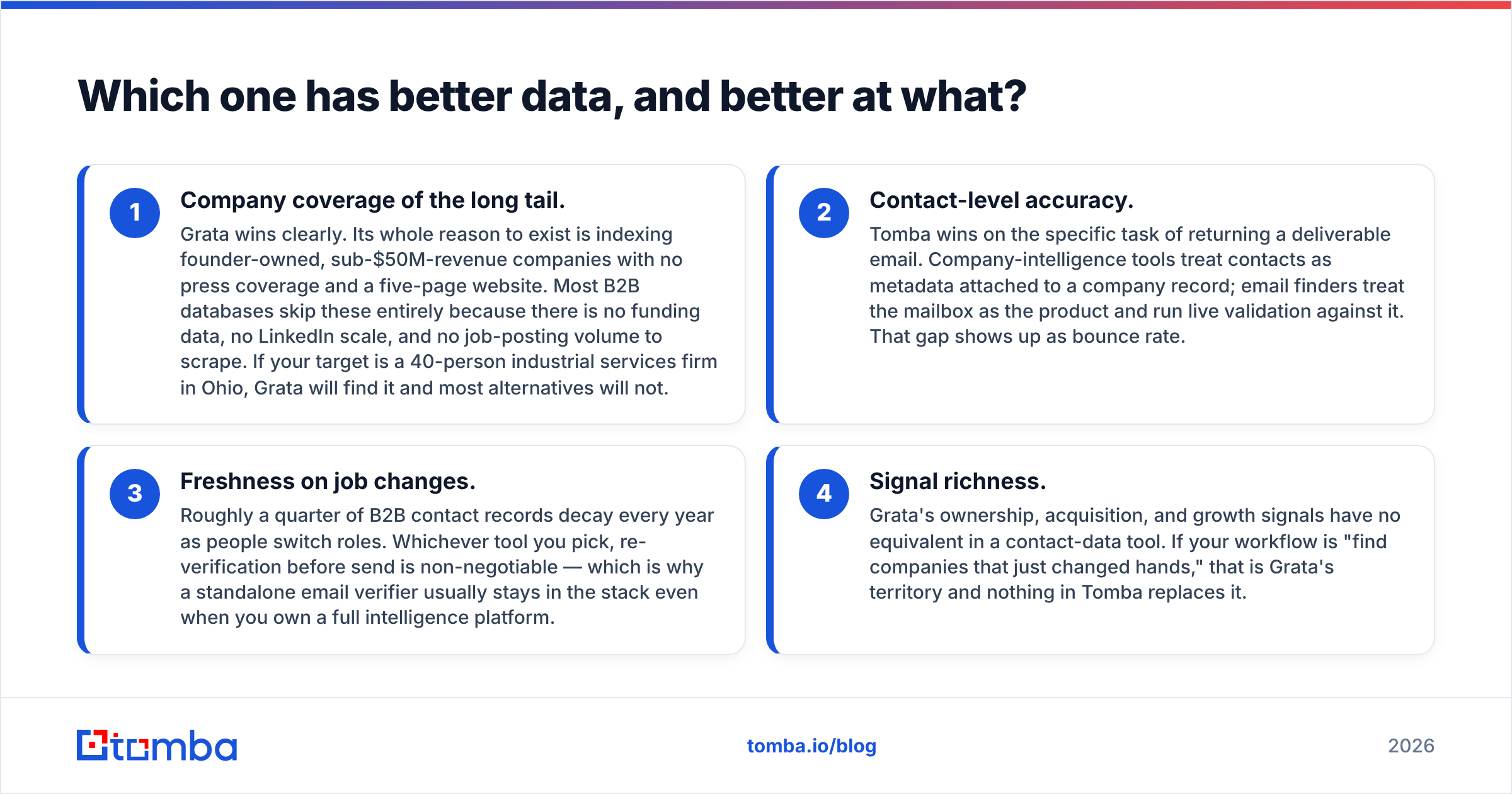
Data quality arguments get sloppy because "better" is undefined. Break it into four questions and the answer stops being ambiguous:
- Company coverage of the long tail. Grata wins clearly. Its whole reason to exist is indexing founder-owned, sub-$50M-revenue companies with no press coverage and a five-page website. Most B2B databases skip these entirely because there is no funding data, no LinkedIn scale, and no job-posting volume to scrape. If your target is a 40-person industrial services firm in Ohio, Grata will find it and most alternatives will not.
- Contact-level accuracy. Tomba wins on the specific task of returning a deliverable email. Company-intelligence tools treat contacts as metadata attached to a company record; email finders treat the mailbox as the product and run live validation against it. That gap shows up as bounce rate.
- Freshness on job changes. Roughly a quarter of B2B contact records decay every year as people switch roles. Whichever tool you pick, re-verification before send is non-negotiable — which is why a standalone email verifier usually stays in the stack even when you own a full intelligence platform.
- Signal richness. Grata's ownership, acquisition, and growth signals have no equivalent in a contact-data tool. If your workflow is "find companies that just changed hands," that is Grata's territory and nothing in Tomba replaces it.
Read that list again and you will notice something: three of the four are about different jobs. This is not a fight over the same square of ground.
What does each one cost in 2026?#
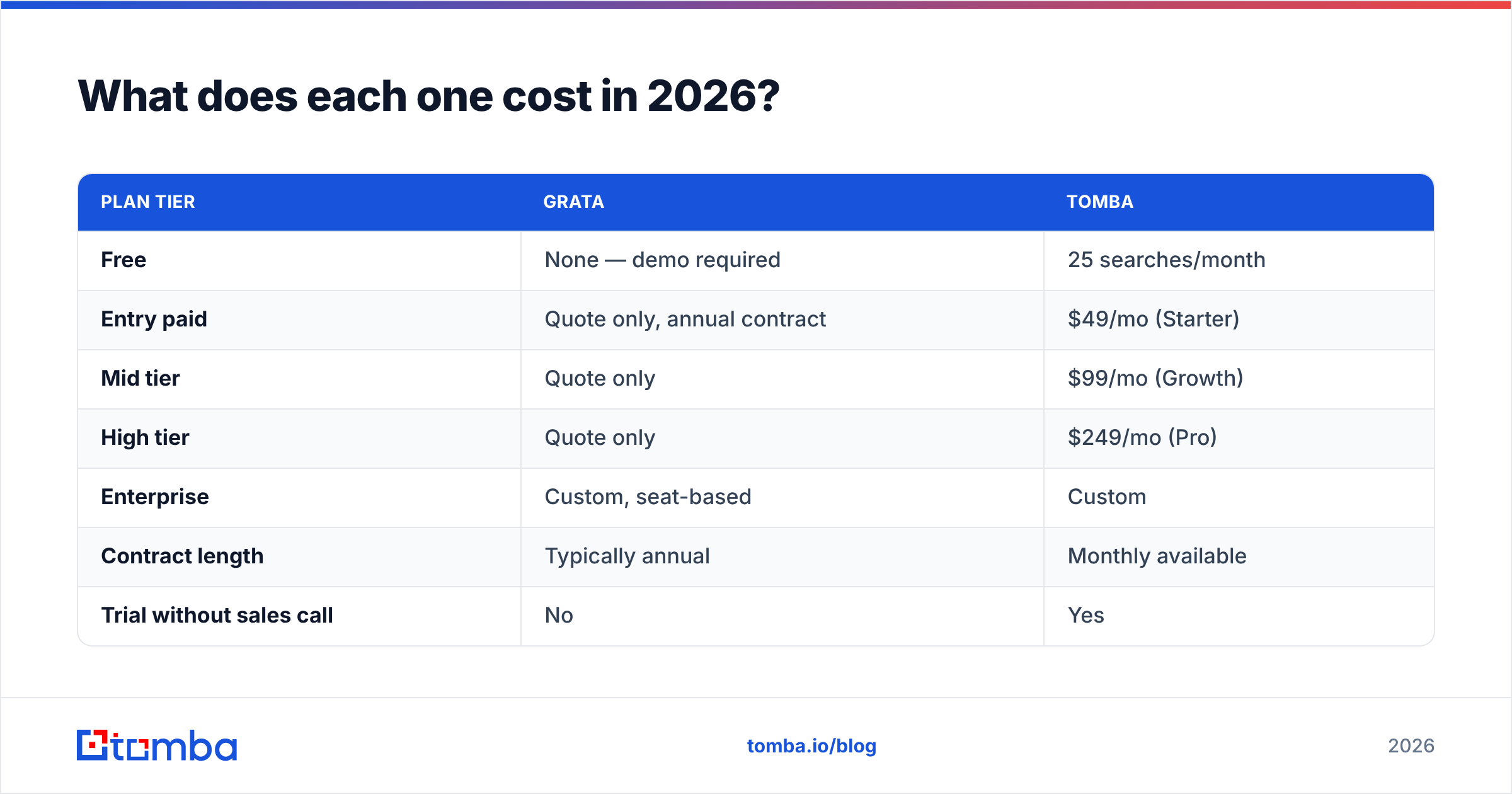
Grata does not publish pricing. Every quote is scoped by seat count, export volume, and modules, and comes through a sales conversation. Public reviews on G2 and buyer chatter consistently place it in annual-contract, five-figure territory — normal for deal-sourcing software, brutal for a two-person growth team. Treat any specific number you read online as a data point, not a price list, and get your own quote.
Tomba's pricing is on the page. That transparency is itself a feature when you are trying to model cost per contact before you commit.
| Plan tier | Grata | Tomba |
|---|---|---|
| Free | None — demo required | 25 searches/month |
| Entry paid | Quote only, annual contract | $49/mo (Starter) |
| Mid tier | Quote only | $99/mo (Growth) |
| High tier | Quote only | $249/mo (Pro) |
| Enterprise | Custom, seat-based | Custom |
| Contract length | Typically annual | Monthly available |
| Trial without sales call | No | Yes |
Full details are on the Tomba pricing page. The strategic point is not that one is cheap and one is expensive — Grata's price is defensible if a single sourced deal closes. The point is that they are priced for different decision-makers. A PE firm expenses a $30K annual contract without blinking. An agency running outbound for six clients cannot, and should not.
Who should buy Grata?#
Buy Grata if most of these describe you:
- You source acquisition targets, not customers. Your output is a target list for an investment committee, not a sequence.
- The long tail is the whole point. You need companies that do not appear in Crunchbase, PitchBook, or standard sales databases.
- Ownership status is a filter, not a footnote. "Founder-owned, never raised, no PE backing" is a real search you run weekly.
- One closed deal justifies the software budget. With deal economics, the ROI math is trivially favorable, which is exactly why the pricing works.
- You have a team to operationalize it. Grata rewards structured thesis work. Buying it for occasional lookups is waste.
What Grata will not do for you: run outbound at scale. Once you have your target list, you still need deliverable email addresses for the operating partner, the CFO, and the founder — and the contact layer is where most deal teams end up bolting on a second tool.
Who should buy Tomba?#
Choose Tomba when the bottleneck is reaching people, not finding companies:
- You already know your ICP and can list the domains. Outbound sales, recruiting, partnerships, link building, and agency prospecting all start from a known domain list.
- Bounce rate is a live problem. Verification and catch-all handling are first-class here, not an afterthought. That directly protects sender reputation.
- You want to test before you talk to anyone. The free tier and monthly plans mean an evaluation costs an afternoon, not a quarter.
- You need it inside your own systems. The Tomba API, CLI, spreadsheet add-ons, and CRM integrations mean enrichment can live in your pipeline instead of a browser tab.
- Volume matters more than narrative. Bulk find and bulk verify handle list-level work without per-record clicking.
Can you use Grata and Tomba together?#
Yes, and for deal teams this is usually the correct answer rather than a compromise. The two products stack cleanly because they touch different fields on the same record.
A working sequence:
- Define the thesis in Grata. Sector, geography, size band, ownership status. Export the company list with domains.
- Map the buying committee. Pull the two or three roles that matter per target — founder, CFO, VP Ops. Titles and names come from Grata or LinkedIn.
- Resolve emails with Tomba. Feed names plus domains through the bulk email finder to convert people into deliverable addresses at list scale.
- Verify before send. Run the output through verification, quarantine catch-all domains, and drop anything below your confidence threshold. This is the step most teams skip and then blame the copy for their reply rate.
- Push to the CRM. Sync enriched, verified records into HubSpot, Salesforce, or Pipedrive so ownership and activity tracking live where your team already works. HubSpot's own data-quality guidance is worth reading before you design the sync.
- Re-verify quarterly. Contact data decays. Treat re-verification as maintenance, not a project.
That workflow costs roughly the Grata contract plus $49–$99/month. The second line item is a rounding error, and it is the line item that determines whether your emails arrive.
What are the common complaints about each?#
Neutrality means naming the friction, so here it is.
Grata. The recurring themes in buyer feedback: contact data is thinner than the company data, which forces a second vendor; pricing opacity makes budgeting awkward and comparison shopping slow; coverage is strongest in North America and thins out internationally; and there is a real learning curve to getting semantic search to return what you actually meant. The product is excellent at its job, but that job is narrower than the marketing surface suggests.
Tomba. Honest limitations: it will not build a thesis-driven target list for you, there are no ownership or M&A signals, and — like every email finder on the market — catch-all domains cannot be resolved to a hard "valid" verdict by anyone. What Tomba does is label them accurately with a catch-all verifier rather than pass them through as confirmed, which is the difference between an informed risk and a surprise bounce. Coverage also skews toward companies with an indexed web presence, so a business with no website and no online footprint is a hard case.
Neither list is disqualifying. Both are worth knowing before you sign anything.
Grata vs Tomba: what is the verdict?#
If you have to pick one, pick based on which half of the funnel is actually broken.
Cannot find the right companies? That is a Grata problem, and no amount of email credits fixes it. Budget for the annual contract, staff someone to run it properly, and accept the sales cycle.
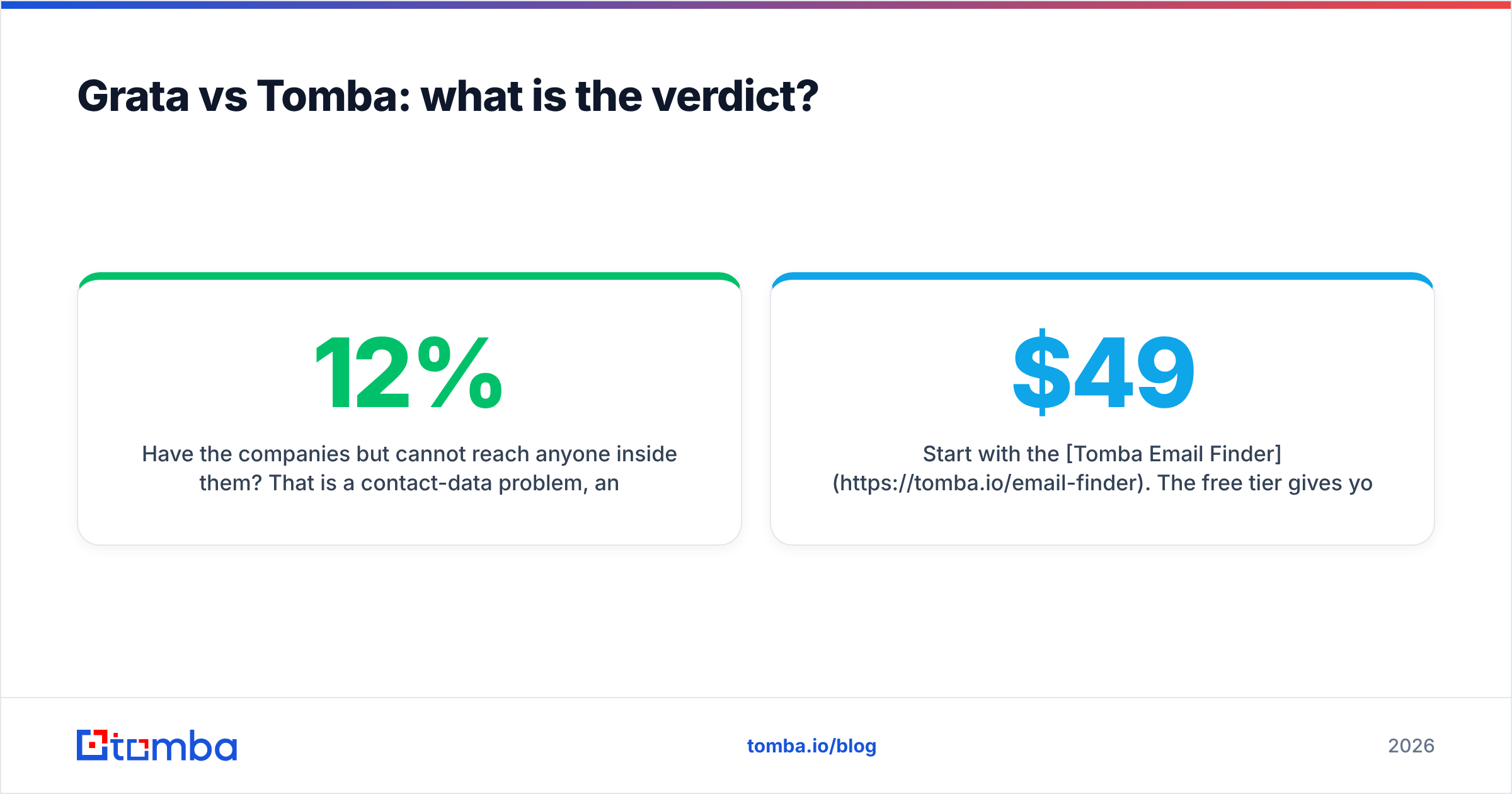
Have the companies but cannot reach anyone inside them? That is a contact-data problem, and it is dramatically cheaper to solve. Sequences that bounce at 12% are not a copywriting failure — they are a data failure, and the fix costs less per month than a single SDR's software stack.
For most teams reading a comparison like this, the second scenario is the real one. Deal sourcing is a specialist purchase for a specialist workflow. Contact resolution is universal — every outbound, recruiting, partnership, and fundraising motion needs it, and the cost of getting it wrong compounds through your domain reputation.
Start with the Tomba Email Finder. The free tier gives you 25 searches a month with no card and no demo call, which is enough to run your own accuracy test against a list of contacts you can independently confirm. If it holds up, Starter is $49/mo and Growth is $99/mo — and you will know exactly what you are buying before you pay for it. That is a better evaluation than any comparison post, including this one.
Related guides#
Ready to find emails that actually work?
Join 150,000+ professionals who stopped guessing and started sending. Free credits on signup — no credit card required.
Get the Tomba newsletter
Practical outbound tactics and product updates — once every two weeks.
About the author