Grata vs Wiza (2026): Deal Sourcing vs LinkedIn Prospecting
Grata and Wiza both sell "B2B data," but they answer opposite questions. One maps private companies for dealmakers; the other exports LinkedIn contacts for sellers. Here is which one you actually need in 2026.
Grata vs Wiza looks like a head-to-head. It isn't one. Grata finds private companies to buy. Wiza finds people to email. This guide shows which side of that split you are on, and what each tool costs in 2026.
TL;DR
- Grata vs Wiza is not a fair fight. The two tools answer different questions.
- Grata is a search engine for private companies. It serves M&A, private equity, and corp dev teams. Wiza exports LinkedIn contacts for SDRs and recruiters. The overlap is small — maybe 15%.
- Pick Grata if your unit of work is the company. Think target lists, market maps, ownership data, and deal signals.
- Pick Wiza if your unit of work is the person. Turn a Sales Navigator list into emails and mobile numbers you can use tomorrow.
- Neither tool is a strong contact-data layer on its own. Grata's exec contacts are thin. Wiza goes blank when a prospect is not active on LinkedIn.
- Most teams add a cheap, API-first email layer under the platform they buy. Tomba's email finder fills that gap at $49/mo, not a five-figure annual seat.
What is Grata, and who buys it?#
Grata is a search engine for private companies. You describe a business in plain words — "companies that install commercial HVAC systems for data centers in the Southeast." Grata returns a ranked list of private firms that match. The index is built from company websites, news, job posts, and filings. In a Grata vs Wiza split, Grata owns the company side.
The buyer is easy to name. Private equity associates, bankers, corp dev teams, and the search-fund crowd. Their job is not to book meetings this week. It is to build a list of 400 targets in one niche. Then work out which firms are founder-owned and which are sponsor-backed. Then watch for a signal — new funding, a new leader, a hiring spike — that makes one worth a call.
The product reflects that. Profiles show revenue and headcount bands, ownership status, funding history, and similar companies. You can push records into Salesforce or HubSpot. Datasite bought Grata in 2024, and the tool now sits inside a wider deal workflow.
What Grata is not: a volume outbound tool. Contact data sits on the profiles, but it is a side feature. If you want to email 3,000 marketing managers, you bought the wrong thing.
What is Wiza, and where does its data come from?#
Wiza is the opposite bet. It is a Chrome extension plus a web app that rides on LinkedIn and Sales Navigator. You build a search in Sales Navigator and hit export. Wiza hands back a CSV of those profiles with work emails, personal emails, and — on higher tiers — mobile numbers. Each address is checked in real time, not pulled from an old snapshot.
That design is Wiza's biggest strength and its hard ceiling. The strength: the source is the live profile, so job titles stay current. Databases go stale in months. LinkedIn profiles get updated by the person who owns them. The ceiling: no LinkedIn profile, no record. The owner of a $12M manufacturing shop may have a profile last touched in 2019, or none at all.
Wiza runs on credits, sells to SDR teams and recruiters, and scores well on G2 for ease of use. You buy it when the problem is simple. You have a list of people and no way to reach them. In a Grata vs Wiza choice, Wiza owns the people side.

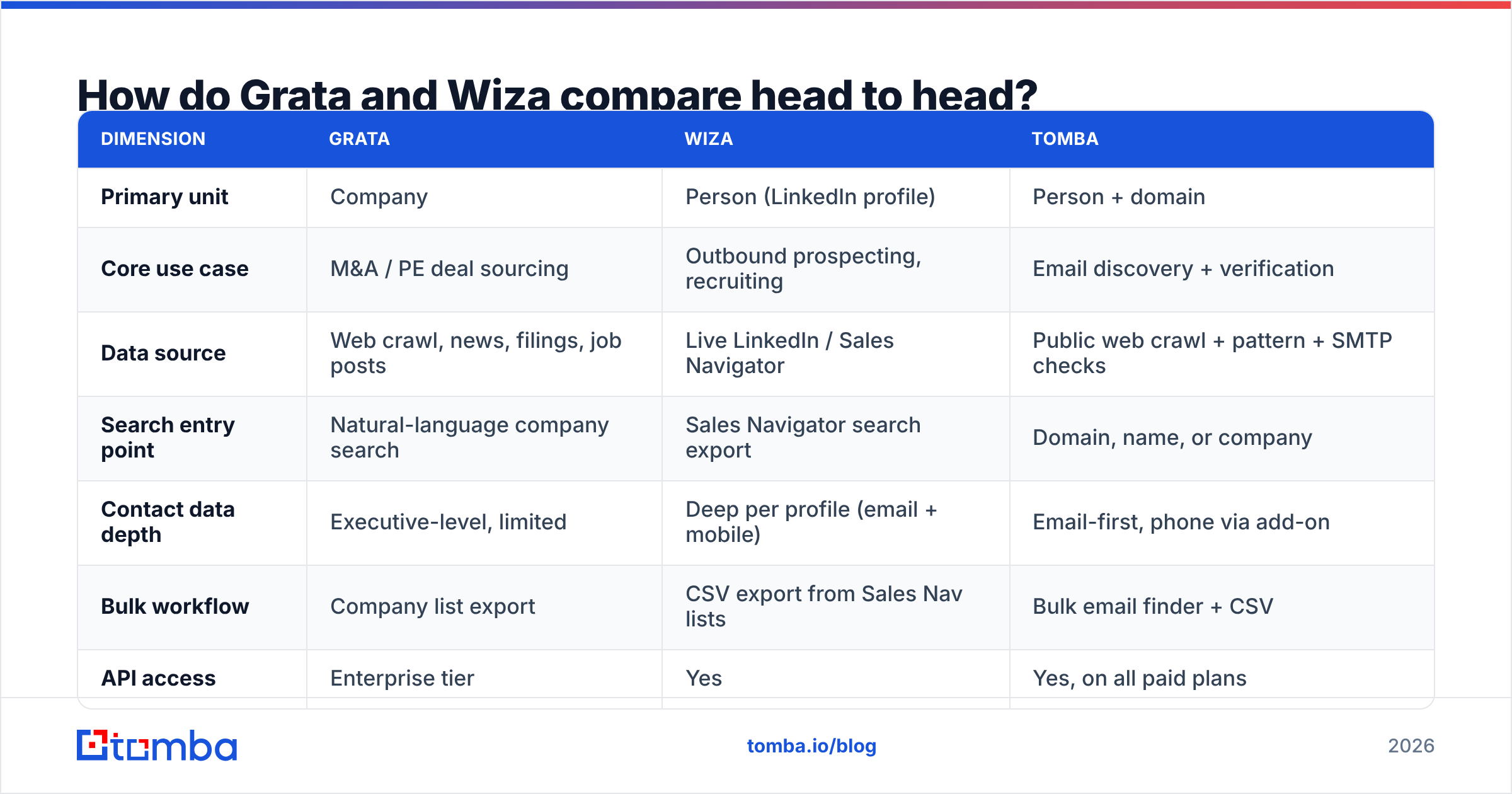
Grata vs Wiza: how do they compare head to head?#
| Dimension | Grata | Wiza | Tomba |
|---|---|---|---|
| Primary unit | Company | Person (LinkedIn profile) | Person + domain |
| Core use case | M&A / PE deal sourcing | Outbound prospecting, recruiting | Email discovery + verification |
| Data source | Web crawl, news, filings, job posts | Live LinkedIn / Sales Navigator | Public web crawl + pattern + SMTP checks |
| Search entry point | Natural-language company search | Sales Navigator search export | Domain, name, or company |
| Contact data depth | Executive-level, limited | Deep per profile (email + mobile) | Email-first, phone via add-on |
| Bulk workflow | Company list export | CSV export from Sales Nav lists | Bulk email finder + CSV |
| API access | Enterprise tier | Yes | Yes, on all paid plans |
| Verification built in | No | Real-time email validation | Dedicated email verifier + catch-all handling |
| Entry price | Custom annual contract | Credit tiers, published online | Free tier, then $49/mo |
| Best for | Deal teams mapping a market | SDRs working a LinkedIn ICP | Any team needing accurate emails cheaply |
The table makes the real point. This is not a versus. It is a fork. People stuck on Grata vs Wiza usually have not settled one question. Are you sourcing companies to buy or people to email?
Grata vs Wiza: which one has better data quality?#
Wrong question. Better at what?
Company coverage. Grata wins, and it is not close. Its index is built around private, low-profile firms. A two-page website, no press, no funding round. That is the whole product thesis. Wiza has no real company-discovery layer. It inherits Sales Navigator's filters, which lean toward firms with an active LinkedIn presence.
Person-level contact accuracy. Wiza wins, with a caveat. Real-time checks mean your exported emails were tested minutes ago, not months ago. But "valid" and "reachable" split apart on catch-all domains. That is where most B2B lists quietly leak. A catch-all domain accepts every address at the SMTP layer. So a basic check returns green for a mailbox that does not exist. A dedicated catch-all verifier matters more than the accuracy number on any vendor's homepage.
Freshness. Wiza again. Live profiles beat snapshot databases on job changes, and job changes cause most bounces.
Coverage of the long tail. Grata for companies. Neither for people. The 55-year-old owner of a regional distributor shows up in Grata as a company. In Wiza he often has no record at all. Here a pattern-plus-verify approach wins. Take the domain, work out the email format, then confirm the mailbox. A domain search still returns the addresses published on the firm's own site, press pages, and support docs.
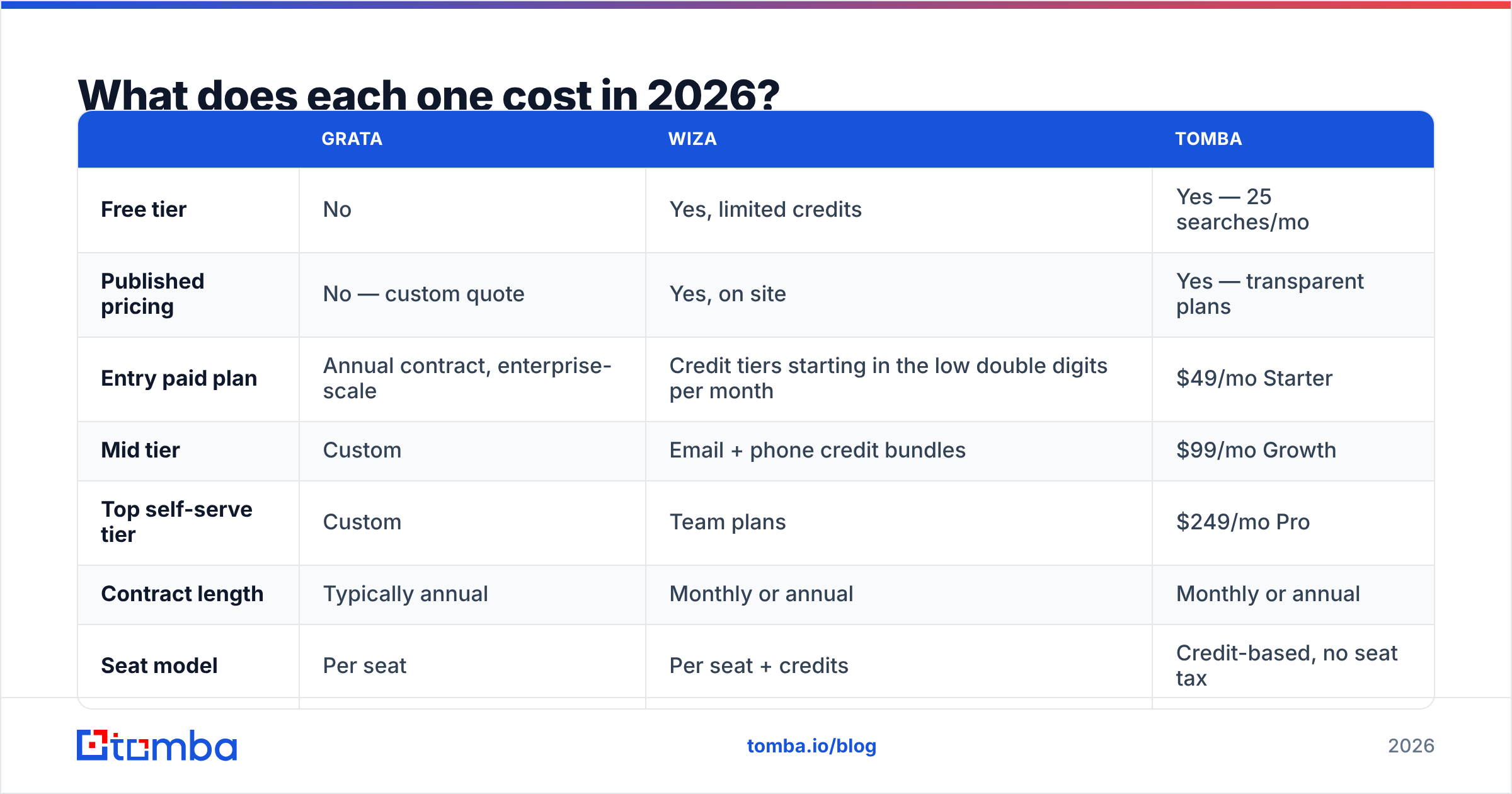
Grata vs Wiza pricing: what does each one cost in 2026?#
Pricing transparency is itself a signal here.
| Grata | Wiza | Tomba | |
|---|---|---|---|
| Free tier | No | Yes, limited credits | Yes — 25 searches/mo |
| Published pricing | No — custom quote | Yes, on site | Yes — transparent plans |
| Entry paid plan | Annual contract, enterprise-scale | Credit tiers starting in the low double digits per month | $49/mo Starter |
| Mid tier | Custom | Email + phone credit bundles | $99/mo Growth |
| Top self-serve tier | Custom | Team plans | $249/mo Pro |
| Contract length | Typically annual | Monthly or annual | Monthly or annual |
| Seat model | Per seat | Per seat + credits | Credit-based, no seat tax |
Grata does not publish prices. That tells you the sales motion. A demo, a scoping call, then an annual deal sized to your fund or corp dev team. That is normal for deal sourcing, and it is not a knock. Those buyers have the budget lines. It is a problem if you are a five-person sales team who found Grata in a "best B2B databases" listicle. Check each vendor's own pricing page before you budget. Credit bundles in this market get repackaged all the time.
Wiza publishes its tiers and sells self-serve, which fits an SDR buyer. The real cost is not the sticker price. It is credit burn. A 5,000-row Sales Navigator export eats an allowance fast. Phone credits also cost several times more than email credits.
How should you structure the stack?#
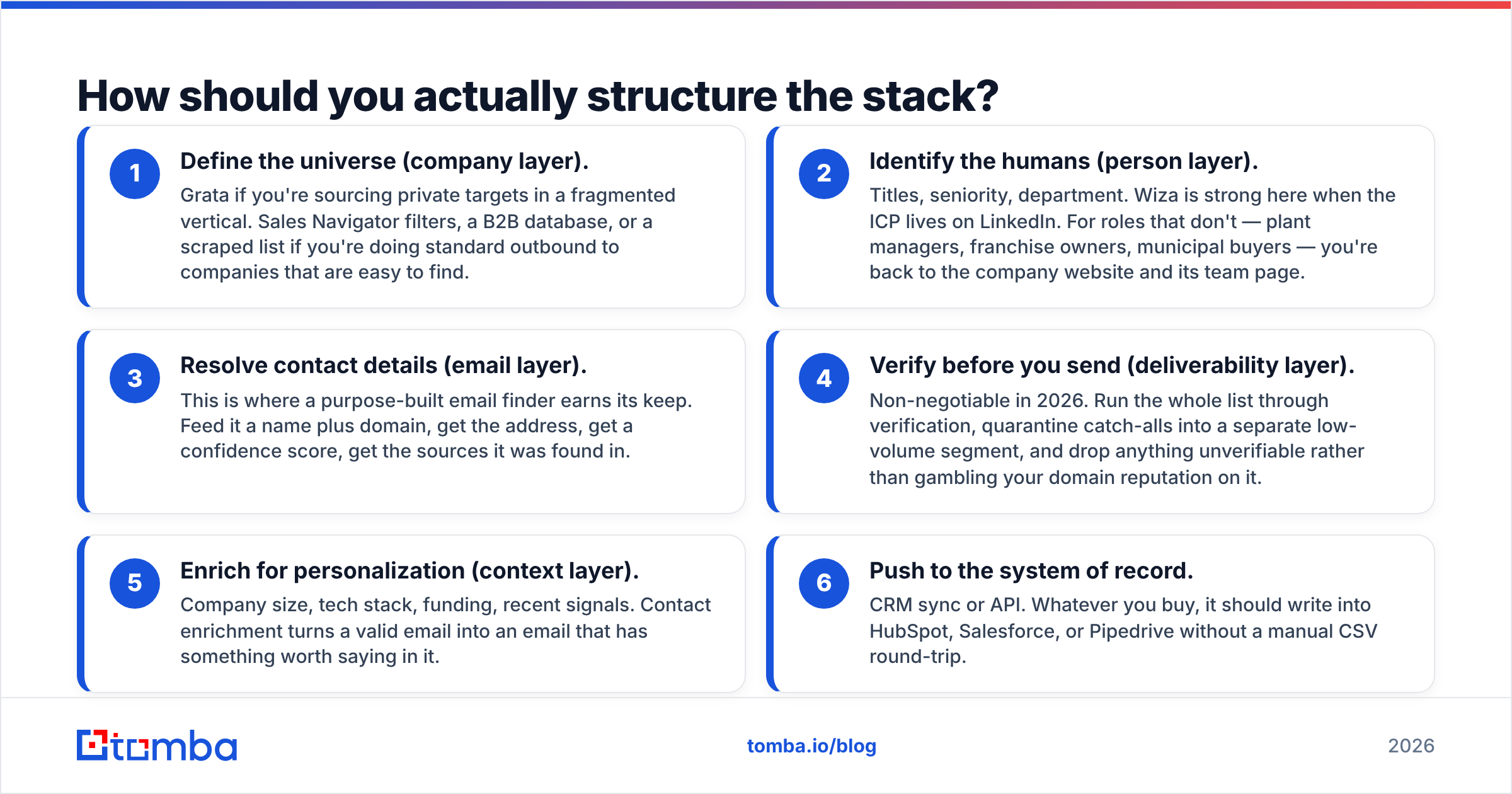
Most teams that buy either tool end up with three layers. Here is the order that holds up.
- Define the universe (company layer). Use Grata to source private targets in a fragmented niche. Use Sales Navigator filters, a B2B database, or a scraped list for companies that are easy to find.
- Identify the humans (person layer). Titles, seniority, department. Wiza is strong when your ICP lives on LinkedIn. For plant managers, franchise owners, and municipal buyers, go back to the company team page.
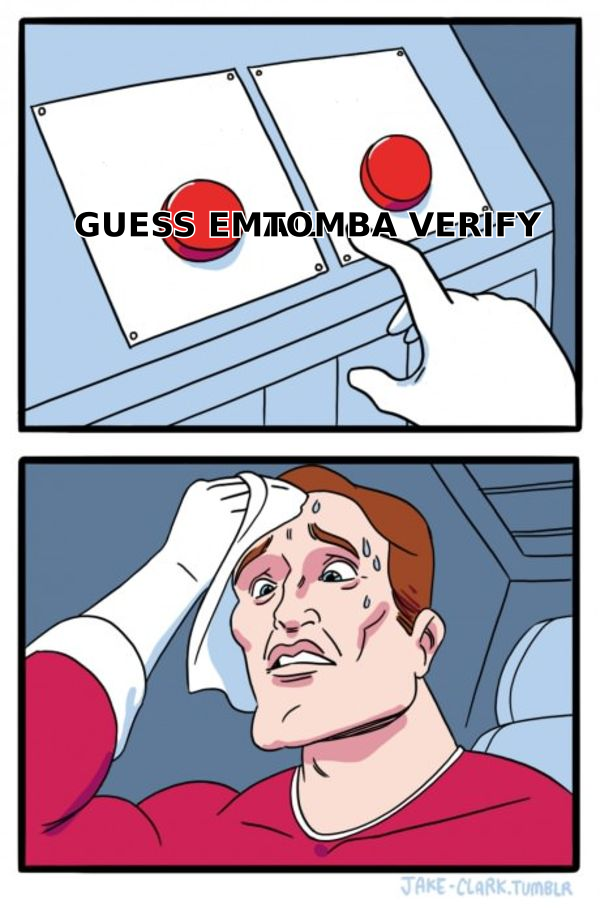
- Resolve contact details (email layer). A purpose-built email finder earns its keep here. Feed it a name plus a domain. Get the address, a confidence score, and the sources it came from.
Those three steps build the list. The next three decide whether the list actually delivers.
- Verify before you send (deliverability layer). Non-negotiable in 2026. Run the whole list through verification. Hold catch-alls in a separate, low-volume segment. Drop anything you cannot verify.
- Enrich for personalization (context layer). Company size, tech stack, funding, recent signals. Contact enrichment turns a valid email into one worth sending.
- Push to the system of record. CRM sync or API. It should write into HubSpot, Salesforce, or Pipedrive with no manual CSV step.
Line up Grata vs Wiza against those six layers. Grata covers 1 and 5, and barely touches 3 and 4. Wiza covers 2, 3, and part of 4, and ignores 1. Neither is a stack. Both are parts of one.
Who should choose Grata?#
Buy Grata if most of these are true:
- Your output is a target list, not a meeting. You build market maps for an investment committee, not sequences.
- Your companies are private and hard to find. Under $50M revenue, founder-owned, small digital footprint. This is why Grata exists.
- Ownership status matters to you. Knowing a target is already sponsor-backed changes whether you reach out.
- You have a deal-team software budget. If a custom quote is a dealbreaker, this category is not for you.
- Search speed is your bottleneck. Grata's plain-language search cuts work that took an associate two weeks of Googling.
Who should choose Wiza?#
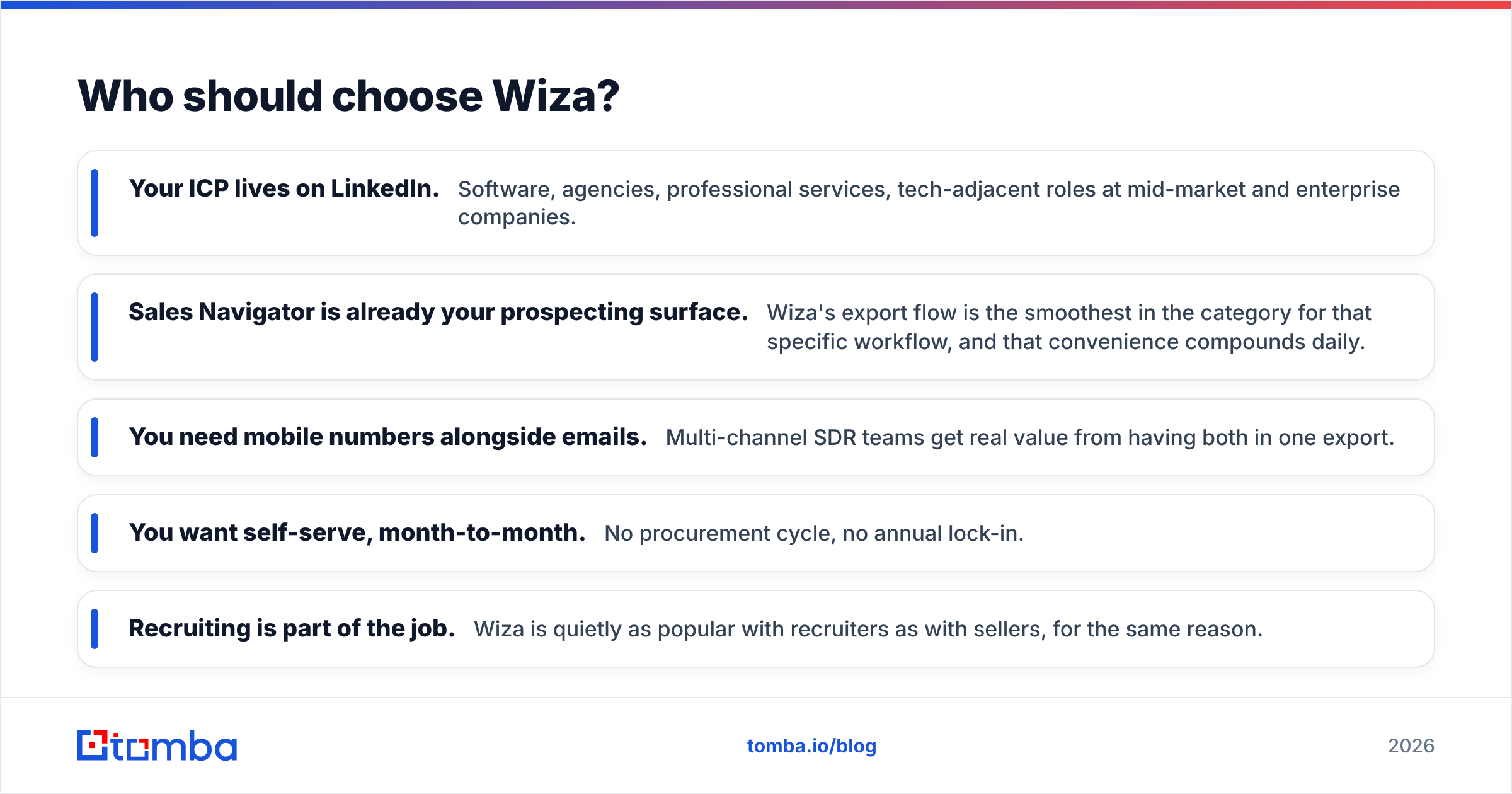
Buy Wiza if:
- Your ICP lives on LinkedIn. Software, agencies, professional services, and tech-adjacent roles at mid-market and enterprise firms.
- Sales Navigator is already your surface. Wiza's export flow is the smoothest in the category, and that saves time every day.
- You need mobile numbers too. Multi-channel SDR teams get real value from one export with both.
- You want self-serve, month to month. No procurement cycle. No annual lock-in.
- Recruiting is part of the job. Wiza is as popular with recruiters as it is with sellers.
Some readers reach Grata vs Wiza from the wrong shortlist. If you are really comparing LinkedIn exporters and enrichment tools, look at a Wiza alternative built around API-first email discovery and verification instead of extension exports.
Is there a case for buying both?#
Yes. It is more common than vendors admit: buy-side origination teams doing their own outbound. For them the Grata vs Wiza answer is often "both, plus an email layer."
A search fund or PE platform uses Grata to define the universe — say 600 companies in a niche. Then it has to reach the owners. Grata gives you the company and maybe an exec name. It rarely gives you a working inbox for a 61-year-old founder who avoids LinkedIn.
Here is the flow that works. Export the target list from Grata. Resolve contacts with a bulk email finder against each domain. Verify the results. Only then load them into a sequencer at low daily volume. Wiza can fill in the LinkedIn-visible names, but it will leave gaps. Those gaps are mostly the founder-owned firms you most want to call.
Sales teams run the same pattern in reverse. Wiza for the LinkedIn-native slice of the ICP, and a domain-based finder for the rest.
What's the verdict on Grata vs Wiza?#
Grata wins if you source companies. Wiza wins if you contact people. Neither wins as your contact-data foundation.
Grata is the better platform. It is deeper, harder to copy, more expensive, and built for a buyer with a different definition of a good week. Wiza is the better tool. It is sharper, cheaper, self-serve, and tied to LinkedIn being where your market lives.
The mistake is to treat either one as the full answer to "where do I get accurate B2B emails?" Grata's contact layer is a bonus feature. Wiza's is good but capped by LinkedIn coverage. Email deliverability decides whether you have pipeline next quarter. That layer deserves its own line item, and it should cost far less than the platform sitting on top of it.
Start with the layer everything else depends on. Whichever way your Grata vs Wiza call goes, run your target list through the Tomba Email Finder. The free tier gives 25 searches a month with no card. Starter is $49/mo. Every plan includes API access and built-in verification, so catch-all domains do not quietly torch your sender reputation. Feed it domains from Grata, names from Wiza, or a list you scraped yourself. It does not care where the list came from. It only cares that the addresses deliver.
Related guides#
Ready to find emails that actually work?
Join 150,000+ professionals who stopped guessing and started sending. Free credits on signup — no credit card required.
Get the Tomba newsletter
Practical outbound tactics and product updates — once every two weeks.
About the author