Great Cold Calling Scripts: 2026 Templates That Book Meetings
Most cold calling scripts fail in the first seven seconds. Here are the openers, objection blocks, and structures that actually book meetings in 2026 — with the data behind why they work.
TL;DR
- A great cold calling script is not a word-for-word monologue. It is a decision tree: a permission-based opener, one reason-for-calling line, a problem question, and a pre-written path for the four objections you actually hear.
- The first seven seconds decide the call. "Did I catch you at a bad time?" and "I know I'm an interruption" openers consistently outperform "How are you today?"
- Connect rate is a data problem, not a script problem. If 40% of your dials hit a wrong or dead number, no rewrite saves you — fix the phone data first.
- Scripts should be ~150 words of spoken content on the page. Anything longer gets read instead of said, and prospects hear reading.
- Test one variable at a time: opener, then reason-for-call, then close. Batch 50 dials per variant before you judge it.
What makes a cold calling script "great" instead of just written?#
A great script survives contact with a hostile human. That is the whole test.
Think of a script like a recipe versus a GPS. Bad scripts are recipes — a fixed sequence you follow top to bottom, and if the prospect says something off-menu, you burn the dish. Great scripts are GPS: you know the destination (a booked meeting or a clean disqualification), you have a preferred route, and you have pre-computed reroutes for the three or four wrong turns that happen most.
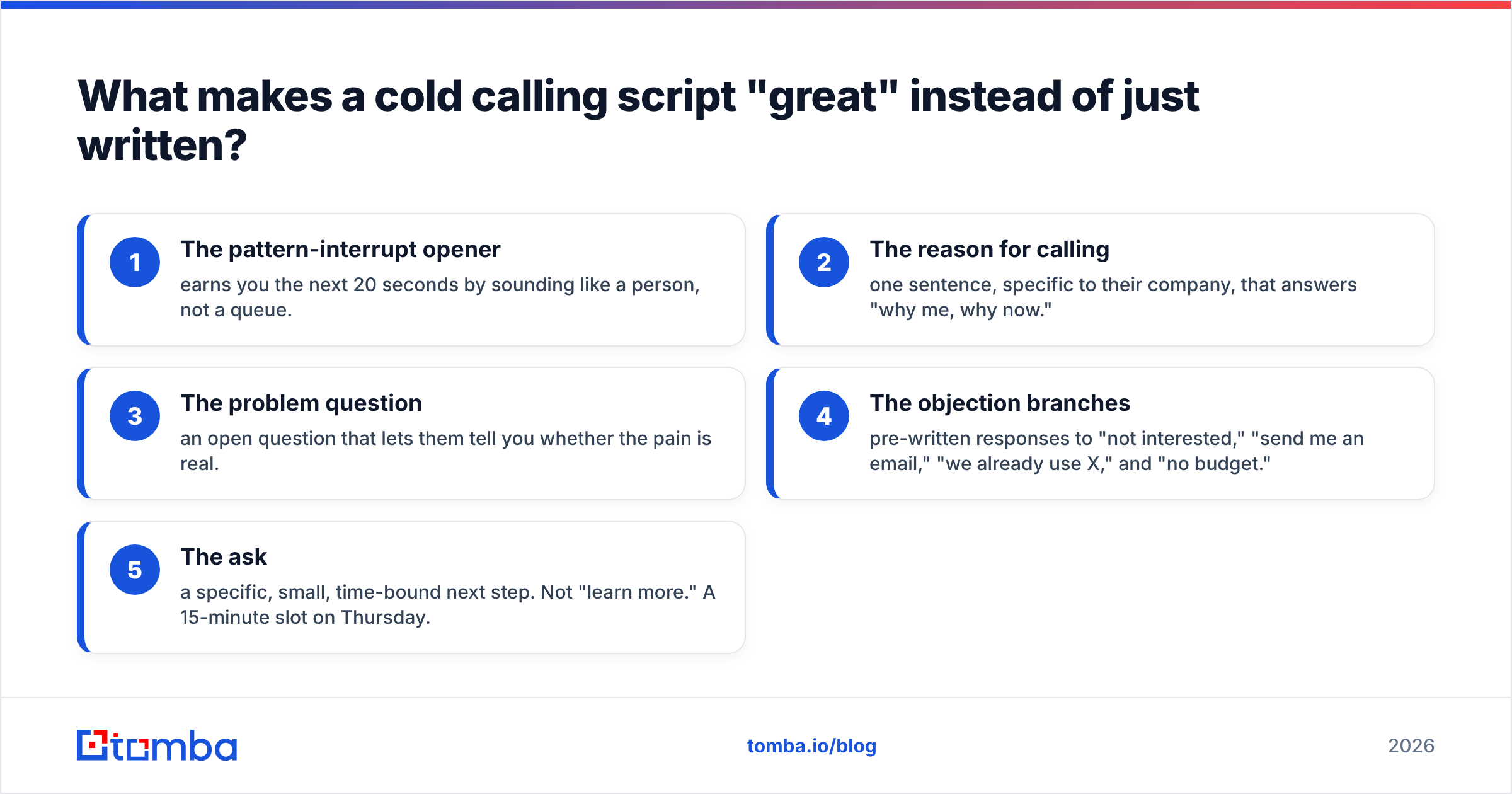
Concretely, a great cold calling script has five parts, and each one has a job:
- The pattern-interrupt opener — earns you the next 20 seconds by sounding like a person, not a queue.
- The reason for calling — one sentence, specific to their company, that answers "why me, why now."
- The problem question — an open question that lets them tell you whether the pain is real.
- The objection branches — pre-written responses to "not interested," "send me an email," "we already use X," and "no budget."
- The ask — a specific, small, time-bound next step. Not "learn more." A 15-minute slot on Thursday.
Everything else — the value props, the case studies, the pricing — is optional depth you deploy only if the prospect pulls you there.
Which cold call opener actually works in 2026?#
The opener does one job: buy time. It does not sell, qualify, or impress.
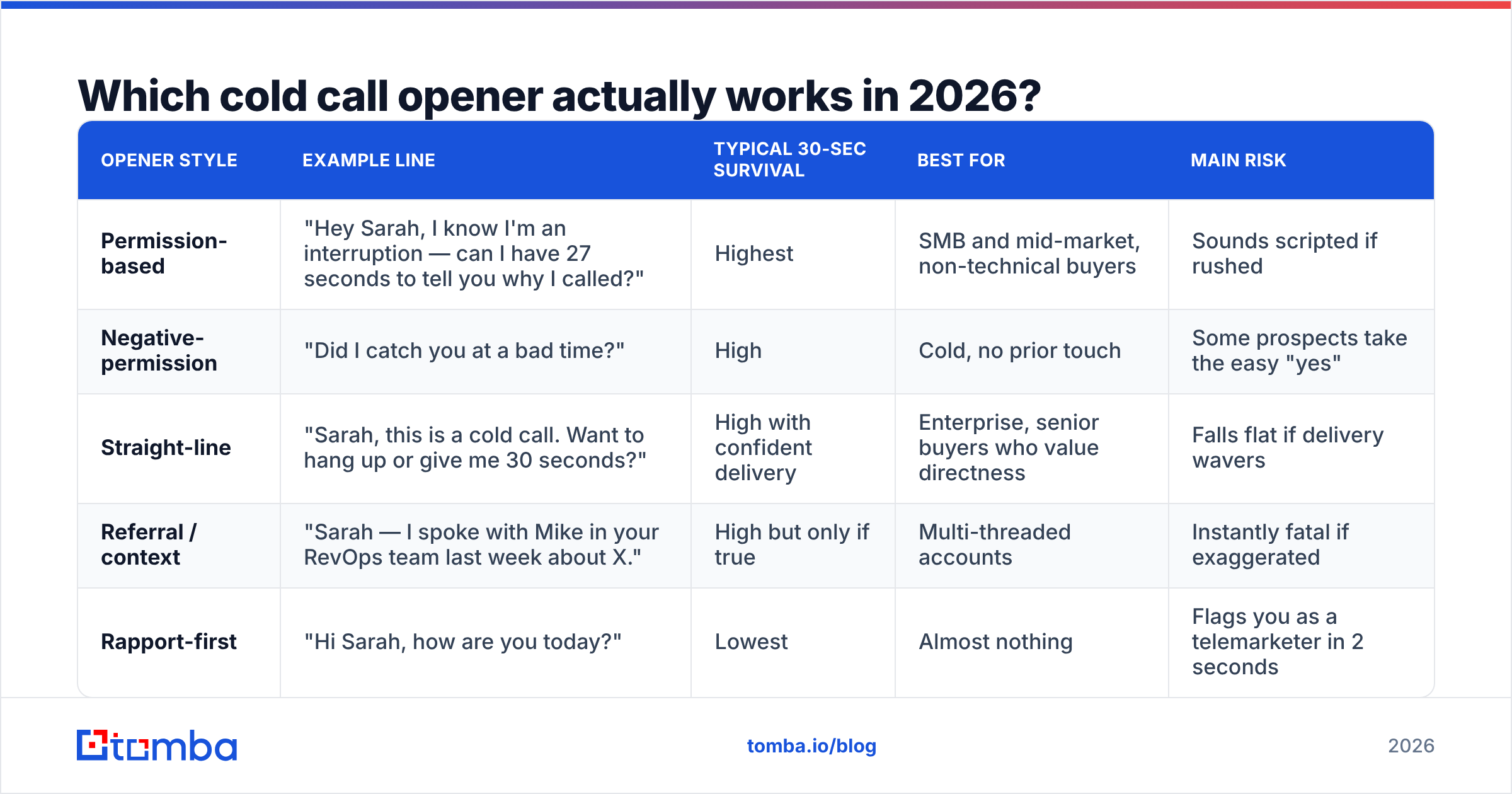
Four openers dominate real call recordings, and they behave very differently. Here is how they compare across the metric that matters — whether the prospect is still on the line at the 30-second mark.
| Opener style | Example line | Typical 30-sec survival | Best for | Main risk |
|---|---|---|---|---|
| Permission-based | "Hey Sarah, I know I'm an interruption — can I have 27 seconds to tell you why I called?" | Highest | SMB and mid-market, non-technical buyers | Sounds scripted if rushed |
| Negative-permission | "Did I catch you at a bad time?" | High | Cold, no prior touch | Some prospects take the easy "yes" |
| Straight-line | "Sarah, this is a cold call. Want to hang up or give me 30 seconds?" | High with confident delivery | Enterprise, senior buyers who value directness | Falls flat if delivery wavers |
| Referral / context | "Sarah — I spoke with Mike in your RevOps team last week about X." | High but only if true | Multi-threaded accounts | Instantly fatal if exaggerated |
| Rapport-first | "Hi Sarah, how are you today?" | Lowest | Almost nothing | Flags you as a telemarketer in 2 seconds |
The pattern is obvious once you see it: openers that acknowledge the interruption beat openers that pretend it isn't one. Prospects already know it's a cold call. Pretending otherwise costs you credibility before you say a word.
One rule that applies to every opener: say their first name, then pause for half a second. The pause is not decoration. It triggers the recognition reflex and shifts them from screening mode to listening mode.
What does a complete cold calling script look like?#
Here is a full B2B SaaS script, annotated. Total spoken length: roughly 45 seconds before the first real exchange.
Opener
"Hey Sarah — this is Daniel from Tomba. I know I'm calling out of nowhere. Can I have 30 seconds to tell you why, and then you can tell me to get lost?"
Wait. Actually wait. Do not talk over the "…sure, go ahead."
Reason for calling
"I noticed your team posted three SDR roles in the last month. Usually when a team scales outbound that fast, the bottleneck moves from headcount to contact data — reps burning half their day on dead numbers and bounced emails. That's the specific thing I called about."
Two things are working here. The observation is verifiable (job postings), and the inference is specific (data bottleneck). Generic "I help companies grow revenue" openers die here.
Problem question
"Out of curiosity — when your reps pull a list today, roughly what percentage of the direct dials actually connect?"
Open question, low commitment, and their answer tells you whether to continue or disqualify. If they say "we don't track that," you have found the pain.
The ask
"That's exactly what I expected. Look, I'm not going to pitch you on a cold call. I'd rather show you 3 accounts from your own ICP with verified direct dials and let you judge. Fifteen minutes Thursday at 10, or is Friday morning better?"
Small, specific, choice-of-two. Never "does sometime next week work?"
How do you handle the four objections you will actually hear?#
Ninety percent of objections fall into four buckets. Write these once, drill them, and stop improvising.
- "I'm not interested." — Do not argue. Acknowledge and redirect to a question: "Totally fair, you don't know me yet. Quick one before I go — is it that contact data isn't a priority right now, or that you've already solved it?" You are converting a wall into a fork. Either answer is useful.
- "Send me an email." — This is usually a polite exit. Take it, but attach a condition: "Happy to. So I don't send you something useless — is your team more focused on volume of contacts or accuracy of the ones you have?" Get one qualifying answer, then send the email and reference their words in the subject line.
- "We already use [competitor]." — Never attack the incumbent. "Good tool. Most teams I talk to who use it keep it — they just add a second source for the records it can't match. What's your fallback today when a lookup comes back empty?" You are selling into a gap, not a rip-and-replace.
- "No budget." — Usually means "no priority." "Understood. Is that a this-quarter thing or a this-year thing? If it's this quarter, I'd rather ping you in April than waste your time now." This either books a future call or ends it cleanly. Both beat pushing.
- "How did you get my number?" — Answer honestly and instantly. "Public business directory data — same place your competitors get it. If you'd rather I not call again, say the word and you're off my list permanently." Honesty defuses this in one line. Evasion escalates it.
- "I'm in a meeting." — "Of course. Thirty seconds now to book five minutes later, or should I call back at 4?" Give them a fast exit that still contains a next step.
Notice that every branch ends with a question. A script that ends a branch in a statement leaves the prospect holding the silence, and silence on a cold call resolves as a hangup.
Why do great scripts fail on bad phone data?#
Because the best script in the world has a zero percent conversion rate against a disconnected number.
This is the part most "cold calling scripts" articles skip. Your talk-time-to-meeting ratio is a product of three things: connect rate, conversation rate, and close rate. Reps obsess over the third. The first is where the leverage is.
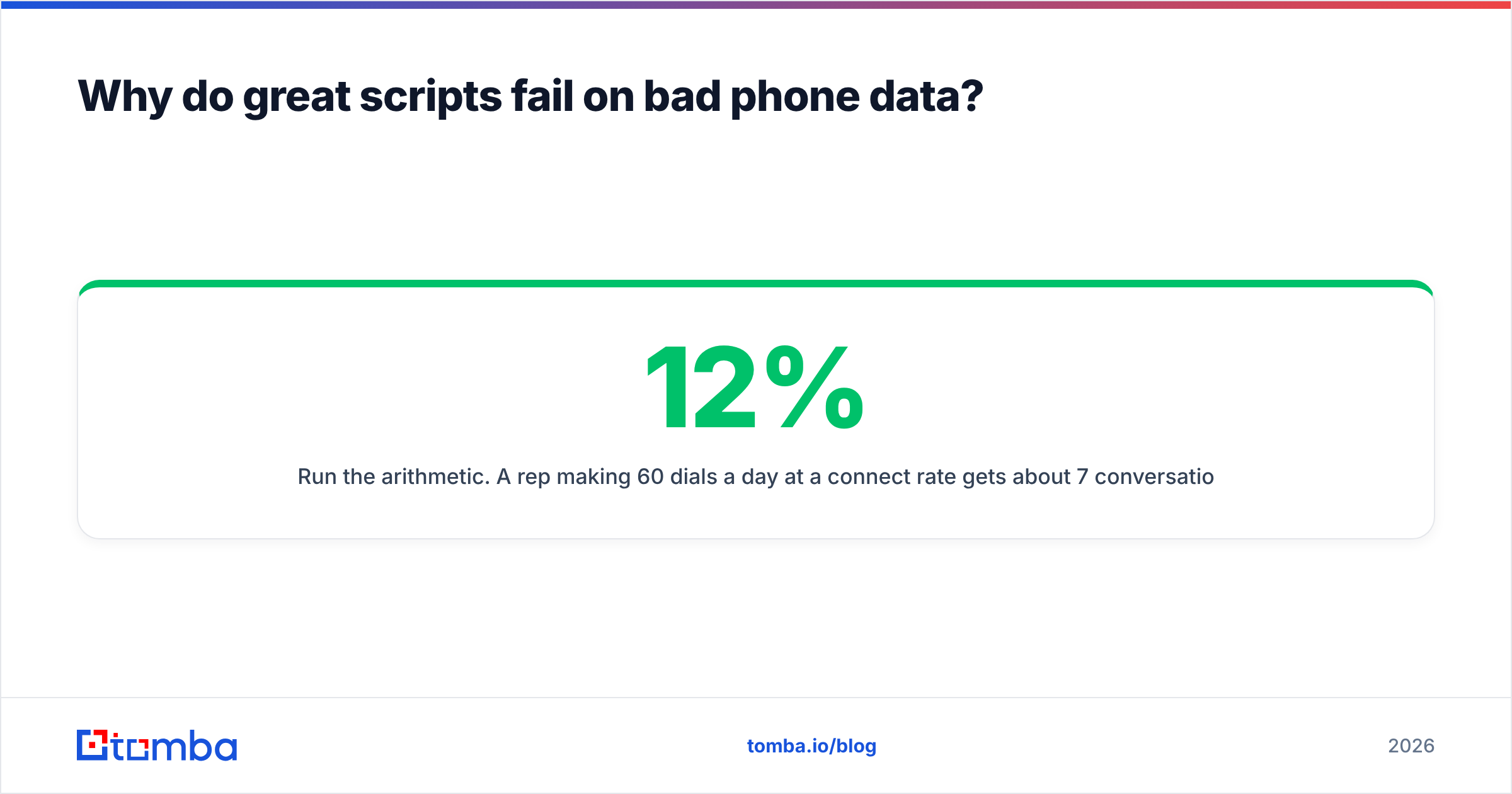
Run the arithmetic. A rep making 60 dials a day at a 12% connect rate gets about 7 conversations. Push the connect rate to 22% by cleaning the phone data and the same 60 dials produce 13 conversations — an 85% increase in coachable reps-on-phone moments, with no change to the script at all.
Two practical fixes, in order of impact:
- Validate numbers before dialing. A phone validator catches disconnected lines, invalid formats, and line-type mismatches (calling a landline when you meant a mobile) before they eat a dial.
- Get direct dials, not switchboards. Company main lines route you to a gatekeeper. Sourcing B2B phone numbers tied to the individual skips that layer entirely.
There is a third fix that rarely gets mentioned: pair every call with an email touch. Reps who send a short email immediately after a voicemail see materially better callback rates, because the name becomes familiar. Pulling verified addresses via Tomba Email Finder makes that a two-minute workflow instead of a manual hunt. Research summarized by HubSpot's sales statistics consistently shows multi-touch, multi-channel sequences outperforming single-channel attempts, and the phone-plus-email pair is the cheapest version of that.
How should you structure a script for different call types?#
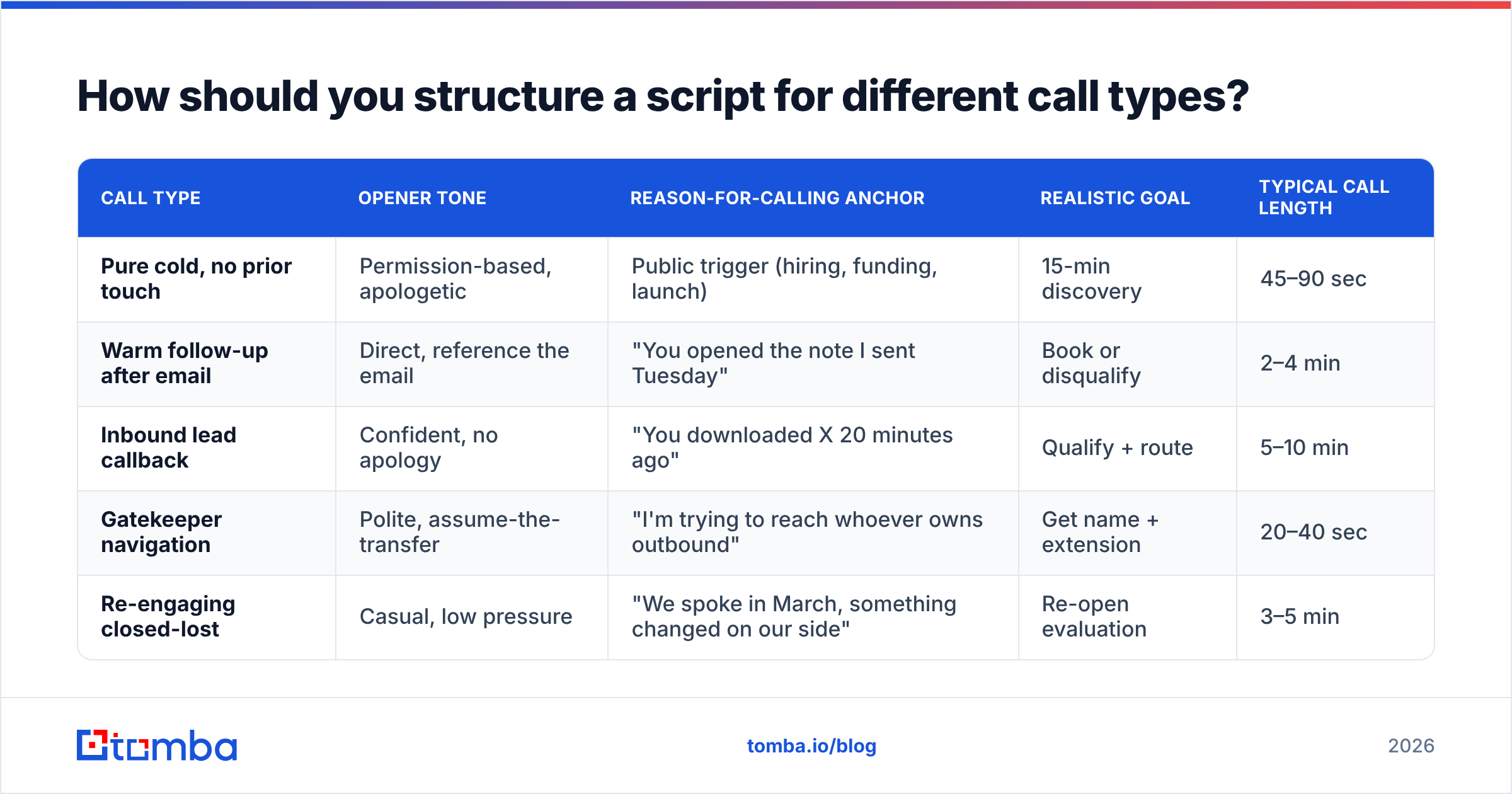
One script does not cover every scenario. Build a small library instead — four variants, each with the same skeleton but a different reason-for-calling line.
| Call type | Opener tone | Reason-for-calling anchor | Realistic goal | Typical call length |
|---|---|---|---|---|
| Pure cold, no prior touch | Permission-based, apologetic | Public trigger (hiring, funding, launch) | 15-min discovery | 45–90 sec |
| Warm follow-up after email | Direct, reference the email | "You opened the note I sent Tuesday" | Book or disqualify | 2–4 min |
| Inbound lead callback | Confident, no apology | "You downloaded X 20 minutes ago" | Qualify + route | 5–10 min |
| Gatekeeper navigation | Polite, assume-the-transfer | "I'm trying to reach whoever owns outbound" | Get name + extension | 20–40 sec |
| Re-engaging closed-lost | Casual, low pressure | "We spoke in March, something changed on our side" | Re-open evaluation | 3–5 min |
The gatekeeper variant deserves its own note. Do not try to be clever. "Hi, I'm hoping you can help me — I'm trying to figure out who owns outbound prospecting over there." Asking for help works better than pretending you already know the person. Gatekeepers screen for confidence and honesty, and pushiness fails both tests.
How do you test and improve a script without guessing?#
Treat the script like a landing page: one variable, enough volume, a clear metric.
- Isolate one element. Change the opener OR the ask, never both. If both change and the number moves, you have learned nothing.
- Set a sample floor. Fifty connected conversations per variant, minimum. Fifty dials is not fifty conversations — with a 15% connect rate, fifty dials is seven data points and pure noise.
- Measure the right stage. For openers, measure 30-second survival. For reason-for-calling, measure whether they answer the problem question. For the ask, measure booked-to-connected ratio. A single "meetings booked" number hides where the script actually breaks.
- Record and review weekly. Ninety percent of script improvement comes from listening to your own calls, not from reading more templates. Pick the three calls that died fastest and find the exact sentence where the energy dropped.
- Kill lines nobody says. If reps consistently skip a line in the script, delete it. Reps skip lines that feel fake, and their instinct is usually right.
For benchmarking what "good" looks like beyond your own team, G2's sales engagement category is a reasonable place to see how vendors report connect and conversion metrics — with the usual caveat that vendor-reported numbers skew optimistic.
What are the most common cold calling script mistakes?#
- Writing for the eye instead of the ear. Read every line out loud. If you would not say it to a friend at a bar, cut it. "Leverage," "solutions," and "synergies" fail this test instantly.
- Front-loading credentials. Nobody cares that you're the leading provider of anything in the first 15 seconds. Earn that later.
- Asking for 30 minutes. The ask should be small enough that saying yes is cheaper than arguing. Fifteen minutes, or ten.
- No disqualification path. A script that only has a "yes" branch turns reps into pests. Give them a clean, respectful way to end a call that isn't a fit — it protects your brand and your rep's morale.
- Ignoring compliance. Know your DNC obligations and local calling rules. The FTC's telemarketing guidance is the baseline reference for US calling, and B2B exemptions are narrower than most reps assume.
- Calling the same list twice with the same script. If a list has been burned, changing the script won't unburn it. Build a fresh segment, and use data enrichment to add the context — headcount, tech stack, recent triggers — that makes a new angle credible.
Where do you go from here?#
Pick one script from this post. Strip it to 150 spoken words. Drill the four objection branches until you can say them without thinking. Then make 50 dials and record every one.
The script is the easy half. The hard half is having 50 numbers that actually ring the person whose name is on your screen. That is a data problem, and it is solvable before your next call block.
Start with the contact layer: Tomba Email Finder gives you verified professional email addresses to pair with every dial, so the voicemail you leave has a follow-up waiting in their inbox two minutes later. The free tier covers 25 searches a month if you just want to test the workflow against a handful of target accounts; Tomba pricing starts at $49/mo on Starter when you're ready to run a full list. Fix the data, then let the script do its job.
Related guides#
Ready to find emails that actually work?
Join 150,000+ professionals who stopped guessing and started sending. Free credits on signup — no credit card required.
Get the Tomba newsletter
Practical outbound tactics and product updates — once every two weeks.
About the author