Growbots Reviews 2026: Honest Pros, Cons, and Pricing Verdict
An independent look at Growbots in 2026 — what the all-in-one outbound platform actually does well, where its data and pricing frustrate teams, and which alternatives fit better.
TL;DR
- Growbots is an all-in-one outbound platform: a built-in B2B contact database, sequence sending, and an "Outbound Concierge" managed service layered on top.
- It suits small sales teams that want prospecting data and email sending in one subscription and do not want to stitch together three vendors.
- The recurring complaints in Growbots reviews are consistent: entry pricing around $199/mo is steep for the contact volume, data quality varies sharply by region and seniority, and contract terms are less flexible than newer tools.
- If you already own a sequencer (Instantly, Smartlead, Lemlist, HubSpot Sequences), paying Growbots for a bundled sender is waste — buy data separately and keep your sending stack.
- Best fit: 2–10 person teams selling into US mid-market who value one vendor over best-of-breed. Poor fit: technical teams, EU/APAC-heavy ICPs, and anyone needing API-first enrichment.
What is Growbots and who actually uses it?#
Growbots is an outbound sales platform built around a single promise: you should not have to buy a database, a sequencer, and a verification tool separately. You define an ideal customer profile inside the app, Growbots returns matching contacts from its database, and you drop those contacts straight into an email sequence that sends from your own mailbox.
The company has been around since 2015, which in outbound-tooling years makes it an elder. That maturity shows in the sequencing side — the campaign builder, the reply detection, the inbox rotation are all stable and unsurprising. It shows less on the data side, where the market has moved fast and Growbots' database has not obviously kept pace with providers whose entire business is contact data.
The typical Growbots customer is a founder-led or small sales team doing 500–3,000 outbound emails a month, selling a mid-ticket B2B product into North America. They do not have a RevOps person. They want a login, a list, and a send button. For that buyer, the bundle is genuinely convenient.
The atypical customer — a team with an existing outbound stack, a developer who wants to enrich records programmatically, or a company selling into Germany or Japan — tends to churn. Not because Growbots is bad, but because the bundle stops being a bargain the moment you already own half of it.

How much does Growbots cost in 2026?#
This is where most Growbots reviews get vague, so let's be precise about the structure even where exact numbers shift with sales negotiation.
Growbots sells two things: Outreach (the software, you do the work) and All-in-One (software plus a managed concierge that writes and runs campaigns for you). Published entry pricing for the self-serve tier has historically sat around $199/month, with contact credits metered separately and the concierge tier moving into four figures monthly. Annual commitments are standard; month-to-month exists but costs more per month.
Two cost details that surprise buyers:
- Contacts and sending are metered separately. Running out of credits mid-month is common when your ICP is broad.
- The concierge tier is a service contract, not software. Judge it against an agency retainer, not against a SaaS subscription. At that comparison it is often reasonable.
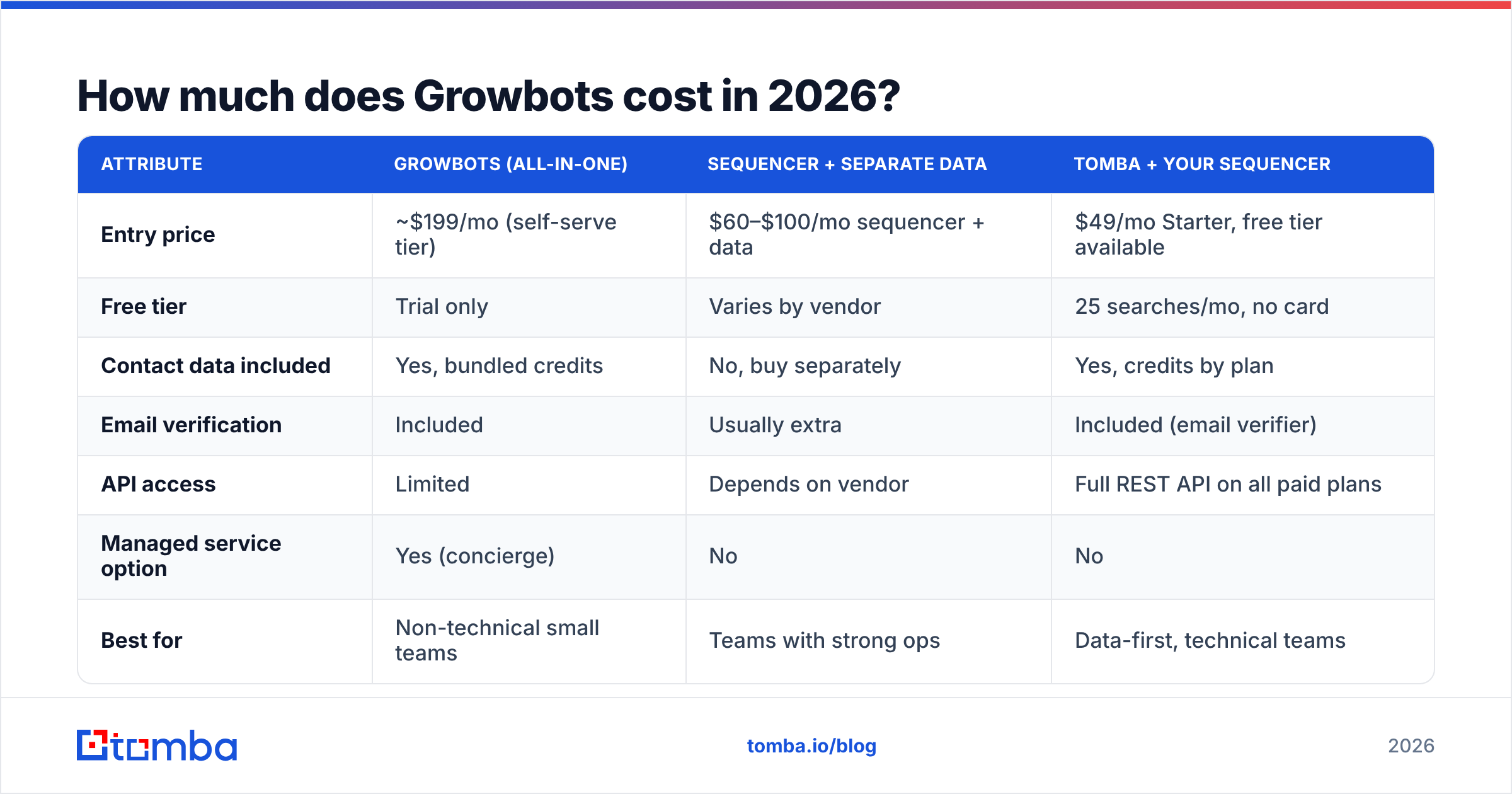
Here is how the total cost of an outbound stack compares across three common approaches:
| Attribute | Growbots (All-in-One) | Sequencer + separate data | Tomba + your sequencer |
|---|---|---|---|
| Entry price | ~$199/mo (self-serve tier) | $60–$100/mo sequencer + data | $49/mo Starter, free tier available |
| Free tier | Trial only | Varies by vendor | 25 searches/mo, no card |
| Contact data included | Yes, bundled credits | No, buy separately | Yes, credits by plan |
| Email verification | Included | Usually extra | Included (email verifier) |
| API access | Limited | Depends on vendor | Full REST API on all paid plans |
| Managed service option | Yes (concierge) | No | No |
| Best for | Non-technical small teams | Teams with strong ops | Data-first, technical teams |
| Contract flexibility | Annual preferred | Monthly common | Monthly, cancel anytime |
The honest read: Growbots is not overpriced for what it bundles. It is overpriced for what most buyers use. If you send 1,000 emails a month and pull 500 contacts, you are paying enterprise-shaped money for startup-shaped volume. Compare that against Tomba pricing, where the Starter plan is $49/mo and the free tier lets you validate data quality before spending anything.
How accurate is Growbots' contact data?#
Data accuracy is the single biggest driver of Growbots reviews going three stars instead of five, so it deserves a careful answer rather than a marketing one.
Growbots' database performs reasonably on US-headquartered companies with 50–1,000 employees and contacts at director level or below. That is the sweet spot most of its customers live in, which is why the average review is positive rather than negative.
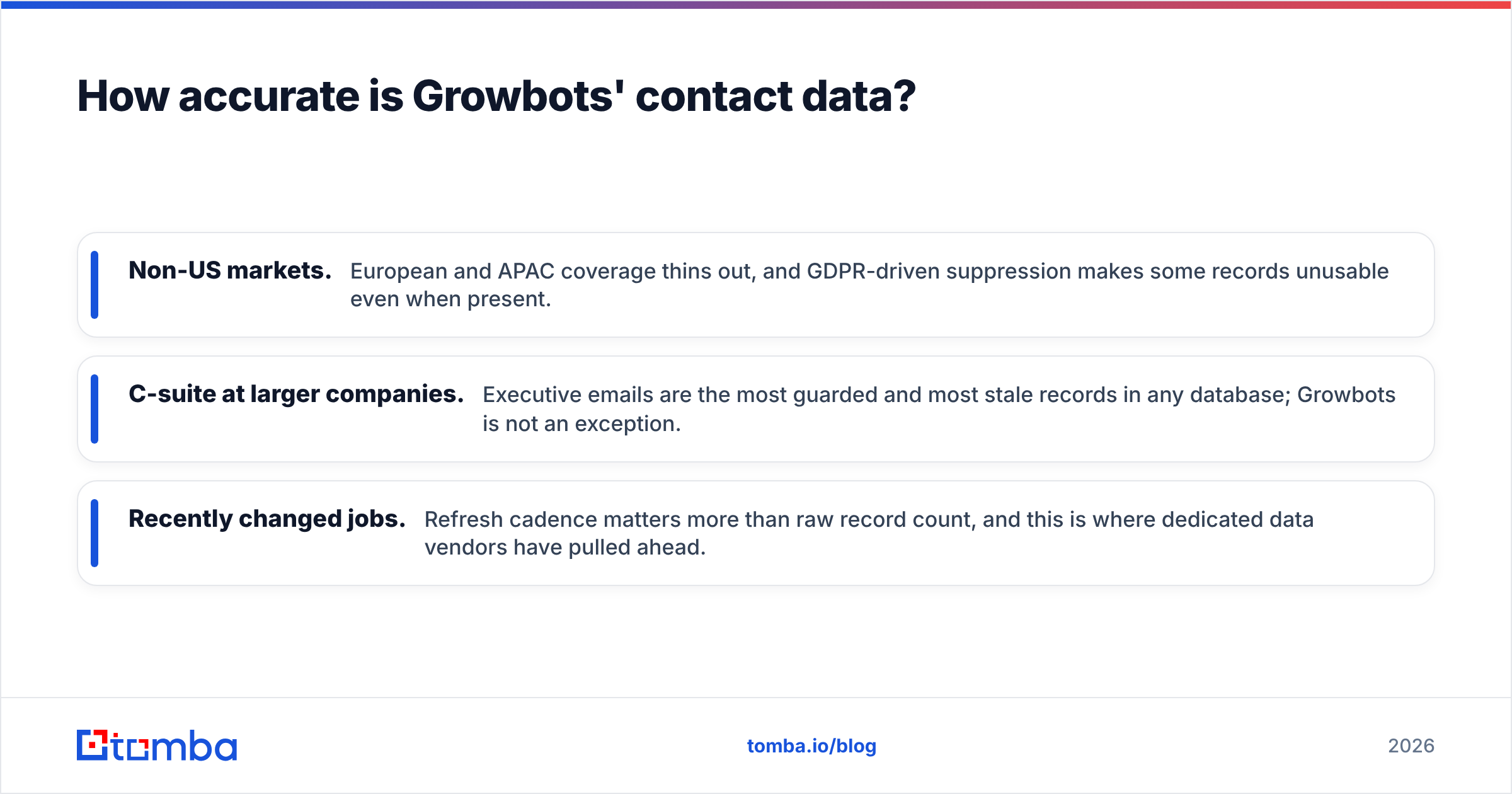
It performs noticeably worse in three situations:
- Non-US markets. European and APAC coverage thins out, and GDPR-driven suppression makes some records unusable even when present.
- C-suite at larger companies. Executive emails are the most guarded and most stale records in any database; Growbots is not an exception.
- Recently changed jobs. Refresh cadence matters more than raw record count, and this is where dedicated data vendors have pulled ahead.
The practical mitigation is one most Growbots users adopt eventually: treat the built-in list as a candidate list, not a verified list, and run it through a dedicated email verifier before it enters a sequence. Bounces above 3% will damage your sender reputation quickly, and no bundle discount is worth a burned domain.
For catch-all domains — increasingly common as more companies route mail through Microsoft 365 with accept-all policies — you need a purpose-built check. A catch-all verifier resolves the "unknown" bucket that generic verification tools simply hand back to you as a shrug.
If you want to compare vendor-published accuracy claims independently, G2's category listings aggregate enough recent reviews to spot patterns that vendor case studies hide, and Growbots' own product pages are clear about which regions it prioritizes.
What do users praise and complain about most?#
Pulling the recurring themes out of public review sites, the split is remarkably consistent year over year.
What reviewers consistently praise:
- Onboarding and support responsiveness. The customer success team gets named positively more often than is typical for a tool at this price. Real humans, fast replies.
- The concierge service. Teams that bought the managed tier and had no prior outbound experience report the strongest satisfaction of any Growbots cohort. You are buying expertise, and it shows.
- Time to first campaign. Going from signup to a live sequence in one afternoon is genuinely achievable, which is not true of Outreach or Salesloft.
- Deliverability defaults. Sending limits, warmup guidance, and inbox rotation are configured sanely out of the box rather than left to you to discover the hard way.
What reviewers consistently complain about:
- Price relative to volume. The most common single complaint. The value equation breaks for low-volume senders.
- Data gaps outside the US. Covered above, and it is the second most cited issue.
- Contract rigidity. Annual terms and renewal handling come up repeatedly; read the agreement carefully before signing.
- Limited API and integration depth. If your workflow lives in a CRM or a script, Growbots expects you to come to it rather than meeting you where you are.
- UI feels dated. Functional, not delightful. This is cosmetic but it shows up in reviews anyway.
Notice the pattern: the praise is about service, the complaints are about economics and data. That is a precise signal about who should buy it.
Is Growbots better than the alternatives?#
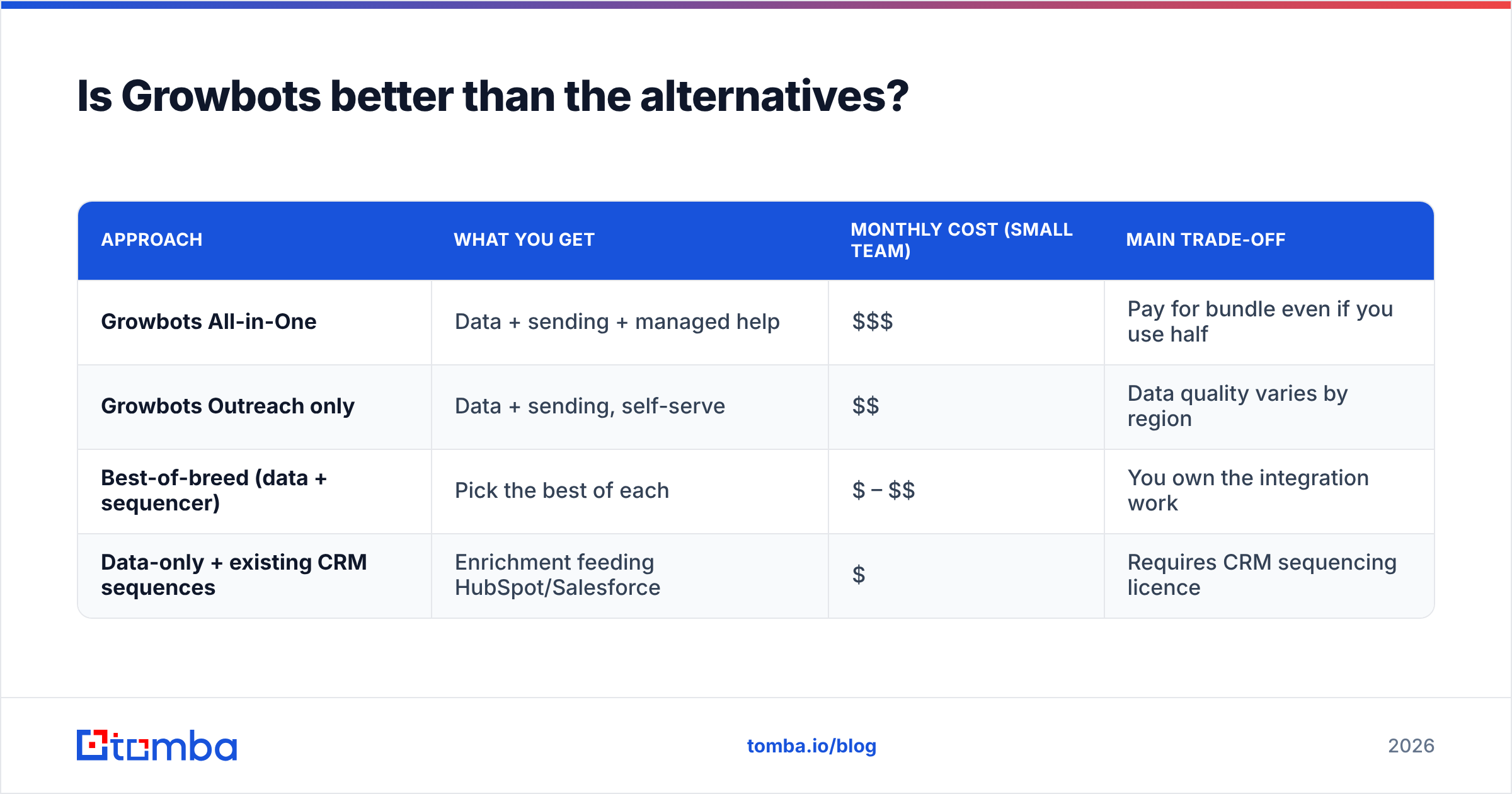
Depends entirely on whether you value bundling or unbundling. Three realistic paths, honestly assessed.
| Approach | What you get | Monthly cost (small team) | Main trade-off |
|---|---|---|---|
| Growbots All-in-One | Data + sending + managed help | $$$ | Pay for bundle even if you use half |
| Growbots Outreach only | Data + sending, self-serve | $$ | Data quality varies by region |
| Best-of-breed (data + sequencer) | Pick the best of each | $ – $$ | You own the integration work |
| Data-only + existing CRM sequences | Enrichment feeding HubSpot/Salesforce | $ | Requires CRM sequencing licence |
If you already run a sequencer, the calculation is simple: you need contacts, not another sending tool. A dedicated email finder plus domain search to map a target account's full org chart gives you the same input at a fraction of the bundled price, and you keep the sequencer your team already knows.
If you have zero outbound infrastructure and zero appetite to build any, Growbots' concierge tier is a legitimately good answer — better than hiring an SDR too early, and cheaper than most agencies. Just price it against an agency retainer, not against software.
For teams somewhere in the middle, the deciding question is technical capability. Growbots assumes you will work inside its UI. If you want enrichment triggered from a workflow — new CRM record created, lead form submitted, website visitor identified — you want an API-first vendor. HubSpot's own research on sales tooling makes the same point repeatedly: consolidation helps non-technical teams and constrains technical ones.
Note also that some of the strongest competition in this category comes from vendors with a different shape entirely — BookYourData, for example, sells verified contact lists on a pay-as-you-go basis with no subscription at all, which is a genuinely different and often better fit for teams running a handful of campaigns a year rather than continuous outbound. Worth evaluating alongside Growbots rather than instead of it.
Who should buy Growbots, and who should not?#
Clear recommendation, no hedging.
Buy Growbots if:
- You are a 2–10 person team with no dedicated RevOps or sales ops person.
- Your ICP is US-based, 50–1,000 employees, non-executive buyers.
- You want one vendor, one invoice, one support contact.
- You are considering the concierge tier and would otherwise hire an agency or an early SDR.
- You send consistently — at least 2,000 emails a month — so the bundled economics actually work.
Do not buy Growbots if:
- You already pay for a sequencer. You would be buying a duplicate.
- Your ICP is majority EU or APAC.
- You need programmatic enrichment via API, CLI, or spreadsheet workflows.
- Your volume is under ~1,000 emails a month. The per-contact economics do not work.
- You need month-to-month flexibility to scale up and down seasonally.
For the "do not buy" group, the replacement stack is usually cheaper and more capable: a data provider with an email finder API for enrichment, your existing sequencer for sending, and a verification pass before every campaign. That stack costs less than the Growbots entry tier and each component is independently replaceable when a better option appears.
How should you evaluate Growbots before committing?#
Run a two-week test that costs you almost nothing and answers the only questions that matter.
- Build one narrow ICP — a single industry, single title band, single geography, roughly 200 contacts. Broad tests hide data gaps.
- Export the list and verify it externally. Do not trust any vendor's internal verification, including verification bundled with a data product. Run it through an independent checker and record the bounce-risk rate.
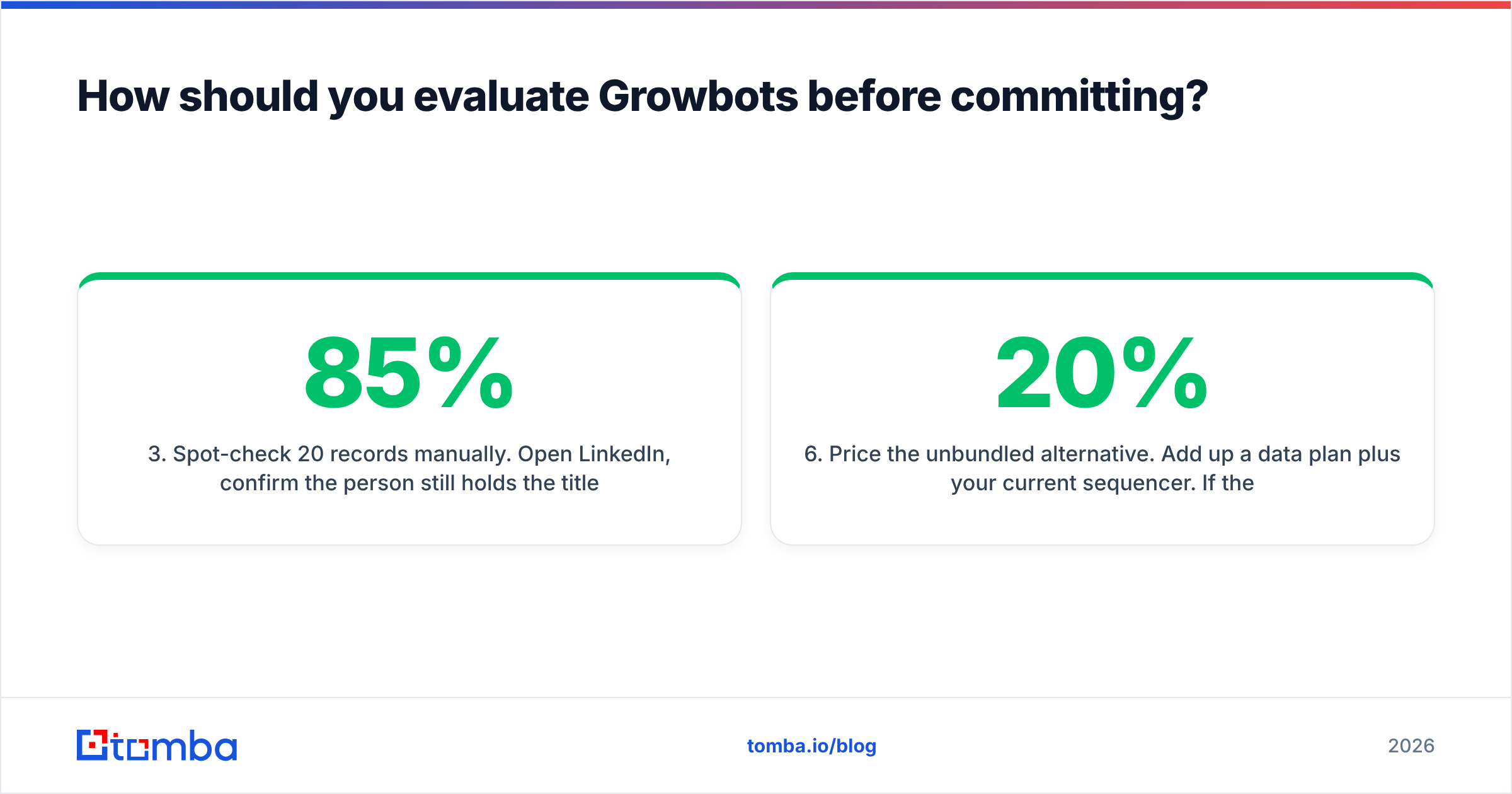
- Spot-check 20 records manually. Open LinkedIn, confirm the person still holds the title. Anything under 85% still-accurate is a red flag for a paid database in 2026.
- Send a 50-contact pilot through your existing tooling before migrating anything. Measure reply rate against your baseline, not against a vendor benchmark.
- Ask directly about contract terms. Renewal notice period, mid-term downgrade rules, credit rollover. Get answers in writing before signing an annual deal.
- Price the unbundled alternative. Add up a data plan plus your current sequencer. If the gap is under 20%, the bundle wins on simplicity. If it is 2x, it does not.
That checklist takes an afternoon of setup and saves you from the most common outcome in Growbots reviews: a team that signed annually, discovered the data gaps in month three, and spent nine months paying for a tool it had already routed around.
The verdict#
Growbots is a competent, mature outbound platform whose value depends almost entirely on what you already own. Buy it for the service and the simplicity, not for the data. If you are non-technical, US-focused, and sending consistently, it earns its price. If you are technical, international, or already running a sequencer, you are subsidizing features you will never open.
The most common smart move in 2026 is unbundling: keep your sequencer, buy data from a specialist, and verify everything before it hits a mailbox. Start with the Tomba Email Finder — the free tier gives you 25 searches a month with no card required, Starter is $49/mo, and every plan includes API access so enrichment can live inside your workflow rather than inside someone else's UI. Test it against whatever list Growbots hands you in a trial and let the bounce rates decide.
Related guides#
Ready to find emails that actually work?
Join 150,000+ professionals who stopped guessing and started sending. Free credits on signup — no credit card required.
Get the Tomba newsletter
Practical outbound tactics and product updates — once every two weeks.
About the author