GrowMeOrganic vs Influno: Which B2B Prospecting Tool Wins in 2026?
GrowMeOrganic and Influno both promise unlimited prospecting on a small budget. We compared pricing, data quality, deliverability controls, and LinkedIn workflows to find where each one actually earns its seat.
GrowMeOrganic vs Influno comes down to one question: do you need more contacts, or better inbox placement? We tested both. Here is the short answer, then the detail.
TL;DR
- GrowMeOrganic is LinkedIn-first and lifetime-deal friendly. It bundles a scraper, an email finder, and a sequencer for roughly $49–$99/mo. "Unlimited" sending is its headline pitch.
- Influno is a leaner, newer cold email tool. It is built around inbox rotation, deliverability hygiene, and simple sequences. Less scraping, more sending discipline.
- Neither is a serious data vendor. Both grab contact data where they can. Both leave verification costs to you.
- Is your real bottleneck finding and verifying accurate B2B emails? Then pair either tool with a dedicated finder and verifier. Bundled enrichment will not carry you.
- Pick GrowMeOrganic if you live in LinkedIn Sales Navigator and want one bill. Pick Influno if you send at volume and deliverability already hurts.
GrowMeOrganic vs Influno: what does each tool do?#
Both tools sit in the same crowded lane: "everything you need for outbound, cheaper than Apollo." They get there from opposite directions.
GrowMeOrganic started as a Chrome extension that scrapes LinkedIn and Sales Navigator. Later it added an email finder, a CSV enrichment layer, and a drip sender. It sells on volume language: unlimited email credits, unlimited sending on higher tiers. It has also been sold heavily through lifetime-deal marketplaces. That shapes both its user base and its support load.
Influno came the other way. It is a cold email platform first. Connect your mailboxes, rotate sends across them, warm them, run sequences, track replies. Prospecting data is a side feature, not the pitch. Its design assumptions look a lot like Instantly's or Smartlead's: many domains, many inboxes, low volume per inbox.
That gap matters more than any feature checklist. GrowMeOrganic optimizes for how many contacts you can pull. Influno optimizes for how many of your emails land. Those are different failure modes. Pick based on the one hurting you now.

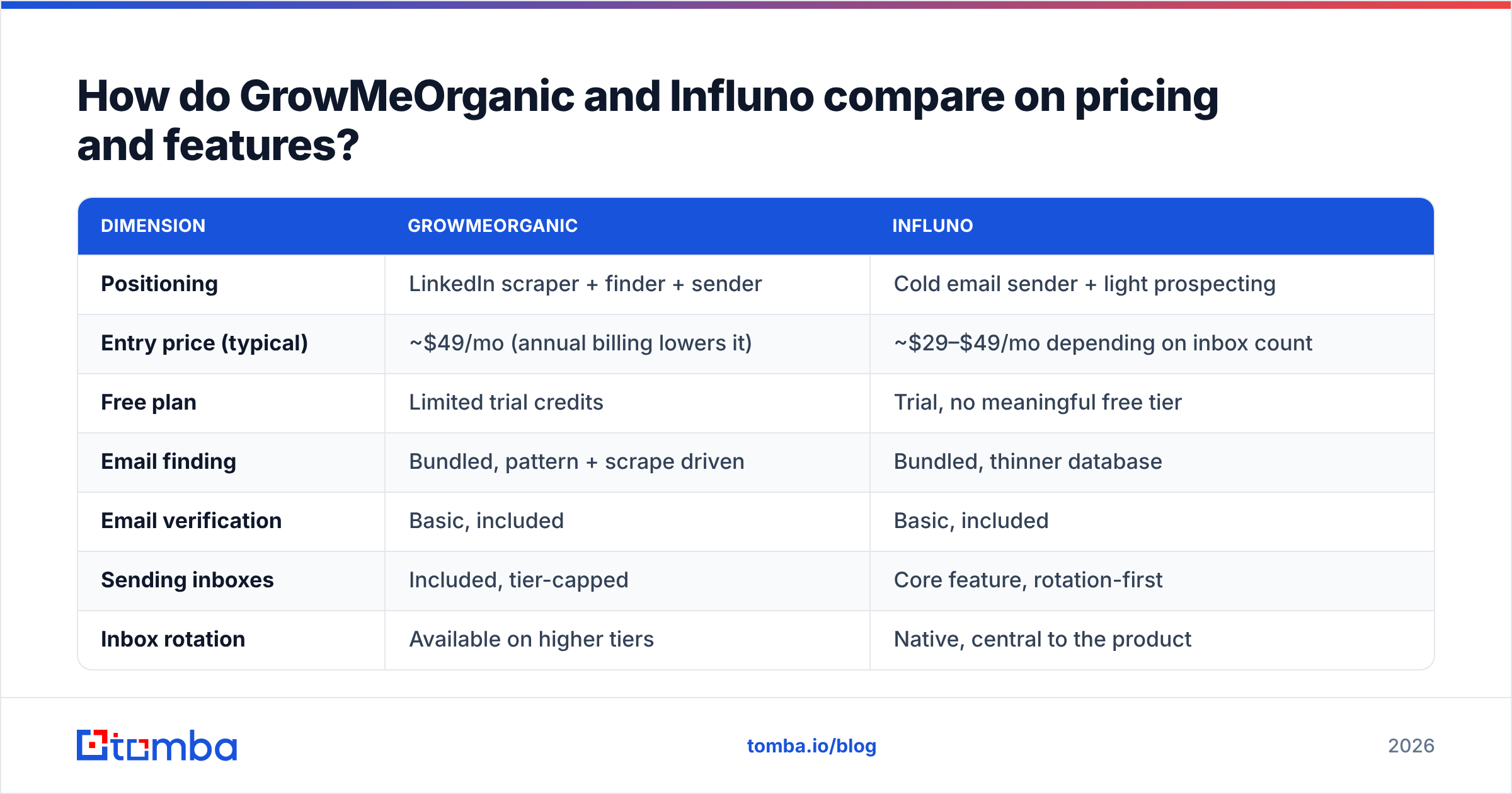
How do GrowMeOrganic and Influno compare on pricing and features?#
Pricing moves on both platforms. Both run frequent promos and lifetime offers. Treat the numbers below as a starting point, and confirm in-app before you commit to a year.
| Dimension | GrowMeOrganic | Influno |
|---|---|---|
| Positioning | LinkedIn scraper + finder + sender | Cold email sender + light prospecting |
| Entry price (typical) | ~$49/mo (annual billing lowers it) | ~$29–$49/mo depending on inbox count |
| Free plan | Limited trial credits | Trial, no meaningful free tier |
| Email finding | Bundled, pattern + scrape driven | Bundled, thinner database |
| Email verification | Basic, included | Basic, included |
| Sending inboxes | Included, tier-capped | Core feature, rotation-first |
| Inbox rotation | Available on higher tiers | Native, central to the product |
| Warmup | Limited / third-party | Built in |
| LinkedIn extraction | Strong (extension + Sales Nav) | Weak to absent |
| CRM/API depth | Basic API, Zapier | Basic API, Zapier |
| Best fit | Solo founders, agencies on a budget | Volume senders fighting spam folders |
The short version: GrowMeOrganic gives you more surface area per dollar. Influno gives you more reliability per send. Few teams need both from one vendor. That is why the "all-in-one saves money" case usually falls apart by month three.
Where the "unlimited" claim breaks down#
Unlimited credits are not the same as unlimited usable contacts. In practice, the limits are:
- Extraction limits — LinkedIn throttles hard. Scraping tools inherit that ceiling, whatever your plan says.
- Pattern-guessed emails — many bundled "found" emails are guesses (firstname.lastname@domain). Nobody checked them against a mail server.
- Catch-all domains — about one in five B2B domains accepts every address at SMTP level. A simple valid/invalid check tells you nothing there. Use a catch-all verifier to sort real mailboxes from wildcard noise.
- Bounce cost — every unverified send taxes your sender reputation. Credits get refunded. Reputation does not.
- Suppression drift — unlimited sending invites sloppy list hygiene. Bounce rates then climb campaign after campaign.
None of this is unique to these two vendors. It is the structural flaw in any bundle that treats data as a giveaway to sell seats.
Which tool has better data accuracy?#
Neither publishes an audited accuracy number. That silence tells you something. Dedicated data providers publish their method and let you sample. Bundled finders rarely do.
Here is a test you can run yourself in an afternoon:
- Pull 200 contacts from a segment you know well. Best case: companies where you already hold verified emails.
- Run the same 200 through each tool's finder.
- Compare match rate (how many returned anything) with hit rate (how many returned the correct address).
- Send a small, warmed batch. Log hard bounces at 48 hours.
Expect match rates to look great and hit rates to look ordinary. That gap is where money leaks. In our experience with tools in this class, GrowMeOrganic covers LinkedIn-sourced profiles more broadly but gets noisy on smaller domains. Influno covers less ground, yet leans on fewer guesses, because it is not trying to win a volume argument.
If accuracy is your binding constraint, switching between these two will not fix it. Put a real email verifier between your source and your sequencer instead. Providers that publish their sourcing, such as Tomba's data sources, let you reason about why a record exists. A black box does not.
Is GrowMeOrganic better than Influno for cold email deliverability?#
No. This is the clearest verdict in the GrowMeOrganic vs Influno matchup: Influno wins deliverability.
Influno assumes you will run several sending domains and rotate across a pool of inboxes. That keeps each mailbox in the 20–40 sends a day range that Google and Microsoft tolerate. Warmup is native, not an afterthought. Reply detection and auto-pause on bounce spikes come standard.
GrowMeOrganic can send too, and on higher tiers it can send a lot. But "unlimited sending" is a risky tool to hand someone whose list came from an unverified scrape. Google's bulk sender requirements set clear limits on spam rate and authentication. Break them from a single domain with a guessed list and you will burn a company mailbox fast.
Guardrails, whichever tool you pick:
- Authenticate everything. SPF, DKIM, and DMARC on every sending domain. Test yours with an SPF checker before the first send, not after the first complaint.
- Never send from your primary domain. Use lookalike domains. A reputation hit should not take down billing and support email.
- Cap per-inbox volume. Thirty a day is a safe ceiling for a warmed mailbox. A warmup calculator shows how long the ramp takes.
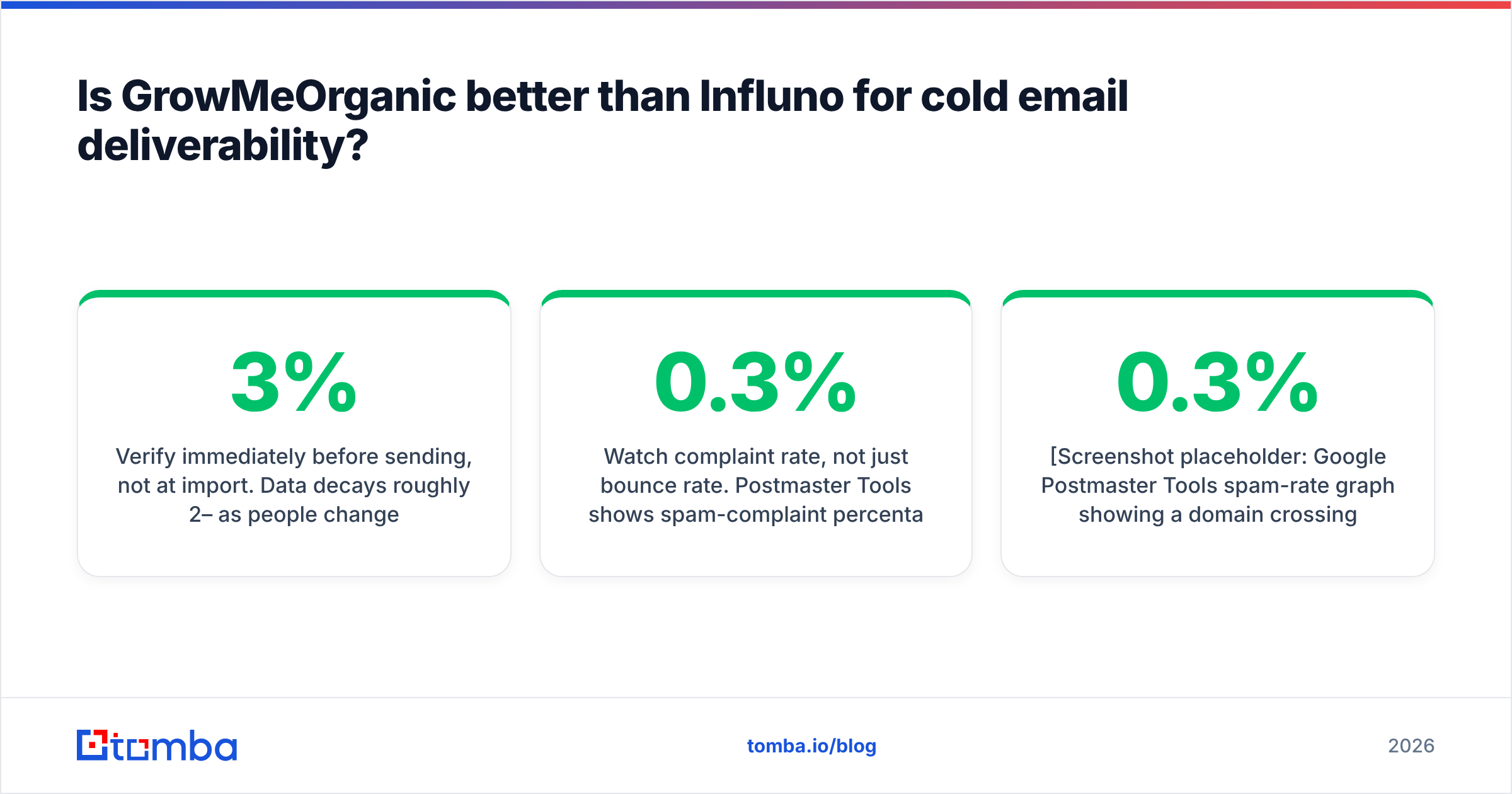
- Verify right before sending, not at import. Data decays about 2–3% a month as people change jobs.
- Watch complaint rate, not just bounce rate. Postmaster Tools shows your spam-complaint share. Above 0.3% you are already in trouble.
[Screenshot placeholder: Google Postmaster Tools spam-rate graph showing a domain crossing the 0.3% threshold]
[Screenshot placeholder: Influno inbox-rotation settings panel with per-mailbox daily caps]
How do the LinkedIn workflows differ?#
This is GrowMeOrganic's strongest card. Its Chrome extension walks Sales Navigator results, pulls profiles in bulk, and tries to find emails inline. Agencies building lists across many client ICPs save real time versus manual export-and-enrich.
Influno has no comparable extraction layer. You bring a list. It sends to it.
The trade-off is durability. Scraper workflows break whenever LinkedIn changes its page markup or tightens rate limits. Account restrictions are a real risk too. LinkedIn's user agreement prohibits automated scraping, and enforcement has grown stricter. Teams that built their whole top-of-funnel on extension scraping have lost a quarter to a single ban.
A safer pattern: use LinkedIn to identify accounts and people. Then resolve contact details through an API that does not depend on your logged-in session. A LinkedIn finder that works from a profile URL keeps the research value and leaves your personal account alone.
What should you actually pay for outbound tooling in 2026?#
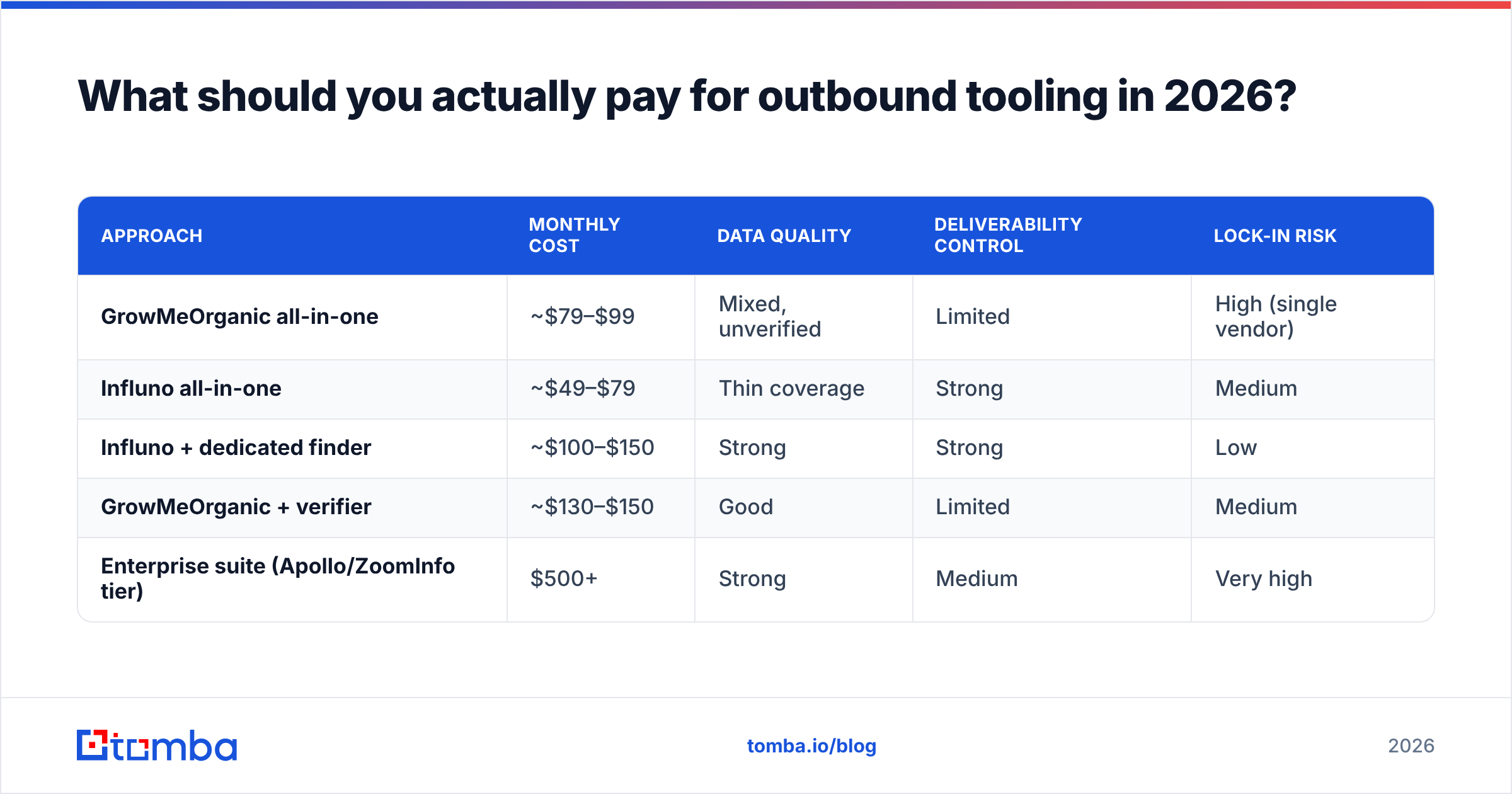
Here is a realistic stack cost for a two-rep team sending about 4,000 emails a month, next to the all-in-one pitch.
| Approach | Monthly cost | Data quality | Deliverability control | Lock-in risk |
|---|---|---|---|---|
| GrowMeOrganic all-in-one | ~$79–$99 | Mixed, unverified | Limited | High (single vendor) |
| Influno all-in-one | ~$49–$79 | Thin coverage | Strong | Medium |
| Influno + dedicated finder | ~$100–$150 | Strong | Strong | Low |
| GrowMeOrganic + verifier | ~$130–$150 | Good | Limited | Medium |
| Enterprise suite (Apollo/ZoomInfo tier) | $500+ | Strong | Medium | Very high |
The unbundled options cost more on paper and less in practice. The big cost in outbound is not software. It is wasted rep hours and burned domains. A $50 monthly saving that buys a 12% bounce rate is not a saving.
If the middle rows appeal to you, Tomba pricing starts free at 25 searches a month. Paid tiers run $49/mo Starter, $99/mo Growth, and $249/mo Pro. That sits under most bundled plans, and it does one job properly instead of five jobs approximately.
One more model deserves a mention: prepaid verified databases. Vendors like BookYourData sell pay-as-you-go verified contacts with bounce guarantees. That suits teams who need one defined list, not constant discovery. If your ICP is stable and you buy in batches, it is a legitimate third path. Neither GrowMeOrganic nor Influno competes there directly.
Who should choose which?#
Choose GrowMeOrganic if:
- Your prospecting starts and ends in LinkedIn Sales Navigator
- You are an agency juggling many small client ICPs and need cheap breadth
- You accept scraping risk and will verify externally before sending
- Budget predictability matters more than data precision
Choose Influno if:
- You already have a list source and need it delivered reliably
- You run multi-domain, multi-inbox infrastructure
- Your current problem is spam placement, not list size
- You want a simpler product with fewer half-finished modules
Choose neither as your data layer if:
- A bounce rate above 5% is costing you deals
- You sell into SMB domains, where pattern-guessing fails hardest
- You need API-level enrichment inside a CRM or product workflow
- Compliance review requires documented data sourcing
For that last group, one pattern holds up: a dedicated finder feeding a dedicated sender. Pull contacts by company with domain search. Resolve individuals with the email finder. Verify catch-alls before they hit a sequence. Then let Influno, or any sender, do the one job it is good at. G2's sales intelligence category is a fair place to sanity-check that split against peer reviews rather than vendor claims.
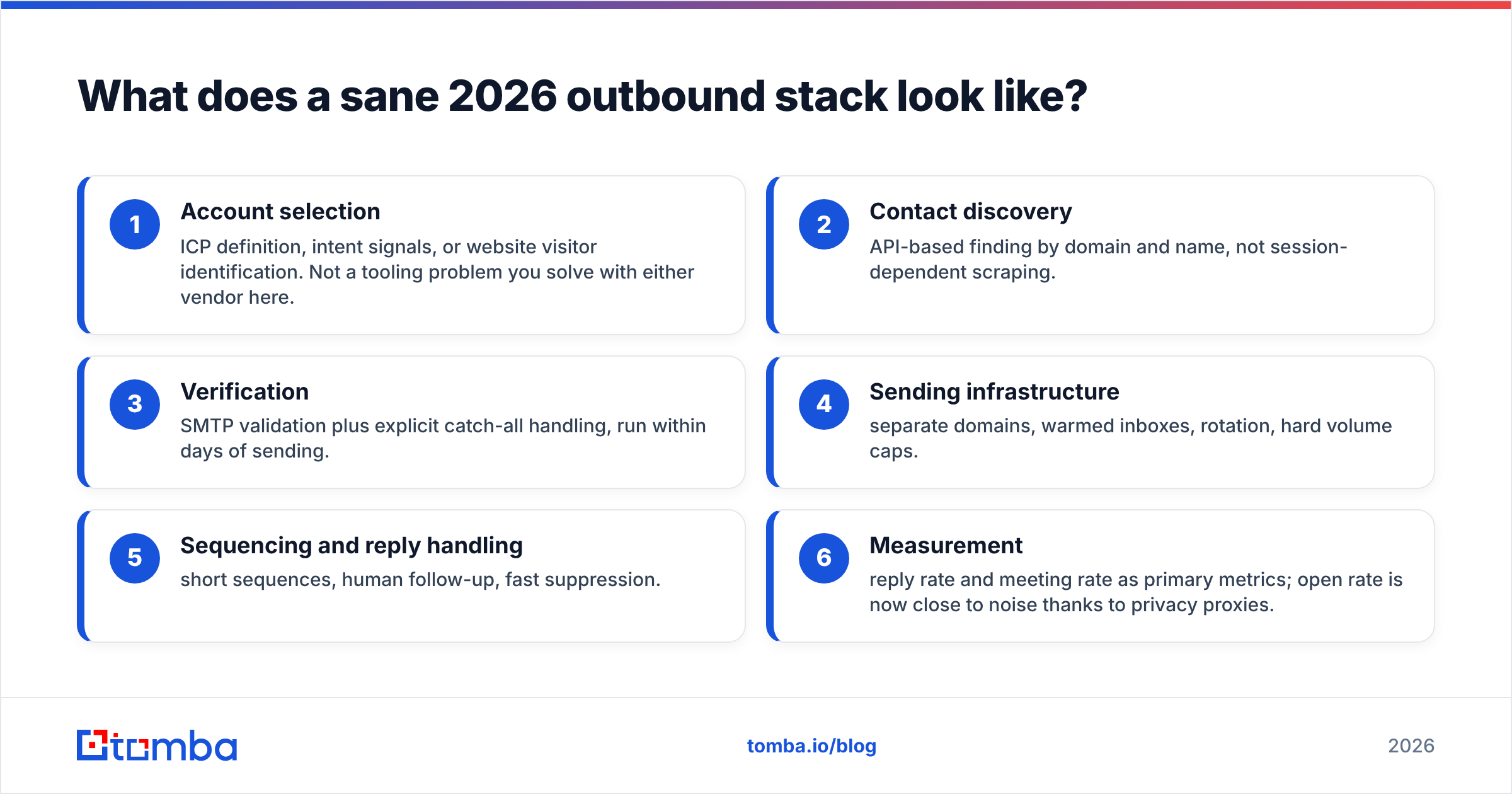
What does a sane 2026 outbound stack look like?#
- Account selection — ICP definition, intent signals, or website visitor identification. Neither vendor here solves this.
- Contact discovery — API-based finding by domain and name, not session-dependent scraping.
- Verification — SMTP validation plus explicit catch-all handling, run within days of sending.
- Sending infrastructure — separate domains, warmed inboxes, rotation, hard volume caps.
- Sequencing and reply handling — short sequences, human follow-up, fast suppression.
- Measurement — reply rate and meeting rate first. Open rate is close to noise now, thanks to privacy proxies.
GrowMeOrganic tries to own steps 2 through 5, and shouts loudest about step 2. Influno owns steps 4 and 5, and does them well. Neither owns step 3 well enough to bet a domain on.
GrowMeOrganic vs Influno: the verdict#
Forced to pick one? Influno for teams whose emails are not landing. GrowMeOrganic for teams who do not have enough contacts yet. But that framing is the trap. Most outbound teams stuck at low reply rates do not have a sender problem or a scraper problem. They have a data problem wearing one of those two costumes.
Fix the data first. Run 500 contacts from your current platform through an independent verifier. Look at the invalid and catch-all share before you renew anything. If more than 15% comes back questionable, no amount of inbox rotation or unlimited credits will save the campaign.
Start with the Tomba Email Finder free tier. Twenty-five searches a month is enough to benchmark your current tool honestly. Feed the verified output into whichever sender you prefer. A $49 plan plus discipline beats any bundle promising unlimited everything.
Related guides#
Ready to find emails that actually work?
Join 150,000+ professionals who stopped guessing and started sending. Free credits on signup — no credit card required.
Get the Tomba newsletter
Practical outbound tactics and product updates — once every two weeks.
About the author