GrowMeOrganic vs LeadGibbon: Which B2B Data Tool Wins in 2026?
GrowMeOrganic bundles scraping, email finding, and sequences into one subscription. LeadGibbon sells verified B2B contacts by the list. Here's which one actually fits your outbound motion — and where both fall short.
TL;DR
- GrowMeOrganic is an all-in-one outbound suite: LinkedIn scraping, email finding, drip sequences, and a CRM-lite pipeline on one unlimited-seat subscription starting around $49/month.
- LeadGibbon is a narrower play: a B2B contact database and list-builder where you search, filter, verify, and export to CSV or Google Sheets — no sending layer.
- Pick GrowMeOrganic if you want one tool for prospecting and sending. Pick LeadGibbon if you already run Instantly/Smartlead and only need clean contact rows.
- Both are weakest at the same point: verification depth and API access. Neither is designed to sit inside an engineering-owned enrichment pipeline.
- If your bottleneck is finding and verifying the email — not the sending — a dedicated finder like Tomba costs less per usable contact and exposes a real API.
Most "GrowMeOrganic vs LeadGibbon" searches come from the same moment: you've burned a free trial on one, the export limits bit you, and you're wondering whether the other tool is meaningfully different. It is — but not in the way the landing pages suggest. These two products barely compete on features. They compete on what part of your outbound stack you're willing to outsource.
This breakdown covers what each actually does, where the data comes from, real pricing math per usable contact, and when neither is the right answer.
What is GrowMeOrganic?#
GrowMeOrganic is an India-based outbound platform that bundles four jobs into one subscription:
- A LinkedIn/Sales Navigator scraper — a Chrome extension that pulls profile lists into your workspace.
- An email finder and verifier — pattern-based discovery against company domains, plus a basic SMTP check.
- A cold email sender — drip sequences, mail-merge personalization, and multi-inbox rotation.
- A lightweight CRM — pipeline stages, task reminders, basic reporting.
The pitch that wins deals for them is unlimited team seats. Most outbound tools charge $50–$100 per user per month, so a five-person SDR team on Apollo or Outreach pays several hundred dollars before touching credits. GrowMeOrganic flattens that: one plan, everyone in.
The trade-off is depth. Each of the four modules is roughly 70% as good as a dedicated tool. The sequencer has no real deliverability tooling. The CRM won't replace a proper CRM. And the email finder is where teams most often get burned, because bounce rates on scraped-then-guessed addresses climb fast once you leave well-known domains.
What is LeadGibbon?#
LeadGibbon takes the opposite approach. It's a B2B contact database with a list-building interface on top. You filter by job title, industry, company size, technology, and location; you preview the matching contacts; you export what you want as CSV or push directly into Google Sheets.
Three things define it:
- Human-in-the-loop verification. LeadGibbon has historically leaned on manual/assisted verification for records rather than pure automated SMTP pings, which is why its accuracy claims hold up better than most scrapers on paper.
- List-first workflow. You're not enriching one contact at a time. You're building a segment and pulling it down.
- No sending layer. LeadGibbon assumes you already have Instantly, Smartlead, Lemlist, or a CRM sequencer. It hands you rows and gets out of the way.
That focus is a feature if your stack is already assembled and a limitation if it isn't. LeadGibbon also has a smaller database than the Apollo/ZoomInfo tier, so coverage in niche verticals or non-US geographies can thin out quickly. Test your exact ICP before you commit — that's true of every list vendor, but especially the mid-sized ones.
How do GrowMeOrganic and LeadGibbon compare head-to-head?#
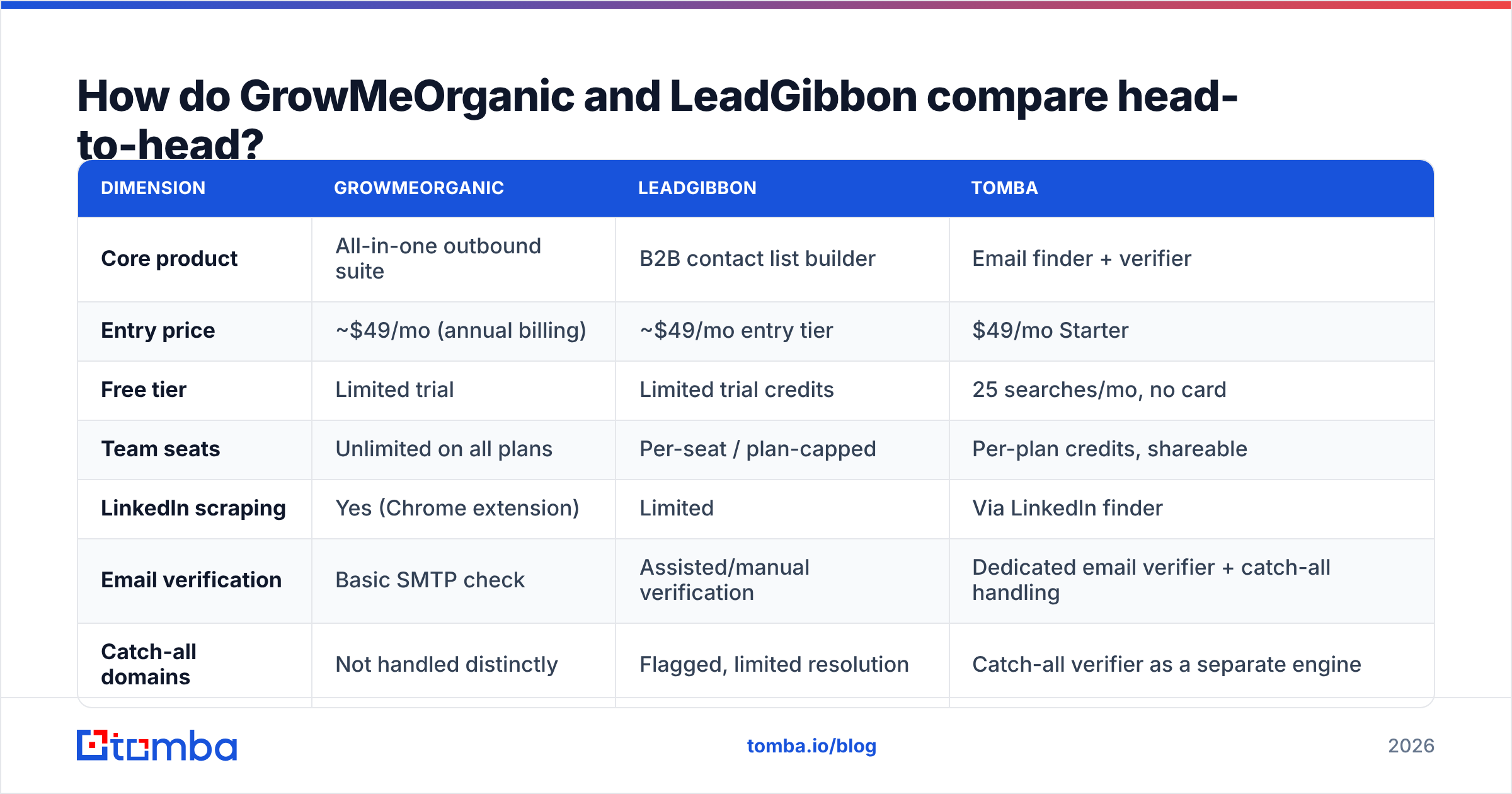
Here's the honest side-by-side. Prices move; check both vendors' pricing pages before you buy.
| Dimension | GrowMeOrganic | LeadGibbon | Tomba |
|---|---|---|---|
| Core product | All-in-one outbound suite | B2B contact list builder | Email finder + verifier |
| Entry price | ~$49/mo (annual billing) | ~$49/mo entry tier | $49/mo Starter |
| Free tier | Limited trial | Limited trial credits | 25 searches/mo, no card |
| Team seats | Unlimited on all plans | Per-seat / plan-capped | Per-plan credits, shareable |
| LinkedIn scraping | Yes (Chrome extension) | Limited | Via LinkedIn finder |
| Email verification | Basic SMTP check | Assisted/manual verification | Dedicated email verifier + catch-all handling |
| Catch-all domains | Not handled distinctly | Flagged, limited resolution | Catch-all verifier as a separate engine |
| Cold email sending | Built in | No | No (integrates with senders) |
| CRM features | Basic pipeline | No | No |
| Public API | Limited | Limited | Full email finder API, CLI, MCP |
| Bulk processing | In-app campaigns | CSV export | Bulk email finder + verification |
| Best for | Solo founders, small agencies | Teams with a sender already | Data layer for any stack |
Read that table as three different products, not three competitors. GrowMeOrganic sells breadth. LeadGibbon sells lists. A dedicated finder sells the accuracy of a single field — the email address everything else depends on.
Which one has better data accuracy?#
Neither publishes independently audited accuracy numbers, so treat any headline percentage from either vendor as marketing until you test it.
What you can reason about is method, and method predicts bounce rate:
- GrowMeOrganic derives emails largely from patterns. It sees
firstname.lastname@company.comworks for three known employees and infers the rest. This is cheap, fast, and fine on large companies with consistent conventions. It degrades on companies under 50 employees, on domains with multiple formats, and on anything behind a catch-all — which is where a "valid" result is really "we can't tell." - LeadGibbon front-loads verification before the record reaches you. That produces cleaner exports on average, but the database only contains what it contains. Coverage gaps show up as missing contacts rather than wrong ones — a better failure mode, but still a failure.
- A dedicated finder treats discovery and verification as two separate engineering problems, with a distinct path for catch-all domains, role-based addresses, and deliverability signals.
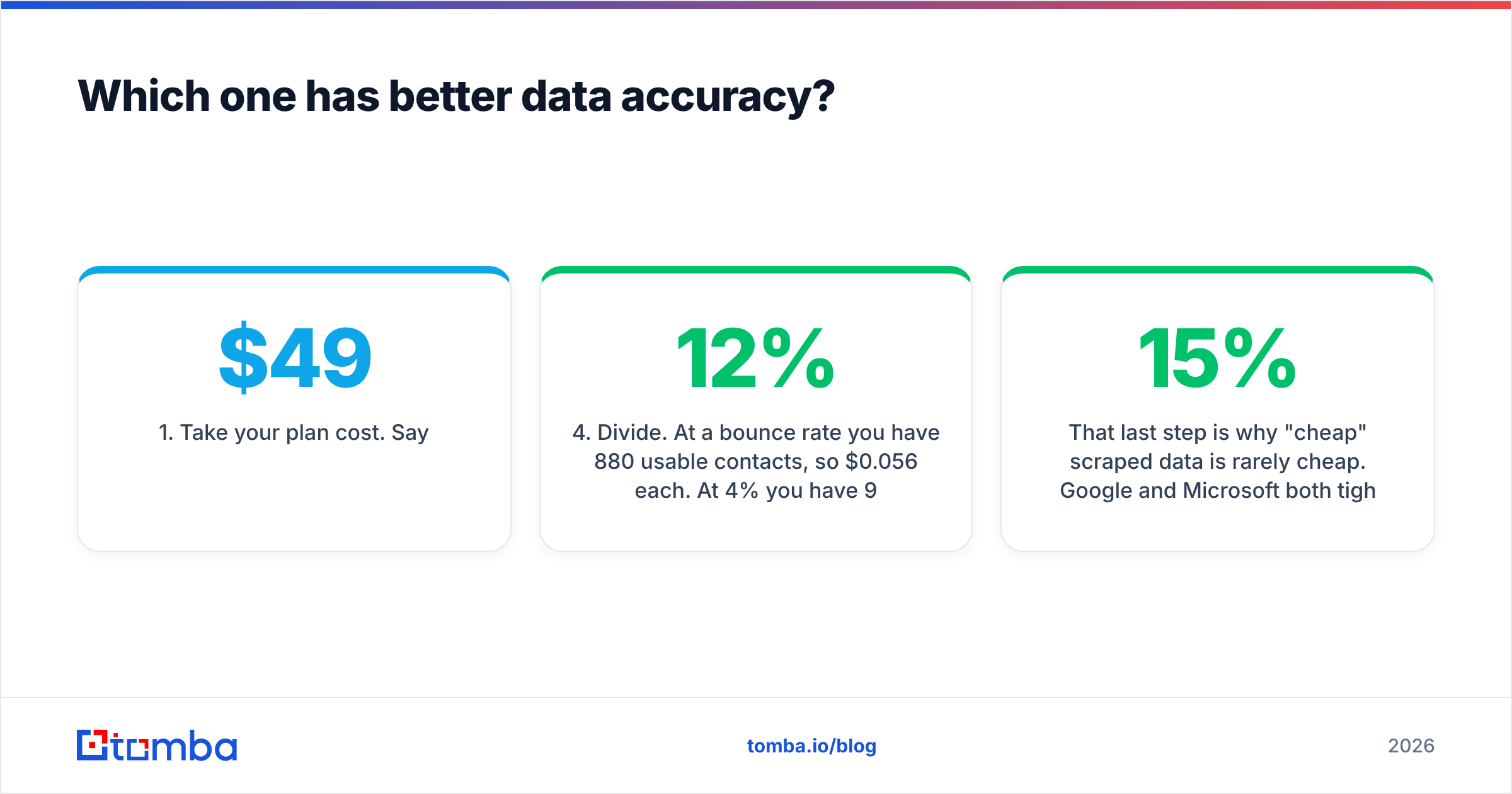
The number that actually matters isn't accuracy — it's cost per usable contact. Run the math:
- Take your plan cost. Say $49/month.
- Take the credits or exports included. Say 1,000.
- Test 100 real contacts from your ICP and measure the bounce rate on a small send.
- Divide. At a 12% bounce rate you have 880 usable contacts, so $0.056 each. At 4% you have 960, so $0.051 each — but you also protect sender reputation, which is the expensive part.
- Add the hidden cost. A domain that gets throttled because of a bad list costs weeks of pipeline, not dollars.

That last step is why "cheap" scraped data is rarely cheap. Google and Microsoft both tightened bulk-sender requirements, and their published guidance is explicit that spam complaint rates and invalid recipients drive filtering decisions. Google's bulk sender guidelines are the reference document here — read them once, and the cost of a 15% bounce list becomes obvious.
Is GrowMeOrganic better than LeadGibbon for cold outreach?#
For a solo founder or a two-person agency with no existing stack: yes, probably GrowMeOrganic. One subscription, one login, unlimited seats, and you can go from LinkedIn search to sent sequence in an afternoon. The consolidation is genuinely worth something when your alternative is stitching together four tools and four invoices.
For a team already running a real sending platform: LeadGibbon, or a dedicated finder. Don't pay for a sequencer you'll never open. Buying GrowMeOrganic when you already have Smartlead means paying for redundant infrastructure and, worse, tempting a teammate into sending from a second, unwarmed system.
There's a third case people underweight. If you're doing account-based outbound at low volume and high value — 50 target accounts, multiple stakeholders each — neither list-based nor pattern-based bulk tools serve you well. You want per-contact precision: domain search to map who works there, then per-person verification before a single email leaves your outbox. Buying 10,000 rows to reach 50 people is the wrong shape of purchase.

What are the hidden costs and limits?#
Both tools have friction points that don't appear on the pricing page. Watch for these:
- Export caps per period. "Unlimited" in an all-in-one plan usually means unlimited seats, not unlimited credits. Read the credit table, not the headline.
- Annual-only discounts. The $49-ish figures on both sides frequently assume annual prepay. Monthly billing runs meaningfully higher.
- Credit consumption on failures. Some tools burn a credit whether or not they return a valid address. Ask support directly and get it in writing.
- Catch-all ambiguity. A domain with a catch-all MX accepts everything at the SMTP layer. Tools that report these as "valid" are inflating their own accuracy stats. Check how each vendor labels them.
- LinkedIn account risk. Scraping extensions operate against LinkedIn's terms. Restrictions and bans do happen, and no vendor indemnifies you.
- Data freshness. B2B contact data decays roughly 2–3% per month as people change jobs. A list exported in January is materially worse in June. Vendor-side refresh cadence matters more than database size.
On the last point, G2's category listings are useful for spotting patterns in recent user reviews — specifically, look for complaints about stale records rather than star averages.
Where does Tomba fit in this comparison?#
Honestly: Tomba isn't a replacement for either tool's full scope. It doesn't send sequences and it isn't a pre-built list marketplace. It solves one layer — finding and verifying the email address — and it's built to be called by whatever sits above it.
That matters in three situations:
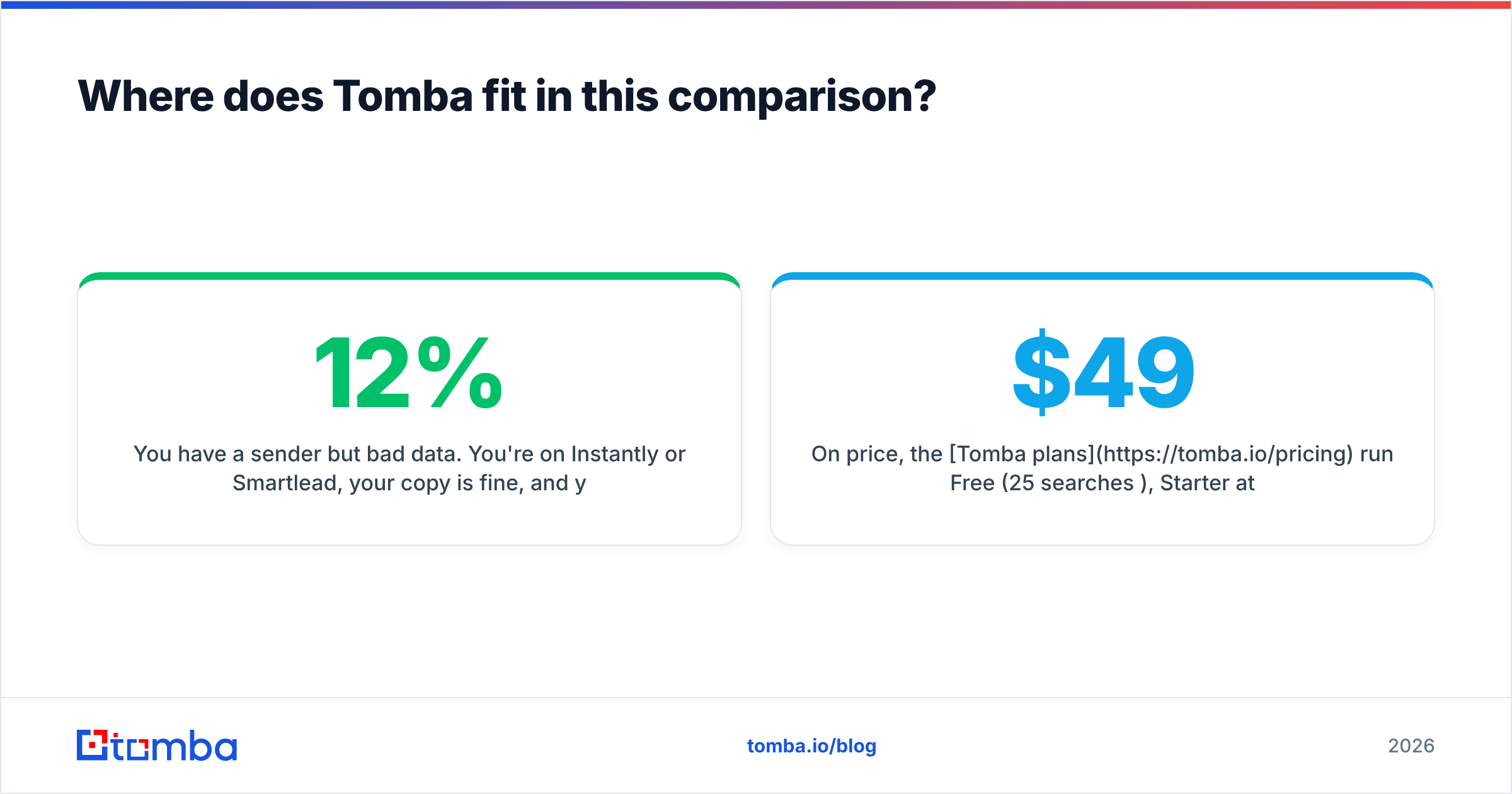
You have a sender but bad data. You're on Instantly or Smartlead, your copy is fine, and your bounce rate is 12%. You don't need another platform. You need a better email finder and a verification pass before every send.
You have a list but no confidence in it. You bought or scraped rows from somewhere. Run them through bulk verification before they touch your domain. The cost of verification is always lower than the cost of a reputation hit.
You're building, not clicking. If enrichment lives in your product or your data warehouse, you need an API, not a dashboard. Tomba exposes a documented REST API, a CLI, an MCP server, and native connections to Sheets, Excel, Airtable, and HubSpot via integrations. GrowMeOrganic and LeadGibbon are both fundamentally UI-first products; you can get data out of them, but you can't cleanly build on them.

On price, the Tomba plans run Free (25 searches/month), Starter at $49/month, Growth at $99/month, Pro at $249/month, and Enterprise custom — the same entry point as both tools discussed here, but scoped to data rather than to a bundle. Whether that's better value depends entirely on whether you'd use the bundle.
If you want a broader survey of list vendors before deciding, it's worth also looking at established data providers like BookYourData, which sells verified B2B contacts with a pay-as-you-go model — a different commercial shape from both tools here, and a fair option if you dislike subscriptions.
Which should you choose?#
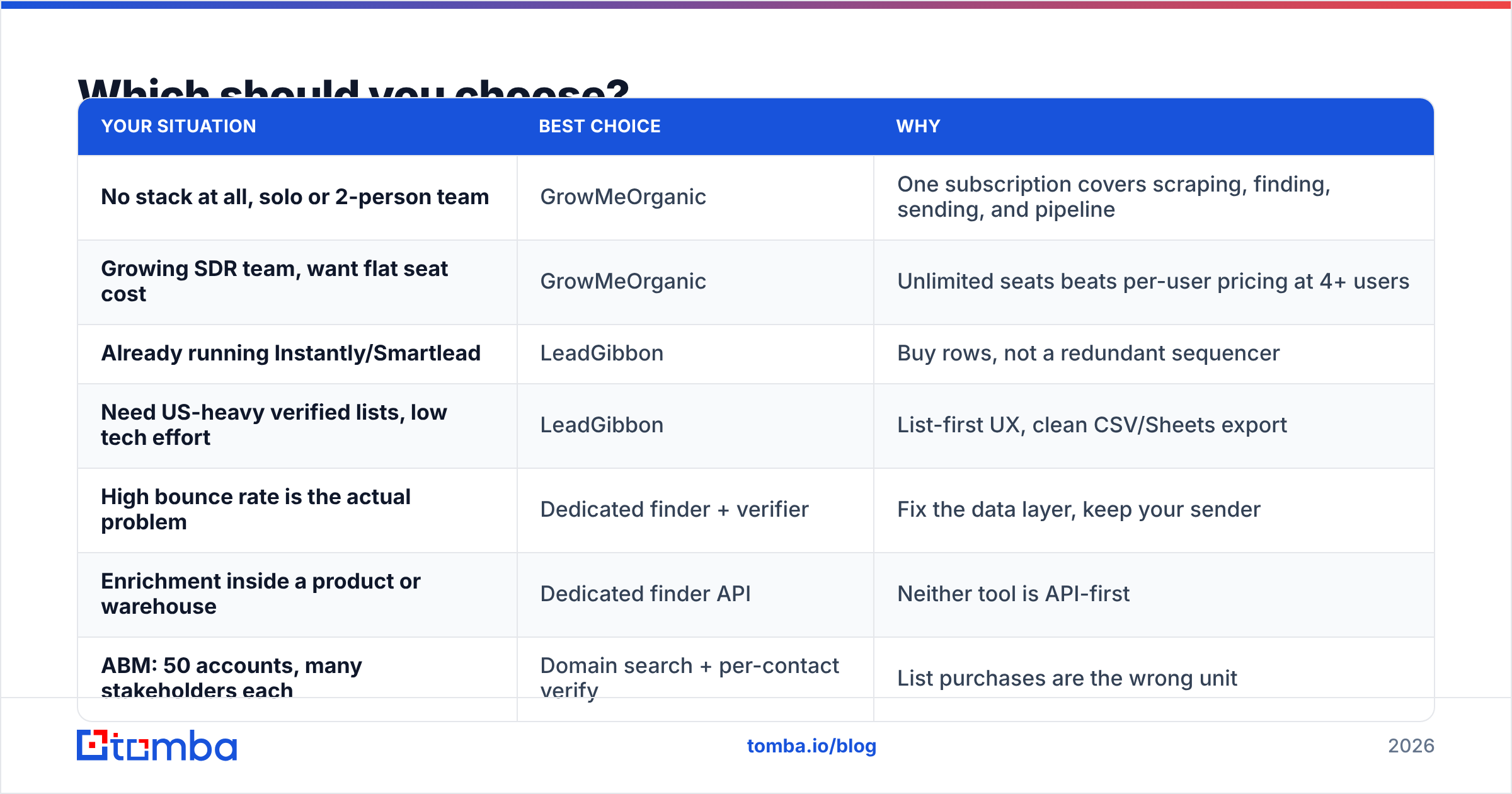
Decide by what you're missing, not by which review scores higher:
| Your situation | Best choice | Why |
|---|---|---|
| No stack at all, solo or 2-person team | GrowMeOrganic | One subscription covers scraping, finding, sending, and pipeline |
| Growing SDR team, want flat seat cost | GrowMeOrganic | Unlimited seats beats per-user pricing at 4+ users |
| Already running Instantly/Smartlead | LeadGibbon | Buy rows, not a redundant sequencer |
| Need US-heavy verified lists, low tech effort | LeadGibbon | List-first UX, clean CSV/Sheets export |
| High bounce rate is the actual problem | Dedicated finder + verifier | Fix the data layer, keep your sender |
| Enrichment inside a product or warehouse | Dedicated finder API | Neither tool is API-first |
| ABM: 50 accounts, many stakeholders each | Domain search + per-contact verify | List purchases are the wrong unit |
The honest summary: GrowMeOrganic and LeadGibbon aren't really rivals. They're two answers to two different missing pieces. If you can name the piece you're missing in one sentence, the choice makes itself.
And if that sentence is "I can't reliably get the right email address," neither bundle nor list solves it — a purpose-built finder does.
Fix the data layer first. Bounces come from the email address, not the sequencer. Try the Tomba Email Finder free — 25 searches a month, no card required — and run 25 contacts from your actual ICP against whatever you're using now. Compare the bounce rates on a small send before you sign an annual contract with anyone. If Tomba wins, plans start at $49/month with a full API, CLI, and bulk processing included.
Related guides#
Ready to find emails that actually work?
Join 150,000+ professionals who stopped guessing and started sending. Free credits on signup — no credit card required.
Get the Tomba newsletter
Practical outbound tactics and product updates — once every two weeks.
About the author