GrowMeOrganic vs LeadMine: Which Lead Tool Wins in 2026?
GrowMeOrganic bundles scraping, email finding, and sequences. LeadMine stays narrow and accurate. We compare pricing, data quality, and which one actually fits your outbound motion in 2026.
GrowMeOrganic vs LeadMine is a choice between a bundle and a scalpel. One tool wants to run your whole outbound stack. The other finds emails and stops there. Here is how the two compare in 2026 on price, data quality, and fit.
TL;DR
- GrowMeOrganic is a bundle. You get LinkedIn scraping, email finding, a B2B database, and a cold-email sender. Plans start near $49/mo, billed yearly.
- LeadMine is narrow. You get a lead database and an email finder with a public accuracy claim. Credit packs start near $49/mo for 250 credits.
- Want one tool that scrapes and sends? GrowMeOrganic wins on scope. Want clean emails for a sequencer you already pay for? LeadMine wins on focus.
- Both burn credits on unverified results. Neither is a strong verifier. Budget for verification either way.
- Many teams split the stack instead. They pair a dedicated finder and verifier (Tomba, $49/mo Starter, free 25-search tier) with the sequencer they already trust.
What are GrowMeOrganic and LeadMine, actually?#
GrowMeOrganic is an all-in-one prospecting suite built around a Chrome extension. You scrape LinkedIn and Sales Navigator lists. You pull emails and phone numbers. You tap a B2B database of company and contact records. Then you run drip campaigns from the same dashboard. It markets itself hard on "unlimited" — unlimited exports, unlimited campaigns. In practice that means fair-use ceilings and daily caps, not a literal infinity.
LeadMine does far less, on purpose. It is a searchable B2B lead database. Filters cover job title, industry, location, and company size. An email finder returns one professional address for a name-and-domain pair. LeadMine publishes a 95%+ accuracy claim and bills in plain credit packs. No sequencer. No LinkedIn automation. No dialer.
That gap drives every other point below. Suite versus single-purpose tool. You are not really comparing two email finders. You are comparing a Swiss Army knife against a chef's knife.

GrowMeOrganic vs LeadMine: pricing and features compared#
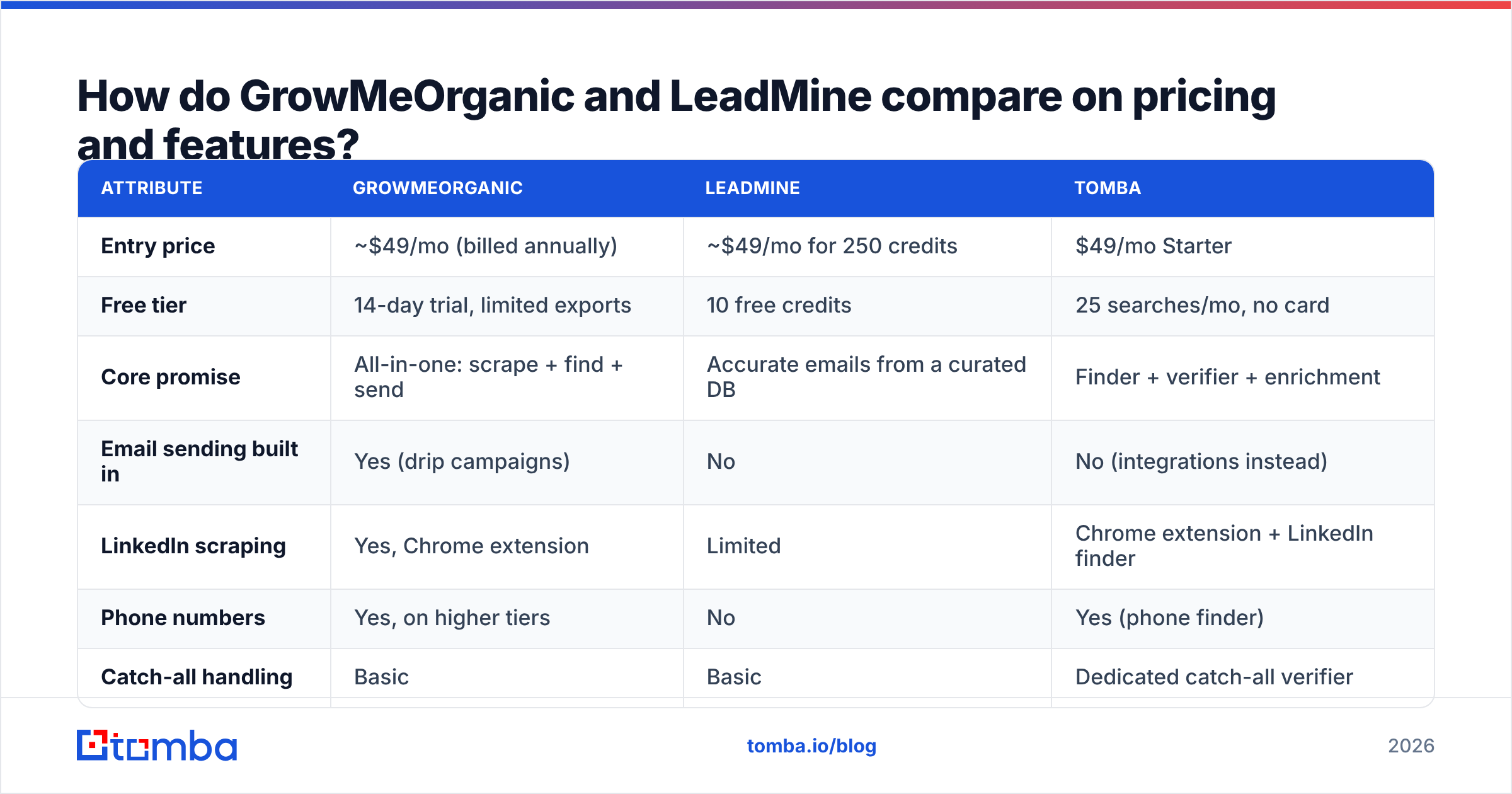
Pricing is where the two split hardest. GrowMeOrganic pushes annual billing. Its headline monthly numbers are annual-equivalent, and month-to-month costs more. LeadMine sells credits the boring way: one pack per month. On lower tiers, unused credits do not roll over.
| Attribute | GrowMeOrganic | LeadMine | Tomba |
|---|---|---|---|
| Entry price | ~$49/mo (billed annually) | ~$49/mo for 250 credits | $49/mo Starter |
| Free tier | 14-day trial, limited exports | 10 free credits | 25 searches/mo, no card |
| Core promise | All-in-one: scrape + find + send | Accurate emails from a curated DB | Finder + verifier + enrichment |
| Email sending built in | Yes (drip campaigns) | No | No (integrations instead) |
| LinkedIn scraping | Yes, Chrome extension | Limited | Chrome extension + LinkedIn finder |
| Phone numbers | Yes, on higher tiers | No | Yes (phone finder) |
| Catch-all handling | Basic | Basic | Dedicated catch-all verifier |
| API access | Limited | Yes | Full REST API, CLI, MCP |
| Bulk processing | Yes, with daily caps | Yes, CSV upload | Bulk finder + bulk verify |
| Best for | Solo founders wanting one bill | Recruiters and small SDR teams | Teams that need data accuracy at scale |
Read the table for what it implies about your stack, not just for the numbers. GrowMeOrganic's built-in sender only pays off if you would otherwise buy Instantly, Smartlead, or Lemlist for $30–$100/mo. Most outbound teams already run one. If you do, you pay for a sequencer twice, and the bundled one is the weaker of the two.
LeadMine fails the other way. Credits feel cheap until you run a big campaign. Then 250 a month vanish in one afternoon of list-building. There is no pressure valve. Teams building 2,000+ contacts a month find the per-credit math worse than a dedicated finder with volume tiers.
Which one has better email accuracy?#
Neither publishes third-party audited numbers. Treat both claims with care.
LeadMine advertises 95%+ accuracy. In practice it delivers respectable bounce rates on standard corporate domains — think firstname.lastname@company.com at companies with 200+ staff and steady naming patterns. Its weakness is coverage. The database is curated and smaller, so you get "not found" on many SMB, agency, and non-US targets. A high accuracy rate on a low hit rate is an easy metric to win.
GrowMeOrganic flips that trade. It scrapes harder and returns more results. That buys better coverage, plus far more guessed-pattern addresses that were never SMTP-confirmed. Users report bounce rates that climb once they leave the enterprise segment. Export 1,000 rows, blast them with no verification pass, and you will hurt your sender reputation.
The rule for either tool is the same: never send to raw exports. Run the list through a real email verifier first. Route anything flagged catch-all through a catch-all verifier instead of deleting it or sending blind. Catch-all domains are roughly a fifth of B2B addresses. Treating them as one bucket is where most bounce damage starts.

Screenshot placeholder: side-by-side bounce report from a 1,000-row export, raw vs post-verification.
Is GrowMeOrganic's "unlimited" claim real?#
Partly. Here is what "unlimited" means in this category. Read it before you commit to an annual plan.
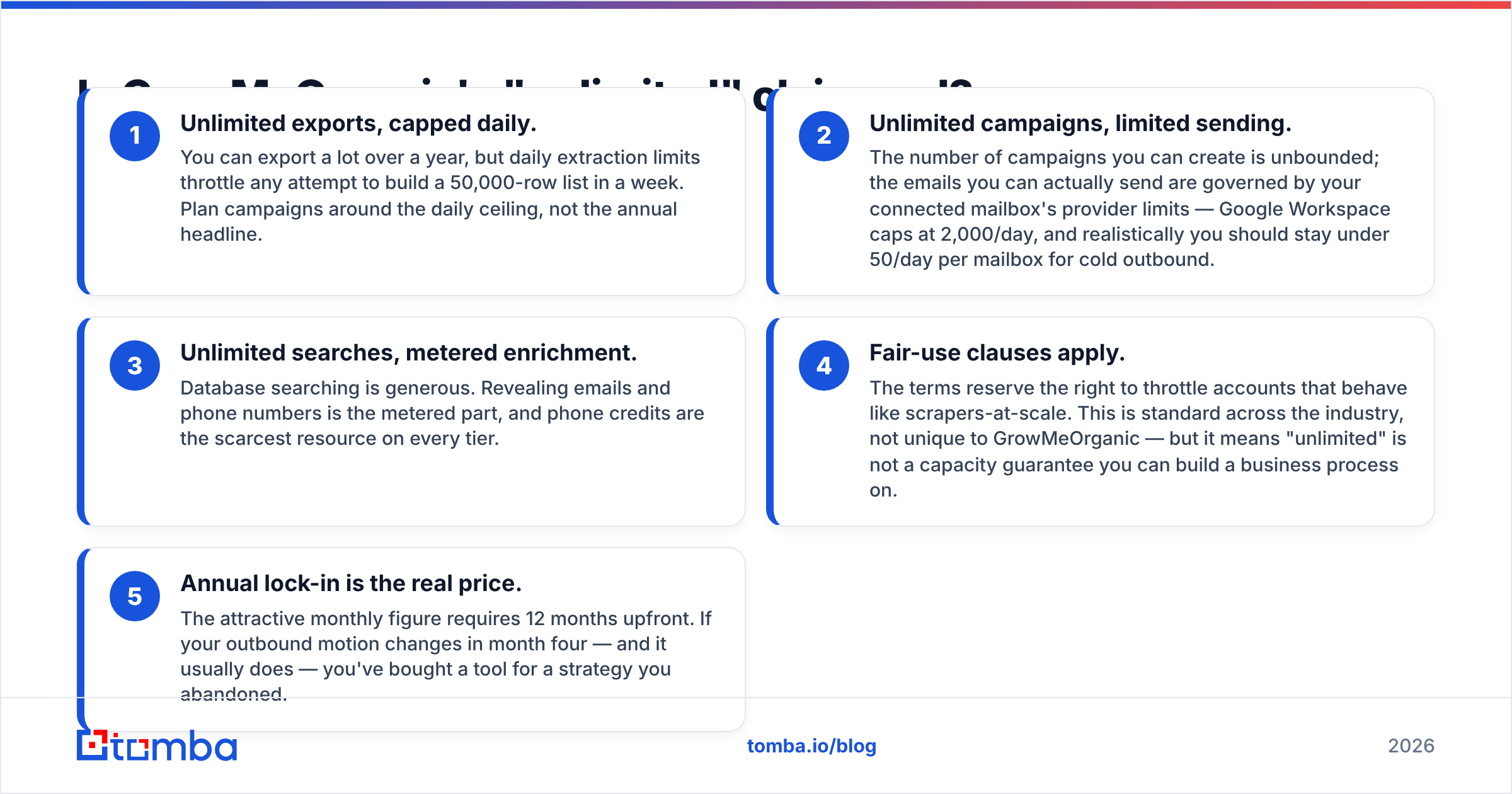
- Unlimited exports, capped daily. You can export a lot over a year. Daily extraction limits still block a 50,000-row list in one week. Plan around the daily ceiling, not the annual headline.
- Unlimited campaigns, limited sending. You can create any number of campaigns. What you can actually send is set by your mailbox provider. Google Workspace caps at 2,000/day, and cold outbound should stay under 50/day per mailbox.
- Unlimited searches, metered enrichment. Database search is generous. Revealing emails and phone numbers is the metered part. Phone credits are the scarcest resource on every tier.
Two more limits matter, and both sit in the contract rather than the feature list.
- Fair-use clauses apply. The terms let the vendor throttle accounts that behave like scrapers at scale. That is standard across the industry. It also means "unlimited" is not a capacity guarantee you can build a process on.
- Annual lock-in is the real price. The attractive monthly figure needs 12 months upfront. If your outbound motion changes in month four — and it usually does — you bought a tool for a strategy you dropped.
None of that makes GrowMeOrganic a bad product. It makes it a product whose pricing page and invoice tell different stories. Most bundles do. Compare it against transparent per-search pricing before you assume the bundle is cheaper.

Which should you pick for your use case?#
Match the tool to the motion, not to the feature count.
Pick GrowMeOrganic if: you are a solo founder or a two-person team, you do not already pay for a cold-email sender, you prospect mostly on LinkedIn, and you want one login and one invoice. The bundle saves real setup time when you start from zero.
Pick LeadMine if: you are a recruiter or a small SDR team, and you already run Instantly, Smartlead, or Outreach for sending. A few hundred verified contacts a month fits it well. The credit model is honest, and accuracy on enterprise domains is fine.
Pick neither if: you need API-first data at scale, you enrich an existing CRM instead of building lists, or your ICP skews SMB, non-US, or off LinkedIn. Both tools were built for LinkedIn-shaped prospecting. Both degrade outside it.
A fourth pattern is now the most common one we see. Teams unbundle on purpose. A dedicated email finder handles discovery and verification through an API. A purpose-built sequencer handles sending. A CRM handles pipeline. Each layer is replaceable. When Instantly raises prices, or LinkedIn changes its scraping defenses, you swap one part instead of migrating a whole suite. G2's category data shows this pattern dominating mid-market stacks — see the sales intelligence category on G2 for how fragmented the space has become.
What about the alternatives to both?#
The GrowMeOrganic vs LeadMine framing is narrower than most buyers realize. A realistic 2026 shortlist includes several tools neither vendor mentions.
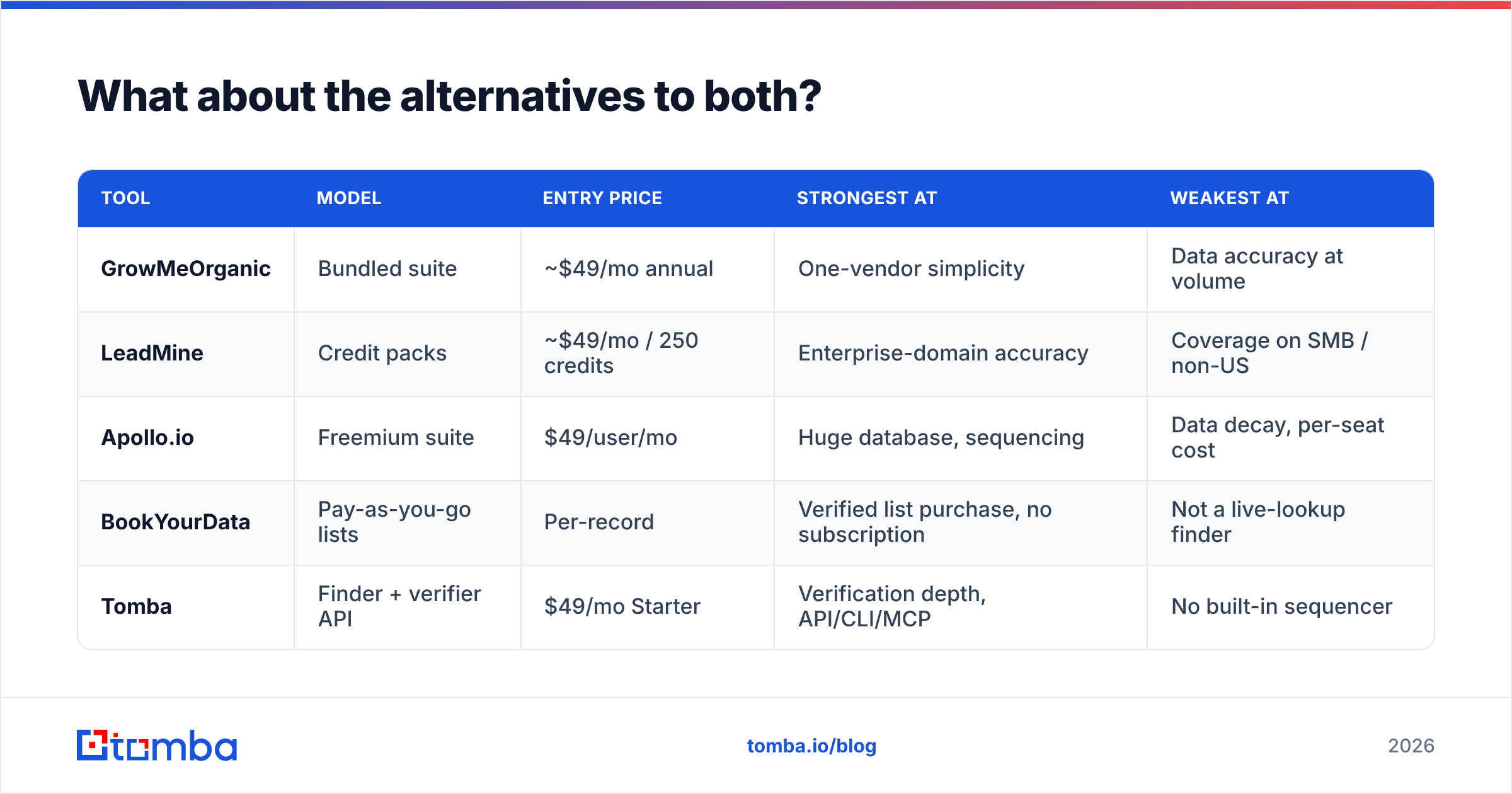
| Tool | Model | Entry price | Strongest at | Weakest at |
|---|---|---|---|---|
| GrowMeOrganic | Bundled suite | ~$49/mo annual | One-vendor simplicity | Data accuracy at volume |
| LeadMine | Credit packs | ~$49/mo / 250 credits | Enterprise-domain accuracy | Coverage on SMB / non-US |
| Apollo.io | Freemium suite | $49/user/mo | Huge database, sequencing | Data decay, per-seat cost |
| BookYourData | Pay-as-you-go lists | Per-record | Verified list purchase, no subscription | Not a live-lookup finder |
| Tomba | Finder + verifier API | $49/mo Starter | Verification depth, API/CLI/MCP | No built-in sequencer |
BookYourData deserves a mention, because it solves a different problem cleanly. If you want a verified list handed to you, pay-as-you-go record purchase skips the subscription question. That suits teams running two or three campaigns a year rather than a continuous motion.
Apollo is still the default heavyweight. If you are evaluating it seriously, read a proper Apollo alternative breakdown first. Per-seat pricing on a five-person team changes the math completely.

How do you test both without wasting money?#
Run the same controlled test on any tool you evaluate. It takes about an hour. It beats every review you will read, including this one.
- Build a 50-contact golden list. Pick real people at real companies you can verify yourself. Public LinkedIn profiles, conference speaker lists, or current customers all work. You need ground truth.
- Run that list through each free tier. GrowMeOrganic's 14-day trial, LeadMine's 10 free credits, Tomba's 25 free searches. Same names, same domains, same day.
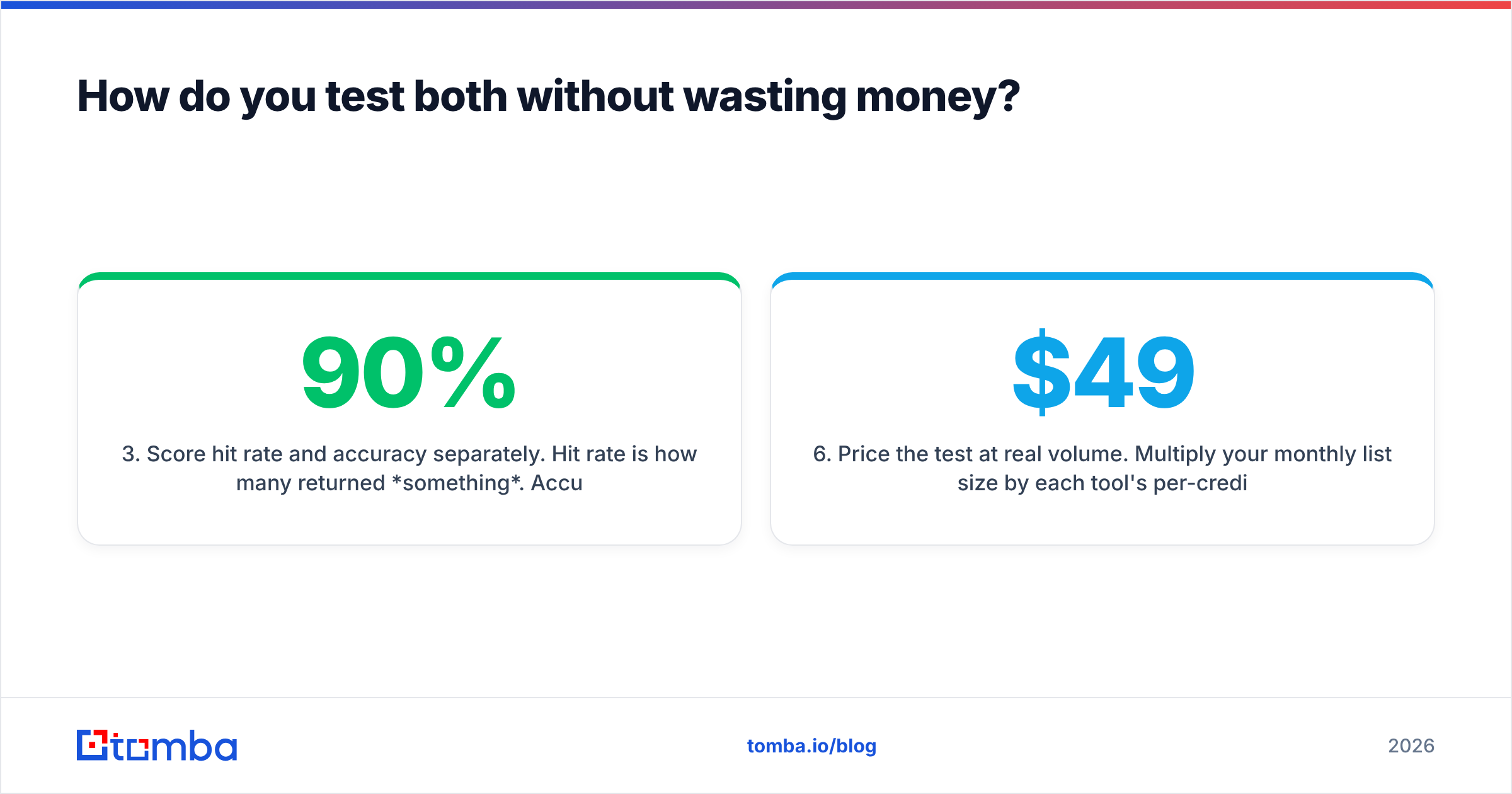
- Score hit rate and accuracy separately. Hit rate is how many returned something. Accuracy is how many returned the right thing. A tool at 90% hit rate and 70% accuracy is worse than one at 60% and 98%. The first quietly poisons your domain.
Then check the parts vendors rarely put on a pricing page.
- Verify results through a neutral third party. Use a free email checker or an API that is not the tool under test. Self-reported "verified" flags are marketing.
- Check catch-all handling. Include 10 known catch-all domains. See whether the tool flags them, sends them anyway, or charges a credit for a coin flip.
- Price the test at real volume. Multiply your monthly list size by each per-credit or per-seat cost. The $49 entry price means little if your usage lands on a $249 tier.
For a neutral primer on how sending infrastructure meets list quality, read HubSpot's email deliverability guidance. List hygiene drives more of your inbox placement than copy ever will.
GrowMeOrganic vs LeadMine: what's the verdict?#
For most teams: LeadMine if you already have a sequencer. GrowMeOrganic only if you truly do not. That is the honest split. GrowMeOrganic's value sits entirely in the bundle. The bundle's value collapses the moment you already pay for a sending tool, which describes almost every team past its first ten customers.
LeadMine's value is real but narrow. Accurate emails, modest volumes, no surprises. Its ceiling arrives fast. Once you build thousands of contacts a month, or enrich a CRM through code, the credit packs and the thin API turn into friction.
There is an uncomfortable third answer. Neither tool is the accuracy layer of a serious 2026 stack. Both are list-building tools with verification bolted on. Google and Microsoft have tightened bulk-sender rules, and a burned domain takes a long time to recover. If bounce rates keep you up at night, verification has to be a first-class tool, not a checkbox.
Start with the Tomba Email Finder. You get 25 free searches a month with no card, $49/mo Starter when you are ready, and real SMTP verification with catch-all handling. A REST API, CLI, and Chrome extension slot into whatever sequencer and CRM you already run. Put your golden list through all three tools, compare the bounce reports, and let the numbers pick your stack.
Related guides#
Ready to find emails that actually work?
Join 150,000+ professionals who stopped guessing and started sending. Free credits on signup — no credit card required.
Get the Tomba newsletter
Practical outbound tactics and product updates — once every two weeks.
About the author