GrowMeOrganic vs Mail Rocket: Which Wins in 2026?
GrowMeOrganic bundles LinkedIn scraping with sending; Mail Rocket bets on lightweight cold email at low cost. Here's how the two actually compare on data quality, deliverability, and price.
TL;DR
- GrowMeOrganic is an all-in-one: LinkedIn scraping, a B2B contact database, email finding, and a sending engine bundled into one unlimited-flavored subscription. Best when you want one tool and one bill.
- Mail Rocket is the lean side: a cold email sending platform focused on inbox rotation, warmup, and sequences. It assumes you bring your own list.
- The real split isn't features — it's where your data comes from. GrowMeOrganic gives you data plus sending; Mail Rocket gives you sending and expects clean data.
- Both stumble in the same place: unverified scraped emails. Neither one's built-in verification matches a dedicated verifier, and bounce rates above 5% will wreck your domain either way.
- Practical answer for most teams in 2026: pick your sender on deliverability features, and source and verify contacts with a dedicated email finder instead of trusting a bundled scraper.
What are GrowMeOrganic and Mail Rocket, actually?#
They're not the same category of product, which is why the comparison confuses people.
GrowMeOrganic is an all-in-one B2B prospecting suite. Its pitch is unlimited: a Chrome extension that pulls contacts off LinkedIn and Sales Navigator, a claimed 575M+ contact database, an email finder, and a drip campaign sender — all under a flat seat price. You log in once and, in theory, run the entire outbound motion from lead to reply.
Mail Rocket sits in the cold email sending category alongside tools like Instantly and Smartlead. The focus is on getting messages into the inbox: connecting multiple sending mailboxes, rotating between them, warming them up, and running multi-step sequences with reply detection. Lead sourcing isn't its job.
So the honest framing is: GrowMeOrganic competes with Apollo and Lusha and with sending tools. Mail Rocket competes only with senders. If you're evaluating both, you're really asking "do I want one bundled tool or a best-of-breed stack?"

How do GrowMeOrganic and Mail Rocket compare head to head?#
Here's the practical breakdown. Pricing moves, so treat these as directional and confirm on each vendor's page before you buy.
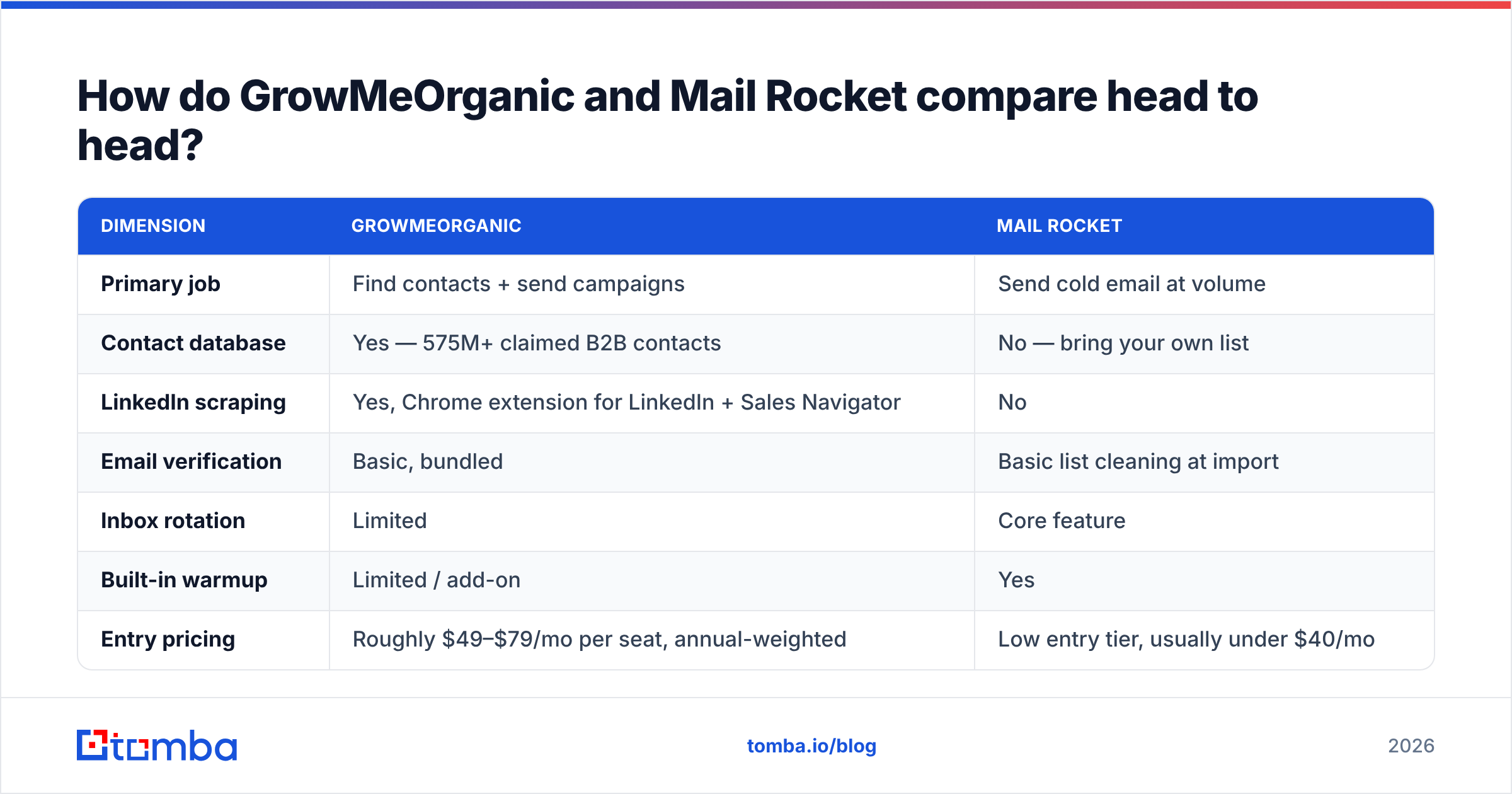
| Dimension | GrowMeOrganic | Mail Rocket |
|---|---|---|
| Primary job | Find contacts + send campaigns | Send cold email at volume |
| Contact database | Yes — 575M+ claimed B2B contacts | No — bring your own list |
| LinkedIn scraping | Yes, Chrome extension for LinkedIn + Sales Navigator | No |
| Email verification | Basic, bundled | Basic list cleaning at import |
| Inbox rotation | Limited | Core feature |
| Built-in warmup | Limited / add-on | Yes |
| Entry pricing | Roughly $49–$79/mo per seat, annual-weighted | Low entry tier, usually under $40/mo |
| Pricing model | Per seat, "unlimited" usage framing | Per mailbox / contact volume |
| API access | Limited | Limited |
| Best for | Solo founders and small teams wanting one tool | Agencies and teams running multi-inbox outbound |
| Weak spot | Data accuracy on scraped contacts | No data layer at all |
The table hides one thing worth saying plainly: "unlimited" in GrowMeOrganic's marketing refers to seats and exports, not to guaranteed-valid emails. Unlimited bad data is still bad data, and it costs you more than credits — it costs you your sending domain.
Which one has better data quality?#
GrowMeOrganic wins by default because Mail Rocket doesn't have a data product. But "wins by default" is not the same as "good enough."
Scraped LinkedIn data has a structural problem: LinkedIn doesn't publish work emails. Every tool that "finds" an email off a LinkedIn profile is either matching against a purchased database or guessing a pattern — first.last@, f.last@, firstinitiallast@ — and then, at best, running an SMTP check. When the guess isn't verified, or when the domain is catch-all and silently accepts everything, you ship a bounce.
Three things separate a real data layer from a bundled scraper:
- Multi-source corroboration. A single scraped source is a single point of failure. Real providers cross-check web crawl data, public records, and pattern inference before returning a result — see where the data comes from for what that looks like in practice.
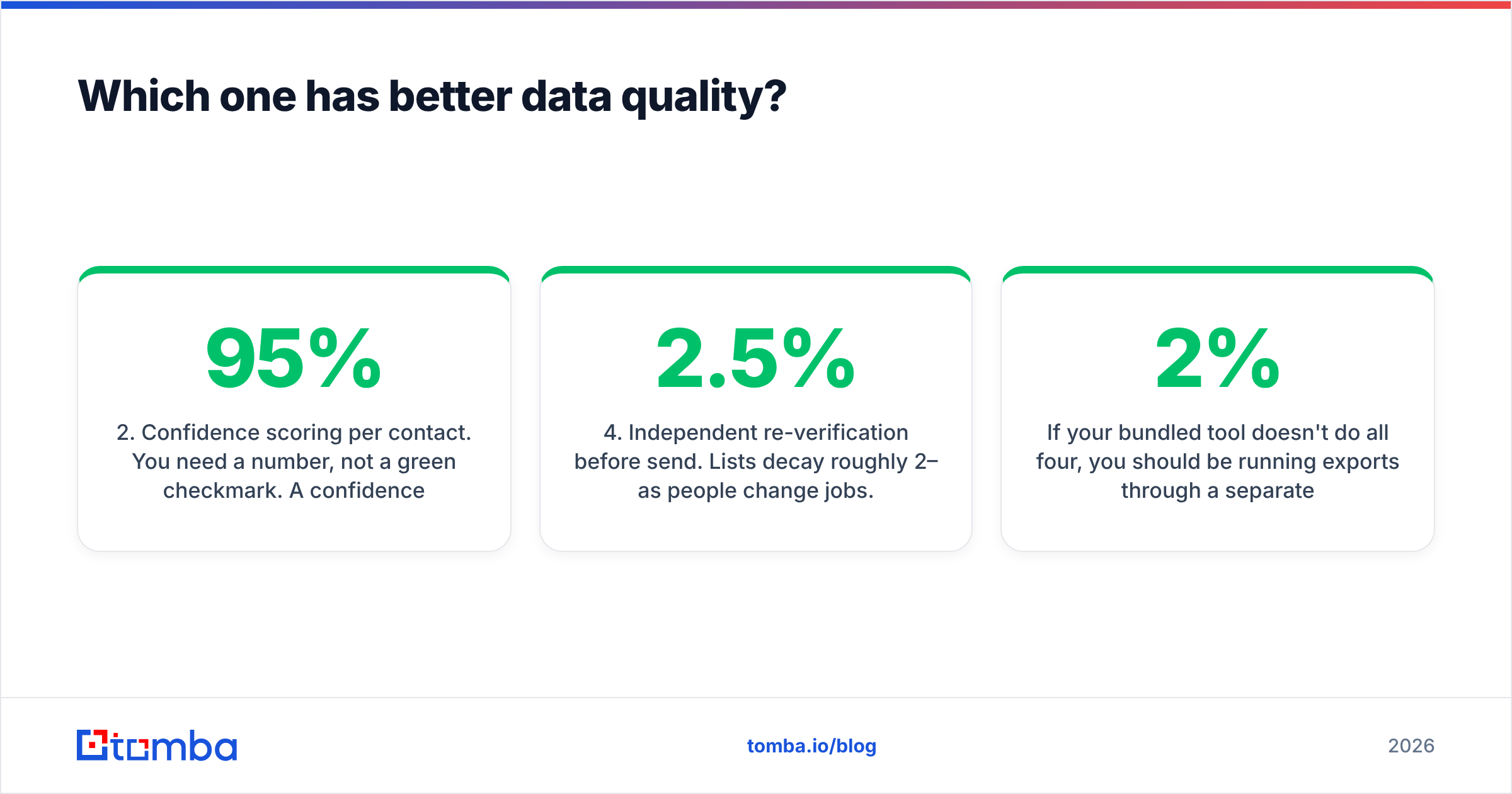
- Confidence scoring per contact. You need a number, not a green checkmark. A 95% confidence email and a 55% confidence guess should never enter the same sequence.
- Catch-all handling. Catch-all domains accept every address at the SMTP layer, so a naive verifier marks garbage as valid. A dedicated catch-all verifier runs deeper checks instead of shrugging and passing it through.
- Independent re-verification before send. Lists decay roughly 2–2.5% per month as people change jobs. A contact scraped in January is measurably worse in June.
If your bundled tool doesn't do all four, you should be running exports through a separate email verifier before they touch a sequence. That single step is usually the difference between a 2% bounce rate and a 15% one.

Suggested screenshot: GrowMeOrganic's LinkedIn Chrome extension mid-scrape, showing the extracted-contacts panel and the confidence indicator column.
Which one is better for deliverability?#
Mail Rocket, clearly — that's the category it's built for.
Cold email deliverability in 2026 runs on a short list of non-negotiables, and most were tightened by the Google and Yahoo bulk-sender requirements that landed in 2024 and have only gotten stricter since:
- Authentication. SPF, DKIM, and DMARC all aligned. Not optional. Run your domain through an SPF checker before your first send, not after your first spam complaint.
- Complaint rate under 0.3%. Google's published threshold. Cross it consistently and you're throttled.
- Bounce rate under 2–3%. This is a data problem, not a sending problem, and no sender fixes it for you.
- Volume ramping. A brand-new mailbox sending 200/day on week one is a burned mailbox by week three.
Mail Rocket handles the sending side of that list: rotation across mailboxes so no single inbox spikes, warmup to build a reputation baseline, and throttling. GrowMeOrganic's sender is functional but noticeably thinner — it works for a founder sending 50 personalized emails a day, and it strains when an agency tries to run 15 inboxes across five clients.
But notice which item on that list neither tool solves: the bounce rate. Both accept whatever list you feed them. Google's own Postmaster Tools documentation is explicit that sending to invalid addresses damages domain reputation — and that reputation follows your domain across every tool you ever migrate to.
Suggested screenshot: Google Postmaster Tools domain reputation graph over 90 days, showing the drop that follows a high-bounce campaign.
Is the all-in-one or best-of-breed approach better in 2026?#
Depends on volume and on how much your domain is worth to you.
All-in-one (GrowMeOrganic) makes sense when:
- You're a solo founder or a two-person team.
- You send under ~500 emails a month.
- You value one login and one invoice over marginal quality gains.
- Your ICP is well-covered by LinkedIn (SaaS, agencies, tech-forward SMB).
Best-of-breed makes sense when:
- You send more than a few thousand a month.
- You run multiple domains or client accounts.
- Your ICP includes industries with thin LinkedIn presence — manufacturing, local services, healthcare, trades.
- You need data in a CRM or warehouse, not just in a sequence tool.
The best-of-breed stack most teams converge on looks like this: a dedicated data source for finding and verifying contacts, a dedicated sender for deliverability, and a CRM as the system of record. Three tools, three bills, but each layer is replaceable without rebuilding the others. When you buy a bundle, migrating any one layer means migrating all three.
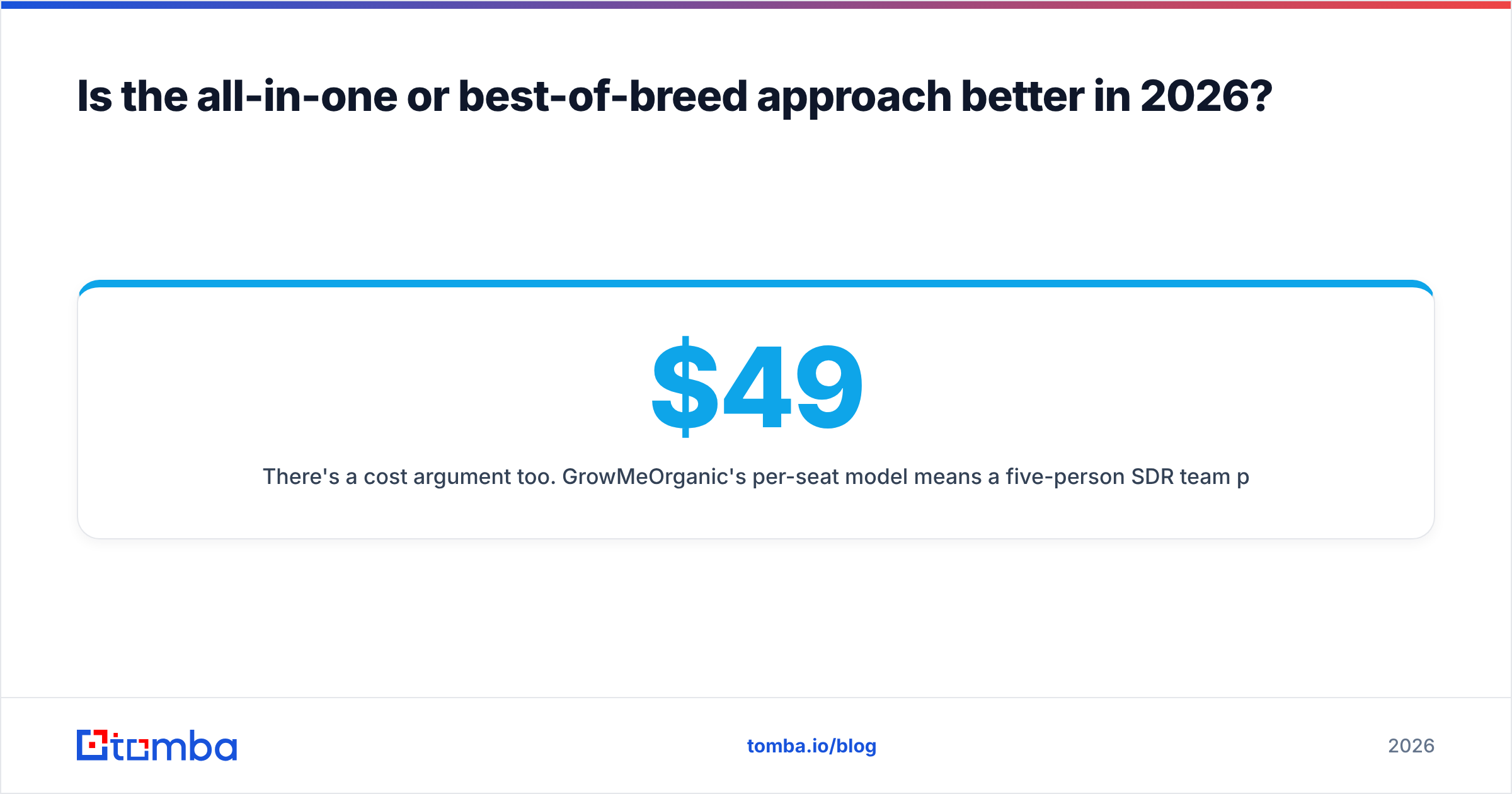
There's a cost argument too. GrowMeOrganic's per-seat model means a five-person SDR team pays five times over, even if three of them barely touch the tool. A credit or API-based data layer scales with usage instead of headcount — that's part of why Tomba pricing starts at a free tier with 25 searches a month and moves to $49/mo on Starter, $99/mo on Growth, and $249/mo on Pro rather than charging per seat.

What do GrowMeOrganic and Mail Rocket each miss?#
Every tool has gaps. Naming them is more useful than a feature checklist.
GrowMeOrganic's gaps:
- Verification depth. The bundled check is a basic syntax-and-MX pass. It won't reliably catch catch-all domains or role accounts.
- Sending sophistication. Rotation, warmup, and per-inbox throttling lag behind purpose-built senders.
- API and automation. Programmatic access is limited, which matters the moment you want enrichment inside your own product or workflow.
- Data freshness. Large claimed databases are often heavy on volume and light on recency. Ask when a record was last verified, not how many records exist.
Mail Rocket's gaps:
- No data layer. You are entirely responsible for sourcing and verifying. That's a feature if you have a good source; a wall if you don't.
- Thin enrichment. No firmographics, no tech stack signals, no phone numbers. Personalization is limited to whatever columns you upload.
- Smaller ecosystem. Fewer native integrations than the market leaders, so more of your workflow lands in Zapier or Make.

Where third-party signal matters, G2's sales intelligence category is the least-bad place to compare user-reported accuracy across these tools — vendor-published accuracy numbers are marketing until independently tested.
How should you actually build the stack?#
Here's the sequence that avoids the common failure — burning a domain in month one.
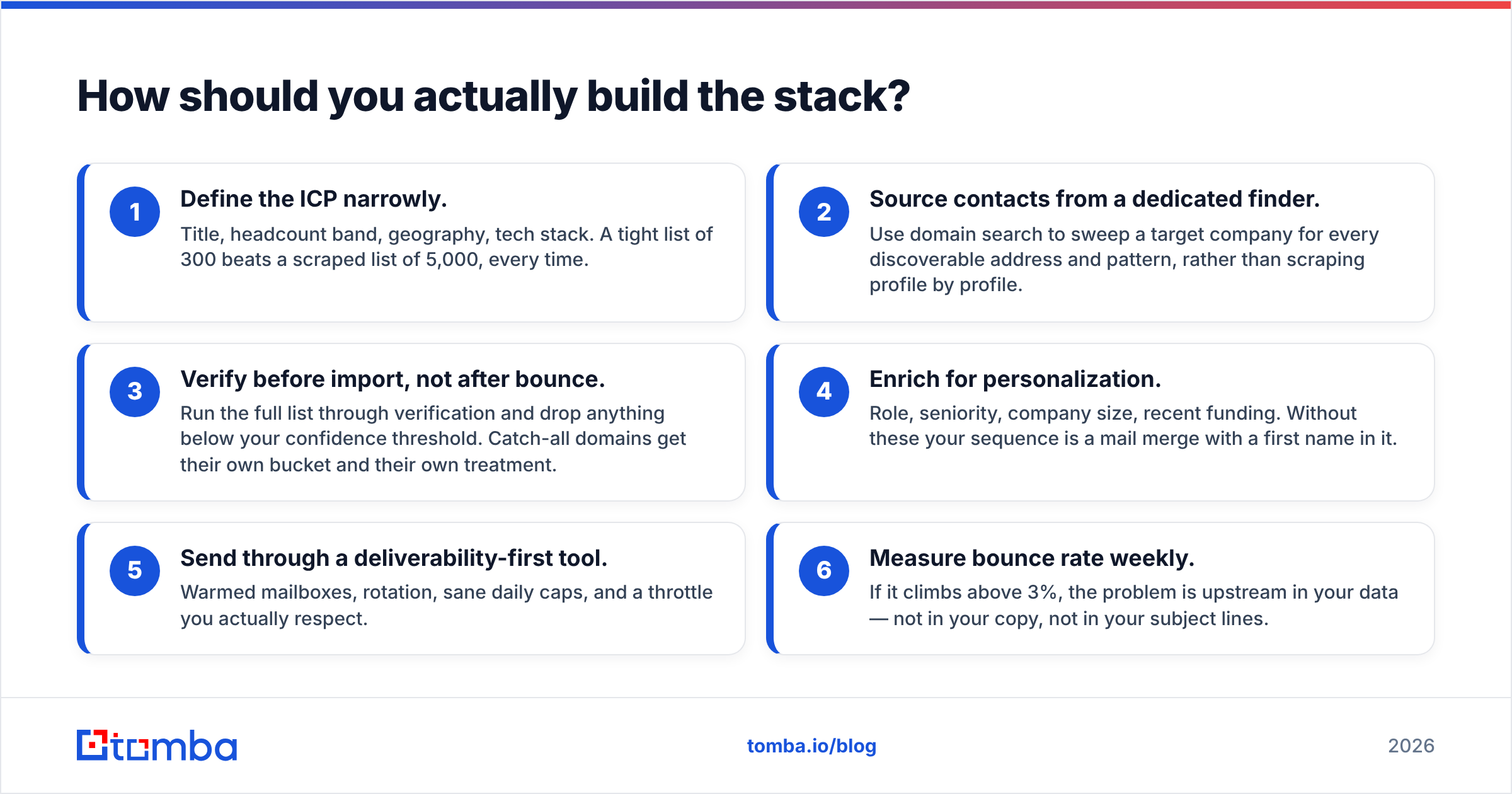
- Define the ICP narrowly. Title, headcount band, geography, tech stack. A tight list of 300 beats a scraped list of 5,000, every time.
- Source contacts from a dedicated finder. Use domain search to sweep a target company for every discoverable address and pattern, rather than scraping profile by profile.
- Verify before import, not after bounce. Run the full list through verification and drop anything below your confidence threshold. Catch-all domains get their own bucket and their own treatment.
- Enrich for personalization. Role, seniority, company size, recent funding. Without these your sequence is a mail merge with a first name in it.
- Send through a deliverability-first tool. Warmed mailboxes, rotation, sane daily caps, and a throttle you actually respect.
- Measure bounce rate weekly. If it climbs above 3%, the problem is upstream in your data — not in your copy, not in your subject lines.
Steps 2 through 4 are where bundled tools quietly cost you money. A scraper that returns a plausible-looking address with no confidence score is worse than returning nothing, because it moves the failure downstream to your domain reputation, where it's expensive and slow to fix. For teams doing this at scale, running it through the Tomba API or a bulk email finder job means verification happens before the CSV ever reaches your sender.
Which should you choose?#
Choose GrowMeOrganic if: you're a solo operator or small team, your prospects live on LinkedIn, you send modest volume, and consolidating into one subscription is worth more to you than best-in-class accuracy. Just budget for external verification on every export.
Choose Mail Rocket if: you already have a reliable contact source, you're running multi-inbox or multi-client outbound, and deliverability infrastructure is what you're missing. Do not choose it expecting a data layer — it doesn't have one and doesn't claim to.
Choose neither as your data source if: accuracy is what actually gates your pipeline. Both tools treat data as a supporting feature. When bounce rates decide whether your domain survives the quarter, the data layer deserves a specialist.
If you want the outbound-focused sending features Mail Rocket offers but need a broader ecosystem, our breakdown of Instantly alternatives covers the adjacent options, and the Apollo alternative comparison is the closer match to GrowMeOrganic's all-in-one positioning.
Fix the data layer first. Whichever sender you land on, the emails going into it decide whether your campaign lands in the inbox or in the spam folder. The Tomba Email Finder sources verified professional addresses by name, domain, or company — with confidence scoring, catch-all detection, and multi-source corroboration built in, not bolted on. Start on the free tier with 25 searches a month, or move to Starter at $49/mo when you're ready to scale. Your sending domain will thank you.
Related guides#
Ready to find emails that actually work?
Join 150,000+ professionals who stopped guessing and started sending. Free credits on signup — no credit card required.
Get the Tomba newsletter
Practical outbound tactics and product updates — once every two weeks.
About the author