GrowMeOrganic vs Mailshunt: Which Tool Wins in 2026?
GrowMeOrganic bundles scraping, email finding, and sequencing. Mailshunt goes deep on sending and deliverability. We compared pricing, data quality, and sending limits to find which one actually fits your outbound motion.
TL;DR
- GrowMeOrganic is an all-in-one: LinkedIn/Google Maps scraping, email finding, and a basic sequencer, sold on flat unlimited-ish seats. Best if you want one login and can tolerate mixed data quality.
- Mailshunt is sending-first: inbox rotation, warmup, unified inbox, and campaign management. Best if you already have a data source and need volume sending that lands.
- They are not really the same product. GrowMeOrganic overlaps on ~60% of the workflow; Mailshunt owns the last mile.
- Both are weakest at the same point: verified contact data. GrowMeOrganic's scraped emails carry real bounce risk; Mailshunt barely pretends to find emails at all.
- The pragmatic 2026 stack for most teams: a dedicated data layer (Tomba, Apollo, or similar) + one sending tool. Bundles save money until a 9% bounce rate costs you a domain.
What is GrowMeOrganic and what is Mailshunt?#
GrowMeOrganic launched as a LinkedIn prospecting tool and grew into a bundle. Today it sells four things under one seat: a Chrome extension that scrapes LinkedIn and Sales Navigator, a Google Maps / local business scraper, an email finder and verifier, and a drip campaign sender. Its pitch is flat pricing with generous limits — you pay per seat, not per credit, on most plans. That single pricing decision drives everything people love and hate about it.
Mailshunt comes at outbound from the opposite end. It is a cold email sending platform: connect unlimited mailboxes, rotate sends across them, warm them up, run sequences, and manage replies in a unified inbox. It sits in the same category as Instantly, Smartlead, and Saleshandy. Data acquisition is not its job — it assumes you arrive with a CSV.
So the honest framing of growmeorganic vs mailshunt is not "which is better." It is: do you need a data-plus-sending bundle, or a specialist sender you feed from elsewhere?

How do GrowMeOrganic and Mailshunt compare feature by feature?#
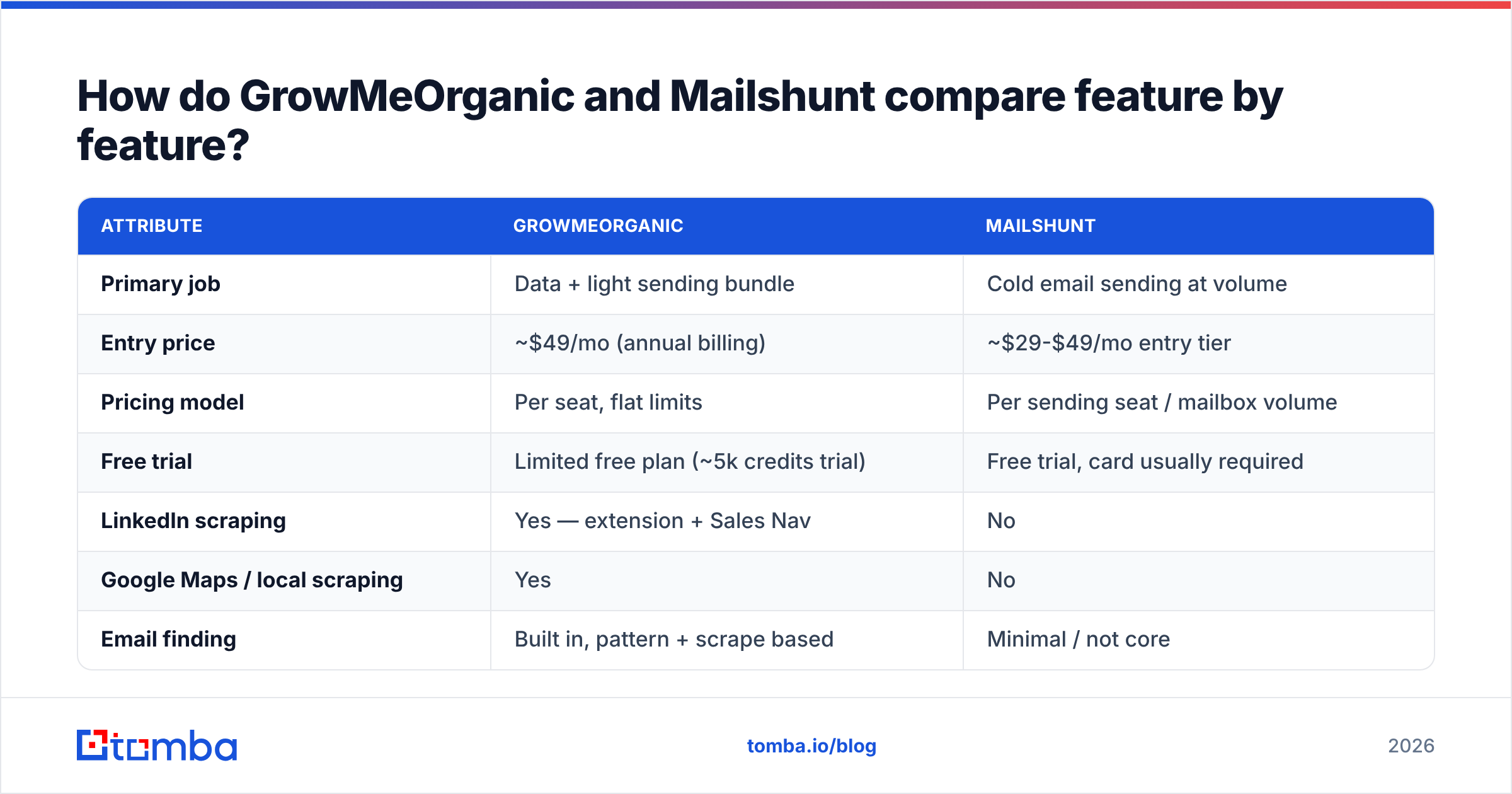
Here is the side-by-side on the attributes that actually change your results.
| Attribute | GrowMeOrganic | Mailshunt |
|---|---|---|
| Primary job | Data + light sending bundle | Cold email sending at volume |
| Entry price | ~$49/mo (annual billing) | ~$29-$49/mo entry tier |
| Pricing model | Per seat, flat limits | Per sending seat / mailbox volume |
| Free trial | Limited free plan (~5k credits trial) | Free trial, card usually required |
| LinkedIn scraping | Yes — extension + Sales Nav | No |
| Google Maps / local scraping | Yes | No |
| Email finding | Built in, pattern + scrape based | Minimal / not core |
| Email verification | Basic, bundled | Basic list cleaning |
| Mailbox rotation | Limited | Yes, core feature |
| Built-in warmup | No (third-party needed) | Yes |
| Unified reply inbox | Basic | Yes |
| API access | Limited | Available on higher tiers |
| CRM integrations | HubSpot, Pipedrive, Zapier | Zapier, webhooks, native few |
| Best for | Solo founders, agencies doing their own list building | Teams sending 10k+/mo who already have data |
The pattern is clean. GrowMeOrganic wins on breadth. Mailshunt wins on depth in the one part of outbound that gets your domain blacklisted if you get it wrong.
Which one has better data quality?#
Neither is a data company, and that matters more than any feature checkbox.
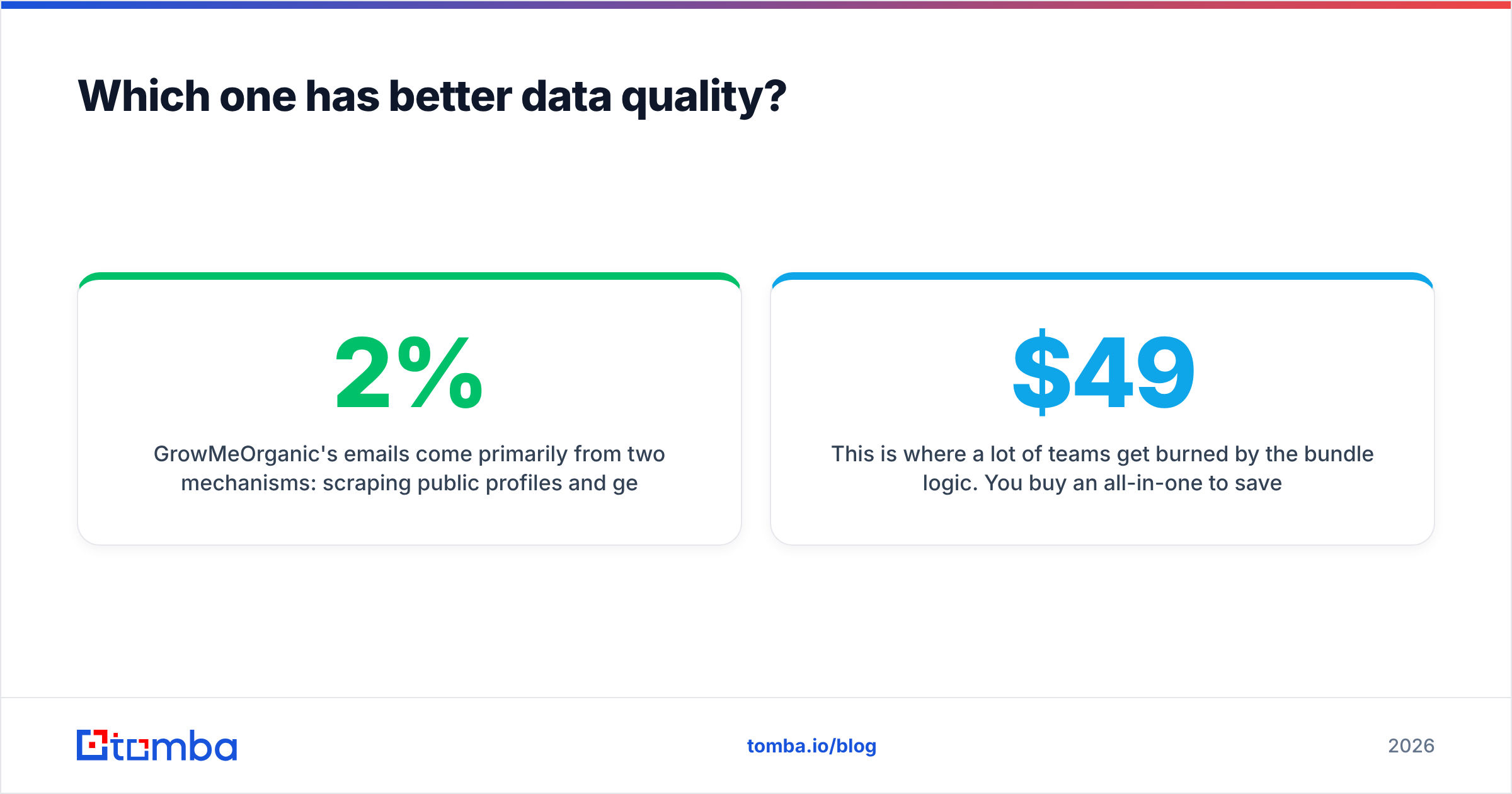
GrowMeOrganic's emails come primarily from two mechanisms: scraping public profiles and generating pattern-based guesses (first.last@domain, f.last@domain) then running a light SMTP check. That is a legitimate approach — it is roughly how every finder works — but the quality of the underlying pattern database and the rigor of the verification step is what separates a 2% bounce rate from a 9% one. In practice, users report GrowMeOrganic exports needing a second pass through a dedicated verifier before they are safe to send.
Mailshunt does not seriously compete here. It cleans lists and flags obvious syntax problems, but it is not enriching anything. If you upload garbage, it sends garbage very efficiently.
This is where a lot of teams get burned by the bundle logic. You buy an all-in-one to save $49/mo on a separate data tool, then blow through a 5% bounce ceiling in week three, and Google Postmaster starts showing your domain reputation sliding from "High" to "Medium." Recovering a burned domain takes six to eight weeks. That is not a $49 problem.
If bounce rate is your constraint, run any scraped list through a dedicated email verifier before it touches a sending tool — and use a catch-all verifier for the domains that return ambiguous SMTP responses, which is where most bundled tools simply mark everything "risky" and give up.
What does each one actually cost?#
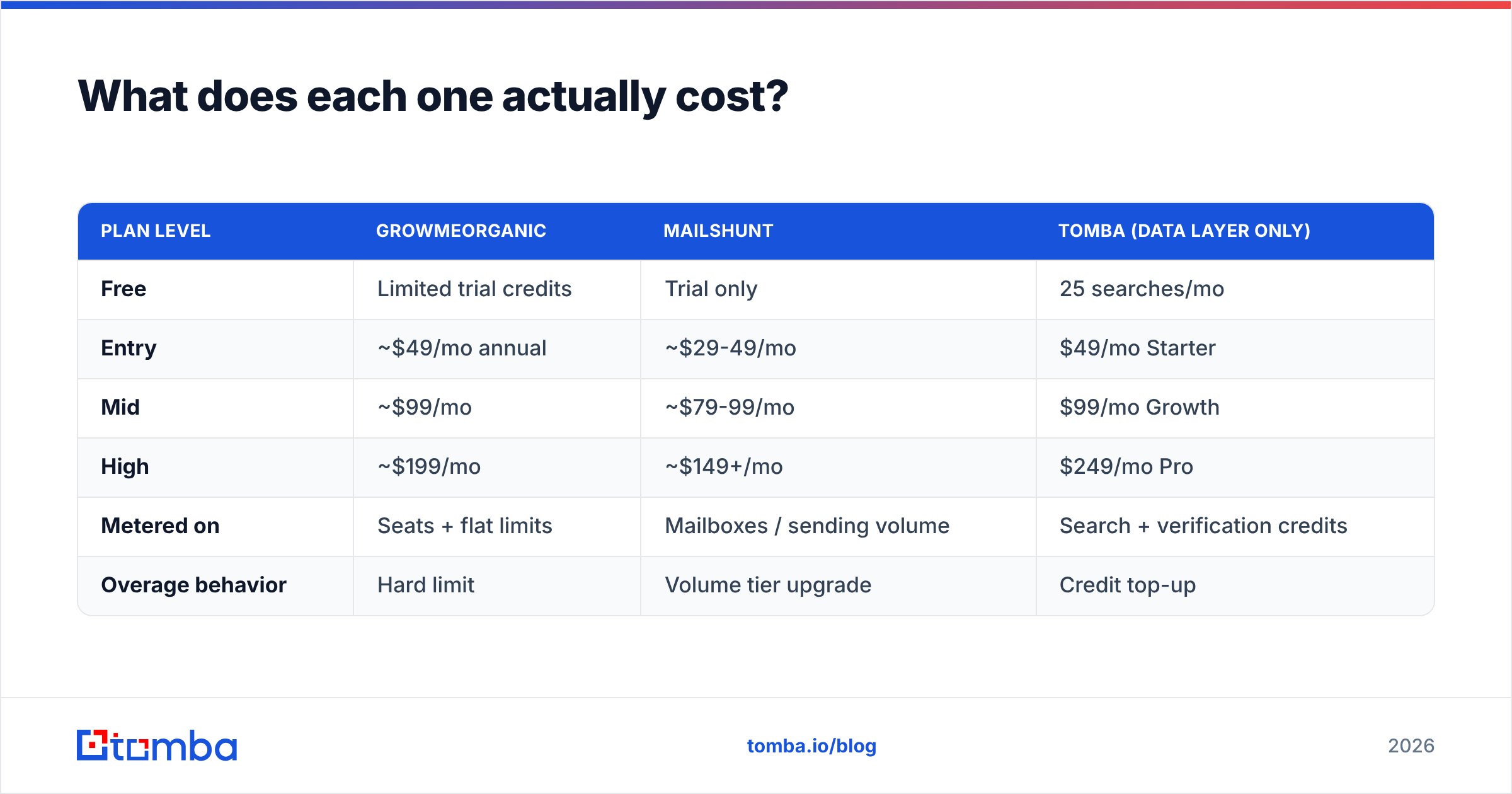
Pricing is where the two diverge hardest, because they meter different things.
| Plan level | GrowMeOrganic | Mailshunt | Tomba (data layer only) |
|---|---|---|---|
| Free | Limited trial credits | Trial only | 25 searches/mo |
| Entry | ~$49/mo annual | ~$29-49/mo | $49/mo Starter |
| Mid | ~$99/mo | ~$79-99/mo | $99/mo Growth |
| High | ~$199/mo | ~$149+/mo | $249/mo Pro |
| Metered on | Seats + flat limits | Mailboxes / sending volume | Search + verification credits |
| Overage behavior | Hard limit | Volume tier upgrade | Credit top-up |
Two things to notice.
First, flat pricing is not free pricing. GrowMeOrganic's "unlimited" language applies to specific actions on specific plans, with fair-use caps behind it. Read the plan page, not the landing page.
Second, Mailshunt's cost scales with mailboxes, not contacts. If you run 20 sending inboxes to spread volume, your bill tracks that — and you still owe money to whoever supplies your data. Budget for both. A realistic all-in monthly for a two-person outbound team in 2026 is $150-$250 across a data tool plus a sender, not $49.
Compare that against Tomba pricing if you are trying to isolate the data cost from the sending cost — separating the two line items is the only way to know which one is actually underperforming.
Is GrowMeOrganic better than Mailshunt for cold outreach?#
It depends entirely on which half of the problem you have not solved.
Choose GrowMeOrganic if:
- You build your own lists from LinkedIn or Google Maps. The scraping extension is genuinely the product's strongest piece, especially for local-business and agency prospecting where no database has good coverage.
- You are a solo operator or small agency sending under ~2,000 emails a month, where the built-in sequencer is adequate and mailbox rotation is not yet a requirement.
- You want one bill and one login. Real operational value, not nothing.
- Your ICP is not well covered by the big databases — regional SMBs, trades, local services. Scraping beats a database that has never heard of these companies.
Choose Mailshunt if:
- You already have a data source you trust and your bottleneck is landing in the inbox, not finding addresses.
- You send at real volume — 10,000+ emails/month across multiple domains — where rotation and warmup are non-negotiable infrastructure.
- Reply management is a team activity. A unified inbox with assignment beats forwarding threads around.
- You care about email deliverability as a first-class metric, with per-mailbox health visibility rather than one aggregate number.
Choose neither as your data layer if: your entire outbound depends on contact accuracy and you are sending to enterprise buyers whose emails are not scrapeable from a public profile.

What about deliverability and sending limits?#
This is Mailshunt's home turf and GrowMeOrganic's soft spot.
Mailshunt ships mailbox rotation, built-in warmup, per-mailbox daily caps, and send-time randomization. Those four features are the practical baseline for any cold sending in 2026, because Google and Microsoft both tightened bulk sender requirements — authenticated SPF/DKIM/DMARC, one-click unsubscribe, and a spam complaint rate under 0.3%. Google's bulk sender guidelines are the reference document worth reading in full before you send a single campaign.
GrowMeOrganic's sender is fine for low-volume drips from a single mailbox. Push it to multi-domain, multi-inbox sending and you will end up adding a dedicated sending tool anyway — at which point the bundle argument collapses and you are paying for a sequencer you do not use.
A few things neither tool does for you:
- Verify your SPF alignment before launch. Run your domain through an SPF checker — a single misconfigured include silently tanks authentication.
- Check your domain against blacklists after any volume increase. A blacklist checker takes 20 seconds and catches problems weeks before your reply rate tells you.
- Score your copy for spam triggers. Both tools send whatever you write. Neither tells you that "free consultation" plus three links plus a tracking pixel is a filter magnet.
How do you build the stack instead of picking one?#
The teams getting the best numbers in 2026 stopped choosing between bundles and started splitting the stack by function.
The split looks like this:
- Data layer — finding and verifying contacts. This is where accuracy compounds. A dedicated provider with a real pattern database and SMTP verification, exposed via API so you can enrich on demand rather than in batch dumps.
- Sending layer — mailbox management, rotation, warmup, sequencing. Mailshunt, Instantly, Smartlead all live here and are broadly interchangeable at the feature level.
- CRM layer — where replies land and pipeline gets tracked. HubSpot or Pipedrive for most, Salesforce above 50 reps.
- Enrichment layer — filling in firmographics, tech stack, and phone numbers after the initial match.
GrowMeOrganic tries to be the first and second layer at once. Mailshunt is purely the second. Neither is wrong; the mistake is assuming a bundle at layer one means you can skip verification.
If you go the split route, the data layer wants an API rather than a UI. Pulling contacts programmatically through an email finder API means your enrichment happens at the moment a lead enters your system, not in a weekly CSV ritual that is stale by Wednesday. And for teams whose list building starts on LinkedIn — the same place GrowMeOrganic's extension operates — a LinkedIn finder resolves profiles to verified work emails without the export-then-clean detour.
For a broader read on how the tool categories are consolidating, G2's sales intelligence category is a decent neutral map of who competes with whom, and worth checking before you commit to an annual plan.
What are the alternatives worth checking first?#
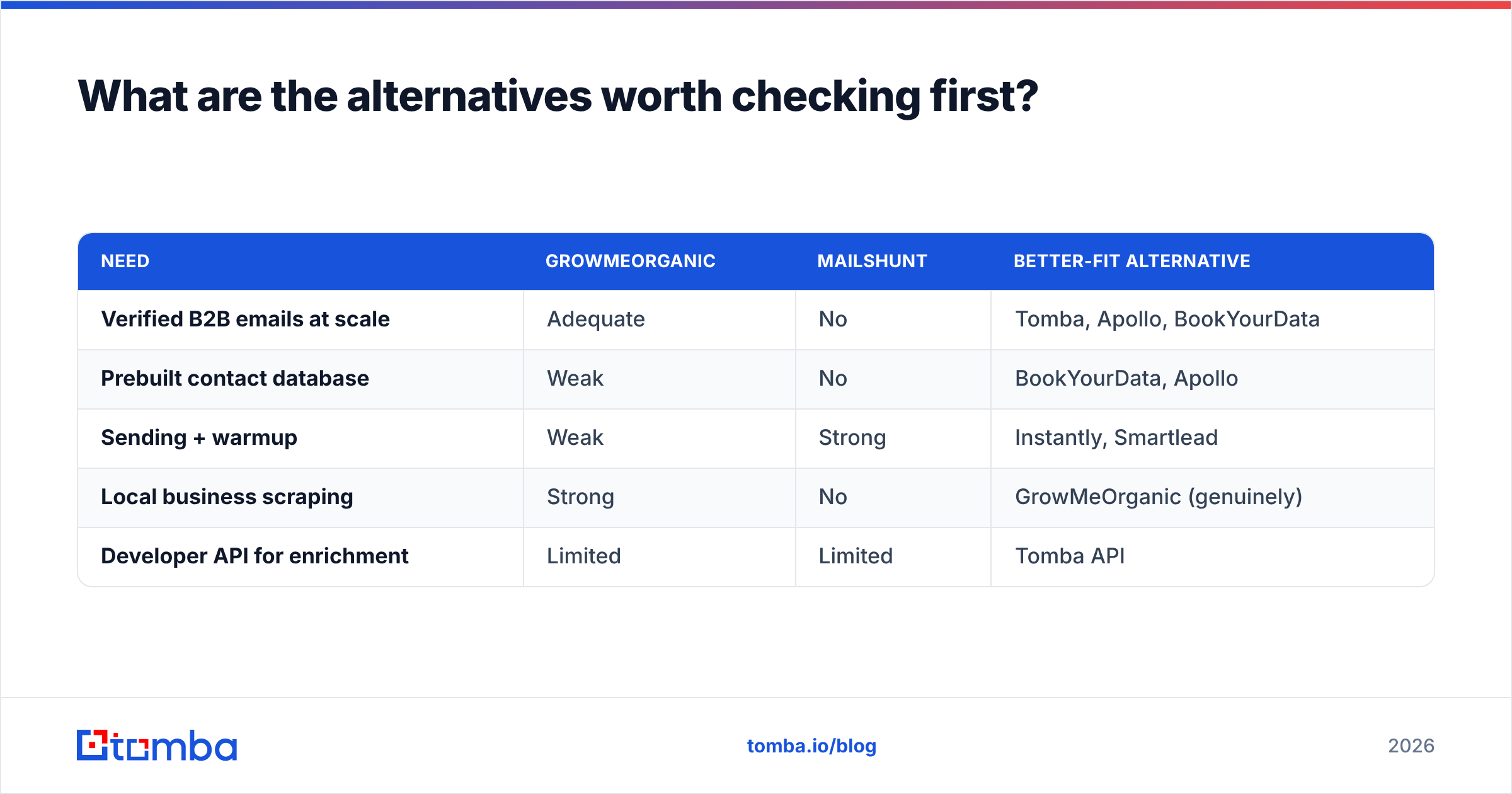
Before you sign either annual contract, three comparisons are worth ten minutes.
| Need | GrowMeOrganic | Mailshunt | Better-fit alternative |
|---|---|---|---|
| Verified B2B emails at scale | Adequate | No | Tomba, Apollo, BookYourData |
| Prebuilt contact database | Weak | No | BookYourData, Apollo |
| Sending + warmup | Weak | Strong | Instantly, Smartlead |
| Local business scraping | Strong | No | GrowMeOrganic (genuinely) |
| Developer API for enrichment | Limited | Limited | Tomba API |
BookYourData is worth a look if what you actually want is a prebuilt, pay-as-you-go contact list rather than a scraping workflow — it solves a different shape of the problem and does it well, with no seat commitment.
And if you are already deep in a bundle evaluation, it is worth comparing against a dedicated finder head-to-head: our Apollo alternative breakdown covers how bundle economics change once your list volume passes ~5,000 contacts a month.
The verdict#
Mailshunt wins on sending. GrowMeOrganic wins on list building. Neither wins on data accuracy — and that is the metric that decides whether your campaign works.
If you have to pick one and you build lists yourself from LinkedIn and Google Maps, GrowMeOrganic gives you more surface area per dollar, and you can bolt a real verifier onto the export. If you have data and need it to land, Mailshunt is the more focused, more capable tool and there is no honest argument for GrowMeOrganic's sender over it.
The version most teams end up at after six months: a specialist sender, a specialist data source, and no bundle at all.
Start with the data layer. Bad addresses are the only outbound problem that gets worse the more you send. Tomba's Email Finder resolves names and domains to verified work emails with SMTP-level checking built in — free tier gives you 25 searches a month to test coverage against your actual ICP before you pay anyone. Run 100 of your existing contacts through it and compare the bounce prediction against what your current tool told you. That single test will settle the growmeorganic vs mailshunt question faster than any feature table.
Related guides#
Ready to find emails that actually work?
Join 150,000+ professionals who stopped guessing and started sending. Free credits on signup — no credit card required.
Get the Tomba newsletter
Practical outbound tactics and product updates — once every two weeks.
About the author