GrowMeOrganic vs ManyReach: Which Outbound Tool Wins in 2026?
GrowMeOrganic bundles a B2B database with sequences; ManyReach is a lean, pay-as-you-go cold email sender. Here is how the two actually compare on data, deliverability, pricing, and who each one is built for.
GrowMeOrganic vs ManyReach comes down to one question: do you need a lead database, or just a better sender? One tool bundles data. The other only sends. Here is the short answer first.
TL;DR
- GrowMeOrganic is the all-in-one play. You get a B2B contact database, LinkedIn and Chrome scraping, an email finder, and a sequence sender in one plan. Breadth over depth.
- ManyReach is lean and sender-first. It runs on pay-as-you-go credits, unlimited mailboxes, and a simple sequence engine. Depth on sending, no database of its own.
- No list and no budget for extra tools? GrowMeOrganic gets you moving fastest. Already have data? ManyReach costs less per email and carries less bloat.
- Neither is a best-in-class data provider. Both work better with a dedicated email verifier in front of the sender. Bundled "verification" is usually just a syntax and MX check, not a full SMTP test.
- The 2026 stack most teams want: a real data source, then a verify step, then a dedicated sender. Bundling all three saves money and costs you accuracy.
What are GrowMeOrganic and ManyReach?#
GrowMeOrganic started as a lead-gen suite for agencies and solo founders. The pitch: one subscription instead of four. It ships a B2B contact database, a Chrome extension that pulls contacts from LinkedIn and Sales Navigator, an email-finder module, a drip sender, and light CRM pipeline views. Its pricing has always leaned on near-unlimited usage caps and cheap annual terms.
ManyReach went the other way. It is a cold email sending platform, full stop. Connect unlimited mailboxes, upload or API-push your prospects, build sequences, send. Pricing runs on credits, not seats. That is rare in a market where almost every rival charges per user per month. There is no contact database. You bring your own leads.
That one design choice explains nearly every other gap between them. One vendor wants the whole funnel, from "who do I email" to "did they reply." The other wants one step, done cheap and fast.
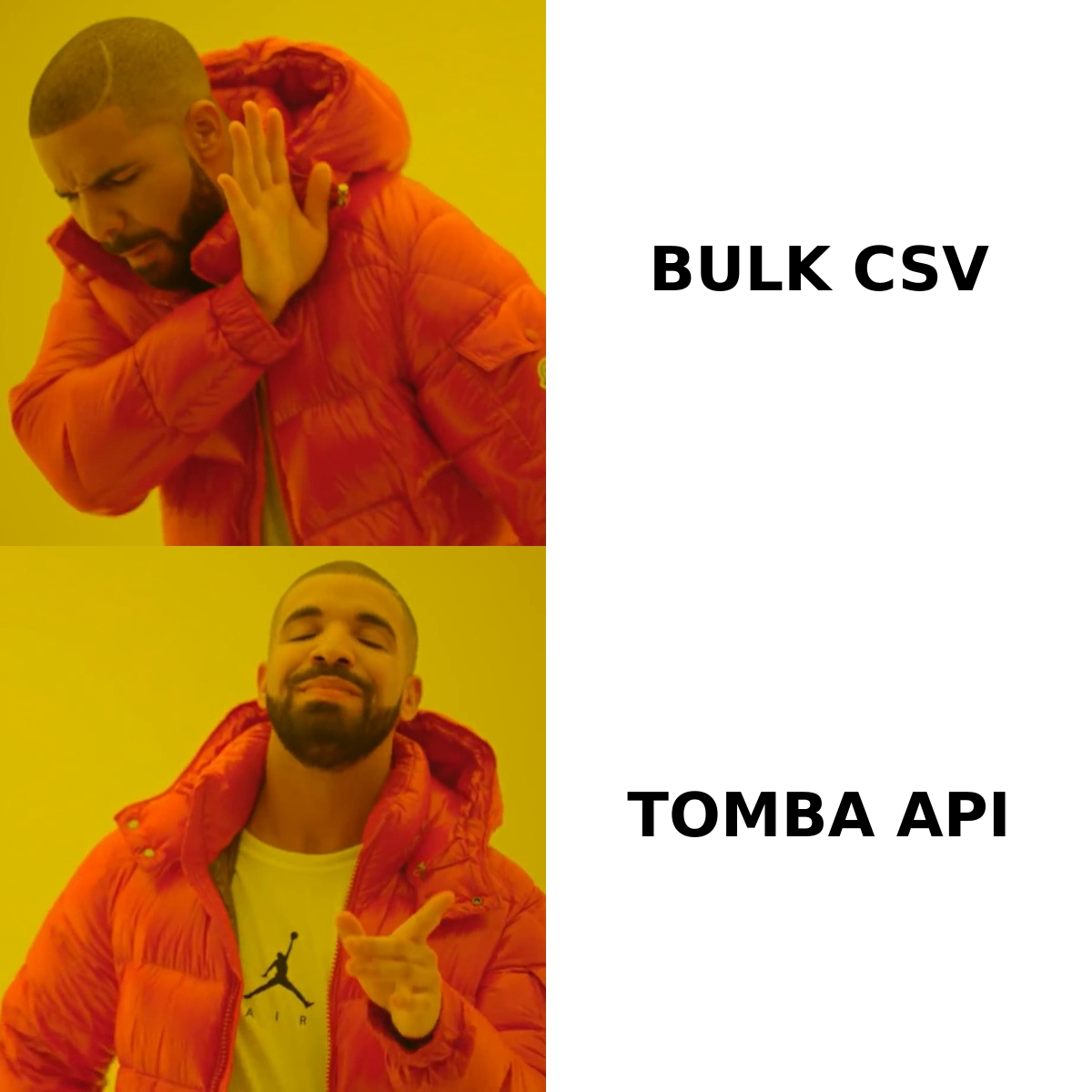
GrowMeOrganic vs ManyReach: how do they compare head-to-head?#
Here is the practical comparison, feature by feature. Pricing moves. Always check the vendor's own page before you sign an annual term.
| Attribute | GrowMeOrganic | ManyReach |
|---|---|---|
| Core identity | All-in-one lead gen + sender | Cold email sender only |
| Built-in B2B database | Yes (bundled contacts) | No — bring your own |
| LinkedIn scraping | Yes, Chrome extension | No |
| Email finder | Bundled module | No |
| Email verification | Basic, bundled | Basic, bundled |
| Mailbox connections | Capped by plan | Unlimited on all plans |
| Pricing model | Per-user subscription (annual-heavy) | Pay-as-you-go credits |
| Entry price | ~$49/mo annual-billed tier | Credit packs, no seat fee |
| Sequence builder | Yes, basic drip | Yes, conditional steps |
| Inbox rotation | Limited | Yes |
| Deliverability tooling | Minimal | Warmup integrations, sending caps |
| API access | Limited | Yes, sender-focused |
| Best for | Solo founders, small agencies with no data | Teams with existing lead data or a data vendor |
Two things stand out. First, GrowMeOrganic loses its edge if you already pay for data. You would be buying a database you do not need. Second, ManyReach loses its edge if you have no leads. On day one it has nothing to sell you.
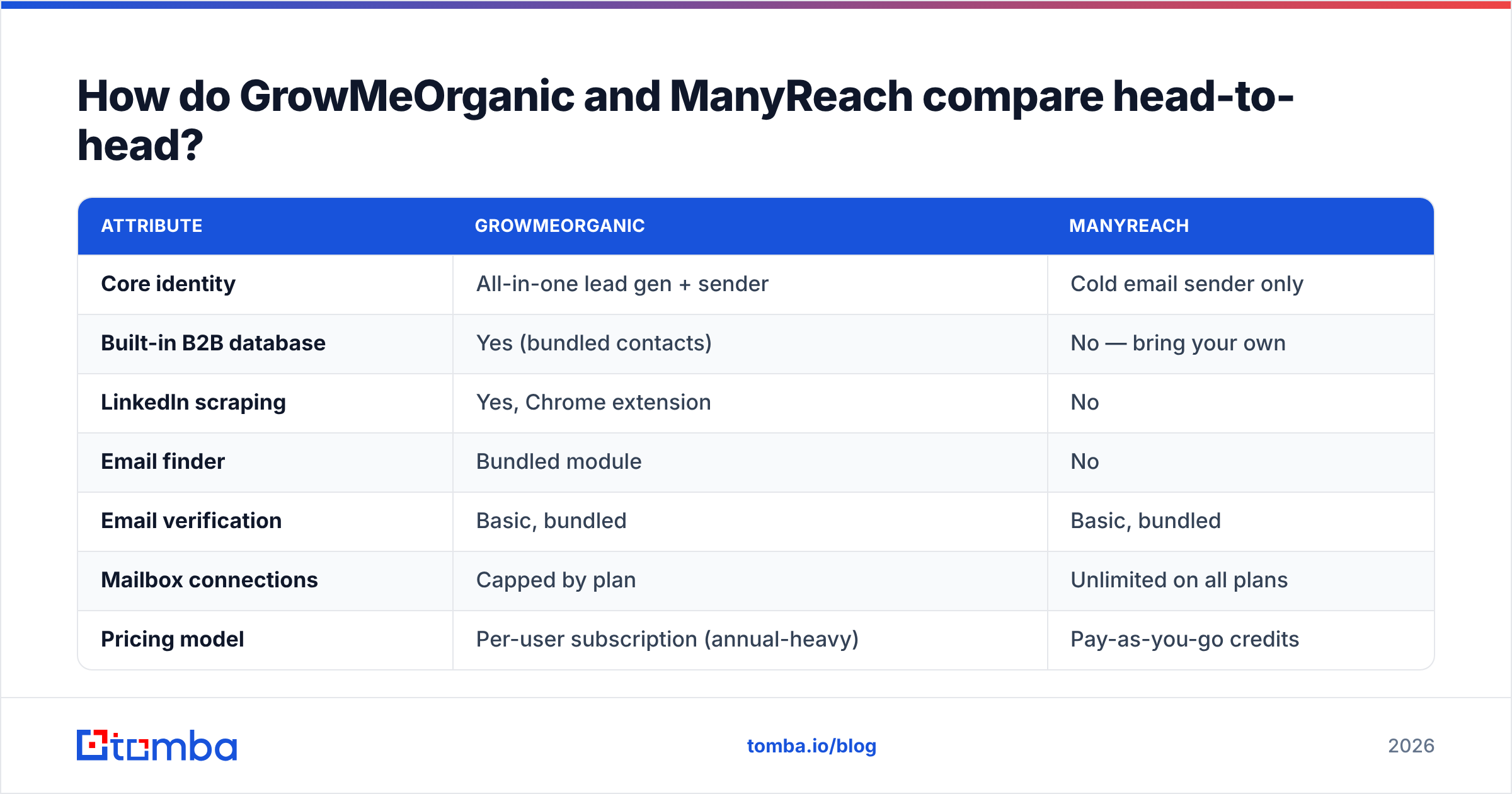
Which one has better data quality?#
Short answer: neither is a data company. Do not treat either bundled database as your only source of truth.
Bundled databases in all-in-one tools are usually licensed or aggregated, not collected and re-checked in house. That produces symptoms you will notice within a week of sending:
- Stale titles and job changes. B2B contact data goes bad by roughly 22–30% a year, per widely cited G2 category research on sales intelligence tools. A database that refreshes once a quarter is already behind.
- Catch-all domains marked "valid." Many bundled verifiers pass "accept-all" as valid. That is what quietly wrecks your bounce rate. Accept-all domains say yes to every address at the SMTP handshake, then bounce it later.
- Guessed addresses. When a tool cannot find a real address, some build
first.last@domain.comand label it "probable." Sending to guesses is the fastest way to burn a new domain. - Thin coverage outside the US. Both tools skew North American. Selling into DACH, the Nordics, MENA, or APAC? Run a sample test before you buy a year.
The fix is not to drop either sender. Split the data layer off instead. Pull contacts from a dedicated source. Run them through a real SMTP-level email verification pass, with a proper catch-all verifier step. Then push only the survivors into your sender.
At volume, a bulk email finder plus an API workflow kills the CSV shuffle. The Tomba API is built for that handoff: find, verify, push to sender.
Is GrowMeOrganic better than ManyReach for cold outreach?#
It depends on which problem you actually have.
Pick GrowMeOrganic if:
- You are starting from zero. No list, no data vendor, no scraping setup. You can go from signup to first send in an afternoon.
- You are a one-person agency. Four subscriptions folded into one is real relief when margins are thin.
- Your volume is modest. Under a few thousand emails a month, convenience beats the deliverability limits.
- You want LinkedIn extraction included. The Chrome extension is genuinely useful for Sales Navigator work, and buying it alone costs real money.
Pick ManyReach if:
- You already own your data. With a finder and verifier in place, GrowMeOrganic's database is a bill you will never use.
- You run many domains and mailboxes. Unlimited mailboxes with no per-seat fee is ManyReach's strongest card. Inbox rotation is a real deliverability lever.
- Your volume is spiky. Credits mean a quiet month costs almost nothing. Seat pricing charges the same whether you send 10 emails or 10,000.
- You want a sender that stays a sender. Fewer bundled features means fewer half-finished ones.
Deliverability is where the gap widens. ManyReach was built for it: unlimited mailboxes, rotation, and per-mailbox send caps. Those are the standard defenses against the volume signals that trigger filtering. GrowMeOrganic's sender works fine, but it was not designed as a deliverability tool first. At real scale, that difference adds up.
Before you send from either, check your authentication with an SPF checker. Make sure your domain is not already flagged. No sequence tool can outrun a broken SPF record.
What do they actually cost in 2026?#
Headline pricing misleads on both sides, for opposite reasons.
GrowMeOrganic's entry price assumes annual billing. Monthly costs a good deal more. The word "unlimited" in the marketing copy usually hides fair-use caps on exports and email credits. Read the plan table, not the landing page.
ManyReach's credits look cheap because there is no seat fee. But credits burn per email sent. A high-volume sender can blow past a rival's flat subscription. Run your real monthly volume through the math first.
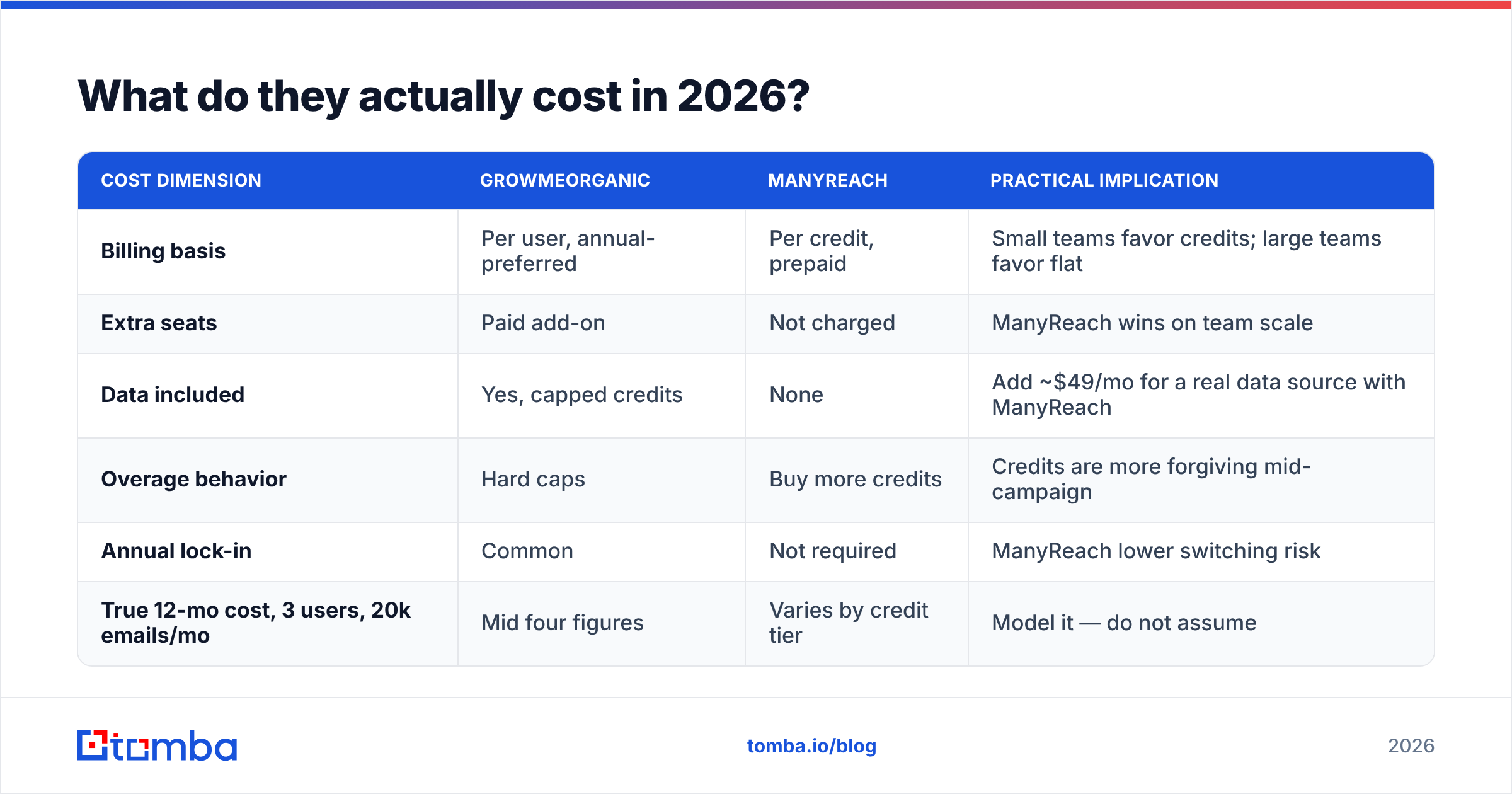
| Cost dimension | GrowMeOrganic | ManyReach | Practical implication |
|---|---|---|---|
| Billing basis | Per user, annual-preferred | Per credit, prepaid | Small teams favor credits; large teams favor flat |
| Extra seats | Paid add-on | Not charged | ManyReach wins on team scale |
| Data included | Yes, capped credits | None | Add ~$49/mo for a real data source with ManyReach |
| Overage behavior | Hard caps | Buy more credits | Credits are more forgiving mid-campaign |
| Annual lock-in | Common | Not required | ManyReach lower switching risk |
| True 12-mo cost, 3 users, 20k emails/mo | Mid four figures | Varies by credit tier | Model it — do not assume |
The honest math: add a dedicated data provider to ManyReach — say Tomba pricing at $49/mo Starter or $99/mo Growth — and you land near GrowMeOrganic's mid tier on total cost. But you get better data and a better sender. That is the real trade. You are not picking cheap over expensive. You are picking one average vendor over two good ones.

What about alternatives to both?#
Neither tool is the only shape of this problem. The neighbors are worth knowing:
- BookYourData — good when you want prepaid, pay-per-lead B2B contact data with clear accuracy guarantees instead of a subscription. Pairs well with a lean sender like ManyReach.
- Instantly / Smartlead — sender-first tools in ManyReach's lane, with more mature warmup ecosystems. See our Instantly alternative breakdown.
- Apollo — the heavyweight all-in-one. Far bigger database than GrowMeOrganic, and priced to match. Covered in our Apollo alternative comparison.
- Dedicated finder + any sender — the modular route. Use a domain search tool to map a company's contacts, a verifier to clean them, and whichever sender fits your budget.
The modular route wins on quality almost every time. The all-in-one route wins on speed. Be honest about which one your team actually needs.
How should you test them before committing?#
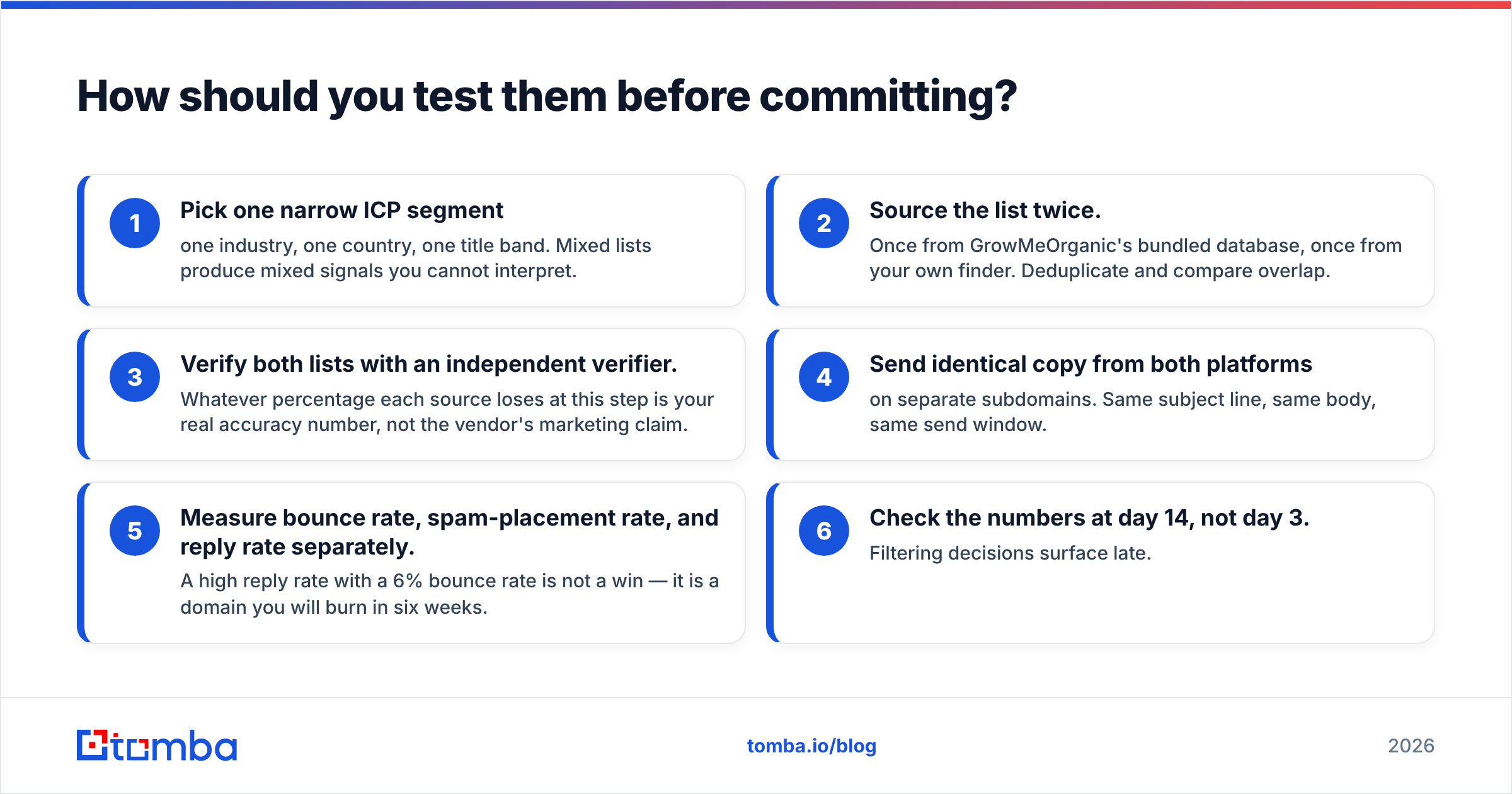
Run the same 200-contact test on both. It takes an afternoon and saves you from a year-long contract you regret.
- Pick one narrow segment — one industry, one country, one title band. Mixed lists give mixed signals you cannot read.
- Source the list twice. Once from GrowMeOrganic's bundled database, once from your own finder. Dedupe and compare the overlap.
- Verify both lists with an outside verifier. Whatever each source loses at this step is its real accuracy number, not the one in the marketing copy.
- Send the same copy from both platforms on separate subdomains. Same subject line, same body, same send window.
- Track bounce rate, spam placement, and reply rate on their own. A great reply rate with a 6% bounce rate is not a win. It is a domain you will burn in six weeks.
- Read the numbers at day 14, not day 3. Filtering shows up late.
If the bounce gap between the two sources is more than two points, your data layer is the problem, not your sender. Fix that first. No amount of sequence tuning saves a dirty list, and email deliverability damage takes far longer to repair than to cause.
GrowMeOrganic vs ManyReach: which should you choose?#
Choose GrowMeOrganic if you are a solo operator or small agency starting from zero. You send modest volume and you value one bill over best-in-class parts. It is a fair on-ramp.
Choose ManyReach if you already have a data source and run several sending domains. You want unlimited mailboxes without seat fees, and you would rather pay for what you send. It is the better sender on its own.
Choose neither as your data layer. Most comparison posts skip this part. Both tools will happily send to a list they cannot vouch for. Both will let you blame the sequence when the real cause was a 12% invalid rate. Own your data quality apart from whichever sender you pick.
For most teams reading this in 2026, the winning setup is simple. Build the list with a dedicated finder. Verify it hard. Then push it into the leanest sender your volume needs. That usually means ManyReach or a peer on the sending side, with a real data provider up front.
Build the list before you pick the sender. Tomba's Email Finder sources professional addresses by domain, name, or company. It then verifies them at the SMTP level, catch-alls included. So whatever reaches GrowMeOrganic, ManyReach, or any other sender is already clean. Start free with 25 searches a month. Move to Starter at $49/mo when your outbound volume justifies it. Your sending tool cannot fix bad data. Your data layer can.
Related guides#
Ready to find emails that actually work?
Join 150,000+ professionals who stopped guessing and started sending. Free credits on signup — no credit card required.
Get the Tomba newsletter
Practical outbound tactics and product updates — once every two weeks.
About the author